
- Home: eye surgery in Istanbul
- Knowledge centre
- Lens & cataract guides
Cataract Surgery Guide: Lens and Cataract Questions Answered by Our Surgeons
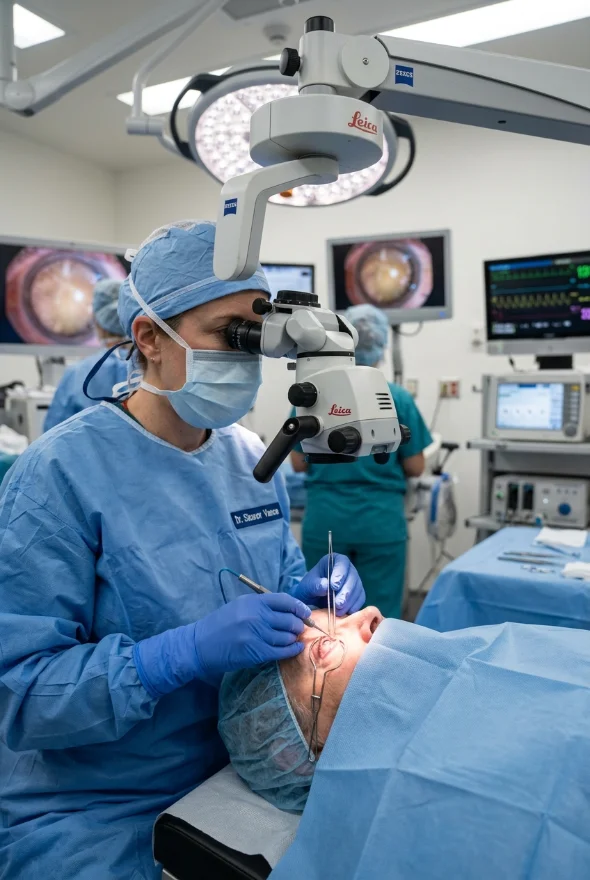
This cataract surgery guide collects our plain-English articles on cataracts and lens implants: when to operate, which lens to choose, recovery and flying home. Cataract surgery usually takes 20 to 45 minutes under local anaesthetic (NHS), and 9 in 10 people see better afterwards (National Eye Institute). Prof. Dr. Ahmet Satıcı, Doç. Dr. Muhammet Derda Özer and Op. Dr. Aysan Bayram review the guides.
A cataract is a clouding of the eye's natural lens. It develops slowly, and the National Eye Institute (NEI) says that by age 80 most people either have a cataract or have already had cataract surgery. The only way to remove a cataract is an operation: the surgeon replaces the clouded lens with a clear artificial lens, called an intraocular lens (IOL). That is why almost every question people ask about cataracts is really one of three: "is it time for surgery?", "which lens should I choose?" and "what happens afterwards?"
Each guide below answers one of those questions in plain language, with the numbers that matter and the source behind every figure. They are grouped the way most people research: first deciding whether surgery is needed, then choosing a lens, then recovery and travel, and finally the problems that can appear months or years later.
The guides are reviewed by the surgeons who operate in Istanbul. Prof. Dr. Ahmet Satıcı, former Head of Ophthalmology at Harran University, leads our cataract and premium-lens surgery. Op. Dr. Aysan Bayram is a cataract, laser and retina surgeon. Doç. Dr. Muhammet Derda Özer (Doç. = Associate Professor) operates on cataracts in eyes that also have corneal, retinal or inflammatory disease. Lens replacement is the same operation as cataract surgery, done to reduce your need for glasses rather than to treat a cloudy lens, so the lens guides apply to both.
If you already know you want surgery, the main pages explain methods, lens options and the trip to Istanbul.
Lens and cataract guides, by question
1. Is it time for cataract surgery?
Cataract symptoms and stages: when is it time for surgery?
Cataracts do not need immediate treatment. The NHS lists blurred vision, difficulty seeing at night, sensitivity to light and faded colours as the usual symptoms, and the NEI says your doctor may suggest surgery once a cataract gets in the way of everyday activities such as reading or driving. Most people do not need to rush, and waiting typically will not harm the eye.
Cataract symptoms and stages: when is it time for surgery?NHS cataract waiting times by region (updated quarterly)
How long the NHS wait is depends on where you live. NHS England's figures for the end of July 2026 show 620,931 ophthalmology patients on waiting-list pathways, with 72.9% waiting up to 18 weeks against the 92% standard. These figures cover all ophthalmology, not cataracts alone; the guide breaks the picture down by region.
NHS cataract waiting times by region (updated quarterly)How long does cataract surgery take?
Usually 20 to 45 minutes per eye, according to the NHS, under local anaesthetic, and most people go home the same day. The guide walks through each step, from the dilating drops to the new lens, and explains why both eyes are normally done on separate days.
How long does cataract surgery take?2. Choosing a lens and the right treatment
Trifocal vs EDOF vs monofocal lenses compared
A monofocal lens, the most common type, has one focusing distance and usually means reading glasses. Multifocal (including trifocal) and extended-depth-of-focus (EDOF) lenses aim to reduce glasses. A Cochrane review of 20 trials with 2,230 people found multifocal lenses gave better near vision but made halos about 3.6 times more likely, so the right choice depends on what matters to you.
Trifocal vs EDOF vs monofocal lenses comparedPanOptix vs Vivity vs Synergy: premium lens guide
PanOptix is a trifocal lens, Vivity is an EDOF lens, and Synergy combines multifocal and EDOF designs in one lens. In a 2022 US comparison, 83% of PanOptix patients were completely free of glasses against 33% with Vivity, while 85% of Vivity patients noticed no or only a little glare and halo in dim light against 69% with PanOptix. These are manufacturers' lens names, not clinics.
PanOptix vs Vivity vs Synergy: premium lens guideTrifocal lenses: bad experiences, halos and how to avoid them
Halos and glare are the commonest complaint. In the US approval study of the PanOptix lens, 12.6% of patients reported severe halos at six months (0.9% with a monofocal lens), although only 2.4% were bothered very much by them. The American Academy of Ophthalmology (AAO) suggests frequent night drivers consider a monofocal lens instead.
Trifocal lenses: bad experiences, halos and how to avoid themLens replacement vs laser eye surgery after 50
Laser reshapes the cornea and cannot restore the eye's focusing power. The Royal College of Ophthalmologists (RCOphth) says refractive lens exchange (RLE) is often preferred to laser in the retirement age group, in whom early cataract is common. This guide compares both by age.
Lens replacement vs laser eye surgery after 50Disadvantages of lens replacement surgery
Every operation has downsides, and this guide lists them honestly. The NHS names a detached retina, posterior capsule opacification, a second operation, under- or over-correction, halos and glare. A 2025 review in the British Journal of Ophthalmology classed retinal detachment as rare after cataract surgery (about 1 in 1,000) and uncommon after lens replacement (about 1 in 500).
Disadvantages of lens replacement surgeryICL vs laser for high myopia and thin corneas
When a prescription is too strong or a cornea too thin for laser, an implantable collamer lens (ICL) is often the alternative. The RCOphth describes it as the most used phakic lens, placed behind the iris in front of your natural lens. Its US label covers myopia from −3.0 D to −15.0 D, with a reduction up to −20.0 D, and warns of a higher long-term risk of cataract.
ICL vs laser for high myopia and thin corneas3. Recovery, glasses and travel
Cataract surgery recovery and flying home
You usually feel better within a day or two, and the NEI says most people are completely healed after 8 weeks. The AAO says there is generally no restriction on air travel after cataract surgery in an otherwise healthy eye, and surgeons usually check the eye the day after and again about a week later. Most patients can fly about 3–7 days after surgery, once their surgeon has examined the eye.
Cataract surgery recovery and flying homeBending, lifting, showering and sleeping after cataract surgery
The NHS says do not rub the eye, do not get water in it, do not lift anything heavy or play sports, and wear a plastic shield at night if you are given one. The NEI adds that bending over should also be avoided for a few weeks. The NHS expects you to use eye drops for about four weeks.
Bending, lifting, showering and sleeping after cataract surgeryCan I use my old glasses after cataract surgery?
Possibly for a short time, but your prescription will probably have changed. The NHS says you may still need glasses for reading or distance and that the prescription may differ from before, and the NEI says you might need a new prescription once the eye is completely healed.
Can I use my old glasses after cataract surgery?Fluctuating vision after cataract surgery
Vision can change from hour to hour while the eye heals, and the NHS says it may take several days to improve. If it does not settle, the surface of the eye is a common culprit: a case discussed in Cataract & Refractive Surgery Today (February 2022) traced fluctuating vision after a multifocal lens to dry eye, which improved with treatment of the eye surface.
Fluctuating vision after cataract surgery4. Problems that can appear later
Blurry vision after cataract surgery (posterior capsule opacification / YAG)
Vision that was clear and then turns misty months or years later is often posterior capsule opacification (PCO), sometimes called a secondary cataract or "after-cataract". The NEI says it can appear weeks, months or even years after surgery, and your eye doctor can fix it with laser treatment. Other causes, such as dry eye or a leftover prescription, are covered too.
Blurry vision after cataract surgery (posterior capsule opacification / YAG)After-cataract (posterior capsule opacification) and YAG laser
NHS patient information says PCO occurs in between 10 and 20% of patients at any time after surgery, and that YAG laser treatment takes about five to ten minutes and is painless. The cloudy membrane is simply opened with the laser, and for the vast majority of people vision improves. The guide explains the rare risks and what to expect afterwards.
After-cataract (posterior capsule opacification) and YAG laserCataract and lens questions: where to start
The first sentence of each guide answers the question; the rest gives you the detail. If you only have a few minutes, start here:
| If your question is… | Read first |
|---|---|
| "How do I know it is a cataract, and is it time?" | Cataract symptoms and stages |
| "How long will I wait on the NHS?" | NHS cataract waiting times by region |
| "Which lens is best for me?" | Trifocal vs EDOF vs monofocal lenses |
| "I'm over 50 and tired of reading glasses" | Lens replacement vs laser after 50 |
| "I'm worried about halos and glare" | Trifocal lenses: halos and how to avoid them |
| "How long is the operation, and how long is recovery?" | How long does cataract surgery take? · Recovery and flying home |
| "My vision has gone cloudy again" | After-cataract and YAG laser |
Lens surgery is not the only way to change how you see. If your question is about laser, read our laser eye surgery guides; for thin or irregular corneas, see our keratoconus and cornea guides; for retina and eye-pressure problems, our retina and glaucoma guides; and for heavy or drooping lids, our eyelid and cosmetic guides. For side-by-side comparisons of every eye treatment, go to eye treatment comparisons, and for unfamiliar terms such as "phacoemulsification", "IOL" or "capsulotomy", use the eye glossary A–Z.
Cataract surgery guide: frequently asked questions
A cataract is a clouding of the natural lens inside the eye. It develops gradually, and the NHS lists blurred vision, difficulty seeing at night, sensitivity to light, faded colours (especially blue), double vision and halos around lights as the usual symptoms. Risk rises significantly from about age 60, and smoking, diabetes, eye injury and long-term steroid use also increase it.
When the cataract starts to get in the way of everyday life. The NHS says cataracts do not need immediate treatment and that surgery is the choice if you want to improve your sight, and the NEI says waiting typically will not harm your eye. Your surgeon will help you decide after measuring how much the cataract affects your vision, and driving standards can also play a part.
Usually 20 to 45 minutes per eye, according to the NHS, and it is normally done under local anaesthetic, so you are awake but feel no pain. You go home the same day. If both eyes need surgery they are normally treated on separate days.
There is no single best lens, only the best lens for your eyes and priorities. The AAO says the standard monofocal lens is the most common and gives one focusing distance, usually distance, so you would wear reading glasses. Multifocal, trifocal and EDOF lenses can reduce your need for glasses, but they raise the chance of halos and glare, and the AAO advises against them for people with glaucoma, macular degeneration or other eye disease. A toric lens can correct astigmatism.
The operation is the same; the reason is different. The RCOphth explains that refractive lens exchange (RLE) is identical to modern cataract surgery but is done mainly to reduce dependence on glasses, while cataract surgery restores clear vision when glasses or contact lenses can no longer do it. Because RLE is done on an eye that may not yet have a cataract, its retinal detachment risk is higher than after cataract surgery, about 1 in 500 against 1 in 1,000 in the 2025 review above.
Most patients can fly about 3 to 7 days after surgery, once their surgeon has checked the eye. The AAO says there is generally no restriction on air travel after cataract surgery in an otherwise healthy eye, and ophthalmologists usually examine the eye the day after surgery and about a week later. Keep your eye drops and your surgical report in your hand luggage, and follow your surgeon's advice for your own eye.
The cataract itself cannot, because the clouded lens has been removed, but the thin membrane that holds the new lens can turn cloudy. This is called posterior capsule opacification, and NHS patient information says it occurs in between 10 and 20% of patients at any time after surgery. A painless YAG laser treatment of five to ten minutes opens the membrane and usually restores clear vision.
Yes, in England standard cataract surgery is provided by the NHS, but waiting times vary. NHS England's July 2026 statistics show 72.9% of ophthalmology patients waiting up to 18 weeks against a 92% standard. Lens surgery to reduce your need for glasses is not usually offered on the NHS, and the AAO notes that premium lenses are usually paid for out of pocket.
Our cataract and lens guides are reviewed by Prof. Dr. Ahmet Satıcı, Op. Dr. Aysan Bayram and Doç. Dr. Muhammet Derda Özer, who operate in a fully equipped, Ministry of Health–licensed operating theatre in Istanbul. Every figure is taken from a named medical source such as the NHS, the NEI, the AAO, the RCOphth or the US Food and Drug Administration, and the review date is shown at the top of each guide.
Sources for the facts on this page
- *Medical facts (all opened and checked, 7 October 2026):**
- NHS, Cataract surgery (reviewed 6 March 2025): usually 20–45 minutes; usually local anaesthetic; blurry for a few hours; several days for vision to improve; eye may hurt for a few days; drops for about 4 weeks; plastic shield at night; no rubbing, no water in the eye, no heavy lifting or sport; no driving until vision back to normal; glasses may still be needed and the prescription may differ. https://www.nhs.uk/conditions/cataract-surgery/
- NHS, Cataract surgery: recovery (reviewed 6 March 2025): same recovery advice; contact an optician for cloudy or blurry vision and NHS 111 for sudden floaters, flashes or a dark curtain. https://www.nhs.uk/conditions/cataract-surgery/recovery/
- NHS, Cataracts in adults (reviewed 12 March 2025): symptoms (blurred vision, night vision, light sensitivity, faded colours, double vision, halos); risk rises significantly from about 60; smoking, diabetes, injury and steroids as risk factors; no immediate treatment needed; separate days for each eye; same-day discharge. https://www.nhs.uk/conditions/cataracts/
- NHS, Laser eye surgery and lens surgery (reviewed 15 February 2024): not usually offered on the NHS; lens-surgery risks (detached retina, PCO, second operation, under/over-correction, halos and glare). https://www.nhs.uk/tests-and-treatments/laser-eye-surgery-and-lens-surgery/
- National Eye Institute (NIH), Cataracts (updated 19 August 2026): by age 80 most people have cataracts or have had surgery; surgery when a cataract gets in the way of everyday activities; most people need not rush; 9 in 10 see better afterwards. https://www.nei.nih.gov/learn-about-eye-health/eye-conditions-and-diseases/cataracts
- National Eye Institute (NIH), Cataract surgery (updated 5 December 2024): eye feels better after 1–2 days; most people completely healed after 8 weeks; avoid touching the eye, bending over and lifting heavy things for a few weeks; new prescription once healed; secondary cataract (PCO) can appear weeks, months or years later and is fixed with laser. https://www.nei.nih.gov/learn-about-eye-health/eye-conditions-and-diseases/cataracts/cataract-surgery
- American Academy of Ophthalmology, IOL implants: lens replacement after cataracts (18 June 2026): monofocal (most common, one focusing distance), multifocal, EDOF, accommodative, light-adjustable and toric lenses. https://www.aao.org/eye-health/diseases/cataracts-iol-implants
- American Academy of Ophthalmology, Factors to consider in choosing an IOL for cataract surgery (31 March 2025): multifocal and EDOF lenses generally not recommended with glaucoma, macular degeneration or other eye disease; frequent night drivers may prefer monofocal; toric lenses for astigmatism; premium lenses usually paid out of pocket. https://www.aao.org/eye-health/tips-prevention/best-artificial-lens-implant-iol-cataract-surgery
- American Academy of Ophthalmology, When can you fly after cataract surgery? (Ask an Ophthalmologist; updated 1 June 2026): generally no restriction on air travel; examinations the day after surgery and about a week later. https://aao.org/eye-health/ask-ophthalmologist-q/when-can-you-fly-after-cataract-surgery
- de Silva SR, Evans JR, Kirthi V, Ziaei M, Leyland M. Multifocal versus monofocal intraocular lenses after cataract extraction. Cochrane Database of Systematic Reviews 2016 (CD003169.pub4): 20 trials, 2,230 people; less spectacle dependence; glare RR 1.41; haloes RR 3.58 (moderate-certainty). https://pmc.ncbi.nlm.nih.gov/articles/PMC6463930/
- Hovanesian JA, Jones M, Allen Q. The Vivity Extended Range of Vision IOL vs the PanOptix Trifocal, ReStor 2.5 Active Focus and ReStor 3.0 Multifocal Lenses. Clinical Ophthalmology 2022;16:145–152: complete spectacle independence 83% (PanOptix) vs 33% (Vivity); none or just a little glare/halo in dim light 69% vs 85%. https://pubmed.ncbi.nlm.nih.gov/35082481/
- US Food and Drug Administration, Summary of Safety and Effectiveness Data, PMA P040020/S087: AcrySof IQ PanOptix Trifocal IOL (approved 26 August 2019): severe halos 12.6% vs 0.9% (monofocal) at 6 months; 2.4% bothered very much by halos. (SSED text opened and checked.)
- Moshirfar M, et al. Assessing Visual Outcomes: A Comparative Study of US-FDA Premarket Approval Data for Multifocal and EDOF Lens Implants in Cataract Surgery. Journal of Clinical Medicine 2023: PanOptix (trifocal), Synergy (multifocal-EDOF hybrid) and Symfony (EDOF) as separate lens designs. https://pmc.ncbi.nlm.nih.gov/articles/PMC10342887
- Passaro ML, et al. Retinal detachment incidence in refractive lens exchange versus cataract surgery: uncommon versus rare. British Journal of Ophthalmology 2025: 40 studies; about 8.6 million eyes; retinal detachment rare after cataract surgery (1/1,000) and uncommon after RLE (1/500). Abstract checked via Europe PMC (PMID 40015940). https://pubmed.ncbi.nlm.nih.gov/40015940/
- US Food and Drug Administration, Directions for Use, EVO/EVO+ Visian Implantable Collamer Lens (label): correction of myopia −3.0 D to ≤ −15.0 D, reduction to −20.0 D; increased risk of cataract; requires periodic monitoring. (Label text opened and checked.)
- NHS specialist eye-hospital patient leaflet (Moorfields Eye Hospital NHS Foundation Trust; named here as a source only, not on the page), YAG laser treatment for posterior capsule opacification (PCO) (patient information): PCO in 10–20% of patients at any time after surgery; painless; 5–10 minutes, up to two hours in hospital; do not drive yourself home; very few complications. https://www.moorfields.nhs.uk/mediaLocal/adiigm1v/yag-laser-treatment-for-posterior-capsule-opacification-pco.pdf
- Starr CE, panel case "Fluctuating vision with a multifocal IOL", Cataract & Refractive Surgery Today, February 2022: fluctuating vision traced to ocular surface disease; improved with treatment. https://crstoday.com/topics/refractive-surgery/fluctuating-vision-with-a-multifocal-iol/44645/
- *Project files:**
Have a cataract or lens question these guides don't answer? Ask a surgeon, free
Send your glasses prescription and any recent eye report. Prof. Dr. Satıcı, Op. Dr. Bayram or Doç. Dr. Özer will tell you whether cataract surgery or lens replacement is likely to suit your eyes, which lens they would consider, and what it would cost, in writing, with no obligation. If you go ahead, your price covers your examination and scans, surgery, medication, follow-up checks in Istanbul, a personal interpreter, a coordinator and remote follow-up. Flights are not included, and hotel and airport transfers are a separate charge, arranged on request.
3 eye surgeons
Your case is reviewed by a named surgeon, not a salesperson. Reply within {{response time}}.
 Prof. Dr. Ahmet Satıcı
 Doç. Dr. Muhammet Derda Özer
 Op. Dr. Aysan Bayram