
- Home
- Knowledge centre
- Lens & cataract guides
- Can I Use My Old Glasses After Cataract Surgery? (And Do Sunglasses Prevent Cataracts?)
Can I Use My Old Glasses After Cataract Surgery? (And Do Sunglasses Prevent Cataracts?)
Only briefly. Your new lens changes your prescription, so wear old glasses only if your surgeon agrees, until new ones are measured once the eye has healed. Do sunglasses prevent cataracts? They cut one risk factor, UV exposure, but cannot guarantee it. Prof. Dr. Ahmet Satıcı, Doç. Dr. Muhammet Derda Özer and Op. Dr. Aysan Bayram plan your glasses with you.
Can you use your old glasses after cataract surgery?
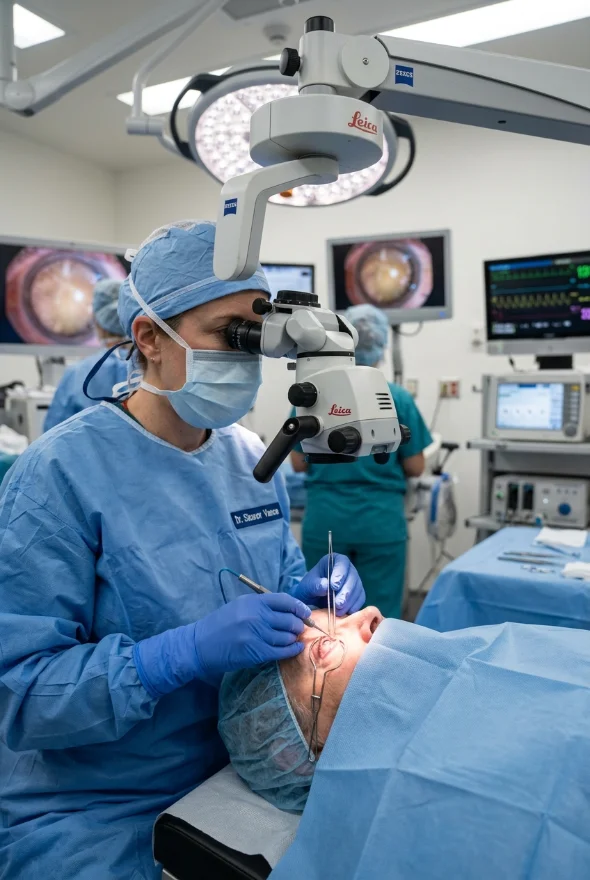
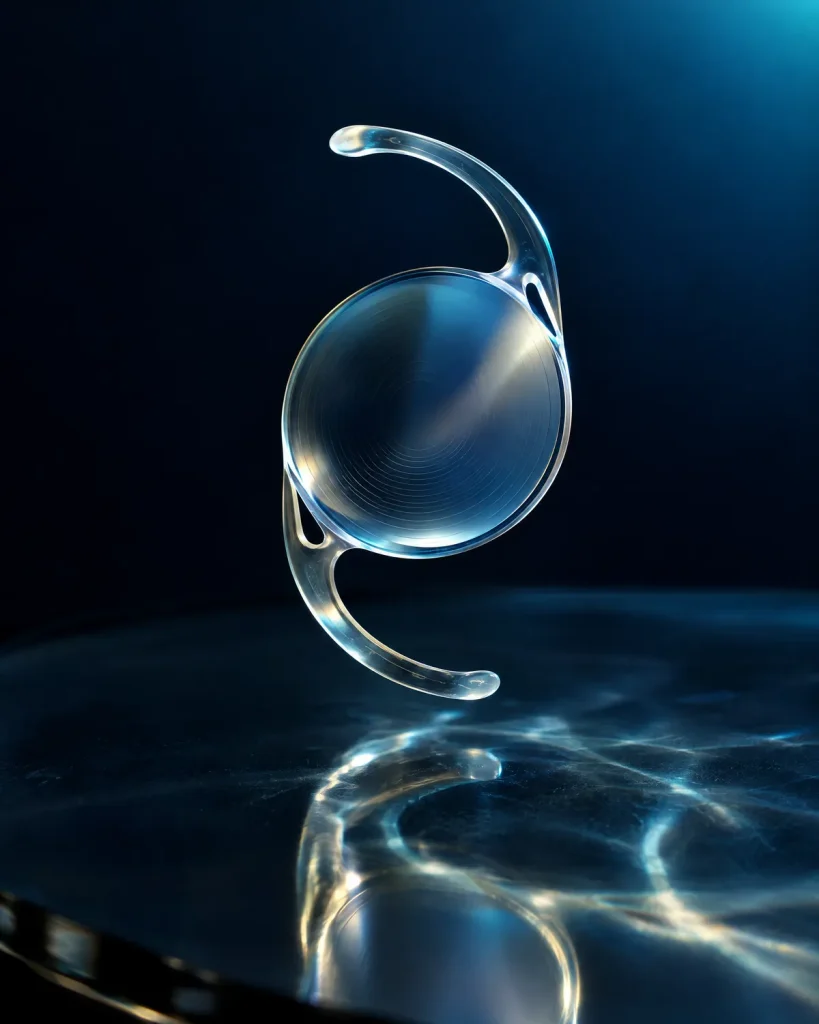
Sometimes for a few days or weeks, but not as your long-term glasses. Cataract surgery removes your clouded natural lens and replaces it with an artificial lens (an intraocular lens, or IOL). The focusing power of that new lens is chosen to suit your eye, not to match the glasses you wore with the cataract. That is why the NHS warns that you may still need glasses for reading or seeing long distances and that your prescription may be different to before surgery.
What you can wear depends on where you are in your treatment:
| Your situation | Can you use your old glasses? | What to do |
|---|---|---|
| First eye operated, second eye still has its cataract | Not as they are: the lens for the operated eye is likely to be the wrong strength, and the difference between your eyes can feel uncomfortable | Ask your surgeon or optician what to wear until the second eye is done (see the section on glasses between surgeries below) |
| Both eyes operated, first days and weeks | Only if your surgeon says so; vision is still settling | Do not buy new glasses yet. Use sunglasses if lights seem bright, and keep your old pair safe |
| Both eyes healed, standard (monofocal) lenses | No: the old prescription no longer fits | Get an eye test and a new prescription, usually reading glasses and sometimes distance glasses |
| Both eyes healed, premium (EDOF or trifocal) lenses | Usually not needed | You may need no glasses for most tasks, or only light reading glasses; your surgeon explains what to expect |
Whatever your lens, keep your old glasses until your new prescription is made. They are a useful reference for your optician and a spare if a new pair is delayed.
Why is my old prescription wrong after cataract surgery?
Because the lens inside your eye has changed. Your old glasses were designed to work together with your natural lens, which a cataract had been slowly clouding and often changing. The new artificial lens has its own fixed power. The surgeon calculates that power from measurements of your eye, aiming for the vision you agreed on beforehand, most often sharp distance vision with a standard lens.
Three things follow from this:
Your distance prescription may change a lot
The new lens takes over part of the focusing your glasses used to do, so the strength of your old distance glasses no longer applies.
Reading glasses are common
A standard monofocal lens is usually set for distance, so close work often needs reading glasses. According to the StatPearls review on prescribing glasses after cataract surgery, many patients continue to rely at least partly on glasses even after a successful operation, and complete independence from glasses is not always achievable.
Vision changes while the eye heals
In the first days and weeks it can vary during the day. If yours does, read our guide on fluctuating vision after cataract surgery.
When can I get new glasses after cataract surgery?
Usually once your surgeon says the eye has settled, which is typically between 2 and 8 weeks after the operation. Sources give slightly different timings, because eyes heal at different speeds and surgeons are cautious:
| Source | What it says |
|---|---|
| National Eye Institute (NEI), USA | Most people are completely healed about 8 weeks after surgery; once your eye has healed you may need a new glasses prescription |
| American Academy of Ophthalmology (AAO) | Most people see better within a few days; full healing can take about 4–6 weeks |
| NHS | You usually use eye drops for about 4 weeks after surgery |
| Study of 116 short-sighted patients (Feng et al., 2024) | Measurements at 1 week and 1 month did not differ significantly, so the authors concluded that new glasses could be prescribed earlier |
| Study of 194 eyes after small-incision surgery (Pattanayak et al., 2022) | Measurements at 2 and 6 weeks did not differ significantly, so spectacles could safely be prescribed at 2 weeks in uncomplicated cases |
What this means for you: the studies suggest that vision is often stable after 1–2 weeks in uncomplicated cases, while the NEI and AAO guidance allows for full healing up to 8 weeks. Do not choose the date yourself. Your surgeon decides when the eye is ready; with Laser Istanbul Clinic, that is part of your follow-up. After you fly home, we usually plan a video check, and a local eye test with an optometrist if needed, at around 1–3 months for your glasses prescription. Take your handover pack with you: it states your lens model and power, which your optician needs.
What do you do with glasses between cataract surgeries?
Ask your surgeon before the first operation, because the plan depends on your prescription. When one eye has a new lens and the other still has its cataract, the two eyes can end up with very different prescriptions (a difference called anisometropia). Glasses cannot comfortably correct a large difference, because they magnify or shrink the image differently for each eye.
The EyeWiki clinical encyclopedia (AAO) explains the numbers:
- Each dioptre of difference between the eyes that is corrected with glasses produces roughly 1% difference in image size (aniseikonia).
- A difference of 3 dioptres or more can produce a clinically significant difference of over 3%.
- After surgery on one eye, a difference in image size of 4% or more can occur, particularly in some long or short eyes.
- Tolerance varies a lot from person to person, and image-size difference typically returns to near its starting level once the second eye is treated.
What people do in practice:
- Keep the old glasses and ask which lens to use. Your optician or surgeon may advise that the lens in front of the operated eye is no longer needed or is now too strong. The lens in front of the eye with the cataract may still help.
- Contact lens or a temporary pair. The StatPearls review notes that surgeons can use partial corrections or contact lenses while waiting for the second eye.
- A planned leftover prescription. The same review says surgeons may deliberately aim the first eye slightly away from perfect distance vision, to reduce the imbalance with the second eye.
- Shorten the gap. The StatPearls review gives an average of 61 days between the two operations when they are done on separate occasions, while the NEI says each eye is usually done about a month apart. If you travel to Istanbul for treatment, your surgeon may plan both eyes in the same trip, or on the same day if you are suitable, which keeps the awkward period short. Cataract surgery in Turkey / Istanbul →
Safety first: until your vision is back to normal, do not drive. The NHS gives this instruction for the period after surgery, and a mismatch between the eyes is another reason to wait for your surgeon's go-ahead.
Cataract glasses after surgery: will I need them at all?
It depends mostly on the lens you choose. Standard monofocal lenses give one sharp focus, usually for distance, so reading glasses are common. Premium lenses (EDOF, multifocal or trifocal) are designed to reduce the need for glasses, with trade-offs such as more glare and halos around lights at night, which your surgeon will discuss with you.
Treatment at Laser Istanbul Clinic starts with a full assessment of your eyes, lifestyle and wishes. Prof. Dr. Ahmet Satıcı leads our cataract and premium-lens surgery. Doç. Dr. Muhammet Derda Özer (Doç. means Associate Professor) operates on cataracts in eyes that also have corneal, retinal or inflammatory disease, and Op. Dr. Aysan Bayram, a female surgeon who speaks English, treats cataract and retinal disease.
If you do not have a cataract yet but are tired of reading glasses, the same operation can be done for that reason: Lens replacement (RLE / smart lens) in Turkey →
Do sunglasses prevent cataracts?
Sunglasses cannot guarantee that you will not get cataracts, but UV-blocking sunglasses lower one known risk factor. The NHS lists regular, unprotected exposure to a lot of sunlight as a risk factor for cataracts and mentions sunglasses as protection. The AAO goes further and lists time spent in the sun without UV-blocking sunglasses among the causes of cataracts, recommending 100% UV-blocking sunglasses and a wide-brimmed hat. The NEI also lists spending a lot of time in the sun as a risk factor and advises sunglasses and a brimmed hat.
What does the research show? A 2021 meta-analysis of 31 epidemiological studies (Li et al., BioMed Research International) found that greater sunlight exposure was linked to a higher risk of age-related cataract (pooled odds ratio 1.15, 95% confidence interval 1.09 to 1.21), mainly the cortical type. A 2011 review in Eye & Contact Lens (Roberts) likewise describes ultraviolet radiation as a risk factor for cataract and recommends UV-blocking sunglasses.
How to read this honestly:
- These studies show an association between sunlight and cataract. They do not show that wearing sunglasses stops cataracts forming; in the sources we opened, sunglasses are a recommended precaution, not a proven cure.
- Sun is only one risk factor among several, so sunglasses lower one risk rather than removing the chance of a cataract.
- Wearing UV-blocking sunglasses is a simple, low-cost precaution, so it is reasonable for everyone to do it.
What to look for: following the AAO, choose sunglasses that block 100% of UV rays and add a wide-brimmed hat.
Do I need sunglasses after cataract surgery?
Yes, if bright light bothers you. The NHS advises wearing sunglasses if lights seem brighter than normal while you recover. Your eye may feel more sensitive to light and touch for a day or two (NEI). Some surgeons also ask you to wear glasses or a shield over the eye to protect it (AAO), and the NHS notes that you may need a plastic shield at night while the eye is healing. Follow the instructions on your own sheet.
Other care rules that affect what you wear and do (not rubbing the eye, bending, lifting, showering and sleeping position) are in our guide: Bending, lifting, showering and sleeping after cataract surgery →
When should I call my surgeon?
Call straight away if you notice sudden changes, not just because glasses feel wrong. The NHS says to get urgent help if you have sudden floaters, flashes of light, a dark curtain across your vision or sudden blurring, because these can be signs of a detached retina. Also call if pain, redness or vision gets worse rather than better.
Blurred vision that comes back months or even years later can be posterior capsule opacification, a clouding behind the lens that the NHS lists as a possible later problem. Tell your surgeon or optician about it rather than assuming new glasses will fix it.
Your glasses checklist
Before surgery
bring your current glasses and prescription to your consultation, or upload them with your scans.
Before you fly home
make sure you have your handover pack with the lens model and power, and a drop schedule.
First days
keep wearing sunglasses outdoors if lights seem bright; do not drive until your vision is back to normal.
After the first operation (if one eye at a time)
ask what to wear until the second eye is done.
When your surgeon says the eye has settled
book an eye test and get your new glasses.
Keep the old pair
until the new prescription is confirmed.
Frequently asked questions
Only temporarily, and only if your surgeon agrees. The new lens changes how your eye focuses, so your old prescription is usually wrong. The NHS says your prescription may be different to before surgery. Plan to get new glasses once the eye has healed.
Most surgeons wait until the eye has settled, usually 2 to 8 weeks. The NEI says most people are completely healed about 8 weeks after surgery. Small studies suggest vision can be stable after 1 to 2 weeks in uncomplicated cases. Your surgeon decides.
Ask your surgeon or optician what to wear. The two eyes may have very different prescriptions until the second operation, and glasses cannot fix a large difference comfortably. Options include using only the lens that still helps, a contact lens or a temporary pair. Do not drive until your vision meets the standard.
Often reading glasses with standard lenses, and sometimes light distance glasses. The NHS says you may still need glasses for reading or seeing long distances. With a premium lens, many people need glasses less, but not all.
They cannot guarantee it, but UV protection is recommended. The NHS, AAO and NEI list sun exposure as a risk factor and advise sunglasses and a brimmed hat. A 2021 meta-analysis of 31 studies found a link between sunlight and cataract risk (odds ratio 1.15).
Yes, if lights seem brighter than normal, according to the NHS. Your eye may be sensitive to light for a few days. Some surgeons ask for a shield or glasses to protect it as well.
Do not drive until your vision is back to normal, as the NHS advises. Your surgeon tells you when you meet the legal standard, and your glasses may need to change first.
Not yet. Keep them until your new prescription is made and you are happy with it. They help your optician, and they are a spare.
Planning cataract surgery and unsure what glasses you will need?
Send us your current glasses prescription and scans, and your surgeon explains which lens suits your eyes and how many glasses you are likely to need afterwards. Cataract surgery at Laser Istanbul Clinic is performed by Prof. Dr. Ahmet Satıcı, Doç. Dr. Muhammet Derda Özer or Op. Dr. Aysan Bayram in a fully equipped, Ministry of Health–licensed operating theatre in Istanbul. Your pre-operative examination and scans, surgery by your named surgeon, medication, follow-up checks in Istanbul, personal interpreter, coordinator and remote follow-up are included.
Sources for the facts on this page
- All opened and checked on 7 Oct 2026.
- NHS. Cataract surgery (glasses may be needed for reading or distance; prescription may differ; sunglasses if lights seem bright; drops for about 4 weeks; plastic shield at night; do not drive until vision is back to normal; eyes treated on separate days; warning signs of retinal detachment; posterior capsule opacification). https://www.nhs.uk/tests-and-treatments/cataract-surgery/
- NHS. Cataracts (regular exposure to a lot of sunlight without protection such as sunglasses listed as a risk factor). https://www.nhs.uk/conditions/cataracts/
- National Eye Institute (NIH). Cataract Surgery (completely healed by about 8 weeks; new prescription once healed; each eye operated separately, usually about a month apart; eye sensitive to light for 1–2 days). https://www.nei.nih.gov/learn-about-eye-health/eye-conditions-and-diseases/cataracts/cataract-surgery
- National Eye Institute (NIH). Cataracts (time in the sun as a risk factor; wear sunglasses and a brimmed hat). https://www.nei.nih.gov/learn-about-eye-health/eye-conditions-and-diseases/cataracts
- American Academy of Ophthalmology. What Is Cataract Surgery? (most people see better within days; full healing about 4–6 weeks; eyeglasses or a shield for protection). https://www.aao.org/eye-health/treatments/what-is-cataract-surgery
- American Academy of Ophthalmology. What Are Cataracts? (sun exposure without UV-blocking sunglasses as a cause; 100% UV-blocking sunglasses and a wide-brimmed hat). https://www.aao.org/eye-health/diseases/what-are-cataracts
- EyeWiki (AAO). Aniseikonia (about 1% size difference per dioptre of spectacle-corrected anisometropia; 3 D or more can exceed 3%; 4% or more possible after unilateral cataract surgery; returns near baseline after the second eye). https://eyewiki.org/Aniseikonia
- Davis GS, Stokkermans TJ, Hobbs SD. Prescribing Glasses For Pseudophakia. StatPearls, NCBI Bookshelf, 2025 (abstract opened; many patients rely partly on glasses; complete independence not always achievable; separate-day bilateral surgery averages 61 days apart; intentional residual error, partial corrections or contact lenses). https://www.ncbi.nlm.nih.gov/books/NBK623727/
- Feng R, Wang M, Tao S, Liang F, Liu X, He C, Fan S. Refractive stability and timing of spectacle prescription following cataract surgery in myopic eyes. Ophthalmic & Physiological Optics 2024;44(3):576–583. https://doi.org/10.1111/opo.13285
- Pattanayak S, Patra SHS, Nanda AK, Subudhi P. Stabilization of refraction and timing of spectacle prescription following manual small-incision cataract surgery. Indian Journal of Ophthalmology 2022;70(11):3938–3941. https://doi.org/10.4103/ijo.IJO_95_22
- Li X, et al. Correlation of Sunlight Exposure and Different Morphological Types of Age-Related Cataract (meta-analysis of 31 studies). BioMed Research International 2021. PubMed ID 34805407. https://pubmed.ncbi.nlm.nih.gov/34805407/
- Roberts JE. Ultraviolet radiation as a risk factor for cataract and macular degeneration. Eye & Contact Lens 2011;37(4):246–249. https://doi.org/10.1097/ICL.0b013e31821cbcc9