
- Home: eye surgery in Istanbul
- Knowledge centre
- Keratoconus & cornea guides
Keratoconus Guide: Cornea Articles on Symptoms, Cross-Linking, Rings and Transplant
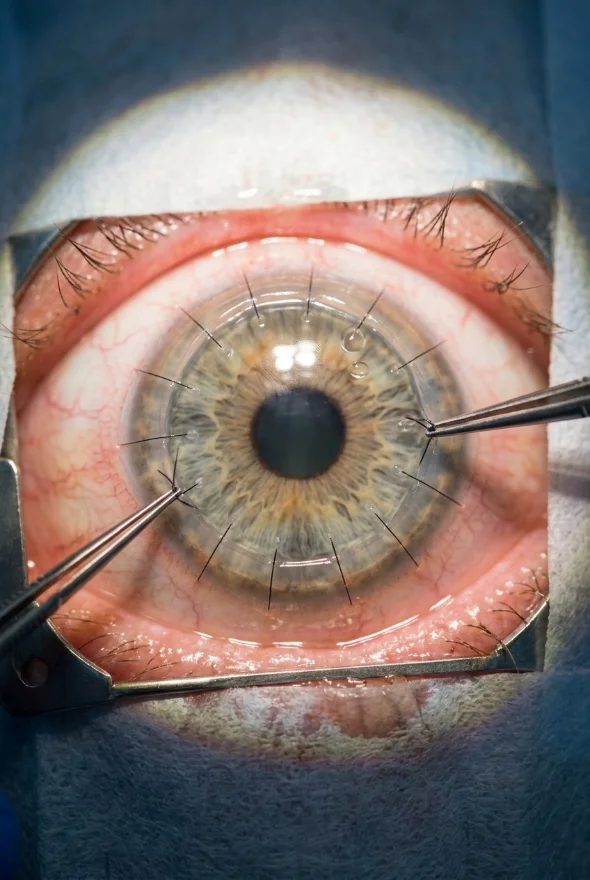
Keratoconus is a condition in which the cornea, the clear front window of the eye, thins and bulges into a cone, blurring and distorting vision. It usually starts in the teens or early twenties. Cross-linking can stop it getting worse; glasses, special contact lenses, corneal rings and, in advanced cases, a corneal transplant restore vision. This keratoconus guide gathers our articles, overseen by cornea specialist Doç. Dr. Muhammet Derda Özer.
This keratoconus guide is the starting point for everything we have written about keratoconus and other cornea problems. The cornea does most of the eye's focusing, so when it loses its round shape, vision becomes blurred, doubled or streaky, and prescriptions change again and again. According to the American Academy of Ophthalmology (AAO), keratoconus typically begins in the late teens to early twenties and progresses over about 10 to 20 years, although in some people it worsens quickly.
The good news is that keratoconus today is a very treatable condition. Moorfields Eye Hospital, a specialist NHS eye hospital in London, states plainly that keratoconus does not cause blindness. Corneal cross-linking, approved by the US Food and Drug Administration in April 2016, is now the main treatment that stops it progressing, and fewer people reach the stage where they need a transplant.
The five articles below each answer one question in depth: how keratoconus develops and is staged, how the treatments compare, whether laser or ICL is possible, what a corneal transplant involves, and why children need early treatment. They are written for patients and families and reviewed by our surgeons. Doç. Dr. Muhammet Derda Özer ("Doç." is the Turkish title for Associate Professor) leads cornea and keratoconus care in our team. He has published peer-reviewed research on accelerated cross-linking in children and teenagers with keratoconus.
Keratoconus and cornea articles
Keratoconus: symptoms, stages and treatment options
The complete overview: early signs such as blurring, wavy straight lines, glare and frequent prescription changes; how doctors measure and stage keratoconus with corneal topography; and which treatment usually fits each stage, from glasses to transplant.
Best for: anyone newly diagnosed, or who suspects keratoconus.
Reviewed by: Doç. Dr. Muhammet Derda Özer
Keratoconus: symptoms, stages and treatment optionsCross-linking vs corneal rings vs transplant
A side-by-side comparison of the three main procedures: what each one does, who it suits, recovery time and risks. Cross-linking stabilises the cornea, rings reshape it, and a transplant replaces damaged tissue. Many people need only one; some need a combination.
Best for: people deciding between treatments after a scan.
Reviewed by: Doç. Dr. Muhammet Derda Özer
Cross-linking vs corneal rings vs transplant: which one do you need?Can keratoconus patients have laser or ICL?
Why standard laser eye surgery is usually not advised in keratoconus, when a surface laser combined with cross-linking is sometimes considered, and how an implantable lens (toric ICL) can correct high short sight and astigmatism once the cornea has been stable for months.
Best for: people with keratoconus who want to depend less on glasses or contact lenses.
Reviewed by: Doç. Dr. Muhammet Derda Özer with Prof. Dr. Ahmet Satıcı (laser and ICL)
Can keratoconus patients have laser eye surgery or ICL?Corneal transplant success rates and recovery
What partial (DALK) and full-thickness (PK) corneal transplants involve, the long-term graft survival figures for keratoconus, how long vision takes to settle, stitches, rejection warning signs and follow-up.
Best for: people with advanced keratoconus or corneal scarring who have been told they may need a transplant.
Reviewed by: Doç. Dr. Muhammet Derda Özer
Corneal transplant success rates and recovery: what to expectKeratoconus in children and teenagers: why early CXL matters
Keratoconus diagnosed at 18 or younger tends to be more advanced and to progress faster. This article explains the warning signs parents should look for, why eye rubbing matters, and why doctors treat children with progressing keratoconus early.
Best for: parents, and teenagers whose prescription keeps changing.
Reviewed by: Doç. Dr. Muhammet Derda Özer
Keratoconus in children and teenagers: why early cross-linking mattersKeratoconus treatment options at a glance
The right treatment depends on two questions: is the keratoconus still getting worse, and how well can you see with glasses or contact lenses? This table summarises the main options; the comparison article goes into detail.
| Treatment | What it does | Usually considered when |
|---|---|---|
| Glasses or soft contact lenses | Correct vision; do not change the cornea | Early, mild keratoconus |
| Rigid, hybrid or scleral contact lenses | Create a smooth new front surface over the irregular cornea | Most people once glasses no longer give clear vision |
| Corneal cross-linking (CXL) | Riboflavin (vitamin B2) drops and UV light stiffen the cornea to stop progression | Keratoconus is getting worse, and the cornea is thick enough |
| Corneal ring segments (ICRS) | Small implants flatten and regularise the cornea | Contact lenses are not tolerated and the central cornea is clear |
| Toric ICL (implantable lens) | Corrects short sight and astigmatism inside the eye | The cornea has been stable for months, often after CXL |
| Corneal transplant (DALK or PK) | Replaces the damaged part, or all, of the cornea with donor tissue | Advanced keratoconus or scarring, when lenses no longer give useful vision |
Three facts from authoritative sources help put these options in context:
- Cross-linking aims to stop, not reverse, keratoconus. Moorfields Eye Hospital reports that cross-linking works in more than 90% of treated eyes (about 94% in its own data since 2013) and that its main aim is to stabilise, not improve, vision.
- Fewer transplants are needed since cross-linking arrived. A 2016 Dutch national registry study found that about 10 to 20% of people with keratoconus eventually need a transplant, and that about 25% fewer transplants were performed after cross-linking was introduced (201 versus 269 over two three-year periods).
- Transplants for keratoconus last well. In a 2023 study of 502 keratoconus eyes in the British Journal of Ophthalmology, 20-year graft survival was 97.0% after DALK and 94.9% after PK.
Every option has risks, and none suits everyone. Your surgeon recommends treatment only after corneal topography and thickness scans, and explains the risks for your eyes before you decide.

Other cornea problems we cover
Keratoconus is the most common reason young adults see a cornea specialist, but it is not the only cornea problem. The NHS lists keratoconus alongside Fuchs' dystrophy (a condition in which the inner layer of the cornea stops working well), severe infections, eye injuries and complications after cataract surgery as reasons a cornea transplant may be needed. Infections of the cornea (keratitis), corneal scarring and swelling are all assessed by Doç. Dr. Özer. Short definitions of these terms are in our glossary, and our comparison articles cover treatment choices that cut across topics.
Keratoconus questions people ask most
Keratoconus is an eye condition in which the cornea gradually thins and bulges forward into a cone shape. The AAO describes the result as blurry and distorted vision, where straight lines can look bent or wavy, often with glare and light sensitivity. It usually affects both eyes, but often one eye much more than the other.
Keratoconus is more common than once thought. EyeWiki (AAO) notes that prevalence is often reported as 1 in 700 and is higher in the Middle East, India, China and Australia, while a 2017 Dutch study of 4.4 million insured people estimated 1 in 375. It usually starts in the teenage years or early twenties.
There is no treatment that returns the cornea to a completely normal shape, but keratoconus can be stopped and vision can usually be restored. Cross-linking stops progression in most treated eyes, and contact lenses, ring segments, ICL or a transplant improve sight. According to Moorfields Eye Hospital, keratoconus usually stops getting worse by the mid-30s as the cornea stiffens naturally with age.
No. Moorfields Eye Hospital states that keratoconus does not cause blindness, and even advanced cases can usually be corrected with contact lenses or a transplant. A small number of people develop hydrops, a sudden painful swelling of a very thin cornea; it settles with time but can leave scarring, and it needs prompt care from an eye doctor.
Partly. The AAO reports that about 1 in 10 people with keratoconus have a parent who has it too, so brothers, sisters and children of people with keratoconus are worth checking. Other risk factors include eye allergies, frequent eye rubbing and connective-tissue disorders such as Marfan and Ehlers-Danlos syndrome. The AAO's simplest advice is to avoid rubbing your eyes.
Yes, and most people do. EyeWiki notes that rigid gas-permeable lenses are needed in the majority of cases, with scleral and hybrid lenses as alternatives when rigid lenses are uncomfortable. When no lens fits comfortably, corneal ring segments or a transplant may be considered.
Usually not standard LASIK. The US Food and Drug Administration lists keratoconus as a precaution for LASIK and warns that laser surgery on a cornea that is too thin may cause blinding complications. Some people with stable keratoconus can have a toric ICL instead, or a surface laser combined with cross-linking; our article on laser and ICL explains who may be suitable.
Doç. Dr. Muhammet Derda Özer leads keratoconus, cross-linking and corneal transplant care; he speaks Turkish and English. Prof. Dr. Ahmet Satıcı advises on ICL and laser options once the cornea is stable, and Op. Dr. Aysan Bayram performs cataract surgery, including in eyes with keratoconus. Surgery takes place in a fully equipped, Ministry of Health–licensed operating theatre in Istanbul.
More guides from the knowledge centre
Sources for the facts on this page
- *Medical facts (all opened and checked, October 2026):**
- American Academy of Ophthalmology, What Is Keratoconus?: cornea thins and bulges like a cone; early and late symptoms (blurring, wavy lines, glare, frequent prescription changes); onset late teens to early 20s; progression over about 10–20 years, sometimes rapid; about 1 in 10 have a parent with it; risk factors (genetics, eye allergies, eye rubbing, Marfan and Ehlers-Danlos syndromes); treatments (glasses, soft and hard contact lenses, Intacs, cross-linking, transplant); "avoid rubbing your eyes". https://www.aao.org/eye-health/diseases/what-is-keratoconus
- EyeWiki (AAO), Keratoconus: prevalence often reported as 1 in 700, higher in the Middle East, India, China and Australia; onset in adolescence; paediatric keratoconus (diagnosis at 18 or younger) more advanced and faster-progressing; mostly bilateral but often asymmetric; rigid gas-permeable lenses needed in the majority, scleral and hybrid alternatives; CXL as the principal disease-modifying treatment; ICRS, DALK and PK; acute hydrops. https://eyewiki.org/Keratoconus
- EyeWiki (AAO), Corneal Collagen Cross-Linking: FDA approval 18 April 2016; riboflavin and UV-A protocol; 400 µm thickness threshold. https://eyewiki.org/Corneal_Collagen_Cross-Linking
- Moorfields Eye Hospital NHS Foundation Trust, Keratoconus: "keratoconus does not cause blindness"; usually develops in teenagers or people in their twenties; about 1 in 10 have an affected first-degree relative; hydrops settles with time. https://www.moorfields.nhs.uk/eye-conditions/keratoconus
- Moorfields Eye Hospital NHS Foundation Trust, Corneal cross-linking: effective in more than 90% of treated eyes, about 94% in Moorfields' data since 2013; main aim to stabilise, not improve, vision; keratoconus usually stops getting worse by the mid-30s. https://www.moorfields.nhs.uk/eye-conditions/keratoconus/corneal-cross-linking
- NHS, Cornea transplant: reasons (keratoconus, Fuchs' dystrophy, severe infections, cataract surgery complications, injuries); partial or full-thickness transplants; rejection signs; follow-up for 1–2 years. https://www.nhs.uk/conditions/cornea-transplant/
- US Food and Drug Administration, When is LASIK not for me?: keratoconus listed as a precaution; refractive surgery on a cornea that is too thin "may result in blinding complications". https://www.fda.gov/medical-devices/lasik/when-lasik-not-me
- Godefrooij DA, et al. Nationwide reduction in the number of corneal transplantations for keratoconus following the implementation of cross-linking. Acta Ophthalmol. 2016;94(7):675–678 (PMID 27213687): about 10–20% eventually need a transplant; about 25% fewer transplants after CXL (201 vs 269). https://pubmed.ncbi.nlm.nih.gov/27213687/
- Godefrooij DA, et al. Age-specific Incidence and Prevalence of Keratoconus: A Nationwide Registration Study. Am J Ophthalmol. 2017;175:169–172 (PMID 28039037): 4.4 million insured people; estimated prevalence 1 in 375. https://pubmed.ncbi.nlm.nih.gov/28039037/
- Borderie VM, et al. Long-term outcomes of deep anterior lamellar versus penetrating keratoplasty for keratoconus. Br J Ophthalmol. 2023: 502 eyes; 20-year graft survival 97.0% DALK, 94.9% PK. https://pmc.ncbi.nlm.nih.gov/articles/PMC10803977/
- Vega-Estrada A, Alió JL. The use of intracorneal ring segments in keratoconus. Eye and Vision. 2016: rings flatten and regularise the cornea; indications include contact lens intolerance and a clear central cornea; removable. https://pmc.ncbi.nlm.nih.gov/articles/PMC4791885/
- Antonios R, et al. Safety and Visual Outcome of Visian Toric ICL Implantation after Corneal Collagen Cross-Linking in Keratoconus: Up to 2 Years of Follow-Up. J Ophthalmol. 2015: toric ICL implanted 6 months after CXL in 30 eyes; effective and safe in selected patients. https://pmc.ncbi.nlm.nih.gov/articles/PMC4383407/
- Ozer MD, et al. Long-Term Results of Accelerated Corneal Cross-Linking in Adolescent Patients With Keratoconus. Cornea. 2019;38(8):992–997 (PMID 31033692). https://pubmed.ncbi.nlm.nih.gov/31033692/
- Ozer MD, et al. Comparison of the efficacy of accelerated corneal cross-linking therapy in different pediatric age groups having progressive keratoconus. Int Ophthalmol. 2020;40(10):2651–2658 (PMID 32488590). https://pubmed.ncbi.nlm.nih.gov/32488590/ (the two Ozer papers support the statement that Doç. Dr. Özer has published research on accelerated cross-linking in children and teenagers)
Have a keratoconus diagnosis or a scan? Ask a cornea specialist, free
Send your corneal topography, prescription or eye reports. Doç. Dr. Özer will tell you whether your keratoconus looks stable or progressing and which treatments may suit your eyes, in writing, with no obligation.
3 eye surgeons
Your case is reviewed by a named surgeon, not a salesperson. Reply within {{response time}}.
 Prof. Dr. Ahmet Satıcı
 Doç. Dr. Muhammet Derda Özer
 Op. Dr. Aysan Bayram