
- Home: eye surgery in Istanbul
- All eye treatments
- ICL / EVO ICL implantable lens
ICL Surgery in Turkey: EVO ICL Implantable Lens in Istanbul
ICL surgery in Turkey with Laser Istanbul Clinic means a thin, removable lens placed inside your eye to correct high short sight and astigmatism, planned and performed by Prof. Dr. Ahmet Satıcı. It is often the answer for people told their prescription is too high or their cornea too thin for laser. Your surgeon measures your eyes before recommending anything, you see the full price in writing before you travel, and a personal interpreter stays with you throughout.
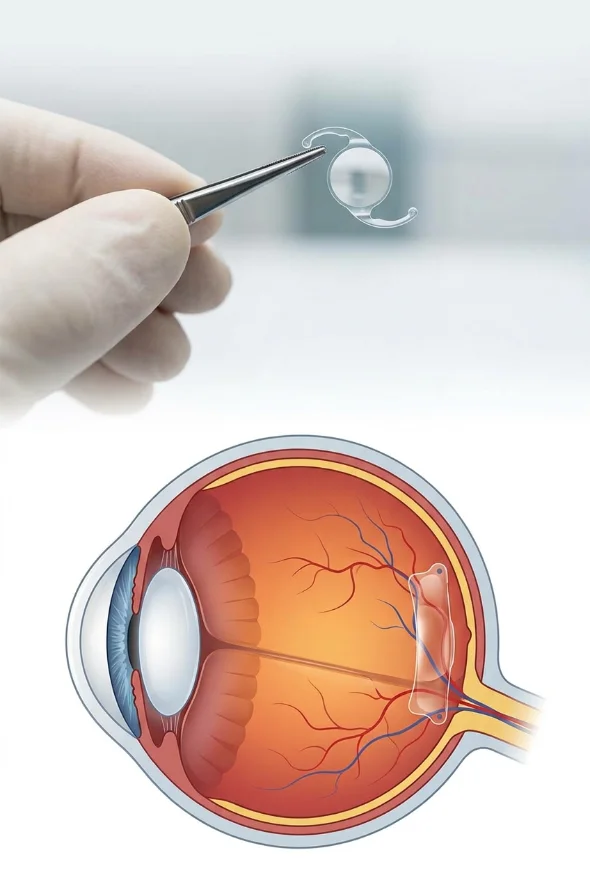
An ICL (Implantable Collamer Lens) is a soft lens implanted behind the iris and in front of your natural lens. Nothing is removed from the eye, and the lens can be taken out later. It suits adults with stable, high prescriptions or corneas unsuitable for laser. Surgery takes about 20 minutes per eye. In Istanbul, ICL with Prof. Dr. Ahmet Satıcı starts from {{£ ICL package price}} per eye; hotel and transfers are extra.
What is an ICL lens, and what makes the EVO ICL different?
An ICL lens is a phakic intraocular lens: a corrective lens implanted inside an eye that keeps its own natural lens. "Phakic" simply means the eye still has its natural lens, so a phakic eye is a normal eye that has not had cataract or lens replacement surgery. The Royal College of Ophthalmologists (RCOphth) describes these lenses as "a bit like building your contact lenses into your eyes", which is why people also search for them as implantable contact lenses.
According to the RCOphth, the Visian ICL is the most commonly implanted phakic lens in the UK and worldwide. It is:
- Made of Collamer. A soft, flexible material that EyeWiki (American Academy of Ophthalmology) describes as a copolymer of hydroxyethyl methacrylate and porcine collagen. If you have concerns about a material that contains collagen of pig origin, tell your surgeon at your first consultation.
- Placed behind the iris. The lens sits in the narrow space between the coloured iris and your natural lens, vaulting over the natural lens without touching it. You cannot see or feel it, and it needs no cleaning.
- Folded and injected through a small opening. Because it unfolds inside the eye, it goes in through a self-sealing entry about 3 mm wide, and it can later be removed through a similar opening.
Why EVO matters. Older ICLs could block the natural flow of fluid inside the eye, so surgeons first made a small drainage hole in the iris (an iridotomy) to prevent a sudden pressure rise. The EVO and EVO+ Visian ICL have a 360-micron central port, a tiny hole in the middle of the lens, that lets fluid flow naturally. EyeWiki and the RCOphth both state that a peripheral iridotomy is no longer needed with EVO lenses in short-sighted patients. The US Food and Drug Administration (FDA) approved the EVO/EVO+ ICL on 25 March 2022, and toric versions correct astigmatism as well as short sight.
Technology we use: {{ICL models used, e.g. EVO / EVO+ Visian ICL, spherical and toric}}, implanted in a fully equipped, Ministry of Health–licensed operating theatre in Istanbul. Each lens is ordered for your eye from your measurements, so your exact lens power and size are fixed before surgery day.
Who is suitable for ICL surgery?
ICL surgery is usually offered to adults whose prescription is too high, or whose cornea is too thin or irregular, for laser eye surgery. The RCOphth says patients under 60 who are unsuitable for laser vision correction are often offered a phakic lens, because it corrects a wider range of prescriptions and may be safer if the cornea or eye surface already has problems.
The RCOphth's general suitability criteria (UK guidance, 2024):
| Criterion | Usual requirement |
|---|---|
| Age | Over 18 (the US FDA approves the EVO ICL for ages 21–45) |
| Stable prescription | No change greater than 0.5 D in the last 2 years (FDA: within 0.5 D for 1 year) |
| Short sight (myopia) | Up to about −23.50 D (FDA-approved EVO range: −3.00 to −20.00 D) |
| Long sight (hyperopia) | Up to about +12.00 D (hyperopic ICLs are not FDA-approved in the US) |
| Astigmatism | Up to about ±4.50 D (FDA toric EVO: 1.0 to 4.0 D) |
| Space inside the eye | Enough depth in the front of the eye; the FDA requires an anterior chamber depth of at least 3.00 mm |
For very high prescriptions, the RCOphth notes that supplementary laser can extend this range, a combination called bioptics.
ICL is usually not the right choice if you have:
- cataract, glaucoma (the FDA lists moderate to severe glaucoma as a contraindication) or recurrent inflammation inside the eye (uveitis)
- a shallow front chamber or a narrow drainage angle
- a low count of endothelial cells, the pump cells on the inner surface of the cornea; the FDA's minimum depends on your age and eye depth
- pregnancy or breastfeeding
- active eye disease, or retinal or macular disease that needs treatment first
Age and the alternatives. The RCOphth notes that older patients with high prescriptions are more likely to develop cataract after a phakic lens and have already lost most of their natural focusing range, so after about 50, lens replacement (RLE) is often the better option if laser is not suitable. Laser is generally preferred for lower prescriptions, because it carries very few long-term risks.
What your examination measures. Expect a refraction with and without dilating drops, corneal topography and thickness, anterior chamber depth, endothelial cell count, pupil size in dim light, the eye measurements used to size your lens, eye pressure and a dilated retina check. High short sight raises the risk of retinal problems, so retinal findings can be reviewed by Op. Dr. Aysan Bayram or Doç. Dr. Muhammet Derda Özer before surgery.
Keratoconus. In stable, early-to-moderate keratoconus, published studies report good results with a toric ICL implanted after corneal cross-linking has stopped the condition progressing. Doç. Dr. Özer, our cornea specialist, decides whether your cornea is stable enough.
Older ICL vs EVO ICL at a glance
| Older ICL (no central port) | EVO / EVO+ ICL (central port) | |
|---|---|---|
| Fluid flow inside the eye | Needed a separate hole in the iris | Flows through a 360-micron central port |
| Laser iridotomy before surgery | Usually required | Not required for short-sighted eyes |
| Pupillary block (sudden pressure rise) | 3.2% (17 of 526 eyes) in the original FDA myopia study | 1 case in 4,196 eyes reviewed (Packer, 2018) |
| Anterior subcapsular cataract | A recognised risk | 0.49% asymptomatic opacities; no visually significant cataracts reported up to 5 years (Packer, 2018) |
| Corrects astigmatism | Toric version available | Toric version available |
| What we offer | Not offered for short sight | {{confirm: EVO / EVO+ for all myopic eyes}} |
ICL surgery cost in Turkey: price and what is included
At Laser Istanbul Clinic, ICL surgery starts from {{£ ICL package price}} per eye. Your surgeon confirms your exact price in writing after reviewing your prescription and scans, before you book anything. ICL prices are usually quoted per eye, because each lens is made to your measurements; check this whenever you compare quotes.
Typical published ICL prices, per eye (USD, 2025–26):
| Where | Typical price range per eye |
|---|---|
| UK private clinics | $3,350–8,700 |
| USA | $3,500–9,000 |
| Germany | from $2,900 |
| UAE | $2,720–4,900 |
| Istanbul (published package prices) | $1,800–3,500 |
| Istanbul with Laser Istanbul Clinic | from {{£ ICL package price}} per eye |
Typical ranges published by clinics and price-comparison sites in 2025–26, not quotes. Comparing range midpoints, Istanbul is roughly half the UK price. Published Istanbul prices are often packages that include a hotel, so compare like with like.
Your ICL price includes:
- full pre-operative examination and scans, including the measurements needed to size your lens
- ICL surgery by Prof. Dr. Ahmet Satıcı, including the lens itself
- medication and eye drops for your recovery
- follow-up checks in Istanbul with the same surgeon
- a personal interpreter, a dedicated coordinator and remote follow-up after you return home
Not included: flights, hotel and airport transfers. Hotel and transfers are a separate charge, and we can arrange them for you if you ask. In the UK, the RCOphth notes that surgery to correct the need for glasses or contact lenses is not available on the NHS and is not covered by private health insurance, so the cost of implantable contact lenses is self-paid wherever you have them.
What can change the price: a toric lens for astigmatism, a very high prescription, or a combined bioptics treatment. {{Policy on lens exchange or repositioning if sizing needs correcting, and for how long it is covered.}}
Getting an ICL quote takes three steps: send your current glasses prescription, any recent eye report and, if you have them, corneal topography scans. Your surgeon replies with suitable options and a written quote within {{response time}}.
Your ICL surgeon



Your ICL surgery journey, step by step
- Free online assessment
Send your prescription and any eye reports. Prof. Dr. Satıcı tells you whether ICL, laser or lens replacement is likely to suit you and sends a written quote.
- Measurements and lens order
ICLs are made to your measurements, so your full examination must happen before the lens can be ordered. {{How the lens is ordered for international patients: from scans sent in advance, or after the examination in Istanbul, and how long delivery takes.}}
- Book your dates
Plan {{days in Istanbul for ICL}} days in Istanbul. Your coordinator helps you choose dates with your surgeon.
- Full eye examination
The tests listed above, with your interpreter beside you. If ICL is not right for you, your surgeon tells you and explains the alternatives.
- Surgery on the first eye
Strong dilating drops widen your pupil. The RCOphth explains that ICL surgery uses anaesthetic eye drops, with light sedation if you need it. A small clip keeps your eyelids open while your surgeon makes tiny self-sealing openings, injects the folded lens, positions it behind the iris and washes out the supporting gel. It takes about 20 minutes per eye, and you go back to your hotel the same day.
- Pressure check within hours
The FDA advises checking eye pressure 1–6 hours after ICL surgery, so any early rise can be treated straight away.
- Second eye
The RCOphth notes that some centres treat both eyes on the same day, but more commonly the second eye is done a day or more later, once the first eye is recovering well and the lens size is confirmed.
- Final check and home
Your surgeon checks lens position and eye pressure before clearing you to fly. Your coordinator stays in touch, and your surgeon reviews your progress by video at agreed intervals.
Recovery after ICL surgery: what to expect
-
Day of surgery
Blurred vision while the dilating drops wear off. A clear shield protects the eye on the way back to your hotel.
-
Days 1–3
Vision normally recovers substantially within two to three days. Washing and showering are fine from day one. Gym and jogging can restart from day one.
-
First week
Wear the eye shield at night. No swimming. Use antibiotic and anti-inflammatory drops exactly as prescribed, leaving at least two minutes between different drops.
-
Within a few days
Most people can drive again; your surgeon confirms when your vision meets the driving standard.
-
Up to 6 weeks
Red blotches on the white of the eye (harmless small bleeds) can take up to six weeks to fade.
-
1 month
Contact sports can restart, not before.
-
First few months
Glare, halos and starbursts, especially from car headlights at night, are common early on and usually improve within a few months.
-
Every year
A routine eye health check with an optometrist once a year is enough after an ICL, mainly to watch for cataract.
Report straight away to your surgeon, or to an eye casualty department at home, if you have increasing aching pain, light sensitivity, redness or blurred vision.
Risks and side effects of ICL surgery
ICL surgery has a strong safety record, but it is surgery inside the eye, and the risks are not zero. These are the figures from the RCOphth, the FDA and the published literature.
Results. In the FDA clinical trial that led to the 2022 approval of the EVO ICL, 75.9% of patients had 20/20 vision or better and 98.9% had 20/32 or better without glasses at six months, and 90.5% of eyes were within 0.50 D of the planned correction. The RCOphth reports that over 95% of patients are satisfied with phakic lens surgery. A Cochrane review of three randomised trials (228 eyes, myopia −6.0 to −20.0 D) found that phakic lenses lost less best-corrected vision at one year than excimer laser, gave better contrast sensitivity and were preferred by patients; those trials used older lens models.
Common, usually temporary side effects:
- Glare, halos and starbursts, especially at night and with very high prescriptions. The FDA notes that if your pupil in dim light is larger than the lens optic, glare and halos are more likely, which is why your pupil size is measured.
- Mild eye-surface discomfort in the first months, often more in one eye than the other.
- Fluctuating vision in the early weeks.
Less common risks:
- Raised eye pressure. With the EVO ICL, an early pressure rise is usually caused by supporting gel left in the eye and is fixed with a further washout (RCOphth). Sudden pressure rises from pupillary block are much less common than with older lenses. This is also why ICL is not offered if you have moderate to severe glaucoma.
- Sizing problems. Lens size is predicted statistically, and in about 1 in 40 cases the ICL needs to be exchanged for a different size (RCOphth). A toric lens may need a small rotation to optimise the astigmatism correction.
- Cataract earlier in life. This is the main long-term risk. The FDA labelling states that the risk increases with each year and may be higher in older patients and those with higher myopia. If cataract develops, the ICL is removed during normal cataract surgery and a new lens implant is placed.
- Loss of corneal endothelial cells. Mean cell loss was 2.3% at six months in the EVO FDA trial and 2.6% across 21 studies (Packer, 2018). Some patients with the older lens lost more than 30% at 5–7 years, so the FDA advises periodic cell counts while the lens is in place.
- Infection inside the eye is very rare: about 1 in 6,000 (RCOphth).
- Retinal detachment. High short sight itself raises this risk. The RCOphth says ICL implantation does not increase it; the FDA labelling says the relationship is undetermined. Learn the warning signs: a dark shadow in your vision, flashing lights or a sudden shower of floaters.
- Serious, permanent loss of vision is very uncommon after ICL implantation, according to the RCOphth.
Your surgeon explains your personal risks in writing and through your interpreter before you sign anything.
ICL surgery in Turkey: frequently asked questions
ICL surgery in Istanbul typically costs about $1,800–3,500 per eye on published price lists (2025–26), compared with about $3,350–8,700 per eye at UK private clinics. With Laser Istanbul Clinic, ICL starts from {{£ ICL package price}} per eye, including your examination and scans, the lens, surgery, medication, follow-up checks, interpreter and coordinator. Hotel and transfers are extra. Your exact price is confirmed in writing after your free assessment.
An ICL (Implantable Collamer Lens) is a thin, soft lens implanted inside the eye, behind the iris and in front of your natural lens. It corrects short sight, long sight and astigmatism like a contact lens, but you cannot see or feel it and it needs no cleaning. Nothing is removed from your eye, and the lens can be taken out later if needed.
The EVO ICL has a tiny 360-micron port in its centre that lets fluid flow naturally inside the eye. Older ICLs needed a laser hole in the iris before surgery to prevent a sudden pressure rise; with EVO lenses in short-sighted eyes this is no longer needed. The US FDA approved the EVO/EVO+ ICL in March 2022.
Neither is better for everyone. For moderate to high short sight, a Cochrane review found phakic lenses gave better contrast sensitivity, lost less best-corrected vision and were preferred by patients at one year. For lower prescriptions, laser is generally preferred because it carries very few long-term risks, while an ICL brings a long-term cataract risk. Prof. Dr. Satıcı performs both and recommends one only after measuring your eyes.
The ICL is designed to stay in your eye long term, but it can be removed or exchanged. The RCOphth says removal usually returns your vision and eye health to how they were before, although not every problem can be reversed by removal. Removal is uncommon unless you need cataract surgery or a different lens size.
Most people feel little more than pressure. Anaesthetic drops numb the eye, and light sedation is available if you are anxious. Afterwards the eye may ache mildly or feel scratchy for a day or two, and vision usually recovers substantially within two to three days.
Possibly, and earlier than you would otherwise. Cataract is the main long-term risk of an ICL, and it is more likely with age and higher prescriptions. If it happens, the ICL is removed through a normal cataract incision and replaced with a lens implant, so an ICL does not stop you having successful cataract surgery later.
A phakic eye is an eye that still has its own natural lens. Phakic intraocular lenses such as the ICL are added in front of that natural lens, unlike cataract surgery or lens replacement, which remove it.
Some surgeons treat both eyes on the same day, but more commonly the second eye is done a day or more after the first, once the first eye's lens size and recovery are confirmed. Plan {{days in Istanbul for ICL}} days in Istanbul; your surgeon checks both eyes before you fly home.
ICL is usually not suitable if you have cataract, moderate to severe glaucoma, recurrent uveitis, a shallow front chamber, a low endothelial cell count, an unstable prescription, or if you are pregnant or breastfeeding. Over about 50, lens replacement is often the better choice. Your scans decide, not your prescription alone.
ICL surgery in Turkey can be as safe as at home when an experienced ophthalmologist performs it after full measurements, in a properly equipped operating theatre, with an eye-pressure check within hours of surgery. Before you book, check your surgeon's name and qualifications, which lens model is used, how sizing problems are handled and how aftercare works once you are home. We give you all of this in writing before you pay.
ICL, laser or lens replacement?
The RCOphth describes three main types of vision correction surgery: laser vision correction, phakic lens implantation (ICL) and refractive lens exchange. Which one suits you depends mostly on your prescription, your corneas and your age.
| ICL / EVO ICL | Laser (LASIK, SMILE Pro, PRK) | Lens replacement (RLE) | |
|---|---|---|---|
| How it works | Adds a lens in front of your natural lens | Reshapes the cornea | Replaces your natural lens with an artificial one |
| Tissue removed | None | Corneal tissue | Natural lens |
| Reversible | Yes, the lens can be removed | No | Lens can be exchanged, but the natural lens is gone |
| Typical prescriptions | High short sight (to about −23.50 D), hyperopia, astigmatism | Up to −10 D, +4 D, ±6 D astigmatism | High prescriptions and reading-glasses age |
| Typical age | Over 18, usually under 50 | Over 18 | Usually 50+ or early cataract |
| Main long-term consideration | Cataract earlier in life | Very few long-term risks | Retinal detachment more common in the early years |
Laser eye surgery
Usually the first choice for low to moderate prescriptions with healthy, thick enough corneas.
Laser eye surgery in TurkeyLens replacement (RLE / smart lens)
Often the better option after about 50, when the natural lens has lost its focusing range; trifocal lenses can reduce the need for reading glasses too.
Lens replacement (RLE / smart lens) in TurkeyCataract surgery
If an ICL ever needs to come out because of cataract, it is removed during standard cataract surgery.
Cataract surgery in IstanbulKeratoconus treatment
If your cornea is too thin or irregular for laser because of keratoconus, cross-linking comes first; a toric ICL may follow once the cornea is stable.
Keratoconus treatment in TurkeySources for the facts on this page
- US FDA, EVO/EVO+ Visian Implantable Collamer Lens – P030016/S035 (approval 25 March 2022): ages 21–45; contraindications (pregnant or nursing, under 21, moderate to severe glaucoma, shallow anterior chamber, angle < Grade III, insufficient endothelial cell density); 75.9% 20/20 or better and 98.9% 20/32 at six months. https://www.fda.gov/medical-devices/recently-approved-devices/evoevo-visian-implantable-collamer-lens-p030016s035
- US FDA, EVO/EVO+ Visian ICL Directions for Use (physician labelling, P030016/S035): indications −3.0 to −20.0 D with ≤2.5 D astigmatism (sphere), 1.0–4.0 D cylinder (toric); ACD ≥3.00 mm; stable within 0.5 D for 1 year; age- and ACD-based minimum endothelial cell density; warnings: >30% cell loss in some older-model patients at 5–7 years, cataract risk increasing each year and higher in older patients and higher myopia, early IOP rise usually from retained OVD, check IOP 1–6 hours after surgery, glare/halos if mesopic pupil exceeds optic, relationship with retinal detachment undetermined; original MICL study pupillary block 17/526 eyes (3.2%). https://www.accessdata.fda.gov/cdrh_docs/pdf3/P030016S035C.pdf
- Packer M. Evaluation of the EVO/EVO+ Sphere and Toric Visian ICL: Six Month Results from the United States Food and Drug Administration Clinical Trial. Clin Ophthalmol 2022 (629 eyes of 327 subjects; 90.5% within ±0.50 D; mean endothelial cell loss 2.3%; no pupillary block, no anterior subcapsular cataract, no iridotomy needed). https://pubmed.ncbi.nlm.nih.gov/35645557/ · full text https://www.dovepress.com/evaluation-of-the-evoevo-sphere-and-toric-visian-icl-six-month-results-peer-reviewed-fulltext-article-OPTH
- Packer M. The Implantable Collamer Lens with a central port: review of the literature. Clin Ophthalmol 2018;12:2427–2438 (67 papers; 4,196 eyes for safety; 0.49% asymptomatic anterior subcapsular opacities; no visually significant cataracts up to 5 years; 1 pupillary block in 4,196 eyes; mean endothelial cell loss 2.6% across 21 studies). https://www.dovepress.com/the-implantable-collamer-lens-with-a-central-port-review-of-the-litera-peer-reviewed-fulltext-article-OPTH
- EyeWiki (American Academy of Ophthalmology), Phakic Intraocular Lenses: Collamer = copolymer of hydroxyethyl methacrylate and porcine collagen; 360-micron central port, no peripheral iridotomy with EVO/EVO+; ~3 mm incision; candidacy and contraindications; halo the most common visual complaint. https://eyewiki.org/Phakic_Intraocular_Lenses
- Barsam A, Allan BDS. Excimer laser refractive surgery versus phakic intraocular lenses for the correction of moderate to high myopia. Cochrane Database Syst Rev 2014 (3 RCTs, 228 eyes, −6.0 to −20.0 D; less loss of BSCVA, better contrast sensitivity, patient preference for phakic IOLs at 1 year). https://www.cochranelibrary.com/cdsr/doi/10.1002/14651858.CD007679.pub4/full
- Safety and Visual Outcome of Visian Toric ICL Implantation after Corneal Collagen Cross-Linking in Keratoconus: Up to 2 Years of Follow-Up (PMC4383407), and Visual and Refractive Outcomes of Toric Implantable Phakic Contact Lens in Stable Keratoconus (PMC12580673): toric ICL after cross-linking in stable early-to-moderate keratoconus. https://www.ncbi.nlm.nih.gov/pmc/articles/PMC4383407/ · https://pmc.ncbi.nlm.nih.gov/articles/PMC12580673/
Find out if an ICL suits your eyes, free
Send us your glasses prescription and any eye reports. Prof. Dr. Ahmet Satıcı will tell you whether an ICL, laser or lens replacement suits you, and what it would cost, with no obligation.
3 eye surgeons
Your case is reviewed by a named surgeon, not a salesperson. Reply within {{response time}}.
 Prof. Dr. Ahmet Satıcı
 Doç. Dr. Muhammet Derda Özer
 Op. Dr. Aysan Bayram