
- Home: eye surgery in Istanbul
- All eye treatments
- Lens replacement in Turkey
Lens Replacement Surgery in Turkey: RLE and Smart Lenses in Istanbul
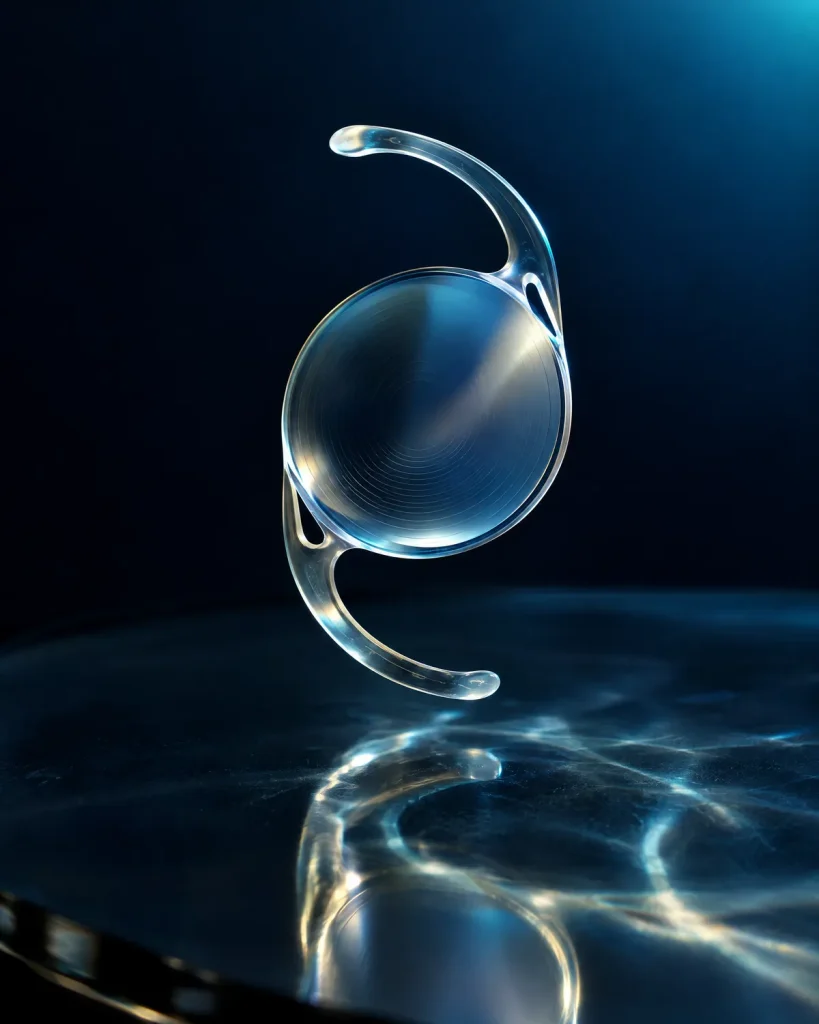
Lens replacement surgery in Turkey, also called refractive lens exchange (RLE), removes your eye's natural lens and replaces it with a clear artificial lens chosen to reduce your need for glasses, including reading glasses and varifocals. At Laser Istanbul Clinic, Prof. Dr. Ahmet Satıcı examines you in Istanbul, recommends a monofocal, toric, EDOF or trifocal lens, and treats you from {{£ price}} for both eyes, with most patients staying 5–7 days.
What is RLE eye surgery?
RLE eye surgery is the same operation as modern cataract surgery, done for a different reason. According to the Royal College of Ophthalmologists (RCOphth), the two procedures are identical: in both, the natural lens behind your pupil is removed and replaced with an intraocular lens (IOL). Cataract surgery is done because the natural lens has turned cloudy; RLE is done to reduce your dependence on glasses or contact lenses, usually before any cataract has formed. That is why you will also see it called clear lens exchange, lens replacement surgery, or "smart lens" surgery.
The RCOphth describes IOL implantation as "a bit like building your glasses or contact lenses into your eyes". The artificial lens is placed inside the eye, in the thin, clear pocket (the lens capsule) that held your natural lens, and it is not felt or seen by other people. Because the new lens cannot cloud over, RLE also means you will not need cataract surgery in later life.
Who lens replacement surgery in Turkey suits
Lens replacement suits people whose natural lens has started to age, and the age at which that tips the balance is usually around 50. The RCOphth says that if you are over 50 and your glasses prescription is higher than the normal range for laser eye surgery, you are likely to be suitable for RLE. Your surgeon decides after measuring your eyes in Istanbul, but you are a typical candidate if:
- You are in your late 40s, 50s, 60s or older and need reading glasses or varifocals. From the mid-40s the natural lens stiffens (presbyopia), which is why reading becomes harder. Laser on the cornea cannot reverse this ageing; replacing the lens can.
- You have a high prescription. According to the RCOphth, almost any level of short sight (myopia) or long sight (hyperopia) can be corrected with RLE, and lenses with built-in astigmatism correction are available.
- You are long-sighted with a "shallow" front chamber. Many long-sighted eyes have little space at the front for fluid to drain, which narrows as the natural lens grows with age and can lead to a sudden, painful form of glaucoma (angle closure). The RCOphth notes that because IOLs are thinner than the natural lens, RLE can both reduce your need for glasses and remove this future risk.
- Your lens is already slightly cloudy. If early cataract is present, lens replacement treats it at the same time. Patients with a significant cataract are looked after through our cataract service: Cataract surgery in Turkey / Istanbul →
- Your expectations are realistic. Lens replacement aims to make you far less dependent on glasses, not to give everyone perfect vision at every distance in every light.
Not sure which lens type fits your life? Our free lens finder quiz gives you a first idea before you speak to a surgeon.
When lens replacement may not be the best choice
- If you are under about 50 and your natural lens is still clear and flexible. The RCOphth advises that laser eye surgery or a phakic implant are generally better options for younger patients, because RLE removes a lens that is still working well for close focus. Laser eye surgery in Turkey / Istanbul → · ICL / EVO ICL implantable lens (/en/icl-surgery-turkey/) · Lens replacement vs laser eye surgery after 50 (/en/eye-health/lens-and-cataract/lens-replacement-vs-laser-eye-surgery-after-50/)
- If you have other eye disease and want a multifocal lens. The American Academy of Ophthalmology (AAO) explains that multifocal and EDOF lenses let less light into the eye, so they can make vision worse for people with glaucoma, macular degeneration or other vision loss. You may still be suitable for RLE with a monofocal lens. Glaucoma treatment & surgery in Turkey → · Retina surgery: vitrectomy & retinal detachment (/en/retina-surgery-turkey/)
- If your cornea is irregular, for example with keratoconus, the cornea itself may need treatment first, and some premium lenses are not a good match. Keratoconus treatment in Turkey →
- If you drive a lot at night and are worried about halos around lights. The AAO notes that night drivers can notice glare, halos or reduced contrast with multifocal lenses; an EDOF or monofocal lens may suit you better.
A note for very short-sighted people: retinal detachment is more common in highly myopic eyes with or without surgery, and the RCOphth says the risk is about five times higher in the first four years after cataract surgery or RLE. This does not rule you out, but it does mean a careful, dilated retinal check before surgery, and knowing the warning signs afterwards (see "Risks").
Types of IOL lenses: monofocal, toric, EDOF and trifocal compared
The lens you choose matters more than anything else in RLE, because the operation itself is the same for every lens. The RCOphth divides IOLs into two main families: monofocal lenses, which aim to free you from glasses for one distance (usually driving), and multifocal lenses, which aim to free you from glasses for a wider range, including computer screens and reading. Extended depth of focus (EDOF) lenses sit between the two, and any of them can be made "toric" to correct astigmatism.
| Monofocal | Monofocal "blended vision" | EDOF (extended depth of focus) | Trifocal / multifocal | Toric (add-on) | |
|---|---|---|---|---|---|
| How it focuses | One focus distance, usually set for distance | Monofocal lenses with one eye set for distance and the other for arm's length | One stretched focus zone covering distance and intermediate | Several focus zones that split light for near, intermediate and distance | Extra built-in correction for astigmatism |
| Glasses afterwards | Usually needed for reading and near work | Often still needed for small print; near vision partly restored | Usually needed for small print; computer and dashboard often glasses-free | About 4 in 5 completely glasses-free with modern multifocal lenses (RCOphth) | Depends on the base lens chosen |
| Halos and glare | Fewest optical side effects | Few | Fewer than trifocal; some designs close to monofocal | More common, especially at night; usually fade over months | As the base lens |
| Often chosen by | People who want the sharpest distance vision and don't mind readers; eyes with other conditions | People who want more freedom without multifocal optics | Active people, frequent night drivers, computer users | People who want the widest freedom from glasses, including reading | People with moderate to high astigmatism |
| Example lenses | Standard aspheric IOLs | Standard aspheric IOLs | Vivity, PureSee | PanOptix, Synergy | Toric versions of most lenses |
| Price | from {{£ price}} | from {{£ price}} | from {{£ price}} | from {{£ price}} | from {{£ price}} |
Lens families and side-effect profile: RCOphth patient information (PROF/2024/498), AAO. Example lenses are illustrative; your surgeon recommends a lens only after your examination, from {{lens brands and models offered}}.
Monofocal lens: sharp distance vision, glasses for reading
A monofocal lens has one focusing distance. According to the AAO, it is the most common lens used in cataract surgery, and most people set it for distance and use reading glasses for close work. The RCOphth notes that monofocal lenses have fewer optical side effects than multifocal lenses but do not give freedom from glasses over such a wide range of activities. They are often the right choice if you have another eye condition, or if you are worried about halos.
Blended vision with monofocal lenses
A common alternative is to set one eye for distance and the other for arm's length. With both eyes open, the brain combines the two images, which the RCOphth calls micro-monovision. You would normally still need glasses for reading, but near vision is partly restored with relatively little optical compromise. It can be a good middle path if you want more freedom from glasses but not multifocal optics.
EDOF lenses (Vivity, PureSee): a smoother range with fewer halos
An extended depth of focus lens has a single focus zone that is stretched to cover distance and intermediate vision. The AAO says this may mean less effort to refocus between distances. For the AcrySof IQ Vivity lens, the US Food and Drug Administration (FDA) approval summary (February 2020) states that, compared with a monofocal lens, it gives better intermediate and near vision with comparable distance vision; in its study, fewer than 4% of patients reported severe or very bothersome visual disturbances at six months, close to the monofocal group. The TECNIS PureSee lens, a purely refractive EDOF lens, was approved by the FDA in March 2026. Most people with an EDOF lens still use glasses for small print.
Trifocal and multifocal lenses (PanOptix, Synergy): the most freedom from glasses
Trifocal lenses split incoming light into focus points for near, intermediate and distance vision, so most people can read, use a computer and drive without glasses. In the FDA approval study for the AcrySof IQ PanOptix trifocal (approved August 2019), 126 of 127 patients said they would choose the same lenses again. The same study found that starbursts, halos and glare were the most frequent bothersome symptoms, although fewer than 5% of patients said they were bothered "very much" at six months. TECNIS Synergy, approved by the FDA in May 2021, combines multifocal and extended-depth-of-focus optics.
The honest trade-off: the RCOphth says all multifocal lenses cause more optical side effects than monofocal lenses, but they all give a greater range of freedom from glasses. Side effects usually ease as the brain adapts, and 19 out of 20 patients are satisfied or very satisfied three to six months after multifocal lens surgery.
Toric lenses for astigmatism
If your cornea is shaped more like a rugby ball than a football, you have astigmatism, and a toric lens corrects it inside the eye. The AAO says people with moderate to high astigmatism are usually happier with toric lenses. According to EyeWiki, most standard toric lenses treat regular corneal astigmatism of about 0.75 to 4.75 dioptres. A toric lens must sit at an exact angle: for one widely used toric lens, every 3 degrees of rotation off-axis reduces its correcting effect by about 10%, which is why careful marking and measurement before surgery matter.
Still comparing? Trifocal vs EDOF vs monofocal lenses compared →
How much is lens replacement surgery in Turkey?
Lens replacement surgery in Istanbul with Laser Istanbul Clinic starts from {{£ price}} for both eyes. The final price depends mainly on the lens you choose. Your surgeon confirms your exact price in writing after your free assessment and before you book flights.
Your price includes:
- full pre-operative examination and scans with your surgeon, including optical biometry to calculate your lens power;
- surgery on both eyes by your named surgeon, including the lenses agreed in your quote;
- medication and eye drops for your recovery;
- follow-up checks in Istanbul with the same surgeon;
- a personal interpreter for every appointment, a dedicated coordinator, and remote follow-up after you return home.
Not included: flights, hotel and airport transfers. Hotel and transfers are a separate charge, and we are happy to arrange them for you if you ask.
Intraocular lens price list: what each lens costs with us
Lenses are not sold separately; the price covers the lens and the surgery together. Prices are for both eyes unless stated.
| Lens type | Laser Istanbul Clinic, both eyes |
|---|---|
| Monofocal lens (distance or blended vision) | from {{£ price}} |
| Monofocal toric lens (astigmatism) | from {{£ price}} |
| EDOF lens | from {{£ price}} |
| EDOF toric lens | from {{£ price}} |
| Trifocal / multifocal lens | from {{£ price}} |
| Trifocal / multifocal toric lens | from {{£ price}} |
Lens replacement in Turkey vs the UK, Germany and the US
Typical published prices (2025–26):
| Treatment | UK private | Germany private | USA | Istanbul (typical published) | Laser Istanbul Clinic |
|---|---|---|---|---|---|
| Trifocal lens replacement / RLE, both eyes | £6,000–11,000 | €5,800–9,000 | $11,000–15,000 | $3,400–7,000 | from {{£ price}} |
| Monofocal lens (cataract surgery), per eye | £2,500–3,500 | covered by statutory insurance for cataract; premium lens extra | $3,500–7,000 | $1,100–2,700 | from {{£ price}} |
| EDOF or toric lens | not in our price data | not in our price data | not in our price data | not in our price data | from {{£ price}} |
UK, German, US and Istanbul figures are typical ranges published by clinics and price-comparison sites in 2025–26, not quotes. Many published Istanbul prices are packages that bundle a hotel and transfers; ours cover your medical treatment, with hotel and transfers charged separately if you want them.
How much do IOL lenses cost on their own? In the US, the AAO says standard insurance covers a monofocal lens, while premium lenses (multifocal, EDOF, toric and others) are usually paid out of pocket and can cost more than $1,000 per eye on top. In the UK, the RCOphth says surgery to correct the need for glasses is not available on the NHS and is not covered by private health insurance, so most British RLE patients pay the full private price at home. NHS cataract surgery uses monofocal lenses, so a trifocal lens means paying privately even if you have a cataract.
What to ask any clinic, at home or abroad: the RCOphth advises that a clinic should be clear from the outset about the total cost. It notes that UK clinics usually include follow-up visits and treatment for any problems for up to 12 months, that a laser touch-up to fine-tune the focus is often needed and normally included, and that a fee may be charged for YAG laser capsulotomy if it is needed later. Ask about all three before you book anywhere. Our policy: {{laser touch-up and YAG capsulotomy policy and the period it covers}}.
Your lens replacement surgeons in Istanbul
Lens replacement with us is led by Prof. Dr. Ahmet Satıcı. You know who will operate on you before you book, and the same surgeon examines you, operates on you and checks your recovery. When your eyes need a second specialist, for example for the retina or cornea, you see them in the same trip.



Your lens replacement trip to Istanbul, step by step
Most patients plan 5–7 days in Istanbul for lens replacement, including the examination, surgery on both eyes and check-ups. Your surgeon tells you how many nights to book after reviewing your case.
- Send your details (free)
Upload your current glasses prescription and any recent eye reports through our free consultation form or on WhatsApp. You get a reply within {{response time}}.
- A surgeon reviews your case
Prof. Dr. Satıcı tells you whether lens replacement is likely to suit you, which lens types are worth considering, or whether laser, an ICL or another treatment would be better, and sends a written quote.
- Prepare at home
Contact lenses change the shape of the cornea, and your lens-power calculation depends on accurate corneal readings, so your surgeon tells you how long to leave your contact lenses out before the examination. Book your flights; if you like, we arrange your hotel and airport transfer at an extra cost.
- Arrival day
Check in to your hotel and meet your coordinator by phone or in person.
- Full eye examination and lens planning
With your surgeon and interpreter, you have a full set of measurements: optical biometry (for example with an IOL Master) to measure the length of your eye and calculate your lens power, corneal mapping to measure astigmatism, OCT scans of the macula, eye pressure, and a dilated check of the retina. This is the most important appointment of your trip. You talk through how you use your eyes (reading, screens, night driving, sport), choose your lens with your surgeon, and sign the consent form only when your questions are answered.
- Surgery day
Surgery takes place in a fully equipped, Ministry of Health–licensed operating theatre in Istanbul. Your pupil is widened with drops, and the eye is numbed with anaesthetic drops, sometimes with a light sedative to help you relax. According to the RCOphth, surgery typically takes about 20 minutes per eye: your surgeon makes tiny self-sealing openings at the edge of the cornea, opens the front of the lens capsule, gently breaks up and removes the natural lens with ultrasound (phacoemulsification), and unfolds the new lens inside the capsule. No stitches are usually needed. You return to your hotel the same day, with a clear shield over the eye, and must not drive.
- The second eye
Many surgeons now treat both eyes on the same day, but you can have one eye at a time if you prefer (RCOphth). Your surgeon explains the pros and cons for your eyes and plans both eyes within your stay.
- Check-ups
Your surgeon examines your eyes the day after surgery and again before you fly.
- Fly home and stay in touch
Most patients fly about 3–7 days after lens surgery, once their surgeon has checked the eyes. Back home, your coordinator stays in touch and your surgeon reviews your progress by video at agreed intervals. You receive your surgical report in English, including the exact lens model and power, so your optometrist at home knows exactly what was done.
RLE recovery: what to expect
Recovery after lens replacement is quick for most people: the RCOphth says vision normally recovers substantially within two to three days, once the pupil-widening drops have worn off. Some variation in vision and comfort is normal in the first weeks, and adapting to a multifocal lens takes longer.
-
First hours
Vision blurred and light looks bright while the pupil is still wide; mild grittiness. Rest and use your drops as prescribed.
-
Day 1–3
First check-up. Vision clears substantially within 2–3 days. Wash and shower normally from day one; gym and jogging allowed from day one (RCOphth).
-
Week 1
Wear the clear eye shield at night for about one week; no swimming for a week. Driving is usually possible within a few days, once your surgeon confirms you meet the driving standard.
-
Week 1–4
Use antibiotic and anti-inflammatory drops exactly as prescribed. No contact sports for a month. Red blotches on the white of the eye fade (they can take up to six weeks).
-
1–6 months
Halos, glare and the shimmering arc some people notice at the edge of vision tend to fade as the brain adapts, especially with multifocal lenses. Most multifocal patients are satisfied by three to six months.
-
Months to years later
Some people develop posterior capsule opacification (a gradual misting behind the lens), treated with a quick YAG laser capsulotomy.
Everyday activities after lens replacement (your surgeon gives you personal dates):
| Activity | Typical advice (RCOphth) |
|---|---|
| Washing and showering | From day one |
| Gym, walking, jogging | From day one |
| Swimming | Not for a week |
| Contact sports | Not for a month |
| Driving | Usually within a few days; only when your surgeon says you meet the standard |
| Eye shield at night | Usually for one week |
| Eye drops | As prescribed; leave at least two minutes between different drops |
Call your surgeon or coordinator straight away if you have increasing aching pain, light sensitivity, redness or blurred vision. If you notice a sudden shower of new floaters, flashes of light (even with your eyes closed) or a shadow or curtain spreading across your vision, these can be signs of a retinal detachment: go to your nearest eye casualty department, then let us know. Most retinal detachments can be repaired, and the chances are much better if treatment starts before the centre of vision is affected (RCOphth).
Is lens replacement safe? The risks, explained honestly
Lens replacement is one of the most refined operations in eye surgery, and most patients are very happy with the result: the RCOphth reports that about 95% are satisfied. But it is intraocular surgery, with higher stakes than laser on the cornea, so you deserve the real numbers before you decide. Your surgeon goes through the risks for your own eyes, in writing and through your interpreter, before you agree to surgery.
Side effects most people notice for a while
- Light-scatter effects: most people notice some glare, halos or unwanted images in the first months, and many notice a shadow or shimmering arc at the edge of their vision with any lens. Halos around lights are more typical of some multifocal lenses, blur or ghost images of others. They usually fade with time but do not always disappear completely (RCOphth).
- Mild eye-surface discomfort or dryness, usually mild and often more in one eye than the other; lubricating drops help.
- Red blotches on the white of the eye, harmless and gone within about six weeks.
Less common problems that can be put right
- Residual prescription: lens power is calculated from measurements and formulas that have limits. A laser touch-up to fine-tune the focus is sometimes needed (RCOphth).
- Posterior capsule opacification (PCO): the commonest reason vision becomes misty after RLE, months or years later. It affects many patients and is normally treated successfully with a one-off YAG laser capsulotomy (RCOphth).
- Difficulty adapting to a multifocal lens: about 1% of multifocal patients cannot adapt and choose a lens exchange to a monofocal lens, which is a potentially complicated operation (RCOphth).
- A toric lens rotating away from its planned position, which may need repositioning.
Rare but serious
- Permanent serious loss of vision affects approximately 1 in 500 patients after RLE, according to the RCOphth, which notes this is significantly more common than after laser eye surgery or a phakic lens implant. It is usually caused by damage to the retina from infection, inflammation, retinal detachment or bleeding during surgery.
- Posterior capsule rupture, a break in the thin membrane behind the lens during surgery. The UK benchmark rate for all cataract surgeons is just under 1.5%, and experienced surgeons have lower rates. If it happens, a multifocal lens may not be safe to implant, and you may rely more on glasses (RCOphth).
- Retinal detachment: the risk is about five times higher in the first four years after RLE or cataract surgery, and higher still in very short-sighted eyes (RCOphth).
Putting the numbers in context: the main alternatives to RLE are varifocal glasses and contact lenses. The RCOphth notes that about 1 in 3,000 contact-lens wearers each year develops a serious corneal infection, and that trouble adapting to varifocals does not mean you will have trouble adapting to a multifocal lens.
For your future eye care: RLE does not stop you having normal treatment later. Glaucoma, diabetic eye disease and age-related macular degeneration can be monitored and treated as usual (RCOphth). Keep your surgical report and lens details, and show them to any future eye doctor.
Having surgery abroad: check who your surgeon is, their training and publications, where the surgery takes place, and how you will be followed up at home. We give you all of this in writing before you pay a deposit. Our policy if a problem needs treatment after you return home: {{complication and re-treatment policy}}.
Lens replacement surgery in Turkey: frequently asked questions
Typical published Istanbul prices for trifocal lens replacement are about $3,400–7,000 for both eyes, compared with roughly £6,000–11,000 in UK private clinics and $11,000–15,000 in the US. With Laser Istanbul Clinic, lens replacement starts from {{£ price}} for both eyes, including your examination, surgery, lenses, medication, check-ups, interpreter and remote follow-up. Flights, hotel and transfers are extra. The final price depends on the lens you choose and is confirmed in writing after your free assessment.
RLE stands for refractive lens exchange. It is the same operation as cataract surgery, but done to reduce your need for glasses rather than to remove a cloudy lens. Your natural lens is replaced with an artificial intraocular lens (IOL) chosen to correct your prescription and, with a premium lens, your need for reading glasses.
Yes. Clear lens exchange, refractive lens exchange, RLE, lens replacement surgery and "smart lens" surgery all describe the same procedure. "Clear" refers to the fact that the natural lens being replaced is usually still clear, without cataract.
An IOL (intraocular lens) is a small, clear artificial lens placed inside the eye to replace the natural lens. According to the AAO, most IOLs are made of silicone, acrylic or other plastic material and are coated to help protect the eye from ultraviolet light. Types include monofocal, toric, EDOF and multifocal or trifocal lenses.
No lens is best for everyone. Trifocal lenses give the most freedom from glasses but more halos at night; EDOF lenses give a smoother range with fewer side effects but usually need readers for small print; monofocal lenses give sharp distance vision with the fewest side effects. Your surgeon recommends one after measuring your eyes and asking how you use them.
Lenses are priced together with the surgery. In the US, the AAO says premium lenses are usually paid out of pocket and can cost more than $1,000 per eye on top of standard surgery. With us, the price for both eyes, lens included, starts from {{£ price}} for a monofocal lens, with EDOF, toric and trifocal lenses priced in our lens price list above.
For suitable patients, lens replacement has a strong track record, and about 95% of patients are satisfied (RCOphth). Temporary halos and glare are common, especially with multifocal lenses. Serious permanent loss of vision is rare but more common than after laser, at about 1 in 500 patients. A thorough examination of the retina and cornea before surgery is the most important safety step.
The artificial lens is not designed to be replaced, and it cannot develop a cataract. The RCOphth says that, unless a new eye problem develops, vision normally stays good and your prescription normally stays stable after RLE. If vision becomes misty months or years later, it is usually capsule clouding, which a quick YAG laser treatment clears.
Often, yes. Many centres now treat both eyes on the same day, but you can have one eye at a time if you prefer (RCOphth). Your surgeon explains the pros and cons for your eyes and plans both eyes within your stay in Istanbul.
Plan for 5–7 days in Istanbul, including your examination, surgery and check-ups. Most patients fly home about 3–7 days after lens surgery, once their surgeon has checked their eyes. Your surgeon confirms the number of nights after reviewing your case.
An IOL Master is an optical biometer: a machine that measures the length of your eye with light, without touching it, so that your surgeon can calculate the power of your new lens. EyeWiki notes that optical biometry is non-contact and typically more accurate, and accuracy matters: a 1 mm error in eye length changes the lens power needed by about 2.5–3 dioptres. Biometry is part of every lens examination with us.
No. According to the RCOphth, surgery to correct the need for glasses or contact lenses is not available on the NHS and is not covered by private health insurance. The NHS offers lens surgery mainly for cataract and sight-threatening conditions, using monofocal lenses. This is why many UK patients compare private RLE at home with RLE in Turkey.
It depends on the lens. With modern multifocal lenses, about four out of five patients are completely free of glasses (RCOphth); if glasses are still needed, it is usually for one specific task. With a monofocal lens set for distance, you will normally need reading glasses.
Sources for the facts on this page
- *Medical facts (all opened and checked, October 2026):**
- American Academy of Ophthalmology, Intraocular Lenses (IOL) for Cataract Surgery: IOL materials and UV coating; monofocal, multifocal, EDOF, accommodative, light-adjustable and toric IOLs. https://www.aao.org/eye-health/diseases/cataracts-iol-implants
- American Academy of Ophthalmology, Factors to Consider in Choosing an IOL for Cataract Surgery: premium lenses usually paid out of pocket and can exceed $1,000 per eye; multifocal/EDOF may cause glare, halos or loss of contrast for night drivers and can worsen vision in glaucoma or macular degeneration; moderate to high astigmatism usually happier with toric IOLs. https://www.aao.org/eye-health/tips-prevention/best-artificial-lens-implant-iol-cataract-surgery
- US Food and Drug Administration, Summary of Safety and Effectiveness Data, AcrySof IQ PanOptix Trifocal IOL (PMA P040020/S087, approved 26 August 2019): 126 of 127 patients would choose the same lenses again; starbursts, halos and glare most frequent bothersome symptoms; fewer than 5% "bothered very much" at month 6. https://www.accessdata.fda.gov/cdrh_docs/pdf4/P040020S087B.pdf
- US Food and Drug Administration, Summary of Safety and Effectiveness Data, AcrySof IQ Vivity Extended Vision IOL (PMA P930014/S126, approved 26 February 2020): improved intermediate and near acuity with comparable distance acuity versus an aspheric monofocal; severe or very bothersome visual disturbances < 4% (monofocal control < 3%) at 6 months. https://www.accessdata.fda.gov/cdrh_docs/pdf/P930014S126B.pdf
- Johnson & Johnson press release, FDA approval of TECNIS PureSee intraocular lens (12 March 2026): purely refractive EDOF IOL; FDA approval date. https://www.jnj.com/media-center/press-releases/johnson-johnson-announces-fda-approval-of-tecnis-puresee-intraocular-lens-a-breakthrough-solution-for-u-s-cataract-patients
- Johnson & Johnson Vision press release via PR Newswire, Approval of TECNIS Synergy and TECNIS Synergy Toric II IOLs in the U.S. (6 May 2021): FDA approval date; combines EDOF and multifocal technologies. https://www.prnewswire.com/news-releases/johnson--johnson-vision-announces-the-approval-of-tecnis-synergy-and-tecnis-synergy-toric-ii-iols-in-the-us-and-tecnis-synergy-toric-ii-iols-in-canada-301286266.html
- EyeWiki (American Academy of Ophthalmology), Toric IOLs: regular corneal astigmatism of about 0.75–4.75 D; AcrySof toric effect reduced by 10% for every 3° off-axis. https://eyewiki.org/Toric_IOLs
- EyeWiki (American Academy of Ophthalmology), Biometry for Intra-Ocular Lens (IOL) Power Calculation: optical biometry (e.g. IOL Master) is non-contact with typically improved accuracy; axial length changes IOL power by about 2.5–3 times (≈ 2.5–3 D per mm). https://eyewiki.org/Biometry_for_Intra-Ocular_Lens_(IOL)_Power_Calculation
- NHS, Laser eye surgery and lens surgery: lens surgery about 20–30 minutes under local anaesthetic, same-day discharge, side effects (glare, halos, floaters), possible second operation, usually only offered on the NHS for sight-threatening conditions. https://www.nhs.uk/tests-and-treatments/laser-eye-surgery-and-lens-surgery/
- US Food and Drug Administration, What should I expect before, during and after surgery? (LASIK): contact lenses change the shape of the cornea before measurements (used for the "leave contact lenses out" step). https://www.fda.gov/medical-devices/lasik/what-should-i-expect-during-and-after-surgery
- *Prices and surgeon facts (project files):**
Find out which lens suits your eyes, free
Send us your glasses prescription and any recent eye report. Prof. Dr. Ahmet Satıcı will tell you whether lens replacement may suit you, which lens types are worth considering, or whether another treatment would be better, and what it would cost, with no obligation.
3 eye surgeons
Your case is reviewed by a named surgeon, not a salesperson. Reply within {{response time}}.
 Prof. Dr. Ahmet Satıcı
 Doç. Dr. Muhammet Derda Özer
 Op. Dr. Aysan Bayram