
- Home: eye surgery in Istanbul
- All eye treatments
- Eyelid surgery (blepharoplasty) in Turkey
Blepharoplasty in Turkey: Eyelid Surgery in Istanbul
Blepharoplasty in Turkey with Laser Istanbul Clinic means eyelid surgery in Istanbul planned and performed by Prof. Dr. Ahmet Satıcı, an ophthalmologist and former Professor and Head of Ophthalmology who has operated on eyes and eyelids since 1992. He examines your eyelids and the eye behind them before recommending anything, you see the full price in writing before you travel, and a personal interpreter stays with you from your first examination to your final check-up.
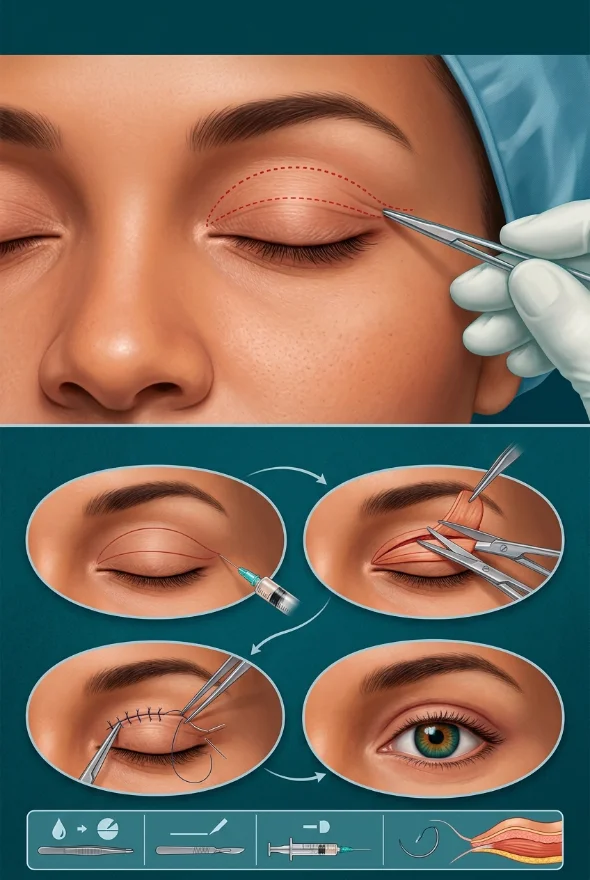
Blepharoplasty is surgery that removes excess skin, fat or muscle from the upper eyelids, or removes and repositions the fat that forms bags under the eyes. It usually takes 45 minutes to 2½ hours, often under local anaesthetic, and most people go home the same day. In Istanbul it is performed by Prof. Dr. Ahmet Satıcı from {{£ price}}; hotel and transfers are extra.
What is blepharoplasty, and how is eyelid surgery done?
Blepharoplasty is an operation to remove excess skin, and sometimes fat or muscle, from the eyelids. The NHS describes it as surgery that changes the look of hooded or drooping eyelids and eye bags. The American Academy of Ophthalmology (AAO) adds a second purpose: when heavy upper-lid skin hangs over the lashes, removing it can restore the upper part of your field of vision.
Upper eyelid blepharoplasty follows three steps, according to the NHS:
- An incision along the natural eyelid crease. Your surgeon marks the crease first. EyeWiki (AAO) puts it at roughly 7–9 mm above the lash line in men and 8–10 mm in women, adjusted to your face.
- Removal of excess skin, fat or muscle. Enough skin is always left for the eye to close fully: EyeWiki advises keeping at least 20 mm of skin between the lid margin and the thicker brow skin.
- Closure. The scar lies inside the natural fold of the lid, so it is usually hidden when your eyes are open.
Lower eyelid blepharoplasty treats bags and puffiness under the eyes. The surgeon makes an incision either just below the lower lashes or on the inside of the lower lid, repositions or removes the fat that forms the bags, sometimes removes a small amount of skin, and supports the muscles and tendon of the lid if needed (NHS).
- Transconjunctival (inside the lid): no visible skin scar. EyeWiki calls it one of the most popular techniques for people who have prominent fat bags but little excess skin.
- Transcutaneous (under the lashes): an incision 1–2 mm below the lash line, used when loose skin also needs to be removed. It can be combined with tightening of the outer corner of the lid (canthopexy) or lifting of the cheek tissue.
- Fat repositioning: instead of simply removing fat, the surgeon can move it down over the bony rim to soften a hollow "tear trough" (AAO).
Anaesthesia. Blepharoplasty can be done under local or general anaesthetic (NHS). Upper eyelid surgery is commonly done with a local anaesthetic injection that numbs the lids (EyeWiki); your surgeon recommends the option for you.
Technique we use: {{Prof. Satıcı's usual techniques and instruments, e.g. scalpel, radiofrequency or laser incision; type of stitches}}, in a fully equipped, Ministry of Health–licensed operating theatre in Istanbul.
Who is a good candidate for blepharoplasty?
You are likely to be a good candidate for blepharoplasty if you are an adult in good general health and excess eyelid skin or fat makes you look tired, makes your lids feel heavy, or gets in the way of your vision. The AAO lists these functional reasons for upper lid surgery:
- excess skin blocks your view and affects daily activities such as driving, reading or computer work
- you lift your eyebrows all day to see, which can cause headaches
- in older people, reduced side and upper vision increases the risk of falls
You can also have eyelid surgery purely to change how your eyes look. Both are valid reasons; the operation is the same.
What blepharoplasty does not fix. Three problems look similar but need different treatment, so your surgeon checks for each:
| What you see | What it usually is | Usual treatment |
|---|---|---|
| Folds of skin hanging over the crease ("hooded eyelids") | Excess upper lid skin (dermatochalasis) | Upper blepharoplasty |
| The edge of the lid itself sits too low over the pupil | Ptosis: a weak or stretched lid-lifting muscle | Ptosis surgery (sometimes with blepharoplasty) |
| Heavy brows pushing the lid skin down | A low or drooping brow | Brow lift, sometimes with blepharoplasty |
| Bags or puffiness under the eyes | Fat bulging forward from the lower lid | Lower blepharoplasty |
| Dark circles without bags | Several possible causes, such as hollowing under the eye | Blepharoplasty alone may not help; your surgeon explains the options |
When you need extra care, or a different plan:
- Dry eye. Removing lid skin can make dry eye worse. The AAO lists dry eye and poor blinking as reasons for caution, and surgical reviews recommend a slit-lamp examination and a tear test (Schirmer's test) before surgery.
- Thyroid eye disease (Graves' disease). The AAO advises special caution because of the higher risk of the eye not closing fully (lagophthalmos) and dryness.
- Blood thinners. Tell your surgeon about aspirin, warfarin, apixaban or any similar medicine (NHS). A surgical review advises stopping aspirin, anticoagulants, anti-inflammatory painkillers, vitamin E, ginkgo and other herbal supplements up to 3 weeks before surgery where possible. Never stop a prescribed blood thinner without the agreement of the doctor who prescribed it.
- Smoking and high blood pressure. Smoke irritates healing eyes (NHS), and high blood pressure was one of the most common factors in cases of bleeding behind the eye in a large US survey (Hass et al., 2004). Both should be controlled before surgery.
Upper vs lower blepharoplasty at a glance
| Upper blepharoplasty | Lower blepharoplasty | |
|---|---|---|
| Treats | Hooded, heavy upper lids; skin resting on the lashes | Bags and puffiness under the eyes, loose lower-lid skin |
| Incision | In the natural upper-lid crease | Inside the lower lid (no skin scar) or just below the lashes |
| What is removed or changed | Skin, sometimes a strip of muscle and some fat | Fat removed or repositioned; sometimes a little skin; the lid may be tightened |
| Can improve vision | Yes, when skin blocks the upper field of view | No; it is mainly for appearance and comfort |
| Main specific risks | Asymmetry, difficulty closing the eye, dry eye | Lower lid pulling down or turning out (ectropion), swelling of the eye surface (chemosis), double vision |
| Stitches | Usually removed after 5–7 days | Often none on the skin with the inside approach |
Many people have upper and lower blepharoplasty together, in one operation.

Double eyelid surgery
Double eyelid surgery creates an upper eyelid crease where there is none. According to EyeWiki, about 50% of people of East Asian descent do not have an upper eyelid crease, and double eyelid surgery is the most frequently requested cosmetic operation in Asia.
There are two main methods:
- Non-incisional (suture) method: stitches create the crease through tiny punctures. It leaves no visible scar and recovery is quicker, but the crease can fade as the stitches loosen.
- Incisional method: a full incision with removal of some skin and tissue, creating a permanent crease. It gives more control but recovery takes longer.
EyeWiki puts a natural-looking crease at around 6–8 mm above the lid margin, and reports uneven creases in up to 35% of cases, which is why careful marking and an experienced eyelid surgeon matter. {{Confirm whether Prof. Satıcı offers double eyelid (Asian) blepharoplasty; if not, remove this section in all languages.}}
Blepharoplasty or blepharitis? Not the same thing
The names sound alike, but blepharitis is not surgery: it is inflammation of the eyelid edges. The NHS describes the symptoms as sore, itchy eyelids, a gritty feeling, flakes or crusts around the roots of the eyelashes, and lids that stick together in the morning. Common causes are bacteria on the skin, skin conditions such as seborrhoeic dermatitis, and eyelid oil glands that do not work properly. It is not contagious.
Blepharitis is usually controlled rather than cured fast: the NHS advises a warm compress for 5–10 minutes, gentle massage and cleaning of the lids twice a day, and carrying on even after symptoms clear. A pharmacist can recommend eyelid wipes and eye drops, and a doctor may prescribe antibiotic ointment or drops if this does not help.
Why it matters for surgery: active blepharitis and dry eye are treated first, so the eye surface is healthy before eyelid surgery. Your examination in Istanbul includes the lid margins and tear film for this reason.
Blepharoplasty in Turkey: price and what is included
At Laser Istanbul Clinic, upper blepharoplasty starts from {{£ price}}, lower blepharoplasty from {{£ lower blepharoplasty price}}, and upper and lower together from {{£ upper and lower blepharoplasty price}}. Prof. Dr. Satıcı confirms your exact price in writing after reviewing your photos, before you book anything.
Upper eyelid blepharoplasty cost in the UK. The NHS states that blepharoplasty in the UK may cost anywhere between £2,000 and £6,000, plus consultations, follow-up care and any further surgery.
Typical published prices for upper and lower blepharoplasty (USD, 2025–26):
| Where | Typical price range |
|---|---|
| UK private clinics | $4,000–10,000 |
| USA | $6,000–12,000 |
| Istanbul (published package prices) | $2,200–4,800 |
| Istanbul with Laser Istanbul Clinic | from {{£ upper and lower blepharoplasty price}} |
Ranges are prices advertised by clinics and price-comparison sites in 2025–26, not quotes. Published Istanbul prices are often packages that include a hotel. On these ranges, Istanbul is about 50–60% cheaper.
Your treatment price includes:
- a full pre-operative eye and eyelid examination with your surgeon
- blepharoplasty by Prof. Dr. Ahmet Satıcı
- medication, ointment and eye drops for your recovery
- follow-up checks in Istanbul, including stitch removal if you are still in Istanbul
- a personal interpreter, a dedicated coordinator and remote follow-up after you return home
Not included: flights, hotel and airport transfers. Hotel and transfers are a separate charge, and we can arrange them for you if you ask.
Does the NHS do eyelid surgery? Only in limited cases. Local NHS services generally pay for blepharoplasty only to correct a functional problem, such as excess lid skin measurably reducing your field of vision, and not for cosmetic reasons. Lower blepharoplasty is funded only in specific medical situations. Most people who want eyelid surgery for appearance pay privately.
Your eyelid surgeon

If your eyes need more than eyelid surgery, our other two surgeons may be involved:
- Doç. Dr. Muhammet Derda Özer (Doç. = Associate Professor) treats corneal disease, retina, uveitis and eye tumours (ocular oncology). He reviews any lump or lesion on the eyelid that needs a specialist opinion.
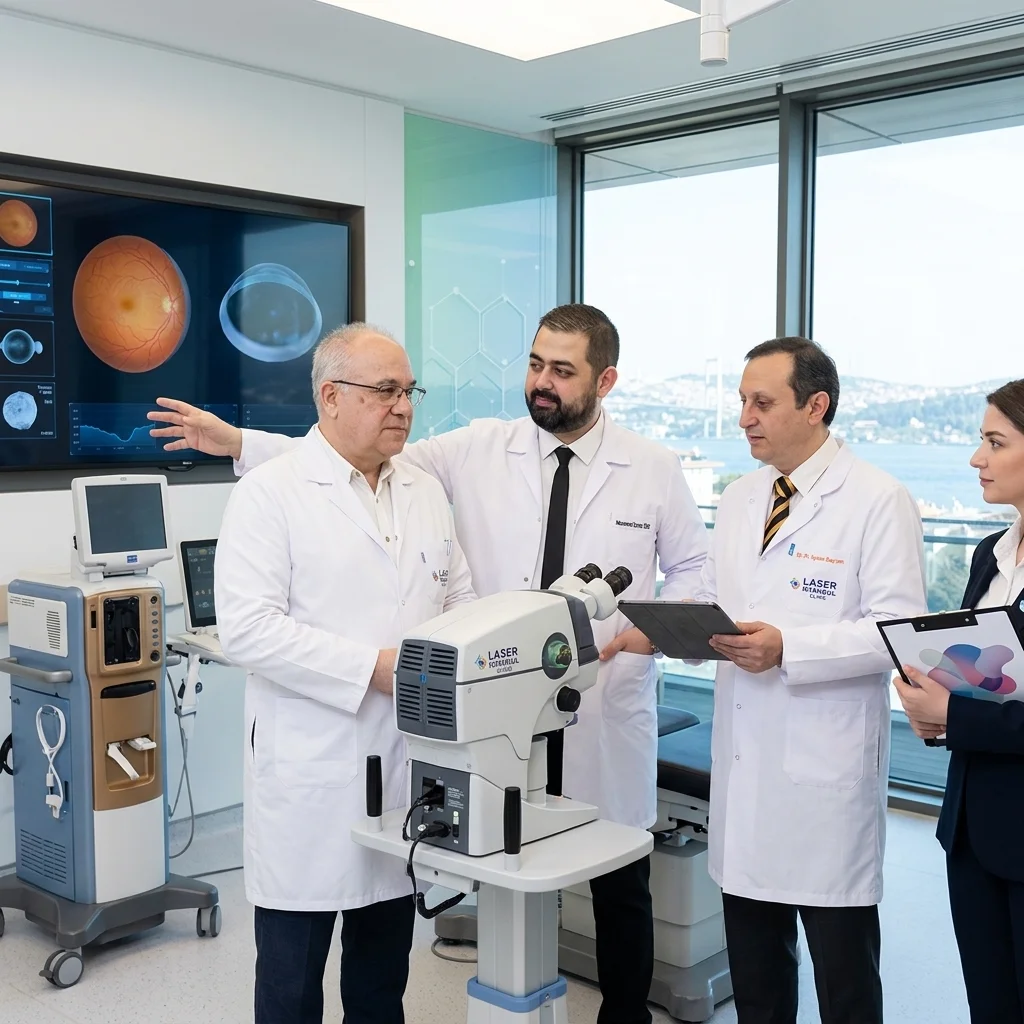
- Op. Dr. Aysan Bayram performs cataract and laser eye surgery and treats retinal disease. She speaks English.
Your eyelid surgery journey, step by step
Free online assessment
Send clear, front-facing photos of your eyes open and closed, in daylight, and tell us what bothers you. Prof. Dr. Satıcı tells you whether upper, lower or combined surgery is likely to suit you and sends a written quote.
Book your dates
Plan {{eyelid stay length}} days in Istanbul. Many patients stay until their stitches are removed, usually 5–7 days after surgery. Stop smoking and agree any medicine changes with your own doctor before you travel.
Examination (day 1)
Your surgeon examines your lids, brow position, tear film and eye surface, checks your vision, and tests your visual field if the skin may be blocking it. Photos are taken and the operation is planned with you, through your interpreter. If surgery is not right for you, your surgeon tells you and explains the alternatives.
Surgery (day 1 or 2)
The lids are numbed with a local anaesthetic injection, or you have a general anaesthetic if planned. The operation takes about 45 minutes to 2½ hours depending on what is done, and most people go home the same day (NHS).
First check (the next day)
Your surgeon checks the wounds and any swelling or bruising, and shows you how to clean the lids and use the ointment.
Stitch removal and home
Stitches are usually removed after 5–7 days. Your surgeon checks you before you fly; {{surgeon's guidance on when patients can fly after blepharoplasty}}. Your coordinator stays in touch, and your surgeon reviews your photos and progress at agreed intervals.
Blepharoplasty recovery timeline
-
First 2–3 days
Puffy, numb eyelids that may be hard to close fully; watery or sensitive eyes. Use cold compresses (EyeWiki advises them for the first 48–72 hours) and rest with your head propped up on pillows (NHS). Mild painkillers such as paracetamol are usually enough.
-
Days 1–2
Most people can resume light, normal activities within 24–48 hours (AAO). Clean the lids gently and use the prescribed ointment or drops.
-
First week
Avoid strenuous activity, swimming, rubbing your eyes and contact lenses (NHS). Wear sunglasses outdoors against sun and wind. Stitches or suture strips are removed within about a week.
-
Up to day 10
No heavy exercise, lifting or bending (EyeWiki advises avoiding strenuous activity for the first 10 days).
-
10–14 days
Bruising usually fades over 10–14 days (AAO). Most people take about 2 weeks off work, depending on their job (NHS).
-
Several weeks
Remaining redness and watery eyes settle; you cannot drive for a number of days, and only once your vision is clear and your surgeon agrees.
-
2–4 months
Numbness and residual swelling settle over about 2–4 months (AAO). Scars may feel tight for a few months, then fade to be barely visible (NHS).
Call your coordinator straight away if you have increasing pain, swelling on one side, bulging of the eye or any change in your vision. Bleeding behind the eye is most likely in the first 24 hours, and needs urgent treatment.
Risks and side effects of eyelid surgery
Blepharoplasty is a well-established operation, but like any surgery it carries risks, and results cannot be guaranteed (NHS). You should know them before you decide.
Common and usually temporary (NHS):
- puffy, numb eyelids that are difficult to close
- irritated, sensitive or watery eyes, which may last a few weeks
- bruising
- scars, which should fade to almost invisible
Occasional:
- blurred or double vision
- uneven eyes (asymmetry)
- noticeable scarring, or reduced or increased feeling in the lids
- dry eye made worse, or the eye not closing fully if too much skin is removed (AAO)
- a result you are unhappy with that needs another operation (NHS)
Rare but serious:
- Bleeding behind the eye (orbital haemorrhage). In a survey of members of the American Society of Ophthalmic Plastic and Reconstructive Surgery covering 269,433 cosmetic eyelid operations (Hass et al., 2004), orbital haemorrhage occurred in 0.055% (about 1 in 2,000) and permanent loss of vision in 0.0045% (about 1 in 22,000). Most bleeds started within the first 3 hours, and the risk fell sharply after 24 hours, which is why you are observed after surgery and stay close by for the first days.
- The lower lid pulling away from the eye or turning outwards (ectropion) after lower lid surgery (NHS).
- Injury to an eye muscle, which can cause double vision (NHS).
- Infection, a blood clot, or a reaction to the anaesthetic, as with any operation (NHS).
Your surgeon explains your personal risks in writing and through your interpreter before you sign anything.
Combining eyelid surgery with lens or cataract surgery
Eyelid surgery is often combined with lens replacement or cataract surgery in one trip, because the people who want both are often the same age: over 45, tired of reading glasses, and noticing heavier lids. Prof. Dr. Satıcı performs both kinds of surgery. Whether two procedures can be done in one stay, and in which order, is your surgeon's decision, and both are written into your quote, with {{£ eyelid add-on price}} for eyelid surgery added to a lens package.
Blepharoplasty in Turkey: frequently asked questions
Published Istanbul prices for upper and lower blepharoplasty together are typically about $2,200–4,800, often as packages that include a hotel. With Laser Istanbul Clinic, upper blepharoplasty starts from {{£ price}}, including your examination, surgery by Prof. Dr. Ahmet Satıcı, medication, follow-up checks, interpreter and coordinator. Hotel and transfers are extra. Your exact price is confirmed in writing after your free assessment.
The NHS puts the cost of blepharoplasty in the UK at £2,000–6,000, plus consultations and follow-up care. Price-comparison data for 2025–26 shows UK prices for upper and lower surgery together of about $4,000–10,000. Eyelid surgery for appearance is not funded by the NHS.
Eyelid surgery in Turkey can be as safe as at home when an experienced surgeon examines you properly first and operates in a properly equipped theatre. Check your surgeon's name and qualifications, where the surgery takes place, and how aftercare works once you are home. We give you all of this in writing before you pay, and your operation takes place in a fully equipped, Ministry of Health–licensed operating theatre in Istanbul.
Often, yes. Blepharoplasty can be done under local or general anaesthetic (NHS). With a local anaesthetic you are awake, but your lids are numb and you feel only pressure and movement. Your surgeon recommends the best option for the surgery you are having.
Plan {{eyelid stay length}} days. Many patients stay until their stitches are removed, usually 5–7 days after surgery, and your surgeon checks you before you fly. Bruising takes 10–14 days to fade, so most people plan about 2 weeks before returning to work or social events.
Upper lid scars sit in the natural crease of the lid, so they are usually hidden when your eyes are open. Lower lid surgery done from the inside of the lid leaves no skin scar. The NHS notes that scars may feel tight for a few months and should eventually fade to almost invisible.
The skin and fat that are removed do not grow back, so the change is long-lasting. Your face continues to age, though, and the brow and skin can loosen again over the years. Some people choose further treatment much later.
It depends on what is drooping. If loose skin hangs over the crease, blepharoplasty removes it. If the edge of the lid itself sits too low because the lifting muscle has stretched, that is ptosis and needs ptosis surgery, sometimes at the same time. Prof. Dr. Satıcı checks this at your examination.
The surgery itself should not hurt, because the area is numbed. Afterwards the lids feel tight, sore and swollen for a few days; paracetamol or the painkillers you are given are usually enough (NHS). Cold compresses and keeping your head raised help.
Yes. Upper and lower eyelid surgery are often done in one operation, which means one recovery period. The operation takes longer, and your surgeon confirms whether combining them is right for you.
No. Blepharitis is inflammation of the eyelid edges, causing itchy, crusty, sore lids, and it is treated with daily lid cleaning, wipes and sometimes drops. Blepharoplasty is surgery to remove excess eyelid skin or fat. If you have blepharitis, it is treated before any eyelid surgery.
Other eye treatments people combine or compare
Eyelid surgery changes the frame around the eye; these treatments change how the eye itself focuses or stays healthy. Many patients ask about one of them on the same visit.
| Eyelid surgery | Lens replacement / cataract | Laser eye surgery | ICL | |
|---|---|---|---|---|
| What it treats | Hooded lids, eye bags, skin blocking vision | Reading glasses after 45, cataract | Short sight, long sight, astigmatism | High short sight, thin corneas |
| Where it works | Eyelid skin, fat and muscle | Inside the eye (natural lens) | Cornea | Inside the eye, in front of the natural lens |
| Usual surgeon with us | Prof. Dr. Satıcı | Prof. Dr. Satıcı, Op. Dr. Bayram, Doç. Dr. Özer | Prof. Dr. Satıcı, Op. Dr. Bayram | Prof. Dr. Satıcı |
Sources for the facts on this page
- NHS, Eyelid surgery (blepharoplasty): definition (hooded/drooping lids, eye bags); UK cost £2,000–£6,000 plus consultations/follow-up; local or general anaesthetic; tell the surgeon about aspirin, warfarin, apixaban; upper incision in the crease, scar hidden in the fold; lower incision below lashes or inside the lid, fat repositioned/removed, muscle and tendon supported; suture strips removed up to 1 week; 45 minutes to 2½ hours; most go home the same day; about 2 weeks off work; no driving for a number of days; bruises/redness several weeks; scars tight for a few months; pillows, cold packs, sunglasses, paracetamol; avoid strenuous activity, swimming, smoking, contact lenses, rubbing; temporary side effects, occasional and rare complications (ectropion, eye-muscle injury, bleeding into the eye socket, visual impairment); results cannot be guaranteed; some need another operation. https://www.nhs.uk/conditions/cosmetic-procedures/eyelid-surgery/
- NHS, Blepharitis: symptoms, causes, not contagious, warm compress 5–10 minutes, lid cleaning twice daily, continue after symptoms clear, pharmacy wipes and drops, antibiotic ointment/drops. https://www.nhs.uk/conditions/blepharitis/
- American Academy of Ophthalmology, Upper Eyelid Blepharoplasty: functional indications (driving, reading, computer work, falls in the elderly, headaches from brow elevation), caution in Graves' disease, dry eye, poor blinking, anticoagulants; normal activities in 24–48 hours; bruising 10–14 days; numbness 2–4 months; orbital haemorrhage ~1:20,000; lagophthalmos, dry eye, asymmetry, ptosis, infection. https://www.aao.org/eye-health/treatments/upper-eyelid-blepharoplasty
- American Academy of Ophthalmology, Lower Eyelid Blepharoplasty: indications (fat protrusion, excess skin, tear trough), transconjunctival, fat redraping, transcutaneous with orbitomalar suspension, canthopexy; ice, head elevation, avoid exertion; retrobulbar haemorrhage with vision loss <1:20,000; lid retraction, ectropion, chemosis. https://www.aao.org/eye-health/treatments/lower-eyelid-blepharoplasty
- EyeWiki (AAO), Upper Eyelid Blepharoplasty: crease ~7–9 mm (men) and 8–10 mm (women); at least 20 mm of skin preserved; ice for the first 3 days; avoid strenuous activity for the first 10 days; follow-up within 1–2 weeks. https://eyewiki.aao.org/Upper_Eyelid_Blepharoplasty
- EyeWiki (AAO), Lower Eyelid Blepharoplasty: transconjunctival approach for fat prolapse without excess skin; infraciliary incision 1–2 mm below the lashes; cold compresses first 48 hours; non-absorbable sutures removed 5–7 days; complications incl. chemosis, inferior oblique injury/diplopia, retraction, ectropion. https://eyewiki.aao.org/Lower_eyelid_blepharoplasty
- EyeWiki (AAO), Asian Blepharoplasty (Double Eyelid Procedure): ~50% of people of Asian descent lack an upper lid crease; most requested cosmetic surgery in Asia; suture vs incisional methods; crease 6–8 mm; asymmetric folds up to 35%. https://eyewiki.aao.org/Asian_Blepharoplasty_(Double_Eyelid_Procedure)
- Hass AN, Penne RB, Stefanyszyn MA, Flanagan JC. Incidence of postblepharoplasty orbital hemorrhage and associated visual loss. Ophthalmic Plast Reconstr Surg 2004;20(6):426–32 (erratum 2005), PMID 15599241: 269,433 cases; orbital haemorrhage 0.055% (1:2,000); permanent visual loss 0.0045% (1:22,000); most within the first 3 hours, risk falls after 24 hours; hypertension, perioperative aspirin, vomiting and physical activity as common comorbidities. https://pubmed.ncbi.nlm.nih.gov/15599241/
- Oestreicher J, Mehta S. Complications of Blepharoplasty: Prevention and Management. Plast Surg Int 2012;2012:252368: slit-lamp examination and Schirmer's test before surgery; stop aspirin, anticoagulants, NSAIDs, vitamin E, ginkgo and herbal medicines up to 3 weeks before, if possible. https://pmc.ncbi.nlm.nih.gov/articles/PMC3357590/
- NHS Cheshire and Merseyside ICB, CMICB_Clin096 Blepharoplasty and Ptosis Surgery (clinical commissioning policy, draft v0.2): not commissioned for cosmetic purposes; upper lid surgery funded for functional impairment (measured visual-field loss or lid position); lower lid surgery only for specific medical situations; definitions of dermatochalasis and ptosis. https://www.cheshireandmerseyside.nhs.uk/media/dmzikss2/pol-clin096-blephptosis-draft-v02.pdf
Find out if blepharoplasty suits you, free
Send us front-facing photos of your eyes, open and closed, in daylight. Prof. Dr. Ahmet Satıcı will tell you whether upper, lower or combined eyelid surgery suits you, and what it would cost, with no obligation.
3 eye surgeons
Your case is reviewed by a named surgeon, not a salesperson. Reply within {{response time}}.
 Prof. Dr. Ahmet Satıcı
 Doç. Dr. Muhammet Derda Özer
 Op. Dr. Aysan Bayram