
- Home: eye surgery in Istanbul
- Free eye tools
Free Eye Tools: Eyesight Test Chart, Colour Blindness Test and More
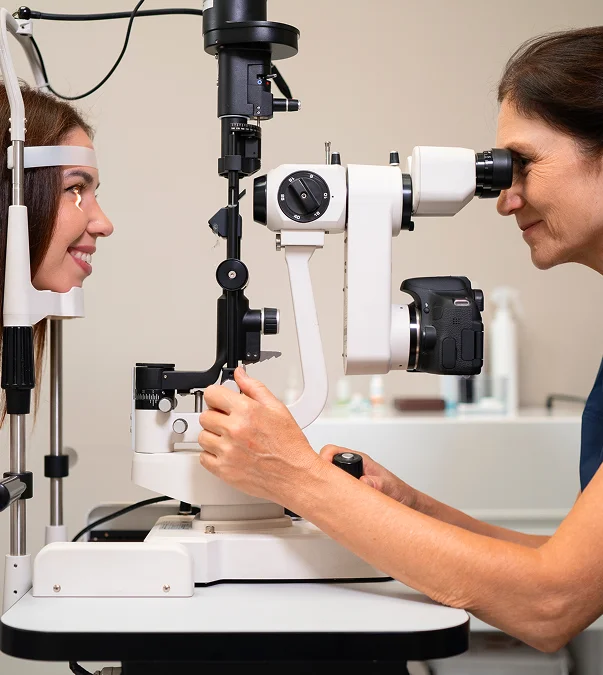
An eyesight test chart, such as the Snellen chart, measures how small a line of letters you can read with each eye from a set distance; 20/20 (6/6 in metres) is the usual benchmark. Our free eye tools let you check your vision, colour vision, astigmatism, depth perception and macula, then plan treatment with Prof. Dr. Ahmet Satıcı, Doç. Dr. Muhammet Derda Özer or Op. Dr. Aysan Bayram. They are screening aids, not an eye exam.
Most people who search for an eyesight test chart want one of two things: a quick way to see whether their vision has changed, or a way to understand a number on a prescription or driving form. This hub has both. Below you will find nine free tools, grouped by what you want to know: how well you see, what your prescription means, and which treatment might suit you.
Each tool is linked to the surgeon whose field it belongs to. Doç. is the Turkish title for Associate Professor, and Doç. Dr. Muhammet Derda Özer is our cornea and retina surgeon. Prof. Dr. Ahmet Satıcı leads our laser, lens and squint surgery, and Op. Dr. Aysan Bayram treats cataract, laser patients and retinal disease. You will see their names on the cards where a result could point to their specialty.
One rule applies to all of them. A tool can show you that something is worth checking; it cannot find the cause. If a result worries you, or your sight changes suddenly, see an eye doctor where you live, today if the change is sudden. If you are thinking about surgery in Istanbul, your surgeon will examine you in person before recommending anything.
Free eye tools, by what you want to know
Check how well you see
Visual acuity converter (20/20, 6/6, decimal, %)
Turns a vision result written one way, such as 20/40, 6/12 or 0.5, into the other systems so you can compare a UK, US and European report. Useful when a form, a driving rule or an eye report uses a different notation from your own.
Best for: anyone reading an eye report or comparing results from different countries.
Visual acuity converter (20/20, 6/6, decimal, %)Astigmatism test
A quick on-screen pattern that shows whether lines look sharper or darker in one direction, a common sign of astigmatism, an uneven curve of the cornea or lens. It cannot measure your prescription, but it tells you whether an eye test is worth booking. Lead surgeons: Prof. Dr. Ahmet Satıcı and Op. Dr. Aysan Bayram.
Best for: people with blur at all distances, headaches or squinting.
Astigmatism testColour blindness test (Ishihara-style)
Plates made of coloured dots with a hidden shape or number, the standard way colour vision deficiency is screened. The National Eye Institute says about 1 in 12 men have a colour vision deficiency, and inherited types have no cure, although special lenses and phone apps can help in daily life.
Best for: people who mix up reds, greens or browns, parents, and anyone choosing a career with colour-coded work.
Colour blindness test (Ishihara-style)3D / stereo vision test
Checks whether your two eyes work together to give depth perception (stereopsis). Reduced stereo vision can be linked to a turned eye or a lazy eye, so an unexpected result is a reason to be examined. Lead surgeon for squint: Prof. Dr. Ahmet Satıcı.
Best for: adults who struggle with depth, parents checking a child's eyes, and people with a history of squint or lazy eye.
3D / stereo vision testAmsler grid test (macular check)
A grid of straight lines with a dot in the middle. Looking at the dot with one eye at a time, you note any wavy, blurred or missing lines, which can be an early sign of a macular problem such as age-related macular degeneration. It takes about 2 minutes. Lead surgeons for the retina: Doç. Dr. Muhammet Derda Özer and Op. Dr. Aysan Bayram.
Best for: people over 50, anyone with a family history of macular disease, and anyone who has noticed lines looking bent.
Amsler grid test (macular check)Understand your eyes
Eye prescription reader (sphere, cylinder, axis, dioptres)
Type in the numbers on your glasses prescription and see in plain English what each one means: whether you are short- or long-sighted, how much astigmatism you have and where, and whether you need a reading "add". Useful before you ask any clinic for a quote.
Best for: anyone holding a prescription they cannot read, and anyone sending their numbers to a surgeon.
Eye prescription reader (sphere, cylinder, axis, dioptres)Eye colour chart & inheritance calculator
Compare your eye colour with a chart and see what colours your children might have. Eye colour depends on the amount of melanin in the iris and on many genes, so any prediction is a likelihood, not a promise.
Best for: curiosity, family conversations and school projects.
Eye colour chart & inheritance calculatorPlan your treatment
Which lens is right for me? (lens finder quiz)
Answer a few questions about how you live and what you want to see, and the quiz points you towards the lens types worth discussing for cataract or lens replacement surgery. Your surgeon makes the final choice after measuring your eyes. Lead surgeon: Prof. Dr. Ahmet Satıcı.
Best for: people with cataracts, people over about 45 tired of reading glasses, and anyone comparing lens options.
Which lens is right for me? (lens finder quiz)Treatment cost & savings calculator (Turkey vs home)
Enter the treatment you are considering and compare a typical home-country cost with the price in Istanbul, so you can see your potential saving before you ask for a quote. Our prices include your pre-operation examination and scans, surgery by your named surgeon, medication, follow-up checks in Istanbul, a personal interpreter, a coordinator and remote follow-up. Hotel and airport transfers are not included; they are a separate charge, arranged on request. Flights are not included either.
Best for: anyone weighing up surgery abroad against waiting or paying at home.
Treatment cost & savings calculator (Turkey vs home)Eyesight test chart: how it works and how to use one at home
What is an eyesight test chart?
An eyesight test chart is a printed or on-screen set of letters, numbers or symbols that get smaller line by line, used to measure visual acuity, how sharply you see detail. The best-known is the Snellen chart. According to EyeWiki, the American Academy of Ophthalmology's clinical reference, it is read from a standard distance of 20 feet (6 metres), and each letter is built so that its whole height covers 5 arcminutes of your view and each stroke 1 arcminute. The smallest line you can read gives your acuity.
Three kinds of chart are common:
| Chart | What it looks like | Why it is used |
|---|---|---|
| Snellen | Rows of capital letters, one big letter at the top and smaller lines below | The classic chart; result written as 20/20 (feet) or 6/6 (metres) |
| ETDRS / LogMAR | Five letters on every line, with equal spacing between lines | EyeWiki calls it the gold standard for clinical research because it scores more consistently than Snellen |
| Tumbling E | The letter E turned in different directions | Works for children and for people who do not read the Latin alphabet: you only say which way the E points |
What does 20/20 vision mean?
20/20 means that, at 20 feet, you see what an average person sees at 20 feet. The American Academy of Ophthalmology (AAO) explains that the top number is your distance from the chart and the bottom number is the distance at which a person with typical eyesight can read the same line. In metres the same result is written 6/6. A result of 20/40 means you read at 20 feet what most people can read from 40 feet. The AAO says only about 35% of adults have 20/20 vision without correction, and about 75% reach it with glasses, contact lenses or surgery. So 20/20 is a benchmark for sharpness at a distance, not "perfect vision": it says nothing about colour, depth, your visual field or eye health.
How to use an eyesight test chart at home
- Use a chart made for your distance. The distance is printed on it. The AAO's home chart for adults is read from 10 feet, and a screen chart must be shown at its real size, so follow its on-screen sizing instructions.
- Put the chart level with your eyes, in good light.
- Keep your distance glasses or contact lenses on if you normally wear them.
- Cover one eye with your palm or a card, without pressing on it, and test each eye separately. Test the right eye first, then the left, as clinics do.
- Read down the chart and note the smallest line where you get more than half of the letters right. The AAO uses this as the home result.
- Compare with 20/20 (6/6). If you cannot read the 20/20 line with each eye, or the two eyes give very different results, book an eye test.
The AAO is clear that a home vision test is no substitute for an exam by an eye care professional. For an on-screen test that guides you through the sizing and scoring, use our online eye test.
Is there a driving eyesight test online?
No website can certify that you meet the driving standard, but a chart can tell you whether you are close to it. In the UK, GOV.UK says you must be able to read a number plate from 20 metres and have a visual acuity of at least decimal 0.5 (6/12) on the Snellen scale, with glasses or contact lenses if needed, using both eyes together. You must also have an adequate field of vision, which only an optician can test. You must tell the DVLA about any eyesight problem that affects both eyes, though short sight, long sight and colour blindness do not need to be reported. If your result is worse than 6/12, have your eyes tested before you drive. Other countries set their own standards, so check with your licensing authority.
Can an online eye test replace an eye exam?
No. An online test or chart can estimate how sharply you see at a distance, and some tools can check for distortion or colour confusion. The AAO states that online vision tests can measure the power of a glasses prescription but cannot detect eye diseases that often have hidden symptoms, such as glaucoma, and it considers them suitable only for healthy adults aged 18 to 39 with mild to moderate prescriptions. It recommends in-person eye exams every 5 to 10 years for healthy adults in that age group, even without symptoms.
How often you should be tested depends on your age, health and country. In England, eligible people can have a free NHS sight test every 2 years, or more often if the optometrist recommends it. If you have diabetes, a family history of glaucoma or any eye disease, your own doctor will advise a shorter interval.
When not to wait for a test
Some changes are urgent. The NHS lists floaters or flashes of light suddenly appearing or increasing, a dark curtain or shadow moving across your vision, and sudden blurring as possible signs of a detached retina, which needs to be treated quickly to stop it permanently affecting your sight. The AAO says that if any area of an Amsler grid looks darker, wavy, blank or blurry, you should contact your ophthalmologist right away. In these cases, contact an eye casualty service or emergency care where you live. Do not book a trip to Istanbul and wait.
Which tool should I use first?
Start from what you are noticing. Each tool is short, and you can share the result with your surgeon.
| If you… | Start with |
|---|---|
| want to see how sharply you see with each eye | Online eye test |
| have a result like 20/40, 6/12 or 0.5 and want it in another system | Visual acuity converter |
| see blur at all distances, or get headaches when reading or using screens | Astigmatism test |
| confuse reds, greens or browns | Colour blindness test |
| have noticed straight lines looking bent or a blank spot in the centre | Amsler grid test (and see an eye doctor promptly) |
| struggle with depth, or have a history of squint or lazy eye | 3D / stereo vision test |
| have a prescription you do not understand | Eye prescription reader |
| have a cataract, or want to stop wearing reading glasses | Lens finder quiz |
| are comparing the cost of treatment in Turkey with home | Treatment cost & savings calculator |
| are curious what colour eyes your children may have | Eye colour chart & inheritance calculator |
Eye tools and eyesight test charts: frequently asked questions
An eyesight test chart is a set of letters, numbers or symbols that get smaller line by line, used to measure how sharply each eye sees at a set distance. The Snellen chart, read from 20 feet (6 metres), is the best known; ETDRS/LogMAR charts are used in research and the tumbling E chart is used for children and non-readers. The line you can read gives your result, such as 20/20 or 6/6.
Use a chart made for your viewing distance, put it level with your eyes in good light, and keep your distance glasses on if you wear them. Cover one eye, read down the lines, and note the smallest line where you get more than half the letters right. Repeat with the other eye. The AAO treats the 20/20 line as the normal result for adults, and says a home test is no substitute for an exam.
It can give a reasonable estimate of how sharply you see at a distance if the chart is shown at the right size and you test one eye at a time, but it is less reliable than a test in an eye clinic. The AAO says online tests can measure the power of a prescription but cannot detect eye diseases that often have hidden symptoms. Treat the result as a prompt to book a proper test, not as a diagnosis.
Not one that counts. In the UK, GOV.UK requires you to read a number plate from 20 metres and to have at least decimal 0.5 (6/12) on the Snellen scale with both eyes together, plus an adequate field of vision. An online chart can show whether you are near that level, but only an optician can test your visual field and confirm that you meet the standard.
It means you see at 20 feet what an average person sees at 20 feet; in metres it is 6/6. It does not mean perfect vision. The AAO says about 35% of adults have 20/20 without correction and about 75% reach it with glasses, contact lenses or surgery. Use the visual acuity converter to change a result between 20/20, 6/6 and decimal.
It depends on your age and health. In England, eligible people can have a free NHS sight test every 2 years, or more often if recommended. The AAO suggests in-person eye exams every 5 to 10 years for healthy adults aged 18 to 39 with no symptoms. If you have diabetes, glaucoma in the family or an eye condition, follow your own doctor's advice.
All nine tools are free to use. You only share anything with us if you choose to send a result or your prescription to one of our surgeons for a free online consultation. The tools do not give a diagnosis and do not replace an eye examination.
No tool can. Suitability depends on your prescription, corneal shape and thickness, eye health and age, which only an in-person examination with scans can measure. The eye prescription reader and the lens finder quiz help you prepare, and a surgeon can review the prescription and any scans you send before you travel.
Sources for the facts on this page
- Snellen chart: 20 feet (6 m) distance, letter height 5 arcmin and stroke 1 arcmin; ETDRS/LogMAR "gold standard for clinical research"; tumbling E for people who cannot name letters; test each eye separately, right first: EyeWiki (American Academy of Ophthalmology), "Visual Acuity Testing in Adults". https://eyewiki.aao.org/Visual_Acuity_Testing_in_Adults
- What 20/20 and 6/6 mean; 20/40 explained; about 35% of adults have 20/20 uncorrected and about 75% with correction: American Academy of Ophthalmology, "What Does 20/20 Vision Mean?" (25 Feb 2025). https://www.aao.org/eye-health/tips-prevention/what-does-20-20-vision-mean
- Home chart test for adults (10 feet, level with eyes, keep distance glasses on, cover one eye, smallest line with more than half the letters right, 20/20 normal, "no substitute for an exam"): American Academy of Ophthalmology, "Home Vision Tests for Children and Adults" (28 Feb 2025). https://www.aao.org/eye-health/tips-prevention/home-eye-test-children-adults
- Online vision tests measure prescription power but cannot detect diseases with hidden symptoms; suitable only for healthy adults 18–39 with mild to moderate prescriptions; in-person exams every 5–10 years for healthy 18–39: American Academy of Ophthalmology, "Using a Home Vision Test to Order Glasses Online" (28 Jan 2022). https://www.aao.org/eye-health/tips-prevention/self-home-vision-test-order-glasses-online
- UK driving standard (number plate at 20 m; decimal 0.5 / 6/12 on the Snellen scale, both eyes together, with glasses if needed; adequate field of vision; tell DVLA about problems affecting both eyes, excluding short or long sight and colour blindness): GOV.UK, "Driving eyesight rules". https://www.gov.uk/driving-eyesight-rules
- Free NHS sight test every 2 years for eligible people, more often if clinically recommended: NHS, "How often can I have a free NHS eye test?" https://www.nhs.uk/nhs-services/opticians/how-often-can-i-have-a-free-nhs-eye-test/
- Urgent symptoms of retinal detachment (floaters, flashes, dark curtain, sudden blurring); needs treating quickly to protect sight: NHS, "Retinal detachment". https://www.nhs.uk/conditions/detached-retina-retinal-detachment/
- Amsler grid: one eye at a time, look at the centre dot; darker, wavy, blank or blurry areas mean contact your ophthalmologist right away: American Academy of Ophthalmology, "Facts About the Amsler Grid Daily Vision Test" (19 Dec 2025). https://www.aao.org/eye-health/tips-prevention/facts-about-amsler-grid-daily-vision-test
- About 1 in 12 men have colour vision deficiency; most types inherited; no cure for inherited types; special lenses and apps help; dot-circle test: National Eye Institute, "Color Vision Deficiency". https://www.nei.nih.gov/learn-about-eye-health/eye-conditions-and-diseases/color-blindness
- Astigmatism is an imperfection in the curve of the cornea or lens that blurs vision at near and far; symptoms; inherited risk; glasses, contact lenses or refractive surgery: American Academy of Ophthalmology, "What Is Astigmatism?" https://www.aao.org/eye-health/diseases/what-is-astigmatism
- Prescription terms (sphere, cylinder, axis, add, OD/OS, dioptres): American Academy of Ophthalmology, "How to Read Your Eyeglasses Prescription" (18 Apr 2023). https://www.aao.org/eye-health/glasses-contacts/how-to-read-eyeglasses-prescription
- Eye colour depends on melanin in the iris; OCA2, HERC2 and other genes; inheritance is not simple, blue-eyed parents can have brown-eyed children: MedlinePlus Genetics (US National Library of Medicine), "Eye color". https://medlineplus.gov/genetics/understanding/traits/eyecolor/
- Stereopsis = depth perception from binocular vision; poor stereopsis can point to strabismus, amblyopia or unequal prescriptions: EyeWiki (American Academy of Ophthalmology), "Stereopsis and Tests for Stereopsis". https://eyewiki.org/Stereopsis_and_tests_for_stereopsis
Got a result you want explained? Ask a surgeon, free
Send your prescription, a tool result, scans or eye reports. Prof. Dr. Satıcı, Doç. Dr. Özer or Op. Dr. Bayram will tell you what they mean, which treatments may suit your eyes and what they would cost, in writing, with no obligation.
3 eye surgeons
Your case is reviewed by a named surgeon, not a salesperson. Reply within {{response time}}.
 Prof. Dr. Ahmet Satıcı
 Doç. Dr. Muhammet Derda Özer
 Op. Dr. Aysan Bayram