
- Home
- Knowledge centre
- Lens & cataract guides
- Food Not to Eat After Cataract Surgery: Aftercare Rules, and Cloudy Vision Later (PCO and YAG Laser)
Food Not to Eat After Cataract Surgery: Aftercare Rules, and Cloudy Vision Later (PCO and YAG Laser)
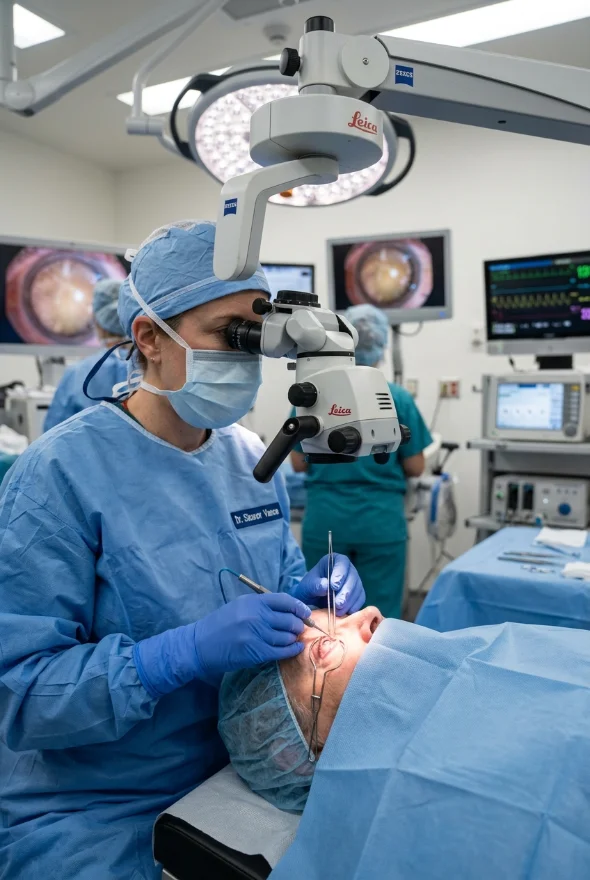
Food not to eat after cataract surgery? NHS aftercare advice names none; it restricts what you do to the eye: no rubbing, no water, no heavy lifting, no swimming. Follow your drop schedule and written rules. If vision turns hazy again months or years later, the usual cause is posterior capsule opacification (after-cataract), cleared by a quick YAG laser from Prof. Dr. Ahmet Satıcı, Doç. Dr. (Associate Professor) Muhammet Derda Özer or Op. Dr. Aysan Bayram.
What food should you not eat after cataract surgery?
No specific food or drink is singled out in the NHS advice for recovering from cataract surgery. The NHS lists what to avoid: rubbing your eye, getting water in it, swimming (even with goggles), eye make-up, heavy lifting and sports. It says to use your prescribed eye drops for about 4 weeks, and that paracetamol or ibuprofen can be used for discomfort. Moorfields, the NHS eye specialist trust in London, and the US National Eye Institute (NEI) give the same kind of advice: protect the eye, use the drops, avoid straining and avoid anything that could injure it. None of these sources gives a list of foods to avoid.
What that means in practice:
- You can eat and drink normally. Eating does not touch the eye.
- Be careful with the way you eat and cook, not with what you eat. Keep steam, hot splashes, spray and smoke away from the eye, and do not rub it with a hand that has food or oil on it. This is the same rule as "do not get water in your eye" and "do not rub your eye".
- Heavy shopping and big pots count as heavy lifting. The NHS says no heavy lifting during recovery.
- Medicines and alcohol. Follow the leaflet that comes with every medicine you were given. If you take medicines for another condition, ask your surgeon whether anything should be avoided with your drops or painkillers. {{surgeon's advice on alcohol and diet in the first days}}
Your surgeon may add personal instructions, for example if you have diabetes or take blood thinners. Those override any general guide, including this one.
Aftercare at a glance: what the main sources say
| Question | Short answer | Source |
|---|---|---|
| Foods to avoid | None listed in NHS aftercare advice | NHS |
| Reading, TV, computer | Fine straight away | Moorfields |
| Showering or bathing | Allowed, but keep water out of the eye | Moorfields, NHS |
| Swimming | No, even with goggles; Moorfields says for the first 2 weeks | NHS, Moorfields |
| Bending down and heavy lifting | Avoid; Moorfields says in the first 2 weeks, the NEI says for several weeks | Moorfields, NEI, NHS |
| Eye make-up | Avoid during recovery | NHS, Moorfields |
| Driving | When your vision meets the legal standard, typically after 3-4 days | Moorfields, NHS, GOV.UK |
| Eye drops | Usually about 4 weeks | NHS |
| Full healing | About 6 weeks (Moorfields) to 8 weeks (NEI) | Moorfields, NEI |
Always follow your own surgeon's written instructions. If they differ from these general sources, theirs apply to your eye.
Showering and washing hair after cataract surgery
You can shower or bathe after cataract surgery, but you must keep water out of the operated eye. Moorfields says bathing and showering are allowed, and the NHS says "do not get water in your eye". The same applies to soap and shampoo.
Practical ways to wash your face and hair:
- Shower with your head tilted back and your face turned away from the water jet.
- Keep the eye closed and a clean, dry tissue to hand to dab away drips; never wipe or rub the eye itself.
- Wash your face with a damp cloth, keeping it away from the eyelids and lashes.
- Wash your hands before putting in your drops.
Can you have a haircut after cataract surgery?
Yes, in most cases, once you feel comfortable, because a haircut does not strain the eye. The points to watch are the same as above: no water, spray, hair clippings or hair dye in the eye, and no rubbing. Tell the hairdresser that you have had eye surgery, ask for a dry cut, and avoid a backwash basin with your head leaning back, where water can run towards your eyes. Keep colour, perm and spray products well away from the eye. {{surgeon's advice on haircuts and hair dye}}
How soon can you cook after cataract surgery?
Most people can cook again within a few days. Moorfields says everyday tasks and light activity return within two or three days. What to protect the eye from is splashes, steam and smoke, and rubbing it with a hand that has food on it.
- Wash your hands before putting in drops.
- Stand back from hot oil, boiling pans and open ovens.
- Do not lift heavy pots, trays or bags of shopping.
- Ask someone else to do the heavy or messy jobs for the first week or two.
How long after cataract surgery can you bend over (UK and NHS advice)?
The NHS gives no number of days for bending, but it says to avoid heavy lifting; Moorfields says to avoid bending down to pick heavy objects up in the first two weeks, and the NEI says to avoid bending over and lifting heavy things for several weeks. The sources differ, so the safe answer is to avoid deep bending and lifting for at least the first 2 weeks, and longer if your surgeon says so.
For everyday jobs, bend your knees instead of folding forward from the waist, pick up light objects only, and avoid keeping your head below your waist for long stretches, for example when gardening or tying shoelaces on the floor. {{surgeon's advice: how long to avoid bending, lifting and sport}}
Can you drive 2 days after cataract surgery?
Usually not safely, and it depends on your vision, not on the calendar. The NHS says not to drive until your vision is back to normal, and Moorfields says most people reach the legal standard after about 3-4 days. In the UK you must be able to read a number plate from 20 metres (GOV.UK). Do not drive home from the clinic: your vision is blurred for a few hours by the pupil-dilating drops (NHS).
A simple self-check: on a quiet street in daylight, with a friend, see whether you can read a number plate at 20 metres, first with the operated eye alone, then with both eyes open, without glare or double vision. If you are in any doubt, wait, and ask your surgeon to confirm. Rules in other countries differ, so check your own country's standard.

Do you need temporary glasses after cataract surgery?
Often yes, but only for a short time, and you should not rush to order new ones. Your surgeon can build your glasses prescription into the lens implant (Moorfields). Even so, vision keeps settling as the eye heals, which is why Moorfields recommends an optician check at about six weeks, in case you need to update your glasses. Until then:
- keep using your existing glasses where they still help, and ask your surgeon whether you need a temporary pair for the operated eye
- wear sunglasses if bright light bothers you, and protective eyewear in windy conditions (NHS)
- wear the eye shield at night if you have been given one (NHS)
How much you rely on glasses depends on the lens you chose. A premium lens aims to reduce your need for glasses, and your surgeon explains what to expect for your eye. {{surgeon's advice: when to test for final glasses after surgery}}
Will streaks of light after cataract surgery go away?
For most people, yes: flashes, arcs, streaks and rings of light after cataract surgery fade as the eye heals and the brain adapts. A 2025 literature review in the Taiwan Journal of Ophthalmology calls these artefacts "positive dysphotopsia". It reports that they affect up to 67% of people immediately after surgery but only about 2.2% still notice them after a year. A dark crescent of shadow at the edge of vision, "negative dysphotopsia", is seen in 15-26% of people in the first week and persists in 0.13-3.2% at one year; improvement over time is attributed to neuroadaptation.
If symptoms persist, there are treatments. In one case series cited in the same review, YAG laser improved a negative-dysphotopsia shadow in 5 of 6 patients, and lens-based options such as a piggyback lens or a lens exchange also exist. Your surgeon will normally wait for your eyes to settle first.
But new flashes of light are not always harmless. The NHS says to call NHS 111 straight away for sudden floaters, flashes of light, a dark curtain across your vision or sudden blurring, as these can be signs of a detached retina. Do not wait to see if they go away. While you are in Istanbul, call your coordinator; at home, go to your nearest eye emergency service.
Why is my vision not sharp after cataract surgery?
Soft or hazy vision is common in the first days and usually improves, but if it is still not sharp after the healing period, the cause needs finding. The usual reasons:
| Reason | What you notice | What happens next |
|---|---|---|
| Healing and dilating drops | Blur for hours to several days (NHS) | Improves on its own |
| Leftover prescription | Distance or reading is not quite sharp | Glasses check at about 6 weeks (Moorfields) |
| Inflammation or other healing problem inside the eye | Blur, redness or pain | Needs an examination; the NHS lists inflammation among possible complications |
| Posterior capsule opacification (after-cataract) | Vision slowly becomes misty again, months or years later | Treated with YAG laser |
If vision was good after surgery and then slowly fades, PCO is the most likely cause. The next sections explain it.
What is after-cataract (posterior capsule opacification, PCO)?
After-cataract, or PCO, is a thin film of cells that grows on the clear capsule behind your lens implant and makes vision cloudy again. It is not the cataract coming back: Moorfields says the cataract will never regrow, but the "bag" that holds the lens can become hazy. The NEI also calls it a secondary cataract. During cataract or lens replacement surgery, your surgeon removes the cloudy natural lens but leaves the capsule in place to hold the new lens. Leftover lens cells can grow across the back of it. The NHS says the lens can become cloudy months or years after surgery.
Symptoms (EyeWiki, from the American Academy of Ophthalmology): blurred vision, glare, sensitivity to light, reduced contrast, halos around lights and difficulty reading, usually months to several years after surgery.
ICD-10 code: in the World Health Organization's ICD-10, posterior capsule opacification falls under H26.4, "After-cataract". Your clinic report may use this code.
How common is PCO?
| Source | Figure |
|---|---|
| Moorfields | About 1 in 5 (20%) patients may benefit from YAG laser |
| NEI | Up to 2 out of 5 people develop a secondary cataract |
| EyeWiki | 20-50% within 2-5 years |
| Systematic overview (Schaumberg et al., Ophthalmology, 1998) | 11.8% at 1 year, 20.7% at 3 years, 28.4% at 5 years |
| Real-world study of 20,763 eyes in seven UK NHS clinics (Ursell et al., Eye) | 5.8% to 19.3% needed YAG laser within 5 years, depending on the lens model |
The figures differ because studies count it differently and because lens design matters: lenses with a sharp, square back edge are associated with less PCO (Sinha et al., Indian Journal of Ophthalmology, 2013). Younger age at surgery, diabetes, uveitis (eye inflammation), retinitis pigmentosa and past eye injury raise the risk (EyeWiki).
Does posterior capsule opacification get worse?
PCO usually develops slowly and does not disappear by itself, so symptoms tend to creep up rather than appear overnight. The NEI says it can appear weeks, months or even years after surgery. {{surgeon's confirmation: PCO progresses gradually and does not clear without laser}} How fast it progresses varies from person to person, and a mild haze may not need treatment. Your surgeon sees it with a slit lamp and compares your vision with your best vision after surgery. Drops and glasses cannot clear it; the treatment is laser.
What is YAG laser capsulotomy, and what happens during it?
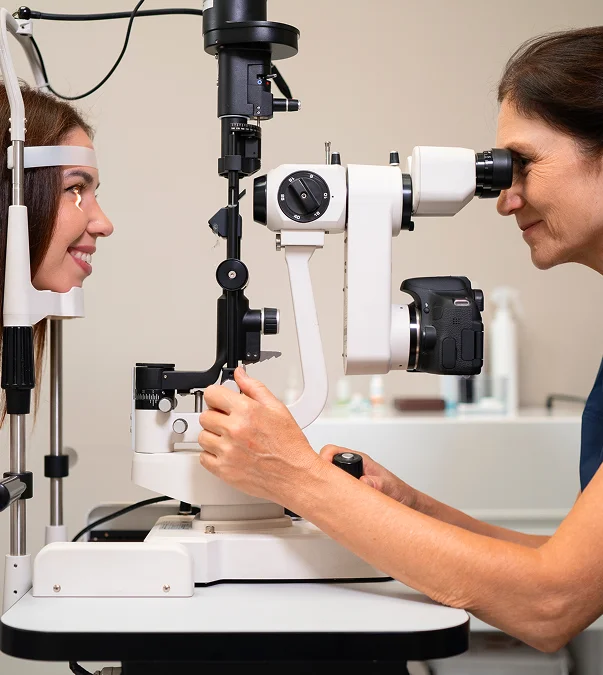
YAG laser capsulotomy makes a small, clear opening in the hazy capsule, without a cut. The NEI says the laser opens the cloudy part and describes the treatment as quick and painless. Moorfields says it is done in the outpatient clinic.
- Examination. Your surgeon checks your vision, compares it with your best vision after cataract surgery and examines the retina, because other problems can also blur vision (EyeWiki).
- Drops. Drops numb the eye and widen the pupil. Pressure-lowering drops, such as apraclonidine, may be used before and after the laser to limit a short rise in eye pressure (Cureus, 2022).
- Laser. You sit at the laser with your chin on a rest. Brief pulses of laser light open the capsule. The surgeon uses the lowest energy that works and aims the pulses slightly behind the lens implant to reduce marks on it (EyeWiki).
- Pressure check and home. Your eye pressure may be checked, then you can leave. {{usual duration of the YAG visit, and the drops used}}
Recovery. The NEI says most people notice their vision is back to normal in a few days. Blur from the drops lasts a few hours, so do not drive that day. A few new floaters are among the minor effects reported (Cureus, 2022).
What are the risks of YAG laser capsulotomy?
YAG laser is a very common, quick treatment, but it is not risk-free. In the French nationwide YAG 2 study (Dot et al., Ophthalmology, 2023; 6,210 patients, 7,958 laser sessions, average age 75), at least one adverse event of interest occurred in 8.6% of patients by 3 months and 13.3% by 12 months.
| Possible problem | What it is | How common (French YAG 2 study) |
|---|---|---|
| Raised eye pressure (ocular hypertension) | A rise in pressure after the laser, mostly within 3 months | About 5% at 3 months |
| Macular oedema | Swelling at the centre of the retina | About 5% at 3 months; higher risk in diabetes |
| Retinal detachment | The retina pulls away from the back of the eye; an emergency | 0.5% or less |
| Marks on the lens implant ("pitting"), floaters, inflammation | Usually minor | Not quantified in the sources opened |
The same study found more adverse events when the laser was done within the first year after cataract surgery, so surgeons may wait unless the haze is affecting your vision. In a 2022 audit of 912 eyes (Cureus), the overall complication rate was 4.3%. Diabetes, glaucoma and previous retinal problems call for closer checks.
If you are unhappy with a trifocal or toric lens and may want it exchanged, tell your surgeon before the laser: opening the capsule makes later lens exchange more difficult (EyeWiki).
When should you contact your surgeon?
Contact your surgeon or an eye emergency service the same day if you notice:
- sudden new floaters, flashes of light, or a dark curtain or shadow across your vision
- sudden blurring or loss of vision
- increasing pain, redness or discharge in the eye
The NHS says to call NHS 111 straight away for signs of a detached retina, and to see an optician if your vision becomes cloudy or blurry or the eye becomes red or painful.
Book a review if your vision slowly turns misty again months or years after cataract or lens replacement surgery, if glare or halos increase, or if reading becomes harder. That pattern points to PCO and can be checked quickly.
With Laser Istanbul Clinic, your surgeon examines your eyes before you fly home, and your coordinator and surgeon review your progress remotely, by video, at agreed intervals. If you need to be seen in person, we help you arrange it with a local ophthalmologist and share your full surgical records.
Frequently asked questions
No food or drink is singled out in NHS aftercare advice. What you must avoid is rubbing the eye, getting water in it, heavy lifting and swimming. Eat normally, keep steam, splashes and smoke away from the eye, and ask your surgeon about alcohol or your own medicines.
You can shower, but keep water and soap out of the operated eye. Tilt your head back, keep your eye closed and do not rub it. Ask your surgeon from which day you can wash your hair normally.
Most people can cook again within a few days, as everyday tasks resume after two or three days (Moorfields). Avoid splashes, steam and heavy pots, and wash your hands before using your drops.
Moorfields advises avoiding bending down to pick up heavy objects for the first two weeks, and the NEI says for several weeks. Avoid deep bending and heavy lifting until your surgeon says it is safe.
Only if your vision meets the legal standard, which in the UK means reading a number plate from 20 metres. Moorfields says this is typically after 3-4 days. If in doubt, wait.
Usually. In a 2025 review, up to 67% noticed streaks, arcs or rings of light straight after surgery, but only about 2.2% still did after a year. Sudden new flashes with floaters or a curtain over your vision are different and need urgent care.
Healing, a leftover prescription, inflammation or PCO can all blur vision. Allow the healing period, have a glasses check at about six weeks, and see your surgeon if vision stays soft or fades later.
PCO is clouding of the capsule behind the lens implant, also called after-cataract or secondary cataract. Its WHO ICD-10 code is H26.4. It is treated with a quick YAG laser.
It usually builds slowly over months or years and does not clear by itself, but a mild haze may never need treatment. Your surgeon can monitor it and treat it when it affects your vision.
The NEI describes it as quick and painless. EyeWiki notes that the capsule can become cloudy again and a second laser treatment may be needed, so follow-up is recommended.
Had cataract surgery and your vision has clouded again, or planning surgery?
Your surgeon at Laser Istanbul Clinic examines your lens capsule and retina and tells you plainly whether the haze needs laser. Cataract, lens and YAG laser care in Istanbul is led by Prof. Dr. Ahmet Satıcı, Doç. Dr. Muhammet Derda Özer and Op. Dr. Aysan Bayram. {{YAG laser / PCO treatment policy for our own cataract patients}}
Lens replacement removes the natural lens in the same way, so PCO can form after it as well. If you are weighing a clear-lens exchange, see Lens replacement (RLE / smart lens) in Turkey →.
Sources for the facts on this page
- NHS. Cataract surgery: recovery. https://www.nhs.uk/conditions/cataract-surgery/recovery/
- NHS. Cataract surgery: risks. https://www.nhs.uk/conditions/cataract-surgery/risks/
- NHS. Cataract surgery: what happens. https://www.nhs.uk/conditions/cataract-surgery/what-happens/
- Moorfields (NHS eye specialist trust). Cataract: diagnosis and treatment (recovery, glasses at six weeks, YAG laser). https://www.moorfields.nhs.uk/eye-conditions/cataract/diagnosis-and-treatment
- National Eye Institute (NIH). Cataract surgery. https://www.nei.nih.gov/learn-about-eye-health/eye-conditions-and-diseases/cataracts/cataract-surgery
- National Eye Institute (NIH). Types of cataract: secondary cataract / posterior capsule opacification. https://www.nei.nih.gov/eye-health-information/eye-conditions-and-diseases/cataracts/types-cataract
- EyeWiki (American Academy of Ophthalmology). Posterior Capsule Opacification. https://eyewiki.org/Posterior_Capsule_Opacification
- GOV.UK. Driving eyesight rules. https://www.gov.uk/driving-eyesight-rules
- WHO. International Classification of Diseases, 10th revision (2019), chapter VII, H26.4 After-cataract. https://icd.who.int/browse10/2019/en#/H25-H28
- Wanniarachchi K, Mehta JS. Management of positive and negative dysphotopsia postcataract surgery: a literature review. Taiwan Journal of Ophthalmology 2025. https://pmc.ncbi.nlm.nih.gov/articles/PMC12782528/
- Schaumberg DA, et al. A systematic overview of the incidence of posterior capsule opacification. Ophthalmology 1998. https://pubmed.ncbi.nlm.nih.gov/9663224/
- Ursell PG, Dhariwal M, O'Boyle D, Khan J, Venerus A. 5 year incidence of YAG capsulotomy and PCO after cataract surgery with single-piece monofocal intraocular lenses: a real-world evidence study of 20,763 eyes. Eye (published 2019/2020). https://pmc.ncbi.nlm.nih.gov/articles/PMC7182577/
- Dot C, et al. Incidence of retinal detachment, macular edema, and ocular hypertension after Nd:YAG capsulotomy: the French YAG 2 study. Ophthalmology 2023. https://pubmed.ncbi.nlm.nih.gov/36581227/
- Richardson-May JG, et al. Can routine patients be safely discharged after Nd:YAG laser posterior capsulotomy? Cureus 2022. https://pmc.ncbi.nlm.nih.gov/articles/PMC8893007/
- Sinha R, Shekhar H, Sharma N, Titiyal J, Vajpayee R. Posterior capsular opacification: a review. Indian Journal of Ophthalmology 2013. https://pmc.ncbi.nlm.nih.gov/articles/PMC3759120/