
- Home
- Knowledge centre
- Lens & cataract guides
- Refractive Lens Exchange Side Effects: Trifocal Lens Bad Experiences, Halos and How to Avoid Them
Refractive Lens Exchange Side Effects: Trifocal Lens Bad Experiences, Halos and How to Avoid Them
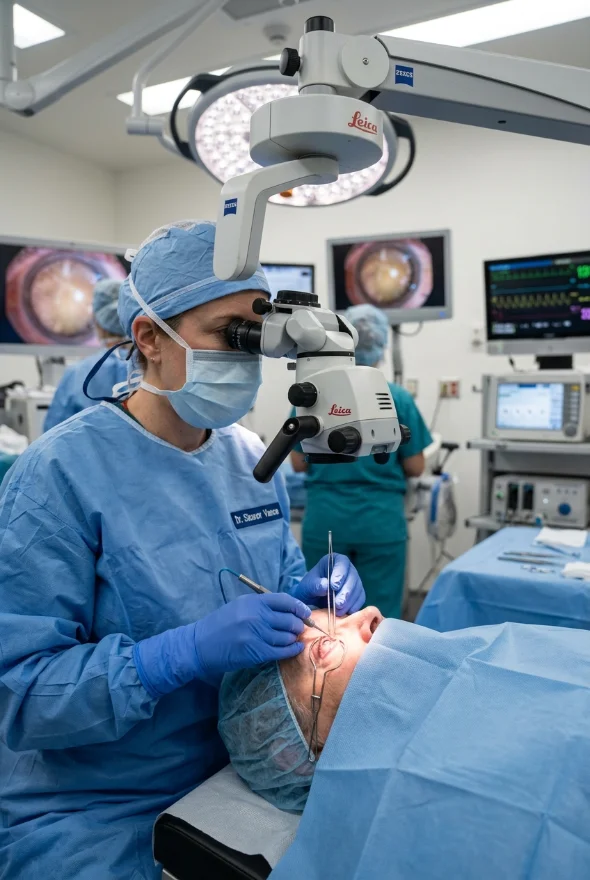
The main refractive lens exchange side effects with a trifocal lens are halos, glare and starbursts around lights at night, because the lens splits light between three focus points. They are common, usually fade over 3 to 6 months, and are rarely severe. Most bad experiences come from treatable causes such as dry eye or a leftover prescription, and careful screening prevents many of them. Trifocal lens surgery is led by Prof. Dr. Ahmet Satıcı.
What are the side effects of refractive lens exchange with a trifocal lens?
The side effects of refractive lens exchange (RLE) with a trifocal lens fall into two groups: risks of the operation itself, and visual side effects caused by the lens design. The Royal College of Ophthalmologists (RCOphth) explains that RLE uses the same procedure as cataract surgery: the eye's natural lens is replaced with an artificial lens, here a trifocal one that focuses at near, intermediate and far distances.
Visual side effects of the trifocal design are the ones people mean by a "bad experience":
- halos (rings around lights), glare (dazzle) and starbursts (rays from point lights), mostly at night
- slightly lower contrast in dim light
- blur or "ghost" images at certain distances or in certain lighting
- a period of adaptation, during which vision can feel less crisp
Risks of the operation are the same as for any lens surgery. The RCOphth says permanent, serious loss of vision affects approximately 1 in 500 patients after RLE, more often than after laser vision correction. Retinal detachment is the other key risk: the RCOphth notes that the risk is about five times higher in the first four years after cataract surgery or RLE, and higher if you are very short-sighted. The RCOphth also lists a tear in the lens capsule (UK benchmark just under 1.5%, after which a multifocal lens may not be safe to implant) and clouding behind the lens, which is treated with a quick laser procedure. Our guide to the disadvantages of lens replacement surgery covers the full list.
The NHS gives the same picture for lens surgery in general: light-scatter side effects, including glare, halos, starbursts and ghost images, will normally improve within a few months, while serious complications such as a detached retina or permanent loss of vision are possible but uncommon.
Why do trifocal lenses cause halos, glare and starbursts?
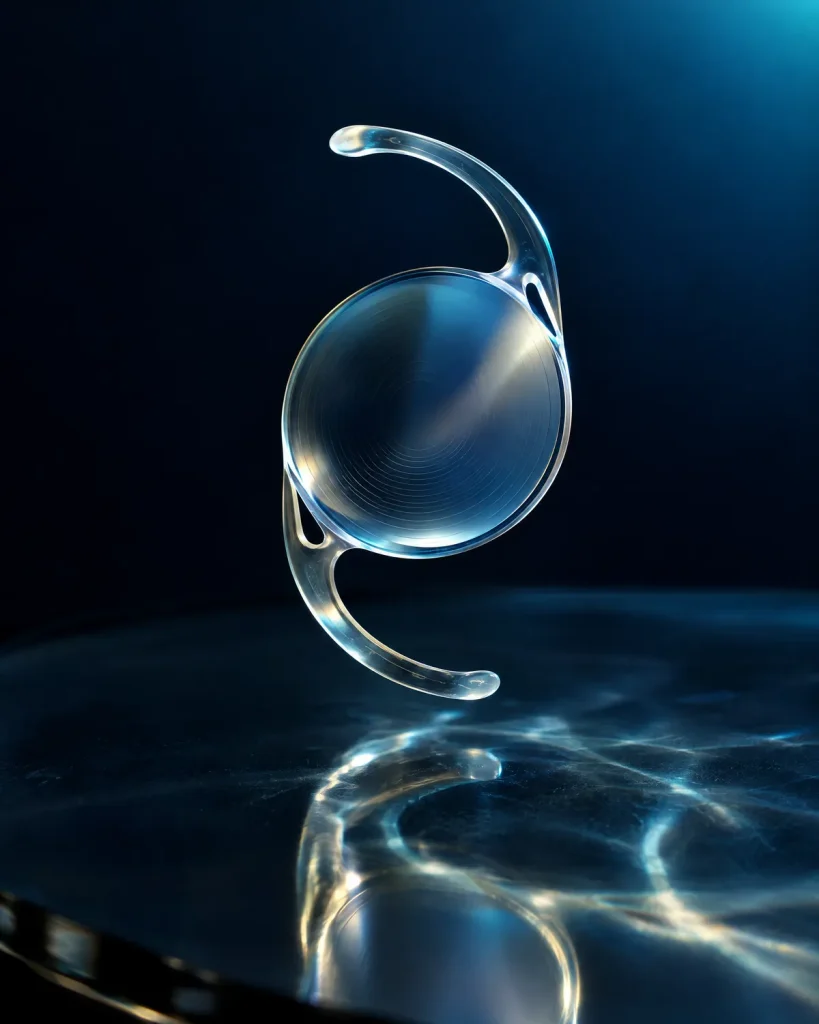
Trifocal lenses cause halos because they split incoming light into three focus points, and the light that is not in focus for a given distance spreads out as a ring or rays around bright lights. A trifocal lens has fine diffractive rings on its surface. In the US Food and Drug Administration (FDA) approval document for the AcrySof IQ PanOptix, these rings sit in the central 4.5 mm of the lens. According to EyeWiki, the American Academy of Ophthalmology's clinical encyclopedia, the PanOptix sends about 25% of light to near, 25% to intermediate and 50% to distance.
That is the trade-off. You gain sharp vision at several distances, but the brain also receives slightly out-of-focus images at the same time. In daylight you rarely notice. At night, a bright point against a dark background makes the extra images visible as rings or rays. The RCOphth states that all forms of multifocal lens are associated with more optical side effects than monofocal lenses, although multifocal lenses also give a greater range of glasses freedom.
Two things are worth knowing:
- Not every visual artefact comes from the trifocal design. A shadow or shimmering arc at the edge of vision (negative dysphotopsia) happens with monofocal lenses too; the RCOphth says patients are commonly aware of it after monofocal or multifocal lenses. In the FDA PanOptix study, 10.2% of PanOptix patients and 7.2% of monofocal patients reported a "dark area".
- Dry eye and a leftover prescription make halos worse, because they blur the image before the lens design adds its own effect. This is why a "bad trifocal" is often not a bad lens (see the causes below).
How common are halos with trifocal lenses, and how bad are they?
Most trifocal patients notice some halos, but only a small minority are seriously bothered by them. The honest answer needs several sources, because trial designs and questions differ.
| Source | Who was studied | What was reported |
|---|---|---|
| FDA approval study, AcrySof IQ PanOptix (2019) | 129 patients with PanOptix, 114 with a monofocal lens; 6 months | 36.2% reported no halos at all; 12.6% rated halos severe (0.9% with monofocal) and 16.0% rated starbursts severe (1.8%). Bothered "quite a bit" or "very much": halos 11.1%, starbursts 12.0%, glare 8.7%. Bothered "very much": under 5%. 126 of 127 said they would choose the same lens again. |
| FDA approval study, TECNIS Synergy | 272 patients (135 Synergy, 137 monofocal); 6 months | "Extremely bothersome": halos 3.8%, glare 4.6%, starbursts 5.3%, all higher than with the monofocal lens. 87.8% wore glasses "none of the time". |
| Cochrane review, multifocal vs monofocal lenses (2016) | 20 trials, 2,230 people | Halos about 3.6 times as likely as with monofocal lenses (moderate-certainty evidence), glare about 1.4 times (low-certainty evidence). |
| Zhang et al., Ophthalmology and Therapy (2026) | 62 patients (122 eyes) with PanOptix; 3 months | Of 50 who completed the questionnaire: halos 78%, starbursts 60%, glare 42%. Overall glasses independence 90%. |
| RCOphth patient information | Summary of published evidence | 19 out of 20 patients are satisfied or very satisfied with their vision 3 to 6 months after multifocal lens surgery. About 1% cannot adapt and choose lens exchange. |
How to read this: halos are an expected feature of trifocal lenses, not a rare complication. The real question is whether they bother you. In the FDA PanOptix study, about one patient in nine was bothered quite a bit or very much by halos at 6 months, and nearly all would choose the lens again. The FDA trials were run by the lens makers on carefully selected patients, which is why the selection steps below matter.
Are halos worse after refractive lens exchange than after cataract surgery?
Possibly. In Zhang et al., clear lens exchange patients reported halos more often than cataract patients (92.3% against 62.5%, from 26 and 24 patients), and the authors conclude that careful candidate selection and counselling are needed. A possible reason, which the study does not prove, is that people with a clear lens start from sharp vision and notice every change. The sample was small and from a single hospital, so treat it as a signal, not a rate. The practical lesson: if you are having lens exchange without a cataract, the discussion about halos should be especially thorough.
Why do some people have a bad experience with trifocal lenses?
People who describe a bad experience with trifocal lenses usually have one of five problems, and most can be found and treated. A 2026 narrative review in Therapeutic Advances in Ophthalmology (Khorrami-Nejad et al.) describes dissatisfaction as multifactorial: it depends on halos and glare, on a leftover prescription, on the state of the eye surface, on the position of the lens and its capsule, and on how well your brain adapts. The same review notes that dissatisfaction is determined less by visual acuity alone than by the balance between range of vision, glasses independence and personal tolerance.
| Cause | What you notice | How it is found | What helps |
|---|---|---|---|
| Leftover prescription (including astigmatism) | Blur at one or more distances, worse halos | Careful refraction with trial lenses | Glasses for a specific task, or a laser touch-up once the eye is stable (RCOphth) |
| Dry eye and eyelid gland problems | Fluctuating blur, gritty eyes, halos | Tear-film and surface tests | Lubricants, lid care, eyelid-gland treatment (Khorrami-Nejad 2026) |
| Clouding behind the lens (posterior capsule opacification, PCO) | Gradual haze or glare, months to years later | Slit-lamp examination | A one-off YAG laser capsulotomy (RCOphth) |
| Lens position (tilt, decentration, capsule changes) | Persistent halos or blur | Slit-lamp examination, scans | Targeted treatment depending on the finding |
| Slow neuroadaptation, or expectations that did not match | Awareness of halos and ghosting that does not fade as expected | Exclusion of the causes above, discussion | Time, counselling and, in some cases, structured visual training; lens exchange as a last resort |
What the evidence shows about causes. In a retrospective study of 32 dissatisfied patients (43 eyes) after multifocal lens surgery, published in the Journal of Cataract & Refractive Surgery in 2009 (Woodward et al.), clouding behind the lens explained 54% of blurred vision and 66% of photic symptoms, a leftover prescription explained 29% of blurred vision, and dry eye 15% of blurred vision. 81% of eyes improved with conservative treatment, and 7% (3 eyes) needed a lens exchange. That study used older multifocal lens models in a single centre, so it shows the pattern of causes rather than today's rates. The pattern still matches the 2026 review: look for the fixable causes first.
Expectations and personality play a part. In a 2026 study of 66 PanOptix patients in Romania, higher neuroticism scores before surgery were associated with worse self-rated quality of vision six months later, most strongly for starbursts. One study cannot predict how you will react, but it supports a point surgeons make often: people who expect perfect vision at every distance with no compromise are the most likely to be disappointed.
How long do halos last after trifocal lens surgery?
For most people, halos and glare fade over 3 to 6 months, though they do not always disappear completely. The RCOphth says optical side effects tend to diminish with time, and that side effects normally improve with time but do not always resolve completely. The NHS says glare, halos and starbursts after lens surgery will normally improve within a few months, and EyeWiki reports that patients' halo complaints with trifocal lenses decrease over time.
-
First days to weeks
Halos, glare and ghosting are common while the eye heals and drops are used (about 4 weeks of drops, according to the NHS).
-
1 to 3 months
Symptoms are often still noticeable. In the 2026 PanOptix study, most patients still reported halos at 3 months.
-
3 to 6 months
Most patients are satisfied or very satisfied (RCOphth: 19 out of 20). The FDA studies measured bother at 6 months.
-
After 6 months
Symptoms that still affect daily life deserve a full check for a leftover prescription, dry eye or clouding behind the lens.
While you are still adapting, do not drive until your vision is back to normal and your surgeon confirms it is safe, and be especially careful at night.
What can you do if you already have halos or are unhappy with your trifocal lens?
Treatment of trifocal lens problems is stepped: find the cause, fix the simple causes first and keep lens exchange as the last step. The 2026 review and the RCOphth describe a similar order, and your surgeon decides which steps apply to you.
- Reassurance and a symptom check
Your surgeon separates expected halos from a problem that needs treatment, using your own description and, ideally, a questionnaire.
- Treat the eye surface
Lubricating drops, lid hygiene and treatment of blocked eyelid glands. The review says ocular surface disease can amplify halos.
- Measure the prescription again
A careful refraction after the surface has settled; glasses for specific tasks, or a laser touch-up when the eye is stable.
- Check the lens and capsule
Slit-lamp examination and, if needed, corneal topography, aberrometry or imaging of the lens position.
- Treat clouding behind the lens with YAG laser, but at the right time
Both Woodward et al. and the 2026 review advise delaying a YAG capsulotomy until it is clear that a lens exchange will not be needed, because opening the capsule makes a later exchange more complicated.
- Drops that make the pupil smaller, in selected cases
The review mentions miotic drops used selectively; a 2025 review of dysphotopsia says their effectiveness is unclear. They are prescription medicines.
- Lens exchange as the last resort
The RCOphth says about 1% of multifocal patients cannot adapt and choose to exchange the lens for a monofocal lens, which it calls a potentially complicated procedure. In the Woodward study, 7% of the dissatisfied eyes needed it.
Ask any clinic what its approach is before you book, because the answer shows how seriously it treats the problem. {{Our surgeons' policy on laser touch-ups, YAG laser and lens exchange after surgery, and how follow-up works once you are home.}}
PanOptix vs Vivity reviews: what do patients report?
Studies that compare PanOptix, a trifocal lens, with Vivity, an extended depth of focus (EDOF) lens, point to the same trade-off: the trifocal gives more freedom from glasses for close work, the EDOF gives fewer halos. The evidence is limited, so be careful with confident claims.
- Patient-reported comparison (Hovanesian et al., 2022). 85% of Vivity patients reported no or only a little glare and halo in dim light, against 69% of PanOptix patients. But 83% of PanOptix patients never needed glasses for any activity, against 33% with Vivity. This compared results across separate studies, and the authors had links to Alcon, which makes both lenses.
- Cochrane review of trifocal versus EDOF lenses (2024). Five studies, 233 participants, low-certainty evidence, using a different EDOF lens from Vivity. Distance vision was similar. In one study of 60 people, 3% of the trifocal group and 30% of the EDOF group could not read fine print (J2) without glasses.
Your choice depends on what you do most. If reading small print without glasses matters most, a trifocal tends to deliver more. If you drive at night often, or you accept reading glasses, an EDOF or monofocal lens may give a calmer experience. The American Academy of Ophthalmology (AAO) says that if night driving is important to you, you might want to steer clear of multifocal or EDOF lenses.
How to avoid a bad experience with a trifocal lens
You avoid most bad experiences with trifocal lenses by choosing the right patient, the right lens and a precise operation, and by agreeing realistic expectations before surgery. These are the checks that make the difference.
- Check that the lens is the only problem. The AAO says multifocal and EDOF lenses are generally not recommended for people with vision loss from glaucoma, macular degeneration or other eye diseases, because these lenses let less light into the eye. The RCOphth says you may not be suitable if you have existing eye health problems. A scan of the macula (OCT) and a glaucoma check are part of this.
- Treat dry eye and eyelid disease first. The RCOphth says treatment and prevention are based on a healthy eye surface before and after surgery, and the 2026 review calls ocular surface disease a frequent, modifiable factor.
- Get precise measurements. Optical biometry, corneal topography (shape and astigmatism) and, where there is astigmatism, a toric lens. The RCOphth notes that limits on measurement accuracy mean a laser touch-up is sometimes needed, and the 2026 review calls a leftover prescription one of the most common fixable causes of dissatisfaction.
- Talk through your day, not only your prescription. How much you drive at night, how much you read small print, and whether you work on screens. The review recommends defining success by tasks, because intermediate vision is often misaligned with expectations.
- Ask for the alternatives. Monofocal lenses have fewer optical side effects but less glasses freedom (RCOphth), and EDOF lenses sit in between. A surgeon who offers only one lens is not helping you choose.
- Hear the halos talk, with numbers. You should be told that most trifocal patients notice halos, that in the FDA PanOptix study about one in nine was bothered quite a bit or very much by them, and that adapting takes months. If nobody mentions halos, be cautious.
- Be extra careful if you have a clear lens. Without a cataract, you swap a natural lens for one that always carries a trade-off. The RCOphth says laser eye surgery or a phakic lens is generally better than RLE for younger patients with a clear, flexible lens, which includes most patients under 50.
- Ask what happens if things go wrong. Who does a touch-up, when YAG laser is used, what lens exchange involves, and how follow-up works once you are home.
Who should think twice about a trifocal lens:
| If you... | Why | What may suit better |
|---|---|---|
| Drive a lot at night | More halos and glare, slightly lower contrast | EDOF or monofocal lens |
| Have glaucoma, macular degeneration or other eye disease causing vision loss | Multifocal lenses let less light into the eye (AAO) | Monofocal lens, after the disease is assessed |
| Have untreated dry eye | Surface problems amplify halos | Treat first, then decide |
| Are under about 50 with a clear natural lens | Better options usually exist (RCOphth) | Laser eye surgery or a phakic lens |
| Expect perfect vision at every distance with no compromise | Dissatisfaction follows unrealistic expectations | An honest discussion; monofocal lenses plus reading glasses if you cannot accept the trade-offs |
When should you see your surgeon urgently?
See your surgeon or an eye emergency service straight away if, after lens surgery, floaters appear suddenly or increase in number, you see flashes of light, a dark curtain or shadow moves across your vision, or your vision suddenly blurs. The NHS lists these as warning signs that need prompt help. Persistent halos, a hazy image months later or slowly worsening vision are not emergencies, but they deserve a review.
How we approach trifocal lens surgery
At Laser Istanbul Clinic, trifocal lens surgery is led by Prof. Dr. Ahmet Satıcı, who also performs laser eye surgery and can therefore tell you honestly whether a lens or laser suits your age and eyes. Op. Dr. Aysan Bayram performs cataract surgery. If your scans show a corneal or retinal problem, Doç. Dr. Muhammet Derda Özer (Doç. = Associate Professor), our cornea and retina specialist, reviews your case before any lens is chosen.
Before we recommend a trifocal lens, your examination covers an OCT scan of the macula, corneal topography, optical biometry, a tear-film check and a dilated retina check, and we talk through how you use your eyes, including night driving. If a trifocal lens is not right for you, your surgeon tells you and explains the alternatives. Surgery takes place in a fully equipped, Ministry of Health–licensed operating theatre in Istanbul.
Read the full treatment guide: Trifocal / multifocal lens surgery (PanOptix, Synergy), or see all options in Lens replacement (RLE / smart lens) in Turkey.
Frequently asked questions
The most common refractive lens exchange side effects with a multifocal or trifocal lens are halos, glare and starbursts, slightly lower contrast in dim light and a period of adaptation. Rarer risks include permanent serious vision loss (about 1 in 500, according to the RCOphth), retinal detachment, a torn lens capsule and clouding behind the lens, which is treated with a quick laser procedure.
Yes. Halos are expected with trifocal lenses because the lens splits light between three focus points. In the FDA PanOptix study, 36.2% of patients reported no halos, 12.6% rated them severe, and fewer than 5% were bothered very much at 6 months. Most people notice them most at night, and most adapt.
For most people they fade over 3 to 6 months, but they do not always disappear completely. The RCOphth reports that 19 out of 20 patients are satisfied or very satisfied by 3 to 6 months. If halos still affect your life after 6 months, ask for a check for dry eye, a leftover prescription and clouding behind the lens.
The usual causes are a leftover prescription, dry eye, clouding behind the lens, lens position, and expectations that did not match the trade-offs. In one study of dissatisfied multifocal patients, 81% of eyes improved with conservative treatment and 7% needed a lens exchange. Careful selection and counselling before surgery prevent many of these problems.
Yes, but it is a more complex operation than the first one. The RCOphth says about 1% of multifocal patients cannot adapt and choose to exchange the lens for a monofocal lens. Surgeons treat the more common causes first, and they avoid a YAG capsulotomy until a lens exchange has been ruled out.
Neither is better for everyone. In a comparison across separate studies, 83% of PanOptix patients never needed glasses against 33% with Vivity, while 85% of Vivity patients reported no or only a little glare and halo in dim light against 69% with PanOptix. Choose by what matters most to you, and ask your surgeon to explain why they recommend one.
Many people do, but night driving is where halos and glare matter most. The AAO advises people for whom night driving is important to consider steering clear of multifocal and EDOF lenses. Do not drive until your surgeon confirms your vision is safe, and discuss night driving before choosing a lens.
It can be, if freedom from glasses matters to you and your eyes are otherwise healthy. A Cochrane review concluded that whether better near vision outweighs glare and halos varies from person to person, and that motivation to be free of glasses is likely to be the deciding factor. The RCOphth says about 95% of patients are satisfied with the outcome of RLE.
Multifocal lenses are generally not recommended if you have vision loss from glaucoma, macular degeneration or other eye disease (AAO), and people who drive a lot at night may prefer another lens. Younger patients with a clear, flexible lens are generally better served by laser eye surgery or a phakic lens (RCOphth).
Wondering whether a trifocal lens is right for your eyes?
Send us your glasses prescription and any eye reports. Prof. Dr. Ahmet Satıcı or Op. Dr. Aysan Bayram will tell you honestly whether a trifocal, EDOF or monofocal lens suits you, and whether you are better off with something else. Your price is confirmed in writing before you travel and includes the pre-operative examination and scans, surgery by your named surgeon, medication, follow-up checks in Istanbul, a personal interpreter, a coordinator and remote follow-up. Hotel and airport transfers are not included; they are a separate charge and we can arrange them on request.
Sources for the facts on this page
- The Royal College of Ophthalmologists. Refractive Lens Exchange: Patient Information (PROF/2024/498). https://www.rcophth.ac.uk/wp-content/uploads/2026/08/Refractive-lens-exchange-patient-information.pdf (landing page: https://www.rcophth.ac.uk/guidance-resources/refractive-lens-exchange/)
- US Food and Drug Administration. Summary of Safety and Effectiveness Data, PMA P040020/S087: AcrySof IQ PanOptix Trifocal and PanOptix Toric Trifocal IOLs (approved 26 August 2019). https://www.accessdata.fda.gov/cdrh_docs/pdf4/P040020S087B.pdf
- US Food and Drug Administration. Summary of Safety and Effectiveness Data, PMA P980040/S124: TECNIS Synergy and Synergy Toric II IOLs. https://www.accessdata.fda.gov/cdrh_docs/pdf/P980040S124B.pdf
- de Silva SR, Evans JR, Kirthi V, Ziaei M, Leyland M. Multifocal versus monofocal intraocular lenses after cataract extraction. Cochrane Database of Systematic Reviews 2016;12:CD003169. https://pubmed.ncbi.nlm.nih.gov/27943250/
- Tavassoli S, et al. Trifocal versus extended depth of focus (EDOF) intraocular lenses after cataract extraction. Cochrane Database of Systematic Reviews 2024;7:CD014891. https://pubmed.ncbi.nlm.nih.gov/38984608/
- Khorrami-Nejad M, Noori AM, Jadidi K, Narooie-Noori F, Khodaparast M. When trifocal IOLs disappoint: diagnostic and management pathway. Therapeutic Advances in Ophthalmology 2026;18:25158414261471349 (narrative review). https://pmc.ncbi.nlm.nih.gov/articles/PMC13519220/
- Zhang X, Sun L, et al. Visual Outcomes and Patient-Reported Dysphotopsia After PanOptix and PanOptix Toric Implantation Stratified by Preoperative Chord Mu: A Prospective Observational Cohort Study. Ophthalmology and Therapy 2026;15(9):3117–3135. https://pmc.ncbi.nlm.nih.gov/articles/PMC13518765/
- Rednik-Pușcă AM, Nicula CA. Association of Preoperative Personality Traits with Six-Month Subjective Quality of Vision After Bilateral PanOptix Trifocal IOL Implantation: A Prospective Single-Center Study. Vision (Basel) 2026;10(4):70. https://pmc.ncbi.nlm.nih.gov/articles/PMC13600082/
- Woodward MA, Randleman JB, Stulting RD. Dissatisfaction after multifocal intraocular lens implantation. Journal of Cataract & Refractive Surgery 2009;35(6):992–997. https://pubmed.ncbi.nlm.nih.gov/19465282/
- Hovanesian JA, Jones M, Allen Q. The Vivity Extended Range of Vision IOL vs the PanOptix Trifocal, ReStor 2.5 Active Focus and ReStor 3.0 Multifocal Lenses: A Comparison of Patient Satisfaction, Visual Disturbances, and Spectacle Independence. Clinical Ophthalmology 2022;16:145–152. https://pubmed.ncbi.nlm.nih.gov/35082481/
- Wanniarachchi K, Mehta JS. Management of positive and negative dysphotopsia postcataract surgery: a literature review. Taiwan Journal of Ophthalmology 2025;15(4):572–579. https://pmc.ncbi.nlm.nih.gov/articles/PMC12782528/
- EyeWiki (American Academy of Ophthalmology). Trifocal Intraocular Lenses. https://eyewiki.org/Trifocal_Intraocular_Lenses
- American Academy of Ophthalmology. Factors to Consider in Choosing an IOL for Cataract Surgery (published 31 March 2025). https://www.aao.org/eye-health/tips-prevention/best-artificial-lens-implant-iol-cataract-surgery
- NHS. Laser eye surgery and lens surgery. https://www.nhs.uk/tests-and-treatments/laser-eye-surgery-and-lens-surgery/
- NHS. Cataract surgery and Cataract surgery: recovery. https://www.nhs.uk/conditions/cataract-surgery/ · https://www.nhs.uk/conditions/cataract-surgery/recovery/