
- Home: eye surgery in Istanbul
- How it works
How Eye Surgery in Turkey Works: From WhatsApp to Surgery to Home
Here's how eye surgery in Turkey works with Laser Istanbul Clinic, from your first WhatsApp message to your last video check-up at home. You know your surgeon's name before you book, you see your price in writing before you travel, and a personal interpreter is with you at every appointment in Istanbul.

You send your prescription or eye reports on WhatsApp. One of our three surgeons, Prof. Dr. Ahmet Satıcı, Doç. Dr. Muhammet Derda Özer or Op. Dr. Aysan Bayram, reviews them and sends a written plan and price. You fly to Istanbul, have a full examination, then surgery with the same surgeon. Most patients stay 3–5 days for laser surgery and 5–7 days for lens or cataract surgery, and your surgeon follows your recovery by video once you're home.
How eye surgery in Turkey works: the journey at a glance
The whole journey has nine steps. Most of the deciding happens at home, before you book a flight; Istanbul is for the examination, the surgery and the first check-ups.
| Step | What happens | Where | Who looks after you |
|---|---|---|---|
| 1. First message | You send your prescription, eye reports and questions | Home, on WhatsApp or our form | Your coordinator |
| 2. Surgeon review | A surgeon reviews your case and sends a written plan and price | Home | Your surgeon |
| 3. Video call | You ask your surgeon everything, then take time to decide | Home | Your surgeon, with an interpreter if you wish |
| 4. Booking | You fix your dates; hotel and transfers are optional extras | Home | Your coordinator |
| 5. Preparing | Contact-lens break, medicines list, documents | Home | Your coordinator |
| 6. Examination | Full scans and examination, final plan confirmed | Istanbul, day 1 or 2 | Your surgeon and interpreter |
| 7. Surgery | Your operation, then rest the same day | Istanbul | Your surgeon and interpreter |
| 8. Check-ups | Your surgeon checks your eyes and confirms you can fly | Istanbul | Your surgeon and interpreter |
| 9. Home | Remote follow-up by video, help locally if you need it | Home | Your coordinator and surgeon |
Step 1: Send your details on WhatsApp
The first step is a message, not a booking. Send us a photo of your glasses or contact-lens prescription, any recent eye reports or scans, and a few lines about what you'd like to change about your vision. WhatsApp is the easiest way for most people; you can also use our free assessment form or email. You'll hear back within {{response time}}.
Useful things to include:
- Your glasses prescription (a photo of the paper from your optician is fine)
- Whether you wear contact lenses, and what type
- Any eye conditions, previous eye surgery or eye injuries
- Your age and general health, including diabetes and the medicines you take
- Roughly when you would like to travel
Don't worry if you don't have scans. Many patients only have a prescription, and that's enough for a first opinion. Your coordinator handles your messages, paperwork and dates from this point on, so you always know who to contact.
Step 2: A surgeon reviews your case
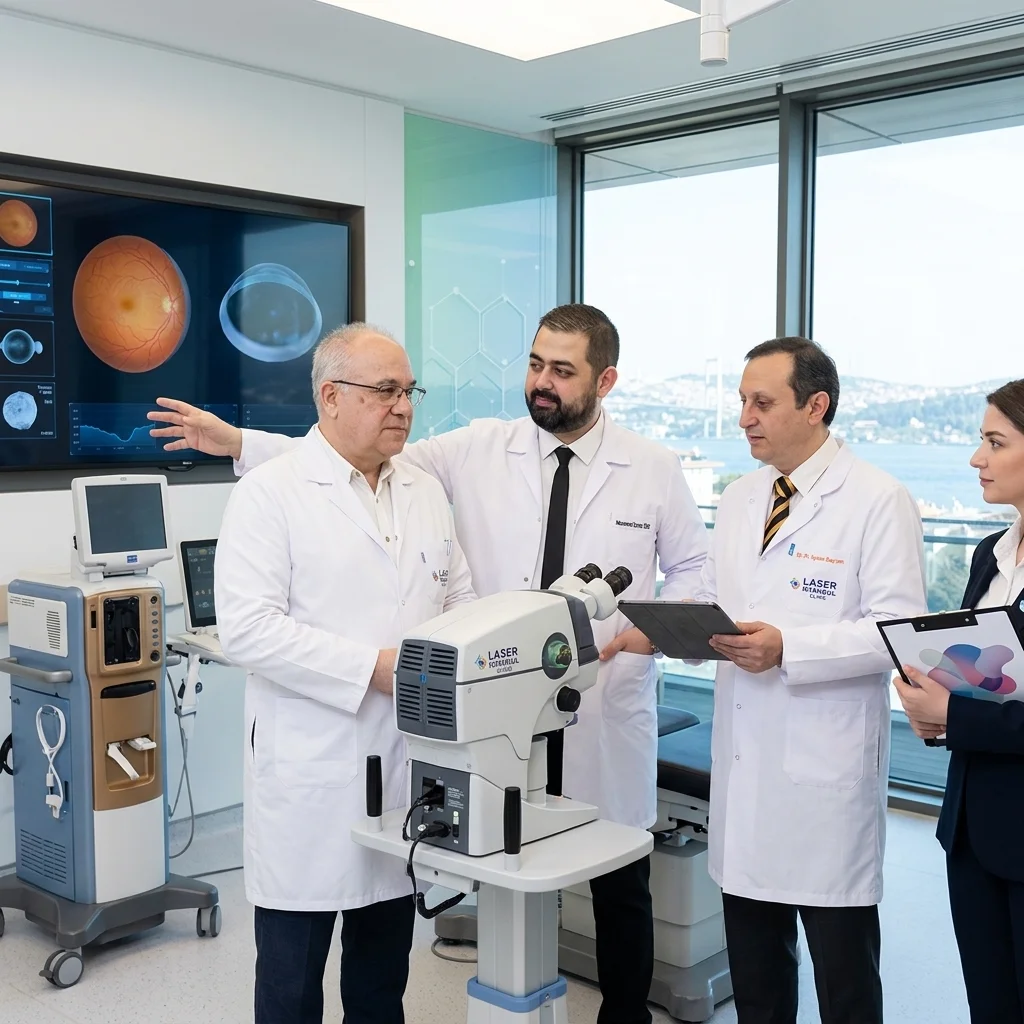
Your case is read by a surgeon, not a salesperson. Depending on your eyes, it goes to the surgeon who specialises in your problem:
- Prof. Dr. Ahmet Satıcı: cataract, premium lens replacement (refractive lens exchange, trifocal lenses), laser eye surgery (LASIK, SMILE Pro, PRK), ICL lenses, eyelid surgery, squint and glaucoma
- Doç. Dr. Muhammet Derda Özer (Doç. means Associate Professor): cornea, keratoconus, cross-linking, corneal transplant, retina, uveitis and eye tumours, as well as cataract
- Op. Dr. Aysan Bayram: cataract, laser eye surgery and retinal disease
You then receive a written plan: the treatment your surgeon thinks may suit you, why, the alternatives, your surgeon's name and your price. The price includes your pre-operative examination and scans, surgery by your named surgeon, medication, follow-up checks in Istanbul, a personal interpreter, your coordinator and remote follow-up after you go home. Hotel and airport transfers are not included; we can book them for you at a separate charge. Flights are not included either.
At this stage the plan is provisional. The final decision is always made after your full examination in Istanbul, because measurements taken on modern equipment can change what is safest for your eyes.
Step 3: Talk to your surgeon by video, then take your time
You can speak to the surgeon who will operate on you before you book. A short video call lets you ask about the procedure, the lens or laser type, the risks for your eyes and what recovery will feel like. An interpreter can join the call.
The Royal College of Ophthalmologists (RCOphth), the UK professional body for eye surgeons, advises meeting the surgeon who will perform your procedure and taking at least a week after that consultation to think things through before surgery. It also says only the operating surgeon should advise you on the choice of procedure and take your consent, and that you should never feel rushed by limited-time offers. When you're travelling for surgery, the sensible way to follow that advice is to have the conversation by video and do your thinking at home, before you fly.
Questions worth asking on the call:
- Why is this procedure right for my eyes, and what are the alternatives?
- What are the most common complications you see with it, and how are they treated?
- How long should I stay in Istanbul, and when can I fly home?
- What will I be able to do, and not do, in the first weeks?
Step 4: Book your dates
Once you're ready, you fix your dates with your surgeon and pay a deposit. {{payment terms: deposit amount, how it is paid, when the balance is paid and when the deposit is refundable}}. Your quote states what is included and what isn't, and nothing is added later without your agreement.
Then:
- Flights: you book your own, once your surgeon has confirmed your dates. A flexible return fare is a good idea in case your surgeon wants one more check before you fly.
- Hotel and airport transfers: optional, at a separate charge. Tell us if you'd like us to book them; if you prefer to arrange your own, that's fine too.
- Visa: many visitors, including British, Irish, EU, US, Canadian and Australian passport holders, can visit Turkey without a visa for short stays. Rules change, so check the current rules for your passport before you book; we send a supporting letter if you need one.
- A companion: you're welcome to bring someone. It helps on surgery day, when you shouldn't travel around the city alone.

Step 5: Prepare before you travel
Good preparation protects the accuracy of your measurements. Your coordinator sends you a checklist for your treatment. The most important points:
Contact lenses. Lenses change the shape of the cornea for weeks, and measurements taken too soon can lead to the wrong treatment plan. Before laser eye surgery, the US Food and Drug Administration (FDA) advises stopping soft lenses for 2 weeks, toric soft or rigid gas-permeable lenses for at least 3 weeks, and hard lenses for at least 4 weeks before the baseline examination. Your surgeon will confirm what applies to you, including for lens and cataract surgery.
Medicines. Bring a list of every medicine you take, and the medicines themselves. The RCOphth says you can eat and drink normally before laser surgery and should take your regular medication as usual, unless your surgeon tells you otherwise.
Make-up and creams. The FDA advises avoiding creams, lotions, make-up and perfume the day before laser surgery. Bring clean glasses or sunglasses rather than contact lenses.
What to bring:
- Passport, and a copy of your written plan
- Your glasses, your latest prescription and any previous eye reports or scans
- Your medicines and a list of them
- Sunglasses (eyes are often sensitive to light after surgery)
- Comfortable clothes for surgery day, and something to listen to while you rest
- Travel insurance details. Standard travel insurance doesn't normally cover you if you travel for elective surgery, according to the UK government, so look for a policy that covers treatment abroad
Step 6: Arrival and your full eye examination
Your full examination with your surgeon is usually the morning after you arrive. It's the most important appointment of the trip, and it can take a few hours because your pupils may be dilated. Typical tests include:
| Test | What it measures |
|---|---|
| Refraction | Your exact prescription |
| Corneal topography | The shape of your cornea |
| Corneal thickness | How much tissue there is to work with |
| Wavefront scan | An optical map of your eye, used for laser treatments |
| Biometry | Eye length and lens power, for lens and cataract surgery |
| Eye pressure | Screening for glaucoma |
| OCT scan and retina check | The health of the back of your eye |
Your surgeon then explains the results and confirms the plan, through your interpreter. If the scans show that another treatment would suit you better, or that surgery isn't safe for you, your surgeon will tell you, even after you've travelled. You won't be operated on to fit a booking.
Before surgery, your surgeon goes through the risks for your eyes with you and takes your consent in person, with your interpreter beside you. Ask anything that isn't clear.
Step 7: Surgery day, what to expect
Most laser and lens procedures take under 30 minutes, and you go back to your hotel the same day. Your surgery takes place in a fully equipped, Ministry of Health–licensed operating theatre in Istanbul, and your coordinator gives you the address before you travel.
Laser eye surgery (LASIK, SMILE Pro, PRK). According to the RCOphth, all laser vision correction is done with eye-drop anaesthetic while you lie down and stay awake, looking at a target light. A small clip holds your eyelids open, so you don't need to worry about blinking. Both eyes are usually treated in the same session, which typically takes about half an hour. Afterwards, rest with your eyes closed and use lubricating drops often for the first few hours.
Lens replacement and cataract surgery. The NHS describes cataract surgery as usually taking 20 to 45 minutes under local anaesthetic, so you're awake but don't feel pain, and you go home the same day. Don't drive yourself home, and it's best to have someone with you. Refractive lens exchange is the same operation, done to reduce your need for glasses. When both eyes need lens surgery, the NHS notes they are treated on separate days; your surgeon plans the gap between them and tells you whether both eyes can be done in one stay.
Other treatments. Cross-linking, ICL, corneal transplant, retina, glaucoma and eyelid surgery each have their own routine. Your surgeon explains yours in your written plan, including how long you'll need in Istanbul.
Your interpreter stays with you before, during and after surgery, so you understand every instruction.
Step 8: Check-ups in Istanbul and "fit to fly"
Your surgeon checks your eyes again before you leave Istanbul. For laser surgery, the FDA advises a first check within 24 to 48 hours. The number of check-ups depends on your treatment, and your surgeon signs you off to fly only when your eye is ready.
Typical time in Istanbul, from the examination to the last check-up:
| Treatment | Usual stay in Istanbul | When most patients can fly |
|---|---|---|
| Laser eye surgery (LASIK, SMILE Pro, PRK) | 3–5 days | 1–3 days after surgery, once checked |
| Lens replacement (RLE) or cataract surgery | 5–7 days | About 3–7 days after surgery, once checked |
| Retina surgery with a gas bubble | Your surgeon will tell you | Not until the gas has gone, often several weeks |
| Cornea, ICL, glaucoma and eyelid surgery | Your surgeon will tell you after reviewing your case | Your surgeon confirms at your last check-up |
Why the gas bubble matters: after some retinal detachment operations, a bubble of gas is placed in the eye, and the NHS says you may need to avoid flying. You may also be asked to keep your head in a particular position for up to 7 days. If your treatment might involve a gas bubble, your surgeon plans your dates around it before you book flights.
Use any spare days gently. Most surgeons recommend no swimming for at least a week after laser surgery (RCOphth); the FDA advises avoiding swimming pools and hot tubs for 1–2 months after LASIK, so follow your own surgeon's instructions. Gym and jogging are usually fine from day one after laser surgery, but contact sports should wait at least a month after LASIK.

Step 9: Going home and remote follow-up
You leave Istanbul with your full records and a plan. You go home with:
- Your surgical report in English
- For lens and cataract surgery, the exact lens model and power
- Your eye-drop schedule (after cataract surgery, the NHS says drops are usually needed for about 4 weeks)
- Direct contact details for your coordinator, and the name of the doctor responsible for your aftercare
Back home, your coordinator stays in touch and your surgeon reviews your recovery by video at agreed intervals: {{remote follow-up schedule, e.g. 1 week, 1 month and 3 months after surgery}}. If you need to be seen in person, we help you arrange it with a local optometrist or ophthalmologist and send them your records.
Your eyes keep settling for months. After laser surgery, the RCOphth says some changes in vision and comfort are normal in the early weeks; dry, gritty eyes and glare at night usually improve within a few months, and it can take up to two years for the result to stabilise fully. Red blotches on the white of the eye are common and can take up to 6 weeks to fade. Keep every review appointment, even if your eyes feel fine: the RCOphth points out that you may not notice a problem that needs treatment during healing.
You'll understand every step, in your language
Every patient has a personal interpreter in Istanbul, at the examination, the consent discussion, on surgery day and at every check-up. Your interpreter covers {{languages your team covers}}, and your written documents are provided in English. Doç. Dr. Özer and Op. Dr. Bayram speak English; the interpreter joins anyway, so nothing is lost in the conversations that matter most.
Your coordinator is a separate role: one person who organises your dates, appointments, records and messages from your first WhatsApp to your last video check-up. You never have to work out who to call.
Planning your trip around your surgery
A few practical points make the trip easier:
- Arrive the day before your examination. Flights to Istanbul take about 4 hours from London and about 3 hours from most German and Dutch airports, so most patients from Europe arrive in the afternoon or evening.
- Choose your hotel area with your coordinator. Istanbul is large and traffic is heavy. A hotel close to where you'll be treated saves time on examination and surgery days. Hotel and airport transfers are a separate charge if you'd like us to book them.
- Keep the first days quiet. Plan sightseeing for after your surgeon has checked you, and wear sunglasses outside. Avoid dusty places, pools and the sea until your surgeon says it's safe.
- Fly when your surgeon says so. The UK government's advice for anyone travelling for treatment is to check when you can fly home before you book your return.
When to contact us, and when to get urgent help
Most problems after eye surgery can be treated, but some need help quickly. Your coordinator is your first contact for questions about drops, appointments and normal healing.
Contact your surgeon without delay if you have increasing pain, increasing sensitivity to light, increasing redness or blurred vision, or an injury to the eye followed by pain, blurring or watering (RCOphth).
Get urgent medical help first, then tell us, if you notice new floaters, flashes of light, a dark curtain or shadow across part of your vision, or vision that suddenly becomes blurred. After cataract or lens surgery these can be signs of a retinal detachment, which needs urgent treatment. In the UK, call NHS 111 or go to an eye casualty or emergency department.
If something goes wrong: {{complication policy: what the surgeons cover if there is a complication or re-treatment is needed, for how long, whether a return trip to Istanbul is covered, and who pays for an in-person review at home}}
It's a good idea to tell your GP or optometrist about your plans before you travel and to share your records with them when you're back. The RCOphth also recommends that, if you have cataract surgery in future, you tell that surgeon you've had laser surgery, because it changes the lens calculations.
Why patients find this process easy to follow
We built the journey around a few simple promises:
- Three named surgeons only. You know who will examine you, operate and check your recovery, and you can read about their training and publications before you book.
- The same surgeon throughout, from the first review of your scans to your last check-up.
- Your price in writing before you pay a deposit, listing what's included; hotel and airport transfers are not included and are charged separately if you want us to arrange them.
- A personal interpreter and one coordinator, so you're never left guessing.
- Permission to say no. If your eyes aren't suitable, your surgeon will tell you.
Want to hear how it went for others? Read and watch our patients' stories, in their own words.
Still comparing destinations? These guides help you decide before you start:
Frequently asked questions
You send your prescription or eye reports on WhatsApp, a named surgeon reviews them and sends a written plan and price, and you can talk to that surgeon by video before booking. In Istanbul you have a full examination, then surgery with the same surgeon, then check-ups until you're cleared to fly. Back home, your surgeon follows your recovery by video.
Plan for 3–5 days for laser eye surgery and 5–7 days for lens replacement or cataract surgery, including your examination, surgery and check-ups. Cornea, retina, ICL, glaucoma and eyelid treatments vary, so your surgeon tells you after reviewing your case. If you're having retina surgery with a gas bubble, you'll need to stay or wait much longer before flying.
Most patients can fly 1–3 days after laser eye surgery and about 3–7 days after lens or cataract surgery, once their surgeon has checked the eye. After retina surgery that uses a gas bubble, flying isn't safe until the gas has gone, which often takes several weeks. Your surgeon confirms you're fit to fly at your last check-up.
Yes, usually. For laser eye surgery the FDA advises stopping soft lenses for 2 weeks, toric soft or rigid gas-permeable lenses for at least 3 weeks, and hard lenses for at least 4 weeks before the examination, because lenses change the shape of the cornea. Your surgeon will confirm the right break for your lenses and your treatment.
Yes. Your surgeon reviews your case before you book, and you can ask questions by video call, with an interpreter if you wish. The Royal College of Ophthalmologists advises taking at least a week after that conversation to decide, and when you're travelling, it's best to do that at home before you fly.
No. Your price includes your examination and scans, surgery by your named surgeon, medication, follow-up checks in Istanbul, a personal interpreter, your coordinator and remote follow-up. Hotel and airport transfers are a separate charge, and we can book them for you if you ask. Flights are not included.
Laser and lens surgery are done with numbing drops or local anaesthetic, so you shouldn't feel pain during the operation, only some pressure. Afterwards your eyes may feel gritty, watery or sensitive to light. After surface laser treatments such as PRK, the eye is normally very sore for a few days while the surface heals, and your surgeon gives you drops and medicine for comfort.
No. A personal interpreter joins every appointment in Istanbul, and your written documents are provided in English. Doç. Dr. Özer and Op. Dr. Bayram also speak English.
Yes, and it helps on surgery day, when you shouldn't drive or travel around the city alone. Your companion's flights and hotel room are booked and paid separately; we can arrange a twin or family room if we book your hotel.
Contact your coordinator straight away; your surgeon reviews your eye by video and, if you need to be seen in person, we help you arrange it locally and send your records. For sudden flashes, new floaters, a shadow in your vision or worsening pain, get urgent medical help first. {{complication policy, one sentence}}
Sources for the facts on this page
- US Food and Drug Administration, What should I expect before, during, and after LASIK surgery?: contact-lens breaks (soft 2 weeks; toric soft or RGP at least 3 weeks; hard at least 4 weeks); avoid creams, lotions, make-up and perfume the day before; arrange transport; procedure under 30 minutes; first check within 24–48 hours; avoid swimming and hot tubs for 1–2 months; at least four weeks before strenuous contact sports. https://www.fda.gov/medical-devices/lasik/what-should-i-expect-during-and-after-surgery
- NHS, Cataract surgery: usually 20–45 minutes under local anaesthetic; home the same day, don't drive yourself home; drops for about 4 weeks; avoid rubbing, swimming, eye make-up and heavy lifting until told otherwise; both eyes treated on separate days; urgent signs (new floaters, flashes, dark curtain or shadow, sudden blurring: call NHS 111). https://www.nhs.uk/tests-and-treatments/cataract-surgery/
- NHS, Retinal detachment: treatment: you may need to avoid flying if a gas bubble has been put into your eye; positioning for up to 7 days; blurred vision and time off driving and work for 2–6 weeks. https://www.nhs.uk/conditions/retinal-detachment/treatment/
- GOV.UK, Medical emergencies, treatment and hospitalisation abroad: check when you can fly home; standard travel insurance does not normally cover elective surgery abroad; healthcare after treatment may be limited. https://www.gov.uk/guidance/in-hospital-abroad
Start with one message
Send us your prescription or eye report and your questions. Prof. Dr. Satıcı, Doç. Dr. Özer or Op. Dr. Bayram will tell you which treatment may suit your eyes, how long you'd need in Istanbul and what it would cost, with no obligation. You'll get a reply within {{response time}}.
3 eye surgeons
Your case is reviewed by a named surgeon, not a salesperson. Reply within {{response time}}.
 Prof. Dr. Ahmet Satıcı
 Doç. Dr. Muhammet Derda Özer
 Op. Dr. Aysan Bayram