
- Home: eye surgery in Istanbul
- All eye treatments
- Keratoconus treatment in Turkey
Keratoconus Treatment in Turkey: Cross-Linking, Corneal Rings and Transplant in Istanbul
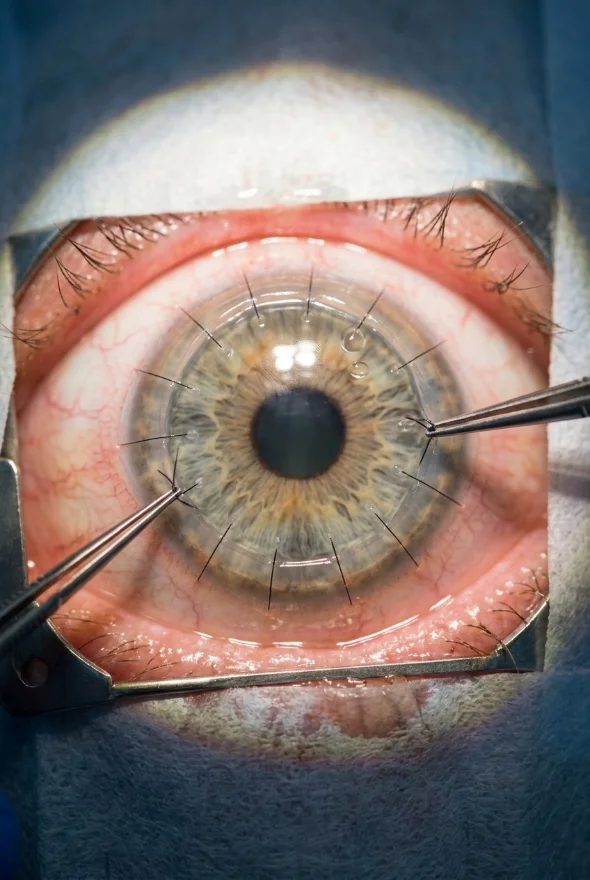
Keratoconus treatment in Turkey aims first to stop the cornea getting weaker, usually with corneal cross-linking (CXL), and then to restore sharp vision with specialist contact lenses, corneal rings, an implantable lens or, in advanced cases, a corneal transplant. At Laser Istanbul Clinic, cornea specialist Doç. Dr. Muhammet Derda Özer reviews your scans, recommends the right step for your stage, and treats you in Istanbul, with cross-linking from {{£ price}} per eye.
What is keratoconus?
Keratoconus is an eye condition in which the cornea, the clear dome at the front of the eye, gradually thins and bulges forward into a cone shape. Because the cornea does most of the eye's focusing, the cone bends light unevenly, and vision becomes blurred and distorted in a way that glasses correct less and less well. According to the American Academy of Ophthalmology (AAO), keratoconus often starts in the late teens or early twenties and can progress over about 10 to 20 years. It does not cause blindness, as NHS patient information points out, but without treatment it can seriously affect reading, driving and work.
It is also more common than once thought. The figure often quoted is 1 in 700 people (EyeWiki), but a 2017 nationwide study of 4.4 million people in the Netherlands found a prevalence of about 1 in 375, with an average age at diagnosis of 28 and 61% of patients male. EyeWiki notes higher rates in the Middle East, India, China and Australia.
Symptoms: how keratoconus shows itself
The AAO lists these signs:
- Early stage: mild blurring, slightly distorted vision in which straight lines look bent or wavy, more sensitivity to light and glare, and sometimes redness or swelling of the eye.
- Later stage: more blurring and distortion, increasing short-sightedness and astigmatism, and contact lenses that no longer fit or feel comfortable.
A glasses prescription that keeps changing, especially rising astigmatism in a teenager or young adult, is the classic warning sign. Our free astigmatism test can show you whether your focus is uneven, but only a corneal scan can diagnose keratoconus.
Who gets keratoconus?
The cause is not fully understood. The AAO and EyeWiki list these risk factors:
- Family history: about 1 in 10 people with keratoconus has a parent with it (AAO).
- Eye rubbing, often linked to eye allergies (atopy, vernal keratoconjunctivitis). EyeWiki describes eye rubbing in genetically predisposed people as a driver of both onset and progression.
- Allergic conditions such as asthma and eczema.
- Some general conditions: Down syndrome, connective-tissue disorders (Marfan and Ehlers-Danlos syndromes), sleep apnoea and hormonal change in pregnancy.
The single most useful thing you can do today is the simplest: stop rubbing your eyes. The AAO warns that rubbing damages thin corneal tissue and makes symptoms worse.
Who keratoconus treatment in Turkey suits
Keratoconus treatment is planned around two questions: is your keratoconus getting worse, and how well can you see? Your answer to each decides the treatment.
You are likely to benefit from an assessment with Doç. Dr. Özer if:
- You have been diagnosed with keratoconus and your scans show it is progressing. Progression is usually defined as an increase of 1 dioptre (1D) or more in the steepest corneal reading over 12 months, a rise of 1D or more in astigmatism, or a 0.5D or greater shift in overall prescription (EyeWiki). This is the main reason for cross-linking.
- You are a teenager or young adult. Keratoconus progresses faster in patients aged 18 and under (EyeWiki), so early treatment matters most at this age.
- Your vision is no longer good enough in glasses or contact lenses, or you cannot tolerate rigid lenses. This is when vision-improving treatments such as corneal rings, an implantable lens or a transplant are considered.
- You were told you are not suitable for laser eye surgery because your scans showed a thin or irregular cornea.
- You want a second opinion on a treatment already proposed at home.
Keratoconus stages: what "stage 2" means
The most widely used grading is the Amsler-Krumeich classification, which places an eye in stage 1 to 4 by its prescription, corneal curvature (K reading), thickness and any scarring:
| Stage | Prescription (myopia and/or astigmatism) | Mean corneal curvature (K) | Thinnest cornea | Scarring |
|---|---|---|---|---|
| Stage 1 | under 5D | 48D or less; eccentric steepening | — | none |
| Stage 2 | 5–8D | under 53D | over 400 µm | none |
| Stage 3 | 8–10D | over 53D | 200–400 µm | none |
| Stage 4 | not measurable | over 55D | under 200 µm | central scar |
Criteria as summarised by Khorrami-Nejad et al., Journal of Ophthalmic and Vision Research, 2019. Newer systems such as Belin's ABCD grading add the back surface of the cornea and your corrected vision.
Keratoconus stage 2 is moderate disease with a cornea that is still thicker than 400 µm and free of scarring. That matters because 400 µm is the standard minimum thickness for conventional cross-linking (EyeWiki), so stage 1 and 2 eyes are usually good candidates if they are progressing. Thinner corneas can sometimes still be cross-linked with modified protocols. A stage tells you the shape of the cornea at one moment; whether it is changing is what decides treatment.
Keratoconus in one eye only?
Keratoconus usually affects both eyes, but often unevenly. EyeWiki describes most cases as bilateral but asymmetric, and the "better" eye may show only high astigmatism or mild steepening on a scan. So if you have been told you have keratoconus in one eye only, the other eye still needs regular corneal scans, and each eye is treated on its own merits. If one eye is progressing, it can be cross-linked while the other is monitored.
Keratoconus treatment options compared
Keratoconus treatments fall into two groups: treatments that stop the disease getting worse (cross-linking) and treatments that improve vision (lenses, corneal rings, implantable lenses and transplant). Many patients need one from each group.
| Glasses and specialist contact lenses | Corneal cross-linking (CXL) | Corneal rings (ICRS, e.g. Intacs) | Toric ICL (implantable lens) | Corneal transplant (DALK or PK) | |
|---|---|---|---|---|---|
| Main aim | Sharper vision | Stop progression | Flatten the cone, improve vision | Correct short sight and astigmatism | Replace a scarred or very thin cornea |
| How it works | Rigid, hybrid or scleral lenses create a smooth new optical surface | Riboflavin (vitamin B2) drops plus UV light stiffen the corneal collagen | Two small curved plastic segments placed deep in the cornea | A thin lens placed inside the eye, in front of your natural lens | Donor tissue replaces the front layers (DALK) or the full thickness (PK) |
| Typical stage | All stages | Progressive keratoconus, cornea usually ≥ 400 µm | Mild to moderate, clear central cornea, contact-lens intolerance | Stable keratoconus, often after CXL | Advanced: scarring, very thin cornea, lenses no longer work |
| Stops progression? | No | Yes, in more than 90% of cases | No (often combined with CXL) | No | Replaces the diseased tissue |
| Removable or reversible? | Yes | No | Yes, segments can be removed | Yes, can be removed | No |
| Recovery | None | Sore 1–3 days; vision settles over weeks to months | Usually quicker than transplant; your surgeon advises | Usually quick | Up to 18 months (DALK) or 2 years (PK) for full visual recovery |
| Price | Fitted at home or in Istanbul | from {{£ price}} per eye | from {{£ price}} per eye | from {{£ price}} per eye | from {{£ price}} per eye |
Sources: EyeWiki (AAO), NICE guidance HTG319 (formerly IPG466), NHS patient information, Vega-Estrada and Alió 2016, Antonios et al. 2015. Your surgeon recommends a plan only after examining your eyes.
Glasses and specialist contact lenses
In early keratoconus, glasses or soft contact lenses are often enough. As the cornea becomes more irregular, rigid gas-permeable (RGP) lenses usually give much sharper vision because they replace the uneven cone with a smooth optical surface. EyeWiki notes that most people who can wear hard or gas-permeable lenses see a dramatic improvement. If rigid lenses are uncomfortable, there are other designs: hybrid lenses (a rigid centre with a soft skirt), "piggyback" lenses (a rigid lens over a soft one) and large scleral lenses that rest on the white of the eye and vault over the cornea.
Lenses do not stop keratoconus progressing, which is why a progressing eye is usually cross-linked as well. Contact lenses are fitted by a specialist optometrist; we recommend you keep your lens fitter at home and send us their records.
Keratoconus NHS contact lenses: in the UK, hospital contact lens services fit lenses when there is a medical need, usually when vision cannot be improved enough with glasses but can with contact lenses, and keratoconus is one of the listed conditions. Patients pay a set NHS charge per lens (one NHS trust listed £60.75 in 2023), with exemptions such as being under 16, or 16–18 and in full-time education. You are normally referred through your GP or optometrist to the hospital eye service.
Corneal cross-linking (CXL): the treatment that can stop keratoconus
Corneal cross-linking is the only treatment that can stop keratoconus getting worse. Riboflavin (vitamin B2) drops are soaked into the cornea and then activated with a controlled dose of ultraviolet-A light. This creates new bonds (cross-links) between the collagen fibres, stiffening the cornea in the same way it naturally stiffens with age from the thirties onwards. In the UK, NICE guidance says the evidence on standard epithelium-off CXL is adequate in quality and quantity for normal use. The US Food and Drug Administration approved cross-linking in April 2016 (EyeWiki).
How well does it work? NHS patient information reports that cross-linking stops progression in more than 90% of cases, with a large UK eye hospital's own figures since 2013 at about 94% and fewer than 1% needing a repeat treatment. In US trials summarised by EyeWiki, the steepest corneal reading flattened by an average of 1.6D, about a third of patients gained some corrected vision and about 5% lost some. It also reduces the need for transplants: in the Netherlands, about 25% fewer corneal transplants for keratoconus were performed in the three years after CXL was introduced nationally than in the three years before (201 versus 269).
What it does not do: cross-linking aims to stabilise vision, not to improve it. Some people see a little better a year later as a bonus, but you will usually still need glasses or contact lenses afterwards.
Epithelium-off, accelerated and epithelium-on. In the standard (Dresden) protocol, the thin surface skin of the cornea is removed, riboflavin is applied for about 30 minutes and UV light is given for 30 minutes. Accelerated protocols use a stronger light for a shorter time, for example about 10 minutes. Epithelium-on ("epi-on") cross-linking leaves the surface skin in place, which is more comfortable. NICE (2013) judged the evidence for epi-on and combined "CXL-plus" procedures to be limited, and in October 2025 the FDA approved the first epithelium-on cross-linking drug system (EyeWiki). Doç. Dr. Özer explains which protocol suits your cornea and why.
Who is it for? People whose keratoconus is progressing, usually with a cornea at least 400 µm thick at its thinnest point. NHS patient information notes that CXL is generally not needed after the mid-30s, because keratoconus tends to stop progressing as the cornea stiffens naturally with age; your scans decide, not your age alone.
Corneal rings (intracorneal ring segments, ICRS / Intacs)
Corneal rings are two small, curved segments of medical plastic placed in a tunnel deep in the outer cornea, away from the centre of vision. They flatten the cone and move its tip back towards the centre. In a 2016 review in Eye and Vision, Vega-Estrada and Alió report an average flattening of 3–5D, with the best gains in people whose vision was poor before surgery; people who already see well in lenses risk losing some sharpness. Rings suit people with reduced vision who cannot tolerate contact lenses and have a clear central cornea. Possible complications include the segments moving or working their way out, infection, haze and thinning over a segment. A real advantage is that the segments can be removed. Because rings do not stop progression by themselves, they are often combined with cross-linking.
Corrective eye surgery for keratoconus: laser, ICL and lens surgery
Many people search for corrective eye surgery for keratoconus hoping for LASIK. Standard laser eye surgery thins and weakens the cornea further, so the FDA and the AAO list keratoconus as a reason not to have LASIK. There are safer ways to reduce your dependence on glasses once the cornea is stable:
- Toric ICL (implantable collamer lens): a thin lens placed inside the eye corrects short sight and astigmatism without removing corneal tissue. In a 2015 study of 30 eyes treated with a toric ICL six months after cross-linking, 60% saw 20/30 or better without glasses at one year, and no eye lost two or more lines of corrected vision (Antonios et al.). Prof. Dr. Ahmet Satıcı implants ICLs. ICL / EVO ICL implantable lens →
- Surface laser combined with cross-linking: in selected eyes, a carefully limited topography-guided surface laser is combined with CXL to smooth the cornea. NICE describes the evidence for such combined "CXL-plus" procedures as limited, so this is only for carefully chosen corneas. Laser eye surgery in Turkey / Istanbul →
- Lens or cataract surgery: if you also have a cataract, or are older and want lens replacement, the lens calculation is harder in keratoconus because the corneal readings are less reliable and can lead to a long-sighted "surprise" (EyeWiki). Toric lens implants are recommended only in stable, mild to moderate keratoconus, and you must leave out rigid contact lenses for several weeks before measurements. Lens replacement (RLE / smart lens) in Turkey → · Cataract surgery in Turkey / Istanbul (/en/cataract-surgery-turkey/)
Corneal transplant for advanced keratoconus
A transplant is considered when the cornea is scarred or too thin and contact lenses no longer give useful vision. Without cross-linking, between 10% and 20% of people with keratoconus eventually need one (Godefrooij et al., 2016). There are two main options:
- DALK (deep anterior lamellar keratoplasty): replaces the front and middle layers and keeps your own inner layer (endothelium), so there is no risk of endothelial rejection. NHS information gives up to 18 months for full visual recovery.
- PK (penetrating keratoplasty): a full-thickness transplant held with stitches, with up to two years for full visual recovery (NHS).
Keratoconus transplants do well. In a 2023 British Journal of Ophthalmology study of 502 eyes, graft survival at 20 years was 97.0% after DALK and 94.9% after PK, and vision improved on average from about 20/378 to about 20/32. The authors concluded that DALK may be the better choice when it is possible, because it preserves more of the eye's own endothelial cells. Partial transplants of the inner layers (DMEK and DSAEK) are used for other corneal diseases rather than for keratoconus itself.
Is orthokeratology a treatment for keratoconus?
No. Orthokeratology (pronounced or-tho-ker-a-TOL-o-gee, often shortened to ortho-k) uses specially designed rigid contact lenses, worn overnight, to temporarily flatten a healthy cornea so that you can see without glasses during the day (AAO). It is used mainly for short sight, in adults and in children. It does not strengthen the cornea, and the effect wears off when you stop wearing the lenses. Keratoconus needs the opposite: a cornea that is made stronger and kept stable.
Corneal mapping before fitting is used to screen out people with keratoconus or an irregular cornea (Charm, Clinical Optometry, 2017), and a 2026 pilot study described the safety of ortho-k in keratoconus as "largely unexplored and potentially controversial".
Is orthokeratology safe? For suitable eyes and careful wearers, it is an established treatment, but any overnight lens carries a risk of corneal infection (microbial keratitis). A US study estimated 13.9 cases per 10,000 patient-years of wear in children, similar to other overnight contact lenses (Bullimore et al., 2013), and the AAO highlights that children may find lens hygiene harder.
Where to buy orthokeratology lenses (UK and elsewhere): ortho-k lenses are custom-fitted medical devices. They should be fitted and monitored by an optometrist or ophthalmologist after corneal mapping, not bought online. If you have keratoconus, ask your eye specialist before trying any reshaping lens. We do not offer orthokeratology.
How much is keratoconus treatment in Turkey?
Keratoconus treatment in Istanbul with Laser Istanbul Clinic starts from {{£ price}} per eye for corneal cross-linking. Doç. Dr. Özer confirms your treatment plan and exact price in writing after reviewing your scans, before you book flights.
| Treatment | Laser Istanbul Clinic |
|---|---|
| Corneal cross-linking (CXL), per eye | from {{£ price}} |
| Corneal rings (ICRS), per eye | from {{£ price}} |
| Corneal rings combined with cross-linking, per eye | from {{£ price}} |
| Toric ICL after cross-linking, per eye | from {{£ price}} |
| Corneal transplant (DALK or PK), per eye | from {{£ price}} |
Your price includes:
- full pre-operative examination and corneal scans (topography, tomography and thickness mapping) with your surgeon;
- treatment by your named surgeon, using the method agreed in your quote;
- medication and eye drops for your recovery;
- follow-up checks in Istanbul with the same surgeon;
- a personal interpreter for every appointment, a dedicated coordinator, and remote follow-up after you return home.
Not included: flights, hotel and airport transfers. Hotel and transfers are a separate charge, and we are happy to arrange them for you if you ask.
Typical published prices per eye (USD, 2025–26):
| Treatment | UK private | USA | Istanbul (typical published) |
|---|---|---|---|
| Corneal cross-linking | $2,400–4,700 | $2,500–6,000 | $1,400–2,240 |
| Corneal transplant | $8,000–14,000 | $13,000–28,000 | $4,000–7,000 |
Typical ranges advertised by clinics and price-comparison sites in 2025–26, not quotes. Published Istanbul prices are often packages that bundle a hotel and transfers; ours cover your medical treatment, with hotel and transfers charged separately if you want them. We have no reliable published price data for corneal rings.
On these figures, cross-linking in Istanbul typically costs about 45–50% less than private treatment in the UK, and a corneal transplant up to about 73% less than in the USA. In the UK, cross-linking for progressive keratoconus is available on the NHS. Some patients choose private treatment, at home or abroad, to choose their surgeon or their timing; if you can be treated promptly at home, that is a good option too.
Your keratoconus specialist in Istanbul
Keratoconus treatment with us is led by our cornea specialist. You know who will treat you before you book, and the same surgeon examines you, treats you and checks your recovery.



Your keratoconus treatment in Istanbul, step by step
Your stay depends on the treatment: plan {{nights in Istanbul for cross-linking}} for cross-linking and {{nights in Istanbul for a corneal transplant}} for a transplant. Doç. Dr. Özer tells you how many nights to book once he has seen your scans.
- Send your scans (free)
Upload your corneal topography or tomography scans, your glasses or contact-lens prescription and any eye reports through our free consultation form or on WhatsApp. If you have older scans, send those too: comparing scans over time is how progression is shown. You get a reply within {{response time}}.
- Doç. Dr. Özer reviews your case
He tells you whether your keratoconus appears to be progressing, which treatments may suit your stage, and sends a written quote.
- Prepare at home
Your surgeon tells you how long to leave out your contact lenses before your examination, because rigid lenses temporarily change the shape of the cornea and can distort the scans. Book your flights; if you like, we arrange your hotel and airport transfer at an extra cost.
- Arrival and full examination
With your surgeon and interpreter, you have repeat corneal mapping and thickness measurements, a vision and prescription check and a full eye examination. Your surgeon compares the results with your earlier scans, explains the recommended treatment, the expected result and the risks for your eye, and you have time to ask questions before you sign the consent form.
- Treatment day
Treatment takes place in a fully equipped, Ministry of Health–licensed operating theatre in Istanbul. Cross-linking is done under numbing drops; NHS patient information describes the procedure itself as taking about 30 minutes. A soft bandage contact lens is placed on the eye afterwards. You go back to your hotel the same day.
- Check-ups in Istanbul
Your surgeon checks the surface of the eye as it heals and decides when the bandage lens can come out and when you are fit to fly.
- Fly home and stay in touch
Your coordinator stays in touch and your surgeon reviews your progress by video at agreed intervals. Repeat corneal scans, usually with your optometrist or eye doctor at home, show whether the treatment has stabilised the cornea. Your full treatment report is provided in English.
- Second eye, if needed
If both eyes need cross-linking, the second eye is often treated after the first has settled; NHS patient information notes this can take a month or longer. Your surgeon advises whether both can be planned in one trip.
Recovery after keratoconus treatment: what to expect
Recovery after epithelium-off cross-linking is like recovery after surface laser: the first few days are uncomfortable while the surface skin heals, and vision then settles over weeks to months.
| When | After cross-linking (epithelium-off) | After corneal transplant |
|---|---|---|
| First 1–3 days | Sore, watery and light-sensitive; the first 1–2 days are usually the worst. Drops and painkillers as prescribed; bandage contact lens in place | Swollen and uncomfortable for up to 2 weeks; drops as prescribed |
| Days 3–7 | Surface skin regrows, usually within 3–4 days; bandage lens removed by your surgeon | First check-ups in the first week |
| Weeks 1–2 | Vision blurred but gradually clearing; plan at least 1 week off work, 2 if your job involves a lot of screen work | About 2 weeks off work |
| Weeks 2–4 | Eye drops usually continue for about 4 weeks; contact lenses often resumed from the end of the second week to about 1 month, once the surface has healed | Stitches stay in for several months and are removed gradually |
| 1–12 months | Glasses prescription updated no earlier than 1 month; the cornea and prescription stabilise over 6 months to a year | Vision recovers over up to 18 months (DALK) or up to 2 years (PK) |
| Long term | Repeat scans confirm the cornea has stopped changing | Long-term steroid drops to reduce the risk of rejection; follow-up every few months for 1–2 years or longer |
Sources: NHS patient information on cross-linking and cornea transplant; EyeWiki. Your surgeon gives you personal dates.
Everyday activities after cross-linking (your surgeon confirms your own plan):
| Activity | Typical advice |
|---|---|
| Driving | Not for at least a week, and only when your vision meets the legal standard |
| Swimming | Not for about a week, until the surface has healed |
| Exercise | Usually allowed (NHS patient information) |
| Eye rubbing | Avoid, now and long term |
| Contact lenses | Usually from the end of week 2 to about 1 month |
Call your surgeon or coordinator without delay if you have increasing pain, redness, discharge or a sudden drop in vision.
Is keratoconus treatment safe? The risks, explained honestly
Cross-linking is a safe, well-established treatment, but it is still a procedure on your cornea, so you deserve the real numbers. Your surgeon goes through the risks for your own eyes, in writing and through your interpreter, before you agree to treatment.
Cross-linking
- Discomfort and hazy vision in the first days and weeks are expected.
- Corneal haze is very common at first (in up to 100% of eyes) and usually fades; permanent haze is reported in up to 10% (EyeWiki).
- Reduced vision afterwards affects fewer than 3% of patients, and infection fewer than 1% (NHS patient information).
- Rare but serious: corneal melting, scarring and swelling.
- The treatment may not hold. Fewer than 1% need a repeat treatment in NHS data. Young patients need closer follow-up: in Doç. Dr. Özer's 2020 study, keratoconus still progressed within two years in 35% of eyes in children aged 14 and under, compared with 4% in teenagers aged 15–18. In his long-term study of patients aged 14 and under, 20% of eyes had progressed after an average of 56 months. This is why repeat scans after treatment matter.
Corneal rings
- Segments can move or work their way out, and infection, haze, new blood vessels and thinning over a segment are possible. EyeWiki reports complication rates of up to 30% in published series. The segments can be removed, and the cornea then tends to return towards its earlier shape.
Corneal transplant
- Rejection can happen at any time and is treated with steroid drops if caught early. The warning signs are a red eye, pain, light sensitivity and blurred vision.
- Recovery is long: stitches stay in for several months, and follow-up continues every few months for 1–2 years or longer (NHS).
Doing nothing also has risks. Untreated progressive keratoconus can lead to scarring and to acute hydrops, a sudden break in the inner layer of the cornea that causes swelling, pain, watering, light sensitivity and a sharp drop in vision (EyeWiki). It is treated with drops or ointment for weeks to months until it settles.
Having treatment abroad: check who your surgeon is, their training and publications, where treatment takes place and how you will be followed up at home. We give you all of this in writing before you pay a deposit. Our policy if a problem needs treatment after you return home: {{complication and re-treatment policy}}.
Keratoconus treatment in Turkey: frequently asked questions
Cross-linking in Istanbul typically costs about $1,400–2,240 per eye in published prices, compared with about $2,400–4,700 in UK private clinics. With Laser Istanbul Clinic, cross-linking starts from {{£ price}} per eye, including your examination and scans, treatment, medication, check-ups, interpreter and remote follow-up. Flights, hotel and transfers are extra. Doç. Dr. Özer confirms your price in writing after reviewing your scans.
There is no treatment that reverses keratoconus completely, but it can usually be stopped and vision can be improved. Cross-linking stops progression in more than 90% of cases, and contact lenses, corneal rings, an implantable lens or, if needed, a transplant then restore sharper vision. Keratoconus does not cause blindness.
It depends on whether your keratoconus is getting worse and how well you see. If it is progressing, cross-linking is the first step, because it is the only treatment that can stop it. Vision is then improved with lenses, corneal rings or a toric ICL, and a transplant is kept for advanced, scarred or very thin corneas.
In the Amsler-Krumeich system, stage 2 means a prescription of 5–8 dioptres, a mean corneal curvature under 53D, no scarring and a thinnest corneal point above 400 µm. It is moderate keratoconus. If scans show it is progressing, a stage 2 cornea is usually thick enough for standard cross-linking.
It can look that way, but keratoconus usually affects both eyes to different degrees. The less affected eye may show only mild changes on a scan, so both eyes should be monitored. Each eye is treated according to its own scans.
Pain is not one of the main symptoms of keratoconus; the AAO lists light sensitivity, glare, redness and, later, uncomfortable contact lenses. Stop rubbing your eyes, ask your doctor about treating any eye allergy, and have your lens fit checked if your lenses hurt. Sudden pain with watering, light sensitivity and a sharp drop in vision can be acute hydrops and needs urgent eye care.
The treatment itself is done under numbing drops. Afterwards, the eye is usually sore, watery and light-sensitive for 1–3 days, the first 1–2 days being the worst, while the surface skin heals under a bandage contact lens. You are given drops and pain relief.
Not standard LASIK: it thins the cornea further, and keratoconus is a recognised reason not to have it. Once the cornea is stable, options include a toric ICL, or in selected eyes a limited surface laser combined with cross-linking. Your surgeon checks your scans before suggesting anything.
Yes. NICE guidance supports standard cross-linking for progressive keratoconus, and it is offered in NHS eye departments. Some patients choose private treatment, at home or abroad, to choose their surgeon or their timing. Ask your NHS eye clinic how soon you could be treated, because a progressing cornea should not wait long.
Yes, if you have a medical need. NHS hospital contact lens services fit lenses for keratoconus when glasses cannot give you good enough vision, and there is a set charge per lens unless you are exempt (for example, if you are under 16). Ask your GP or optometrist for a referral.
Often, yes. Keratoconus progresses faster in children and teenagers, and early cross-linking can protect vision. Doç. Dr. Özer's research shows that very young patients, aged 14 and under, still need close follow-up after treatment because some continue to progress.
Plan {{nights in Istanbul for cross-linking}} for cross-linking and {{nights in Istanbul for a corneal transplant}} for a transplant. Your surgeon checks the eye as the surface heals and tells you when it is safe to fly. Exact dates are confirmed after your scans are reviewed.
Sources for the facts on this page
- *Medical facts (all opened and checked, October 2026):**
- American Academy of Ophthalmology, What Is Keratoconus?: definition, early and late symptoms, onset late teens to early 20s, progression over about 10–20 years, about 1 in 10 have a parent with it, allergies, eye rubbing, connective-tissue disorders, treatment list, "avoid rubbing your eyes". https://www.aao.org/eye-health/diseases/what-is-keratoconus
- EyeWiki (AAO), Keratoconus: prevalence often reported as 1 in 700, higher in the Middle East, India, China and Australia; onset in adolescence, faster progression at ≤ 18; bilateral but often asymmetric; risk factors (eye rubbing, atopy, Down syndrome, connective-tissue disorders, sleep apnoea, pregnancy); contact lens options; most RGP wearers improve dramatically; DALK vs PK; acute hydrops; ICRS complication rates up to 30%. https://eyewiki.org/Keratoconus
- EyeWiki (AAO), Corneal Collagen Cross-Linking: progression definitions (≥ 1D Kmax in 12 months, ≥ 1D cylinder, ≥ 0.5D spherical equivalent); 400 µm minimum; Dresden protocol (30 min riboflavin, 3 mW/cm² for 30 min); accelerated 10 mW/cm² for 9 min; US trial results (Kmax −1.6D; about one-third gained, about 5% lost corrected vision); haze (temporary up to 100%, permanent up to 10%); epithelium regrowth 3–4 days; FDA approval 18 April 2016; epithelium-on system approved October 2025. https://eyewiki.org/Corneal_Collagen_Cross-Linking
- EyeWiki (AAO), Surgical Approach to Cataract Surgery with Keratoconus: unreliable keratometry, risk of hyperopic surprise, toric IOLs only in stable mild–moderate keratoconus, contact-lens holiday (soft 2 weeks, RGP 5 weeks). https://eyewiki.org/Surgical_Approach_to_Cataract_Surgery_with_Keratoconus
- NICE, Photochemical corneal collagen cross-linkage using riboflavin and ultraviolet A for keratoconus and keratectasia (HTG319, formerly IPG466, published 25 September 2013): epithelium-off evidence adequate for normal arrangements; epithelium-on and CXL-plus evidence inadequate; patient selection by corneal thickness and likelihood of progression. https://www.nice.org.uk/guidance/htg319/chapter/1-Recommendations
- NHS eye-hospital patient information (Moorfields Eye Hospital NHS Foundation Trust), Corneal cross-linking: success in more than 90%, own data about 94% since 2013, fewer than 1% need repeat treatment, not usually needed after the mid-30s, procedure under 30 minutes, bandage lens, first 1–2 days most uncomfortable, at least 1 week off work (2 for heavy screen use), contact lenses from end of week 2, glasses update no earlier than 1 month, stabilisation 6–12 months, fewer than 3% lose vision, infection under 1%, aims to stabilise not improve vision. https://www.moorfields.nhs.uk/eye-conditions/keratoconus/corneal-cross-linking · Keratoconus: "does not cause blindness", hydrops, 1 in 10 familial. https://www.moorfields.nhs.uk/eye-conditions/keratoconus · Diagnosis and treatment: CXL effective in over 94% with a single 30-minute outpatient procedure. https://www.moorfields.nhs.uk/eye-conditions/keratoconus/diagnosis-and-treatment
- NHS patient information (The Dudley Group NHS Foundation Trust), Corneal cross-linking (CXL): about 30 minutes, discomfort 2–3 days, drops about 4 weeks, no driving or swimming for at least a week, second eye after one month or longer, up to 20 in 100 untreated patients may need a transplant, rare serious risks (infection, melting, scarring, swelling). https://www.dgft.nhs.uk/pil/corneal-cross-linking-cxl/
- NHS hospital contact lens service (Kingston and Richmond NHS Foundation Trust), Contact lens service: lenses for medical need, keratoconus listed, lens types, charge £60.75 per lens (2023), exemptions. https://www.kingstonandrichmond.nhs.uk/patients-and-families/patient-leaflets/contact-lens-service
- NHS, Cornea transplant: keratoconus as a reason, 1–2 hours, about 2 weeks off work, visual recovery up to 6 months / 18 months / 2 years by type, stitches for several months, long-term drops, follow-up for 1–2 years. https://www.nhs.uk/conditions/cornea-transplant/
- US Food and Drug Administration, When is LASIK not for me?: keratoconus and thin corneas as contraindications. https://www.fda.gov/medical-devices/lasik/when-lasik-not-me
- American Academy of Ophthalmology, What Is Orthokeratology?: overnight lenses that temporarily flatten the cornea, mainly for short sight, reversible, infection risk especially in children. https://www.aao.org/eye-health/glasses-contacts/what-is-orthokeratology
- Godefrooij DA, et al. Age-specific Incidence and Prevalence of Keratoconus: A Nationwide Registration Study. Am J Ophthalmol. 2017;175:169–172 (PMID 28039037): 4.4 million insured people; prevalence 1:375; mean age at diagnosis 28.3; 60.6% male. https://pubmed.ncbi.nlm.nih.gov/28039037/
- Godefrooij DA, et al. Nationwide reduction in the number of corneal transplantations for keratoconus following the implementation of cross-linking. Acta Ophthalmol. 2016;94(7):675–678 (PMID 27213687): 10–20% eventually need a transplant; about 25% fewer transplants after CXL (201 vs 269). https://pubmed.ncbi.nlm.nih.gov/27213687/
- Khorrami-Nejad M, et al. Changes in Corneal Asphericity after MyoRing Implantation in Moderate and Severe Keratoconus. J Ophthalmic Vis Res. 2019 (Amsler-Krumeich criteria, stages 1–4). https://pmc.ncbi.nlm.nih.gov/articles/PMC6825702/
- Belin MW, et al. ABCD: A new classification for keratoconus. Indian J Ophthalmol. 2020. https://pmc.ncbi.nlm.nih.gov/articles/PMC7856970/
- Vega-Estrada A, Alió JL. The use of intracorneal ring segments in keratoconus. Eye and Vision. 2016: indications, 3–5D mean flattening, complications, explantation, combination with CXL. https://pmc.ncbi.nlm.nih.gov/articles/PMC4791885/
- Antonios R, et al. Safety and Visual Outcome of Visian Toric ICL Implantation after Corneal Collagen Cross-Linking in Keratoconus: Up to 2 Years of Follow-Up. J Ophthalmol. 2015 (30 eyes; 60% UDVA 20/30 or better at 12 months; no eye lost ≥ 2 lines). https://pmc.ncbi.nlm.nih.gov/articles/PMC4383407/
- Borderie VM, et al. Long-term outcomes of deep anterior lamellar versus penetrating keratoplasty for keratoconus. Br J Ophthalmol. 2023 (502 eyes; 20-year graft survival 97.0% DALK, 94.9% PK; vision 20/378 to about 20/32). https://pmc.ncbi.nlm.nih.gov/articles/PMC10803977/
- Deshmukh R, Gore D. Keratoconus: diagnosis and management. Community Eye Health. 2024 (CXL transformative; reduced need for transplant; PRK combined with CXL). https://pmc.ncbi.nlm.nih.gov/articles/PMC11921258/
- Ozer MD, et al. Long-Term Results of Accelerated Corneal Cross-Linking in Adolescent Patients With Keratoconus. Cornea. 2019 (PMID 31033692): 35 eyes, age ≤ 14, mean follow-up 56 months, progression in 20%. https://pubmed.ncbi.nlm.nih.gov/31033692/
- Ozer MD, et al. Comparison of the efficacy of accelerated corneal cross-linking therapy in different pediatric age groups having progressive keratoconus. Int Ophthalmol. 2020 (PMID 32488590): progression at 2 years in 35% of eyes aged ≤ 14 vs 4% aged 15–18. https://pubmed.ncbi.nlm.nih.gov/32488590/
- Charm J. Orthokeratology: clinical utility and patient perspectives. Clin Optom. 2017;9:33–40: topography screens out keratoconus before ortho-k. https://pmc.ncbi.nlm.nih.gov/articles/PMC6095568/
- Bullimore MA, et al. The risk of microbial keratitis with overnight corneal reshaping lenses. Optom Vis Sci. 2013;90(9):937–944 (PMID 23892491): 13.9 per 10,000 patient-years in children; 7.7 overall. https://pubmed.ncbi.nlm.nih.gov/23892491/
- Zhang C, et al. Orthokeratology for stable mild-to-moderate keratoconus: a pilot study. Int Ophthalmol. 2026 ("largely unexplored and potentially controversial"). https://pmc.ncbi.nlm.nih.gov/articles/PMC13090189/
- *Prices and surgeon facts (project files):**
Find out whether your keratoconus is progressing, free
Send us your corneal scans (and older ones if you have them), your glasses or contact-lens prescription and any eye report. Doç. Dr. Muhammet Derda Özer will tell you whether your keratoconus appears to be progressing, which treatment may suit your eyes, and what it would cost, with no obligation.
3 eye surgeons
Your case is reviewed by a named surgeon, not a salesperson. Reply within {{response time}}.
 Prof. Dr. Ahmet Satıcı
 Doç. Dr. Muhammet Derda Özer
 Op. Dr. Aysan Bayram