
Eye Injection for Macular Degeneration: Anti-VEGF Injections in Istanbul
An eye injection for macular degeneration delivers an anti-VEGF medicine into the eye to stop leaking blood vessels from damaging your central vision. The same intravitreal injections treat diabetic macular oedema and swelling after a retinal vein occlusion. In Istanbul they are planned and given by Doç. Dr. Muhammet Derda Özer or Op. Dr. Aysan Bayram after a full retina examination and OCT scan. You know your surgeon, your medicine and your written price before you travel, and a personal interpreter stays with you at every visit.
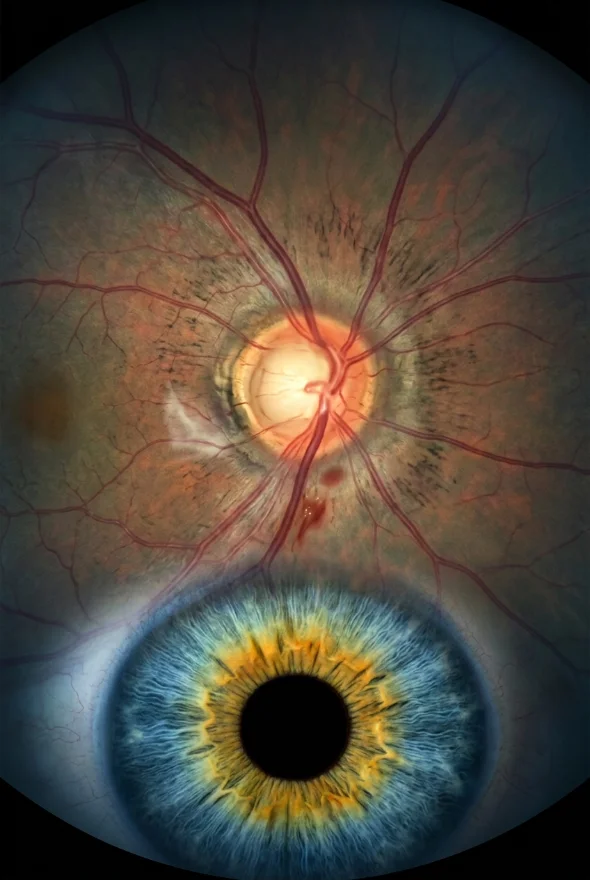
An anti-VEGF eye injection puts a tiny dose of medicine, such as aflibercept (Eylea), faricimab (Vabysmo), ranibizumab (Lucentis) or bevacizumab (Avastin), into the gel inside the eye. The injection itself takes less than 20 seconds under numbing drops. Treatment usually starts with three to four injections four weeks apart, then continues at longer intervals. According to the American Academy of Ophthalmology, it improves vision in about 1 in 3 people and stabilises it in about 9 in 10. In Istanbul, Doç. Dr. Özer or Op. Dr. Bayram treats you from {{£ price}} per injection; hotel and transfers are extra.
What is an anti-VEGF injection?
An anti-VEGF injection is a medicine injected through the white of the eye into the vitreous, the clear gel that fills the eye, so that it reaches the retina directly. This is why it is also called an intravitreal injection.
VEGF (vascular endothelial growth factor) is a protein your body makes to grow new blood vessels. In some eye diseases, the retina makes too much of it. Fragile new vessels then grow under the macula, the small central part of the retina you use for reading, driving and recognising faces, and they leak fluid and blood. The American Academy of Ophthalmology explains that anti-VEGF medicines block this protein and so reduce abnormal vessel growth and leakage.
How does an eye injection for macular degeneration work?
In wet age-related macular degeneration (wet AMD), abnormal vessels grow underneath the retina and leak. An NHS patient leaflet explains that a series of anti-VEGF injections stops these vessels growing and helps control the leakage, which prevents or limits damage to the light-sensing cells. The same leaflet states that these medicines prevent further loss of central vision in up to 90% of treated eyes.
The medicine does not stay in the eye for ever. As it wears off, the vessels can become active again, which is why injections are repeated. Your surgeon decides when the next one is due by checking your vision and an OCT scan, a quick, painless cross-section image of the retina that shows any fluid.
Who needs anti-VEGF eye injections?
Anti-VEGF injections are for eyes with active leakage or abnormal vessel growth at the back of the eye. An NHS patient leaflet notes that only patients with active leaking of blood and fluid can benefit, so your surgeon confirms this on scans before recommending them.
| Condition | What goes wrong | How injections usually start |
|---|---|---|
| Wet age-related macular degeneration | Abnormal vessels grow under the macula and leak | A loading course of three (or four, depending on the medicine) monthly injections |
| Diabetic macular oedema (DMO) | Damaged small vessels leak and the macula swells | Monthly injections at first, then monthly or less often |
| Macular oedema after retinal vein occlusion | A blocked retinal vein raises pressure, and vessels leak into the macula | Usually three monthly injections, then reviews |
| Myopic choroidal neovascularisation | In very short-sighted eyes, the stretched retina splits and new vessels grow beneath it | Often a single injection, then monthly checks |
| Proliferative diabetic retinopathy (some cases) | Fragile new vessels grow on the retina | Injections as an alternative or addition to laser |
Starting schedules: RNIB guidance on anti-VEGF treatment and the medicines' prescribing information.
What about dry macular degeneration? About 75% of people with AMD have the early or "dry" form, according to an NHS patient leaflet. The NHS states that there is currently no treatment for dry AMD, and anti-VEGF injections cannot help geographic atrophy, the late form of dry AMD in which the macula slowly wears out without leaking vessels. In the US, a different injection, pegcetacoplan (Syfovre), is approved to treat geographic atrophy; it aims to slow the damage rather than restore vision. Your surgeon can tell you which type you have and what may help. For advanced AMD, a magnifying lens implant can be an option for some people.
Who should not have anti-VEGF, or should take extra care. You should not have an injection if you are allergic to the medicine or have an infection in or around either eye. NHS guidance advises caution if you have had a heart attack or stroke in the last three months, or have uncontrolled angina or high blood pressure. Women who could become pregnant should use effective contraception during treatment and for at least three months after the last injection, and the medicines are not recommended while breastfeeding.
New, sudden distortion or a dark patch in your central vision needs prompt care. In the UK, NHS guidance is that you should be referred to a specialist within one week, and RNIB states that people with wet AMD should receive their first injection, if needed, within two weeks of referral. If this is happening to you now, do not wait for a trip abroad: get seen at home first.
Eye injection names: Eylea, Vabysmo, Lucentis, Avastin and others
The "eye injection name" you hear in clinic is usually a brand name. Five anti-VEGF medicines are in common use; the right one depends on your condition, how your eye responds and how often you can attend.
| Medicine (brand) | How it works | Typical rhythm after the first doses | Points to know |
|---|---|---|---|
| Aflibercept 2 mg (Eylea) | Blocks VEGF | Every 8 weeks or adjusted to your scans | The comparison medicine in the faricimab trials, given every 8 weeks after the loading doses |
| Aflibercept 8 mg (Eylea HD / Eylea 8 mg) | Higher dose of the same medicine | After 3 monthly doses, every 8 to 16 weeks; every 20 weeks may be considered after a year of good response (US label, 2026) | Designed for longer gaps between injections |
| Faricimab (Vabysmo) | Blocks both VEGF-A and angiopoietin-2, which helps stabilise vessels | After 4 monthly doses, intervals of 8 to 16 weeks in wet AMD (US label, 2026) | Approved in the US in January 2022 |
| Ranibizumab (Lucentis) | Blocks VEGF | Monthly at first, then adjusted | The medicine studied in the original MARINA and ANCHOR trials |
| Bevacizumab (Avastin) | Blocks VEGF | Monthly at first, then adjusted | Not licensed for use in the eye in the UK (NICE, 2018); the AAO notes that the main differences between Avastin, Lucentis and Eylea are cost and packaging |
| Brolucizumab (Beovu) | Blocks VEGF | Varies | Less commonly used; your surgeon explains if it applies |
Is one medicine better than the others? For wet AMD, the UK's NICE guideline (2018) states that no clinically significant differences in effectiveness or safety were seen between aflibercept, bevacizumab and ranibizumab in the trials it reviewed. Newer medicines mainly differ in how long they last. In the TENAYA and LUCERNE trials of 1,329 patients (The Lancet, 2022), faricimab given at up to 16-week intervals gave vision gains equivalent to aflibercept given every 8 weeks (about 5 to 7 letters gained on the eye chart after a year). If an eye still leaks after about three injections, surgeons often switch to a different medicine.
Other medicines are also injected into the eye, such as a slow-release steroid implant for some kinds of macular swelling and inflammation. They are not anti-VEGF medicines, and your surgeon tells you if one suits you better.

How many eye injections do I need?
Most people need injections for months to years, and the number depends on how active the disease stays. An NHS patient leaflet explains that many patients start with a loading course of three injections four weeks apart, and that most then need further injections, timed by how leaky the vessels are at each check.
- Loading phase. Three monthly injections for aflibercept and most other medicines; four for faricimab.
- Treat-and-extend. If the scan is dry, the gap to the next injection is lengthened step by step, usually by up to four weeks at a time, up to 12 or 16 weeks (and up to 20 weeks with aflibercept 8 mg after a year). If fluid returns, the gap is shortened again.
- Long term. An NHS patient leaflet tells patients to expect long-term management once injections start. In an expert discussion published by the American Academy of Ophthalmology, the panel noted that stopping wet-AMD treatment completely is very rare, although some stable eyes can move to monitoring with injections only when needed.
Can both eyes be injected on the same day? Yes, if both need treatment. EyeWiki (American Academy of Ophthalmology) reports that in large studies of same-day injections in both eyes, infection in both eyes was not seen, and that more than 90% of patients surveyed strongly preferred having both eyes done on the same day.
How long do eye injections take to work?
Many people notice their vision steadier or clearer within the first few injections, and most of the improvement comes in the first three months. In the original MARINA and ANCHOR trials of monthly ranibizumab, the majority of visual improvement occurred during the first three months, with little improvement after that (AAO EyeNet expert panel, 2016). The same panel noted that roughly 80% of eyes on aflibercept and 70% on ranibizumab are dry on the scan after three injections.
What to expect realistically:
- Wet AMD: the main aim is to stop vision getting worse. About 1 in 3 people gain vision and about 9 in 10 keep their vision stable (American Academy of Ophthalmology).
- Diabetic macular oedema: injections are usually given monthly at first, and the swelling may take several injections to settle (RNIB).
- Earlier is better. RNIB notes that the better your vision is when treatment starts, the better the outcome is likely to be. Scarring that has already formed cannot be reversed by injections.
Anti-VEGF injections in Istanbul: when it makes sense
Because anti-VEGF is a repeated treatment, the best place for most of your injections is usually close to home. Istanbul makes sense when the trip fits the treatment, not the other way round. Our patients usually come for one of these reasons:
A diagnosis or second opinion with full scans
You want a retina specialist to review your OCT, confirm the diagnosis, recommend the medicine and interval, and give you a written plan your own eye doctor can follow.
Starting treatment during a planned stay
Some patients have the first injection, or the full loading course, while they are in Istanbul. A loading course of three injections four weeks apart means a stay of about two months, or three short trips.
You spend long periods in Turkey
Residents, people with family in Turkey and regular visitors can keep their injections on schedule here, with reports in English for their doctor at home.
Combining treatments
If you also need cataract surgery, retinal laser or vitrectomy, your surgeon can plan injections around the operation in one trip.
Continuing at home. After each visit you receive your OCT images, the medicine and dose given, and the recommended date for the next injection, so any retina service can continue your treatment without a gap. Your coordinator keeps in touch, and your surgeon can review new scans remotely.
Eye injection cost in Istanbul, and what is included
With Laser Istanbul Clinic, anti-VEGF injections start from {{£ price}} per injection. The price depends mainly on the medicine. Your surgeon confirms the medicine and the exact price in writing after reviewing your scans, before you book anything.
| Medicine | Price per injection in Istanbul |
|---|---|
| Bevacizumab (Avastin) | {{£ price: bevacizumab}} |
| Ranibizumab (Lucentis) | {{£ price: ranibizumab}} |
| Aflibercept 2 mg (Eylea) | {{£ price: aflibercept 2 mg}} |
| Aflibercept 8 mg (Eylea HD / 8 mg) | {{£ price: aflibercept 8 mg}} |
| Faricimab (Vabysmo) | {{£ price: faricimab}} |
Your treatment price includes:
- a retina examination with dilating drops and an OCT scan before each injection
- the injection by your named surgeon, and the medicine
- eye drops and any medication you need afterwards
- follow-up checks in Istanbul with the same surgeon
- a personal interpreter, a dedicated coordinator and remote follow-up after you return home, including your scan reports for your doctor at home
Not included: flights, hotel and airport transfers. Hotel and transfers are a separate charge, and we arrange them for you if you ask.
Vabysmo injection cost in the UK. On the NHS, anti-VEGF injections are free for patients who meet NICE criteria. Privately, you pay for the medicine plus the consultation, scans and procedure. For reference, NICE lists faricimab (Vabysmo) at £857 per vial and aflibercept 2 mg (Eylea) at £816 per vial, both excluding VAT; the NHS pays a confidential discounted price. These are medicine list prices only, not the full fee a private clinic charges.
Your retina specialists for eye injections


Your eye injection, step by step
Free online review
Send your latest eye report and OCT scans, plus details of any injections you have already had (medicine, dates, number). A surgeon tells you whether injections are likely to help and sends a written plan and quote.
Book your dates
Plan {{number of days}} in Istanbul for an assessment and first injection; longer, or repeat trips, if you want to complete the loading course here.
Examination and scans
Your vision is measured, drops widen your pupils and an OCT scan checks for fluid. Tell your surgeon about all your medicines, including blood thinners, and any recent heart problems or stroke. Allow a few hours: NHS patient leaflets describe a total visit of about two hours.
The injection
It is given in a fully equipped, Ministry of Health–licensed setting in Istanbul. You lie back comfortably. Numbing drops go in, then the eyelids and eye surface are cleaned with an iodine antiseptic to prevent infection. A small sterile drape covers your face and a clip keeps the eye open. The surgeon marks the spot and gives the injection through the white of the eye with a very fine needle. According to an NHS patient leaflet, the whole procedure takes five to seven minutes and the injection itself is over in less than 20 seconds. Most people feel pressure or a brief sting, often compared with having blood taken.
Straight after
The antiseptic is rinsed out, your surgeon checks that you can see, and your eye pressure may be measured. Antibiotic drops are not needed; NHS and AAO sources agree they do not lower the infection risk. You go back to your hotel the same day.
Next steps
You receive your scan report and the date your next injection is due, whether in Istanbul or at home. Your coordinator sets this up.
After the injection: restrictions, rest and recovery
Most people return to normal daily life the next day. There is no bed rest and no eye patch to wear for days, but a few simple precautions lower the risk of infection. The advice below comes from NHS patient leaflets published between 2023 and 2025; your surgeon may adjust it for you.
- First few hours
Blurred vision, floaters ("blobs" or specks) and sometimes flashes or swirls of light. Grittiness as the numbing wears off.
- First 24 hours
Do not drive. Do not get the eye wet. No energetic exercise. Do not rub the eye.
- 1–2 days
A sore, tender or gritty eye; lubricating drops and a mild painkiller such as paracetamol help. Large floaters usually clear within about 24 hours.
- First few days
Blurred vision and small specks fade. Avoid getting water in the eye.
- First week
No swimming and no mascara or eye make-up.
- 1–2 weeks
A red patch on the white of the eye where the needle went in fades by itself.
Should I rest after an eye injection?
You do not need bed rest. Take it easy for the rest of the day, avoid energetic exercise for 24 hours, and you can usually return to your normal routine the next day. Reading and watching TV are fine.
How long after an eye injection can you drive?
Do not drive for 24 hours after an eye injection, according to NHS patient leaflets. Your pupils are usually dilated and your vision blurred, so arrange a lift or a taxi; your coordinator can organise transport in Istanbul.
Can I shower after an eye injection?
Yes, you can shower or bathe, but keep water, soap and shampoo out of the injected eye for the first 24 hours. Keep your eyes closed while you wash your hair. Avoid swimming for a week.
Why do I have a runny nose after an eye injection?
A runny nose is a harmless, common nuisance. Your eye drains into your nose through the tear duct, a small channel at the inner corner of the eyelids (American Academy of Ophthalmology). The numbing drops, the iodine antiseptic, rinsing fluid and extra tears all drain the same way, so your nose may run for a while afterwards. It settles on its own. A runny nose with fever, or with a painful red eye, is a different matter and needs checking.
Can I fly after an eye injection?
Yes. Unlike some retinal operations, an injection leaves no gas bubble in the eye, and an NHS patient leaflet states there are no special travel restrictions. Your surgeon checks your eye before you fly home.
After eye injection side effects and risks
Side effects are common but usually mild and short-lived; serious complications are rare. An NHS patient leaflet notes that most complications come from the injection itself rather than the medicine, and that significant loss of vision from treatment is very uncommon. RNIB states that about 3 in 10 people have one of the common, temporary side effects.
Common side effects (usually settle within days):
- A red patch on the white of the eye where the needle went in, clearing in a week or two.
- A sore, gritty or watery eye for a day or two. NHS leaflets say most of the discomfort comes from the iodine antiseptic, which is essential to prevent infection; a true iodine allergy is extremely rare.
- Floaters for a few days, and sometimes flashes or swirls of light straight after the injection.
- Blurred vision in the injected eye for a few days.
Rare but serious risks:
- Infection inside the eye (endophthalmitis): about 1 in 2,000 injections, according to NHS patient leaflets; a large series reported on EyeWiki found a rate of 0.027%. It usually shows itself within the first week.
- Retinal detachment.
- Raised eye pressure, usually brief and within an hour of the injection, which is why your pressure may be checked.
- Inflammation inside the eye.
- Bleeding inside the eye.
- Cataract.
- A possible link with stroke or heart attack from blocking VEGF in the body; the US prescribing information lists arterial thromboembolic events as a potential risk, although the rate in trials was low.
Get help the same day if you notice: an eye that becomes increasingly red, painful or swollen, a deep ache in the eye socket, vision that gets worse or more misty, more and denser floaters, or sensitivity to light. These can be early signs of infection. NHS leaflets also advise urgent help for new chest pain, slurred speech or weakness in any part of the body. Call your coordinator, and seek urgent eye care wherever you are.
Eye injections for macular degeneration: frequently asked questions
It is called an anti-VEGF or intravitreal injection. The most common medicines are aflibercept (Eylea and Eylea 8 mg), faricimab (Vabysmo), ranibizumab (Lucentis) and bevacizumab (Avastin). They all block VEGF, the protein that makes leaky vessels grow; they differ mainly in how long each dose lasts and in cost.
Most people feel pressure or a brief sting rather than pain, because numbing drops are used first. NHS patient information compares it with having blood taken. The eye may feel sore and gritty for a day or two afterwards, mostly from the iodine antiseptic, and lubricating drops help.
Treatment usually starts with three monthly injections, or four with faricimab, and most people then need further injections at intervals set by their scans. With treat-and-extend, the gap can often be stretched to 12 or 16 weeks if the macula stays dry. Wet AMD usually needs long-term treatment, and stopping completely is rare.
Some people notice an improvement after the first injection, and most of the gain comes within the first three months. In the key trials of monthly ranibizumab, the majority of visual improvement happened in the first three months. For many people the main benefit is that vision stops getting worse.
You do not need bed rest. Take it easy for the rest of the day and avoid energetic exercise for 24 hours. Most people go back to normal activities, including reading and watching TV, the next day.
NHS patient leaflets advise not driving for 24 hours. Your vision is usually blurred and your pupil may still be dilated, so plan for someone else to drive you home.
Yes, but keep water, soap and shampoo out of the injected eye for the first 24 hours. Avoid swimming, mascara and eye make-up for a week.
The eye drains into the nose through the tear duct. The drops, iodine antiseptic and extra tears from the procedure drain that way, so a runny nose for a while afterwards is common and harmless. See a doctor if it comes with fever or a painful red eye.
Common side effects are a red patch on the white of the eye, a sore or gritty eye for a day or two, floaters for a few days and blurred vision. Rare but serious risks include infection inside the eye (about 1 in 2,000 injections), retinal detachment, inflammation, bleeding and a rise in eye pressure. Seek help the same day if your eye becomes more painful or red, or your vision gets worse.
The cost depends mostly on the medicine. In Istanbul with Laser Istanbul Clinic, injections start from {{£ price}} each, including the examination and OCT scan, the medicine, the injection by your named surgeon, follow-up, interpreter and coordinator; hotel and transfers are extra. In the UK, NICE lists Vabysmo at £857 and Eylea at £816 per vial before VAT, for the medicine alone.
Yes. Many patients have their assessment, scans and first injection, or the full loading course, in Istanbul and continue with their own eye doctor. You leave with your OCT images, the medicine and dose given and the date the next injection is due, so treatment continues without a gap.
No. Anti-VEGF injections control wet AMD; they do not cure it, and they do not help dry AMD or geographic atrophy. With regular treatment, about 9 in 10 people keep their vision stable, and about 1 in 3 see better.
Other retina treatments in Istanbul
Injections are one of several retina treatments. Which one you need depends on whether the retina is leaking, torn, detached or growing abnormal vessels, and many eyes need more than one.
| Anti-VEGF injections | Retinal laser | Vitrectomy | |
|---|---|---|---|
| What it treats | Wet AMD, diabetic macular oedema, vein occlusion, myopic CNV | Retinal tears, diabetic retinopathy, some vein occlusions | Retinal detachment, macular hole, bleeding that does not clear |
| How it is done | Medicine injected into the eye under numbing drops | Light through the pupil, no incision | Operation in theatre |
| Typical course | Repeated injections, monthly at first, then every 8–16 weeks | One session (tear) or 1–4 sessions (diabetic laser) | Usually one operation |
| Recovery | Normal activities the next day | Next day for most activities | Weeks; flying may be restricted if a gas bubble is used |
Macular degeneration treatment and the Scharioth macula lens
The full guide to wet and dry AMD, and the magnifying lens implant that can help some people with advanced macular degeneration.
Macular degeneration treatment and the Scharioth macula lensArgon laser (retinal laser photocoagulation)
Seals retinal tears and treats diabetic retinopathy; sometimes combined with injections.
Argon laser eye treatment (retinal laser)Vitrectomy
Removes the vitreous gel to clear bleeding, release traction or repair the retina from inside the eye.
Vitrectomy in IstanbulRetinal detachment surgery
If the retina has lifted off, surgery is needed rather than injections.
Retinal detachment surgerySources for the facts on this page
- Moorfields Eye Hospital NHS Foundation Trust, Anti-VEGF intravitreal injection treatment (patient leaflet, revision 4): conditions treated (wet AMD, myopic CNV, DMO, RVO); ~75% of AMD is early/dry; geographic atrophy not helped by anti-VEGF; contraindications (allergy, eye infection) and caution after heart attack/stroke within 3 months, uncontrolled angina or blood pressure; contraception for at least 3 months after the last injection, not recommended in breastfeeding; prevents further central vision loss in up to 90%; only active leakage benefits; procedure 5–7 minutes, injection < 20 seconds, lying down, anaesthetic drops, cleaning, drape, speculum, discomfort like a blood test; no benefit from antibiotic drops; loading course of three injections four weeks apart, most need more; red eye clears in a week or two, sore/gritty a day or two, floaters a few days, flashes/swirls; most discomfort from povidone-iodine, iodine allergy extremely rare; serious infection 1 in 2,000; detached retina, raised pressure, bleeding, inflammation, cataract; infection signs usually within first week; able to travel, avoid water in the eye and swimming for the first few days. https://www.moorfields.nhs.uk/mediaLocal/fmincyp1/anti-vegf-intravitreal-injection-treatment.pdf
- University Hospitals of Leicester NHS Trust, Aftercare for an intravitreal injection in your eye (leaflet 957, reviewed September 2023): red and uncomfortable for a few days; blurred vision and floaters for a few days; do not get the eye wet for 24 hours; no energetic exercise for 24 hours; do not drive for 24 hours; warning signs incl. new chest pain, slurred speech or weakness. https://yourhealth.leicestershospitals.nhs.uk/library/musculoskeletal-specialist-surgery-mss/ophthalmology/1148-aftercare-for-an-intravitreal-injection-in-your-eye/file
- Royal Berkshire NHS Foundation Trust, Advice following an eye injection (April 2025): redness settles in a week or two; tender a day or two; gritty and watery; large floaters ~24 hours, specks a few days; avoid rubbing, swimming for a week, mascara for a week; infection warning signs; long-term management once injections start. https://www.royalberkshire.nhs.uk/media/0k4h5dp0/advice-following-an-eye-injection_apr25.pdf
- Milton Keynes University Hospital NHS Foundation Trust, Intravitreal injection: appointment about 2 hours; no driving on the day; severe infection 1 in 2,000; iodine antiseptic. https://www.mkuh.nhs.uk/patient-information-leaflet/intravitreal-injection
- American Academy of Ophthalmology, Anti-VEGF Treatments: what VEGF is; Avastin, Lucentis, Eylea; conditions treated; improves vision in about 1 in 3, stabilises in about 9 in 10; procedure steps; injection takes a few seconds. https://www.aao.org/eye-health/treatments/anti-vegf-treatments
- American Academy of Ophthalmology EyeNet, Haller JA, Do DV, Kaiser PK, 3 Experts on Anti-VEGF Tx for AMD: Starting, Switching, and Stopping (October 2016): MARINA/ANCHOR majority of improvement in first 3 months; ~80% aflibercept / ~70% ranibizumab eyes dry after 3 injections; switch after ~3 injections if still active; very rare to stop treatment. https://www.aao.org/eyenet/article/3-experts-on-anti-vegf-tx-amd-starting-switching-s
- American Academy of Ophthalmology, What Is a Blocked Tear Duct?: tears drain through the puncta, canaliculi, lacrimal sac and nasolacrimal duct into the nose (basis for the runny-nose explanation). https://www.aao.org/eye-health/diseases/what-is-blocked-tear-duct
- EyeWiki (AAO), Intravitreal Injections: technique (povidone-iodine, 30-gauge needle); endophthalmitis 0.027% (28 in 101,932 bilateral same-day injections), no bilateral cases; >90% of patients preferred bilateral same-day injections; post-injection antibiotics not recommended; drug list incl. aflibercept 8 mg and brolucizumab. https://eyewiki.org/Intravitreal_Injections
- EyeWiki (AAO), Faricimab: dual VEGF-A / angiopoietin-2 inhibition; FDA approval January 2022 (RVO added October 2023); safety. https://eyewiki.org/Faricimab
- Heier JS, Khanani AM, Quezada Ruiz C, et al. Efficacy, durability, and safety of intravitreal faricimab up to every 16 weeks for neovascular age-related macular degeneration (TENAYA and LUCERNE). Lancet 2022;399:729–740: 1,329 patients; faricimab up to every 16 weeks non-inferior to aflibercept every 8 weeks (+5.8 vs +5.1 and +6.6 vs +6.6 letters). https://pubmed.ncbi.nlm.nih.gov/35085502/
- US FDA prescribing information, VABYSMO (faricimab-svoa) (label effective April 2026, via openFDA): 4 monthly doses then regimens at weeks 28/44, 24/36/48 or 20/28/36/44 in wet AMD; IOP rise within 60 minutes; endophthalmitis and retinal detachment; potential arterial thromboembolic events. https://api.fda.gov/drug/label.json?search=openfda.brand_name:%22VABYSMO%22
- US FDA prescribing information, EYLEA HD (aflibercept) 8 mg (label effective April 2026, via openFDA): 3 monthly doses then every 8–16 weeks; every 20 weeks may be considered after one year. https://api.fda.gov/drug/label.json?search=openfda.brand_name:%22EYLEA+HD%22
- US FDA prescribing information, SYFOVRE (pegcetacoplan) (label effective September 2025, via openFDA): indicated for geographic atrophy secondary to AMD. https://api.fda.gov/drug/label.json?search=openfda.brand_name:%22SYFOVRE%22
- NICE guideline NG82, Age-related macular degeneration (2018): offer anti-VEGF for wet active AMD; no clinically significant differences in effectiveness and safety between aflibercept, bevacizumab and ranibizumab; bevacizumab unlicensed for this use in the UK. https://www.nice.org.uk/guidance/ng82/chapter/Recommendations
- NICE TA800, Faricimab for treating wet age-related macular degeneration: £857 per 120 mg/ml vial excluding VAT; NHS discount confidential. https://www.nice.org.uk/guidance/ta800/chapter/2-Information-about-faricimab
- NICE TA294, Aflibercept for treating wet age-related macular degeneration: list price £816 per vial excluding VAT; confidential NHS discount. https://www.nice.org.uk/guidance/ta294
- NHS, Age-related macular degeneration (AMD): treatment and diagnosis (reviewed January 2025): anti-VEGF injections for wet AMD; currently no treatment for dry AMD; referral to a specialist within 1 week. https://www.nhs.uk/conditions/age-related-macular-degeneration-amd/treatment/
- RNIB, Anti-VEGF treatment: first injection within two weeks of referral for wet AMD; loading dose of three injections; RVO, DMO and myopic CNV schedules; about 3 in 10 have common temporary side effects; better starting vision, better outcome. https://www.rnib.org.uk/your-eyes/eye-conditions-az/anti-vegf-treatment/
- Moorfields Eye Hospital NHS Foundation Trust, Ozurdex for patients with macular oedema or uveitis: biodegradable dexamethasone (steroid) implant given as an intravitreal injection for macular oedema from uveitis, vein occlusion or diabetes (background for the "other injections" sentence). https://www.moorfields.nhs.uk/mediaLocal/4t3doibd/ozurdex.pdf
- Gross JG, et al. (DRCR Retina Network). Five-Year Outcomes of Panretinal Photocoagulation vs Intravitreous Ranibizumab for Proliferative Diabetic Retinopathy. JAMA Ophthalmol 2018: injections as an alternative to laser for PDR (basis for the table row). https://pubmed.ncbi.nlm.nih.gov/30043039/
Find out if eye injections can help your vision, free
Send us your latest eye report and OCT scans, and tell us about any injections you have already had. Doç. Dr. Özer or Op. Dr. Bayram will tell you whether anti-VEGF injections, laser or another treatment suits you, which medicine they recommend and what it would cost, with no obligation.
3 eye surgeons
Your case is reviewed by a named surgeon, not a salesperson. Reply within {{response time}}.
 Prof. Dr. Ahmet Satıcı
 Doç. Dr. Muhammet Derda Özer
 Op. Dr. Aysan Bayram