
Corneal Transplant in Turkey: DMEK, DSAEK, DALK and PK in Istanbul
A corneal transplant replaces a damaged or cloudy cornea with healthy donor tissue. At Laser Istanbul Clinic, corneal transplant surgery is planned and performed by Doç. Dr. Muhammet Derda Özer (Doç. = Associate Professor), our cornea specialist. He reviews your eye reports and scans before you travel, recommends the type of transplant that fits your eye, and you receive the full price in writing before you book. A personal interpreter stays with you from your first examination to your final check-up in Istanbul.
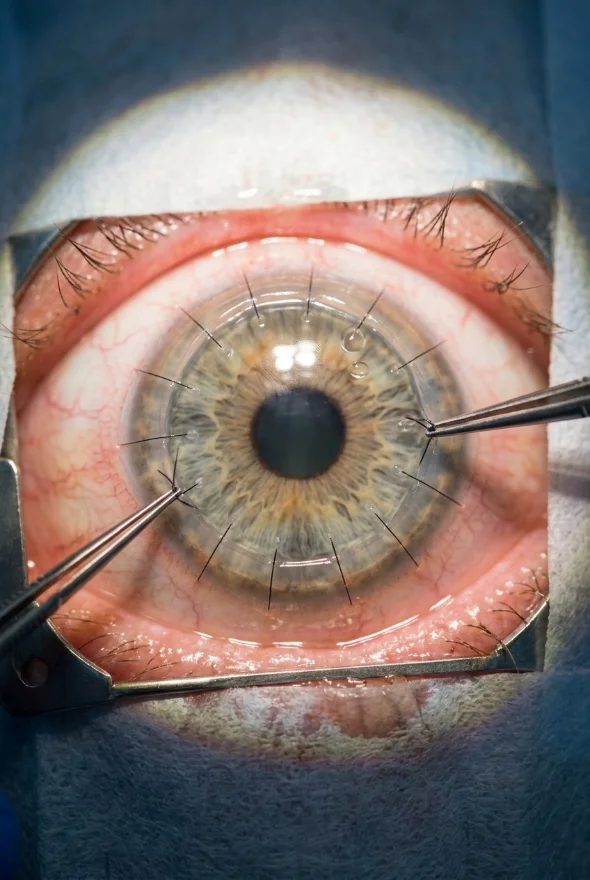
A corneal transplant (keratoplasty) replaces only the damaged layers of the cornea where possible: the inner layer in DMEK or DSAEK, the front and middle layers in DALK, or the full thickness in PK. The operation takes 1–2 hours and most people go home the same day. In a large US trial, about 75% of full-thickness grafts for swollen corneas were still clear at 10 years, and grafts for keratoconus do even better. In Istanbul, a transplant with Doç. Dr. Özer starts from {{£ price}} per eye; hotel and transfers are extra.
What is a corneal transplant, and which type do you need?
A corneal transplant is an operation that removes all or part of your cornea, the clear window at the front of the eye, and replaces it with a healthy cornea from a donor. According to the NHS, it is usually offered when glasses or contact lenses can no longer improve your vision, or when the eye is painful.
The cornea has layers. Modern surgery replaces only the layer that is damaged, which is why there are several types of transplant:
- DMEK (Descemet membrane endothelial keratoplasty) replaces only the innermost layer: the endothelium, the single layer of cells that pumps water out of the cornea to keep it clear, together with the thin membrane it sits on (Descemet's membrane). The donor tissue is rolled up, placed inside the eye through a small incision and held against the back of your cornea by an air or gas bubble. No stitches hold the graft.
- DSAEK (Descemet stripping automated endothelial keratoplasty) also replaces the inner layer, but the donor disc carries a thin slice of supporting tissue with it. EyeWiki describes it as about 10–30% of the inner donor cornea. The slightly thicker graft is easier to handle; a thinner version is called ultrathin DSAEK (UT-DSAEK).
- DALK (deep anterior lamellar keratoplasty) replaces the front and middle layers and keeps your own endothelium. It is often used for keratoconus and for scars that do not reach the inner layer.
- PK (penetrating keratoplasty) replaces the full thickness of the cornea with a round donor button held by stitches; EyeWiki notes that 16 stitches are typical. It is needed when every layer is damaged.
How common is each? In the United States, Eye Bank Association of America data analysed in Cornea (2023) show that DMEK grew from 9.8% to 27.8% of all corneal transplants between 2015 and 2020, while PK fell from 40% to 36.4% and DSAEK from 47% to 33.9%. A review by Nottingham surgeons (2018) notes that in most specialist centres, DALK and endothelial transplants have replaced full-thickness PK wherever possible, because partial transplants avoid the weak wound and much of the astigmatism that come with a full-thickness graft.
Before surgery, your examination includes corneal topography and tomography (maps of the shape and thickness of the cornea), a corneal thickness measurement, an endothelial cell assessment where needed, and a check of the lens, eye pressure and retina.
Who needs a corneal transplant?
You may need a corneal transplant when the cornea is too cloudy, swollen, scarred or misshapen for glasses or contact lenses to give useful vision. The NHS lists the main reasons as keratoconus, Fuchs' dystrophy, severe eye infections, complications after cataract surgery and eye injuries.
| Your problem | Layer affected | Transplant usually considered |
|---|---|---|
| Fuchs' endothelial dystrophy (cornea swells and clouds, often worse in the morning) | Inner layer (endothelium) | DMEK or DSAEK |
| Corneal swelling after cataract surgery (bullous keratopathy) | Inner layer | DMEK or DSAEK |
| A previous endothelial graft that has failed | Inner layer | Repeat DMEK or DSAEK |
| Advanced keratoconus with scarring, or a cornea too thin for other options | Front and middle layers | DALK, or PK if DALK is not possible |
| Scars from infection or injury that do not reach the inner layer | Front and middle layers | DALK |
| Damage or scarring through the full thickness, or a failed full-thickness graft | All layers | PK |
Indications for DMEK from EyeWiki; keratoconus and scarring options from EyeWiki and the NHS. Your surgeon makes the final choice after examining your eye.
Keratoconus usually does not need a transplant. Without cross-linking, between 10% and 20% of people with keratoconus eventually need one (Godefrooij et al., 2016). Cross-linking can stop the cornea getting weaker, and contact lenses or corneal rings often restore vision for years before a graft is needed. Doç. Dr. Özer will tell you if a less invasive option still suits your eye.
Other things your surgeon checks first: inflammation, infection or dry-eye problems that must be treated before surgery; glaucoma, because steroid drops and some transplants can raise eye pressure; cataract, which can sometimes be removed in the same operation as DMEK; and whether you can keep up months of drops and follow-up visits after you go home.
DMEK vs DSAEK vs DALK vs PK at a glance
| DMEK | DSAEK | DALK | PK | |
|---|---|---|---|---|
| What is replaced | Inner layer only (endothelium + Descemet's membrane) | Inner layer + thin slice of supporting tissue | Front and middle layers; your own inner layer is kept | Full thickness |
| Held by | Air or gas bubble, no stitches | Air or gas bubble, no stitches | Stitches | Stitches |
| Typical uses | Fuchs' dystrophy, swelling after cataract surgery | Same as DMEK; complex eyes where a thicker graft is easier to handle | Keratoconus, scars that spare the inner layer | Damage through all layers, repeat grafts |
| Visual recovery (NHS) | Up to 6 months | Up to 6 months | Up to 18 months | Up to 2 years |
| Rejection episodes | 1% at 2 years (one US centre) | 12% at 2 years (same centre) | No risk of endothelial rejection | 18% at 2 years (same centre) |
| Main drawback | Graft may partly detach and need more air ("rebubbling") | Vision often slightly less sharp than after DMEK | Technically demanding; may need converting to PK during surgery | Stitches, astigmatism, risk of wound rupture after injury |
Rejection figures: Anshu, Price and Price, Ophthalmology 2012, comparing 141 DMEK, 598 DSEK and 30 PK eyes treated with the same steroid regimen. DALK: Singh, Said and Dua, 2018. Recovery times: NHS.
In a randomised US trial (DETECT), DMEK gave better visual acuity than ultrathin DSAEK, although improvement in vision-related quality of life at 12 months was similar with both (JAMA Ophthalmology, 2019).
Why are cornea transplants rarely rejected?
Cornea transplants are rarely rejected because the cornea is "immune privileged": the immune system reacts to it far less than to other transplanted tissue. In a 2013 review, immunologist Jerry Niederkorn explains that about 90% of first-time, uncomplicated corneal transplants are accepted, whereas skin grafts between unmatched individuals are rejected in about 100% of cases. Corneal transplants were first performed successfully in 1905.
The main reasons are:
- No blood vessels. The healthy cornea is clear because it has no blood vessels, so immune cells have no direct route into the graft.
- No lymphatic vessels. Without lymph drainage, the immune system is slow to "notice" the donor tissue.
- Few warning signals. The corneal endothelium carries little or none of the main tissue-type markers (MHC class I) that trigger rejection elsewhere.
- Built-in brakes. Molecules on corneal cells (such as Fas ligand and PD-L1) and in the fluid inside the eye switch off attacking immune cells, and the eye actively trains the immune system to tolerate what it finds there.
This is also why corneal transplants are not routinely tissue-type matched: in a randomised study of high-risk grafts, matching for HLA class II tissue types did not reduce rejection (Yin, 2021). Instead, rejection is prevented and treated with steroid eye drops (NHS). Privilege is reduced when the cornea has grown blood vessels, after previous rejections or with active inflammation, and those eyes are "high-risk" grafts. Partial transplants lower the risk further: a 2021 review of long-term studies gives rejection rates of 1.7–2.8% for DMEK and 5–11.4% for DSAEK, and immune rejection remains the leading cause of failure in PK.
How long does a corneal transplant last?
A corneal transplant often lasts many years, and many last for life, but none is guaranteed to be permanent. How long it lasts depends mostly on why you needed it:
| Situation | What the research shows |
|---|---|
| PK for Fuchs' dystrophy or swelling after cataract surgery | 10-year success 77% with donors aged 12–65 and 71% with donors aged 66–75 (Cornea Donor Study, 1,090 patients, 2013); about 75% for donors aged 34–71 |
| DALK or PK for keratoconus | Graft survival 97.0% after DALK and 94.9% after PK at 20 years (502 eyes, British Journal of Ophthalmology, 2023) |
| DMEK (with or without cataract surgery) | Primary graft failure 1.5% and no rejection in the first year; secondary graft failure 12.4% at 7 years; good vision maintained up to 10 years (Düsseldorf study, Cornea, 2024) |
Keratoconus grafts do so well because the rest of the eye is usually healthy. Grafts for swollen corneas lose donor endothelial cells slowly over time: in the 2024 DMEK study the cell count fell by about 4% a year, and EyeWiki reports a steady decline after DSEK too. When too few cells remain, the cornea swells again and a new graft is needed.
A transplant can be repeated. In the United States, a repeat corneal transplant was the most common specific reason for PK from 2017 to 2020. A repeat endothelial graft (DMEK or DSAEK) is often possible after a failed one. Each graft carries a higher risk than the one before, which is why careful follow-up of the first one matters.
Corneal transplant cost in Istanbul, and what is included
At Laser Istanbul Clinic, a corneal transplant starts from {{£ price}} per eye. The price depends on the type of transplant and on whether cataract surgery is combined with it. Doç. Dr. Özer confirms your plan and exact price in writing after reviewing your reports, before you book anything.
| Corneal transplant with Laser Istanbul Clinic | Price per eye |
|---|---|
| DMEK or DSAEK (endothelial transplant) | from {{£ price DMEK/DSAEK}} |
| DMEK combined with cataract surgery | from {{£ price DMEK + cataract}} |
| DALK (deep anterior lamellar) | from {{£ price DALK}} |
| PK (full-thickness transplant) | from {{£ price PK}} |
Typical published cornea transplant prices per eye (USD, 2025–26):
| Where | Typical price range |
|---|---|
| UK private clinics | about $8,000–14,000 |
| USA (before insurance) | about $13,000–28,000 |
| Istanbul (published package prices) | about $4,000–7,000 |
| Istanbul with Laser Istanbul Clinic | from {{£ price}} |
Typical ranges advertised by clinics and price-comparison sites in 2025–26, not quotes. Published Istanbul prices are often packages that bundle a hotel and transfers; ours cover your medical treatment, with hotel and transfers charged separately if you want them.
On these figures, a corneal transplant in Istanbul typically costs up to about 73% less than the US cash price.
Your treatment price includes:
- full pre-operative eye examination and corneal scans with your surgeon
- the corneal transplant by Doç. Dr. Muhammet Derda Özer, in a fully equipped, Ministry of Health–licensed operating theatre in Istanbul
- donor cornea tissue: {{included / quoted separately}}
- medication and eye drops for your stay
- follow-up checks in Istanbul with the same surgeon
- a personal interpreter, a dedicated coordinator and remote follow-up after you return home
Not included: flights, hotel and airport transfers. Hotel and transfers are a separate charge, and we can arrange them for you if you ask. Long-term eye drops after you go home, and check-ups with your eye doctor at home, are also outside the Istanbul price.
Cornea transplant cost with insurance. In the UK, corneal transplants are available on the NHS when they are clinically needed. In the US, what you pay with insurance depends on your plan's deductible, co-pays and coinsurance and on whether the surgeon and facility are in network, so ask your insurer for an estimate based on the procedure your surgeon proposes. Treatment abroad is usually self-funded; if you want any of it covered, check with your insurer before you travel.
Your corneal transplant journey, step by step
- Free online assessment
Send your eye reports, corneal scans and current prescription. Doç. Dr. Özer tells you whether a transplant is likely to help, which type, and sends a written quote within {{response time}}.
- Plan your dates and your aftercare
Plan {{nights in Istanbul for a corneal transplant}} in Istanbul. Before you book, we agree who will see you at home for check-ups, drops and, after DALK or PK, stitch removal: {{follow-up arrangement at home}}. Donor tissue is arranged for your surgery date: {{donor cornea source and typical lead time}}.
- Full eye examination
Corneal scans, eye pressure, a lens and retina check and, if needed, endothelial cell counts. If a transplant is not the right step, your surgeon tells you and explains the alternatives.
- Surgery
According to the NHS, a corneal transplant takes 1 to 2 hours, usually under local anaesthetic with numbing drops, sometimes with sedation or a general anaesthetic. Most people go home the same day; some stay 1–2 days.
- Lying flat (DMEK and DSAEK)
An air or gas bubble holds the new layer in place. You lie on your back, face up, as much as possible for the first days, as your surgeon instructs (EyeWiki).
- Checks in Istanbul
Your surgeon checks the graft the next day and again before you leave, adds more air if part of the graft has lifted, and confirms when you can fly.
- Fly home and keep in touch
You continue drops at home, your coordinator stays in touch, and your surgeon reviews your progress by video and through your local eye doctor's reports. You receive a full treatment report in English.
When can I fly? Not while there is gas in your eye, because a bubble expands at altitude and can raise eye pressure dangerously. As a general rule for gas in the eye, UK NHS patient guidance gives up to about 2 weeks for air and 4 weeks for SF6 gas. Bubbles used for endothelial transplants are smaller, and your surgeon checks your eye before clearing you to fly.
Recovery timeline after a corneal transplant
| When | DMEK / DSAEK | DALK / PK |
|---|---|---|
| First days | Lie face up as instructed while the bubble supports the graft. Vision is blurred. | Protect the eye as your surgeon instructs; it may feel gritty. Vision is blurred. |
| First 2 weeks | Most people take about 2 weeks off work (NHS). No eye rubbing, swimming or heavy lifting until your surgeon allows. | About 2 weeks off work (NHS). Protect the eye: the wound is held by stitches. |
| 3 months | DMEK: 63% of eyes reach 20/25 or better (EyeWiki). | Vision improving slowly; glasses or contact lenses often needed. |
| 6 months | DMEK: 79–94% reach 20/40 or better. Most visual recovery done for endothelial grafts (NHS: up to 6 months). | Stitches removed gradually over several months at follow-up visits. |
| 18 months – 2 years | Drops continue as your surgeon advises. | Full visual recovery: up to 18 months after DALK, up to 2 years after PK (NHS). Astigmatism is corrected with glasses, contact lenses or further treatment. |
| For years | Steroid drops for a long time; regular check-ups. | Same; after PK, the wound edge remains a weak point, so protect the eye from injury. |
Sources: NHS, EyeWiki. Your surgeon gives you personal dates.
Call your coordinator or see an eye doctor the same day if you notice redness, sensitivity to light, worse vision or pain in the transplanted eye. These can be signs of rejection, which the NHS says is usually treated with steroids if it is found quickly. Rejection can happen at any time after a transplant, even years later.

Risks of corneal transplant surgery
A corneal transplant is a well-established operation, but it is real surgery inside the eye, and you should know the risks before you decide.
Risks listed by the NHS: rejection of the donor cornea, the cornea becoming cloudy again, astigmatism, inflammation inside the eye (uveitis), raised eye pressure (glaucoma), infection, retinal detachment and cataract.
Risks that depend on the type:
- DMEK and DSAEK: the graft can partly detach and need more air injected; EyeWiki reports a rebubbling rate of 14–15% after DMEK. A graft that never clears (primary graft failure) occurred in 1.5–2.8% in one series.
- DALK: EyeWiki notes that the operation is technically demanding and sometimes has to be converted to a PK during surgery; haze between the layers can reduce vision.
- PK: about 1 in 5 patients develop astigmatism (EyeWiki), many still need rigid contact lenses for their sharpest vision, and the wound edge can rupture after a blow to the eye. Rejection is more likely than after partial transplants.
- Raised eye pressure: glaucoma is on the NHS list of complications, and in the 2023 keratoconus study raised pressure needing treatment was more common after PK than after DALK, so eye pressure is checked at every visit.
Your own risk depends on your eye: previous grafts, blood vessels growing into the cornea, glaucoma or active inflammation raise it. Doç. Dr. Özer explains your personal risks in writing and through your interpreter before you sign anything.
Corneal transplant: frequently asked questions
Typical published prices per eye in 2025–26 are about $13,000–28,000 in the US before insurance, $8,000–14,000 in UK private clinics and $4,000–7,000 in Istanbul. With Laser Istanbul Clinic, a corneal transplant starts from {{£ price}} per eye, including your examination, surgery, medication, check-ups in Istanbul, interpreter and coordinator. Hotel and transfers are extra, and your exact price is confirmed in writing after your free assessment.
It depends on your plan. In the US, your share is set by your deductible, co-pays and coinsurance and whether the surgeon and facility are in network, so ask your insurer for an estimate. In the UK, a corneal transplant is available on the NHS when it is clinically needed. Treatment abroad is usually self-funded.
Many last for decades. For keratoconus, 20-year graft survival was 97.0% after DALK and 94.9% after PK in a 2023 study of 502 eyes. For PK in swollen corneas (Fuchs' dystrophy or after cataract surgery), the large US Cornea Donor Study found about 75% still clear at 10 years. If a graft fails, it can usually be replaced.
The cornea has no blood or lymphatic vessels, carries few tissue-type markers and is protected by immune "brakes" inside the eye, a state called immune privilege. About 90% of first-time, uncomplicated corneal transplants are accepted. Rejection is still possible at any time, so you use steroid drops and watch for warning signs.
For diseases of the inner layer, such as Fuchs' dystrophy, DMEK usually gives the sharpest vision and the lowest rejection risk: 1% at 2 years, compared with 12% for DSEK and 18% for PK in one US centre. DSAEK can be easier in complex eyes, and PK or DALK are needed when the front layers are damaged. Your surgeon recommends the type that fits your eye.
Usually you are awake with local anaesthetic and numbing drops, so you should not feel pain during the operation; sedation or a general anaesthetic is sometimes used. The NHS says the operation takes 1 to 2 hours. Afterwards the eye may feel gritty and sore for a few days, which drops and simple painkillers help.
Most people take about 2 weeks off work. Vision recovers over up to 6 months after an endothelial transplant (DMEK or DSAEK), up to 18 months after DALK and up to 2 years after PK, according to the NHS. Drops and check-ups continue for a long time.
Plan {{nights in Istanbul for a corneal transplant}}; your surgeon confirms this once he has seen your reports. You cannot fly while there is gas in your eye, so your surgeon checks the bubble before clearing you. Follow-up continues at home with your local eye doctor and by video.
Watch for a red eye, eye pain, sensitivity to light or blurred vision in the transplanted eye. Get your eye checked the same day: rejection is usually treated with steroids, and early treatment gives the best chance of saving the graft.
Yes, corneal transplants are available on the NHS when they are clinically needed. Some patients choose private treatment, at home or abroad, to choose their surgeon or their timing. If you can be treated promptly at home, that is a good option too.
Before a transplant: other cornea treatments in Istanbul
For keratoconus, a transplant is usually the last step, not the first. These treatments can stop the disease or improve vision first:
| Corneal cross-linking (CXL) | Corneal rings (Intacs / ICRS) | Corneal transplant | |
|---|---|---|---|
| Aim | Stops keratoconus getting worse | Flattens the cone to improve vision | Replaces scarred or very thin cornea |
| Your own cornea | Kept and stiffened | Kept, with small implants | Partly or fully replaced with donor tissue |
| Recovery | Sore for a few days | Usually quicker than a transplant | Months to 2 years |
| Often chosen for | Progressive keratoconus | Moderate keratoconus, contact-lens intolerance | Advanced keratoconus, scarring, swollen corneas |
Corneal cross-linking (CXL)
Riboflavin drops and UV light stiffen the cornea to stop keratoconus progressing, and can reduce the need for a transplant later.
Corneal cross-linking (CXL) in IstanbulCorneal rings (Intacs / ICRS)
Small curved implants placed in the cornea to flatten the cone and improve vision, often combined with cross-linking.
Intacs and corneal ring segments in IstanbulSources for the facts on this page
- NHS, Cornea transplant: reasons (keratoconus, Fuchs' dystrophy, severe infection, complications after cataract surgery, injury); offered when glasses/contact lenses no longer help or the eye is painful; three types by layer; 1 to 2 hours; local anaesthetic with numbing drops, or general anaesthetic, optional sedation; most go home the same day, some stay 1–2 days; about 2 weeks off work; visual recovery up to 6 months (inner layer), 18 months (outer and middle layers), 2 years (whole cornea); stitches for several months, removed gradually; steroid and antibiotic drops long term; rejection can happen at any time, usually treated with steroids if found quickly; warning signs; complications (rejection, cloudiness, astigmatism, uveitis, glaucoma, infection, detached retina, cataract). https://www.nhs.uk/conditions/cornea-transplant/
- EyeWiki (AAO), Descemet Membrane Endothelial Keratoplasty: indications (Fuchs, PPMD, CHED, bullous keratopathy, ICE, failed EK); rejection 1.4–5% (mean 3.7%), 0.7% in another study, vs 9% DSAEK and 17% PK historical controls; 63% ≥ 20/25 at 3 months; 79–94% ≥ 20/40 at 6 months; rebubble rate 14–15%; iatrogenic primary failure 1.5–2.8%; supine positioning in the first week; endothelial cell loss. https://eyewiki.org/Descemet_Membrane_Endothelial_Keratoplasty
- EyeWiki (AAO), Descemet Stripping Endothelial Keratoplasty: graft of posterior stroma, Descemet and endothelium (10–30% of the inner donor cornea); indications; supine positioning with air bubble; endothelial cell decline about 110 cells/mm² per year from 6 months to 10 years; advantages over PK; DMEK better final acuity than DSAEK. https://eyewiki.org/Descemet_Stripping_Endothelial_Keratoplasty
- EyeWiki (AAO), Penetrating Keratoplasty: indications, typically 16 sutures, about 1 in 5 develop postoperative astigmatism. https://eyewiki.org/Penetrating_Keratoplasty
- EyeWiki (AAO), Keratoconus: DALK eliminates endothelial rejection, faster visual rehabilitation, technically challenging with possible conversion to PK, interface haze; PK risks include infection, rejection and traumatic rupture at the wound margin, many still need RGP lenses; DALK generally preferred when the endothelium is healthy. https://eyewiki.org/Keratoconus
- Anshu A, Price MO, Price FW Jr. Risk of corneal transplant rejection significantly reduced with Descemet's membrane endothelial keratoplasty. Ophthalmology 2012;119(3):536–540 (PMID 22218143): 141 DMEK, 598 DSEK, 30 PK eyes; cumulative probability of rejection at 1 and 2 years 1%/1% DMEK, 8%/12% DSEK, 14%/18% PK. https://pubmed.ncbi.nlm.nih.gov/22218143/
- Yin J. Advances in corneal graft rejection. Curr Opin Ophthalmol 2021;32(4):331–337 (PMID 33989234): HLA class II matching did not reduce rejection in a randomised study of high-risk PK; rejection is the leading cause of PK failure; long-term rejection rates DALK 1.7–13%, DSAEK 5–11.4%, DMEK 1.7–2.8%. https://pubmed.ncbi.nlm.nih.gov/33989234/
- Niederkorn JY. Corneal transplantation and immune privilege. Int Rev Immunol 2013;32(1):57–67 (PMID 23360158; PMC3885418): skin allografts rejected in ~100%; corneal allografts survive long-term in 50% to >90%; ~90% of first-time uncomplicated corneal transplants accepted; avascular graft bed, lymphatics, little or no MHC class Ia on endothelium, FasL, PD-L1, ACAID, aqueous humour factors, Tregs; first successful corneal allograft by Zirm in 1905. https://pmc.ncbi.nlm.nih.gov/articles/PMC3885418/
- Writing Committee for the Cornea Donor Study Research Group. The effect of donor age on penetrating keratoplasty for endothelial disease: graft survival after 10 years in the Cornea Donor Study. Ophthalmology 2013;120(12):2419–2427 (PMID 24246825): 1,090 participants, Fuchs 62%, pseudophakic/aphakic oedema 34%; 10-year success 77% (donors 12–65) vs 71% (66–75); ~75% for donors 34–71. https://pubmed.ncbi.nlm.nih.gov/24246825/
- Borderie VM, et al. Long-term outcomes of deep anterior lamellar versus penetrating keratoplasty for keratoconus. Br J Ophthalmol 2023;108(1):10–16 (PMID 37890880): 502 eyes; graft survival at 20 years 97.0% DALK, 94.9% PK; vision 20/378 to 20/32; postoperative ocular hypertension needing treatment more common after PK than DALK. https://pmc.ncbi.nlm.nih.gov/articles/PMC10803977/
- Teubert S, et al. Ten-Year Follow-Up After Descemet Membrane Endothelial Keratoplasty. Cornea 2024 (PMID 39476369): 201 eyes, 54 followed 5–10 years; primary graft failure/rejection 1.5%/0% in the first year; secondary graft failure 12.4% at 7 years; ECD loss about 4% a year; excellent acuity preserved at 10 years. https://pubmed.ncbi.nlm.nih.gov/39476369/
- Xiao G, et al. Keratoplasty in the United States: Trends and Indications From 2015 to 2020. Cornea 2023;42(11):1360–1364 (PMID 36730420): EBAA data; 47,903 transplants in 2015, 49,143 in 2019; PK 40% → 36.4%, DMEK 9.8% → 27.8%, DSAEK 47% → 33.9%; repeat transplant the most common specific PK indication 2017–2020. https://pubmed.ncbi.nlm.nih.gov/36730420/
- Singh NP, Said DG, Dua HS. Lamellar keratoplasty techniques. Indian J Ophthalmol 2018;66(9):1239–1250 (PMID 30127133): DALK eliminates failure from endothelial rejection; EK almost eliminates induced astigmatism and the weak graft-host junction; DALK and EK have replaced PK where possible in most specialist centres. https://pmc.ncbi.nlm.nih.gov/articles/PMC6113816/
- Chamberlain W, et al. DETECT trial secondary analysis, JAMA Ophthalmol 2019 (PMID 31046075): DMEK superior visual acuity to UT-DSAEK in DETECT; vision-related quality of life improvement not greater with DMEK. https://pubmed.ncbi.nlm.nih.gov/31046075/
- Godefrooij DA, et al. Nationwide reduction in the number of corneal transplantations for keratoconus following the implementation of cross-linking. Acta Ophthalmol 2016;94(7):675–678 (PMID 27213687): 10–20% of keratoconus patients eventually need a transplant. https://pubmed.ncbi.nlm.nih.gov/27213687/
- NHS patient leaflet, Retinal detachment surgery (Moorfields Eye Hospital NHS Foundation Trust): gas in the eye and flying, air up to 2 weeks, SF6 up to 4 weeks. https://www.moorfields.nhs.uk/mediaLocal/s1jdmews/retinal-detachment-surgery-_0.pdf (as cited on the retinal detachment page)
- Medicare.gov, Organ transplants (checked 6 Oct 2026): lists heart, lung, kidney, pancreas, intestine and liver; cornea not listed, so no Medicare out-of-pocket figure is quoted. https://www.medicare.gov/coverage/organ-transplants
Find out if a corneal transplant can help your eye, free
Send us your eye reports, corneal scans and current prescription. Doç. Dr. Muhammet Derda Özer will tell you whether a transplant is likely to help, which type suits your eye, and what it would cost, with no obligation.
3 eye surgeons
Your case is reviewed by a named surgeon, not a salesperson. Reply within {{response time}}.
 Prof. Dr. Ahmet Satıcı
 Doç. Dr. Muhammet Derda Özer
 Op. Dr. Aysan Bayram