
YAG Laser Capsulotomy and Iridotomy in Istanbul
YAG laser capsulotomy is a quick, painless laser treatment that clears the cloudy film that can form behind a lens implant months or years after cataract surgery. With Laser Istanbul Clinic, it is carried out by Prof. Dr. Ahmet Satıcı, Doç. Dr. Muhammet Derda Özer or Op. Dr. Aysan Bayram after a full eye examination. The same laser is also used for iridotomy, a tiny opening in the iris that protects eyes with narrow drainage angles.
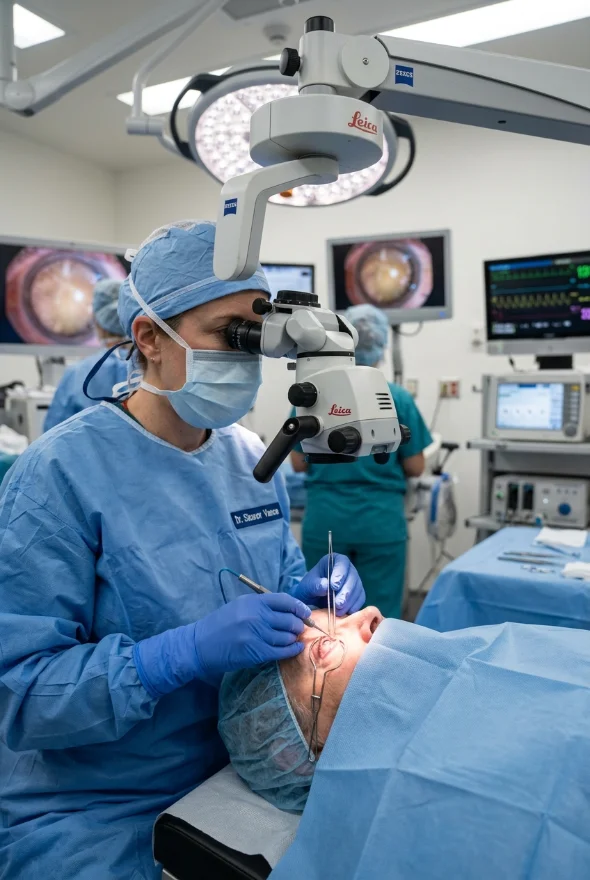
If your vision has become misty again after cataract surgery, the usual cause is posterior capsule opacification (PCO), not a returning cataract. YAG laser capsulotomy makes a small opening in the clouded capsule behind your lens implant, with numbing drops and no cut. The US National Eye Institute says most people notice their vision is back to normal within a few days. In Istanbul, our cataract surgeons perform it from {{£ YAG capsulotomy price}} per eye; hotel and transfers are extra.
What is YAG laser capsulotomy, and why does vision get cloudy after cataract surgery?
YAG laser capsulotomy is the standard treatment for clouding of the lens capsule after cataract surgery. During cataract surgery, your surgeon removes the cloudy natural lens but leaves its thin, clear outer bag (the capsule) in place, because it holds your new artificial lens. Over time, a few lens cells left behind on the capsule can grow, migrate across the back of it and turn it hazy. This is called posterior capsule opacification (PCO), also known as a secondary cataract or after-cataract.
It is common. The American Academy of Ophthalmology's EyeWiki calls PCO the most common complication of cataract surgery and reports that it occurs in 20–50% of patients within two to five years. The US National Eye Institute (NEI) puts it more simply: up to 2 out of 5 people who have cataract surgery develop it. In a real-world study of 20,763 eyes treated in UK NHS clinics, 5.8–19.3% needed YAG laser capsulotomy within five years, depending on the lens model implanted (Ursell et al., Eye, 2020).
Typical symptoms (EyeWiki), usually appearing months to several years after an uneventful operation:
- vision becoming blurred or misty again, like looking through a frosted window
- glare and halos around lights, especially at night
- sensitivity to bright light
- reduced contrast, so faces and steps are harder to make out
- difficulty reading
Who is more likely to develop PCO. Younger age at the time of cataract surgery is a significant risk factor. EyeWiki also lists diabetes, uveitis (eye inflammation), myotonic dystrophy, retinitis pigmentosa and cataracts caused by injury. In children, rates reach 100%. The design of the lens implant matters too: lenses with a sharp, square back edge are associated with less PCO.
How the laser works. "YAG" is short for Nd:YAG, a neodymium-doped yttrium aluminium garnet laser. The Q-switched Nd:YAG laser used in eye clinics emits invisible infrared light at 1064 nm in extremely short pulses. Instead of burning tissue, each pulse creates a tiny, rapidly expanding plasma bubble that mechanically splits the target (photodisruption), so it works through the clear front of the eye without any incision (EyeWiki). For a capsulotomy, your surgeon focuses the pulses just behind the lens implant and opens a small, clear window in the centre of the hazy capsule. Light can then pass straight through to the retina again.
EyeWiki describes Nd:YAG capsulotomy as non-invasive, quick and effective, but "not without significant risk", which is why the surgeon uses the lowest effective energy and keeps the opening no larger than needed. A 2014 review by Turkish ophthalmologists (Karahan et al.) reached the same conclusion: less total energy and smaller openings reduce complications.
Technology we use: {{YAG laser platform name}}, in a fully equipped, Ministry of Health–licensed operating theatre in Istanbul.
Who needs YAG laser capsulotomy, and when it should wait
You may need YAG laser capsulotomy if you have had cataract or lens replacement surgery, your vision has slowly become cloudy again, and an eye examination shows a hazy posterior capsule. The diagnosis is made at the slit lamp. Before treating, your surgeon compares your current vision with your best vision after surgery and checks the retina, because other problems can also blur vision after cataract surgery. If the symptoms seem worse than the haze explains, EyeWiki recommends a scan of the macula (OCT) to rule out swelling of the retina, a membrane on the retina, macular degeneration or diabetic eye disease.
It is usually not done, or is postponed, when (EyeWiki):
- the eye is still inflamed, or there has been recent swelling of the central retina (cystoid macular oedema)
- retinal disease is unstable, or you have recently developed new floaters from a vitreous detachment
- the lens implant may still need to be rotated or exchanged. This matters for people who are unhappy with a trifocal or toric lens: once the capsule has been opened, exchanging the lens becomes more difficult, so that decision is made first.
- a chronic low-grade infection inside the eye is suspected
Extra caution, and closer checks, are needed if you have glaucoma or high eye pressure, advanced optic nerve damage, high short-sightedness at a younger age, a previous retinal tear or detachment, previous macular swelling, uveitis or active wet macular degeneration (EyeWiki). This does not usually rule the laser out; it changes how it is planned and how you are followed up.
Timing after cataract surgery. A French nationwide study of 6,210 patients (the YAG 2 study, Ophthalmology, 2023) found a higher risk of side effects, mainly macular swelling, when the laser was done within the first year after cataract surgery than when it was done later. An earlier study summarised by Karahan et al. found a low rate of macular swelling when capsulotomy was delayed for more than six months after the lens implant. Your surgeon weighs this against how much the haze is affecting your daily life.
If you have not had cataract surgery yet, YAG capsulotomy does not apply to you: a cataract in your natural lens is treated with cataract surgery.
YAG laser capsulotomy vs YAG laser iridotomy at a glance
The same type of laser is used for two different treatments. Both are done with numbing drops, without a cut, and you go home the same day.
| YAG laser capsulotomy | YAG laser peripheral iridotomy | |
|---|---|---|
| What it treats | Posterior capsule opacification (cloudy vision after cataract surgery) | Narrow drainage angles, angle closure and angle-closure glaucoma |
| Who it is for | People who have had cataract or lens replacement surgery | People with a natural lens (or, rarely, an implant) whose iris blocks the eye's drain |
| What the laser does | Opens a small, clear window in the centre of the hazy capsule behind the lens implant | Makes a tiny hole at the edge of the iris so fluid can reach the drain |
| Main goal | Clearer vision | Preventing or treating a dangerous rise in eye pressure |
| Most common side effect | Temporary rise in eye pressure; macular swelling in some | Temporary rise in eye pressure; minor bleeding from the iris |
| Our surgeons | Prof. Dr. Satıcı, Doç. Dr. Özer, Op. Dr. Bayram | Prof. Dr. Satıcı |
| Price per eye | from {{£ YAG capsulotomy price}} | from {{£ laser iridotomy price}} |
What is a YAG laser iridotomy?
A laser peripheral iridotomy is a tiny opening made by laser in the outer edge of the iris, the coloured part of the eye. It gives the fluid inside the eye a shortcut from behind the iris to the front, which relieves "pupillary block" and lets the drainage angle open (EyeWiki). EyeWiki notes that the Nd:YAG laser works in all iris colours, needs less energy than older argon lasers and its openings are less likely to close.
When an iridotomy is clearly recommended (EyeWiki):
- acute angle-closure attack: a sudden, painful pressure rise with a red eye, headache, blurred vision, rainbow halos and nausea. This is an emergency: go to the nearest eye casualty or emergency department straight away. After the attack, iridotomy is the preferred definitive treatment.
- the other eye after an attack: about 50% of people have a second attack in the fellow eye within five years without treatment, and an iridotomy significantly reduces that risk.
- primary angle closure and angle-closure glaucoma: the iris already touches or sticks to the drain, or pressure is raised.
When it is optional. Many people are told they have "narrow angles" (primary angle-closure suspects) with normal pressure and healthy optic nerves. In the ZAP trial (The Lancet, 2019), 889 people aged 50–70 had laser iridotomy in one eye and none in the other. Over six years, angle-closure disease developed at 4.19 per 1,000 eye-years in treated eyes and 7.97 in untreated eyes. The authors called the effect "modest" and did not recommend routine preventive iridotomy for everyone with narrow angles. So your surgeon decides case by case.
When lens surgery may be better. In the EAGLE trial, summarised on EyeWiki, removing the natural lens worked better than iridotomy plus drops as a first treatment for people with primary angle closure and an eye pressure over 30 mmHg. If you are over 50 and also have an early cataract or want to stop wearing glasses, Prof. Dr. Satıcı may discuss lens surgery instead of, or after, the laser.
YAG laser eye surgery cost in Istanbul, and what is included
At Laser Istanbul Clinic, YAG laser capsulotomy starts from {{£ YAG capsulotomy price}} per eye, and YAG laser iridotomy from {{£ laser iridotomy price}} per eye. Your surgeon confirms your exact price in writing after reviewing your eye report, before you book anything.
Your treatment price includes:
- a full eye examination before the laser, including eye pressure, a dilated retina check and, where needed, a macular scan (OCT)
- the YAG laser treatment by your named surgeon
- medication and eye drops
- follow-up checks in Istanbul with the same surgeon, including the eye-pressure check after the laser
- a personal interpreter, a dedicated coordinator and remote follow-up after you return home
Not included: flights, hotel and airport transfers. Hotel and transfers are a separate charge, and we can arrange them for you if you ask.
If you had your cataract surgery with us: {{YAG laser / PCO treatment policy and the period it covers}}.
What affects the cost of YAG laser eye surgery:
- one eye or both eyes (PCO often develops at different times in each eye)
- whether extra scans are needed before treatment, for example a macular scan if you have diabetes or previous macular swelling
- whether you need extra pressure-lowering medication, which is more likely if you have glaucoma
- whether YAG is combined with other treatment in the same trip, such as cataract surgery in the second eye
A note on value. YAG capsulotomy is a short treatment, and in many countries it is available close to home. Coming to Istanbul makes most sense if you had your cataract or lens surgery with us, if you are already travelling for treatment of your other eye, or if you want one of our surgeons to examine a complex eye, for example after a trifocal lens, uveitis or retinal problems. We will tell you honestly if a local appointment is the simpler option.
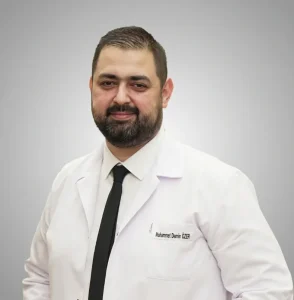
Your YAG laser surgeons in Istanbul
You know which surgeon will treat you before you book. Ideally, the surgeon who examines your eye also performs the laser and checks your eye pressure afterwards.


Your YAG laser treatment, step by step
Send your details (free)
Upload your latest eye report and, if you have it, your cataract surgery report showing the lens implant model. A surgeon tells you whether YAG laser is likely to help and sends a written quote within {{response time}}.
Book your dates
Plan {{number of nights for YAG laser}} nights in Istanbul. If you are combining the laser with other treatment, your surgeon tells you how many nights to add.
Full eye examination
With your surgeon and interpreter: vision and glasses check, eye pressure, a slit-lamp examination of the capsule, a dilated retina check and, if needed, a macular OCT scan. Your surgeon explains the benefit and your personal risks before you agree.
Laser treatment
Drops numb your eye; your surgeon may also give pressure-lowering drops before and after the laser, as EyeWiki advises for eyes at risk of a pressure rise. You sit at the laser with your chin and forehead resting on supports. You see a bright light; the NEI describes the treatment as painless. For an iridotomy, a small contact lens is placed on the eye with gel to keep it steady and focus the laser (EyeWiki).
Pressure check
Your eye pressure is checked after the laser, because a temporary rise is the most common side effect. After an iridotomy, EyeWiki advises checking the pressure 30 minutes to 2 hours later. You then return to your hotel.
Follow-up and home
Your surgeon examines the eye again before you fly. You go home with a written report in English, your drop schedule and direct contact details for your coordinator.
YAG laser eye surgery recovery time
Most people recover very quickly: the NEI says most notice their vision is back to normal within a few days. Vision is often blurred for the first hours, partly because of the drops used during the examination.
| When | What to expect | What to do |
|---|---|---|
| First hours | Blurred vision from the drops; some glare | Do not drive; have someone accompany you |
| Same day | Eye pressure checked after the laser | Use any pressure-lowering drops exactly as prescribed |
| First few days | Vision clears for most people (NEI) | Use your anti-inflammatory drops if prescribed, often for 4–7 days after an iridotomy (EyeWiki) |
| 1–4 weeks | Your glasses prescription can shift slightly towards long sight, more so with large openings | Wait at least 1 week before new glasses, or 4 weeks after a large capsulotomy (Karahan et al.) |
| First 3 months | Most side effects that occur appear in this period (French YAG 2 study) | Keep your follow-up checks; report any warning signs at once |
| 6 months and later | PCO rarely returns | A routine check about 6 months later is advised (EyeWiki) |
Get urgent help if you notice a sudden shower of new floaters, flashes of light, a dark curtain or shadow across your vision, increasing pain or redness, or vision getting worse instead of better. These can be signs of a retinal detachment or high eye pressure. If you are already home, go to your nearest eye casualty or emergency department first, then let us know.
Driving and flying. Do not drive until your vision is clear and meets the driving standard, and not on the day of treatment. Your surgeon tells you when you can fly; {{usual time before flying after YAG laser}}.
Risks and side effects of YAG laser capsulotomy and iridotomy
YAG laser is a routine, low-risk treatment, but it is not risk-free. Here are the real numbers.
After YAG laser capsulotomy
- Raised eye pressure is the most common complication. Reported rates vary widely between studies, from under 1% to 15–30% even with preventive drops, depending on the patient group and the energy used (Karahan et al.). It is usually temporary and treated with drops; it matters most if you already have glaucoma.
- Macular swelling (cystoid macular oedema) blurs central vision and is treated with drops. In the French YAG 2 study of 7,958 procedures, the rates of raised pressure and of macular swelling were each about 5% at three months. People with diabetes were at higher risk of both.
- Overall, the same study found at least one of these side effects (raised pressure, macular swelling or retinal detachment) in 8.6% of patients at three months and 13.3% at twelve months, and 68.4% of them occurred within the first three months.
- Retinal detachment stayed at or below 0.5% over twelve months in the French study. Whether YAG itself raises the risk is debated: a 2022 meta-analysis of 11 studies (65,117 eyes) found a modestly higher risk (relative risk 1.57), while a Finnish study of 17,688 eyes found no link after modern cataract surgery. The risk is higher in long, short-sighted eyes, after a previous retinal detachment or lattice degeneration, and after a capsule tear during cataract surgery (Karahan et al.).
- Small marks on the lens implant ("pitting") were seen in about 9–20% of eyes in older studies. Focusing the laser slightly behind the lens reduces them.
- Lens implant movement and a small change in your glasses prescription can occur, especially with larger openings.
- Rare: persistent inflammation, macular hole, bleeding in the retina, damage to the cornea, and the spread of a hidden, low-grade infection.
- Recurrence: occasionally the opening clouds over again and a second laser treatment is needed (EyeWiki).
After YAG laser iridotomy (EyeWiki)
- A temporary rise in eye pressure is the most common complication, usually within the first 4 hours: a rise of at least 8 mmHg is reported in 6–10% of patients. Preventive drops reduce it.
- Minor bleeding from the iris is common and usually stops with gentle pressure from the contact lens.
- Visual disturbances such as a line of light, glare or ghosting are reported in 2–16% of people; a line-shaped glare in 2–3%. Most improve within six months.
- Closure of the opening occurs in 1% at 2 weeks and up to 20% within 6 months; it can be repeated.
- Faster cataract development has been reported in the years after iridotomy.
Your surgeon explains your personal risks in writing and through your interpreter before you agree to treatment.
YAG laser capsulotomy: frequently asked questions
YAG laser capsulotomy is a laser treatment for posterior capsule opacification, the cloudy film that can form on the capsule behind a lens implant after cataract surgery. The laser makes a small, clear opening in the centre of the capsule, without any cut, so light reaches the retina again. It is done with numbing drops, and you go home the same day.
No. Once your natural lens has been removed, a cataract cannot come back. Cloudy vision months or years later is usually posterior capsule opacification, also called a secondary cataract. The NEI says up to 2 in 5 people develop it, and it is treated with YAG laser.
With Laser Istanbul Clinic, YAG laser capsulotomy costs from {{£ YAG capsulotomy price}} per eye, including the examination, the laser by your named surgeon, drops, follow-up checks, interpreter and coordinator. YAG laser iridotomy costs from {{£ laser iridotomy price}} per eye. Flights, hotel and transfers are extra. Your exact price is confirmed in writing after your free assessment.
Recovery is fast: the NEI says most people notice their vision is back to normal within a few days. Vision is blurred for a few hours from the drops, so do not drive that day. Wait at least a week before buying new glasses, because your prescription can shift slightly.
No. The NEI describes the treatment as quick and painless. Your eye is numbed with drops, and you see only a bright light while the laser works. If anything feels uncomfortable afterwards, tell your surgeon.
Only when PCO is actually affecting your vision and your eye has fully settled after surgery. The French YAG 2 study found more side effects, mainly macular swelling, when the laser was done within the first year after cataract surgery. Your surgeon also waits if the eye is inflamed or if the lens implant might need to be exchanged.
Rarely. The opening made by the laser usually stays clear, but EyeWiki notes that occasional re-clouding can need a second treatment, more often in children. A follow-up check about six months after the laser is advised.
No. LASIK and SMILE reshape the cornea to correct short sight, long sight or astigmatism. YAG laser capsulotomy does not reshape anything: it opens the clouded capsule behind a lens implant to restore clarity. It does not replace glasses, although your glasses prescription may change slightly afterwards.
Yes. PCO affects premium lenses as well, and it can blur vision noticeably with a trifocal lens. But once the capsule is opened, exchanging the lens becomes more difficult, so if you are unhappy with your lens for other reasons, your surgeon settles that question first. Your surgeon also adjusts the size of the opening for premium lenses (EyeWiki).
The most common side effects are a temporary rise in eye pressure and swelling of the central retina, each seen in about 5% of patients at three months in a large French study. Retinal detachment stayed at or below 0.5% over one year. Most side effects appear within three months and are treatable, which is why follow-up matters.
Not always. An iridotomy is strongly recommended after an angle-closure attack, for the other eye after an attack, and for angle closure or angle-closure glaucoma. For narrow angles with normal pressure, the ZAP trial found only a modest benefit, so routine preventive treatment is not recommended. Prof. Dr. Satıcı decides after examining your eye's drainage angle.
Plan {{number of nights for YAG laser}} nights. The laser itself is a short outpatient treatment, but you need an examination beforehand and a pressure check and follow-up afterwards. If you combine it with other treatment, your surgeon tells you how many nights to add.
YAG laser and the other treatments it is confused with
Several eye treatments use a laser or happen after cataract surgery. This is how YAG laser compares.
| YAG laser capsulotomy | Cataract surgery | LASIK / SMILE | SLT laser for glaucoma | |
|---|---|---|---|---|
| What it treats | Clouding behind a lens implant (PCO) | A cloudy natural lens (cataract) | Short sight, long sight, astigmatism | High eye pressure in open-angle glaucoma |
| What is done | Laser opening in the capsule, no cut | Natural lens removed, artificial lens implanted | Cornea reshaped by laser | Low-energy 532 nm laser applied to the eye's drain |
| Who it is for | People who have already had cataract or lens surgery | People with a cataract | People with a clear natural lens and stable glasses | People with open-angle glaucoma or high pressure |
| Changes your glasses prescription? | Only slightly | Yes, by design | Yes, by design | No |
Cataract surgery in Turkey. If you still have your natural lens and it has clouded, you need cataract surgery, not YAG. Choosing a lens with a sharp, square back edge is associated with less PCO later (EyeWiki).
Cataract surgery cost. Prices per eye for each lens type, and what to ask any clinic about later YAG treatment.
Sources for the facts on this page
- *Medical facts (opened and checked 6 October 2026):**
- EyeWiki (American Academy of Ophthalmology), Posterior Capsule Opacification (last edited 21 July 2026): most common complication of cataract surgery; 20–50% within 2–5 years; children up to 100%; risk factors (younger age, diabetes, uveitis, myotonic dystrophy, retinitis pigmentosa, traumatic cataract); symptoms (decreased/blurred vision, glare, light sensitivity, contrast, halos, reading); slit-lamp diagnosis, OCT when symptoms exceed PCO; Nd:YAG noninvasive, quick, effective but "not without significant risk"; complication list; rare reopacification; lowest effective energy, adjust size to premium IOL; when to delay (inflammation, recent CME, unstable retina, recent symptomatic PVD, possible IOL rotation/exchange, suspected chronic C. acnes endophthalmitis); high-risk groups; IOP prophylaxis and early IOP check; sharp square-edge optics reduce PCO; follow-up at 6 months. https://eyewiki.org/Posterior_Capsule_Opacification
- EyeWiki (American Academy of Ophthalmology), Laser Peripheral Iridotomy (reviewed 29 July 2026): definition and pupillary block; Q-switched Nd:YAG 1064 nm, photodisruption via plasma, works in all iris colours, less energy and less closure than argon; indications (acute angle closure; fellow eye, 50% second attack within 5 years; PAC/PACG strongly recommended; PACS individual, ZAP trial); EAGLE trial (clear lens extraction superior for IOP > 30 mmHg); pre-treatment pilocarpine, alpha-2 agonist, topical anaesthesia, contact lens with gel; IOP check 30 min–2 h; steroid drops 4–7 days; complications (IOP rise ≥ 8 mmHg in 6–10%, mostly in first 4 h; hyphaema common and minor; dysphotopsia 2–16%, linear 2–3%, most resolve by 6 months; closure 1% at 2 weeks to 20% within 6 months; cataract progression). https://eyewiki.org/Laser_Peripheral_Iridotomy
- National Eye Institute (NIH), Types of Cataract, section "Secondary cataracts" (updated 6 August 2025): also called after-cataract or PCO; up to 2 out of 5 people after cataract surgery; YAG laser capsulotomy quick and painless; most people notice vision back to normal in a few days. https://www.nei.nih.gov/eye-health-information/eye-conditions-and-diseases/cataracts/types-cataract
- National Eye Institute (NIH), Cataract Surgery (updated 5 December 2024): secondary cataracts can appear weeks, months or years after surgery and are fixed with laser. https://www.nei.nih.gov/eye-health-information/eye-conditions-and-diseases/cataracts/cataract-surgery
- NHS, Cataract surgery (reviewed 6 March 2025): vision can become cloudy months or years after surgery (PCO); see an optician; retinal detachment warning signs. https://www.nhs.uk/tests-and-treatments/cataract-surgery/
- Ursell PG, Dhariwal M, O'Boyle D, Khan J, Venerus A. 5 year incidence of YAG capsulotomy and PCO after cataract surgery with single-piece monofocal intraocular lenses: a real-world evidence study of 20,763 eyes. Eye (Lond) 2020;34(5):960–968 (seven UK NHS clinics; Nd:YAG 5.8–19.3% at five years by lens model; industry-funded). https://pmc.ncbi.nlm.nih.gov/articles/PMC7182577/
- Karahan E, Er D, Kaynak S. An Overview of Nd:YAG Laser Capsulotomy. Med Hypothesis Discov Innov Ophthalmol 2014;3(2):45–50: IOP rise most common (15–30% despite prophylaxis in some studies; 0.6–1.0% in others); IOL pitting 9.4–19.8%; hyperopic shift, new glasses after ≥ 1 week or 4 weeks with large capsulotomy; low CME when delayed > 6 months; RD risk factors (history of RD/lattice, axial length > 24 mm, posterior capsule rupture); rare complications; smaller openings and less energy reduce complications. https://pmc.ncbi.nlm.nih.gov/articles/PMC4346677/
- Dot C, Schweitzer C, Labbé A, et al. Incidence of Retinal Detachment, Macular Edema, and Ocular Hypertension after Nd:YAG Capsulotomy: A Population-Based Nationwide Study — The French YAG 2 Study. Ophthalmology 2023 (6,210 patients, 7,958 procedures, mean age 75; AE 8.6% at 3 months, 13.3% at 12 months; 68.4% within 3 months; OHT and ME ≈ 5% each at 3 months; RD ≤ 0.5%; higher risk within 1 year of cataract surgery and in diabetes). https://pubmed.ncbi.nlm.nih.gov/36581227/
- Liu H, Liu X, Chen Y, et al. Effect of Nd:YAG laser capsulotomy on the risk for retinal detachment after cataract surgery: systematic review and meta-analysis. J Cataract Refract Surg 2022 (11 studies, 65,117 eyes; RR 1.57). https://pubmed.ncbi.nlm.nih.gov/34538778/
- Elbaz U, Hakkala L, Hecht I, et al. Nd:YAG capsulotomy is not a risk factor for retinal detachment after phacoemulsification cataract surgery. Acta Ophthalmol 2021 (17,688 eyes; no association). https://pubmed.ncbi.nlm.nih.gov/33423371/
- He M, Jiang Y, Huang S, et al. Laser peripheral iridotomy for the prevention of angle closure: a single-centre, randomised controlled trial (ZAP). Lancet 2019;393:1609–1618 (889 people aged 50–70; 4.19 vs 7.97 per 1,000 eye-years; HR 0.53; modest effect; widespread prophylactic LPI not recommended). https://pubmed.ncbi.nlm.nih.gov/30878226/
Find out if YAG laser will clear your vision, free
Send us your latest eye report and your cataract surgery details. Prof. Dr. Ahmet Satıcı, Doç. Dr. Muhammet Derda Özer or Op. Dr. Aysan Bayram will tell you whether YAG laser is likely to help, what else might explain your symptoms, and what it would cost, with no obligation.
3 eye surgeons
Your case is reviewed by a named surgeon, not a salesperson. Reply within {{response time}}.
 Prof. Dr. Ahmet Satıcı
 Doç. Dr. Muhammet Derda Özer
 Op. Dr. Aysan Bayram