
Toric Lens Implant Cost in Istanbul: Astigmatism Corrected Inside the Eye
The toric lens implant cost in Istanbul with Laser Istanbul Clinic starts from {{£ price}} for both eyes, lens included. A toric lens is an artificial lens with built-in astigmatism correction, implanted during cataract surgery or lens replacement. It is planned and implanted by Prof. Dr. Ahmet Satıcı or Op. Dr. Aysan Bayram after a full set of corneal measurements. You see the full price in writing before you travel, and a personal interpreter stays with you from your first scan to your final check-up.
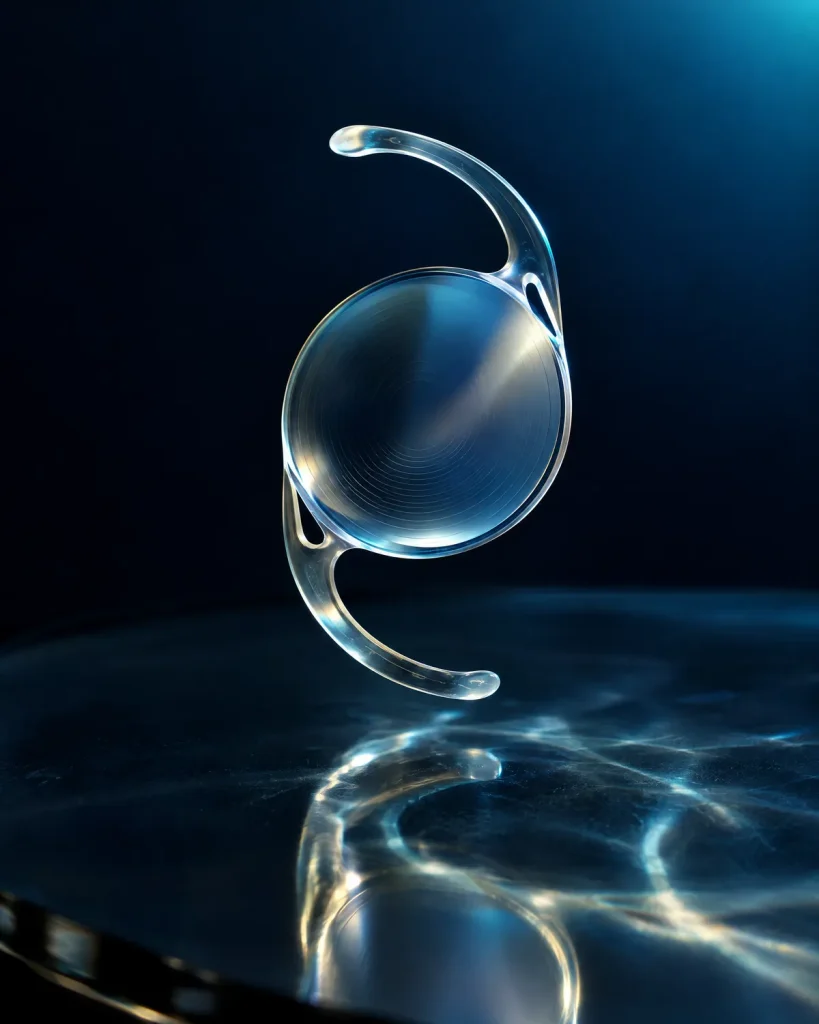
A toric lens implant (toric IOL) replaces your eye's natural lens and corrects regular corneal astigmatism at the same time, usually about 0.75 to 4.75 dioptres. It must sit at an exact angle: each degree of rotation removes about 3.3% of its effect. Toric versions exist for monofocal, EDOF and trifocal lenses. In Istanbul, Prof. Dr. Satıcı or Op. Dr. Bayram treats both eyes from {{£ price}}; hotel and transfers are extra.
What is a toric lens implant, and how does it correct astigmatism?
A toric lens implant is an intraocular lens (IOL) with two different focusing powers set at right angles to each other, designed to cancel out the uneven curve of an astigmatic cornea. The American Academy of Ophthalmology (AAO) describes toric lenses as lenses with "extra built-in correction for astigmatism", available as monofocal lenses and as some presbyopia-correcting lenses.
Why astigmatism needs its own lens. In astigmatism, the cornea is curved more like a rugby ball than a football, so light focuses at more than one point and vision blurs at every distance. A standard (non-toric) lens corrects short or long sight, but it cannot correct this uneven curve. Without a toric lens, astigmatism stays after surgery, and you need glasses for sharp distance vision.
How common it is. A systematic review of studies from 1996 to 2015, summarised on EyeWiki (the AAO's encyclopaedia for eye doctors), found astigmatism greater than 1.0 dioptre (D) in 47% of eyes before cataract surgery. In a German analysis of 23,239 eyes (median age 74), 8% had corneal astigmatism above 2.00 D and 2.6% above 3.00 D.
How a toric lens works, step by step:
- Your surgeon measures the astigmatism: how much there is, and its axis, the direction of the steepest curve of the cornea.
- A lens power is calculated for both your overall prescription and the astigmatism. EyeWiki gives toric lens cylinder powers of about 1.5 to 6.0 D, which correct about 0.75 to 4.75 D of astigmatism at the cornea.
- The lens is implanted and turned to the planned axis. Small marks on the lens edge are lined up with marks or a digital guide on your eye.
- The lens stays in that position. The lens capsule, the thin bag that held your natural lens, gradually closes around it and holds it in place.
Why the angle matters. EyeWiki states that every degree a toric lens sits off its planned axis reduces its astigmatism correction by about 3.3%. At 30 degrees off axis the lens loses its full correcting effect. This is why careful measurement, marking and alignment matter more with a toric lens than with any other lens.
Technology we use: {{toric lens models actually offered, e.g. AcrySof IQ Toric, TECNIS Toric II, PanOptix Toric, Vivity Toric, PureSee Toric II}}, implanted in a fully equipped, Ministry of Health–licensed operating theatre in Istanbul. Before surgery, your examination includes optical biometry, corneal topography to map your astigmatism, and an OCT scan of the macula. {{Alignment method used: manual ink marking / digital image-guided marking system}}.
Types of toric lenses for astigmatism
Toric lenses for astigmatism come in the same families as other lens implants: toric is an add-on, not a separate lens type. Your surgeon first chooses the lens family for your lifestyle, then adds toric correction if your astigmatism needs it.
| Toric lens type | What it gives you | Examples of toric versions |
|---|---|---|
| Monofocal toric | Sharp vision at one distance, usually far; reading glasses needed | AcrySof IQ Toric, TECNIS Toric II, enVista Toric |
| EDOF toric | Distance and arm's-length vision; light reading glasses often still needed | Vivity Toric, TECNIS PureSee Toric II |
| Trifocal / multifocal toric | Distance, intermediate and near vision, the most freedom from glasses | PanOptix Toric, TECNIS Synergy Toric II |
EyeWiki lists toric versions from several manufacturers, including Alcon, Johnson & Johnson, Bausch + Lomb, HOYA and STAAR. Lens material and design affect how well a lens resists rotation, which is one reason your surgeon chooses the model rather than the cheapest lens (see Toric lens rotation below).
Monovision with toric lenses. Some people choose monofocal toric lenses with one eye set for distance and the other slightly short-sighted for reading. This "blended vision" can reduce the need for reading glasses without multifocal optics. Your surgeon checks whether your eyes tolerate it before suggesting it.
Who a toric lens suits, and who should choose something else
A toric lens usually suits you if you are having cataract surgery or refractive lens exchange (RLE) and you have regular corneal astigmatism of about 1 dioptre or more. EyeWiki notes that toric lenses are generally recommended from 1 D of corneal astigmatism, and the AAO says people with moderate to high astigmatism are usually happier with a toric lens.
You are likely to be a good candidate if you:
- have a cataract, or are over about 45–50 and want lens replacement instead of reading glasses or varifocals
- have regular astigmatism (the two main curves of the cornea at right angles), confirmed on corneal topography
- want sharp distance vision without glasses, or want a trifocal or EDOF lens and also have astigmatism
- have a healthy, stable lens capsule and supporting fibres (zonules) to hold the lens steady
A toric lens may not be the right choice, or needs extra care, if you have:
- Irregular astigmatism, for example from corneal scarring or advanced keratoconus. EyeWiki states that irregular astigmatism caused by corneal scars or ectasia is not suitable for a toric lens, because a cylindrical lens cannot fully correct it.
- Very low astigmatism (below about 0.75 D), where the effect is small; NICE suggests that surgeons consider placing the incision on the steep axis (on-axis surgery) or limbal relaxing incisions instead.
- Weak lens support or previous eye surgery. EyeWiki lists zonular instability (weak fibres holding the lens capsule), a damaged capsule, poor pupil dilation and previous retinal or glaucoma surgery as relative contraindications.
- Previous laser eye surgery, which changes corneal measurements; extra calculations are needed.
Keratoconus. A toric lens can sometimes help in stable keratoconus, but results depend on the stage. A 2022 meta-analysis of 14 studies (456 eyes) found that 83–94% of eyes with mild keratoconus ended within 1 D of the target prescription, compared with 51–57% in moderate and 12–48% in advanced keratoconus. If your scans show keratoconus or another corneal problem, your case is reviewed by Doç. Dr. Muhammet Derda Özer (Doç. = Associate Professor), our cornea specialist, before any lens is chosen.
Under about 45, with a clear natural lens? A toric implantable contact lens (toric ICL) or laser eye surgery usually suits you better, because they keep your natural focusing lens.
Toric vs regular lens implant: what is the difference?
The only difference between a toric and a regular (non-toric) lens is the built-in astigmatism correction; the operation is the same. With a regular lens, astigmatism remains after surgery and is corrected with glasses, or sometimes reduced with small relaxing incisions in the cornea.
| Regular (non-toric) lens | Toric lens | |
|---|---|---|
| Corrects short or long sight | Yes | Yes |
| Corrects corneal astigmatism | No | Yes, about 0.75–4.75 D |
| Extra planning | Standard biometry | Topography, axis measurement, alignment marking |
| Lens must sit at a fixed angle | No | Yes (3.3% loss per degree off axis) |
| Distance glasses after surgery | More often needed if you have astigmatism | Less often needed |
| Extra risk | Standard lens-surgery risks | The same, plus a small chance of rotation needing repositioning |
| Price | Lower | Higher (premium lens) |
What the evidence shows. A 2016 systematic review of 13 randomised trials (1,413 eyes) found high-quality evidence that people with a toric lens had better uncorrected distance vision and were about half as likely to need distance glasses as people with a non-toric lens, with no clear increase in complications (moderate-quality evidence). Residual astigmatism was lower even when the non-toric group had relaxing incisions.
A 2019 Cochrane review compared toric lenses with limbal relaxing incisions (small cuts at the edge of the cornea). About 700 in 1,000 eyes with a toric lens ended with less than 0.5 D of astigmatism, against about 500 in 1,000 with relaxing incisions. EyeWiki notes that relaxing incisions can correct up to 3.0 D but are most predictable up to 1.5 D.
Toric contact lenses vs a toric lens implant
Toric contact lenses and toric lens implants use the same optical idea, a lens with built-in astigmatism correction, but one sits on the eye and the other is placed permanently inside it.
| Toric contact lenses | Toric lens implant (toric IOL) | |
|---|---|---|
| Where it sits | On the front of the cornea | Inside the eye, in place of your natural lens |
| Permanent? | No; you replace them | Yes; it does not wear out |
| Daily care | Cleaning, handling, replacing | None |
| Also treats cataract and reading glasses | No | Yes, depending on the lens family |
| Who it suits | Any age with regular astigmatism | Usually cataract patients or people over about 45–50 |
The AAO lists toric soft lenses and rigid gas-permeable (RGP) lenses as the two main types of contact lenses for astigmatism, and notes that RGP lenses may work best for more severe or irregular astigmatism. If you are tired of contact lenses but under about 45, ask about laser eye surgery or a toric ICL rather than a lens implant.
Before your measurements, leave your contact lenses out, because lenses temporarily change the shape of the cornea and would distort your astigmatism reading. Your coordinator confirms how long: {{contact-lens break before the pre-op exam: soft / toric / rigid lenses}}.
Toric lens implant cost in Istanbul, and what is included
At Laser Istanbul Clinic, toric lens surgery starts from {{£ price}} for both eyes, lens included. The price depends mainly on the lens family. Your surgeon confirms your exact price in writing after reviewing your prescription and scans, before you book anything.
Toric lens price list
| Toric lens type (both eyes, lens included) | Laser Istanbul Clinic |
|---|---|
| Monofocal toric lens | from {{£ monofocal toric price}} |
| EDOF toric lens | from {{£ EDOF toric price}} |
| Trifocal / multifocal toric lens | from {{£ trifocal toric price}} |
| One eye only (for example, cataract in one eye) | from {{£ toric lens price per eye}} |
What toric lenses cost elsewhere
Published price lists rarely show toric lenses separately; they are priced as premium lenses. Typical published figures in 2025–26:
| Where | What is published |
|---|---|
| UK private clinics | Monofocal cataract surgery about £2,500–3,500 per eye; premium (trifocal) lens replacement about £6,000–11,000 for both eyes |
| USA | Premium lenses, including toric lenses, are usually paid out of pocket and can cost more than $1,000 per eye on top of standard cataract surgery (AAO) |
| Istanbul (published package prices) | Monofocal cataract about $1,100–2,700 per eye; trifocal lens replacement about $3,400–7,000 for both eyes |
| Toric lens surgery with Laser Istanbul Clinic | from {{£ price}} for both eyes |
UK and Istanbul figures are typical ranges published by clinics and price-comparison sites in 2025–26, not quotes. Published Istanbul prices are often packages that include a hotel.
Who pays at home? In the UK, NHS cataract surgery uses monofocal lenses. An NHS patient leaflet notes that a toric lens may be used if your astigmatism cannot be sufficiently corrected by other means during surgery, but premium multifocal lenses are not available to NHS patients, and lens replacement purely to reduce glasses is not on the NHS. In the US, a Medicare ruling of 22 January 2007 (CMS-1536-R) covers the standard-lens part of cataract surgery, and patients pay the extra cost of the astigmatism-correcting lens themselves.
Your treatment price includes:
- full pre-operative eye examination, biometry, topography and scans with your surgeon
- toric lens surgery by your named surgeon, including the lenses
- medication and eye drops for your recovery
- follow-up checks in Istanbul with the same surgeon
- a personal interpreter, a dedicated coordinator and remote follow-up after you return home
Not included: flights, hotel and airport transfers. Hotel and transfers are a separate charge, and we can arrange them for you if you ask.
Your toric lens surgeons



Your toric lens journey, step by step
Free online assessment
Send your glasses prescription, any eye reports and, if you have them, previous topography scans. A surgeon tells you whether a toric lens is likely to suit you and sends a written quote within {{response time}}.
Book your dates
Plan 5–7 days in Istanbul. We help you choose dates with your surgeon and recommend flights.
Full eye examination and lens planning
Optical biometry, corneal topography, an OCT scan of the macula and a dilated retina check. Your surgeon measures the astigmatism on more than one device. This matters: a 2012 study of 715 corneas found that measuring only the front surface of the cornea misjudged total astigmatism by more than 0.5 D in 5% of eyes, because the back surface adds astigmatism of its own (on average 0.30 D). The UK's NICE guidance also advises considering corneal topography for people with significant astigmatism. You then choose the lens family with your surgeon.
Surgery
Before surgery, while you sit upright, reference marks or a digital image of your eye record the horizontal axis, because the eye can rotate slightly when you lie down (cyclotorsion, about 2–4 degrees according to EyeWiki). Numbing drops or a local anaesthetic are used, so you are awake but should not feel pain. The natural lens is removed through a tiny incision, the toric lens is unfolded and turned to the planned axis. The NHS gives 20–45 minutes as the usual length of the operation. The two eyes are treated on separate days: {{confirm your surgeons' usual gap between eyes}}.
Check-ups
Your surgeon checks your vision and the lens axis the day after surgery, and again before you fly home.
Home
Most patients can fly about 3–7 days after lens surgery, once their surgeon has checked the eye. Your coordinator stays in touch, and your surgeon reviews your progress by video at agreed intervals.
Recovery after toric lens surgery
-
First hours
Vision is blurry from the dilating drops. Rest and wear the eye shield as advised.
-
First week
Vision improves over several days. Avoid rubbing or pressing on the eye: in one study, most toric lens rotation that occurred happened between day 1 and day 7, with no significant further rotation between day 7 and day 30.
-
About 4 weeks
Use the antibiotic and anti-inflammatory drops for about 4 weeks, as the NHS advises. No swimming or eye make-up during this time.
-
After both eyes settle
Your surgeon checks for any small residual prescription and whether you need light glasses for some tasks.
Do not drive until your vision is back to normal and your surgeon confirms it meets the driving standard. Contact your coordinator or a local eye emergency service straight away if you notice sudden floaters, flashes of light, a dark curtain across your vision, sudden blurring, or increasing pain and redness.
Risks, side effects and toric lens complaints
Toric lens surgery carries the same risks as any cataract or lens replacement operation, plus one specific to toric lenses: rotation. Serious complications are rare, but they are not zero.
Toric lens rotation
The most common toric lens complaint is a lens that turns away from its planned axis, so some astigmatism comes back and vision is less sharp than expected. A systematic review summarised on EyeWiki found that most toric lenses rotated less than 5 degrees. Repositioning surgery is needed in a small minority:
- A 2022 meta-analysis of 18 studies found a pooled repositioning rate of 2%, with lower rates for hydrophobic acrylic, loop-haptic designs than for silicone or plate designs.
- In a 2023 US review of 993 eyes, repositioning was recommended in 1.6%, ranging from 0.6% to 5.7% depending on the lens model.
- In a 2021 study of 5,529 toric lenses, about 1.5–1.8% were repositioned; rotation was more likely in younger patients and in eyes with higher or with-the-rule astigmatism. Repositioning improved vision, with no major complications and no repeat rotation.
If your lens rotates, your surgeon can turn it back with a short second procedure, usually in the first weeks, or correct the remaining astigmatism with glasses or a laser touch-up. {{Your surgeons' policy on toric lens repositioning, laser touch-ups and lens exchange, and whether these are included in the price.}}
Other toric lens complaints
- Residual astigmatism or prescription. Measurements and lens formulas have limits, so a small prescription can remain. A laser touch-up to fine-tune the focus is sometimes needed (RCOphth).
- Halos and glare at night. These come mainly from the lens family, not the toric part: they are more typical of trifocal and multifocal lenses, and usually fade over months but do not always disappear completely (RCOphth).
- Mild dryness or grittiness in the first weeks, helped by lubricating drops.
Risks of any lens operation
- Clouding behind the lens (posterior capsule opacification), months or years later, treated with a quick YAG laser treatment.
- Retinal detachment. A 2025 review of more than 8.5 million eyes classified it as rare after cataract surgery (about 1 in 1,000) and uncommon after refractive lens exchange (about 1 in 500). Short-sighted eyes have a higher risk.
- Infection inside the eye (endophthalmitis). Rare but serious: about 1.4 cases per 1,000 operations in a Canadian study of 442,177 cataract operations.
- Permanent serious loss of vision affects approximately 1 in 500 patients after RLE, according to the Royal College of Ophthalmologists (RCOphth), usually from infection, inflammation, retinal detachment or bleeding.
- Inflammation, raised eye pressure, or a lens that moves or tilts.
In the 2016 review of 13 trials, toric lenses were not associated with more complications than regular lenses. Your surgeon explains your personal risks in writing and through your interpreter before you sign anything.
Toric lens implants: frequently asked questions
With Laser Istanbul Clinic, toric lens surgery starts from {{£ price}} for both eyes, including your examination and scans, surgery, the lenses, medication, follow-up checks, interpreter and coordinator; hotel and transfers are extra. The price depends on whether you choose a monofocal, EDOF or trifocal toric lens. In the US, the AAO says premium lenses such as toric lenses can cost more than $1,000 per eye out of pocket on top of standard cataract surgery.
Yes. A toric lens is a premium lens, made to your astigmatism, and it needs extra measurements and alignment, so it costs more than a standard monofocal lens. Our toric lens price list shows each lens family separately, and your surgeon confirms your exact price in writing before you book.
A toric lens has built-in correction for astigmatism and must sit at a fixed angle in the eye; a regular lens corrects only short or long sight. The surgery is the same. In a 2016 review of 13 trials, people with toric lenses were about half as likely to need distance glasses as people with regular lenses.
Standard toric lenses correct about 0.75 to 4.75 dioptres of corneal astigmatism, according to EyeWiki. For higher amounts, EyeWiki notes that combining a toric lens with corneal incisions (astigmatic keratotomy) may be the best way to treat the total astigmatism. Irregular astigmatism, for example from advanced keratoconus, cannot be fully corrected by a toric lens.
It depends on the lens family. With a monofocal toric lens you usually see well in the distance but need reading glasses; with an EDOF toric lens you may need light glasses for small print; a trifocal toric lens gives the most freedom from glasses. A small residual prescription is possible with any lens.
The most common complaint is a lens rotating off its planned axis, which brings back some astigmatism. Studies report repositioning in about 1.5–2% of eyes. Other complaints include a small residual prescription and, with multifocal toric lenses, halos around lights at night.
There is no single best toric lens for everyone. Check that your surgeon measures your astigmatism on more than one device, including the back surface of the cornea, chooses a lens model with good rotational stability, and explains which lens family fits your daily life. Prof. Dr. Satıcı or Op. Dr. Bayram recommends a lens only after your examination.
Yes. Toric versions exist for monofocal, EDOF and trifocal lenses, such as PanOptix Toric and TECNIS Synergy Toric II (trifocal or multifocal) and Vivity Toric and PureSee Toric II (EDOF). This lets you correct astigmatism and reduce your need for reading glasses in one operation.
If you are under about 45 with a clear natural lens, laser eye surgery or a toric ICL usually suits you better. If you have a cataract, or you are over about 45–50 and need reading glasses, a toric lens corrects astigmatism and replaces the ageing lens in the same operation.
Plan 5–7 days in Istanbul for both eyes, including your examination, surgery and check-ups. Most patients can fly about 3–7 days after lens surgery, once their surgeon has checked the eye and the lens position.
Other lens options in Istanbul
A toric lens is an add-on to a lens family. Your surgeon may suggest one of these, with or without toric correction, after measuring your eyes.
Trifocal / multifocal lens
Three focus points for distance, intermediate and near: the most freedom from glasses, with more night-time halos. Available in toric versions.
Trifocal / multifocal lens surgery (PanOptix, Synergy)EDOF lens
A continuous range from distance to arm's length, with fewer halos than a trifocal; light reading glasses are often still needed. Available in toric versions.
EDOF lens (Vivity, PureSee)Sources for the facts on this page
- EyeWiki (American Academy of Ophthalmology), Toric IOLs: generally recommended from 1 D of corneal astigmatism; cylinder powers 1.5–6.0 D correcting about 0.75–4.75 D; AcrySof toric effect reduced 10% per 3° off axis, full effect lost at 30°; models from Alcon, AMO/Johnson & Johnson, Bausch + Lomb (enVista), HOYA and STAAR, plus multifocal/trifocal toric versions (PanOptix Toric); irregular astigmatism from corneal scars or ectasia unsuitable; zonular instability, capsular dehiscence, poor dilation and prior vitreoretinal or glaucoma surgery relative contraindications; mark with the patient sitting because of cyclotorsion; higher astigmatism may combine toric IOL with astigmatic keratotomy. https://eyewiki.org/Toric_IOLs
- EyeWiki (AAO), Physiology of Astigmatism: cyclotorsion of about 2–4 degrees from sitting to lying. https://eyewiki.org/Physiology_of_Astigmatism
- EyeWiki (AAO), Astigmatism Correction at the Time of Cataract Surgery: 0.75–4.75 D at the corneal plane; 3.3% reduction per degree off axis; most toric IOLs rotate <5° (systematic review); astigmatism >1.0 D in 47% of eyes before cataract surgery (systematic review 1996–2015); LRIs up to 3.0 D, most predictable up to 1.5 D; irregular astigmatism not fully correctable with cylindrical lenses. https://eyewiki.org/Astigmatism_Correction_at_the_Time_of_Cataract_Surgery
- American Academy of Ophthalmology, Factors to Consider in Choosing an IOL for Cataract Surgery (31 March 2025): toric lenses have extra built-in correction, available in monofocal and some presbyopia-correcting IOLs; moderate-to-high astigmatism usually happier with toric; Medicare and most insurers cover monofocal; premium lenses (incl. toric) usually paid out of pocket and can cost more than $1,000. https://www.aao.org/eye-health/tips-prevention/best-artificial-lens-implant-iol-cataract-surgery
- American Academy of Ophthalmology, Astigmatism Treatment: toric soft and RGP contact lenses; RGP may work best for severe or irregular astigmatism. https://www.aao.org/eye-health/diseases/astigmatism-treatment
- Kessel L, et al. Toric Intraocular Lenses in the Correction of Astigmatism During Cataract Surgery: A Systematic Review and Meta-analysis. Ophthalmology 2016;123(2):275–286: 13 RCTs, 707 toric vs 706 non-toric eyes; better UCDVA (high quality); spectacle dependence RR 0.51; complications RR 1.73 (95% CI 0.60–5.04, not significant, moderate quality); lower residual astigmatism vs non-toric + relaxing incision. https://pubmed.ncbi.nlm.nih.gov/26601819/
- Lake JC, et al. Toric intraocular lens versus limbal relaxing incisions for corneal astigmatism after phacoemulsification. Cochrane Database Syst Rev 2019;12:CD012801: 10 RCTs, 626 eyes; ~700 vs ~500 per 1,000 with <0.5 D residual astigmatism (RR 1.40, moderate certainty); clinically significant astigmatism in up to ~20% of cataract patients. https://pubmed.ncbi.nlm.nih.gov/31845757/
- Hoffmann PC, Hütz WW. Analysis of biometry and prevalence data for corneal astigmatism in 23,239 eyes. J Cataract Refract Surg 2010;36(9):1479–1485: median age 74; 8% >2.00 D, 2.6% >3.00 D. https://pubmed.ncbi.nlm.nih.gov/20692558/
- Koch DD, et al. Contribution of posterior corneal astigmatism to total corneal astigmatism. J Cataract Refract Surg 2012;38(12):2080–2087: 715 corneas; mean posterior corneal astigmatism −0.30 D; anterior-only measurement error >0.50 D in 5% of eyes; risk of over-correcting with-the-rule and under-correcting against-the-rule astigmatism. https://pubmed.ncbi.nlm.nih.gov/23069271/
- Wu J, et al. Impact of Material and Lens Design on Repositioning Surgery of Toric Intraocular Lenses: A Single-Arm Meta-Analysis. J Ophthalmol 2022:6699596: 18 studies; pooled repositioning 2%; plate and silicone 6% vs loop and hydrophobic acrylic 2%. https://pubmed.ncbi.nlm.nih.gov/35223091/
- Hu EH. Repositioning Rates of Toric IOLs Implanted in Cataract Surgery Patients: A Retrospective Chart Review. Clin Ophthalmol 2023;17:4001–4007: 993 eyes; repositioning recommended in 1.6% (0.6–5.7% by model). https://pubmed.ncbi.nlm.nih.gov/38152615/
- Haripriya A, et al. Comparison of surgical repositioning rates and outcomes for hydrophilic vs hydrophobic single-piece acrylic toric IOLs. J Cataract Refract Surg 2021;47(2):178–183: 5,529 toric IOLs; actual repositioning 1.8% vs 1.5%; higher with younger age, higher and with-the-rule astigmatism; repositioning safe and effective, no recurrent rotation. https://pubmed.ncbi.nlm.nih.gov/32925653/
- Dubinsky-Pertzov B, et al. Clinical outcomes of Ankoris toric intraocular lens implantation using a computer-assisted marker system. Int Ophthalmol 2020;40(12):3259–3267: rotation increased between day 1 and day 7, no significant rotation between day 7 and day 30. https://pubmed.ncbi.nlm.nih.gov/32720169/
- Yahalomi T, et al. Refractive Outcomes of Non-Toric and Toric Intraocular Lenses in Mild, Moderate and Advanced Keratoconus: A Systematic Review and Meta-Analysis. J Clin Med 2022;11(9):2456: 14 studies, 456 eyes; within 1 D of target 83–94% (mild), 51–57% (moderate), 12–48% (advanced). https://pubmed.ncbi.nlm.nih.gov/35566583/
- NICE guideline NG77, Cataracts in adults: management, recommendation 1.3.4 (consider corneal topography for people with significant astigmatism, among others) and 1.4.5 (consider on-axis surgery or limbal-relaxing incisions to reduce postoperative astigmatism). https://www.nice.org.uk/guidance/ng77/chapter/Recommendations
- The Dudley Group NHS Foundation Trust, patient information Cataract surgery: NHS lenses are monofocal; a toric lens implant may be used if astigmatism cannot be sufficiently corrected by other means; multifocal lenses not available as an NHS patient. https://www.dgft.nhs.uk/pil/cataract-surgery/
- Centers for Medicare & Medicaid Services, Ruling No. CMS-1536-R (22 January 2007): astigmatism-correcting IOLs partially covered; the beneficiary pays the portion exceeding the charge for a conventional IOL. https://www.cms.gov/regulations-and-guidance/guidance/rulings/downloads/cms1536r.pdf
- The Royal College of Ophthalmologists, Refractive Lens Exchange: Patient Information (PROF/2024/498): laser touch-ups for residual prescription; light-scatter effects fade but may not disappear; permanent serious loss of vision about 1 in 500 after RLE; RLE not on the NHS. https://www.rcophth.ac.uk/guidance-resources/refractive-lens-exchange/
- Passaro ML, et al. Retinal detachment incidence in refractive lens exchange versus cataract surgery: uncommon versus rare. Br J Ophthalmol 2025;109(7):756–764: 8,592,380 eyes; RD ~1/1,000 after cataract surgery, ~1/500 after RLE. https://pubmed.ncbi.nlm.nih.gov/40015940/
- Hatch WV, et al. Risk factors for acute endophthalmitis after cataract surgery: a population-based study. Ophthalmology 2009;116(3):425–430: 442,177 surgeries, 1.4 per 1,000. https://pubmed.ncbi.nlm.nih.gov/19091417/
- NHS, Cataract surgery (operation 20–45 minutes, local anaesthetic, eyes on separate days, drops for about 4 weeks) and Cataract surgery: recovery (no rubbing, swimming or eye make-up; driving; warning signs). https://www.nhs.uk/conditions/cataract-surgery/ · https://www.nhs.uk/conditions/cataract-surgery/recovery/
Find out if a toric lens suits your astigmatism, free
Send us your glasses prescription and any eye reports. Prof. Dr. Satıcı or Op. Dr. Bayram will tell you whether a monofocal, EDOF or trifocal toric lens suits you, and what it would cost, with no obligation.
3 eye surgeons
Your case is reviewed by a named surgeon, not a salesperson. Reply within {{response time}}.
 Prof. Dr. Ahmet Satıcı
 Doç. Dr. Muhammet Derda Özer
 Op. Dr. Aysan Bayram