
- Home: eye surgery in Istanbul
- All eye treatments
- Keratoconus treatment in Turkey
- Intacs / corneal ring segments
Intacs Surgery Cost and Corneal Ring Segments in Istanbul
Intacs surgery cost, candidacy, results and recovery, explained by the specialist who would treat you. At Laser Istanbul Clinic, corneal ring segments (Intacs and similar implants) for keratoconus are planned and performed by Doç. Dr. Muhammet Derda Özer (Doç. = Associate Professor), our cornea and keratoconus specialist. He reviews your corneal scans before you travel, you receive the full price in writing before you book, and a personal interpreter stays with you from your first examination to your final check-up.
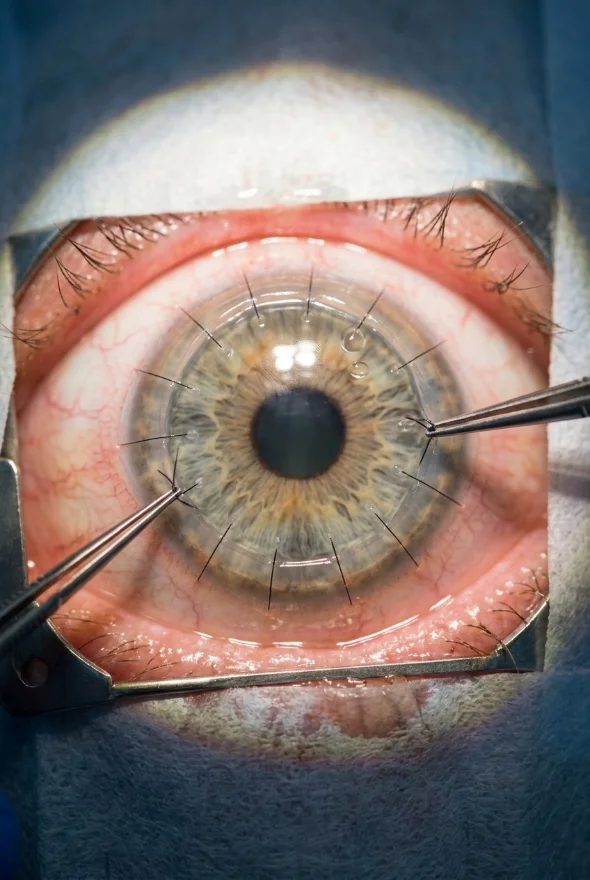
Intacs are small, clear plastic arcs placed inside the outer cornea to flatten the cone of keratoconus and improve vision, especially for people who can no longer see well with, or tolerate, contact lenses. They do not stop keratoconus progressing, so they are often combined with cross-linking, and most people still need glasses or lenses afterwards. In Istanbul, Intacs surgery with Doç. Dr. Muhammet Derda Özer starts from {{£ price}} per eye; hotel and transfers are extra.
What are Intacs, and how does Intacs surgery work?
Intacs are intracorneal ring segments (ICRS): two thin, crescent-shaped implants made of PMMA, a medical plastic used in eye implants for decades. "Intacs" is the brand name of the first ring segments approved in the United States; other brands include Keraring, Ferrara rings and MyoRing. Doctors often use the generic terms "corneal rings" or "ring segments" for all of them.
How they work. In keratoconus, the cornea, the clear dome at the front of the eye, thins and bulges forward into a cone. That causes short sight and irregular astigmatism that glasses cannot fully correct. The segments are placed deep in the outer part of the cornea, at roughly two-thirds to four-fifths of its thickness, well away from the centre of vision. EyeWiki explains that they act as spacers between the collagen layers of the cornea: they shorten its arc, which flattens the central cornea. In keratoconus where the cone sits off-centre, the US FDA's approval summary notes that Intacs also move the cone back towards the centre.
Three things make ring segments different from other keratoconus surgery. According to EyeWiki, they need no removal of corneal tissue and no incision inside the eye, and they leave the central cornea untouched. And unlike laser surgery or a transplant, they are designed to be removed or exchanged if needed.
A short history. Intacs were first marketed for mild short sight in Europe from 1996 and in the United States from February 1999. They received the European CE mark for keratoconus in November 2003, and on 26 July 2004 the FDA approved Intacs for keratoconus patients who can no longer achieve adequate vision with contact lenses or glasses, "so that their functional vision may be restored and the need for a corneal transplant procedure may potentially be deferred".
Intacs surgery, step by step:
- Numbing drops are put in your eye. The procedure is done under topical anaesthesia, so no injection is needed.
- A channel is made inside the cornea. Today this is usually done with a femtosecond laser, which cuts a precise circular tunnel at a set depth. The older method uses a small diamond-knife incision and mechanical instruments. EyeWiki and the 2016 review by Vega-Estrada and Alió describe the laser method as preferred because of its precision and safety profile.
- One or two segments are slid into the tunnel through one small entry cut, depending on the shape and position of the cone. Their thickness and arc length are chosen from your scans, prescription and the position of the cone.
- The small entry cut is left to heal, sometimes with a fine stitch, and you go home the same day with antibiotic and anti-inflammatory drops.
Thickness matters. EyeWiki summarises Barraquer's principle: the flattening effect grows with the thickness of the segment and with a smaller ring diameter. That is why your surgeon chooses from several sizes rather than one standard implant.
Technology we use: {{ring segment brand(s) and types used}}, implanted with {{femtosecond laser platform name}}, in a fully equipped, Ministry of Health–licensed operating theatre in Istanbul. Before surgery, your examination includes corneal topography and tomography, corneal thickness mapping (pachymetry), a refraction and a full eye examination.
Who is Intacs for keratoconus suitable for?
Intacs for keratoconus suit people with mild to moderate keratoconus, a clear central cornea and enough corneal thickness, whose vision is no longer good enough with glasses or contact lenses, or who cannot tolerate rigid lenses.
You are likely to be a candidate if:
- your vision with glasses or contact lenses is no longer good enough for daily life, or you cannot wear rigid lenses comfortably
- the centre of your cornea is clear, without scarring
- your cornea is at least 450 microns thick where the segments will go. This is the threshold in the FDA's approved indication and in EyeWiki's candidacy criteria
- your keratoconus is stable, or will be stabilised with cross-linking. Vega-Estrada and Alió state that disease stability should be confirmed before ring segments are suggested
- your steepest corneal reading is within the range your surgeon can treat; in a 2013 review, Rabinowitz lists a steepest K of 58 dioptres or less among the features of the best candidates
Who benefits most? Rings help most when vision is poor before surgery. In the 2016 review by Vega-Estrada and Alió, 82.9% of eyes with poor corrected vision gained at least one line of vision, whereas in eyes that already saw well in glasses only 37.9% gained and 25.8% lost two lines or more. If you already see well with your lenses, your surgeon may advise you not to have rings.
Ring segments are usually not the right choice if you have:
- scarring or clouding in the centre of the cornea
- a cornea thinner than about 450 microns at the planned implant site
- an active eye infection, recurrent corneal erosions or a corneal dystrophy
- autoimmune, collagen-vascular or immune-deficiency disease, or conditions that slow healing, such as insulin-dependent diabetes or severe atopic disease
- a history of herpes infection of the eye
- pregnancy or breastfeeding
- the expectation of perfect vision without glasses, which Rabinowitz lists as a reason someone is a poor candidate
The FDA approval for Intacs covers patients aged 21 and over. Doç. Dr. Özer decides on your scans and your eyes, and will tell you plainly if cross-linking, specialist contact lenses, an implantable lens or a transplant would serve you better.
Intacs after laser eye surgery. Ring segments are also used for corneal ectasia, a bulging of the cornea that can rarely develop after LASIK. Rabinowitz notes that the channel must then be placed deep below the LASIK flap.
Before your scans, take a break from contact lenses so your cornea shows its true shape: the Community Eye Health review advises 1 week for soft lenses and 2 weeks for rigid gas-permeable lenses. Bring any previous corneal scans.
Intacs, Keraring and other corneal ring types compared
Several ring designs exist. They all work on the same principle; the differences are their arc, diameter and cross-section, which change how strongly and where they flatten the cornea.
| Ring type | Arc and shape | Typical use (EyeWiki; Vega-Estrada & Alió, 2016) |
|---|---|---|
| Intacs | Two 150° segments, hexagonal cross-section; larger diameter (6.8 mm inner) | Standard ring segments for keratoconus; US-approved thicknesses 0.25–0.35 mm |
| Intacs SK | 150° segments, oval cross-section, smaller (6 mm) inner diameter | Higher short sight |
| Keraring / Ferrara-type | 90° to 210° segments, triangular cross-section, smaller diameter (about 4.4–6 mm) | Widely used; many arc lengths allow tailoring to the shape of the cone |
| MyoRing | Full 360° ring | Higher short sight, stronger flattening |
Your surgeon chooses the ring type, number of segments and thickness from your topography, the position of your cone and your prescription. {{List here only the ring types Doç. Dr. Özer implants.}}
Intacs surgery cost in Istanbul, and what is included
At Laser Istanbul Clinic, Intacs surgery starts from {{£ price}} per eye, and corneal rings combined with cross-linking start from {{£ price rings + CXL}} per eye. Doç. Dr. Özer confirms your exact price in writing after reviewing your scans, before you book anything.
| Treatment | Laser Istanbul Clinic |
|---|---|
| Intacs / corneal ring segments, per eye | from {{£ price}} |
| Corneal ring segments combined with cross-linking, per eye | from {{£ price rings + CXL}} |
| Corneal cross-linking alone, per eye | from {{£ CXL price}} |
What other clinics charge. Few clinics publish a fixed price for ring segments: when we checked UK private clinics' 2026 price lists in October 2026, they listed cross-linking but quoted ring segments only after an assessment. For context, the same UK lists show about £1,700–2,400 for cross-linking of one eye, and some quote the surgeon's fee only, with scans and facility fees extra. Ask any clinic for a written, all-in price per eye before you compare.
What changes the Intacs surgery cost:
- one eye or both: ring segments are priced per eye, and keratoconus is often worse in one eye
- rings alone or with cross-linking: combining the two costs more, but treats both the shape and the progression
- the ring type and number of segments your cornea needs
- how the channel is made: we use a femtosecond laser
- your scans: whether you need repeat tomography to confirm stability first
Your treatment price includes:
- full pre-operative eye examination and corneal scans with your surgeon
- Intacs surgery by Doç. Dr. Muhammet Derda Özer, including the implants
- medication and eye drops for your recovery
- follow-up checks in Istanbul with the same surgeon
- a personal interpreter, a dedicated coordinator and remote follow-up after you return home
Not included: flights, hotel and airport transfers. Hotel and transfers are a separate charge, and we can arrange them for you if you ask.
Getting a quote takes three steps: send your current glasses or contact lens prescription, any eye reports and, most importantly, your corneal topography or tomography scans. Doç. Dr. Özer replies with his opinion and a written quote within {{response time}}.

Your Intacs surgery journey, step by step
Free online assessment
Send your prescription, eye reports and corneal scans. Doç. Dr. Özer tells you whether ring segments are likely to help, whether you need cross-linking as well, and sends a written quote.
Book your dates
Plan to stay in Istanbul for {{number of days}}. We help you choose dates and recommend flights.
Full eye examination (day 1)
Corneal topography and tomography, thickness mapping, refraction and a full eye check through your interpreter. Your surgeon plans the ring type, thickness and position. If rings are not right for you, he tells you and explains the alternatives.
Surgery (day {{day}})
Numbing drops, then the femtosecond laser channel and ring insertion. {{Typical time in theatre per eye.}} You go back to your hotel the same day with drops and pain relief.
Check-ups in Istanbul
Your surgeon checks the position of the segments and the entry cut, usually the next day, and confirms when you can fly.
Home and follow-up
Your coordinator stays in touch, and your surgeon reviews your progress by video. Repeat corneal scans near home can be sent to Doç. Dr. Özer. Your contact lenses are refitted once the cornea has settled.
One eye or both? {{Your surgeon's policy on treating both eyes on one trip.}}
Recovery after Intacs surgery
Unlike epithelium-off cross-linking, Intacs surgery leaves the surface layer of the cornea in place, so the first days are usually more comfortable. Vision, however, takes time to settle.
-
Days 1–4
Some discomfort, watering and light sensitivity. A university eye centre describes post-operative discomfort for one to four days. Use the drops exactly as prescribed.
-
First weeks
Vision fluctuates; this can last weeks to months. Do not rub your eyes. Your surgeon tells you when you can return to work, drive and swim.
-
Contact lenses
Rabinowitz reports that soft lenses can be worn soon after surgery, while rigid lens fitting is usually delayed for at least 3 months. Many patients find their lenses fit better and feel more comfortable than before.
-
3–12 months
The cornea settles and your glasses or contact lens prescription is updated. Repeat scans check the result and, if you have not had cross-linking, whether keratoconus is still stable.
If you have night-time glare or halos, tell your surgeon: they are a known side effect and are more likely if your pupils are large. Call your coordinator straight away if pain, redness, discharge or blurred vision get worse, as these can be signs of infection.
Intacs for keratoconus success rate, and the risks
Results. Corneal rings usually flatten the cornea by a few dioptres and improve vision by a couple of lines on the eye chart, but they do not give perfect vision.
- A 2019 meta-analysis in the Journal of Refractive Surgery pooled 1,325 eyes from 18 studies: at 12 months the cornea was on average 3.41 dioptres flatter, short sight was reduced by 2.81 dioptres and astigmatism by 1.49 dioptres, and uncorrected vision improved by about two lines.
- In the main study behind the FDA approval (74 eyes), 72% gained two or more lines of uncorrected vision and 45% gained two or more lines of best-corrected vision; 4% lost two or more lines.
- In a 2013 review, Rabinowitz reports that 70–80% of patients saw better with and without glasses after Intacs.
- How long do results last? In a 5-year study of 124 eyes (Journal of Cataract & Refractive Surgery, 2021), no regression was seen. In a smaller 5-year Intacs study (Scientific Reports, 2019, 30 eyes), the gain in best-corrected vision lasted 5 years, but uncorrected vision drifted back towards its starting level by year 5.
What EyeWiki says. The American Academy of Ophthalmology's EyeWiki notes that most patients end up with a flatter cornea and find contact lenses easier to wear, but usually still need glasses or lenses for their best vision.
How strong is the evidence? A 2019 Cochrane review found no randomised trials comparing rings with glasses or contact lenses, so the evidence comes from case series and comparative studies. That is another reason why contact lenses remain the first option, and why rings are best for people for whom lenses no longer work.
Risks and side effects:
- Overall complications. In the largest series, 850 eyes with femtosecond-laser channels, complications occurred in 5.7%. The most common were an incomplete channel during surgery (2.7%) and segment migration afterwards (1.3%). EyeWiki notes that published complication rates range up to 30%, from harmless to sight-threatening, depending on technique and series.
- Segment movement or extrusion, where a segment shifts or works its way towards the surface and may need repositioning or removal. In the FDA approval study, 7% of eyes needed further surgery, for example for migration, foreign-body sensation, inflammation or halos.
- Glare, halos and night-vision problems. In one European study, 7 of 57 eyes (12.3%) had their rings removed because of visual symptoms.
- Infection (0.1% in the 850-eye series), corneal melting over a segment (0.2%) and perforation during channel creation (0.6%).
- Harmless white deposits along the channel, new blood vessels in the cornea (more likely in contact lens wearers) and corneal haze.
- Vision may not improve, or may get worse, particularly if you already saw well in lenses.
Rings are reversible. In the FDA summary, eyes whose segments were removed returned to their pre-operative state, and Vega-Estrada and Alió report that removal brings vision and corneal shape back towards their starting values.
Doç. Dr. Özer explains your personal risks in writing and through your interpreter before you sign anything.
Intacs and corneal rings: frequently asked questions
At Laser Istanbul Clinic, Intacs surgery starts from {{£ price}} per eye, including your scans, surgery, implants, medication, follow-up checks, interpreter and coordinator; hotel and transfers are extra. Few clinics publish a fixed ring price, because the cost depends on the ring type and whether cross-linking is added. Ask any clinic for a written, all-in price per eye.
Yes. Intacs surgery is planned and priced per eye, because keratoconus is often more advanced in one eye and each cornea needs its own ring plan. If both eyes need rings, ask for a both-eyes price.
Intacs is a brand name for intracorneal ring segments (ICRS): small, clear plastic arcs implanted inside the cornea to flatten it. Many people use "Intacs" for all corneal rings, although other brands, such as Keraring, Ferrara rings and MyoRing, work in a similar way.
Most suitable eyes gain some vision: a 2019 meta-analysis of 1,325 eyes found about two lines of improvement in uncorrected vision and 3.41 dioptres of corneal flattening after 12 months. In the FDA approval study, 72% gained two or more lines of uncorrected vision. Results are best when vision was poor before surgery and the cornea is stable.
No. Ring segments reshape the cornea but do not strengthen it, so they are often combined with corneal cross-linking. A 2018 meta-analysis in Cornea suggests doing both at the same session may give better results than doing them months apart.
Most people do. The FDA summary states that most patients still need glasses, soft toric or rigid gas-permeable lenses after Intacs. The aim is clearer, more stable vision and easier lens wear, not glasses-free vision.
The surgery itself is done under numbing drops, so you feel pressure rather than pain. Afterwards, expect some discomfort, watering and light sensitivity for one to four days, managed with drops and simple pain relief.
Yes. Ring segments are designed to be removed or exchanged, for example if you have troublesome glare or a segment moves. After removal, the cornea tends to return towards its earlier shape, and a corneal transplant remains possible later if ever needed.
They do different jobs: cross-linking stops progression, and Intacs improve the shape of the cornea and your vision. If your keratoconus is progressing, cross-linking comes first or at the same time. Doç. Dr. Özer recommends one, the other or both after studying your scans.
Plan {{number of days}} in Istanbul, including your examination, surgery and first check-up. Your surgeon confirms when you can fly.
Intacs, cross-linking or corneal transplant?
Corneal rings are one of several keratoconus treatments. They do different jobs, and many patients need more than one.
| Intacs / corneal ring segments | Corneal cross-linking (CXL) | Corneal transplant | |
|---|---|---|---|
| Main goal | Flatten the cornea to improve vision and lens tolerance | Stop keratoconus getting worse | Replace scarred or very thin cornea |
| Usually suits | Mild to moderate keratoconus, clear centre, cornea ≥ 450 µm | Progressing keratoconus | Advanced keratoconus or scarring |
| Reversible? | Yes, segments can be removed | No | No |
| Combined with others? | Often with CXL | Often with rings | Usually done instead, in advanced cases |
Corneal cross-linking (CXL)
Riboflavin drops and UV light stiffen the cornea to stop keratoconus progressing; often done before or together with rings.
Corneal cross-linking (CXL) in IstanbulCorneal transplant
Partial or full-thickness replacement of the cornea with donor tissue when it is too scarred or thin for rings. The FDA summary notes that corneal grafts last about 10–15 years on average, one reason to delay a transplant when rings can help.
Corneal transplant in Turkey (DMEK, DSAEK, PK)Sources for the facts on this page
- US FDA, Summary of Safety and Probable Benefit, INTACS® Prescription Inserts for Keratoconus (HDE H040002, approved 26 July 2004): indication wording; patients ≥ 21, clear central cornea, ≥ 450 µm at incision site, transplant the only remaining option; contraindications (≤ 449 µm, collagen-vascular/autoimmune/immunodeficiency disease, pregnancy/nursing, recurrent erosion or dystrophy, isotretinoin, amiodarone); not recommended with insulin-dependent diabetes, severe atopic disease, herpes history; large pupils and low-light symptoms; two PMMA segments of 150°, thicknesses 0.25/0.30/0.35 mm, about two-thirds depth, small radial incision, designed for removal or replacement; flattens and recentres the cone; CE mark for keratoconus 4 Nov 2003; myopia marketing EU 1996, US 10 Feb 1999; Boxer Wachler study 74 eyes (72% ≥ 2 lines UCVA gain, 45% ≥ 2 lines BSCVA gain, 4% ≥ 2 lines BSCVA loss, 7% reintervention for migration, foreign-body sensation, inflammation, halos); European study 7/57 eyes (12.3%) removed for visual symptoms, eyes returned to preoperative state; most patients still need spectacles, soft toric or RGP lenses; corneal grafts last about 10–15 years. https://www.accessdata.fda.gov/cdrh_docs/pdf4/H040002B.pdf and HDE record https://www.accessdata.fda.gov/scripts/cdrh/cfdocs/cfhde/hde.cfm?id=H040002
- EyeWiki (AAO), Keratoconus: ICRS for mild–moderate keratoconus with clear central cornea and > 450 µm at the insertion site; no tissue removal, no intraocular incision, central cornea untouched; flatter cornea and easier contact-lens wear, spectacles/lenses usually still needed; complication rates up to 30%; approved for contact-lens-intolerant patients. https://eyewiki.org/Keratoconus
- EyeWiki (AAO), ICRS: Corneal Biomechanics Effects: implantation depth 66–80%; arc-shortening/spacer mechanism; Barraquer's principle (effect proportional to thickness, inverse to diameter); PMMA; dimensions of Intacs, Intacs SK, Ferrara, Keraring, MyoRing. https://eyewiki.org/ICRS:_Corneal_Biomechanics_Effects
- Vega-Estrada A, Alió JL. The use of intracorneal ring segments in keratoconus. Eye and Vision 2016: selection (contact-lens intolerance, no central scarring, stability first); outcomes by baseline vision (82.9% gain ≥ 1 line with poor CDVA; 37.9% gain and 25.8% lose ≥ 2 lines with good CDVA); 3–5 D mean flattening; femtosecond 70–80% depth preferred; ring types (Keraring 90–210° triangular, Intacs 150° hexagonal, Intacs SK oval, MyoRing 360°); complications incl. extrusion, migration, neovascularisation, haze, melting, infectious keratitis, harmless white deposits; explantation returns parameters towards baseline; ICRS then CXL. https://pmc.ncbi.nlm.nih.gov/articles/PMC4791885/
- Rabinowitz YS. INTACS for keratoconus and ectasia after LASIK. Int Ophthalmol Clin 2013;53(1):27–39: best candidates (contact-lens intolerance, clear optical zone, steepest K ≤ 58 D, ≥ 450 µm), poor candidates (scarring, < 450 µm, rapidly progressive without CXL, expecting excellent unaided vision); topical anaesthesia; femtosecond vs mechanical; 2–3 D flattening; 70–80% improved; soft lenses soon after, rigid lenses after ≥ 3 months; post-LASIK ectasia with channel below the flap. https://pmc.ncbi.nlm.nih.gov/articles/PMC3653443/
- Izquierdo L Jr, Mannis MJ, Mejías Smith JA, Henriquez MA. Effectiveness of Intrastromal Corneal Ring Implantation in the Treatment of Adult Patients With Keratoconus: A Systematic Review. J Refract Surg 2019 (PMID 30855097): 1,325 eyes, 18 studies, 12 months; UDVA +0.23 logMAR, sphere 2.81 D, cylinder 1.49 D, keratometry 3.41 D; combined with CXL better than ICRS alone. Abstract via Europe PMC: https://europepmc.org/article/MED/30855097
- Zadnik K, et al. Intrastromal corneal ring segments for treating keratoconus. Cochrane Database Syst Rev 2019 (CD011150.pub2): no RCTs vs spectacles/contact lenses; modest flattening 2–3 D and 2–3 lines; reports of perforation and severe infection. https://pmc.ncbi.nlm.nih.gov/articles/PMC6516208/
- Coskunseven E, Kymionis GD, Tsiklis NS, et al. Complications of intrastromal corneal ring segment implantation using a femtosecond laser for channel creation: a survey of 850 eyes with keratoconus. Acta Ophthalmol 2011 (PMID 19681760): total 5.7%; incomplete channel 2.7%, endothelial perforation 0.6%, migration 1.3%, melting 0.2%, infection 0.1%. https://europepmc.org/article/MED/19681760
- Kubaloglu A, Sari ES, Cinar Y, et al. Comparison of mechanical and femtosecond laser tunnel creation for ICRS implantation in keratoconus: prospective randomized clinical trial. J Cataract Refract Surg 2010 (PMID 20692570): similar outcomes for both techniques. https://europepmc.org/article/MED/20692570
- Hashemi H, Alvani A, Seyedian MA, et al. Appropriate Sequence of Combined Intracorneal Ring Implantation and Corneal Collagen Cross-Linking in Keratoconus: A Systematic Review and Meta-Analysis. Cornea 2018 (PMID 30211742): simultaneous ICRS + CXL may give better outcomes than staged. https://europepmc.org/article/MED/30211742
- Costa JV, Monteiro T, Franqueira N, et al. Five-year long-term outcomes of intrastromal corneal ring segment implantation using the manual technique. J Cataract Refract Surg 2021 (PMID 33196572): 124 eyes, no regression at 5 years. https://europepmc.org/article/MED/33196572
- Kang MJ, Byun YS, Yoo YS, et al. Long-term outcome of intrastromal corneal ring segments in keratoconus: Five-year follow up. Sci Rep 2019 (PMID 30670787): 30 eyes, femtosecond Intacs; CDVA improvement sustained 5 years; UDVA and sphere regressed at 5 years; keratometric flattening maintained. https://pmc.ncbi.nlm.nih.gov/articles/PMC6342932/
- John A. Moran Eye Center, University of Utah Health, Intrastromal Corneal Ring Segments (INTACS): discomfort for one to four days, fluctuating vision for weeks to months, segments can be removed or exchanged, better contact-lens fit. https://healthcare.utah.edu/moran/lasik/intrastromal-corneal-ring-segments
- American Academy of Ophthalmology, Keratoconus Treatment: Intacs are a small curved device placed in the cornea to flatten its curvature and improve vision. https://www.aao.org/eye-health/diseases/keratoconus-treatment
- Deshmukh R, Gore D. Keratoconus: diagnosis and management. Community Eye Health 2024;37(123): contact-lens breaks before scans (1 week soft, 2 weeks RGP). https://pmc.ncbi.nlm.nih.gov/articles/PMC11921258/
- UK private cross-linking prices (2026 published price lists, opened 6 Oct 2026; clinics not named on the page; none listed a fixed ring-segment price): £1,995 one eye (https://www.newmedica.co.uk/private-patients/private-eye-treatment-prices/); £1,700 one eye (https://www.optimalvision.co.uk/corneal-collagen-crosslinking-eye-clinic); £2,399 one eye, surgeon's fee only (https://kvisionc.co.uk/fees).
Could corneal rings help your vision? Find out, free
Send us your glasses or contact lens prescription and your corneal scans. Doç. Dr. Muhammet Derda Özer will tell you whether Intacs, cross-linking, both or another option suits you, and what it would cost, with no obligation.
3 eye surgeons
Your case is reviewed by a named surgeon, not a salesperson. Reply within {{response time}}.
 Prof. Dr. Ahmet Satıcı
 Doç. Dr. Muhammet Derda Özer
 Op. Dr. Aysan Bayram