
- Home: eye surgery in Istanbul
- All eye treatments
- Laser eye surgery in Turkey
- Presbyond (laser for reading glasses)
Laser Eye Surgery Over 40: Presbyond Blended Vision in Istanbul
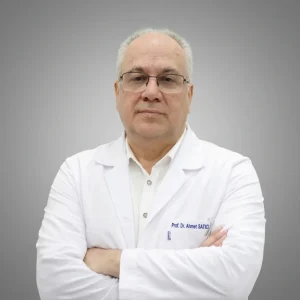
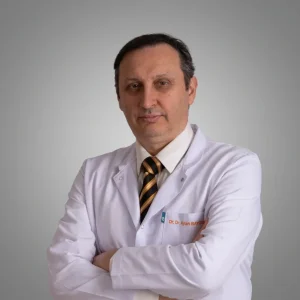
Laser eye surgery over 40 is possible, but it has to deal with something younger patients don't have: presbyopia, the age-related loss of reading vision. Presbyond Laser Blended Vision is a LASIK treatment designed for exactly this. In Istanbul it is planned and performed by Prof. Dr. Ahmet Satıcı or Op. Dr. Aysan Bayram, after a full examination and a test of whether your brain adapts to blended vision.
From your mid-40s, the lens inside your eye stiffens and reading gets harder; this is presbyopia. Standard laser surgery can't reverse it. Presbyond works around it: your dominant eye is corrected for distance, the other eye is left slightly short-sighted for reading, and your brain blends the two. It suits many people aged about 40–55. In Istanbul it starts from {{£ price}} for both eyes with Prof. Dr. Ahmet Satıcı or Op. Dr. Aysan Bayram; hotel and transfers are extra.
What is presbyopia of the eye? Meaning, symptoms and causes
Presbyopia means the gradual, age-related loss of the eye's ability to focus on things up close. The American Academy of Ophthalmology (AAO) describes it as a normal part of ageing that people start to notice shortly after age 40. It is not a disease and it is not caused by anything you did: it happens to everyone, including people who have never needed glasses.
It is also extremely common worldwide. According to the World Health Organization's February 2026 fact sheet, presbyopia is the main cause of near vision impairment, affecting 826 million people whose near vision is not properly corrected.
Presbyopia symptoms
The typical presbyopia vision problems are:
- holding your phone, menus or books further away to read them ("my arms are getting too short")
- small print that blurs, especially in dim light
- eye strain or headaches after reading or close work, which the AAO and the US National Eye Institute (NEI) both list
- needing brighter light to read
- taking off your distance glasses to read, if you are short-sighted
According to the NEI, presbyopia gets worse over time but usually stops getting worse after about age 65.
Presbyopia causes
Presbyopia is caused by the natural lens inside the eye becoming harder and less flexible with age. When you are young, the lens is soft and changes shape easily to focus on close objects, a reflex called accommodation. The Royal College of Ophthalmologists (RCOphth) explains that the natural lens provides about one third of the eye's focusing power and is the flexible part of the system; as it stiffens, accommodation fades and near vision suffers. The AAO notes that this process cannot be stopped or reversed.
This matters for treatment. Laser surgery reshapes the cornea, the clear window at the front of the eye. It cannot make the stiffened lens behind it flexible again. Every laser treatment for presbyopia, including Presbyond, therefore works around the problem rather than curing it.
Presbyopia vs long sight. They feel similar but are different. Long sight (hyperopia) comes mainly from the shape of the eye and is present from birth; presbyopia comes from the ageing lens and affects everyone. Long-sighted people simply notice presbyopia sooner, because their eyes were already using some of their focusing reserve to see clearly.
Presbyopia treatment: glasses, contact lenses, drops, laser and lens surgery
The main presbyopia treatments are reading glasses or varifocals, presbyopia contact lenses, pupil-shrinking eye drops, blended-vision laser surgery and lens replacement. The AAO lists all of these. Which one makes sense depends on your age, your distance prescription, the health of your natural lens and how much you want to be free of glasses.
| Option | How it works | Good to know |
|---|---|---|
| Reading glasses | Magnifying lenses for close work | Simple and cheap; the AAO calls them a good option if presbyopia is your only vision problem |
| Bifocal, trifocal or progressive (varifocal) glasses | Zones for distance, middle and near in one lens | Progressive lenses change power gradually, without a visible line |
| Presbyopia contact lenses: monovision | One eye's lens for distance, the other's for near | A good way to test whether you tolerate blended vision before surgery |
| Presbyopia contact lenses: multifocal | Several power zones in each lens; the brain picks the one it needs | Daily handling and care, as with any contact lens |
| Eye drops | Prescription drops make the pupil smaller to increase depth of focus | Effect lasts up to about six hours (AAO); must be used every day |
| Presbyond Laser Blended Vision | LASIK: distance eye plus slightly short-sighted near eye, with an extended depth of focus | Permanent change to the cornea; for many people aged about 40–55 |
| Presbyopia lens: refractive lens exchange (RLE) | The natural lens is replaced with a trifocal or EDOF lens implant | Often better from the mid-50s or once early cataract appears; cataract cannot develop afterwards |
What is Presbyond, and how does laser blended vision work?
Presbyond Laser Blended Vision is a LASIK treatment for presbyopia: the dominant eye is set for distance, the other eye for near, and both eyes get an extended depth of focus so the brain can merge them into one clear image. It is a software option from ZEISS for its MEL 90 excimer laser, and the manufacturer lists it for LASIK.
It combines three ideas:
- Micro-monovision. Your dominant eye is corrected for distance. Your non-dominant eye is deliberately left slightly short-sighted, so it focuses at reading and arm's length. In published Presbyond studies, the near eye was targeted between about −0.50 and −2.00 dioptres, a smaller difference than in traditional monovision.
- An extended depth of focus. The laser profile is "non-linear aspheric": it adds a carefully calculated amount of spherical aberration so each eye sees sharply over a longer range of distances than a standard treatment gives.
- The blend zone. Because each eye now covers a longer range, the ranges overlap in the middle. With both eyes open, there is a zone at computer and dashboard distance where both eyes see clearly together. This is what makes blended vision easier to adapt to than classic monovision.
The RCOphth describes the same principle in its 2024 patient guidance: from the mid-40s, surgeons often aim for good distance vision in one eye and good vision at arm's length in the other, and with both eyes open the two combine to extend the range of focus. Near vision is at least partly restored with relatively little optical compromise. The RCOphth calls this approach micro-monovision and notes that variations of it are marketed under several brand names.
The reshaping itself is ordinary Femto-LASIK. A femtosecond laser makes a thin flap, the excimer laser reshapes the cornea underneath using the Presbyond profile, and the flap is laid back without stitches. Presbyond can treat short sight, long sight and astigmatism at the same time as presbyopia, and it can also be used if your distance vision is still good and only reading has become a problem. ZEISS lists a treatment range of −8.00 D to +2.00 D sphere and up to 2.00 D of astigmatism; your surgeon decides whether your eyes fall within a safe range.
Technology we use: {{laser platform for blended vision, e.g. ZEISS MEL 90 with Presbyond software, and the femtosecond laser used for the flap}}, in a fully equipped, Ministry of Health–licensed operating theatre in Istanbul.
Laser eye surgery over 40: who Presbyond suits
Presbyond usually suits people aged about 40 to 55 who are starting to rely on reading glasses, whose natural lens is still clear, and whose eyes are healthy enough for LASIK. In the main published studies, patients were between 42 and 70 years old, but the older end of that range is where lens replacement becomes a serious alternative.
You may be a good candidate if:
- you are in your 40s or early 50s and your reading vision is getting worse
- you are short-sighted, long-sighted, have mild astigmatism, or have good distance vision and only need readers
- your prescription has been stable (the RCOphth uses no change greater than 0.5 dioptres in two years for laser vision correction)
- your corneas are healthy and thick enough on topography and thickness scans
- you can adapt to blended vision in a trial (see below)
Presbyond is usually not the right choice if you have:
- early cataract, or a natural lens that is already starting to cloud
- keratoconus or a cornea that is too thin or irregularly shaped
- severe dry eye, uncontrolled diabetes or autoimmune disease, active eye inflammation or advanced glaucoma
- a job or hobby that demands perfect sharpness at one distance in both eyes, or excellent depth perception (your surgeon will discuss this with you)
The blended-vision trial. Not everyone's brain accepts one eye focusing near and the other far. A 2007 review of monovision in contact lens wearers found that 59–67% adapted successfully, with problems mostly at night driving and at middle distances such as computer screens. Presbyond's smaller difference between the eyes and extended depth of focus are designed to make adaptation easier, but your surgeon still tests your tolerance first, in clinic with trial lenses and, if you wear contacts, with a monovision contact lens trial at home before you travel.
Over 55, or with early lens changes? The RCOphth notes that refractive lens exchange is often preferred to laser vision correction in the retirement age group, when early cataract is common. Your surgeon will tell you honestly if a lens implant would serve you better than laser.
Presbyond results: what the studies show
In the published studies, most Presbyond patients could see well at both distance and near with both eyes open, without glasses, and very few lost any sharpness. The key peer-reviewed results:
| Study | Patients | Main results |
|---|---|---|
| Reinstein et al., J Refract Surg 2011 (short-sighted) | 155 patients, age 43–63 | With both eyes: 99% saw 20/20 at distance and could read J5; 96% read J2 (small newsprint). No eye lost 2 or more lines of best-corrected vision |
| Reinstein et al., J Refract Surg 2009 (long-sighted) | 129 patients, age 44–66 | With both eyes: 95% saw 20/20 at distance and could read J5; 81% read J2. Retreatment rate 22% |
| Reinstein et al., J Refract Surg 2012 (no distance prescription) | 148 patients, age 44–65 | With both eyes: 98% saw 20/20 or better at distance; 96% read J2. No eye lost 2 or more lines |
| Hernández-Lucena et al., J Clin Med 2024 (short-sighted, gentler near target) | 144 patients, age 40–60 | With both eyes: 96.5% saw 20/20 at distance; 97.2% read 20/32 or better at near |
| Wong et al., J Refract Surg 2026 (short- and long-sighted) | 125 patients, age 42–70 | 94.4% reported better vision and less need for glasses after the first treatment; retreatment 5.3% (short-sighted) and 12.6% (long-sighted) |
Two points stand out. Long-sighted eyes are more likely to need a touch-up than short-sighted eyes. And the near eye's slight blur at distance does not usually harm distance vision with both eyes open: in the 2009 study, the near eye actually added to binocular distance vision.
These are results from experienced centres, not a promise for your eyes. In a smaller 2022 study of 20 patients aged 41–58, all were satisfied with or accepted the outcome, but the main complaints were disturbances in night vision and near vision that was not as good as they had hoped.
Presbyond vs monovision vs lens replacement
Presbyond, conventional monovision LASIK and refractive lens exchange all reduce the need for reading glasses, but they suit different ages and eyes.
| Presbyond Laser Blended Vision | Conventional monovision LASIK | Refractive lens exchange (presbyopia lens) | |
|---|---|---|---|
| What changes | Cornea (laser) | Cornea (laser) | Natural lens replaced with an implant |
| Difference between the eyes | Small (micro-monovision), with extended depth of focus | Larger | Depends on the lens; trifocal lenses aim for near and distance in each eye |
| Middle distance (screens) | Covered by the blend zone | Often weaker | Good with trifocal and EDOF lenses |
| Depth perception | Mostly preserved | More reduced | Preserved with matched lenses |
| Typical age | About 40–55 | About 40–55 | Usually from the mid-50s, or any age with early cataract |
| Future cataract | Can still develop later | Can still develop later | Cannot develop (the natural lens is gone) |
| Recovery | Fast, as LASIK | Fast, as LASIK | A few days; inside-the-eye surgery |
Ask your surgeon about lens replacement if you are in your mid-50s or older, if you have high long sight, or if your examination shows the first signs of cataract.
Presbyond in Turkey: price and what is included
At Laser Istanbul Clinic, Presbyond Laser Blended Vision starts from {{£ price}} for both eyes. Your surgeon confirms your exact price in writing after reviewing your prescription and scans, before you book anything.
Your treatment price includes:
- full pre-operative eye examination and scans with your surgeon, including the blended-vision tolerance test
- Presbyond treatment of both eyes by your named surgeon
- medication and eye drops for your recovery
- follow-up checks in Istanbul with the same surgeon
- a personal interpreter, a dedicated coordinator and remote follow-up after you return home
Not included: flights, hotel and airport transfers. Hotel and transfers are a separate charge, and we can arrange them for you if you ask.
Ask any clinic, at home or abroad, whether a touch-up is included: the studies above show that some patients, especially long-sighted ones, need one to get the best balance between the eyes. Our policy: {{enhancement / re-treatment policy for Presbyond and the period it covers}}. In the UK, the RCOphth notes that laser vision correction is not available on the NHS and is not covered by private health insurance, so most patients pay privately wherever they are treated.
Your Presbyond surgeons
Your Presbyond journey, step by step
- Free online assessment
Send your glasses prescription (distance and reading), your age and any eye reports. A surgeon tells you whether blended vision is likely to suit you and sends a written quote.
- Optional contact lens trial at home
If you already wear contact lenses, your coordinator can arrange advice on a monovision trial with your own optician before you book flights.
- Book your dates
Plan 3–5 days in Istanbul.
- Full eye examination (day 1)
Corneal topography and thickness, refraction with and without dilating drops, a dry-eye assessment, a check of your natural lens for early cataract, a retina check and a test of which eye is dominant. Your surgeon then tests blended vision with trial lenses so you can see what it feels like. If Presbyond is not right for you, your surgeon says so and explains the alternatives.
- Surgery (day 1 or 2)
Numbing drops are used and a small clip keeps your eyelids open. You feel pressure for a few seconds while the flap is made, then look at a light while the excimer laser works. Both eyes usually take about half an hour in total, and you return to your hotel the same day.
- First check (the next day)
Your surgeon examines both eyes and the flaps.
- Final check and home
Most patients can fly 1–3 days after LASIK, once their surgeon has checked their eyes. Your coordinator stays in touch, and your surgeon reviews your progress by video at agreed intervals.
Recovery after Presbyond
Physical recovery is the same as after Femto-LASIK; the difference is that your brain needs time to learn to blend the two eyes.
-
First few hours
Gritty, watery, light-sensitive eyes. Rest with your eyes closed and use lubricating drops often.
-
Day 1
Distance vision is usually much clearer. Many LASIK patients can return to work the day after surgery. Reading may already be easier, but the near eye can feel slightly blurred at distance.
-
First week
Do not rub your eyes; wear the eye shields as your surgeon advises. No swimming. Use your drops exactly as prescribed.
-
First weeks to months
Your brain learns to use the distance eye for far and the near eye for close work. Night glare, halos and dry-eye symptoms usually improve within a few months.
-
1 month
Contact and combat sports can restart, not before.
-
3–12 months
Vision and the balance between the eyes settle. In one study, the effect of pre-operative depth perception on results had faded by 12 months, suggesting that adaptation continues over the first year. Any touch-up is planned only once your eyes are stable.
Do not drive until your surgeon confirms that your vision meets the driving standard with both eyes open. Call your coordinator straight away if you have increasing pain, light sensitivity, redness or blurred vision.
Risks and side effects of Presbyond
Presbyond carries the usual risks of LASIK plus the specific compromise of blended vision. You should know both before you decide.
Blended-vision trade-offs:
- Not everyone adapts. Some people never feel comfortable with one eye focused nearer than the other. This is why the tolerance test comes first. If you do not adapt, your surgeon can discuss re-treating the near eye for distance, provided there is enough corneal thickness.
- Night driving and dim light. The near eye is slightly blurred at distance, which some people notice most at night. Night-vision disturbances were the main complaint in the 2022 study of 20 patients above.
- Depth perception can be a little reduced, although in the 2022 Presbyond study by Russo and colleagues most patients kept good stereo vision (better than 100 seconds of arc in 79–85%).
- Very small print or long reading sessions in poor light may still need light reading glasses.
- Touch-ups. Retreatment rates in the studies ranged from about 5% for short-sighted eyes to 13–22% for long-sighted eyes.
LASIK risks (usually temporary): dry eye, glare, halos and starbursts, fluctuating vision in the first weeks, and flap problems. Less common are under- or over-correction, infection, inflammation under the flap and corneal ectasia. The RCOphth reports that over 95% of laser patients are satisfied with the outcome, and that fewer than 1 in 5,000 need a corneal transplant to restore vision after laser surgery.
Presbyopia keeps going. Laser does not stop the natural lens from ageing. Your reading range may slowly shrink over the years, and cataract can still develop later. Cataract surgery remains possible after Presbyond; tell any future eye surgeon that you have had LASIK, because it changes the lens-power calculations and can make eye-pressure readings read low.
Your surgeon explains your personal risks in writing and through your interpreter before you sign anything.
Presbyond and laser eye surgery over 40: frequently asked questions
Yes. There is no fixed upper age for laser eye surgery, but over 40 your surgeon must plan for presbyopia. Standard LASIK can still sharpen your distance vision, but you would then need reading glasses. Presbyond blended vision is designed to reduce that need; from the mid-50s, or with early cataract, lens replacement is often the better choice.
Presbyopia means the age-related loss of the eye's ability to focus up close. It happens because the natural lens inside the eye stiffens, and most people start to notice it in their 40s. It affects everyone eventually, including people who have never worn glasses.
The first sign is usually holding your phone, books or menus further away to read them. Small print blurs, especially in dim light, and you may get tired eyes or headaches after close work. The NEI notes that presbyopia gets worse over time but usually stops progressing around age 65.
Most people can do everyday near tasks such as reading a phone, menus and labels without glasses. You may still want light readers for very small print, long reading sessions or poor light, and your reading range may slowly reduce as your natural lens keeps ageing. Your surgeon sets expectations for your eyes before treatment.
Presbyond is a refined form of monovision. The difference between the eyes is smaller, and the laser profile extends each eye's depth of focus, which creates a clear zone at middle distance and helps the brain blend the two images. Conventional monovision uses a larger difference, which some people tolerate less well, especially for night driving and screens.
Yes, for many people. Monovision contact lenses set one eye for distance and one for near, and multifocal contact lenses have several power zones in each lens. A 2007 review found that 59–67% of contact lens wearers adapted successfully to monovision. A monovision contact lens trial is also a useful way to test blended vision before laser surgery.
Glasses are the simplest and safest presbyopia treatment and suit many people perfectly. Surgery makes sense if you are tired of switching between glasses, wear varifocals you dislike, or have an active lifestyle. The choice is personal; your surgeon explains the trade-offs of each option.
With Laser Istanbul Clinic, Presbyond starts from {{£ price}} for both eyes, including your examination and scans, surgery, medication, follow-up checks, interpreter and coordinator. Hotel and transfers are extra. Your exact price is confirmed in writing after your free assessment.
It depends mainly on your age and your natural lens. Presbyond keeps your natural lens and suits many people aged about 40–55 with healthy corneas. Lens replacement with a trifocal or EDOF lens is often better from the mid-50s, for higher long sight, or when early cataract appears, and it means cataract cannot develop later.
It can, especially in the first months. Because one eye is slightly short-sighted, some people notice reduced sharpness, glare or halos when driving at night, and this was the main complaint in a 2022 study of 20 patients. If it bothers you, your surgeon can advise on light distance glasses for night driving or a touch-up once your eyes are stable.
The change to your cornea is permanent. Your eyes keep ageing, though, so reading vision may slowly reduce over the years, and cataract can develop later in life. When it does, cataract surgery can still be done.
Plan 3–5 days in Istanbul. Most patients can fly 1–3 days after treatment, once their surgeon has checked their eyes.
Other laser options in Istanbul
If you are over 40 but presbyopia is not yet a problem, or blended vision does not suit you, one of these laser methods may fit better. Your surgeon can still plan any of them with your age in mind.
LASIK & Femto-LASIK
Blade-free LASIK for short sight, long sight and astigmatism, with the fastest visual recovery. Presbyond is a special Femto-LASIK treatment plan.
LASIK & Femto-LASIK in IstanbulSMILE Pro and ReLEx SMILE
Flap-free keyhole laser correction through a small incision, mainly for short sight with or without astigmatism.
SMILE Pro in Istanbul (VisuMax 800)PRK / LASEK and no-touch Trans-PRK
Surface laser treatment without a flap, often recommended for thinner corneas. Recovery is slower, but long-term results are similar.
PRK / LASEK in IstanbulSources for the facts on this page
- American Academy of Ophthalmology, What Is Presbyopia?: normal part of ageing, noticed shortly after 40; lens becomes rigid after 40; cannot be stopped or reversed; headaches and eye strain; treatments (reading glasses, bifocals/trifocals, progressive lenses, monovision and multifocal contacts, pupil-shrinking drops lasting up to about six hours, monovision LASIK, lens replacement). https://www.aao.org/eye-health/diseases/what-is-presbyopia
- US National Eye Institute (NIH), Presbyopia: definition; lens gets harder and less flexible; symptoms (holding reading material farther away, eye strain, headaches); worsens over time, usually stops after about 65. https://www.nei.nih.gov/learn-about-eye-health/eye-conditions-and-diseases/presbyopia
- World Health Organization, Blindness and vision impairment fact sheet (10 February 2026): presbyopia is the main cause of near vision impairment (826 million). https://www.who.int/news-room/fact-sheets/detail/blindness-and-visual-impairment
- ZEISS Medical Technology, PRESBYOND Laser Blended Vision product page: software option for the MEL 90 excimer laser; micro-monovision with depth-of-focus enhancement and non-linear aspheric profiles; LASIK; treatment range sphere −8.0 to +2.0 D, cylinder up to 2.0 D. https://www.zeiss.com/meditec/en/products/refractive-lasers/excimer-laser/presbyond.html
- Reinstein DZ, Archer TJ, Gobbe M. LASIK for Myopic Astigmatism and Presbyopia Using Non-Linear Aspheric Micro-Monovision with the Carl Zeiss Meditec MEL 80 Platform. J Refract Surg 2011;27(1):23–37 (155 patients, age 43–63; near eye −0.75 to −2.00 D; binocular 20/20 and J5 in 99%, J2 in 96%; no eye lost ≥2 lines). PMID 20205360. https://kclpure.kcl.ac.uk/portal/en/publications/lasik-for-myopic-astigmatism-and-presbyopia-using-non-linear-asph/
- Reinstein DZ, Couch DG, Archer TJ. LASIK for hyperopic astigmatism and presbyopia using micro-monovision with the Carl Zeiss Meditec MEL80 platform. J Refract Surg 2009;25(1):37–58 (129 patients, age 44–66; binocular 20/20 and J5 in 95%; J2 in 81%; retreatment 22%; near eye contributed positively to binocular distance vision). https://pubmed.ncbi.nlm.nih.gov/19244952/
- Reinstein DZ, Carp GI, Archer TJ, Gobbe M. LASIK for presbyopia correction in emmetropic patients using aspheric ablation profiles and a micro-monovision protocol. J Refract Surg 2012;28(8):531–541 (148 patients, age 44–65; binocular 20/20 in 98%; J2 in 96%; no eye lost ≥2 lines). https://pubmed.ncbi.nlm.nih.gov/22869232/
- Russo A, Reinstein DZ, et al. Visual and Refractive Outcomes Following Laser Blended Vision With Non-linear Aspheric Micro-anisometropia (PRESBYOND) in Myopic and Hyperopic Patients. J Refract Surg 2022;38(5):288–297 (139 patients, age 42–70; near eye −0.50 to −1.50 D; stereoacuity better than 100 arc-seconds in 79% myopic / 85% hyperopic; no eye lost 2 lines). https://pubmed.ncbi.nlm.nih.gov/35536710/
- Wong RWL, Beggs C, Marks C, Reinstein DZ, Archer TJ, van Zyl L. Assessing the Visual and Refractive Outcomes of PRESBYOND Laser Blended Vision Treatment in Myopic and Hyperopic Presbyopic Patients in Western Australia. J Refract Surg 2026;42(5):e416–e426 (125 patients, age 42–70; near eye −1.00 to −1.75 D; 94.4% improved visual function and reduced spectacle dependence; retreatment 5.3% myopic, 12.6% hyperopic). https://pubmed.ncbi.nlm.nih.gov/42113932/
- Hernández-Lucena J, Alonso-Aliste F, Amián-Cordero J, Sánchez-González JM. Outcomes of Corneal Compound Myopic Astigmatism with Presbyopia by Zeiss PRESBYOND Laser Blended Vision LASIK Using Default CRS-Master Target Refractions for Reduced Anisometropia. J Clin Med 2024 (144 patients, age 40–60; near target −0.75 to −1.12 D; binocular 20/20 distance 96.54%; 20/32 near 97.22%; no loss of 2 lines). https://pmc.ncbi.nlm.nih.gov/articles/PMC11122580/
- Hernández-Lucena J, et al. Exploring the Effect of Preoperative Stereopsis on Visual Outcomes in Hyperopic Presbyopes Treated with PresbyOND Laser Blended Vision Micro-Monovision. J Clin Med 2023;12:6399 (318 patients; the influence of stereopsis on outcomes faded and was not significant at 12 months). https://pmc.ncbi.nlm.nih.gov/articles/PMC10573515/
- Fu D, Aruma A, Xu Y, Han T, Xia F, Zhou XT. Refractive outcomes and optical quality of PRESBYOND laser-blended vision for presbyopia correction. Int J Ophthalmol 2022;15(10):1671–1675 (20 patients, age 41–58; 38/40 eyes kept or gained CDVA; all satisfied or accepted; main complaints night-vision disturbance and relatively inferior near vision). https://pmc.ncbi.nlm.nih.gov/articles/PMC9522566/
- Evans BJ. Monovision: a review. Ophthalmic Physiol Opt 2007;27(5):417–439 (success rate of monovision in adapted contact lens wearers 59–67%; limitations at night driving and intermediate distance; trial lenses useful). https://pubmed.ncbi.nlm.nih.gov/17718882/
- EyeWiki (AAO), Presbyopia Treatment: monovision LASIK efficacy; anisometropia reduces stereopsis and contrast sensitivity; micro-monovision with lower anisometropia. https://eyewiki.org/Presbyopia_Treatment
Find out if laser for reading glasses suits you, free
Send us your glasses prescription, your age and any eye reports. Prof. Dr. Satıcı or Op. Dr. Bayram will tell you whether Presbyond, standard laser or lens replacement suits your eyes, and what it would cost, with no obligation.
3 eye surgeons
Your case is reviewed by a named surgeon, not a salesperson. Reply within {{response time}}.
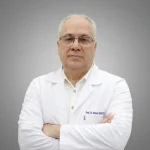 Prof. Dr. Ahmet Satıcı
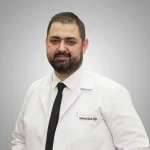 Doç. Dr. Muhammet Derda Özer
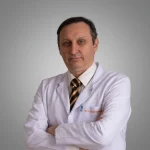 Op. Dr. Aysan Bayram