
- Home
- Knowledge centre
- Eye glossary A–Z
- Orthokeratology (Ortho-K): What It Is, How It Works and Ortho-K Lenses UK Cost
Orthokeratology (Ortho-K): What It Is, How It Works and Ortho-K Lenses UK Cost
Medically reviewed by {{surgeon}}, {{surgeon's title and specialty}}, on {{review date}}. Last updated {{date}}.
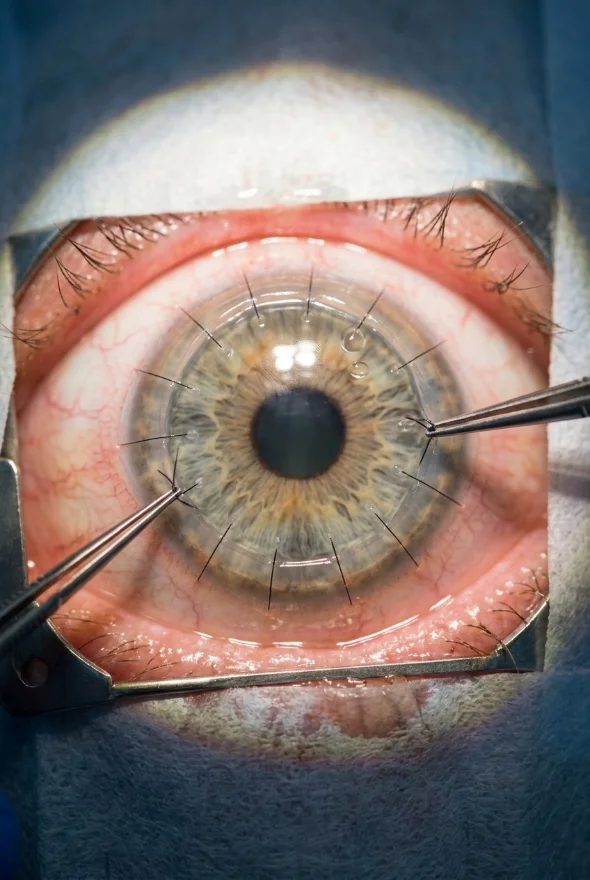
Orthokeratology (noun; also ortho-k, OK, corneal reshaping): orthokeratology is the use of specially designed rigid gas-permeable contact lenses, usually worn overnight, to temporarily flatten the front of the cornea so that short-sightedness (myopia) is corrected during the day without glasses or lenses. The effect is reversible: if the lenses are stopped, the cornea returns to its original shape.
Ortho-k lenses UK cost, in short: ortho-k is a private service in the UK. Opticians set their own fees, the NHS does not pay for it, and the price is typically quoted as a fitting-and-lenses package plus aftercare. Typical UK range: {{UK ortho-k price range}}, checked {{price check date}}.
Orthokeratology: key facts
- What it is
- Rigid gas-permeable (RGP) lenses, custom-designed from a map of your cornea, that reshape the corneal surface while you sleep
- Used for
- Short-sightedness, sometimes with a little astigmatism
- Correction range
- Typically up to about −6.00 dioptres of short-sightedness
- Wear
- Overnight, usually at least 8 hours a night (FDA)
- Time to full effect
- Good vision may come within 1–2 days; higher prescriptions can take two weeks or longer
- Permanent?
- No. Stop wearing the lenses and the cornea returns to its original shape (FDA, AAO)
- Main risk
- Eye infection (microbial keratitis), because lenses are worn while the eyes are closed
- NHS
- Not available on the NHS
- Cost (UK)
- {{UK ortho-k price range}}. For comparison, the AAO quotes US$1,000–$4,000 for the initial treatment in the United States and US$300–$500 a year after that
- Fitted by
- A trained eye-care professional; in the US the FDA requires fitters to be trained and certified before using overnight ortho-k lenses
Ortho-k lenses UK cost: what will you pay?
The honest answer is that there is no single UK price. Orthokeratology is not offered on the NHS, so every practice sets its own fees, and they vary with the practice, the lens design, how complex your eyes are and how many aftercare visits are included. The UK range is {{UK ortho-k price range}} (checked {{price check date}}). We do not quote a UK figure here that we have not been able to source.
What we can source is a benchmark from the United States. The American Academy of Ophthalmology (AAO) says the initial cost of ortho-k runs from US$1,000 to US$4,000 depending on the type and degree of refractive error, with US$300–$500 a year afterwards for replacement lenses, solutions and check-ups. Because ortho-k is elective, insurance rarely pays for it.
When you compare quotes, ask each practice exactly what the price covers:
| Ask about | Why it matters |
|---|---|
| The initial assessment and corneal mapping (topography) | Some practices may charge this separately |
| The first pair of lenses and any lens changes during fitting | Fitting can need adjustments before the vision settles |
| Aftercare visits, and for how long | Regular follow-up is essential for safety, not optional |
| Replacement lenses, and what happens if a lens is lost or damaged | Lenses wear out, and a lost lens means a night without correction |
| Cleaning solutions and the lens case | An ongoing cost, as with any contact lens |
| Monthly payment plans versus a single fee | Total cost over several years is what counts |
Is ortho-k available on the NHS?
No. The NHS says myopia-management options for children, which include overnight orthokeratology lenses, are not available on the NHS because more research is needed. The College of Optometrists' patient website says the same: none of the myopia-management treatments is currently funded by the NHS in any part of the UK, and they cost more than ordinary glasses or contact lenses. Whether you are an adult wanting daytime freedom from glasses or a parent considering it for a child, the ortho-k lenses UK cost is a private expense.
How does orthokeratology work?
Ortho-k works by gently moulding the cornea while you sleep. The cornea is the clear front window of the eye and provides most of its focusing power, so even a very small change in its curve changes your prescription. In short-sightedness, the cornea is too steep or the eye is too long, so light focuses in front of the retina.
Mapping
Your fitter scans the surface of your cornea (corneal topography) and measures your prescription.
Custom lenses
The lenses are designed from that map. They are rigid and gas-permeable, shaped to flatten the centre of the cornea.
Overnight wear
You wear the lenses while you sleep. The FDA says overnight ortho-k lenses are the most common type and are usually worn for at least eight hours a night.
Daytime vision
On waking you remove the lenses. The central cornea stays flatter for a while, so distance light focuses on the retina and you can see without glasses.
Maintenance
The effect fades, so the lenses must be worn every night or on another schedule your fitter prescribes. If you stop, the cornea returns to its original shape and the short-sightedness returns.
Adjustment takes a little time. Some people see well after one or two nights, but with higher prescriptions it can take two weeks or longer for the full effect, and blur or halos can occur while the cornea settles.

Who is ortho-k suitable for?
Ortho-k suits people with low to moderate short-sightedness who want clear daytime vision without glasses and without irreversible surgery. It is most often used for:
- Children and teenagers, to correct vision and, in many cases, to slow the progression of myopia (see below).
- Young adults who are not yet ready for, or eligible for, laser eye surgery, or who want a reversible option.
- People who play contact sports or work in dusty or dirty environments, where glasses are inconvenient and daytime contact lenses are uncomfortable.
It is a poor fit if you cannot commit to nightly wear and strict lens hygiene, if you have an eye infection or active inflammation, or if your cornea is not regular and healthy.
Is ortho-k suitable for keratoconus?
Generally, no. Keratoconus is a condition in which the cornea thins and bulges into a cone shape, while ortho-k lenses are designed to reshape a healthy, regular cornea. A small 2026 pilot study of 24 eyes with stable, mild-to-moderate keratoconus reported improvements in unaided vision after 18 months, but five of the 13 patients stopped because of visual symptoms or poor tolerance, and the authors call for strict selection. That is research, not routine care. If you have keratoconus, or a family history of it, ask a cornea specialist before any lens is fitted. The treatments that can actually stop keratoconus getting worse, such as corneal cross-linking, are a different category: read our guide to keratoconus treatment in Turkey.
Does ortho-k slow myopia in children?
Ortho-k can slow how fast a child's eye grows longer, but the evidence is less certain than the headlines suggest. In 2021, the International Myopia Institute described the mechanism: the lens flattens the central cornea and steepens the mid-periphery, creating peripheral myopic defocus, a signal thought to slow eye growth.
The most reliable summary is the 2023 Cochrane review of 64 studies with 11,617 children. It found that orthokeratology may reduce axial elongation (the lengthening of the eyeball) by about 0.19 mm at one year and 0.28 mm at two years compared with controls. The authors also found that the certainty of evidence ranged from very low to moderate and that the long-term effect is still uncertain.
The AAO lists three approaches for children: low-dose atropine eye drops (which stop or slow progression in about 7 in 10 children), orthokeratology, and special peripheral-defocus contact lenses for children aged about 6–12. It also warns that ortho-k carries a risk of serious, vision-threatening infection. The College of Optometrists' patient site says that, on current research, ortho-k lenses are the most effective of the glasses and contact lens options at slowing eye growth, but that overnight wear carries a higher risk of complications and the lenses are more likely to cause discomfort in children. Which option is right depends on your child's age, prescription and ability to care for lenses; an optometrist or ophthalmologist should guide that choice.
Is ortho-k safe? Risks and side effects
Ortho-k is considered a reasonably safe option when it is properly fitted and cared for, but it carries a real risk of eye infection, and that risk matters more in children. The AAO notes an increased risk of infection (microbial keratitis), which can cause lasting vision loss, and says the risk is particularly concerning for children who may struggle with lens hygiene.
A 2016 systematic review of 170 publications (Liu and Xie, Eye & Contact Lens) found that the risk of microbial keratitis with overnight ortho-k was similar to that of other overnight lens wear. The most common problem was corneal staining; other side effects included iron deposits on the cornea and temporary changes in corneal biomechanics, with no long-term effect on the corneal endothelium. The authors concluded that ortho-k is a safe option when properly fitted, with lens-care compliance, routine follow-up and prompt management of complications.
Other things to expect or watch for:
- Halos and glare, especially at night while the cornea adjusts. See halos and glare.
- Discomfort or dryness from the lenses.
- Light sensitivity, which can be an early sign of corneal inflammation. See photophobia.
- Temporary changes to corneal shape. Overnight lenses change the cornea's shape, and EyeWiki advises that topography should be stable on two separate visits before laser planning when lens-induced changes are suspected. Tell your laser surgeon if you have worn ortho-k.
Reduce the risk: follow your fitter's cleaning routine exactly, keep lenses and the case away from tap water, replace the case every three months, attend every aftercare visit, and take the lenses out and seek help straight away if the eyes become red, painful or sensitive to light (FDA advice for all contact lenses).
Ortho-k or laser eye surgery?
Ortho-k is a reversible, ongoing treatment; laser eye surgery is a one-off operation that permanently reshapes the cornea.
| Orthokeratology | Laser eye surgery (LASIK, SMILE, PRK) | |
|---|---|---|
| Permanent? | No; correction lasts only while you keep wearing the lenses | Yes, the reshaping is permanent (a prescription can still change with age) |
| Age | Used in children and adults | Adults with a stable prescription |
| Daily routine | Lenses in every night, cleaned daily, regular check-ups | None after healing, apart from follow-up |
| Main risks | Infection from overnight lens wear | Rare surgical complications such as dry eye, glare and halos |
| Cost pattern | Ongoing: fitting, lenses, aftercare ({{UK ortho-k price range}} in the UK) | Single fee: from {{price}} per eye with us |
For adults whose prescription has stopped changing and who want to be rid of lenses for good, laser is usually the more permanent route. Our laser work is led by Prof. Dr. Ahmet Satıcı and Op. Dr. Aysan Bayram. The price includes the pre-operative examination and scans, surgery by your named surgeon, medication, follow-up checks in Istanbul, a personal interpreter, a coordinator and remote follow-up. Hotel and airport transfers are not included (they are arranged separately on request), and flights are not included. Surgery takes place in a fully equipped, Ministry of Health–licensed operating theatre in Istanbul. Every laser candidate has the cornea mapped first, because laser suits only healthy corneas of sufficient thickness.
When to see a doctor
Seek same-day care from an eye doctor or eye emergency service if you wear ortho-k lenses and you have:
- a red, painful or watering eye, or sudden sensitivity to light (take the lenses out and do not put them back in)
- discharge, or a white or grey spot on the cornea
- a sudden drop in vision, or blurred vision that does not clear after taking the lenses out
Book a routine appointment if:
- your vision is not clear during the day after the first couple of weeks of wear
- halos, glare or ghosting at night are getting worse
- your glasses prescription keeps rising, especially in a child (ask about myopia management)
- you are a teenager or young adult whose prescription keeps changing or whose vision is distorted: this can be an early sign of keratoconus, and a cornea check is worth having before any lens is fitted
If you want a second opinion on your cornea, or on a permanent option, you can send your scans and prescription for review before you travel.
Frequently asked questions
There is no fixed UK price, because ortho-k is private and each practice sets its own fees. The UK range is {{UK ortho-k price range}} (checked {{price check date}}). For comparison, the AAO quotes US$1,000–$4,000 for the initial treatment in the US and US$300–$500 a year afterwards. Ask what the quote includes: assessment, lenses, aftercare and replacements.
No. The NHS states that myopia-management options, including overnight orthokeratology lenses, are not available on the NHS, and the College of Optometrists says none is funded in any part of the UK. The ortho-k lenses UK cost is therefore paid privately.
It is like braces for the front of the eye. Rigid contact lenses worn overnight temporarily flatten the cornea so you can see without glasses or contact lenses during the day.
No. The FDA states that the effect is temporary and the cornea returns to its original curve if you stop. You need to keep wearing the lenses on the schedule your fitter gives you.
It can be, with proper fitting, strict hygiene and regular check-ups, but the AAO warns of an increased risk of serious infection, especially in children who struggle with lens care. A child who is old enough to look after lenses, with parents who supervise the routine, is the best candidate.
It may slow it. The 2023 Cochrane review found a reduction in eye lengthening of about 0.19 mm at one year and 0.28 mm at two years versus controls, with very low to moderate certainty and uncertain long-term effects. It does not cure myopia.
Your cornea gradually returns to its original shape and your short-sightedness comes back. Tell your fitter before you stop, and tell your laser surgeon if you plan surgery, because the cornea must be stable on scans first.
Generally no. Ortho-k is designed for regular, healthy corneas. A small 2026 pilot study in carefully selected stable mild keratoconus is research, not standard care. Ask a cornea specialist; cross-linking is the treatment that can stop keratoconus worsening.
Neither is better for everyone. Ortho-k is reversible and can be used in children, but it needs nightly lens wear and carries an infection risk. Laser is a permanent one-off operation for adults with a stable prescription and a healthy, thick enough cornea.
Sources for the facts on this page
- US Food and Drug Administration. Types of Contact Lenses (Orthokeratology section). https://www.fda.gov/medical-devices/contact-lenses/types-contact-lenses
- US Food and Drug Administration. Contact Lens Risks. https://www.fda.gov/medical-devices/contact-lenses/contact-lens-risks
- American Academy of Ophthalmology. What Is Orthokeratology? https://www.aao.org/eye-health/treatments/what-is-orthokeratology
- American Academy of Ophthalmology. Nearsightedness: What Is Myopia? (myopia control in children). https://www.aao.org/eye-health/diseases/myopia-nearsightedness
- NHS. Short-sightedness (myopia). https://www.nhs.uk/conditions/short-sightedness/
- College of Optometrists, Look After Your Eyes. Myopia. https://lookafteryoureyes.org/eye-conditions/myopia/
- Lawrenson JG, Shah R, Huntjens B, et al. Interventions for myopia control in children: a living systematic review and network meta-analysis. Cochrane Database Syst Rev 2023. PMID 36809645; DOI 10.1002/14651858.CD014758.pub2
- Liu YM, Xie P. The Safety of Orthokeratology: A Systematic Review. Eye Contact Lens 2016;42(1):35–42. PMID 26704136
- Jonas JB, Ang M, Cho P, et al. IMI Prevention of Myopia and Its Progression. Invest Ophthalmol Vis Sci 2021. PMID 33909032
- Zhang C, et al. Orthokeratology for stable mild-to-moderate keratoconus (pilot study). Int Ophthalmol 2026. PMID 41996040
- Heiting G. Ortho-K and Corneal Reshaping Therapy: Overnight Contacts to Correct Myopia. AllAboutVision (optometrist-authored consumer source). https://www.allaboutvision.com/eyewear/contact-lenses/conditions/orthok-contacts/
- EyeWiki (AAO). Preoperative Evaluation for LASIK Surgery (topography stable on two visits). https://eyewiki.org/Preoperative_Evaluation_for_LASIK_Surgery
Thinking about a permanent alternative, or worried about your cornea?
Send us your prescription and scans. One of our surgeons will review them and tell you which options may suit your eyes, whether that is laser eye surgery or, if your cornea is thinning, keratoconus treatment, with no obligation.
3 eye surgeons
Your case is reviewed by a named surgeon, not a salesperson. Reply within {{response time}}.
 Prof. Dr. Ahmet Satıcı
 Doç. Dr. Muhammet Derda Özer
 Op. Dr. Aysan Bayram