
- Home
- Knowledge centre
- Eye glossary A–Z
- Halos Around Lights: Causes of Halos and Glare, and When to Worry
Halos Around Lights: Causes of Halos and Glare, and When to Worry
Medically reviewed by {{surgeon}}, {{surgeon's title and specialty}}, on {{review date}}. Last updated {{date}}.
Halos around lights (noun; a visual symptom): halos are glowing rings or circles of light seen around bright sources such as street lamps, headlights and traffic lights, most often in the dark. Glare is the related dazzle or washed-out brightness from a strong light. Halos can be harmless, but they also come with cataracts, dry eye, corneal swelling or eye surgery and, if sudden and painful, may signal acute angle-closure glaucoma, an emergency.
What our surgeons say: an eye examination finds the cause of most halos. Prof. Dr. Ahmet Satıcı and Op. Dr. Aysan Bayram (cataract and laser) and Doç. Dr. Muhammet Derda Özer (cornea) assess halos and glare, including after previous surgery.
Halos and glare: key facts
- What you see
- Rings, glowing circles or rainbow-coloured circles around bright lights; glare as dazzle or a veil of brightness
- Related terms
- Starbursts (streaks radiating from a light), glare, ghosting, dysphotopsia, photic phenomena
- Most common causes
- Cataract, dry eye or an uneven tear film, corneal conditions, uncorrected refractive error, some multifocal lenses, and effects of laser or lens surgery
- Emergency cause
- Acute angle-closure glaucoma: halos plus severe eye pain, a red eye, blurred vision, headache and nausea
- Usually worse
- At night, in the dark and with oncoming headlights
- Diagnosed by
- Eye examination: slit-lamp, eye-pressure check, corneal scans, a look at the lens and retina
- Specialist
- Ophthalmologist; at Laser Istanbul Clinic, Prof. Dr. Ahmet Satıcı, Op. Dr. Aysan Bayram or Doç. Dr. Muhammet Derda Özer depending on the cause
What are halos and glare?
Halos and glare are two of the most common visual disturbances after dark. A halo is a ring of light around a bright point; glare is the discomfort or loss of clarity caused by a strong light source. They often occur together with starbursts, where streaks of light radiate from a lamp.
Doctors group these effects as dysphotopsia: unwanted optical patterns on the retina. For artificial lenses, the American Academy of Ophthalmology's EyeWiki describes positive dysphotopsia as a bright artefact of light, seen as arcs, streaks, starbursts, rings or halos. Eye doctors usually diagnose it from your description of the symptom, because no single objective test exists for it.
Why night makes it worse: in dim light the pupil widens, so more of the cornea and lens takes part in focusing. Any cloudiness, irregularity or dryness then shows up as a ring or glow, and bright lights against a dark background make the effect obvious.
Is it normal to see halos around lights?
A faint, steady glow around very bright lights in the dark can be unremarkable, but a new, changing, one-sided or sudden halo is not something to put up with and should be checked. Only an eye examination can tell the two apart. This is the practical difference when you compare halos around lights with normal vision:
| More likely harmless | Needs an eye examination | |
|---|---|---|
| Onset | Always been there, unchanged for years | New, getting worse, or changing |
| Eyes | Both eyes, similar | One eye only, or very uneven |
| When | Only against very bright lights in the dark | In ordinary lighting, or when reading and using screens |
| Other symptoms | None | Blurred vision, haziness, faded colours, light sensitivity, discomfort |
| Eye pain, redness, nausea | None | Any of these with halos: same-day care |
Is it normal to see halos around lights at night?
Some glow around headlights and street lamps at night is common and often mild. It becomes a problem when it makes driving unsafe, keeps getting worse, or comes with other symptoms. The American Academy of Ophthalmology (AAO) advises people with cataracts to limit night driving once night vision, halos or glare become problems, and to have their eyes checked.
Halos around lights: causes
The eye problems behind halos and glare fall into a handful of groups. Here are the common ones.
| Cause | Why it produces halos or glare | Other clues |
|---|---|---|
| Cataract | The natural lens clouds and scatters light. The NHS lists seeing glowing rings (halos) around lights among cataract symptoms; the AAO adds extra sensitivity to light, especially from oncoming headlights | Blurred, misty or ghosted vision, faded colours, trouble at night |
| Dry eye and uneven tear film | Tears keep the eye's surface smooth and clear (AAO); when that film is disturbed, vision blurs | Gritty, burning or tired eyes, blur, especially when reading |
| Corneal swelling or disease | Fuchs' endothelial dystrophy makes the cornea swell, causing glare, halos and reduced vision (EyeWiki); early keratoconus brings sensitivity to light and glare (AAO) | Haze or blur on waking that improves later, distorted vision, a changing glasses prescription |
| Corneal surface damage | A scratch or erosion leaves blurred, hazy vision and light sensitivity (AAO) | Pain, watering, a feeling of something in the eye |
| Uncorrected refractive error | Clinicians correct any refractive error first when assessing halos and other lens-related disturbances (EyeWiki) | Eye strain, headaches, squinting |
| Multifocal or EDOF lens implants | Lenses that split light to give near and far focus can cause glare and rings (AAO) | Started after lens surgery |
| After laser vision correction | The AAO lists glare and halos among LASIK side effects | Started after surgery; see below |
| Acute angle-closure glaucoma | A sudden rise in eye pressure, with a swollen cornea, gives rainbow halos (AAO, StatPearls) | Severe pain, red eye, nausea, headache: emergency |
| Pigment dispersion | Some people see halos or blur after activities such as jogging or basketball (AAO) | Symptoms after exercise |
Other eye conditions, such as a coloboma (a gap in an eye structure present from birth), can cause light sensitivity. We cover that in the glossary entry linked under related terms below.
Rainbow halos around lights
Rainbow-coloured circles around lights deserve more attention than plain white glow. Seeing coloured rings around bright lights is a recognised sign of an attack of acute angle-closure glaucoma, in which fluid cannot drain from the eye and pressure rises fast. The NHS lists "seeing rainbow-coloured circles around bright lights" alongside intense eye pain, a red eye, blurred vision, nausea and a headache, and says to call 999 or go to A&E if glaucoma symptoms develop suddenly.
StatPearls describes acute angle-closure as an emergency: when measured, pressure is typically 50 to 80 mmHg against a normal range of 10 to 21 mmHg, and without prompt treatment it risks irreversible damage and blindness. Treatment can be medical, laser or surgical. The AAO says early symptoms of an attack can be as mild as blurred vision, halos, a mild headache or mild eye pain, and that anyone with these symptoms should be checked by their ophthalmologist as soon as possible.
Is seeing rainbow halos around lights normal?
Not as a new symptom. Rainbow halos that appear suddenly, especially with pain, redness, headache or nausea, should be treated as an emergency until an eye doctor has examined you. A swollen cornea is one of the signs doctors find during an attack (StatPearls).
Rainbow halos around lights at night
Rainbow halos at night need the same urgency as those seen by day. If they come with eye pain, a red eye or sickness, do not drive yourself: the NHS advises asking someone to drive you, or calling 999.
Rainbow halos around lights with contacts
With contact lenses, halos can come from the lens itself (worn, dirty, poorly fitting or a multifocal design) or from the cornea beneath it. Take the lenses out. If your vision clears, the lens or its fit is a likely cause and your optician should check it. If halos persist with the lenses out, or the eye is red or painful, see an eye doctor the same day: contact lens complications range from dryness to sight-threatening infection (Methods and Protocols, 2026 review).
Sudden halos in vision: why am I suddenly seeing halos?
Suddenly seeing halos around lights is a reason to get checked promptly, and an emergency when it comes with eye pain, redness, nausea or a headache. A sudden start points away from slow causes such as a developing cataract and towards a pressure rise, corneal swelling, infection or inflammation. The NHS gives the warning set for sudden glaucoma: intense eye pain, a red eye, tenderness around the eye, rainbow-coloured circles around lights, blurred vision, nausea and a headache.
Other conditions can look similar: the NHS notes that uveitis (inflammation inside the eye) and an eye injury can cause similar symptoms, and EyeWiki says doctors must rule out glaucoma, retinal and intracranial causes when symptoms overlap.
Seeing halos around lights in one eye
Halos in one eye only suggest a problem in that eye rather than a general night-vision habit. Possible causes include a cataract that is more advanced in one eye, a corneal problem, a pressure rise, or an effect of surgery or a lens in one eye. Cover each eye in turn to see which one is responsible, then book an eye examination, or seek same-day care if there is pain or redness. Angle-closure attacks typically cause intense pain around one eye (StatPearls).
Halos and glare after eye surgery
Many readers arrive here after laser or lens surgery, so here is what the evidence shows.
After laser eye surgery (LASIK, SMILE, PRK)
The AAO lists glare and halos (rings), streaks or starbursts around lights among LASIK side effects that can be temporary or, rarely, permanent. Two recent studies show the range:
- In a 2026 study of 300 patients who had WaveLight LASIK for short-sightedness, 12 to 15 months after surgery, 78% said they never or rarely saw halos, 79% never or rarely had glare, and only 3% (9 of 300) found halos extremely or very bothersome. That also means about 22% saw halos at least sometimes.
- In a small 2025 trial of 82 people (164 eyes) comparing TransPRK, SMILE and FS-LASIK at six months, night-time halos were reported most often after FS-LASIK (23.2%), and glare in 26.8%. The TransPRK group had better low-light contrast sensitivity, which the authors linked to its larger optical zone.
The size of the treated zone, your prescription and the health of your tear film all matter, which is why careful pre-operative scans are essential. The AAO says LASIK candidates need thick, healthy corneas, and that severe dry eye, corneal scars and keratoconus rule LASIK out.
After cataract or lens replacement surgery
The AAO states that presbyopia-correcting lenses may cause glare and rings (halos) around lights, and that pilots, night drivers and people who spend a lot of time at computers may find these effects a problem. The research agrees:
- A 2026 simulation study found that trifocal designs produced larger halos than extended-depth-of-focus (EDOF) designs, and that a monofocal lens produced the smallest; halo size rose with the lens's added power.
- A Cochrane review (2024) found both trifocal and EDOF lenses were reported to cause glare and halos, with no meaningful difference detected between them, although the evidence was low-certainty.
- A 2026 narrative review found lower halo rates with monofocal and enhanced monofocal lenses than with full-range designs.
Halos can also follow a monofocal lens. EyeWiki links them to the lens material, design and position, and notes that lens makers have rounded the front edge of some lenses to reduce them. We discuss this trade-off before a patient chooses a premium lens, not after.
After an ICL
Halos, starbursts and ring-shaped visual disturbances are reported by some people after an implantable collamer lens (ICL), often alongside small increases in higher-order aberrations (Frontiers in Medicine, 2026 review).
Halos and glare symptoms: what people notice
| What you notice | What it can point to |
|---|---|
| Glowing rings around lamps and headlights at night | Cataract, tear-film problems, surgery effect, uncorrected refractive error |
| Rainbow-coloured rings with pain, a red eye, headache or nausea | Acute angle-closure glaucoma: emergency |
| Glare from oncoming headlights, fading colours, ghost images | Cataract |
| Blur or haze on waking, with halos or glare | Corneal swelling, such as Fuchs' dystrophy |
| Starbursts or streaks around lights after laser or lens surgery | An optical effect of the surgery; discuss with your surgeon |
| Halos in one eye only | A local problem in that eye, including pressure or corneal change |
How are halos and glare diagnosed?
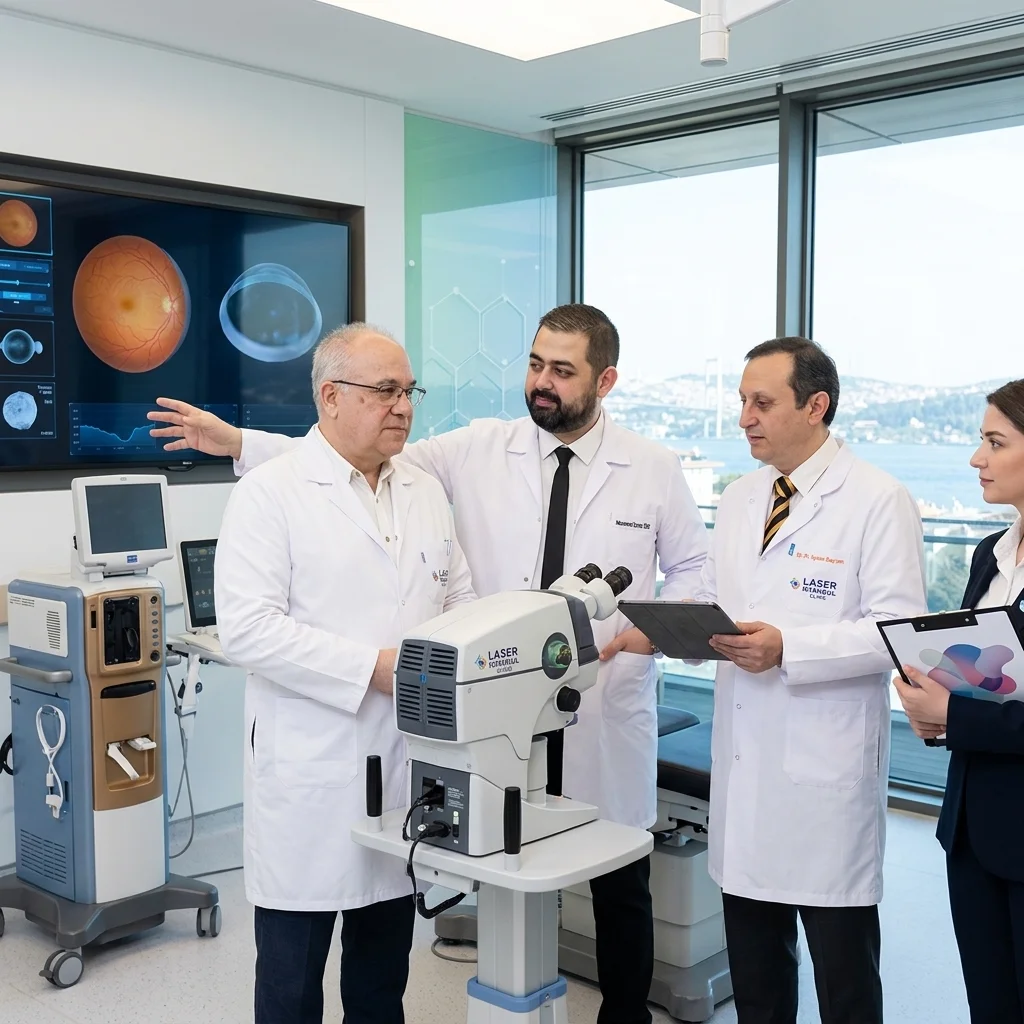
Diagnosis begins with your story: when the halos started, which eye, what lights, whether they come with pain, and what surgery or lenses you have had. The eye examination then looks for the cause:
- Slit-lamp examination to inspect the cornea, tear film, lens and the space at the front of the eye.
- Eye-pressure measurement (tonometry) and a check of the drainage angle (gonioscopy). StatPearls lists a shallow front chamber, corneal swelling and a closed angle among the findings of an angle-closure attack.
- Corneal measurements such as thickness (pachymetry) and scans. The AAO uses pachymetry to check for Fuchs' dystrophy and takes corneal measurements before LASIK.
- A dilated look at the lens and retina to find a cataract or other disease.
- A refraction check to see whether glasses or astigmatism are part of the problem.
If you have a lens implant, your surgeon will want to know which lens you have, because that guides which causes are likely.
At Laser Istanbul Clinic, corneal topography, OCT and biometry are part of every pre-operative examination in Istanbul, and your surgeon reviews your existing scans before you book.
Halos around lights: treatment
Treatment depends on the cause, so the first step is a diagnosis, not a drop or a pair of tinted glasses.
| Cause | Typical treatment |
|---|---|
| Acute angle-closure glaucoma | Emergency pressure-lowering treatment, then laser iridotomy, where the surgeon creates a tiny hole in the iris so fluid can drain (AAO, StatPearls) |
| Cataract | Surgery to replace the clouded lens when symptoms interfere with driving, reading or daily life (AAO) |
| Clouded lens capsule after cataract surgery | A laser capsulotomy opens the cloudy capsule and restores clear vision (AAO) |
| Dry eye | Lubricating drops and treatment of the underlying cause; see an eye doctor if symptoms persist or affect daily life (AAO) |
| Fuchs' dystrophy | Drops or ointment to reduce corneal swelling and, in severe cases, a corneal transplant (AAO) |
| Keratoconus | Specialist cornea care, including corneal cross-linking, Intacs or a transplant when severe (AAO) |
| Uncorrected refractive error | Up-to-date glasses or contact lenses (EyeWiki) |
| Halos after an implanted lens | Correct refractive error, treat dry eye, and treat a clouded capsule; persistent cases may need lens exchange, which EyeWiki reports as mostly successful |
| Halos after laser surgery | Assessment of the cause, including dry eye and the shape of the cornea |
While you wait for treatment, the AAO advises limiting night driving once halos or glare become a problem.
Treatment with us: halos and glare after laser, cataract or lens surgery, and cataract and premium-lens assessment, are handled by Prof. Dr. Ahmet Satıcı and Op. Dr. Aysan Bayram; cornea-related causes such as keratoconus and corneal swelling are led by Doç. Dr. Muhammet Derda Özer.

When to see a doctor about halos
Seek same-day care, or call an ambulance, if you have halos or rainbow-coloured circles with:
- intense eye pain, a red eye or tenderness around the eye
- a sudden drop in vision, or blurred vision that came on quickly
- nausea, vomiting or a headache
- a painful red eye while wearing contact lenses (take them out and do not put them back in)
If you suspect an angle-closure attack, the NHS says not to drive yourself to A&E; ask someone to drive you or call 999.
Book a routine eye examination if you notice:
- halos or glare that are new, getting worse, or limiting night driving
- halos in one eye only
- halos after laser, cataract or lens surgery that are not settling, or that affect daily life
- blurred or hazy vision, faded colours or glare from oncoming headlights, which can mean a cataract
- gritty, tired eyes with blurred vision, which can mean dry eye
If you have already had surgery and want a second opinion on halos, you can send your scans for review before you travel.
Frequently asked questions
Halos are glowing rings or circles seen around bright lights such as headlights and street lamps, usually at night. They can be caused by cataracts, dry eye, corneal problems, uncorrected vision or surgery effects, and, if sudden and painful, by acute angle-closure glaucoma.
A mild, unchanging glow around very bright lights in the dark can be unremarkable. New halos, halos that are getting worse, halos in one eye only, or halos with pain or redness are not normal and need an eye examination.
Some glow around headlights at night is common. If it is getting worse, makes night driving difficult, or comes with blurred vision, have your eyes checked: a cataract is a common cause.
Rainbow-coloured halos can point to acute angle-closure glaucoma, which is an emergency. The NHS lists rainbow-coloured circles around bright lights, with eye pain, a red eye, nausea and headache, as symptoms of sudden glaucoma.
Sudden halos can come from a rise in eye pressure, corneal swelling, inflammation or infection, so get checked promptly. If you also have severe eye pain, a red eye, nausea or a headache, call 999 or go to A&E.
It suggests a problem in that eye, such as a more advanced cataract, a corneal problem or a pressure rise. Book an eye examination soon, or go the same day if you have pain or redness.
Not necessarily, but sudden halos with pain, redness and nausea can mean glaucoma. Open-angle glaucoma has no early symptoms (AAO), so halos are not a reliable test and regular eye examinations matter.
It varies. The AAO says some LASIK side effects, which include glare and halos, usually fade over time but can last longer or, rarely, stay. If halos are not settling, tell your surgeon.
Often they are managed by correcting refractive error, treating dry eye and treating a clouded lens capsule. For persistent cases, lens exchange has been reported as mostly successful (EyeWiki).
It can, especially with presbyopia-correcting lenses (AAO), though some people have halos before surgery because of the cataract itself. Ask your surgeon about the trade-offs between lens types.
Sources for the facts on this page
- NHS. Glaucoma: symptoms, and when to call 999 or go to A&E. https://www.nhs.uk/conditions/glaucoma/
- NHS. Cataracts: symptoms (halos, glare). https://www.nhs.uk/conditions/cataracts/
- Khazaeni B, Zeppieri M, Khazaeni L. Acute Angle-Closure Glaucoma. StatPearls, NCBI Bookshelf (NBK430857). https://www.ncbi.nlm.nih.gov/books/NBK430857/
- American Academy of Ophthalmology. What Is Glaucoma? https://www.aao.org/eye-health/diseases/what-is-glaucoma
- American Academy of Ophthalmology. What Are Cataracts? https://www.aao.org/eye-health/diseases/what-are-cataracts
- American Academy of Ophthalmology. LASIK: Laser Eye Surgery. https://www.aao.org/eye-health/treatments/lasik
- American Academy of Ophthalmology. Presbyopia-Correcting IOLs. https://www.aao.org/eye-health/diseases/presbyopia-correcting-iols
- American Academy of Ophthalmology. What Is Keratoconus? https://www.aao.org/eye-health/diseases/what-is-keratoconus
- American Academy of Ophthalmology. What Is Fuchs' Dystrophy? https://www.aao.org/eye-health/diseases/fuchs-dystrophy
- American Academy of Ophthalmology. What Is Dry Eye? https://www.aao.org/eye-health/diseases/what-is-dry-eye
- American Academy of Ophthalmology. What Is a Coloboma? https://www.aao.org/eye-health/diseases/what-is-coloboma
- American Academy of Ophthalmology. Corneal Abrasion and Erosion. https://www.aao.org/eye-health/diseases/what-is-corneal-abrasion
- EyeWiki (AAO). Dysphotopsia. https://eyewiki.org/Dysphotopsia
- EyeWiki (AAO). Fuchs' Endothelial Dystrophy. https://eyewiki.org/Fuchs%E2%80%99_Endothelial_Dystrophy
- Lobanoff MC, Mann PM, Parikh M, et al. Multi-Site Study of Patient Reported Vision Quality and Dry Eye Following LASIK. Clin Ophthalmol 2026. https://doi.org/10.2147/opth.s566803 (PMC13015263)
- Chen W, Yang Z. Comparison of visual quality and optical zones after TransPRK, SMILE, and FS-LASIK myopia correction procedures. BMC Ophthalmol 2025. https://doi.org/10.1186/s12886-025-04358-4
- Tavassoli S, et al. Trifocal versus extended depth of focus (EDOF) intraocular lenses after cataract extraction. Cochrane Database Syst Rev 2024. https://doi.org/10.1002/14651858.CD014891.pub2
- Halo Measurements in Simulated Multifocal Intraocular Lenses. Transl Vis Sci Technol 2026. https://doi.org/10.1167/tvst.15.5.21
- Ribeiro F, Dick HB, Koch D, et al. Bringing clarity to the clinical framework for photic phenomena and dysphotopsias: a narrative review. Arch Soc Esp Oftalmol 2026. https://doi.org/10.1016/j.oftale.2026.502648
- Hao Z, Zhao L, Pei Y, Nie L. Research progress on postoperative higher-order aberrations after ICL implantation. Front Med 2026. https://doi.org/10.3389/fmed.2026.1764008
- Contact Lens-Associated Ocular Surface and Corneal Disorders. Methods Protoc 2026. https://doi.org/10.3390/mps9030095
Seeing halos or glare after surgery, or at night?
Send us your scans or eye report. Our surgeons will review them and tell you what may be behind your halos and which treatments could suit your eyes, with no obligation.
3 eye surgeons
Your case is reviewed by a named surgeon, not a salesperson. Reply within {{response time}}.
 Prof. Dr. Ahmet Satıcı
 Doç. Dr. Muhammet Derda Özer
 Op. Dr. Aysan Bayram