
- Home: eye surgery in Istanbul
- All eye treatments
- Eye examinations & diagnostic tests
- Autorefractor & lensmeter
Autorefractor Test and Lensmeter: How Your Prescription Is Measured
An autorefractor test is the quick, painless machine measurement that gives your eye doctor a first reading of your glasses prescription, and a lensmeter reads the prescription of the glasses you already wear. Together they are the starting point of every pre-operative examination before laser eye surgery, lens replacement, cataract surgery or an ICL. At Laser Istanbul Clinic your surgeon uses them to plan your treatment and checks them against a full manual refraction.
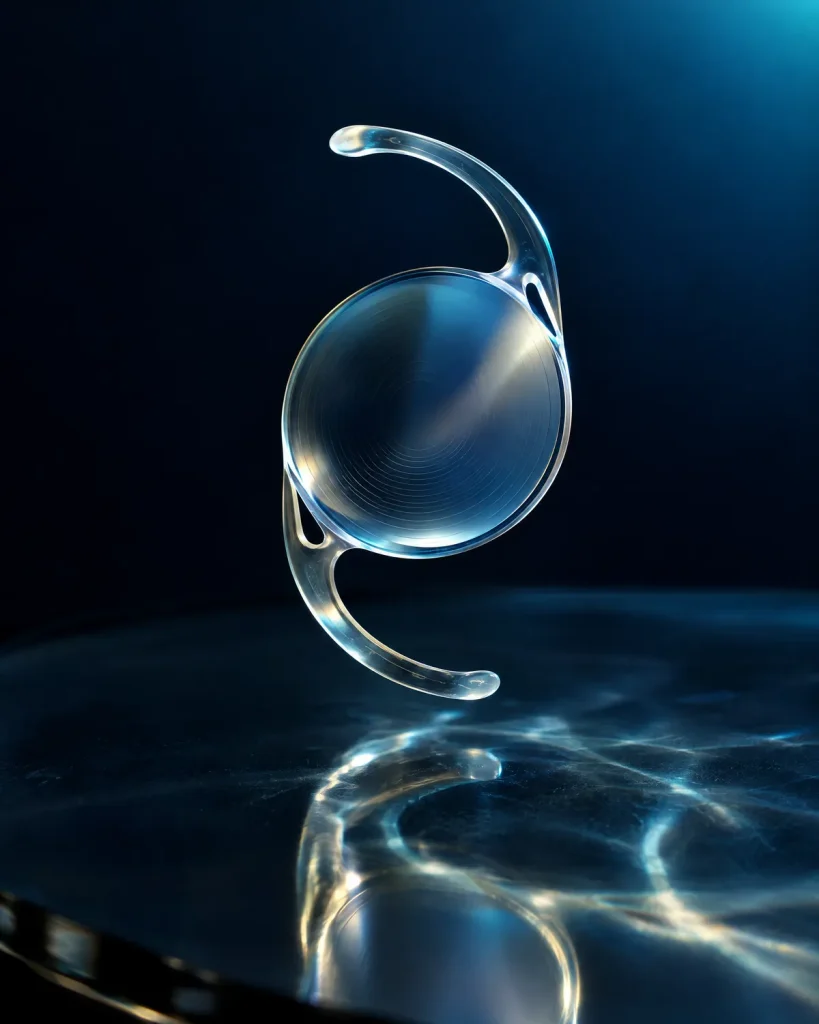
An autorefractor test is a no-touch machine measurement of your refractive error. You look at a picture inside the device, usually for a few seconds per eye, and it reports sphere, cylinder and axis. A lensmeter measures the lenses in your current glasses. Both give your surgeon, Prof. Dr. Satıcı, Doç. Dr. Özer or Op. Dr. Bayram, a starting prescription, which is then confirmed by a manual test.
What do an autorefractor and a lensmeter measure?
An autorefractor measures the eye; a lensmeter measures a lens. Both report the same prescription language (sphere, cylinder, axis and, for reading glasses, add), but they answer different questions.
| Instrument | What it measures | Where the reading comes from | Result is |
|---|---|---|---|
| Autorefractor (the "autorefractor machine") | Your eye's refractive error: short-sightedness, long-sightedness and astigmatism | Light reflected from the back of your eye (retina) | An objective estimate, no answers needed from you |
| Lensmeter (lensometer) | The power of the glasses you wear now: sphere, cylinder, axis, add and prism | Light passing through the lenses of your spectacles | The prescription your glasses were made to, which may be out of date |
| Phoropter (manual refraction) | The lenses that give you the clearest vision | Your answers ("which is clearer, one or two?") | The subjective refraction used to confirm the final prescription |
What is an autorefractor?
According to Moorfields, an NHS eye-care provider, in autorefraction "a computer-controlled instrument determines the lens power required by your eye to focus light on your retina." You rest your chin on a support and look at a small image or light inside the machine. The device measures how light reflects off your retina and calculates your prescription. Many devices also measure the curvature of the front of the cornea (a combined autorefractor-keratometer), which is why one machine may give you two sets of readings.
What is a lensmeter?
EyeWiki, the American Academy of Ophthalmology's wiki, describes a lensometer as an instrument that measures the dioptric vertex power, optical centre, cylindrical axis and prism of a lens. Eye clinics use it to establish and verify a reference prescription before an eye examination. It works on single-vision lenses, bifocals, progressives (including the reading "add"), prisms and, with a special holder, rigid contact lenses. Older manual lensmeters are read through an eyepiece; automated models give a digital readout.
Our examination uses {{autorefractor-keratometer and lensmeter models used by your surgeons}}.
Why are an autorefractor test and lensmeter needed before eye surgery?
Every refractive and lens operation is planned around your prescription, so it must be measured accurately before anything else is decided. The autorefractor and lensmeter give the first numbers; your surgeon confirms them.
1. They show what you actually need to correct. Laser eye surgery treats short-sightedness, long-sightedness and astigmatism by reshaping the cornea, so the amount of correction (in dioptres) and the axis of astigmatism come directly from your refraction. An implantable lens (ICL) is chosen the same way.
2. They help prove your prescription is stable. EyeWiki's pre-operative guidance for LASIK says refraction should have been stable for at least 1 to 2 years and that an unstable refraction is an absolute contraindication. The US FDA's LASIK checklist asks the same question: has your prescription changed in the last year? A lensmeter reading of your old glasses, set beside today's measurement, is one of the quickest ways to see that history.
3. They are one half of the full refraction. The same EyeWiki guidance calls for a manifest refraction and, when appropriate, a cycloplegic refraction (measured after eye drops that relax the focusing muscle). Cycloplegia can uncover hidden long-sightedness, which is a frequent cause of unexpected results; a difference of more than 0.50 D between the two measurements is a reason to repeat the test.
4. They cross-check other scans. In cataract and lens surgery the strength of the new lens is calculated from the length of the eye and the curvature of the cornea, not from the autorefractor. EyeWiki's biometry guidance adds a useful rule: compare the refraction, especially the axis, with the corneal curvature (K) readings, and repeat the measurement if the two eyes differ by more than 1.0 D. A mismatch can flag a measurement error or a corneal problem before the lens is chosen.
5. They set the baseline for afterwards. Comparing your prescription before and after surgery, and checking any new glasses with a lensmeter, shows exactly what the operation changed.
How accurate is an autorefractor?
An autorefractor is accurate enough to be a very good starting point, but not accurate enough to replace a manual refraction. Several published studies agree on this.
- Spherical power is usually close. In a 2023 study in Cureus of 48 eyes, no statistically significant difference in spherical equivalent was found between two autorefractors and subjective refraction. The same study found that cylinder (astigmatism) readings differed in a clinically significant way, so the authors advised close monitoring in people with high astigmatism.
- Design matters. A 2022 PLOS ONE study from the Karolinska Institute compared six different autorefractors in 55 young adults. Mean sphere differences from subjective refraction were below +0.50 D, and the authors concluded that built-in fogging, followed by an open view, were the most important features for precision and accuracy.
- Individual readings can still vary. A 2021 study in Translational Vision Science & Technology compared a table-top autorefractor with retinoscopy and found very little average bias, but wide 95% limits of agreement in individual eyes (±2.25 D for sphere). The authors advise caution when autorefraction is used on its own.
- Children over-focus. In a 2009 Clinical Ophthalmology study of 142 children aged 3 to 15, readings taken without eye drops overestimated short-sightedness and underestimated long-sightedness compared with readings taken after cycloplegia. Children's focusing is more active, so drops are used to relax it.
- Some eyes are hard to measure. Autorefractor accuracy may be reduced by irregular astigmatism (such as corneal scarring or pterygium), a dense cataract or a small pupil, according to a 2011 paper in Clinical & Experimental Ophthalmology. In keratoconus, the irregular cornea makes an accurate refraction difficult, which is why corneal scans are added.
The practical meaning: the autorefractor is the first number, not the final number. Your final prescription comes from your surgeon's refraction, combined with your scans.
Why can readings change from one try to the next? Your eye can change its focus slightly during a measurement. Devices reduce this with "fogging", an optical trick that makes the target look slightly blurred and distant, which encourages the eye's focusing muscle to relax. If your focus tenses, the reading drifts, which is one reason repeated readings are taken.
What to expect: the autorefractor test, step by step
The autorefractor test is quick, comfortable and does not touch your eye.
- You sit down and rest your chin and forehead on the supports. A technician lines the machine up with each eye in turn.
- You look at the picture inside the machine. My Kids Vision, an Australian myopia education resource, notes that this is typically a small image such as a hot air balloon or a house. It is a fixation target, a distant-looking scene that helps your eye relax. The image may appear to move in and out of focus. That is normal.
- The machine measures. Light is reflected from the retina and analysed. Each eye is done separately.
- The test is repeated. The same source notes that the test itself takes only a few seconds and may be repeated a few times for reliable results. At our clinic the whole refraction step, including the manual check, usually takes {{minutes for the refraction step}}.
- Your glasses go on the lensmeter. If you wear glasses, the technician reads them in moments, so please bring them.
Before the test
- Bring your current glasses and, if you have them, old prescriptions. Several years of prescriptions are very useful when we decide whether your eyes are stable.
- Take a break from contact lenses, so your cornea returns to its natural shape. Breaks before an assessment range from a few days for soft lenses to several weeks for rigid lenses (EyeWiki's LASIK guidance gives soft lenses 3 days to 2 weeks, soft toric lenses 2 to 3 weeks, and rigid gas-permeable lenses 3 weeks or longer). Your coordinator will confirm the exact timing for your lenses, and you can read more on our corneal topography page.
- Eye drops: the autorefractor itself needs none. If your surgeon wants a cycloplegic refraction, the drops relax your focusing for a few hours, so close-up vision may be blurry afterwards and you should plan not to drive straight away.
What does an autorefractor look like? It is a small table-top machine with a chin rest and a window you look into, or a handheld unit used for children. {{image: photograph of the autorefractor used at the clinic, alt text "Autorefractor machine with chin rest used to measure glasses prescription"}}
After the test: there are no after-effects. Your surgeon goes through the readings with you at the same appointment.
How to read autorefractor readings and the printout
Autorefractor readings use the same format as a glasses prescription. The printout, often a small strip of paper, lists each eye separately: the right eye (R, or O.D.) and the left eye (L, or O.S.). Layouts differ between manufacturers, but the core values are the same.
| Reading | What it means | Notes |
|---|---|---|
| SPH (sphere) | Overall lens power in dioptres (D) | A minus sign means short-sightedness; a plus sign means long-sightedness (American Academy of Ophthalmology) |
| CYL (cylinder) | The amount of astigmatism | Astigmatism means one curve of the eye is longer than the other, like a rugby ball rather than a football |
| AXIS | The direction of the astigmatism, in degrees between 1 and 180 | Always read together with the cylinder |
| ADD | Extra power for reading | Found on glasses and lensmeter readouts, not on a distance autorefraction |
| Several readings per eye | Repeated measurements, often with an average | A wide spread suggests the eye was not steady, so the test is repeated |
Worked example (our arithmetic, for illustration only): an autorefractor reading of SPH −3.00, CYL −1.00, AXIS 180 means 3 dioptres of short-sightedness with 1 dioptre of astigmatism lined up along 180 degrees. The spherical equivalent, a single average figure often used in studies, is the sphere plus half the cylinder: −3.00 + (−0.50) = −3.50 D.
What an autorefractor reading does not tell you. It is not a prescription you can order glasses from. Moorfields and My Kids Vision both describe autorefraction as the first step, with the final prescription decided after further testing by the eye care professional. It also says nothing about eye health, so it is always combined with scans such as corneal topography and an OCT scan.
What are the main autorefractor uses?
- Starting point for the glasses test: the reading speeds up and guides the manual refraction.
- Pre-operative planning: laser, ICL, cataract and lens replacement surgery.
- Checking stability: comparing today's reading with earlier prescriptions.
- Screening and children: a quick measurement in people who find a long test hard (with drops for children, as above).
- Follow-up: checking changes in your prescription after treatment, and reading new glasses on the lensmeter.
Which autorefractor brand do you use?
Autorefractors, including those from Nidek, are made by several manufacturers. The brand matters less than the design: the 2022 PLOS ONE study found that built-in fogging and an open view were the most important features, and any machine reading is only confirmed once a surgeon checks it manually. Our exact models are {{autorefractor-keratometer and lensmeter models used by your surgeons}}.
Autorefractor and lensmeter price
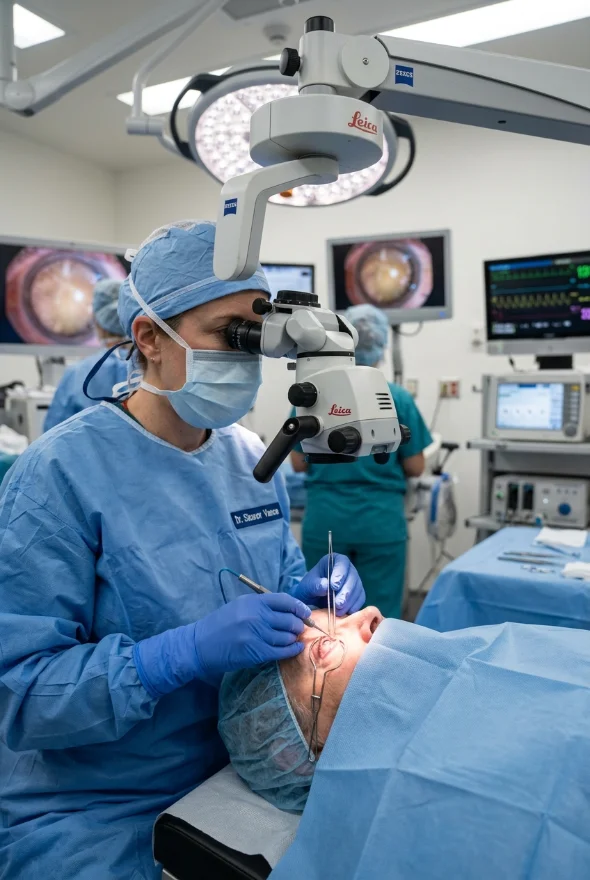
The autorefractor test and lensmeter reading are included in every treatment price at Laser Istanbul Clinic, as part of your full pre-operative examination and scans with your surgeon. If you only want a prescription check or a second opinion, a standalone examination with refraction costs {{£ price for a standalone refraction examination}}. Hotel and airport transfers are not included and are a separate charge if you would like us to arrange them.
You can also send your latest glasses prescription from your own optician for a free initial review before you travel.
Who reads your results
Your readings are checked by the surgeon who will treat you, not just by a machine. Prof. Dr. Ahmet Satıcı and Op. Dr. Aysan Bayram use refraction results to plan laser eye surgery, cataract surgery and lens procedures. Doç. Dr. Muhammet Derda Özer (Doç. is the Turkish title for Associate Professor) reviews cornea cases, including keratoconus, where refraction is combined with corneal scans because an autorefractor alone can be unreliable. Op. Dr. Bayram is a female surgeon, and Doç. Dr. Özer and Op. Dr. Bayram both speak English. Whatever the result, your surgeon explains what it means, through your personal interpreter if you wish.
Treatments these tests support
| Treatment | How the prescription measurement is used |
|---|---|
| Laser eye surgery (LASIK, SMILE Pro, PRK) | Sets the amount of correction, confirms a stable prescription and checks for hidden long-sightedness |
| Myopia (short-sightedness) treatment | Defines how short-sighted you are and how stable your prescription is, so the best method is chosen |
| Lens replacement and cataract surgery | Provides a baseline, a cross-check against corneal curvature and the starting point for the target refraction |
| ICL implantable lenses | Part of the assessment for high prescriptions or corneas too thin for laser |
Other tests in your eye examination
The prescription is only one part of the picture. Your examination usually also includes:
- Corneal topography: maps the shape of your cornea (/en/eye-tests-diagnostics/corneal-topography/)
- OCT scan (optical coherence tomography): detailed cross-section scans of the eye (/en/eye-tests-diagnostics/oct-scan/)
- FFA (fundus fluorescein angiography): imaging of the blood vessels at the back of the eye (/en/eye-tests-diagnostics/fluorescein-angiography/)
- Eye ultrasound (B-scan): imaging when the inside of the eye cannot be seen directly (/en/eye-tests-diagnostics/eye-ultrasound/)
- Visual field test (perimetry): checks your side vision (/en/eye-tests-diagnostics/visual-field-test/)
- Tonometry (eye pressure measurement): the "puff of air" test is a pressure check, not the autorefractor (/en/eye-tests-diagnostics/tonometry/)
Autorefractor test: frequently asked questions
An autorefractor test is a quick, painless machine measurement of your refractive error. You look at a picture inside the device while it measures how light reflects off the back of your eye, then reports sphere, cylinder and axis. It gives your eye doctor a starting prescription.
It estimates your short-sightedness or long-sightedness (sphere), the amount of astigmatism (cylinder) and its direction (axis) for each eye. Many models also measure the curvature of the front of the cornea. It does not measure eye pressure or eye health.
It is the fixation target. Many autorefractors show a small picture, often a hot air balloon or a house, that looks far away. It gives your eye something to focus on and helps it relax while the machine measures. The picture may drift in and out of focus, which is normal.
It is a good starting point but not a final prescription. Studies show spherical readings usually agree closely with subjective refraction, while astigmatism readings, children, dense cataracts, small pupils and irregular corneas are less reliable. That is why a manual refraction always follows.
SPH is the sphere power: minus means short-sighted, plus means long-sighted. CYL is the astigmatism power, and AXIS is its direction from 1 to 180 degrees. R or O.D. is your right eye and L or O.S. is your left. Your surgeon reads these together with your scans.
No. Nothing touches your eye and no drops are needed for the machine itself. You rest your chin on a support and look at an image for a few seconds.
The measurement itself takes only a few seconds per eye, and it may be repeated a few times for a reliable result. Including the manual check, the refraction step at our clinic takes {{minutes for the refraction step}}.
A lensmeter (or lensometer) measures the power of the lenses in your current glasses: sphere, cylinder, axis, add and prism. Reading your glasses shows what you have been wearing, helps us judge whether your prescription has changed, and gives a baseline before and after surgery.
No. An autorefractor measures your eye automatically with no input from you. A phoropter holds different lenses in front of your eyes while you say which looks clearer. The phoropter result, the subjective refraction, is what confirms your final prescription.
We use {{autorefractor-keratometer and lensmeter models used by your surgeons}}. Several manufacturers, including Nidek, make autorefractors. The important points are fogging, repeated readings and a surgeon who confirms the result with a manual test.
Yes. Upload your latest glasses prescription and any recent eye reports for a free review. A surgeon will tell you which treatments may suit you. Your prescription is then measured again in Istanbul, because the final plan is based on your examination here.
Sources for the facts on this page
- Moorfields Eye Hospital NHS Foundation Trust (Moorfields Private), A patient's guide to hospital eye tests and examinations: definition of autorefraction ("a computer-controlled instrument determines the lens power required by your eye to focus light on your retina"). https://www.moorfields.nhs.uk/private/about-moorfields-private/blog-articles/a-patient-s-guide-to-hospital-eye-tests-and-examinations
- My Kids Vision (Myopia Profile Pty Ltd), Autorefraction: what to expect: fixation image such as a hot air balloon or a house; may move in and out of focus; test takes only a few seconds and may be repeated; final prescription decided after further tests; cycloplegia. https://www.mykidsvision.org/knowledge-centre/Autorefraction-what-to-expect
- EyeWiki (AAO), Lensometry: what a lensometer measures (dioptric vertex power, optical centre, cylindrical axis, prism; sphere, cylinder, axis, add); used to establish and verify a reference prescription before an eye exam; progressives, bifocals, prisms, rigid contact lenses; manual and automated types. https://eyewiki.org/Lensometry
- EyeWiki (AAO), Preoperative Evaluation for LASIK Surgery: manifest and cycloplegic refraction; latent hyperopia; >0.50 D discrepancy; refraction stable for at least 1–2 years; unstable refraction an absolute contraindication; contact-lens discontinuation periods. https://eyewiki.org/Preoperative_Evaluation_for_LASIK_Surgery
- EyeWiki (AAO), Biometry for Intra-Ocular Lens (IOL) Power Calculation: axial length, keratometry and anterior chamber depth/effective lens position as the measurements for IOL power; compare refraction (axis) with K values; repeat if >1.0 D difference between eyes. https://eyewiki.org/Biometry_for_Intra-Ocular_Lens_(IOL)_Power_Calculation
- US FDA, LASIK Surgery Checklist ("Are you a good or poor candidate for LASIK?"): "has your prescription changed in the last year?" https://www.fda.gov/medical-devices/lasik/lasik-surgery-checklist
- American Academy of Ophthalmology, How to Read an Eyeglasses Prescription (D. Porter; reviewed by O. R. Chaudhary, MD, 2023): OD/OS, SPH (minus = nearsighted, plus = farsighted, in dioptres), CYL (astigmatism; one curve longer than the other), AXIS (1–180), ADD. https://www.aao.org/eye-health/glasses-contacts/how-to-read-eyeglasses-prescription
- Kemchoknatee P, et al. A Comparison of Autorefraction and Subjective Refraction in an Academic Optometry Clinic. Cureus 2023 (48 eyes; no significant spherical-equivalent difference; cylinder differences clinically significant). https://pmc.ncbi.nlm.nih.gov/articles/PMC10174683/
- Venkataraman AP, Brautaset R, Domínguez-Vicent A. Effect of six different autorefractor designs on the precision and accuracy of refractive error measurement. PLOS ONE 2022 (55 participants; sphere differences below +0.50 D; fogging most important, then open view). https://pmc.ncbi.nlm.nih.gov/articles/PMC9704684/
- Padhy D, Bharadwaj SR, Nayak S, Rath S, Das T. Does the Accuracy and Repeatability of Refractive Error Estimates Depend on the Measurement Principle of Autorefractors? Translational Vision Science & Technology 2021 (mean difference 0.44 D, 95% limits ±2.25 D for sphere; caution advised). https://pmc.ncbi.nlm.nih.gov/articles/PMC7794271/
- Rotsos T, Grigoriou D, Kokkolaki A, Manios N. A comparison of manifest refractions, cycloplegic refractions and retinoscopy on the RMA-3000 autorefractometer in children aged 3 to 15 years. Clinical Ophthalmology 2009 (142 children; non-cycloplegic readings overestimate myopia and underestimate hyperopia). https://pmc.ncbi.nlm.nih.gov/articles/PMC2724033
- Shane TS, Knight O, Shi W, Schiffman JC, Alfonso EC, Lee RK. Treating uncorrected refractive error in adults in the developing world with autorefractors and ready-made spectacles. Clinical & Experimental Ophthalmology 2011 ("Autorefractor accuracy may be reduced in cases of irregular astigmatism (such as corneal scarring or pterygium), dense cataract or miosis"). https://pmc.ncbi.nlm.nih.gov/articles/PMC4139100/
- Patent US 10,881,292 B2 (technical description only): fixation targets such as a balloon in the sky; fogging used to suppress the trigger for accommodation. https://patents.google.com/patent/US10881292B2/en
Have your prescription? Let a surgeon look at it, free
Upload your glasses or contact-lens prescription and any eye reports. Prof. Dr. Satıcı, Doç. Dr. Özer or Op. Dr. Bayram will tell you which treatments may suit you, with no obligation.
3 eye surgeons
Your case is reviewed by a named surgeon, not a salesperson. Reply within {{response time}}.
 Prof. Dr. Ahmet Satıcı
 Doç. Dr. Muhammet Derda Özer
 Op. Dr. Aysan Bayram