
- Home
- Knowledge centre
- Eye glossary A–Z
- Ocular Migraine: What It Is, Symptoms, Causes and Treatment
Ocular Migraine: What It Is, Symptoms, Causes and Treatment
Medically reviewed by {{surgeon}}, {{surgeon's title and specialty}}, on {{review date}}. Last updated {{date}}.
Ocular migraine (noun, informal term): a temporary visual disturbance, such as flashing lights, zigzag lines or a blind spot, that comes on during or around a migraine and then fully clears. Doctors use the phrase for two different conditions: migraine with visual aura, which is common and starts in the brain's visual centres, and retinal migraine, which is rare, affects one eye only and can be diagnosed only after other causes of temporary sight loss are excluded.
Quick answer. An ocular migraine is a short, fully reversible visual disturbance linked to migraine, usually lasting 5 to 60 minutes. Most cases are a migraine aura that affects both eyes, even though it can feel as if it is in one. True one-eye (retinal) migraine is rare. Sudden loss of vision, or a first-ever aura after 40, needs a doctor. At Laser Istanbul Clinic, our eye surgeons can examine your eyes to rule out eye causes.
Ocular migraine: key facts
- What the term means
- An informal label. The medical terms are "migraine with visual aura" (common) and "retinal migraine" (rare)
- Typical look
- A shimmering, zigzag or "fortification" pattern that slowly spreads, often leaving a blind spot behind it
- How long it lasts
- Each visual symptom lasts 5 to 60 minutes; the NHS says aura symptoms should not last longer than 1 hour
- Headache
- Often follows, but not always. A visual aura can happen with no headache at all
- Both eyes or one?
- Usually both eyes (it starts in the brain). Retinal migraine, by definition, affects one eye only
- How common
- Migraine affects about 10 million people in the UK (NHS). Visual aura occurs in over 90% of people who have migraine with aura. Retinal migraine is described as extremely rare
- Who treats it
- A GP or neurologist manages migraine; an ophthalmologist checks that the eyes are healthy
- Eye specialists at Laser Istanbul Clinic
- Doç. Dr. Muhammet Derda Özer (retina and eye inflammation), Op. Dr. Aysan Bayram (retinal disease), Prof. Dr. Ahmet Satıcı (glaucoma and general eye care)
What is an ocular migraine? Two different conditions
"Ocular migraine" is not a single official diagnosis. A 2021 narrative review in the journal Vision explains that the terms "ocular migraine", "ophthalmic migraine" and "retinal migraine" have been used interchangeably for decades, which has caused confusion for both doctors and patients. In practice the phrase covers two things:
| Migraine with visual aura | Retinal migraine | |
|---|---|---|
| How common | Common: visual aura occurs in over 90% of people with migraine with aura, at least in some attacks (ICHD-3) | Rare: described by the International Headache Society as "extremely rare" |
| Which eye | Both eyes. The disturbance is in one side of the visual field of both eyes, even though it can feel as if it comes from one eye | One eye only, by definition |
| Where it starts | In the brain's visual cortex | Debated: the retina or its blood supply, or a migraine-type process; the 2021 review calls the name "potentially a misnomer" |
| Typical symptoms | Flickering zigzag or shimmering shapes that expand, then a blind spot | One eye sees flashes, a blind spot or loses vision, then recovers |
| Duration | 5 to 60 minutes | The ICHD-3 criteria include symptoms lasting 5 to 60 minutes |
| How it is diagnosed | From the story and pattern, after a check that nothing else is going on | Only after other causes of temporary one-eye vision loss are ruled out |
Why the confusion? Our visual field is wider on the temple side (about 90 degrees) than on the nose side (about 60 degrees), so when half of the vision in both eyes is affected, people often feel it only in the eye with the larger lost area. The 2021 review points out that many patients who describe a "one-eye" problem in fact have a symptom shared by both eyes. A simple check is to cover one eye at a time during an episode and note what each eye sees.
Ocular migraine symptoms: what does it look like?
The most common ocular migraine symptom is a flickering or zigzag shape that slowly spreads across your vision. The International Headache Society (ICHD-3) calls the classic form a "fortification spectrum": a zigzag figure near the point you are looking at that gradually spreads to one side, with a shimmering, angled edge, and leaves a blind patch (scotoma) behind as it moves. Research reviews describe it as starting small, often as a flickering blind spot or as flashes or balls of light, and expanding in a C-shape over 5 to 60 minutes.
Typical ocular migraine symptoms include:
- Shimmering, flickering or zigzag lines, usually on one side of the vision
- Flashes of light or expanding balls of light
- A blind spot (scotoma) that may have no sparkle at all: a "hole" or grey patch in the vision
- Blurred, foggy or "heat-wave" vision: in one diary study, 33% of auras included blurring or heat waves, though experts still debate whether this is part of the aura
- Symptoms that stay when you close your eyes. A research review notes that the bright, positive features of a migraine aura remain visible with the eyes shut, which fits an origin in the brain rather than the eye
- Other aura symptoms alongside: the NHS lists numbness or pins and needles, dizziness and difficulty speaking among aura symptoms
The key pattern is gradual build-up and full recovery. ICHD-3 describes aura symptoms that spread gradually over 5 minutes or more, last 5 to 60 minutes each, and fully reverse. Stroke symptoms, by contrast, are often at their worst from the start.
In retinal migraine, the disturbance is confined to one eye. According to the 2021 review, most reported cases involve "negative" symptoms, meaning loss of vision such as a central blind spot or a section of lost vision, rather than the sparkling shapes of a typical aura.
Can you have an ocular migraine without a headache?
Yes. A visual aura can happen with no headache at all. ICHD-3 has a specific category called "typical aura without headache", in which the aura is neither accompanied nor followed by headache of any sort. A research review adds that in a minority of attacks the aura is not followed by headache, which classically happens in older adults and is sometimes called "late-life migraine accompaniments".
There is an important catch. Without a headache to point to migraine, ICHD-3 notes that telling an aura from a serious mimic, such as a transient ischaemic attack (TIA, a "mini-stroke"), becomes harder and often needs investigation. It advises ruling out other causes in particular when:
- an aura happens for the first time after age 40
- the symptoms are only negative (a blank area, such as loss of half the vision, and no sparkle)
- the aura is unusually long or very short
If that describes you, do not assume it is "just a migraine": get it checked.
Ocular migraine causes: why does it happen?
Nobody knows exactly what causes migraine, but a visual aura is linked to a slow wave of altered activity that spreads across the brain's visual cortex. The NHS says the cause of migraine is not known, but it happens when there are changes to nerves and blood vessels in the brain, and that you are more likely to get it if a close family member has it. Women are also more likely to get migraine than men; lifetime prevalence has been reported as about 33% in women and 13% in men.
The wave, called cortical spreading depolarisation, is thought to travel across the visual cortex at a speed in line with how fast the shimmering shape expands in your vision. That is why the disturbance creeps rather than appearing instantly.
For retinal migraine, the cause is less clear. Early theories blamed spasm of the retinal blood vessels; the 2021 review notes that the vasospasm idea has been largely challenged and that several researchers consider "retinal migraine" something of a misnomer. Other theories involve a spreading wave in the retina itself, but this has not been shown directly in humans.
Ocular migraine triggers
The NHS lists these common triggers for migraine attacks:
The NHS suggests keeping a migraine diary to work out your own triggers. Not everyone has an obvious one.
- having your period
- anxiety and depression
- stress and tiredness
- skipping meals or not eating regularly
- too much caffeine
- not getting enough regular exercise
Why am I suddenly getting ocular migraines?
A sudden run of attacks often means a trigger has changed, but a new pattern is worth checking. Look first at the list above: a stressful period, poor sleep, irregular meals, more caffeine, less exercise or your period can all play a part.
See a doctor rather than waiting it out if:
A rare pattern, "migraine aura status", is when at least three auras happen within three days, typically without headache. It is uncommon and also deserves medical review.
- this is your first ever visual aura, especially after 40
- the visual disturbance affects one eye only
- attacks are getting more frequent, longer or different from before
- you have never had migraine and now have visual symptoms
How is an ocular migraine diagnosed?
Diagnosis starts with your description of the episode and with ruling out other causes. No scan or blood test proves an aura. Your doctor will ask how it began, how it spread, how long it lasted, whether it affected one eye or both, and whether a headache followed.
For migraine with aura, ICHD-3 asks for at least two attacks with fully reversible aura symptoms and at least three of these six features: at least one symptom spreading gradually over 5 minutes or more; two or more symptoms in succession; each symptom lasting 5 to 60 minutes; at least one symptom on one side; at least one positive symptom (such as flashes); and a headache with, or within 60 minutes of, the aura.
For retinal migraine, ICHD-3 requires fully reversible one-eye visual disturbance confirmed during an attack, either by a clinical visual field examination or by the patient's own drawing of the one-eye field defect, and requires that other causes of temporary one-eye blindness (amaurosis fugax) have been excluded.
When one-eye symptoms are reported, the 2021 review recommends examination by an ophthalmologist, including formal visual field tests and, ideally, photographs of the back of the eye and an OCT scan. A carotid artery ultrasound may be used to look for narrowed neck arteries, and blood tests for inflammation where arteritis is possible. This is why a disturbance in one eye should be seen by an eye doctor.
Conditions that can look like an ocular migraine
Several conditions cause temporary visual disturbance, and some are serious. That is why a diagnosis of retinal migraine is one of exclusion.
| Condition | How it differs | Why it matters |
|---|---|---|
| Amaurosis fugax (temporary loss of vision in one eye from interrupted blood flow) | Often a "curtain" sweeping in from one side; typically clears within minutes and lasts no longer than an hour | Can come from a clot or plaque from the carotid artery or heart. A 2021 review reports about a 2% risk of stroke within a year when plaque disease is the cause |
| Stroke or TIA | Symptoms are often at their worst from the start; the classic zigzag shimmer is usually absent | An emergency. The NHS says to call 999 for loss of vision, speech or memory problems, or one-sided weakness |
| Giant cell arteritis (inflammation of arteries) | Can cause temporary sight loss and can come with headache | Listed by the 2021 review among the serious causes of temporary one-eye vision loss |
| Eye conditions such as dry eye or intermittent angle-closure glaucoma | Cause temporary vision problems in one eye | Listed by the 2021 review among causes of temporary one-eye vision loss; an eye examination tells them apart |
| Raised pressure around the optic nerve (papilloedema) | Brief "transient visual obscurations" | Listed by the 2021 review among causes of temporary one-eye vision loss |
| Epilepsy | Visual symptoms typically last under 5 minutes and start at the edge of one side of the visual field | A migraine aura more often starts nearer the centre and expands outwards |
Optic-nerve conditions are also on the list of look-alikes. Our guide to optic neuropathy and neuro-ophthalmology explains how the optic nerve is assessed.
Ocular migraine treatment
There is no cure for migraine, but treatment can reduce attacks and ease them. The NHS says migraine cannot be cured, but treatment can help manage symptoms and prevent attacks. Most people need a plan from a GP or neurologist.
During an attack (migraine with aura):
- The NHS lists painkillers such as ibuprofen and paracetamol, triptans and gepants, and medicines for nausea.
- If you take painkillers, the NHS advises taking them as soon as the headache starts, and trying not to take them for more than 2 days a week because that can cause more headaches.
- A research review points out that current acute migraine medicines treat the headache but have no effect on the aura itself, so do not expect them to shorten the visual symptoms.
- The NHS suggests sleeping or lying down in a darkened room during an attack.
To prevent attacks:
- A research review says preventive drugs are generally considered when a person averages more than two attacks per month: beta-blockers, candesartan, topiramate, valproate, amitriptyline or nortriptyline. When they work, auras can also be prevented. For frequent auras, lamotrigine can be tried.
- The NHS also lists acupuncture, relaxation techniques, cognitive behavioural therapy (CBT) and vitamin B2.
- Lifestyle: the NHS advises eating at regular times, limiting caffeine and alcohol, getting plenty of sleep and regular exercise, managing stress and staying well hydrated.
For retinal migraine: evidence is thin because the condition is so rare. The 2021 review reports case reports of propranolol, imipramine, nortriptyline and verapamil, notes that some authors advise against beta-blockers because of a theoretical risk of constricting small arteries, and says that some cases are managed by observation alone. Any treatment decision belongs with a neurologist or neuro-ophthalmologist.
Is it dangerous? A typical visual aura clears completely. Rarely, permanent one-eye vision loss has been reported in people with migraine; ICHD-3 acknowledges such cases, and experts disagree on whether these were true retinal migraine. That is another reason to have one-eye episodes examined.
Ocular migraine in pregnancy
Migraine sometimes improves in pregnancy, but any new or unusual visual symptoms in pregnancy should be checked. The NHS says migraine sometimes improves in pregnancy. It also lists being pregnant (or having just had a baby) as a reason to ask for an urgent GP appointment or get help from NHS 111 if you have a migraine attack. Do not start or stop any migraine medicine in pregnancy without advice from your doctor or midwife.
Ocular migraine on the NHS
The NHS does not use the term "ocular migraine". Its migraine pages describe the same experience as "aura": sight problems such as zigzag lines or flashing lights, sometimes with numbness, dizziness or difficulty speaking, and say aura symptoms should not last longer than 1 hour. NHS advice (page last reviewed 10 March 2026):
- See a GP if attacks are severe or getting worse, last longer than usual, happen more than once a week, are difficult to control, or regularly happen around your period.
- Ask for an urgent GP appointment or get help from NHS 111 if aura symptoms last longer than 1 hour at a time, an attack lasts longer than 72 hours, or you are pregnant or just had a baby.
- Call 999 for a sudden, extremely painful headache, problems speaking or remembering things, loss of vision, blurred or double vision, drowsiness or confusion, a seizure, one-sided weakness, or a recent head injury.

When to see a doctor about ocular migraine
Get same-day help if you:
- lose vision suddenly, or it does not come back within an hour
- have visual symptoms together with weakness, a drooping face, problems speaking or confusion
- have a sudden, extremely painful headache
- are over 50 with a new headache, jaw pain or scalp tenderness and sight problems (possible giant cell arteritis)
Book an appointment soon if:
- it is your first aura, especially after age 40
- the symptoms affect one eye only, or you are not sure
- you have visual symptoms with no headache and no history of migraine
- attacks are more frequent, longer or different from your usual pattern
- you have several auras within a few days
A short, sparkling episode that fully clears is often a migraine aura, but only an examination can tell you that. Checking is the safe choice.
Eye checks at Laser Istanbul Clinic
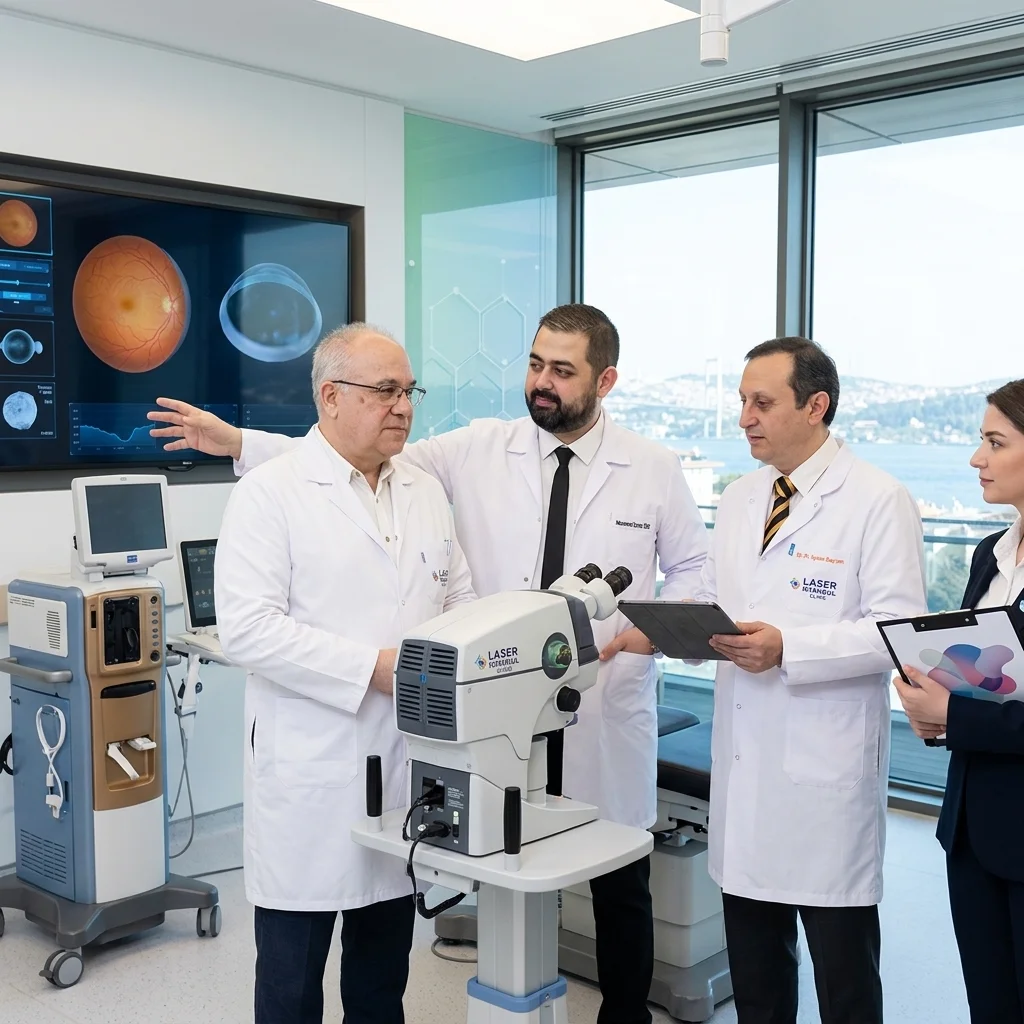
Migraine itself is managed by a GP or neurologist, but an eye examination can rule out eye causes. If you have one-eye episodes, a diagnosis you want checked, or you are unsure whether the disturbance comes from the eye or the brain, our eye surgeons can examine your eyes and review your existing eye reports and scans:
- Doç. Dr. Muhammet Derda Özer: retina and eye inflammation
- Op. Dr. Aysan Bayram: retinal disease (speaks English; female surgeon)
- Prof. Dr. Ahmet Satıcı: glaucoma and general eye care
The tests your surgeon chooses depend on your symptoms, for example a retinal examination, an OCT scan and a visual field test. If the examination suggests a brain or blood-vessel cause, you will be advised to see a neurologist.
Frequently asked questions
An ocular migraine is an informal term for a temporary visual disturbance, such as flashing lights or zigzag lines, linked to migraine. It usually means a migraine aura, which affects both eyes and clears within an hour. Rarely, it means retinal migraine, which affects one eye only.
The typical ocular migraine symptoms are a shimmering or zigzag shape that spreads slowly across the vision, flashes of light and a blind spot, lasting 5 to 60 minutes and then fully clearing. A headache may follow. Some people also have numbness, dizziness or speech difficulty during the aura.
Yes. International Headache Society criteria include "typical aura without headache". It is more typical in older adults. A first aura without headache after age 40 should be checked, because stroke-type conditions can look similar.
Migraine is linked to changes in nerves and blood vessels in the brain, and a slow wave of altered activity in the visual cortex is thought to cause the aura. It runs in families. Triggers listed by the NHS include stress, tiredness, skipping meals, caffeine, your period and too little exercise.
A change in triggers, such as stress, poor sleep, missed meals, more caffeine or your period, is a common reason. If it is your first aura, you are over 40, only one eye is involved, or attacks are changing, see a doctor to rule out other causes.
A typical visual aura clears completely. The risk is mistaking something serious for it. Sudden or lasting vision loss, one-eye curtain-like loss, or visual symptoms with weakness or speech problems need emergency care.
There is no cure, but the NHS lists painkillers, triptans, gepants and anti-sickness medicines for attacks, and preventive options such as beta-blockers, antidepressants, epilepsy medicines, acupuncture and CBT. Acute medicines do not shorten the aura itself. Lifestyle changes and a trigger diary help.
Not exactly. People often use "ocular migraine" for any visual aura. The medical term "retinal migraine" is stricter: fully reversible visual disturbance in one eye only, with other causes ruled out. It is considered rare.
Yes, migraine can occur in pregnancy, although the NHS says it sometimes improves. The NHS lists pregnancy among the reasons to seek urgent advice during a migraine attack. Have any new visual symptoms checked.
Sources for the facts on this page
- International Headache Society. ICHD-3, 1.2 Migraine with aura. https://ichd-3.org/1-migraine/1-2-migraine-with-aura/
- International Headache Society. ICHD-3, 1.2.4 Retinal migraine. https://ichd-3.org/1-migraine/1-2-migraine-with-aura/1-2-4-retinal-migraine/
- International Headache Society. ICHD-3, 1.2.1.2 Typical aura without headache. https://ichd-3.org/1-migraine/1-2-migraine-with-aura/1-2-1-migraine-with-typical-aura/1-2-1-2-typical-aura-without-headache/
- Chong YJ, Mollan SP, Logeswaran A, Sinclair AB, Wakerley BR. Current Perspective on Retinal Migraine. Vision 2021;5(3):38. https://pmc.ncbi.nlm.nih.gov/articles/PMC8396291/ (doi 10.3390/vision5030038)
- van Dongen RM, Haan J. Symptoms related to the visual system in migraine. F1000Research 2019;8:F1000 Faculty Rev-1219. https://pmc.ncbi.nlm.nih.gov/articles/PMC6668047/ (doi 10.12688/f1000research.18768.1)
- NHS. Migraine. https://www.nhs.uk/conditions/migraine/ (page last reviewed 10 March 2026)
- NHS. Migraine: symptoms. https://www.nhs.uk/conditions/migraine/symptoms/
Seeing flashes or blind spots in one eye?
Send us your eye reports and scans. One of our eye surgeons will review them and tell you whether an eye examination in Istanbul makes sense, with no obligation. Sudden loss of vision is an emergency: see a doctor locally the same day.
3 eye surgeons
Your case is reviewed by a named surgeon, not a salesperson. Reply within {{response time}}.
 Prof. Dr. Ahmet Satıcı
 Doç. Dr. Muhammet Derda Özer
 Op. Dr. Aysan Bayram