
- Home
- Knowledge centre
- Lens & cataract guides
- NHS Cataract Waiting Times by Region: England, Scotland and Wales in 2026
NHS Cataract Waiting Times by Region: England, Scotland and Wales in 2026
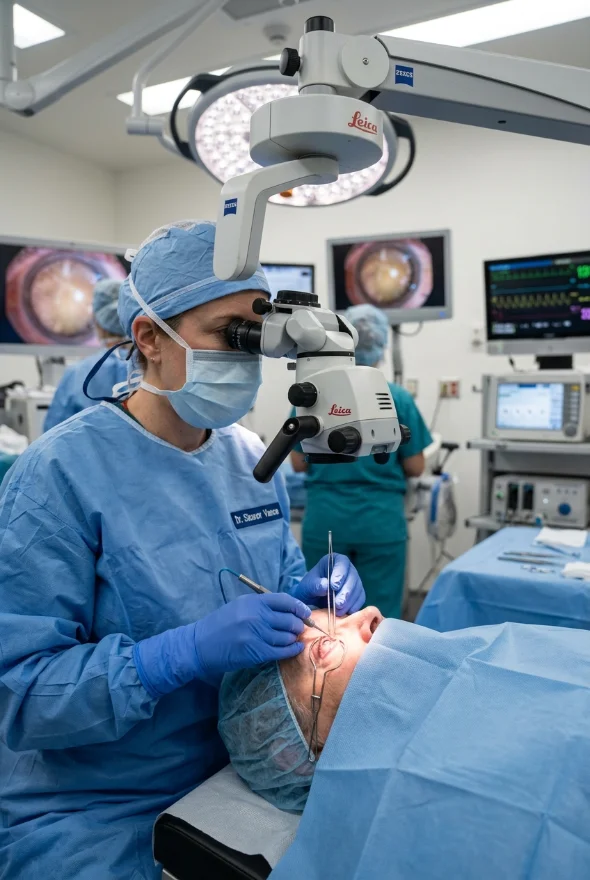
NHS cataract waiting times depend on where you live and which hospital you are referred to. At the end of July 2026, 620,931 people in England were waiting for NHS eye treatment, and 72.9% had waited under 18 weeks against a 92% standard. There is no official cataract-only median: the NHS publishes waits by specialty. The all-specialty median in England was 12.0 weeks, but some patients wait far longer. Cataract surgeons Prof. Dr. Ahmet Satıcı and Op. Dr. Aysan Bayram see UK patients who prefer not to wait.
How long is the NHS wait for cataract surgery?
The honest answer is "it depends on your hospital", and the official statistics measure it by specialty rather than by operation. NHS England publishes waiting times for each treatment function, and cataract surgery sits inside ophthalmology, the specialty that covers all NHS eye treatment. Here is the national picture for England at the end of July 2026, from NHS England's referral-to-treatment (RTT) statistics, published on 10 September 2026:
| Measure (England, end of July 2026) | Ophthalmology (eye) | All specialties |
|---|---|---|
| People or pathways waiting to start treatment | 620,931 | about 7.3 million |
| Share waiting up to 18 weeks | 72.9% | 65.4% |
| NHS standard | 92% within 18 weeks | 92% within 18 weeks |
| Median wait | not published separately | 12.0 weeks |
| 92nd percentile wait | not published separately | 38.4 weeks |
Two things stand out. First, the eye-care list is larger than the lists for general surgery (383,110), urology (368,071) or ear, nose and throat (594,035), so it is one of the biggest in the NHS. Second, ophthalmology is doing slightly better than the NHS average against the 18-week mark, yet more than one in four eye patients had still waited longer than 18 weeks, and the 92% standard has not been met.
What "pathways" means. NHS England counts waiting-list entries (pathways), not individual people, and some patients are on more than one. Across all specialties, NHS England estimates about 6.2 million unique patients for the 7.3 million pathways.
Why is there no official cataract waiting time?
Because the RTT statistics group every operation by specialty. A cataract operation, a glaucoma procedure and a retina treatment all count towards "Ophthalmology Service", so a published "cataract median" would be an estimate rather than an official figure. Cataract surgery is, however, the most frequently performed NHS operation: the Royal College of Ophthalmologists' National Cataract Audit counted about 681,400 publicly funded cataract operations in England between April 2023 and March 2024.
You may see other numbers quoted online, such as "650,000 people waiting for cataract surgery" or "a 41-week median wait". Treat them with care. We could not find either figure in NHS England's published statistics: the official eye-care total is 620,931 pathways (all eye conditions, not cataract alone), and the official median for all specialties is 12.0 weeks, with 38.4 weeks as the point below which 92% of waiting patients fall. A long wait at one hospital is real for the patient at that hospital, but it is not the national median.
NHS cataract waiting times by region
Waiting times for cataract surgery vary between regions, between NHS trusts in the same region and between the four UK nations. England is divided into seven NHS regions, and NHS England's data files show waiting times for each. Use the table below to see where your region stands, and remember that your own hospital's wait matters more than your region's average.
England: the seven NHS regions
| NHS region | Ophthalmology: people or pathways waiting, and % within 18 weeks ({{region data month}}) |
|---|---|
| North East and Yorkshire | {{North East and Yorkshire ophthalmology: waiting, % within 18 weeks}} |
| North West | {{North West ophthalmology: waiting, % within 18 weeks}} |
| Midlands | {{Midlands ophthalmology: waiting, % within 18 weeks}} |
| East of England | {{East of England ophthalmology: waiting, % within 18 weeks}} |
| London | {{London ophthalmology: waiting, % within 18 weeks}} |
| South East | {{South East ophthalmology: waiting, % within 18 weeks}} |
| South West | {{South West ophthalmology: waiting, % within 18 weeks}} |
| England | 620,931 waiting · 72.9% within 18 weeks (end of July 2026) |
Source: NHS England, RTT waiting times, ophthalmology treatment function; regional rows from the commissioner data files, refreshed every quarter.
The four UK nations compared
Scotland, Wales and Northern Ireland publish their own waiting-time statistics, and they measure different things, so the numbers cannot be lined up like for like. The Office for National Statistics' 2024 comparability work, referenced by Public Health Scotland, found that national policies and counting rules differ. The figures below are for all specialties, not for cataract surgery alone.
| England | Scotland | Wales | Northern Ireland | |
|---|---|---|---|---|
| Latest data | July 2026 | August 2026 | July 2026 | {{Northern Ireland data month}} |
| Waiting list | about 7.3 million pathways | 506,512 ongoing waits for a new outpatient appointment; 157,485 ongoing waits for inpatient or day-case treatment | just under 709,700 pathways | {{Northern Ireland waiting list}} |
| Main standard | 92% within 18 weeks of referral | 95% of new outpatients seen within 12 weeks; treatment within 12 weeks of agreeing it | 95% within 26 weeks of referral; nobody over 36 weeks | {{Northern Ireland standard}} |
| Latest performance | 65.4% within 18 weeks | 62.8% of August's new-outpatient waits ended within 12 weeks; 54.7% of inpatient and day-case admissions were within 12 weeks of the decision to treat | 65.7% within 26 weeks; about 172,400 pathways over 36 weeks | {{Northern Ireland performance}} |
| Waits over a year | 111,379 over 52 weeks | 14,116 new-outpatient waits and 16,014 inpatient or day-case waits over 52 weeks | just over 94,900 pathways over one year | {{Northern Ireland over-a-year figure}} |
Sources: NHS England (July 2026), Public Health Scotland (published 29 September 2026), StatsWales and Welsh Government (published 17 September 2026). Cataract surgery is mostly day-case surgery, so the Scottish "inpatient and day case" line is the one that applies to it.
What this means for you. In England, Scotland and Wales, fewer patients than the target share are seen on time, so a long wait for a cataract operation is not unusual. The most useful comparison is between the hospitals you can be referred to: that is where your own decision lies.

Do I have to wait until my cataract is "bad enough"?
No. NICE tells the NHS not to restrict cataract surgery on the basis of visual acuity. The NICE guideline on cataracts in adults (NG77) says the decision to refer should rest on a conversation about how the cataract affects your vision and quality of life, whether one or both eyes are affected, what surgery involves and what happens if you choose not to have it. It adds: "Do not restrict access to cataract surgery on the basis of visual acuity."
The NHS says surgery in adults is not always needed straight away, but may be recommended if cataracts are affecting daily life. If your vision is getting in the way of reading, working or driving, say so to your optometrist and GP: that is the information that supports a referral.
Driving while you wait. In the UK you must be able to read a number plate from 20 metres and have a visual acuity of at least 6/12 with both eyes together, with glasses or contact lenses if you wear them, according to GOV.UK. Glare from cataracts can make night driving harder before you reach that limit, so be honest with yourself about what you can see safely.
How do I find out the wait at my hospital?
Ask, then compare. Waits differ from hospital to hospital, and you usually have a choice of where to go. Four steps:
Ask your optometrist or GP
which hospitals and NHS-funded providers near you carry out cataract surgery.
Use My Planned Care
The NHS says you can use the My Planned Care website to check and compare waiting times at different hospitals.
Choose your hospital when you book
When you book your first outpatient appointment through the NHS e-Referral Service, you can pick the hospital or clinic and an appointment time that suits you.
If your wait is likely to pass 18 weeks,
the NHS says you can ask to be seen or treated by a different provider; the hospital or integrated care board should look into your options. Exceptions apply if you choose to wait longer or miss appointments.
Keep a note of your referral date and any letter that gives a waiting estimate. Those dates are what you need if you decide to compare NHS options with private ones.
What are your options if you don't want to wait?
You have three routes: a different NHS provider, private surgery in the UK, or private surgery abroad. They differ in cost, travel and aftercare, so compare them on the same footing.
| Option | What to know |
|---|---|
| A different NHS hospital or provider | Free at the point of use. You are usually given a standard (monofocal) lens: NICE says not to offer multifocal lenses in NHS cataract surgery. Waits differ by provider, so compare them. |
| Private surgery in the UK | Typical published UK prices are about £2,500–3,500 per eye for monofocal cataract surgery (2025–26 ranges, not quotes). Premium lenses cost more. |
| Private surgery in Istanbul | Surgery by one of three named surgeons, with the price confirmed in writing, in pounds, before you pay a deposit: from {{£ price}} per eye. |
What an Istanbul price includes. Your pre-operative examination and scans, surgery by your named surgeon, medication and eye drops, follow-up checks in Istanbul, a personal interpreter, a coordinator, and remote follow-up once you are home. Hotel and airport transfers are not included. They are a separate charge, arranged on request. Flights are not included either.
Who would operate. Cataract surgery at Laser Istanbul Clinic is performed by Prof. Dr. Ahmet Satıcı (cataract and premium lens surgery), Doç. Dr. Muhammet Derda Özer (Doç. means Associate Professor; cataract, cornea and retina; speaks English) or Op. Dr. Aysan Bayram (cataract, laser and retinal disease; speaks English; female surgeon). Your surgeon examines your eyes first and tells you whether surgery is right for you.
Think about aftercare before you book. The NHS says cataract eye drops are usually used for about 4 weeks, and recovery rules apply (no driving until vision is back to normal, no swimming, no heavy lifting). Ask any provider who checks your eye after surgery, and how.
How is this page kept up to date?
We refresh the figures every quarter. Each update replaces the figures above with the latest published NHS England, Public Health Scotland and Welsh Government data, and records the month the data refers to. NHS England publishes its statistics monthly; the July 2026 figures used here came out on 10 September 2026. If a figure on this page differs from the official release, the official release is right: use the links under Sources.
Frequently asked questions
It depends on your hospital. NHS England does not publish a cataract-only wait; at the end of July 2026, 620,931 people were waiting for NHS eye treatment and 72.9% had waited under 18 weeks, against a 92% standard. For all specialties the median wait was 12.0 weeks and 92% of waiting patients had waited under 38.4 weeks.
Not as a national median. A "41-week median" is quoted online, but we could not find it in NHS England's published statistics, where the all-specialty median is 12.0 weeks. Some patients do wait much longer at particular hospitals, so check your own hospital's wait through your GP or My Planned Care.
There is no single UK cataract list. England's eye-care waiting list stood at 620,931 pathways in July 2026; Scotland, Wales and Northern Ireland publish their own figures, and they are counted differently. These lists cover all eye treatment, of which cataract surgery is a large part.
There is no verified cataract-only answer, because the four nations measure waits differently and publish eye waits separately. Within England, waits vary between regions and between hospitals in the same region. Compare the hospitals you can be referred to, rather than relying on a regional average.
Usually, yes. The NHS says you can choose the hospital or clinic when you book your first outpatient appointment through the NHS e-Referral Service. If you are likely to wait longer than 18 weeks, you can ask to be seen by a different provider.
No. NICE says not to restrict access to cataract surgery on the basis of visual acuity. The decision rests on how the cataract affects your daily life and what you want, which you discuss with your optometrist, GP and surgeon.
Not usually. NICE advises the NHS not to offer multifocal lenses in cataract surgery, so NHS patients are normally given a standard lens. If you want a multifocal or trifocal lens, you generally pay for the operation privately, in the UK or abroad.
Typical published prices are about £2,500–3,500 per eye for monofocal cataract surgery (2025–26 ranges, not quotes). Premium lenses cost more. A surgeon confirms your exact price after examining your eyes.
Tell your optometrist or GP if your vision gets worse or driving becomes difficult, because surgery can be offered when cataracts affect daily life. Separately, the NHS says to get help from NHS 111 if floaters suddenly appear or increase, you see flashes of light, a dark curtain or shadow moves across your vision, or your vision suddenly blurs: these can be signs of a detached retina, not a cataract.
Tired of waiting? Ask a cataract surgeon in Istanbul.
Send us your prescription and any NHS or optician letters. Prof. Dr. Ahmet Satıcı, Doç. Dr. Muhammet Derda Özer or Op. Dr. Aysan Bayram tells you whether cataract surgery or lens replacement may suit your eyes and what it would cost in pounds, with no obligation. You get a reply within {{response time}}.
Sources for the facts on this page
- All opened on 7 Oct 2026 unless noted.
- NHS England. Statistical Press Notice: NHS referral to treatment (RTT) waiting times data, July 2026 (published 10 Sep 2026): Table 1, ophthalmology 620,931 incomplete pathways, 72.9% within 18 weeks; general surgery 383,110, urology 368,071, ENT 594,035; all specialties 7.3 million pathways, 65.4% within 18 weeks, median 12.0 weeks, 92nd percentile 38.4 weeks, 111,379 over 52 weeks; about 6.2 million unique patients; 92% standard. https://www.england.nhs.uk/statistics/wp-content/uploads/sites/2/2026/09/Jul26-RTT-statistical-press-notice-PDF-578K-97ylx5.pdf
- NHS England. RTT waiting times (monthly data files by treatment function, commissioner and provider, used for the regional table; page not openable by automated tools). https://www.england.nhs.uk/statistics/statistical-work-areas/rtt-waiting-times/
- Public Health Scotland. Stage of treatment waiting times, new outpatients, inpatients and day cases (published 29 Sep 2026; data to 31 Aug 2026). https://www.publichealthscotland.scot/publications/stage-of-treatment-waiting-times/
- Welsh Government. NHS activity and performance summary: July and August 2026 (published 17 Sep 2026). https://www.gov.wales/nhs-activity-and-performance-summary-july-and-august-2026-html
- NHS. Guide to NHS waiting times in England (My Planned Care; choice of hospital; asking for a different provider after 18 weeks). https://www.nhs.uk/nhs-services/hospitals/guide-to-nhs-waiting-times-in-england/
- NHS. Cataract surgery (surgery not always needed straight away; drops for about 4 weeks; recovery advice; NHS 111 advice for detached-retina warning signs). https://www.nhs.uk/tests-and-treatments/cataract-surgery/
- NICE. Cataracts in adults: management (NG77), recommendations 1.2.1, 1.2.2 (do not restrict access on visual acuity) and 1.4.2 (do not offer multifocal intraocular lenses). https://www.nice.org.uk/guidance/ng77/chapter/Recommendations
- The Royal College of Ophthalmologists, National Ophthalmology Database. Eighth Annual Report of the National Cataract Audit (2025): about 681,400 publicly funded cataract operations in England, April 2023 to March 2024. https://nodaudit.org.uk/sites/default/files/2025-07/NOD%20Cataract%20Audit%208th%20Annual%20Report%202025%20Final.pdf
- BMA. NHS backlog data analysis (July 2026 England waiting-list summary: 7.33 million cases, median 12 weeks; used to cross-check the NHS England release). https://www.bma.org.uk/advice-and-support/nhs-delivery-and-workforce/pressures/nhs-backlog-data-analysis
- GOV.UK. Driving eyesight rules (number plate at 20 metres; visual acuity at least 6/12). https://www.gov.uk/driving-eyesight-rules
- Internal: UK private monofocal cataract price (£2,500–3,500 per eye) and the UK private-price keyword volumes: content/en/from-uk.md and content/en/home.md; surgeon specialties: reports/doctors-hospitals-research.md; included and excluded items: content/_briefs/ALL_PAGES_RULES.md.