
Macular Degeneration Treatment in Istanbul: Injections and the Scharioth Macula Lens
Macular degeneration treatment depends on which type you have. Wet AMD is treated with anti-VEGF eye injections to protect the sight you still have; for advanced dry or burnt-out AMD, the Scharioth macula lens, a small magnifying implant, can make reading easier again. In Istanbul, your case is assessed by retina specialists Doç. Dr. Muhammet Derda Özer (Doç. = Associate Professor) or Op. Dr. Aysan Bayram, with a full OCT scan before any recommendation.
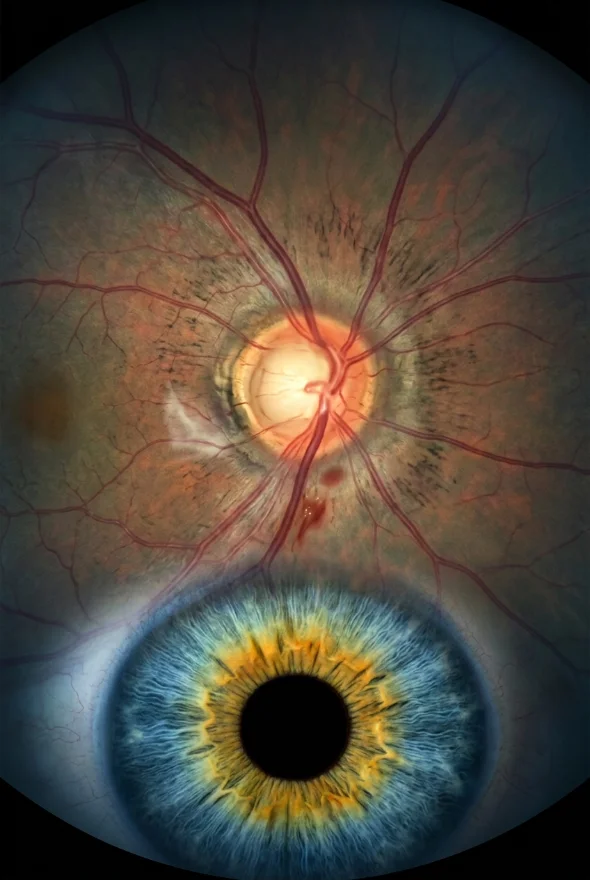
Age-related macular degeneration (AMD) damages the macula, the centre of the retina that gives sharp, straight-ahead vision. Wet AMD is treated with anti-VEGF eye injections, started quickly. Dry AMD has no cure, but AREDS2 vitamins slow intermediate disease. For late AMD in both eyes, the Scharioth macula lens magnifies print about 2.2 times. In Istanbul, Doç. Dr. Muhammet Derda Özer and Op. Dr. Aysan Bayram treat AMD; the lens starts from {{£ price}} per eye, hotel and transfers extra.
What is the macula, and what does it do?
The macula is the central part of the retina, the light-sensitive layer at the back of the eye, and it controls sharp, straight-ahead vision (US National Eye Institute). You use it to read, recognise faces, drive and see fine detail and colour. Your side (peripheral) vision comes from the rest of the retina, which is why macular disease blurs the middle of what you look at but leaves the edges.
Macula anatomy in numbers (Koksaldi et al., Clinical anatomy of the macula, 2025):
| Part | Size | What it does |
|---|---|---|
| Macula (macula lutea, "yellow spot") | about 5.5 mm across | Central retina, packed mainly with cone cells for detail and colour |
| Fovea | about 1.5 mm across, in the centre of the macula | The highest concentration of cones; your sharpest vision |
| Foveola | about 0.35 mm, the floor of the fovea | Cones only; the exact point you look at |
The macula looks yellow because it holds two pigments, lutein and zeaxanthin, most densely at the fovea. They filter blue light and act as antioxidants, which is why they are part of the AREDS2 vitamin formula described below.
What does vision look like with wet macular degeneration?
With wet AMD, straight lines look wavy or bent, and a blurred or dark patch appears in the centre of your vision, often within weeks. The National Eye Institute describes late AMD this way:
- straight lines (door frames, tiles, lines of text) look wavy or crooked; doctors call this metamorphopsia
- a blurry or empty area near the centre of your vision, which can grow over time
- colours look less bright
- it becomes harder to see in dim light
- objects may look smaller than they are (micropsia)
Some people with significant sight loss also see vivid, silent images of patterns, people or places that are not there. This is called Charles Bonnet syndrome. NICE describes these as hallucinations linked to the damaged retina and asks eye doctors to tell people with AMD about them.
Sudden distortion or a new dark patch is urgent. In the UK, NICE guidance says people with suspected wet AMD should be referred to a macula service, normally within 1 working day. If this happens to you, see an eye doctor where you are; do not wait to travel.
How AMD is diagnosed: OCT scan and Amsler grid
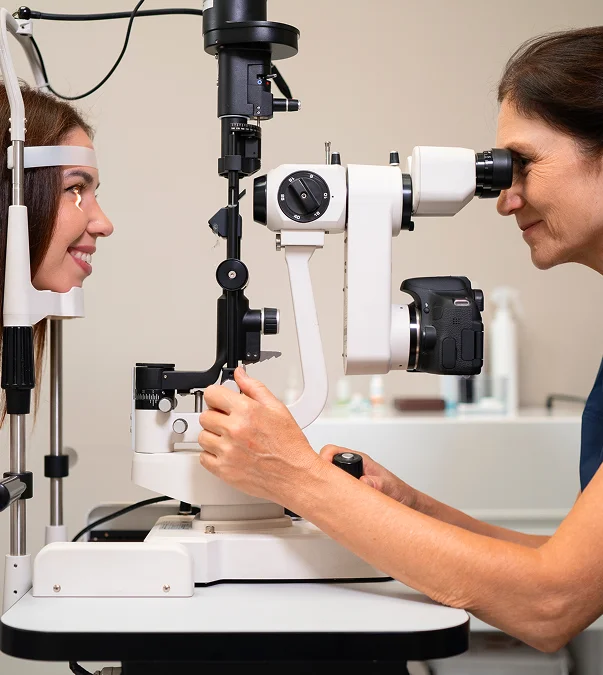
AMD is diagnosed by examining the retina and confirmed with an OCT scan. Optical coherence tomography (OCT) is a painless, non-contact scan that shows the layers of the macula in cross-section; it reveals fluid from wet AMD and is used to check how well treatment is working (EyeWiki). NICE recommends OCT for anyone with suspected wet AMD. If OCT is unclear, a fluorescein angiogram (dye photographs of the retinal blood vessels) may be added.
At home, the American Academy of Ophthalmology advises people with AMD to check each eye separately with an Amsler grid or by reading, so they notice changes early.
Macular degeneration treatment options in 2026
The right macular degeneration treatment depends on the type and stage of your AMD. No treatment repairs macular cells that have already died, so the aim is to protect remaining vision (wet AMD, intermediate dry AMD) or to make better use of it (late AMD).
| Your diagnosis | Treatment | What it does |
|---|---|---|
| Early dry AMD | No proven treatment (AAO). Stop smoking, healthy diet, regular checks | Lowers the risk of progression |
| Intermediate dry AMD (one or both eyes) | AREDS2 vitamin and mineral formula | Original AREDS formula cut progression to advanced AMD by about 25% (NEI) |
| Wet AMD (active) | Anti-VEGF injections into the eye (ranibizumab, aflibercept, bevacizumab, faricimab and others) | Stops leaking vessels; first-line treatment (AAO) |
| Late dry AMD (geographic atrophy) | Complement-inhibitor injections approved in the US since 2023; not authorised in the EU | Slows growth of the atrophy; does not restore vision |
| Late AMD in both eyes, stable | Low-vision aids and rehabilitation; Scharioth macula lens in selected eyes | Magnifies the image to help reading and near tasks |
Anti-VEGF injections for wet AMD. VEGF is a growth signal that drives the abnormal vessels. Blocking it with a fine-needle injection into the eye, under numbing drops, is the most effective treatment for wet AMD (AAO). In the landmark MARINA trial, 33% of eyes treated with monthly ranibizumab gained 15 or more letters on the eye chart after 2 years and only 10% lost 15 or more, compared with 4% and 47% of untreated eyes. The major trials gave injections every 4 or 8 weeks; in everyday practice, "treat-and-extend" schedules stretch the gap step by step while the macula stays dry, and newer medicines such as faricimab let many patients go 3 months or more between injections (EyeWiki). NICE found no clinically significant difference in effectiveness or safety between aflibercept, bevacizumab and ranibizumab.
New injections for geographic atrophy. The US FDA approved pegcetacoplan in February 2023 and avacincaptad pegol in August 2023 for geographic atrophy. Both slow the growth of the damaged area rather than restore vision; in the FDA's trial summary, avacincaptad pegol reduced the growth rate of the atrophy at 12 months compared with placebo. In September 2024 the European Medicines Agency confirmed its refusal to authorise pegcetacoplan, finding the benefit not clinically meaningful enough. Ask your surgeon whether either is available to you and whether it makes sense for your eyes. {{Confirm whether any geographic-atrophy medicine is available in Istanbul}}
Photodynamic therapy and laser now have a small role. NICE advises against photodynamic therapy alone or as a first-line add-on for wet AMD, and against thermal (argon or diode) laser for the drusen of early AMD.
What is the Scharioth macula lens?
The Scharioth macula lens (SML) is a small, foldable add-on lens implant that works as a built-in magnifying glass for reading. It is named after the eye surgeon who invented it, Dr. Scharioth, and is made by Medicontur. It is placed in front of the artificial lens you already have from cataract surgery, in the narrow space behind the iris (the ciliary sulcus).
How it works (Srinivasan et al., BMJ Open Ophthalmology 2019):
- A strong central zone magnifies. The middle 1.5 mm of the 6 mm optic has a +10 dioptre addition. When you hold text about 15 cm from your eye, it enlarges the image on the retina about 2.2 times, so healthier retina around the damaged centre can pick up letters.
- The outer zone is neutral. Most light passes through the clear outer zone, so distance vision and your field of view are largely kept. In the 50-patient trial, distance vision was unchanged at 1 year.
- It goes into one eye, usually the better-seeing eye; the other eye stays as it is for distance.
- It can be removed. Because it sits on top of your existing lens, it can be taken out if needed, for example if a better treatment for AMD appears (Bereczki, 2019).
What the evidence shows:
- European multicentre trial (2019): 50 eyes of 50 patients with dry AMD or treated, stable wet AMD. Average near vision rose from 0.23 to 0.57 (decimal) at 1 year; there were no complications during surgery, and one lens was removed because of glare and halos.
- First series (Scharioth, 2015): near vision improved in 7 of 8 eyes, by an average of 4.4 lines compared with reading glasses at 40 cm.
- Geographic atrophy (Nekolova et al., 2023): in 20 patients with an average age of 81, near vision without glasses improved markedly at 6 months, and a vision quality-of-life questionnaire showed fewer difficulties with near tasks.
- Electrophysiology study (2021): near vision improved significantly in 14 dry-AMD patients, with a slight but measurable decrease in distance and peripheral vision.
The trial authors called the SML safe and effective for near vision and said longer-term data are still needed. The lens does not treat AMD, stop it progressing or bring back central vision. It is a reading aid inside the eye.
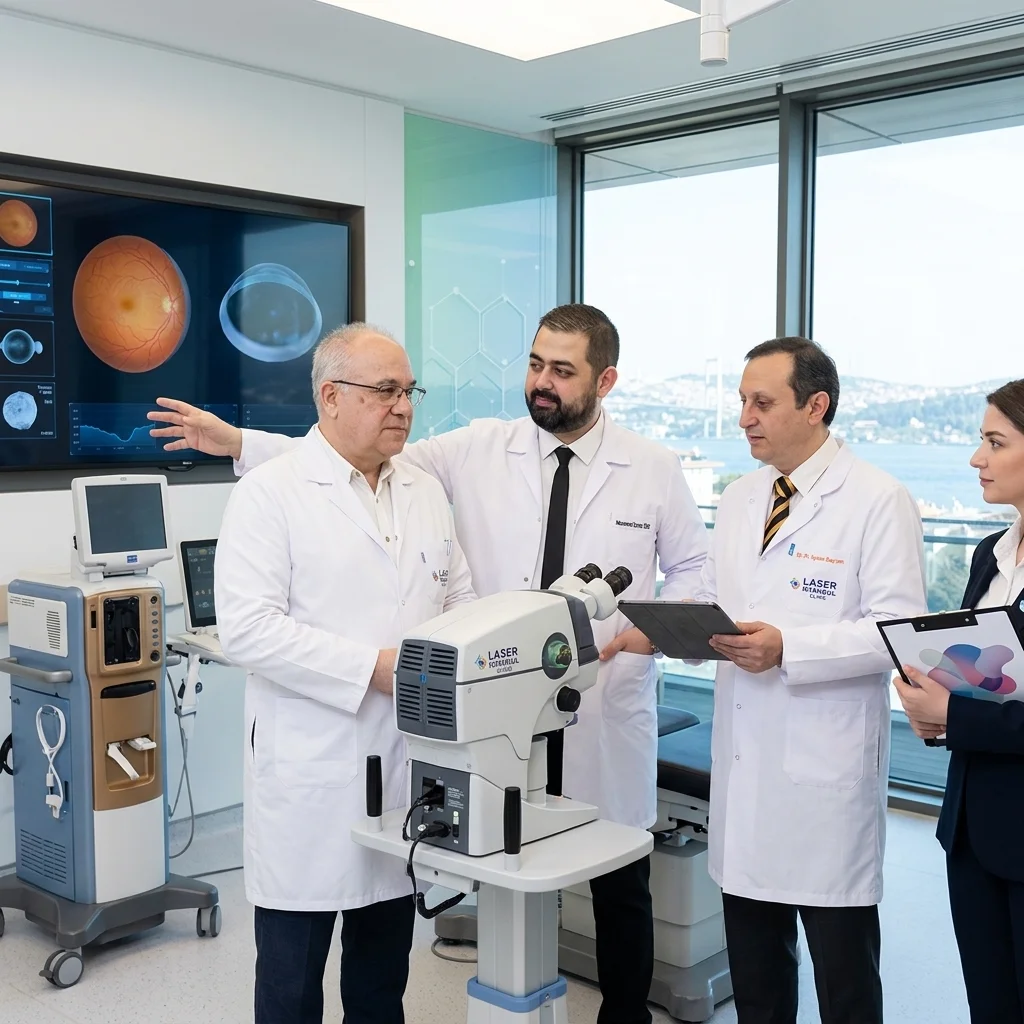
Technology we use: {{confirm the macula lens model offered, e.g. Scharioth macula lens (Medicontur), and the surgeon who implants it}}. Surgery takes place in a fully equipped, Ministry of Health–licensed operating theatre in Istanbul.
Who the Scharioth macula lens suits, and who it does not
You may be a candidate for the Scharioth macula lens if:
- you have reduced near vision in both eyes from late AMD: dry AMD or geographic atrophy, or wet AMD that has been treated and has been stable (inactive) for at least 6 months
- you have already had cataract surgery (an artificial lens in place); the SML is designed as an add-on to that lens
- your vision is reduced but not lost: the European trial included people over 55 with distance vision between 0.4 and 0.1 (decimal, roughly 6/15 to 6/60)
- you pass the pre-test: reading with a strong +6.0 D lens at 15 cm improves your near vision by at least 3 lines compared with ordinary reading glasses at 40 cm. This test predicts how much the implant will help.
- you are motivated to read close up (about 15 cm) and to practise with visual rehabilitation
The SML is usually not suitable if you have: active wet AMD that still needs frequent injections, pseudoexfoliation, a history of uveitis, a complicated earlier cataract operation, or if you cannot attend follow-up checks (the trial's exclusion criteria). If you still have your natural lens, your surgeon will discuss whether cataract surgery is needed first.
Before your examination, send your most recent OCT scans and your injection history if you have wet AMD. Your surgeon will judge from these whether the trip is worthwhile.
Macular degeneration treatment in Istanbul: price and what is included
With Laser Istanbul Clinic, the Scharioth macula lens starts from {{£ price}} per eye. A retina assessment with OCT starts from {{£ price}}, and anti-VEGF injections from {{£ price}} per injection, depending on the medicine. Your surgeon confirms your exact price in writing after reviewing your scans, before you book anything.
| Treatment | Price with Laser Istanbul Clinic |
|---|---|
| Retina assessment with OCT scan (and fluorescein angiogram if needed) | from {{£ price}} |
| Anti-VEGF injection, per eye per injection | from {{£ price}} (depends on the medicine) |
| Scharioth macula lens, one eye | from {{£ price}} |
| Cataract surgery plus macula lens, one eye (if you still have your natural lens) | from {{£ price}} |
Your surgery price includes:
- full pre-operative eye examination and scans with your surgeon, including OCT and the +6.0 D reading pre-test
- surgery by your named surgeon
- medication and eye drops for your recovery
- follow-up checks in Istanbul with the same surgeon
- a personal interpreter, a dedicated coordinator and remote follow-up after you return home
Not included: flights, hotel and airport transfers. Hotel and transfers are a separate charge, and we can arrange them for you if you ask.
Getting a quote takes three steps: send your latest OCT scans, your eye doctor's report and, for wet AMD, a list of injections you have had. Your surgeon replies with suitable options and a written quote within {{response time}}.
Your macular degeneration specialists


Your macula lens journey, step by step
Free online review
Send your OCT scans, eye reports and injection history. A retina surgeon tells you whether the macula lens, injections or neither is likely to help, and sends a written quote.
Book your dates
Plan 5–7 days in Istanbul, as for other lens surgery. We help you choose dates with your surgeon.
Full examination (day 1)
Vision tests for distance and near, the +6.0 D reading pre-test, eye pressure, a dilated retina examination and an OCT scan. If the lens is unlikely to help you, your surgeon tells you and explains the alternatives.
Surgery (day 1 or 2)
Numbing drops are used. The lens is folded and injected through a tiny corneal incision of about 2.2–2.7 mm, then positioned behind the iris. The operation itself takes about 10–15 minutes, and you go back to your hotel the same day.
First check (the next day)
Your surgeon checks the eye, the lens position and the eye pressure.
Reading practice and home
You learn to hold text at about 15 cm with good light. Most patients can fly about 3–7 days after lens surgery, once their surgeon has checked the eye. Your coordinator stays in touch, and your surgeon reviews your progress by video at agreed intervals.
Recovery after the Scharioth macula lens
-
First day
Mild grittiness and blurred vision. Use your drops exactly as prescribed; wear the eye shield when sleeping if advised.
-
Day 1
First check. Near vision often starts to improve within days: in the European trial, average near vision was already 0.42 on day 1 and 0.53 by day 7.
-
First 4 weeks
Steroid and anti-inflammatory drops for about 4 weeks. Do not rub the eye.
-
Week 4 onward
Visual rehabilitation: practising reading at about 15 cm with good lighting. In the trial, all patients had rehabilitation sessions from week 4.
-
Months 1–12
Follow-up checks (the trial used 1, 3, 6 and 12 months), with OCT. Near vision stayed stable to 1 year in the trial.
-
For life
AMD itself continues: keep your regular retina checks and test each eye with an Amsler grid. Report any new distortion or dark patch at once.
Call your coordinator straight away if you have increasing pain, redness, worsening vision or new light sensitivity.
Risks and side effects
The Scharioth macula lens. As with any operation inside the eye, there are small risks such as inflammation, raised eye pressure and infection. In the 50-patient European trial there were no complications during surgery, eye pressure did not change on average, and the macula on OCT stayed unchanged over 1 year; one lens in 50 was removed because of glare and halos. One study found a slight decrease in distance and peripheral vision after implantation. In a 15-patient series, one patient with previously treated wet AMD had the disease become active again 3 months later and needed treatment, which is why regular retina checks continue.
Anti-VEGF injections. The American Academy of Ophthalmology lists infection inside the eye (endophthalmitis), inflammation, raised eye pressure and retinal detachment as the main risks. They are rare: in the MARINA trial, the infection rate was 0.05% per injection. Contact your eye doctor at once if your eye becomes increasingly painful, red or blurred after an injection.
Realistic expectations. Low-vision aids and implants help you use the sight you have; they do not make vision as it was before AMD. The American Academy of Ophthalmology points out that magnifiers and electronic reading aids help people read more effectively, but not as well as before AMD began.
How to prevent macular degeneration, or slow it down
You cannot fully prevent AMD, because age and genes play a large part, but you can lower your risk and slow its progression.
Stop smoking
It is the main risk factor you can change. The American Academy of Ophthalmology notes that after more than 20 years without smoking, the risk of AMD becomes comparable to that of people who never smoked. Passive smoking also raises the risk.
Eat a Mediterranean-style diet
rich in vegetables, leafy greens, fruit, legumes and fish. In pooled European data of more than 4,000 people, close adherence was linked with a 41% lower risk of advanced AMD (AAO).
Keep blood pressure, cholesterol and weight healthy, and stay active
(NHS, NEI).
Take AREDS2 vitamins only if your eye doctor finds intermediate AMD
The formula is vitamin C 500 mg, vitamin E 400 IU, zinc 80 mg, copper 2 mg, lutein 10 mg and zeaxanthin 2 mg (NEI). It slows progression but does not prevent AMD in people who do not have it. The older formula with beta-carotene raised the risk of lung cancer in smokers and former smokers.
Check your eyes
Have regular eye examinations from your 50s, and test each eye at home with an Amsler grid if you have AMD.
Macular degeneration treatment: frequently asked questions
It depends on the type. For wet AMD, anti-VEGF injections are the most effective treatment and should be started quickly. For intermediate dry AMD, AREDS2 vitamins slow progression. For late AMD in both eyes, low-vision aids and, in selected patients, the Scharioth macula lens help with reading. Your retina surgeon recommends one only after an OCT scan.
There is no operation that cures AMD. Surgery can help in two ways: an add-on magnifying implant such as the Scharioth macula lens improves near vision in late AMD, and vitrectomy is sometimes used for a large bleed under the macula, although the evidence for this is limited (AAO). Wet AMD itself is treated with injections, not surgery.
The macula is the central part of the retina, about 5.5 mm across, at the back of the eye. Its function is sharp, detailed, straight-ahead vision and most colour vision: reading, recognising faces and driving all depend on it. Its centre, the fovea, holds the highest density of cone cells.
Straight lines look wavy or bent, and a blurred, grey or dark patch appears in the centre of your vision. Colours can look faded, and seeing in dim light becomes harder. Side vision usually stays normal. Any sudden change like this needs an eye examination within days, not weeks.
There is no treatment that reverses dry AMD. AREDS2 vitamins slow intermediate dry AMD, and two injections that slow geographic atrophy are approved in the US but were not authorised in the EU. For advanced dry AMD in both eyes, low-vision aids and the Scharioth macula lens can make reading easier.
With Laser Istanbul Clinic, the Scharioth macula lens starts from {{£ price}} per eye, including your examination and scans, surgery, medication, follow-up checks, interpreter and coordinator. Hotel and transfers are extra. Your surgeon confirms the exact price in writing after reviewing your OCT scans.
It improves near vision, not distance vision. In the European trial, average near vision more than doubled, from 0.23 to 0.57 (decimal) at 1 year, with text held at about 15 cm. The pre-test with a +6.0 D lens gives a good idea of what you can expect.
Yes. Your surgeon can confirm wet AMD with an OCT scan and give injections in Istanbul. Because injections continue every few weeks or months for a long time, most international patients have their diagnosis and first treatment here and continue with an eye doctor at home, with a full written report. {{Confirm your surgeons' approach to injections for international patients}}
Not completely, but you can lower your risk: stop smoking, eat a Mediterranean-style diet with leafy greens and fish, and keep blood pressure and weight healthy. AREDS2 vitamins help only once intermediate AMD is diagnosed. Regular eye checks catch changes early.
AMD does not cause total blindness, because side vision is kept (NHS). It can, however, make reading, driving and recognising faces very difficult. Fast treatment of wet AMD and low-vision support make a big difference to daily life.
In the published studies, the Scharioth macula lens was implanted in one eye only, usually the better-seeing eye, so the other eye remains for distance vision. Your surgeon will explain what suits your eyes.
Other retina treatments in Istanbul
Macular degeneration is one of several conditions our retina surgeons treat. These treatments are not alternatives to each other; each suits a different problem.
| Anti-VEGF injections | Scharioth macula lens | Argon laser | Vitrectomy | |
|---|---|---|---|---|
| Main use | Wet AMD, diabetic macular oedema, vein occlusion | Near vision in stable late AMD | Retinal tears, diabetic retinopathy | Retinal detachment, macular hole, bleeding inside the eye |
| How often | Repeated, every 4–8 weeks or longer | Once | Usually once or a few sessions | Once |
| Role in AMD | First-line for wet AMD | Reading aid; does not treat AMD | Not used for dry AMD (NICE) | Occasionally for a large bleed under the macula |
Intravitreal injections (anti-VEGF)
Medicine injected into the eye to dry up leaking vessels in wet AMD and diabetic eye disease.
Intravitreal injections (anti-VEGF eye injections)Argon laser
Retinal laser that seals tears and treats diabetic retinopathy. It is not a treatment for dry AMD.
Argon laser (retinal laser photocoagulation)Vitrectomy
Keyhole surgery that removes the vitreous gel to repair the retina or clear bleeding.
Vitrectomy in IstanbulRetinal detachment surgery
An emergency operation to reattach the retina. Sudden flashes, new floaters or a shadow in your vision need same-day care.
Retinal detachment surgerySources for the facts on this page
- NHS, Age-related macular degeneration (AMD): affects the middle of vision, usually first in people in their 50s, does not cause total blindness, can worsen gradually then quickly; risk factors (ageing, smoking, high blood pressure, overweight, family history). https://www.nhs.uk/conditions/age-related-macular-degeneration-amd/ and treatment page https://www.nhs.uk/conditions/age-related-macular-degeneration-amd/treatment/ (no treatment for dry AMD; anti-VEGF and light treatment for wet AMD). Opened 6 Oct 2026.
- US National Eye Institute, Age-Related Macular Degeneration: macula definition, dry vs wet, stages, late-AMD symptoms (wavy lines, central blur, faded colours, low light), risk factors, prevention, no treatment for late dry AMD besides rehabilitation. https://www.nei.nih.gov/learn-about-eye-health/eye-conditions-and-diseases/age-related-macular-degeneration
- NEI, AREDS 2 supplements for AMD: formula and doses; for intermediate AMD; no beta-carotene (lung-cancer risk in smokers/former smokers); cannot prevent AMD. https://www.nei.nih.gov/eye-health-information/eye-conditions-and-diseases/age-related-macular-degeneration/nutritional-supplements-age-related-macular-degeneration
- NEI, About AREDS and AREDS2: AREDS formula reduced progression from intermediate to advanced AMD by about 25%; supplements do not prevent AMD onset. https://www.nei.nih.gov/research/clinical-trials/age-related-eye-disease-studies-aredsareds2/about-areds-and-areds2
- American Academy of Ophthalmology, Age-Related Macular Degeneration Preferred Practice Pattern (approved 13 Sept 2024): smoking as the primary modifiable risk factor; risk comparable to non-smokers after >20 years without smoking; passive smoking; Mediterranean diet and 41% lower risk of advanced AMD (EYE-RISK); no evidence-based treatment for early AMD; anti-VEGF first-line; regimens every 4 or 8 weeks, PRN, treat-and-extend; MARINA outcomes (33% gained / 10% lost ≥15 letters vs 4% / 47% untreated); endophthalmitis 0.05% per injection in MARINA; Amsler/monocular self-monitoring; vision rehabilitation and realistic expectations; vitrectomy/tPA for large submacular haemorrhage with inadequate data. https://www.aao.org/Assets/f832e5ac-c047-4d1c-bdab-c5e52173623d/638760137410500000/age-related-macular-degeneration-ppp-pdf
- EyeWiki (AAO), Age-Related Macular Degeneration: dry 85–90% / wet 10–15% but most severe vision loss; current smokers twice as likely to have AMD-related vision loss; symptoms (metamorphopsia, micropsia, scotoma); OCT and fluorescein angiography; anti-VEGF agents; faricimab with 3-month-plus intervals; pegcetacoplan and avacincaptad pegol results. https://eyewiki.org/Age-Related_Macular_Degeneration
- NICE guideline NG82, Age-related macular degeneration (2018): risk factors; urgent referral for suspected wet AMD normally within 1 working day; OCT; no clinically significant difference between aflibercept, bevacizumab and ranibizumab; no PDT alone or as first-line adjunct; no thermal laser for drusen; Charles Bonnet syndrome information. https://www.nice.org.uk/guidance/ng82/chapter/Recommendations
- US FDA, Drug Trials Snapshots: IZERVAY (avacincaptad pegol): approved 4 Aug 2023 for geographic atrophy; monthly injections; slows lesion growth at 12 months. https://www.fda.gov/drugs/drug-trials-snapshots/drug-trials-snapshots-izervay
- European Medicines Agency, Syfovre: refusal of marketing authorisation (final opinion after re-examination, 19 Sept 2024). https://www.ema.europa.eu/en/medicines/human/EPAR/syfovre and CHMP highlights https://www.ema.europa.eu/en/news/meeting-highlights-committee-medicinal-products-human-use-chmp-16-19-september-2024
- Wong WL, Su X, Li X, et al. Global prevalence of age-related macular degeneration and disease burden projection for 2020 and 2040. Lancet Glob Health 2014 (PMID 25104651): 196 million in 2020, 288 million in 2040. https://pubmed.ncbi.nlm.nih.gov/25104651/
- Koksaldi S, Kayabasi M, Karti O, Saatci AO. Clinical anatomy of the macula. Med Hypothesis Discov Innov Ophthalmol 2025 (PMID 40787281): macula ~5.5 mm, fovea ~1.5 mm, foveola ~0.35 mm; lutein and zeaxanthin. https://pmc.ncbi.nlm.nih.gov/articles/PMC12330045/
- Srinivasan S, Scharioth G, Riehl A, et al. Implantation of Scharioth macula lens in patients with age-related macular degeneration: results of a prospective European multicentre clinical trial. BMJ Open Ophthalmol 2019 (PMID 31355343): 50 eyes; inclusion (age >55, CDVA 0.4–0.1, ≥3-line gain with +6.0 D at 15 cm; dry or treated stable wet AMD ≥6 months); exclusions (pseudoexfoliation, uveitis, complicated cataract surgery); lens design (+10 D central 1.5 mm, 6 mm optic, ~2.2× magnification); 2.2 mm incision; 4 weeks of drops; CNVA 0.23 → 0.57 at 1 year (0.42 day 1, 0.53 day 7); CDVA unchanged; IOP and OCT unchanged; 1 explant for glare/halos; rehabilitation from week 4. https://pmc.ncbi.nlm.nih.gov/articles/PMC6615881/
- Scharioth GB. New add-on intraocular lens for patients with age-related macular degeneration. J Cataract Refract Surg 2015 (PMID 26432110): 8 patients; near vision improved in 7, by 4.4 lines vs glasses at 40 cm; no complications. https://pubmed.ncbi.nlm.nih.gov/26432110/
- Bereczki Á. Experiences with the Scharioth Macula Lens – new hope for patients with dry macular degeneration. Rom J Ophthalmol 2019 (PMID 31334390): 15 patients; implanted any time after cataract surgery; 10–15-minute outpatient operation; removable; one case of reactivated wet AMD at 3 months. https://pmc.ncbi.nlm.nih.gov/articles/PMC6626938/
- Nekolova J, Kremlacek J, Lukavsky J, et al. The intraocular implant and visual rehabilitation improve the quality of life of elderly patients with geographic atrophy secondary to AMD. Graefes Arch Clin Exp Ophthalmol 2023 (PMID 35982247): 20 patients, mean age 81; near vision 1.321 → 0.547 logMAR at 6 months; NEI VFQ-25 improvement. https://pmc.ncbi.nlm.nih.gov/articles/PMC9388354/
- Kremláček J, Nekolová J, Středová M, et al. Vision before and after Scharioth macular lens implantation in patients with AMD: an electrophysiological study. Doc Ophthalmol 2021 (PMID 33392893): 14 patients; near vision improved; slight decrease in distance and peripheral vision. https://pmc.ncbi.nlm.nih.gov/articles/PMC8266777/
Find out if the macula lens or another treatment can help you, free
Send us your latest OCT scans and eye reports. Doç. Dr. Özer or Op. Dr. Bayram will tell you whether injections, the Scharioth macula lens or another option could help your vision, and what it would cost, with no obligation.
3 eye surgeons
Your case is reviewed by a named surgeon, not a salesperson. Reply within {{response time}}.
 Prof. Dr. Ahmet Satıcı
 Doç. Dr. Muhammet Derda Özer
 Op. Dr. Aysan Bayram