
★★★★★ Myrna Marie A., Barbados
I traveled from Barbados to have cataract and lense implants. I couldn't be more pleased with the results. I believe Dr. Satici is the best surgeon in Istanbul …
Source: Google
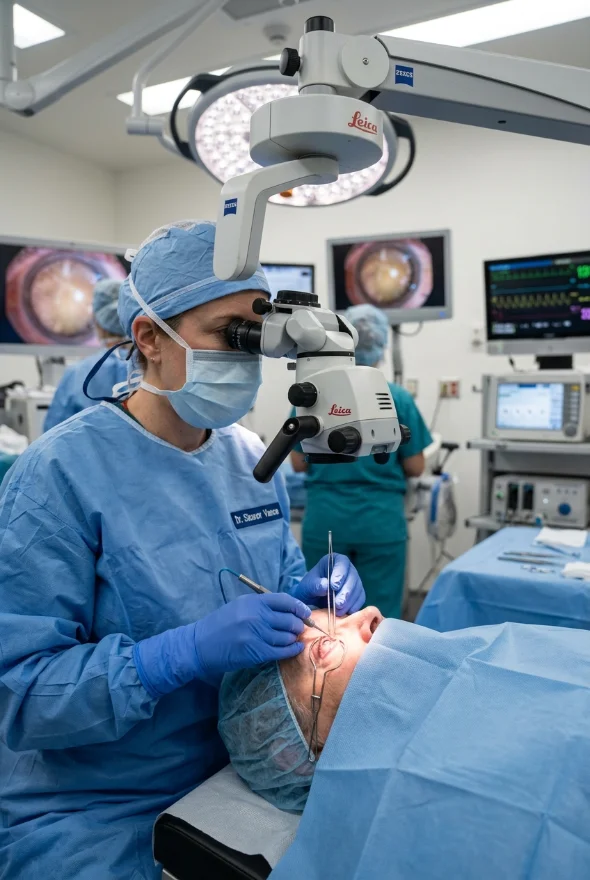
Cataract surgery in Turkey removes your clouded natural lens through a tiny opening, usually with ultrasound (phacoemulsification), and replaces it with a clear artificial lens, typically in 20–45 minutes per eye under local anaesthetic. At Laser Istanbul Clinic, Prof. Dr. Ahmet Satıcı, Doç. Dr. Muhammet Derda Özer or Op. Dr. Aysan Bayram operates in Istanbul from {{£ cataract package price}} per eye, with most patients staying 5–7 days.
A cataract is a clouding of the lens inside your eye, the small clear disc behind the coloured iris that focuses light onto the retina. As the proteins in the lens break down, the lens turns hazy, yellowish or brownish, and things look blurred, dim or washed out. Cataracts in the eyes are extremely common with age: according to the US National Eye Institute (NEI), by age 80 most people either have cataracts or have already had cataract surgery. Worldwide, the World Health Organization (WHO) estimated in February 2026 that 94 million people have impaired vision or blindness because of a cataract that has not been treated.
Cataracts usually develop slowly, often in both eyes but not always at the same pace. The NHS lists the typical symptoms:
You are more likely to develop a cataract if you are over 60, are a woman, smoke, have diabetes or high blood pressure, are very short-sighted, have had an eye injury, eye surgery or uveitis, have taken steroid medicines for a long time, or have spent years in strong sunlight without eye protection (NHS).
Surgery is the only treatment that removes a cataract. The NHS and the NEI both say this plainly. In the early stages, stronger glasses and brighter light for reading can help for a while, and the NHS notes that cataracts do not usually need treating straight away. Over time, though, a cataract gets worse, and without treatment it eventually causes sight loss. Cataract surgery is one of the most common operations in the world (AAO), and the WHO describes it as one of the most cost-effective of all health-care interventions. According to the NEI, 9 out of 10 people who have it see better afterwards.
There is no fixed point at which a cataract becomes "ripe" for surgery. In England, the National Institute for Health and Care Excellence (NICE) tells doctors not to restrict cataract surgery on the basis of a vision score alone. The decision should depend on how the cataract affects your sight and your quality of life, whether one or both eyes are affected, and whether you want the operation. Your surgeon in Istanbul works the same way. Cataract surgery abroad is most often chosen by people who:
Cataract surgery is also often the right answer for people over about 50 who first came to us asking about laser eye surgery: if the natural lens has started to cloud, laser on the cornea does not fix the problem, and replacing the lens does. Laser eye surgery in Turkey / Istanbul →
No cataract yet, but tired of reading glasses? Then the operation you are looking for is lens replacement (refractive lens exchange), the same surgery done for vision correction rather than for a cataract. Lens replacement (RLE / smart lens) in Turkey →
Waits vary widely between hospitals. At the end of July 2026, 620,931 people in England were waiting to start NHS eye (ophthalmology) treatment, according to NHS England's referral-to-treatment statistics, and only 72.9% of them had been waiting less than 18 weeks, against an NHS standard of 92%. These figures cover all NHS eye treatment, of which cataract surgery is the largest part: the Royal College of Ophthalmologists (RCOphth) audit counted about 681,400 publicly funded cataract operations in England in one year (April 2023 to March 2024). Ask your GP, optometrist or hospital how long your own wait is likely to be before you decide to travel; if your local wait is short and a standard lens suits you, NHS surgery may well be the right choice.
The NHS also uses a standard monofocal lens, and NICE advises the NHS not to offer multifocal lenses for cataract surgery. If you want a multifocal or trifocal lens in the UK, you usually pay for the whole operation privately.
Often yes, as long as you still meet the legal eyesight standard for driving. In the UK, that means reading a number plate from 20 metres and having a visual acuity of at least 6/12 with both eyes open (glasses allowed), according to GOV.UK. The DVLA's medical guidance says drivers with cataracts are often safe to drive and may not need to tell the DVLA, but warns that glare can stop you passing the number plate test even when the letters on a chart look fine. If you no longer meet the standard, you must stop driving and tell the DVLA. After surgery, the NHS advises not to drive until your vision is back to normal; your surgeon tells you when you meet the standard again. Other countries have their own driving rules, so check with your local licensing authority.
Most cataracts are straightforward to remove, but some eyes need a surgeon with specific experience, and we match your case to the right one of our three surgeons:
Every cataract operation has two parts: removing the cloudy lens and choosing the new lens that replaces it. The first decides how the surgery is done; the second decides how you see afterwards.
Phacoemulsification ("phaco") is the standard way of removing a cataract today. Introduced by Dr Charles Kelman in 1967, it has been used for about 97% of cataract operations in the US since 2000. The NHS describes the steps:
You are awake but should feel no pain. You may see light, shade and movement, but not the details of the operation. When people search for "cataract operation phaco" or "phacoemulsification for cataracts", this is the operation they mean: it is the method our surgeons use for cataract surgery in Istanbul.
In femtosecond laser-assisted cataract surgery, the eye is first mapped and a computer-guided laser makes some of the openings with a programmed position and depth; the surgeon then removes the lens with the phaco probe as usual. It sounds more advanced, but the evidence does not show it is better. The American Academy of Ophthalmology (AAO) wrote in June 2026 that studies have found neither fewer complications nor better outcomes with laser surgery, and that the result depends largely on the skill and experience of your surgeon. NICE recommends that the NHS uses it only within clinical trials. {{FLACS availability: if the surgeons offer it, add one sentence here on when they recommend it; if not, delete this placeholder.}}
| Phacoemulsification (standard) | Laser-assisted (FLACS) | |
|---|---|---|
| How the lens is removed | Surgeon makes the openings by hand; ultrasound breaks up the lens | Laser makes some of the openings; ultrasound then removes the lens |
| Evidence on results | The proven standard, used for the large majority of operations worldwide | Studies show no fewer complications and no better outcomes than standard phaco (AAO, 2026) |
| Recovery | Some see clearly at once, others within 1–2 weeks; full recovery in about 3 months (AAO) | The same as standard phaco |
| Anaesthetic | Local: drops, with or without an injection; you stay awake | Local |
| Price | Included in your cataract price | {{£ FLACS supplement, or "not offered"}} |
Sources: NHS; AAO, "Traditional vs. laser-assisted cataract surgery" (15 June 2026); NICE NG77. Your surgeon confirms the technique for your eye after your examination.
The lens you choose has the biggest effect on whether you need glasses after cataract surgery. If you are unsure, our lens finder quiz gives you a first idea before you speak to a surgeon. Which lens is right for me? (lens finder quiz) →
| Lens type | What it does | Glasses after surgery | Trade-offs | Price per eye |
|---|---|---|---|---|
| Monofocal (standard) | One sharp focus, usually set for distance | Reading glasses needed for close work | Fewest night-time side effects; the most common lens worldwide and the standard NHS lens | from {{£ cataract package price}} |
| Monofocal, monovision | One eye set for distance, the other for near | Fewer glasses for some tasks | Not everyone adapts; often chosen by people who already used monovision contact lenses | from {{£ cataract package price}} |
| Toric | A lens designed to correct astigmatism as well | Depends on the base lens design | Needs precise measurement of your astigmatism before surgery | from {{£ premium lens price}} |
| EDOF (extended depth of focus) | One corrective zone "extended" to cover distance and middle distance (computer, dashboard) | Often light reading glasses for small print | Less near focus than a trifocal lens; your surgeon explains the trade-off for your eyes | from {{£ premium lens price}} |
| Multifocal / trifocal | Several focus zones for near, middle and far | Many people manage without glasses for most tasks | More likely to cause glare and halos around lights, especially at night; not for every eye | from {{£ premium lens price}} |
Lens descriptions: AAO, "IOL implants: lens replacement after cataracts" (June 2026). Side effects: Cochrane review of 20 trials with 2,230 people (de Silva et al., 2016). Your surgeon recommends a lens only after measuring your eyes. Lens brands and models we use: {{lens brands and models offered}}.
What the evidence says about premium lenses: a Cochrane review of 20 randomised trials found that people given multifocal lenses were less likely to need glasses than people given monofocal lenses, but more likely to notice glare and halos. The reviewers concluded that whether the benefit outweighs the side effects varies from person to person, and that how much you want to be free of glasses is likely to be the deciding factor. That is why your surgeon asks about your work, hobbies and night driving before recommending a lens. If you have another eye condition, such as macular disease, glaucoma or an irregular cornea, your surgeon may advise a different lens type.
Cataract surgery in Istanbul with Laser Istanbul Clinic starts from {{£ cataract package price}} per eye with a monofocal lens, and from {{£ premium lens price}} per eye with a premium (toric, EDOF or trifocal) lens. Your surgeon confirms your exact price in writing after your free assessment and before you book flights.
Not included: flights, hotel and airport transfers. Hotel and transfers are a separate charge, and we are happy to arrange them for you if you ask.
Typical published prices (2025–26):
| Procedure | UK private | USA | Germany | UAE | Istanbul (typical published) | Laser Istanbul Clinic |
|---|---|---|---|---|---|---|
| Cataract surgery, monofocal lens (per eye) | £2,500–3,500 | $3,500–7,000 | covered by statutory insurance; premium lens extra | $2,860–3,130 | $1,100–2,700 | from {{£ cataract package price}} |
| Trifocal lens surgery (both eyes) | £6,000–11,000 | $11,000–15,000 | €5,800–9,000 | about $8,000–8,700 | $3,400–7,000 | from {{£ premium lens price}} per eye |
Typical ranges published by clinics and price-comparison sites in 2025–26, not quotes. Trifocal figures are published prices for trifocal lens replacement, the same operation with the same lens, and are a close guide to cataract surgery with a trifocal lens. Some published Istanbul prices bundle a hotel and transfers; ours cover your medical treatment, with hotel and transfers charged separately if you want them.
Comparing the middle of published ranges, monofocal cataract surgery in Istanbul costs about 63% less than in UK private clinics and about 71% less than in the US. In the UK, the NHS does not fund premium lenses for cataract surgery, so British patients who want a trifocal lens pay the full private price at home.
What to ask any clinic, at home or abroad: which lens model and power you will receive, whether follow-up visits are included, and what happens if you later need YAG laser for clouding behind the lens (see "Risks"). Our policy: {{YAG laser / PCO treatment policy and the period it covers}}.
All three of our surgeons perform cataract surgery. You know which of them will operate on you before you book, and the same surgeon examines you, operates on you and checks your recovery. If you are searching for the best cataract eye surgeon, look past the word "best" and check four things for any surgeon, here or at home: specialist training and years in practice, published research, how many cataract operations they perform, and how they handle complications and follow-up. We give you all of this in writing for your surgeon.
Most patients plan 5–7 days in Istanbul for cataract surgery, including the examination, surgery and check-ups. If both eyes are treated in one trip, your surgeon tells you how many nights to book.
Upload your latest eye report, glasses prescription and any scans through our free consultation form or on WhatsApp, and tell us about your general health and medicines. You get a reply within {{response time}}.
The surgeon best suited to your eyes tells you whether cataract surgery is likely to help, which lens options fit, and sends a written quote.
Book your flights; if you like, we arrange your hotel and airport transfer at an extra cost. If you wear contact lenses, you may need to leave them out for a few days before your examination, because they change the shape of the cornea (NHS); your surgeon confirms how long. Bring a list of all your medicines, including blood thinners, so your surgeon can plan around them (NICE).
Check in to your hotel and meet your coordinator by phone or in person.
With your surgeon and interpreter, you have a complete set of tests: vision and glasses check, eye pressure, optical biometry to measure the length of your eye and the curve of your cornea (NICE's recommended method for calculating lens power), and a dilated check of the retina, with OCT scanning of the macula if needed. Your surgeon then explains the recommended lens, the expected result and your personal risks, and you have time to ask questions before you sign the consent form.
Surgery takes place in a fully equipped, Ministry of Health–licensed operating theatre in Istanbul. Under local anaesthetic, the operation itself usually takes 20–45 minutes per eye (NHS). You can normally eat and drink as usual beforehand, because no general anaesthetic is needed (NHS), and you go back to your hotel the same day, but you must not drive.
Your surgeon examines your eye the next day and again before you fly, and only signs you off when the eye is ready.
Most patients can fly about 3–7 days after cataract surgery, once their surgeon has checked the eye. You go home with your full surgical report in English, including the exact lens model and power, your drop schedule and direct contact details for your coordinator. Your surgeon reviews your progress by video at agreed intervals.
Often, yes. The NHS normally operates on each eye on a separate day, while NICE advises surgeons to consider surgery on both eyes on the same day (immediately sequential bilateral cataract surgery) for people at low risk of complications. NICE also lists the downsides to discuss: if both eyes are done together, the lens choice for the second eye cannot be adjusted based on the result in the first, and a complication, though rare, could affect both eyes. Your surgeon recommends same-day surgery, surgery on separate days during one stay, or two trips after examining you. {{Surgeons' usual plan for both eyes and the extra nights needed}}
Most people recover quickly after cataract surgery. According to the AAO, some people see clearly straight away, others within one to two weeks, and full recovery takes about three months.
| When | What usually happens | What to do |
|---|---|---|
| First hours | Vision blurred, mainly from the pupil-widening drops; eye may be covered with a dressing | Rest at your hotel; do not drive |
| Day 1 | First check-up with your surgeon; vision starting to clear | Start your drops exactly as prescribed; wear the plastic shield at night |
| Days 2–7 | The eye may ache or feel gritty for a few days; vision improves over several days; you may feel more tired than usual | Paracetamol or ibuprofen if needed; sunglasses if lights seem bright; fly home once your surgeon signs you off |
| Weeks 1–4 | Eye settling; most daily activities back to normal | Continue drops for about 4 weeks (NHS); no eye rubbing, eye make-up, swimming, heavy lifting or sport until your surgeon says so |
| Up to 3 months | Vision stabilises (AAO) | Get your new glasses prescription when your surgeon or optometrist says the eye has settled; it may differ from your old one |
| Months to years later | Vision can become cloudy again in some people because of posterior capsule opacification (PCO) | See an optometrist; a quick YAG laser treatment clears it |
Sources: NHS "Cataract surgery" (reviewed 2026); AAO (June 2026). Your surgeon gives you personal dates.
Everyday activities after cataract surgery (NHS advice; your surgeon gives you dates for your eye):
| Activity | Typical advice |
|---|---|
| Walking | Fine from the day of surgery; take care on stairs at first |
| Washing and showering | Keep water out of the operated eye |
| Eye make-up | Not until your surgeon says so |
| Swimming | No swimming, even with goggles, until your surgeon says so |
| Heavy lifting and sport | Avoid until your doctor says you can return to them |
| Driving | Not until your vision is back to normal and meets the driving standard |
| Flying | Usually about 3–7 days after surgery, once your surgeon has checked the eye |
Get urgent help if floaters suddenly appear or increase, you see flashes of light, a dark curtain or shadow moves across your vision, or your vision suddenly blurs: these can be signs of a detached retina (NHS). Contact your surgeon or coordinator without delay, too, if your eye becomes increasingly red or painful. If you are already home, go to your nearest eye casualty or emergency department first, then let us know.
Cataract surgery is one of the safest operations in medicine, and the NHS says serious complications are rare. But it is still surgery, so you deserve the real numbers. The best data come from the RCOphth National Ophthalmology Database audit, which in its 2025 report covered 550,519 cataract operations performed in the UK between April 2023 and March 2024.
Complications after surgery (rates within the first weeks to two months; the audit notes these are estimates, because not every centre reports them)
All rates: RCOphth National Ophthalmology Database, 8th Annual Report of the National Cataract Audit (2025), unless stated otherwise. Your personal risk depends on your eyes and general health, and your surgeon goes through it with you, in writing and through your interpreter, before you agree to treatment.
Having surgery abroad: check who your surgeon is, their training and publications, where the operation takes place, which lens you will receive, and how you will be followed up at home. We give you all of this in writing before you pay a deposit. Our policy if a problem needs treatment after you return home: {{complication and re-treatment policy}}.
Typical published prices for monofocal cataract surgery in Istanbul are about $1,100–2,700 per eye, compared with roughly £2,500–3,500 per eye in UK private clinics and $3,500–7,000 in the US. With Laser Istanbul Clinic, cataract surgery starts from {{£ cataract package price}} per eye, including your examination, surgery, medication, check-ups, interpreter and remote follow-up. Premium lenses cost more, and flights, hotel and transfers are extra. Your surgeon confirms the price in writing after your free assessment.
Cataract surgery is one of the safest operations in medicine wherever it is done well, and your safety depends mostly on your surgeon, the operating theatre and the follow-up. With us, you know your surgeon's name, training and publications before you book, surgery takes place in a fully equipped, Ministry of Health–licensed operating theatre in Istanbul, and you receive a full report in English to take home. For reference, the UK national audit recorded a capsule tear in 0.69% of operations and a good result in 96.4% of otherwise healthy eyes.
Yes, as long as your eyesight still meets the legal driving standard. In the UK, that means reading a number plate from 20 metres and seeing at least 6/12 with both eyes; glare from a cataract can make you fail even when your vision seems fine. If you no longer meet the standard, you must stop driving and tell the DVLA. After surgery, do not drive until your surgeon confirms your vision is back to the standard.
It depends on your hospital. At the end of July 2026, 620,931 people in England were waiting for NHS eye treatment, and 72.9% had waited under 18 weeks, against a 92% standard. Ask your hospital or GP for your expected wait; some areas are much faster than others.
Phacoemulsification ("phaco") is the standard method of cataract surgery. Your surgeon uses ultrasound to break up the cloudy lens through a tiny opening, removes it by suction and puts a clear artificial lens in its place. It has been refined since 1967 and is used for the large majority of cataract operations today.
No, the operation itself should not hurt, because your eye is numbed with drops, an injection or both (NHS). You stay awake and may see light and movement. Afterwards, the eye may ache or feel gritty for a few days, and paracetamol or ibuprofen is usually enough.
Sometimes. NICE advises surgeons to consider same-day surgery on both eyes for people at low risk of complications, while the NHS usually treats each eye on a separate day. With us, your surgeon decides after your examination whether both eyes are done on the same day, on separate days during one stay, or on two trips.
Plan for 5–7 days, including your examination, surgery and check-ups. Most patients can fly about 3–7 days after cataract surgery, once their surgeon has checked the eye. Your surgeon confirms the number of nights after reviewing your case.
With a standard monofocal lens, most people see well in the distance but need reading glasses for close work. Trifocal and EDOF lenses reduce the need for glasses, and toric lenses correct astigmatism, but they are not suitable for every eye. Your new prescription may differ from your old one, so wait until your eye has settled before buying new glasses.
No. Once the natural lens is removed, the cataract cannot return. Some people later notice cloudy vision again because the capsule behind the new lens becomes hazy (posterior capsule opacification). A short YAG laser treatment clears it.
There is no official ranking, so check the facts for any surgeon: specialist training, years in practice, published research, cataract experience and how follow-up works when you are back home. At Laser Istanbul Clinic, cataract surgery is performed by Prof. Dr. Ahmet Satıcı (specialist since 1992, 21 PubMed papers), Doç. Dr. Muhammet Derda Özer (Associate Professor, 27 PubMed papers) or Op. Dr. Aysan Bayram (specialist since 1999). The right one depends on your eyes.
Not according to current evidence. The AAO reported in 2026 that studies have found neither fewer complications nor better outcomes with laser-assisted cataract surgery, and NICE recommends that the NHS uses it only in clinical trials. Your surgeon's skill and the lens you choose matter more than the technique.
I traveled from Barbados to have cataract and lense implants. I couldn't be more pleased with the results. I believe Dr. Satici is the best surgeon in Istanbul …
Source: Google
I am very pleased to meet a very honest and human Prof.dr Ahmet Satıcı. As a patient he succeed to comfort me all the way, as a follow up. He did my Cataract operation very successfully. I came from Canada to do it with a very professional team
Source: Google
Amazing, kind and approachable eye specialist. Having my cataracts removed shall massively improve my quality of life. Thank you once again, Doç. Dr. Muhammet Derda Özer! Highly recommended.
Source: WUPDoc
Send us your latest eye report, glasses prescription or scans. Prof. Dr. Ahmet Satıcı, Doç. Dr. Muhammet Derda Özer or Op. Dr. Aysan Bayram will tell you whether cataract surgery is likely to help, which lens may suit you and what it would cost, with no obligation.
Your case is reviewed by a named surgeon, not a salesperson. Reply within {{response time}}.
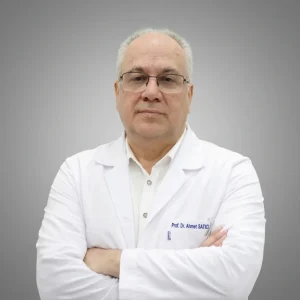
 Prof. Dr. Ahmet Satıcı
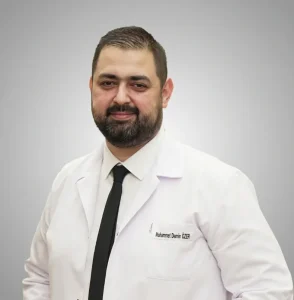
 Doç. Dr. Muhammet Derda Özer
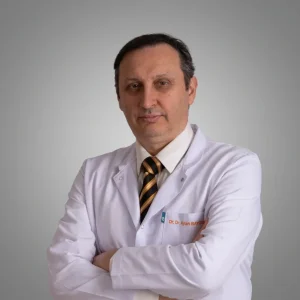
 Op. Dr. Aysan Bayram