
- Home
- Knowledge centre
- Eyelid & cosmetic guides
- Best Eye Cream for Dark Circles and Puffy Under-Eyes: Causes and What Really Works
Best Eye Cream for Dark Circles and Puffy Under-Eyes: Causes and What Really Works
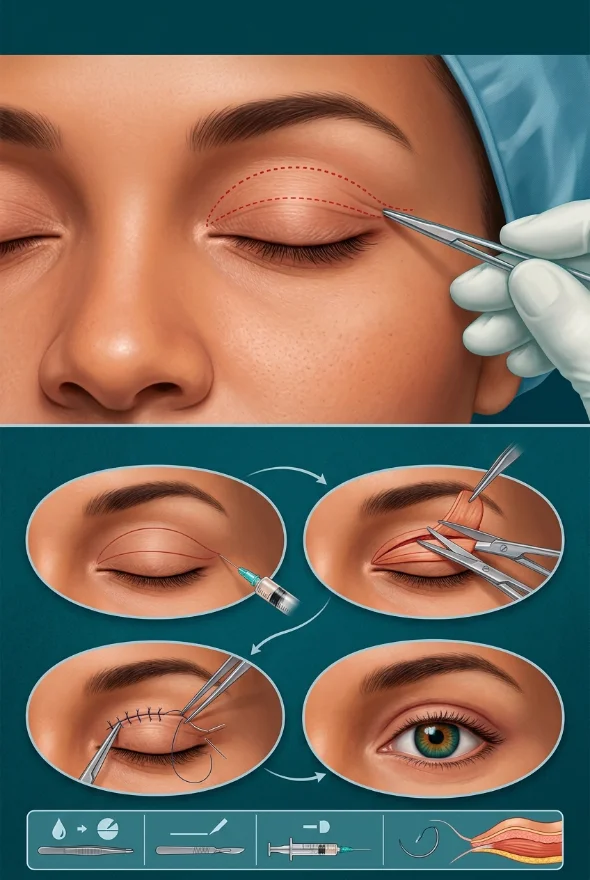
The best eye cream for dark circles is the one that matches the cause, and creams only work on some causes. Sunscreen, vitamin C, retinoids and caffeine can modestly lighten pigment or reduce visible blood vessels, but no cream fills a hollow or removes a fat bag. Doctors sort dark circles into pigment, blood vessels, shadow from hollowing, or a mix. Prof. Dr. Ahmet Satıcı assesses persistent bags and hollows and operates on them when surgery is the right answer.
What causes dark circles under the eyes?
Dark circles have more than one cause, which is why a single cream rarely fixes them. Dermatology reviews (Sarkar et al., 2016; Park et al., 2018) sort dark circles under the eyes by what is actually producing the darkness:
| Type | What you see | What is behind it | Treatments studied |
|---|---|---|---|
| Pigmented | Brown or grey-brown | Extra melanin, often inherited; also after eczema, allergy, rubbing or sun; some medicines | Sunscreen, lightening ingredients, peels, certain lasers |
| Vascular | Blue, pink or purple | Blood vessels showing through very thin skin; fluid in the lid | Caffeine, vitamin K or vitamin C products (limited evidence); vascular lasers |
| Structural | A shadow, with normal skin colour | A tear-trough hollow, bulging fat or loose skin casting shade | Hyaluronic acid filler, fat transfer, lower blepharoplasty |
| Mixed | A bit of each | Two or more of the above | A combination, in the order your doctor chooses |
Three facts help explain why this area is so prone to looking dark:
- The skin is extremely thin. The lower eyelid is one of the thinnest areas of skin in the body, so the vessels and muscle beneath it show through.
- It runs in families. In a 2015 study of 495 women in Brazil (Matsui et al.), 71.9% reported a family history of dark circles, and melanin was the dominant factor in how dark they looked. A study of 200 patients in India (Sheth et al., 2014) found a family history in 63%.
- It starts early. In the Brazilian study, women first noticed dark circles at 24 on average, and the earlier they started, the more severe they tended to be.
Other causes include allergic eczema and contact dermatitis (the inflammation and rubbing leave pigment behind), sun exposure, ageing (the tear trough deepens as fat and bone volume are lost) and some glaucoma drops. Prostaglandin drops such as bimatoprost can darken the skin around the eye, and the change is reversible when the drops are stopped. Never stop glaucoma drops without asking your eye doctor.
Do lack of sleep and iron deficiency cause dark circles?
Lack of sleep can make dark circles look worse for a day, but the evidence does not make it the main cause of long-term ones. In a Swedish experiment (Sundelin et al., Sleep, 2013), 10 people were photographed after a normal night and after 31 hours awake following a night of 5 hours' sleep; 40 observers rated the tired faces as having darker circles under the eyes and more swollen eyes. A larger 2019 trial of 181 people (Holding et al.) found that periorbital darkness predicted how tired a face looked, but did not differ significantly between the sleep-deprived and rested groups. In the Brazilian study above, no sleep habit was linked to how severe the dark circles were.
What deficiency causes dark circles?
No single vitamin or mineral has been proven to cause dark circles. The deficiency most often reported alongside them is iron. In a descriptive study of 200 patients with dark circles in India (Sheth et al., 2014), half had iron deficiency anaemia, and many said their dark circles improved once the anaemia was corrected. The authors suggested that poor oxygen delivery or facial pallor might be the mechanism. The study had no control group, so it shows an association, not that anaemia causes dark circles.
The NHS lists tiredness and paler-than-usual skin among the symptoms of iron deficiency anaemia. If you also feel tired, breathless or notice palpitations, see your GP for a blood test (a full blood count) rather than buying iron supplements on a guess: the NHS says iron deficiency has causes, such as heavy periods or bleeding in the gut, that need to be found.
Why are my under-eyes puffy?
Puffy under-eyes come from fat, fluid or both. According to the American Academy of Ophthalmology (AAO), the tissues around the eye weaken with age, which lets the fat that cushions the eyeball move forward into the lower lids, and fluid can pool in the same area. Doctors call a bulge of lower-lid fat steatoblepharon; each lower lid has three fat pads (inner, central and outer). Genes play a part: the AAO notes that eye bags can be inherited.
The two kinds behave differently:
| Fluid puffiness | Fat bags | |
|---|---|---|
| When you notice it | Worse on waking, after salty food or alcohol, with allergies or a short night | Every day, even when well rested |
| Typical cause | Fluid retention, allergy, smoking, poor sleep | Age and inherited tissue weakness |
| Does a cream help? | A little, for a while | No |
| What corrects it | Home measures | Lower blepharoplasty |
The AAO's home measures for puffiness are cool, damp compresses, 7 to 9 hours of sleep, sleeping with your head raised, less fluid and salt in the evening, stopping smoking and treating allergies. A bag that is still there on a rested, low-salt morning is probably fat.
How can you tell pigment, blood vessels and hollows apart?
You can get a rough idea at home, although an examination is what settles it. Try this in front of a mirror:
Look in daylight
Brown or grey-brown suggests pigment; blue or purple suggests blood vessels; skin of normal colour with a shaded groove suggests a hollow.
Gently stretch the lower lid skin sideways
Darkness that stays is more likely pigment; a shadow that flattens out points to shadowing from contour. Doctors use eyelid stretching for exactly this reason.
Change the light
Overhead lighting makes dark circles look worse. Bright light on the skin brings out pigment, while dim ambient light exaggerates the shadow from a hollow.
Look up at the ceiling
Fat bags bulge more when you look up.
Note the timing
Morning-only puffiness points to fluid; all-day puffiness points to fat.
If the darkness is mostly a shadow or a bag, a cream will not remove it, and you can save the money.
What is the best eye cream for dark circles?
The best eye cream for dark circles contains an ingredient that targets your type, and you should expect gradual, modest change. There is a lot of research on ingredients, but little of it is strong. A 2021 systematic review of 39 studies found limited high-quality evidence and called for more randomised trials, and a 2018 review noted that, despite the many products on sale, there are no evidence-based studies to support their use. This is what individual studies and reviews report:
| Ingredient | What studies report | Limits |
|---|---|---|
| Daily sunscreen | Sun protection is described as a cornerstone of treatment (Roberts, 2014), and sunscreen alone can improve pigment (Sarkar et al., 2016). | Prevents darkening rather than reversing deep pigment |
| Vitamin C | In a 14-person split-face study over 6 months, a sodium ascorbate lotion reduced redness and the dermis tended to thicken; a second vitamin C form showed no significant change (Ohshima et al., 2009). | Very small; the form of vitamin C matters |
| Retinoids (retinol, tretinoin) | Promote collagen and reduce melanin content, giving smoother, less discoloured skin (Vrcek et al., 2016). | Can irritate thin eyelid skin; your doctor advises on strength |
| Caffeine | A randomised, double-blind, placebo-controlled study found a caffeine gel reduced swelling and pigment by constricting vessels (reviewed by Vrcek). A small 2015 trial (11 women, 4 weeks) of a caffeine and vitamin K pad reported about 16% less dark-circle intensity. | The second trial was tiny and single-blind |
| Vitamin K with retinol, vitamin C and E | In a 57-person trial over 8 weeks, 47% had less visible blood pooling, but pigment was not clearly removed (Mitsuishi et al., 2004). | Helps the vascular type, not pigment |
| Hydroquinone, kojic acid, azelaic acid, arbutin | Lightening ingredients. Hydroquinone at 2–6% is the most widely prescribed, with effects seen after 5–7 months; higher strengths can worsen pigment, and there are regulatory concerns about it in Europe and Asia, so kojic acid and arbutin are used as alternatives (Sarkar; Vrcek). | Slow; usually directed by a doctor |
| Peptides | Signal peptides stimulate collagen and elastin production (Vrcek). | Little evidence specific to dark circles |
Best eye cream for dark circles UK: what to check
Dermatology reviews put sun protection and ingredients first, not brands, so we do not name products. Whichever eye cream or dark circles cream you consider, check these things:
- Does it match your type? Pigment: sunscreen and lightening ingredients. Blood vessels and puffiness: caffeine, vitamin K or vitamin C. Hollows and bags: no cream will do it.
- How long were the studies behind it? Trials ran from 4 weeks to 6 months, so give any product at least 8 weeks and photograph your eyes in the same daylight to judge it.
- Does it irritate you? Allergic contact dermatitis is a recognised cause of pigmented dark circles, so stop a product that stings, itches or reddens the lids.
- Is it claiming a cure? Claims of permanent removal from a cosmetic cream are not supported by the research above.
Is there a dermatologist-recommended under-eye cream?
No cream has robust trial evidence behind it as the best dark circles removal cream. What dermatology reviews put first is daily sun protection, then an active ingredient matched to your type, after a proper diagnosis. If your dark circles are inherited and brown, a dermatologist can discuss prescription-strength lightening agents (the AAO notes hydroquinone creams and sun avoidance may help lighten pigment); if the problem is a hollow or a bag, you need an eyelid or facial-plastic specialist.
What is the best treatment for dark circles under the eyes?
The best treatment for dark circles depends on the type, and often combines two approaches. The 2021 systematic review found that soft-tissue fillers and fat grafting worked best for volume-related dark circles, surgery addressed skin laxity, topical products and peels helped pigment, and lasers gave mild to moderate benefit for pigment and vascular types. Here is how the dark circles under eyes treatment options line up:
| Type | Options studied | What to know |
|---|---|---|
| Pigmented | Chemical peels, Q-switched lasers (ruby, alexandrite, Nd:YAG), platelet-rich plasma | One study of 3.75% trichloroacetic acid with 15% lactic acid reported over 90% improvement in Fitzpatrick skin types II–IV. Ruby lasers gave over 40% improvement in pigmented circles but suit lighter skin; Nd:YAG is used for darker skin types. Peels carry a higher risk of pigment problems in darker skin. |
| Vascular | Pulsed dye laser, long-pulsed 1,064 nm laser, intense pulsed light | Pulsed dye laser typically needs three or more sessions, 4 to 6 weeks apart. |
| Structural (hollow) | Hyaluronic acid filler, fat transfer | Filler adds volume; it does not treat pigment. |
| Structural (fat bag, loose skin) | Lower blepharoplasty, with fat removal or repositioning | The standard treatment for true bags. |
Does under-eye filler work for dark circles?
Filler works for dark circles caused by a hollow tear trough, and not for pigment alone. In a prospective study of 24 patients (48 tear troughs, average age 34.8) treated with hyaluronic acid by cannula, an average of 0.43 ml per tear trough, 71% were satisfied at 2 weeks and 75% at 4 weeks, and all reported some improvement; 22 of 24 had mild swelling that settled by week 4 (Diwan et al., 2020). Cleveland Clinic notes that filler typically lasts one to two years and that rare accidental injection into a blood vessel can cause vision problems; extreme pain, loss of vision or floaters during an injection are reasons to get urgent help. A 2024 assessment framework (Liew et al.) warns that injecting directly into the tear trough can cause swelling, lumps and a bluish tinge (the Tyndall effect), and that restoring volume in the cheek can reduce those risks.
Can dark circles be removed permanently?
Some can, some cannot. Dark circles caused by a fat bag or a hollow can be corrected with surgery: a review of lower eyelid surgery describes modern techniques that move fat into the tear trough instead of removing it, with postoperative photographs showing stable results at five years or more (Bhattacharjee et al., 2020). Inherited pigment is different. Because it has a genetic basis (Sarkar et al.), it tends to need ongoing sun protection and maintenance, and it can return after peels or lasers. For that reason, no honest source can promise that you can remove dark circles under eyes permanently with a cream, peel or laser.

When is surgery the right answer?
Surgery is the right answer when the main problem is a fat bag, loose skin or a deep tear trough that creates a persistent shadow. In lower blepharoplasty, the surgeon removes or repositions the fat pads through a cut inside the lid or just beneath the lashes, and removes excess skin if needed. A 2025 systematic review of 36 studies (Gimenez et al.) found lower-lid malposition rates of 0–12% and reoperation rates of 0–9% (mostly under 3%), noted no cases of blindness, double vision or inferior oblique injury in the five articles that reported them, and concluded that the operation is generally safe with high patient satisfaction, with the caveat that the studies varied widely in design. Dry eye after eyelid surgery is a recognised complication, so your surgeon checks your tear film first.
Surgery will not help dark circles that are purely pigment, so an honest assessment comes before any operation. At Laser Istanbul Clinic that assessment is by Prof. Dr. Ahmet Satıcı, an ophthalmologist who performs eyelid and oculoplastic surgery. He examines the lids, fat pads, skin and tear film, tells you which of the causes above applies, and says plainly if surgery will not help.
If your upper lids are the main concern, or you are not sure which area is bothering you, read Hooded eyelids: surgery or non-surgical options? and the page on Eyelid surgery (blepharoplasty) in Turkey.
When should you see a doctor about puffy or dark under-eyes?
See a doctor if the change is new, one-sided or comes with other symptoms. Most dark circles are harmless, but some puffiness has a medical cause.
Get same-day medical help for:
- sudden swelling of one eyelid with redness, pain on moving the eye, fever, a bulging eye, double vision or reduced vision. These can signal orbital cellulitis, an infection that needs prompt hospital treatment because untreated it can cause serious and life-threatening complications (EyeWiki, AAO)
Book an appointment if:
- swelling is painful, itchy, red or persistent (the AAO advises seeing an ophthalmologist)
- puffy eyelids come with gritty, dry or bulging eyes, which can be thyroid eye disease. It affects women about five times more often than men, smoking is the best-established risk factor, and double vision or loss of vision needs urgent attention (EyeWiki)
- you feel tired and look pale: ask your GP about a blood test for anaemia
- the darkness appeared suddenly, is spreading, or began after you started a new medicine or eye drop
Frequently asked questions
There is no single best eye cream, because the right one depends on whether your dark circles are pigment, blood vessels or shadow. For pigment, daily sunscreen plus a lightening ingredient is the best-supported approach; for a bluish, puffy look, caffeine or vitamin K may help; for hollows and fat bags, no cream is enough. The evidence for all of them is limited.
It can help modestly, mainly for the pigmented and vascular types, and only with consistent use. Studies of caffeine, vitamin C and vitamin K products ran for 4 weeks to 6 months and reported small improvements in small groups. A cream cannot remove fat or fill a hollow.
Plan for at least 8 weeks, and longer for lightening agents. In published studies, a vitamin K, retinol and vitamin C gel was assessed at 8 weeks and a vitamin C lotion over 6 months, and hydroquinone shows effects after 5 to 7 months. Photograph your eyes in the same daylight each month to judge progress.
Iron deficiency anaemia is the one most often reported alongside dark circles: half of 200 patients in one Indian study had it. That study had no control group, so it does not prove cause. If you are tired and pale, ask your GP for a blood test rather than starting iron on your own.
Often, yes. In one study of 495 women, 71.9% reported a family history, and in another study of 200 patients 63% did. Inherited dark circles are often first noticed in the early twenties and are the hardest to clear for good.
Only structural causes can be corrected long term, with filler, fat transfer or lower blepharoplasty. Pigmented circles can be lightened but tend to return without sun protection and maintenance. A doctor should identify your type first.
Usually fluid. It collects in the loose tissue of the lids overnight and is worse after salty food, alcohol, allergies or poor sleep. Cool compresses, a raised pillow and less salt in the evening help; bags that remain all day are usually fat.
It fixes the shadow from a hollow tear trough, not brown pigment. In one study of 24 patients, 75% were satisfied at 4 weeks. Filler typically lasts one to two years and carries rare serious risks, including injection into a blood vessel.
When the dark look comes from a fat bag and the hollow beneath it, lower blepharoplasty with fat repositioning can treat both. If you also have pigment, you may need a separate treatment. Prof. Dr. Satıcı examines you and tells you what to expect.
Not sure whether your under-eye bags are fat, fluid or pigment?
Send us three daylight photos (front, left and right, no make-up). Prof. Dr. Ahmet Satıcı reviews them, tells you which cause he sees, and says whether surgery is likely to help or whether skincare or another treatment would serve you better. If surgery is the answer, it takes place in a fully equipped, Ministry of Health–licensed operating theatre in Istanbul.
Sources for the facts on this page
- Vrcek I, Ozgur O, Nakra T. Infraorbital Dark Circles: A Review of the Pathogenesis, Evaluation and Treatment. Journal of Cutaneous and Aesthetic Surgery 2016. https://pmc.ncbi.nlm.nih.gov/articles/PMC4924417/
- Sarkar R, Ranjan R, Garg S, Garg VK, Sonthalia S, Bansal S. Periorbital Hyperpigmentation: A Comprehensive Review. Journal of Clinical and Aesthetic Dermatology 2016. https://pmc.ncbi.nlm.nih.gov/articles/PMC4756872/
- Park KY, Kwon HJ, Youn CS, Seo SJ, Kim MN. Treatments of Infra-Orbital Dark Circles by Various Etiologies. Annals of Dermatology 2018. https://pmc.ncbi.nlm.nih.gov/articles/PMC7992473/
- Michelle L, Pouldar Foulad D, Ekelem C, Saedi N, Mesinkovska NA. Treatments of Periorbital Hyperpigmentation: A Systematic Review. Dermatologic Surgery 2021 (PMID 32740208, abstract). https://pubmed.ncbi.nlm.nih.gov/32740208/
- Matsui MS, Schalka S, Vanderover G, et al. Physiological and lifestyle factors contributing to risk and severity of periorbital dark circles in the Brazilian population. Anais Brasileiros de Dermatologia 2015. https://pmc.ncbi.nlm.nih.gov/articles/PMC4560538/
- Sheth PB, Shah HA, Dave JN. Periorbital hyperpigmentation: a study of its prevalence, common causative factors and its association with personal habits and other disorders. Indian Journal of Dermatology 2014. https://pmc.ncbi.nlm.nih.gov/articles/PMC3969674/
- Sundelin T, Lekander M, Kecklund G, Van Someren EJ, Olsson A, Axelsson J. Cues of fatigue: effects of sleep deprivation on facial appearance. Sleep 2013. https://pmc.ncbi.nlm.nih.gov/articles/PMC3738045/
- Holding BC, Sundelin T, Cairns P, Perrett DI, Axelsson J. The effect of sleep deprivation on objective and subjective measures of facial appearance. Journal of Sleep Research 2019 (PMID 31006920, abstract). https://pubmed.ncbi.nlm.nih.gov/31006920/
- Roberts WE. Periorbital hyperpigmentation: review of etiology, medical evaluation, and aesthetic treatment. Journal of Drugs in Dermatology 2014 (PMID 24719068, abstract). https://pubmed.ncbi.nlm.nih.gov/24719068/
- Ohshima H, Mizukoshi K, Oyobikawa M, et al. Effects of vitamin C on dark circles of the lower eyelids: quantitative evaluation using image analysis and echogram. Skin Research and Technology 2009 (PMID 19626722, abstract). https://pubmed.ncbi.nlm.nih.gov/19626722/
- Mitsuishi T, Shimoda T, Mitsui Y, Kuriyama Y, Kawana S. The effects of topical application of phytonadione, retinol and vitamins C and E on infraorbital dark circles and wrinkles of the lower eyelids. Journal of Cosmetic Dermatology 2004 (PMID 17147559, abstract). https://pubmed.ncbi.nlm.nih.gov/17147559/
- Ahmadraji F, Shatalebi MA. Evaluation of the clinical efficacy and safety of an eye counter pad containing caffeine and vitamin K in emulsified Emu oil base. Advanced Biomedical Research 2015. https://pmc.ncbi.nlm.nih.gov/articles/PMC4300604/
- Bhattacharjee K, et al. Lower eyelid blepharoplasty: An overview. Indian Journal of Ophthalmology 2020. https://pmc.ncbi.nlm.nih.gov/articles/PMC7727946/
- Gimenez AR, Rohrich R, Borab Z, et al. Safety and Complications in Lower Eyelid Blepharoplasty: A Systematic Review. Plastic and Reconstructive Surgery Global Open 2025. https://pmc.ncbi.nlm.nih.gov/articles/PMC12456572/
- Diwan Z, et al. A Prospective Study on Safety, Complications and Satisfaction Analysis for Tear Trough Rejuvenation Using Hyaluronic Acid Dermal Fillers. Plastic and Reconstructive Surgery Global Open 2020. https://pmc.ncbi.nlm.nih.gov/articles/PMC7209844/
- Liew S, et al. Lower Eyelid Dark Circles (Tear Trough and Lid-Cheek Junction): A Stepwise Assessment Framework. Aesthetic Surgery Journal 2024. https://pmc.ncbi.nlm.nih.gov/articles/PMC11177555/
- American Academy of Ophthalmology. How to Get Rid of Bags Under the Eyes. https://www.aao.org/eye-health/tips-prevention/bags-under-eyes
- EyeWiki (AAO). Thyroid Eye Disease. https://eyewiki.org/Thyroid_Eye_Disease
- EyeWiki (AAO). Orbital Cellulitis. https://eyewiki.org/Orbital_Cellulitis
- NHS. Iron deficiency anaemia. https://www.nhs.uk/conditions/iron-deficiency-anaemia/
- Cleveland Clinic. Is Tear Trough Filler Safe? https://health.clevelandclinic.org/is-tear-trough-filler-safe