
- Home: eye surgery in Istanbul
- Free eye tools
- Stereo vision test
Stereo Vision Test: Check Your 3D Depth Perception Online
You will need: red-cyan (anaglyph) paper glasses, a screen at full brightness and about 60 cm of distance. Wear your normal glasses or contact lenses. Ordinary 3D cinema glasses will not work.
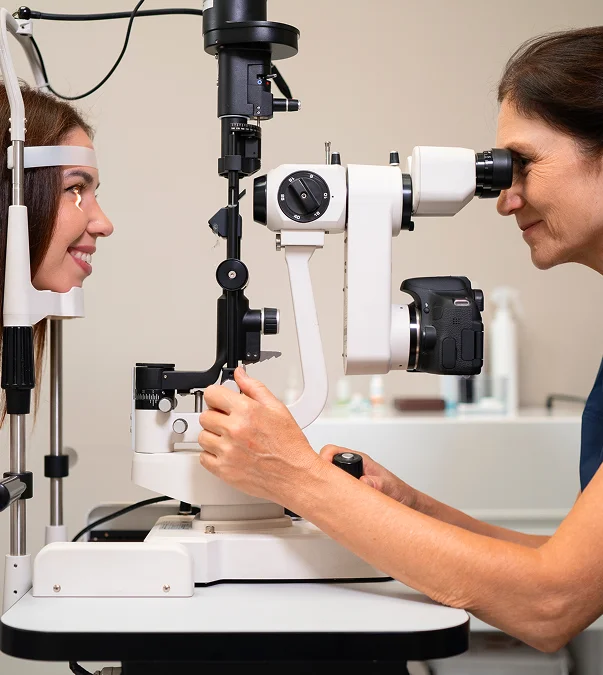
This free stereo vision test checks whether your two eyes work together to give you 3D depth (stereopsis). You view hidden shapes made of random dots through red-cyan glasses and pick the shape you see, from easy to hard. It takes about three minutes and gives an approximate level, not a diagnosis. Prof. Dr. Ahmet Satıcı treats squint, one common cause of reduced stereopsis.
You will need: red-cyan (anaglyph) paper glasses, a screen at full brightness and about 60 cm of distance. Wear your normal glasses or contact lenses. Ordinary 3D cinema glasses will not work.
What your stereo vision test result means
What is stereopsis, and how does it work?
Stereopsis is the brain's ability to see in three dimensions and judge how far away things are, using the small difference between the pictures from your two eyes. The American Academy of Ophthalmology's EyeWiki calls it the highest grade of binocular vision and says it develops in infants at 3 to 6 months of age. Your eyes sit a few centimetres apart, so each sees a slightly different view.
Stereopsis test chart: what the levels mean
Clinics measure stereopsis as stereoacuity, in seconds of arc (″): the smallest depth difference you can detect. A lower number is sharper. This table shows how to read your online stereopsis test results.
| Your level | Meaning |
|---|---|
| 100″ or finer | Good stereopsis on this test |
| 140–200″ | Reduced; worth repeating and checking |
| 400–800″ | Much reduced; book an eye examination |
| No shape seen | No stereopsis seen on this test |
Stereopsis test normal range
There is no single normal figure, because each test has its own limit. In a 2016 study of 206 young adults (average age 22) in Strabismus, the upper limit of normal was 120″ on the TNO test, 70″ on the Preschool Randot, 40″ on the Frisby and 160″ on the Distance Randot. Adults with normal stereopsis on the Preschool Randot averaged about 30 to 40″. A screen cannot match this accuracy, so treat your online level as a rough guide.
Stereopsis example: where you use it
Threading a needle, pouring a drink, catching a ball and judging a step all use stereopsis. You do not need it to function: one-eye cues such as perspective, relative size, shading and movement also give depth.
Stereopsis test fail: why did I not see the shapes?
First rule out the simple causes: glasses back to front, the wrong distance, a dim screen or your usual glasses left off. If you still fail, EyeWiki lists strabismus (squint), amblyopia (lazy eye), a big difference in prescription between the eyes and congenital cataract as conditions that reduce stereopsis. A 2019 review in Ophthalmic and Physiological Optics estimates that about 7% of adults under 60 have no measurable stereopsis ("stereoblindness"). Many never notice, so a failed stereopsis test is a reason to get checked, not to panic.
Stereopsis treatment: can it be improved?
Sometimes. For a squint, the NHS lists glasses, eye exercises, injections and surgery to realign the eyes. In a 2025 study of 132 adults in the Canadian Journal of Ophthalmology, 48% had stereoacuity better than 100″ after strabismus surgery and 21.5% still had none; results were poorest for childhood-onset squint. For lazy eye, the NHS says treatment ideally starts before age 7. In adults, dichoptic (game-based) training has shown mixed results, according to the AAO. No website or app should promise to restore 3D vision.
When to see an eye doctor
Get urgent help today, whatever your result, if you have sudden double vision, sudden loss of vision, a dark curtain across your sight or double vision after a head injury. The NHS says double vision with a severe headache or an enlarged pupil is a 999 emergency. Call your local emergency number (112 in the EU and Türkiye, 999 in the UK, 911 in the US and Canada).
Book an eye examination if your result is band B, C or D, if you have a squint or lazy eye, if your child's eyes turn, or if you get aching, tired eyes or double vision when reading. A squint that starts in adulthood should always be looked at.
This stereo vision test is a screening tool only. It does not diagnose any eye condition, cannot measure stereoacuity the way a clinic test does and does not replace an eye examination by an optometrist, orthoptist or ophthalmologist. Your result depends on your screen, glasses, lighting and distance. If you are worried about your eyes, or your vision changes suddenly, see an eye doctor.
Is a squint behind your result?
If your eyes do not line up, your result may reflect a squint. Read about strabismus (squint) surgery for adults and children. Prof. Dr. Ahmet Satıcı examines the eyes, measures the turn and recommends surgery only when glasses or other treatment are not enough. Surgery takes place in a fully equipped, Ministry of Health–licensed operating theatre in Istanbul.
Try the colour blindness test, the astigmatism test, the Amsler grid test for the macula, the eye prescription reader, the visual acuity converter or the eye colour calculator. Or return to all free eye tools.
Stereo vision test: frequently asked questions
It gives a rough level if you use real red-cyan glasses, sit at 60 cm and calibrate the screen, but it is less precise than a clinic test. Use it as a screening check.
It measures stereoacuity: the smallest depth difference, in seconds of arc, that your two eyes together can detect. Clinic tests such as the Titmus, Randot, TNO and Frisby each have their own normal limit.
Not this one, which needs red-cyan glasses. Do not use 3D cinema glasses or a VR headset for this page.
Not necessarily. Check the glasses, distance and lighting, then repeat the test. If you still see nothing, book an eye examination to look for a squint, lazy eye or a difference between the eyes.
No, stereopsis needs two eyes working together, but people with one eye still judge depth using perspective, size, shading and movement.
Sometimes, depending on cause and age: glasses, patching for lazy eye in children, eye exercises or squint surgery. Results in adults vary and nothing is guaranteed.
Straight away for sudden double vision or vision loss. Otherwise, book an examination if your result is band B, C or D, or you have a squint or lazy eye.
Sources for the facts on this page
- Stereopsis definition (3D and distance judgement), highest grade of binocular vision, develops at 3–6 months; red-cyan anaglyph and polarised tests; conditions that reduce stereopsis (strabismus, amblyopia, anisometropia, congenital cataract): EyeWiki (AAO), "Stereopsis and Tests for Stereopsis" https://eyewiki.aao.org/Stereopsis_and_tests_for_stereopsis
- Upper limits of normal (TNO 120″, Preschool Randot 70″, Frisby 40″, Distance Randot 160″; 206 participants, mean age 22): Piano, Tidbury & O'Connor, "Normative values for near and distance clinical tests of stereoacuity", Strabismus 2016, https://livrepository.liverpool.ac.uk/id/eprint/3007093 (DOI 10.1080/09273972.2016.1242636)
- Adult Randot Preschool means of 30–40″: Birch et al., "Randot Preschool Stereoacuity Test: Normative Data and Validity", J AAPOS 2008, https://research-information.bris.ac.uk/en/publications/randotsupsup-preschool-stereoacuity-test-normative-data-and-valid/
- About 7% stereoblindness in adults under 60: Chopin, Bavelier & Levi, Ophthalmic and Physiological Optics 2019, https://doi.org/10.1111/opo.12607 (summary: https://www.ski.org/?p=15507)
- Adult strabismus surgery and stereopsis (132 adults; 48% better than 100″; 21.5% none; childhood-onset poorest): Rock et al., Canadian Journal of Ophthalmology 2025, https://cris.tau.ac.il/en/publications/improvement-of-stereopsis-following-strabismus-surgery-in-adults-/
- Dichoptic training in adults, mixed results: AAO, "Amblyopia: emerging treatments" https://www.aao.org/disease-review/amblyopia-emerging-treatments
- Squint definition, treatment options (glasses, exercises, surgery, injections), see a GP for an adult squint: NHS, "Squint" https://www.nhs.uk/conditions/squint/
- Lazy eye, treatment ideally before age 7: NHS, "Lazy eye" https://www.nhs.uk/conditions/lazy-eye/
- Double vision, emergency and urgent signs: NHS, "Double vision" https://www.nhs.uk/conditions/double-vision/
- One-eye (monocular) depth cues such as perspective, motion parallax, shading, occlusion: "Cue combination for depth perception in macular degeneration: Motion parallax augments disparity", PMC https://pmc.ncbi.nlm.nih.gov/articles/PMC12849822/
- Emergency numbers: European Commission https://digital-strategy.ec.europa.eu/en/policies/112 · Türkiye 112: https://www.112.gov.tr/kilis/acil-durumlarda-tek-numara-112 · UK 999: https://www.nhs.uk/nhs-services/urgent-and-emergency-care-services/when-to-call-999/ · Canada 911: https://parks.canada.ca/voyage-travel/securite-safety/urgence-emergency
- Own calculations (not external facts): disparity formula (arcsec = shift/distance × 206265); pixel pitch needed for 70″ and 40″ at 60 cm; about 1.6% chance of passing a level by guessing (1/4)^3; band cut-offs, which are screening choices for the reviewing surgeon to confirm.
Do your eyes work together?
Send us your result and any eye reports, and Prof. Dr. Ahmet Satıcı will tell you whether a squint assessment is worth doing, with no obligation.
3 eye surgeons
Your case is reviewed by a named surgeon, not a salesperson. Reply within {{response time}}.
 Prof. Dr. Ahmet Satıcı
 Doç. Dr. Muhammet Derda Özer
 Op. Dr. Aysan Bayram