
- Home
- Knowledge centre
- Retina & glaucoma guides
- Stem Cell Therapy for Macular Degeneration and Optic Nerve Damage: Where the Trials Stand in 2026
Stem Cell Therapy for Macular Degeneration and Optic Nerve Damage: Where the Trials Stand in 2026
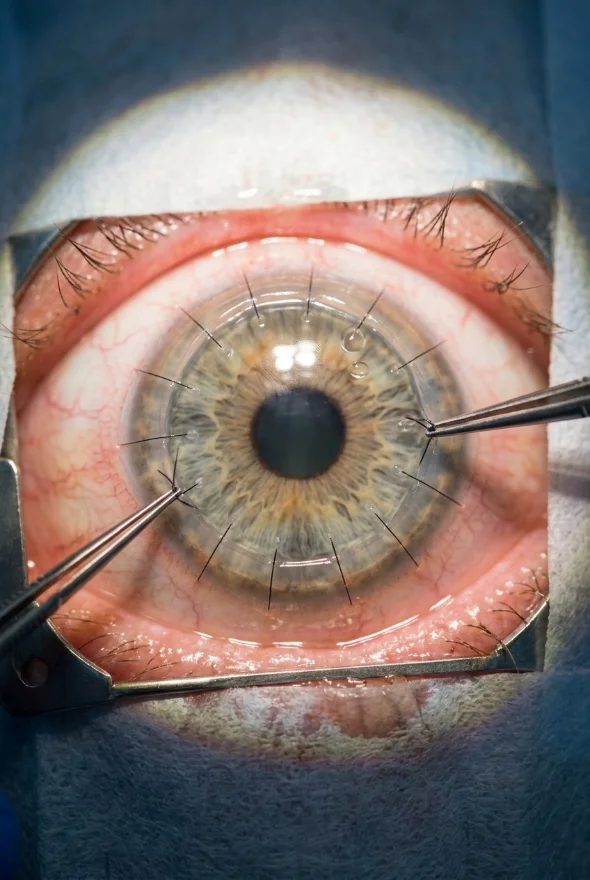
Stem cell therapy for macular degeneration is not an approved treatment in 2026. It is being tested in small early-phase trials that place lab-grown retinal cells under the retina; the surgery looks feasible, but vision benefit is unproven. For optic nerve damage and glaucoma the evidence is thinner still. Our retina surgeons, Doç. Dr. Muhammet Derda Özer (Associate Professor) and Op. Dr. Aysan Bayram, explain the proven options.
Is there an approved stem cell therapy for macular degeneration?
No. The American Academy of Ophthalmology (AAO) states that no stem cell products are approved by the US Food and Drug Administration (FDA) for eye disease, and that anyone who wants stem cell therapy should look for a clinical trial and discuss it with their ophthalmologist. The FDA's own list of approved cell and gene therapies, updated on 17 September 2026, contains two eye products: Luxturna, a gene therapy for one inherited retinal disease, and Encelto, an implant of encapsulated cells that release a nerve-protecting protein, approved in March 2025 for macular telangiectasia type 2. Neither is a stem cell treatment for age-related macular degeneration (AMD).
The NHS position is similar. It says there is currently no treatment for dry AMD, that research into new treatments is ongoing, and that your specialist can tell you about studies you could take part in.
"Stem cell" does not mean the same thing everywhere in eye care. One stem cell treatment for the eye is established: transplantation of limbal stem cells to rebuild a burned or damaged corneal surface. That is a cornea operation, not a retina treatment, and it has its own page (linked at the end of this guide). Everything below concerns the retina and the optic nerve, where stem cell treatment is still experimental.
| Question | Answer in 2026 |
|---|---|
| Is any stem cell product approved for AMD? | No (AAO; FDA list of approved cell and gene therapies, 17 Sep 2026) |
| Is it available outside a clinical trial? | Not as a proven treatment. A clinic offering it for a fee is offering something outside the evidence |
| What is proven for wet AMD? | Anti-VEGF injections into the eye, and in some cases light treatment (NHS) |
| What is available for dry AMD? | The NHS lists no treatment. In the US, two injected drugs for geographic atrophy were approved in 2023; the European Medicines Agency refused one of them in 2024 |
How would stem cell therapy for macular degeneration work?
The idea is to replace the cells that fail first in AMD. Under the macula sits a single layer of cells, the retinal pigment epithelium (RPE), which feeds and cleans the light-sensing photoreceptors above it. In advanced dry AMD (geographic atrophy), RPE cells die in patches, the photoreceptors above them follow, and central vision is lost. If healthy RPE cells could be put back, researchers hope the remaining photoreceptors might survive and work.
Because the cells are delicate, the surgery is demanding. A retina surgeon makes a tiny opening in the retina and places the cells in the subretinal space, either as a liquid suspension or as a thin patch (a single layer of cells grown on an ultra-thin supporting membrane). The cells come from different sources:
- Embryonic stem cells grown into RPE in the laboratory (the London and US patch trials below)
- Induced pluripotent stem cells (iPSCs): adult cells, such as skin cells, reprogrammed into stem cells and then grown into RPE, sometimes from the patient's own cells (the Japanese and US National Eye Institute trials)
- Adult RPE stem cells isolated from donated eyes and grown into RPE cells (a US trial reported in 2025)
This is why the treatment is closer to a retina transplant than to an injection, and why it carries the risks of retina surgery, discussed below. For how retina operations work in general, see our guide to retina surgery: vitrectomy and retinal detachment.
What do the clinical trials of stem cell therapy for macular degeneration show?
Published results are encouraging on safety and feasibility, but they cannot yet show that the treatment restores vision. The table lists the main published studies and the registered trials that are still running, using registry records as they stood on 7 October 2026.
| Trial | Cells and condition | Size and result so far | Status |
|---|---|---|---|
| London phase 1 (published 2018) | Embryonic stem cell RPE patch on a synthetic membrane; severe wet AMD | 2 patients. Vision gains of 29 and 21 letters at 12 months; only local immunosuppression used long term | Published; the authors conclude it supports feasibility and safety |
| Japan, first iPSC patient (published 2017; 4-year follow-up 2019) | Patient's own skin cells turned into an RPE sheet; wet AMD | 1 patient. At 1 year the sheet was intact and vision had neither improved nor worsened; macular swelling was present. At 4 years the sheet had survived and vision was stable | Published |
| US scaffold implant, phase 1/2a (long-term follow-up published 2024) | Embryonic stem cell RPE on a scaffold; geographic atrophy, legally blind in the treated eye | 16 enrolled, 15 implanted, aged 69 to 85, median follow-up 3 years. No unanticipated severe implant-related adverse events; implanted eyes were more likely to gain more than 5 letters than untreated fellow eyes | Published; authors say it merits further clinical evaluation |
| US adult RPE stem cell trial, NCT04627428 (low-dose results 2025) | RPE derived from adult RPE stem cells; dry AMD | 6 patients given 50,000 cells. No significant inflammation, tumour or product-related serious adverse events. The 3 worse-seeing patients gained an average of 21.7 letters at 12 months; the 3 better-seeing patients gained 3.0 letters at 6 months | Recruiting; about 18 participants planned; primary completion estimated December 2026 |
| Genentech OpRegen "GAlette", NCT05626114 | Embryonic-stem-cell-derived RPE; geographic atrophy | Phase 2, about 60 participants planned, sites in the US and Israel | Recruiting; primary completion estimated March 2031 |
| National Eye Institute iPSC-RPE, NCT04339764 | Patient's own iPSC-derived RPE; geographic atrophy | Phase 1/2, about 20 participants planned; ages 55 and older; people with previous wet AMD in the study eye are excluded | Recruiting; primary completion estimated May 2029 |
| BlueRock OpCT-001 "CLARICO", NCT06789445 | Stem-cell-derived photoreceptor cells; inherited photoreceptor diseases such as retinitis pigmentosa (not AMD) | Phase 1/2a, about 54 participants planned, US sites | Recruiting; primary completion estimated October 2029 |
Letter gains are read on an eye chart: 5 letters is roughly one line. These are results for the people who took part, not predictions for you.
How to read these results. Every study above is small and open-label (everyone knows they received the treatment). Except for the US report, which used each patient's untreated eye as a comparison, none has a control group. Gains of 21 or 29 letters in two patients are striking, but two patients cannot establish a treatment. The sounder conclusion is the one the 2024 US authors drew: the implant was safe and well tolerated at a median of three years, which justifies larger studies. Those larger trials, with proper comparison groups, will take years to report; the registered estimates run to 2029 and 2031.
Why is stem cell therapy for macular degeneration not a treatment yet?
Four problems remain, and each is a reason to wait for trial results rather than to travel for an unproven injection.
Proof of benefit
We found no randomised trial showing that replacing RPE cells improves vision compared with no treatment.
Immune rejection
Cells from a donor or an embryonic cell line are foreign to your body. A 2025 review names immune rejection, and differences between cell lines, among the main obstacles. The 2018 London study used immune-suppressing treatment, with only local immunosuppression long term.
Tumour risk
Stem cells that are not fully matured can form tumours, so strict laboratory protocols and long-term follow-up are needed. No tumours were reported in the 2025 US trial above.
Surgical risk
Placing cells under the retina is a delicate operation. In the 2024 US trial, mild, temporary bleeding in the retina during or after surgery was expected in every patient, and the team found a way to reduce the severe form in the second group of patients. A 2025 review adds that long-term cell survival and integration remain a challenge.
Research is moving: the same 2025 review describes better delivery tools, scaffolds and patient-specific cells. For you, the practical meaning is simple: stem cell therapy for macular degeneration is a promising research area, not a service that can be sold.
Can stem cells repair optic nerve damage or treat glaucoma?
Not yet, and the evidence is weaker than for the retina. The optic nerve is the cable that carries signals from the retina's ganglion cells to the brain. Once these cells are lost in glaucoma they do not grow back. Lowering eye pressure protects the ones that remain, but a 2024 review points out that this does not revive lost cells. Replacing them is far harder than replacing RPE, because a new ganglion cell must grow a fibre all the way to the right place in the brain and connect there. A 2026 review lists integration of the new cells, safety, the variety of ganglion cell types and manufacturing at scale as major unsolved challenges.
A 2025 review describes three research routes: replacing ganglion cells, protecting existing cells with substances that stem cells release (neuroprotection), and repairing the eye's drainage tissue to control pressure. Most of this work is still in the laboratory.
| Condition | What has been tested in people | What the evidence shows | Status |
|---|---|---|---|
| Optic neuropathies (optic nerve damage from various causes) | Mesenchymal stem cells (a type of adult stem cell), mostly given by injection near the eye | A 2024 meta-analysis of 7 studies and 66 eyes found average vision improved (logMAR 0.90 to 0.65), but nerve fibre layer thickness on scans did not change significantly | Small studies; not a proven treatment |
| NAION (sudden loss of blood supply to the optic nerve) | Umbilical-cord mesenchymal stem cells, intravenous and under the eye's outer coat | Phase 1 safety trial NCT05147701, about 20 participants; we found no published results | Registry shows "recruiting"; record last updated April 2025 |
| Glaucoma | Ganglion cell replacement and neuroprotection | Reviews describe laboratory and early work and name major hurdles | No approved stem cell treatment |
The meta-analysis needs careful reading. The studies were small, and the gain in vision was not matched by any measurable change in the nerve fibre layer, which makes it hard to say what, if anything, the cells did. We therefore do not offer stem cell treatment for the optic nerve, and we do not advise seeking it outside a registered trial.
For glaucoma, the proven approach is to lower eye pressure. The NHS says there is no cure, but eye drops, laser treatment and surgery can slow the damage and help stop vision getting worse. Prof. Dr. Ahmet Satıcı treats glaucoma at Laser Istanbul Clinic.

What happens when unproven stem cell injections go wrong?
They can blind. In 2017 the New England Journal of Medicine described three women who lost vision in both eyes after a US clinic injected fat-derived "stem cells" into their eyes for macular degeneration. Before the injections their vision ranged from 20/30 to 20/200; one year later it ranged from 20/200 to no light perception. The complications included raised eye pressure, bleeding in the retina and in the gel of the eye, retinal detachment and a dislocated lens.
The FDA's patient information on unapproved regenerative products reports harms including blindness, tumour formation and infection. The AAO adds that such products may carry serious risks, including tumour growth, and that a clinic should not expect you to pay thousands of dollars for an unproven therapy.
How can you tell a genuine trial from an unproven stem cell clinic?
A genuine trial is registered, has a named sponsor and research sites, and does not ask you to pay thousands for the experimental treatment. Before agreeing to anything, ask the three questions the AAO recommends:
- Is the treatment approved by the regulator?
- Is it part of an approved clinical trial?
- Will your health insurance cover it?
If the answers are no, no and no, walk away. Then check these warning signs:
- the clinic offers stem cells for AMD, glaucoma, optic atrophy and "all eye diseases" at once
- the cells come from your own fat, bone marrow or blood and are injected into the eye
- you are asked to pay for a "study" or "protocol"
- there is no registration number, or the number is given without a named sponsor and sites
- results are shown as testimonials rather than published papers
- both eyes are treated in one session
A registry number alone is not proof. The FDA notes that patients are sometimes pointed to ClinicalTrials.gov to suggest an offered product is compliant, so open the record yourself and check the sponsor, the trial sites, the inclusion criteria and the date of the last update.
How can you find a registered stem cell trial for macular degeneration?
Ask your retina specialist first
The NHS advises that your specialist can tell you about studies you could join. Trials usually need a referral and detailed retinal scans.
Search the registry
On ClinicalTrials.gov, search "stem cell" with "geographic atrophy" or "macular degeneration", and filter for "recruiting".
Read the eligibility criteria
Trials set strict limits on age, disease stage and vision. For example, the National Eye Institute trial above accepts people aged 55 and older with geographic atrophy and excludes those who have had wet AMD in the study eye.
Check where the sites are
The recruiting trials in the table are run at research centres in the US and Israel; other trials are registered in China, though some records have not been updated for years. Joining one usually means travelling, with no guarantee that you qualify or that you will receive the cells.
We do not run or recruit for stem cell trials. If you send us your scans, our retina team can tell you what treatment is worth having now and whether your eye looks likely to fit a trial's criteria.
What protects your sight while the research continues?
For most people with AMD, the best protection is early diagnosis and the proven treatment for the type you have.
| Condition | What is proven | Notes |
|---|---|---|
| Wet AMD | Anti-VEGF injections into the eye; in some cases light treatment | Started early and usually repeated over time (NHS) |
| Dry AMD | The NHS lists no treatment, but offers support, low-vision help and lifestyle advice | Age, smoking, high blood pressure, being overweight and family history are linked to AMD (NHS). In the US, two drugs for geographic atrophy slow lesion growth; a 2025 review notes safety concerns such as conversion to wet AMD |
| Glaucoma | Eye drops, laser or surgery to lower eye pressure | No cure; keep every follow-up appointment (NHS) |
| Retinal detachment, macular hole, diabetic bleeding | Retina surgery | See our guide to retina surgery |
See an optician promptly if you notice a blurred or distorted area in the centre of your vision, or straight lines looking wavy. Seek urgent help if your vision suddenly worsens or a dark curtain moves across it (NHS). If your vision is blurry after an operation, read blurry vision after retina surgery: what is normal. If you have diabetes, read diabetic retinopathy: treatment and prevention.
Frequently asked questions
No. There is no approved stem cell treatment, and no cure, for AMD. Small trials of lab-grown retinal cells placed under the retina show that the surgery can be done safely in some patients, but the benefit is unproven. The NHS says there is currently no treatment for dry AMD and that research is ongoing.
No stem cell therapy is approved for dry AMD or geographic atrophy anywhere we could find. The AAO states that no stem cell products are approved by the FDA for eye disease. Trials for geographic atrophy are recruiting, and the registered estimate for the largest phase 2 trial runs to 2031.
It is a thin layer of retinal pigment epithelium cells, grown from stem cells on a supporting membrane and placed under the retina. In a 2018 London phase 1 study, two patients with severe wet AMD gained 29 and 21 letters over 12 months. A US team reported a similar scaffold implant in 15 patients with geographic atrophy, with a good safety record at a median of 3 years. It remains experimental.
Not in people, not yet. Lost retinal ganglion cells do not grow back, and replacing them means growing a new fibre to the brain. A 2024 meta-analysis of small studies in optic neuropathy found average vision improved, but the nerve fibre layer on scans did not change. Reviews in 2025 and 2026 describe stem cell treatment for the optic nerve and glaucoma as an area with major unsolved problems.
No approved one. Proven glaucoma treatment lowers eye pressure with drops, laser or surgery, and it cannot restore lost nerve cells. Stem cell approaches to glaucoma are being studied mainly in the laboratory and in early research.
Not outside a trial. A 2017 report described three women who lost vision in both eyes after fat-derived "stem cell" injections for AMD. The FDA lists blindness, tumour formation and infection among harms reported from unapproved products. Ask for the registration number, the sponsor and the approval status before considering any offer.
Possibly, if you meet the strict criteria. Ask your retina specialist, search ClinicalTrials.gov for recruiting trials and read the eligibility criteria. The recruiting trials listed above are run at research centres in the US and Israel, so joining one usually means travel.
For wet AMD, injections of anti-VEGF medicine are the proven treatment. For dry AMD the NHS lists no treatment, only support and lifestyle measures. Early diagnosis protects the most sight, so keep regular eye tests and report any new distortion in central vision.
Want a clear opinion on your retina or optic nerve?
Send your latest scans and reports. The retina team at Laser Istanbul Clinic, Doç. Dr. Muhammet Derda Özer and Op. Dr. Aysan Bayram, will tell you which proven treatments suit your eye and whether a registered trial might be worth discussing with your own specialist; glaucoma questions go to Prof. Dr. Ahmet Satıcı. We do not offer stem cell treatment for the retina or optic nerve, and we say so plainly.
Sources for the facts on this page
- American Academy of Ophthalmology. Stem Cell Therapy for Eye Disease: What You Need to Know (4 Jun 2019). https://www.aao.org/eye-health/tips-prevention/stem-cell-therapy-eye-disease-facts
- US Food and Drug Administration. Important Patient and Consumer Information About Regenerative Medicine Therapies (content current 8 Apr 2024). https://www.fda.gov/vaccines-blood-biologics/consumers-biologics/important-patient-and-consumer-information-about-regenerative-medicine-therapies
- US FDA. Approved Cellular and Gene Therapy Products (content current 17 Sep 2026). https://www.fda.gov/vaccines-blood-biologics/cellular-gene-therapy-products/approved-cellular-and-gene-therapy-products
- Hoy SM. Revakinagene Taroretcel: First Approval. Molecular Diagnosis & Therapy 2025;29:553–561. https://pmc.ncbi.nlm.nih.gov/articles/PMC12343658/
- NHS. Age-related macular degeneration (AMD): overview and treatments (page last reviewed 22 Jan 2025). https://www.nhs.uk/conditions/age-related-macular-degeneration-amd/ and https://www.nhs.uk/conditions/age-related-macular-degeneration-amd/treatment/
- NHS. Glaucoma. https://www.nhs.uk/conditions/glaucoma/
- da Cruz L, Fynes K, Georgiadis O, et al. Phase 1 clinical study of an embryonic stem cell-derived retinal pigment epithelium patch in age-related macular degeneration. Nature Biotechnology 2018;36:328–337. https://doi.org/10.1038/nbt.4114
- Mandai M, Watanabe A, Kurimoto Y, et al. Autologous Induced Stem-Cell-Derived Retinal Cells for Macular Degeneration. New England Journal of Medicine 2017;376:1038–1046. https://doi.org/10.1056/NEJMoa1608368
- Takagi S, Mandai M, Gocho K, et al. Evaluation of Transplanted Autologous Induced Pluripotent Stem Cell-Derived Retinal Pigment Epithelium in Exudative Age-Related Macular Degeneration. Ophthalmology Retina 2019. https://doi.org/10.1016/j.oret.2019.04.021
- Humayun MS, Clegg DO, Dayan MS, et al. Long-term Follow-up of a Phase 1/2a Clinical Trial of a Stem Cell-Derived Bioengineered Retinal Pigment Epithelium Implant for Geographic Atrophy. Ophthalmology 2024;131:682–691. https://doi.org/10.1016/j.ophtha.2023.12.028
- Rao RC, Arduini BL, Borden S, et al. Safety and tolerability of RPESC-RPE transplantation in patients with dry age-related macular degeneration: Low-dose clinical outcomes. Cell Stem Cell 2025. https://pmc.ncbi.nlm.nih.gov/articles/PMC12533590/
- Kuriyan AE, Albini TA, Townsend JH, et al. Vision Loss after Intravitreal Injection of Autologous "Stem Cells" for AMD. New England Journal of Medicine 2017;376:1047–1053. https://pmc.ncbi.nlm.nih.gov/articles/PMC5551890/
- Chaibakhsh S, Azimi F, Shoae-Hassani A, et al. Evaluating the impact of mesenchymal stem cell therapy on visual acuity and retinal nerve fiber layer thickness in optic neuropathy patients: a systematic review and meta-analysis. BMC Ophthalmology 2024;24:316. https://pmc.ncbi.nlm.nih.gov/articles/PMC11287858/
- Kosior-Jarecka E, Grzybowski A. Retinal Ganglion Cell Replacement in Glaucoma Therapy: A Narrative Review. Journal of Clinical Medicine 2024;13:7204. https://pmc.ncbi.nlm.nih.gov/articles/PMC11642712/
- Chen TY, Meng M, Wu N, Rong D, Sun X. Stem Cell-Based Interventions for Retinal Ganglion Cell Protection and Regeneration in Glaucoma: A Review of Current Evidence and Future Directions. Ophthalmic Research 2026. https://pmc.ncbi.nlm.nih.gov/articles/PMC13446879/
- Yang X, Guo H, Wang S, et al. Stem cell-based approaches for glaucoma treatment: a mini review. Open Life Sciences 2025. https://pmc.ncbi.nlm.nih.gov/articles/PMC13011604/
- Zeppieri M, Visalli F, Musa M, et al. Novel developments in retinal regeneration: Advances and future outlooks in stem cell therapy. World Journal of Stem Cells 2025;17. https://pmc.ncbi.nlm.nih.gov/articles/PMC12754452/
- Xia L, Qin J, Ye S. Addressing the challenges of immunogenicity, heterogeneity and tumorigenicity in the clinical translation of human embryonic stem cells. Stem Cell Research & Therapy 2025. https://pmc.ncbi.nlm.nih.gov/articles/PMC12751827/
- Nissen AHK, Torp TL, Vergmann AS. Clinical Outcomes of Treatment of Geographic Atrophy: A Narrative Review. Ophthalmology and Therapy 2025. https://pmc.ncbi.nlm.nih.gov/articles/PMC12069194/
- European Medicines Agency. Syfovre: refusal of marketing authorisation (final opinion 19 Sep 2024). https://www.ema.europa.eu/en/medicines/human/EPAR/syfovre
- ClinicalTrials.gov, NCT05626114 (GAlette, OpRegen, Genentech; record updated 15 Sep 2026). https://clinicaltrials.gov/study/NCT05626114
- ClinicalTrials.gov, NCT04339764 (autologous iPSC-RPE for geographic atrophy, National Eye Institute; record updated 29 Sep 2026). https://clinicaltrials.gov/study/NCT04339764
- ClinicalTrials.gov, NCT04627428 (RPESC-RPE for dry AMD; record updated 15 Oct 2025). https://clinicaltrials.gov/study/NCT04627428
- ClinicalTrials.gov, NCT06789445 (OpCT-001 CLARICO, BlueRock Therapeutics; record updated 19 Aug 2026). https://clinicaltrials.gov/study/NCT06789445
- ClinicalTrials.gov, NCT05147701 (umbilical-cord mesenchymal stem cells for NAION; record updated 17 Apr 2025). https://clinicaltrials.gov/study/NCT05147701
- ClinicalTrials.gov, NCT05445063 (autologous iPSC-RPE, sponsor a hospital in Beijing; listed as recruiting but record last updated July 2022; example of a trial registered in China). https://clinicaltrials.gov/study/NCT05445063