- Home
- Knowledge centre
- Laser eye surgery guides
- Why Not Laser After 45? Laser vs Lens Surgery by Age
Why Not Laser After 45? Laser vs Lens Surgery by Age
Laser eye surgery after 45 is not banned, but it often solves the wrong problem. Laser reshapes the cornea; it cannot restore the focusing flexibility your natural lens loses from your 40s, and early cataract and dry eye become more likely with age. That is why surgeons compare laser, blended vision and lens replacement. At Laser Istanbul Clinic, Prof. Dr. Ahmet Satıcı and Op. Dr. Aysan Bayram advise on both.
Is there an age limit for laser eye surgery?
No. Laser eye surgery has a minimum age but no upper age limit. The American Academy of Ophthalmology (AAO) says you should be 18 or older (ideally over 21, when your prescription has usually stopped changing) and that there is no upper age limit if your eyes are otherwise healthy. The Royal College of Ophthalmologists (RCOphth) asks for a stable glasses prescription, normally defined as no change greater than 0.5 dioptres in the last two years.
So the real question is not "am I too old?" but "is laser the right operation for the eyes I have now?" For many people over 45 the honest answer is "not on its own", for the reasons below.
Why not laser after 45?
After 45, laser is often not the best choice because the main problems of midlife eyes sit inside the eye, not on the cornea. Laser works on the cornea, the clear window at the front of the eye. Four age-related issues sit elsewhere or behave differently.
1. Presbyopia: laser cannot make the lens flexible again
Presbyopia is the age-related loss of close-up focusing. The AAO says you may start to notice it shortly after age 40, as the lens becomes more rigid and cannot change shape as easily. The US National Eye Institute (NEI) says everyone gets it, usually after age 45, and that it gets worse over time but usually stops getting worse after about age 65.
Because the problem is the lens, not the cornea, the AAO is clear that LASIK cannot correct presbyopia and that almost everyone with excellent distance vision will need reading glasses after around age 40. The US Food and Drug Administration (FDA) makes the same point: if you used reading glasses before surgery, you may still need them afterwards. The RCOphth adds that glasses may still be required for some activities after laser, particularly for reading in older patients.
2. The natural lens is ageing, and cataract is on the way
The NEI says that around age 40 the proteins in the lens start to break down and clump together, and that more than half of all Americans aged 80 or older either have cataracts or have had surgery to remove them. The RCOphth says you may not be suitable for laser vision correction if you already have cataract.
This matters because laser changes the cornea but leaves the ageing lens in place. A person who has laser at 48 may still need cataract surgery later. Replacing the lens now (lens surgery, below) does both jobs at once: it corrects your prescription and removes the need for cataract surgery later.
3. Dry eye becomes a bigger issue
Every laser treatment disturbs corneal nerves, and tear production falls with age. The AAO notes that after age 60, dry eyes can be a particularly challenging result of LASIK because of decreased tear production at that age, and it suggests considering refractive lens exchange instead. The RCOphth also lists problems with the health of the eye surface among the reasons a person may not be suitable for laser.
4. A higher prescription, or a prescription that is still moving
Laser works best within a range. The RCOphth gives up to −10.00 D of short sight, up to +4.00 D of long sight and up to ±6.00 D of astigmatism as the range where laser vision correction is most likely to suit you, although it can be effective outside it. The FDA notes that for some long-sighted patients, results may diminish with age. If your prescription is high or still changing in your 40s and 50s, your surgeon may prefer a lens-based operation.
Laser vs lens surgery by age: which suits which?
Laser is generally better when you are younger and your natural lens is still clear; lens surgery becomes the stronger option as you get older and the lens loses flexibility and clarity. The RCOphth describes it this way: laser or phakic lens implants (lenses placed in front of the natural lens) are generally better than lens exchange for patients who still have a clear, flexible lens, which includes most patients under 50; laser is a relatively low-risk option for many patients over 50 with a lower prescription; and "the balance shifts as you get older". For people over 65, lens exchange is the default for vision correction surgery, although laser may still be better if there are no signs of cataract and the eye surface is healthy.
| Age (general pattern) | Typical situation | Often best | Why |
|---|---|---|---|
| Under about 45 | Clear, flexible lens; distance vision is the problem | Laser (LASIK, SMILE, PRK), or an implantable lens (ICL) if the prescription is outside the laser range | The lens is still clear; no presbyopia yet |
| About 45 to 50 | First signs of reading trouble; lens usually still clear | Laser with blended vision, or lens replacement, chosen by test results and how you use your eyes | Presbyopia has started; standard laser will not fix it |
| About 50 to 65 | Reading glasses or varifocals needed; lens clouding may begin | Lens replacement; or laser if the prescription is lower and the lens is healthy | The lens is ageing; lens replacement also prevents cataract |
| Over 65 | Cataract is common | Lens replacement (cataract surgery with a chosen lens) | RCOphth: the default option, unless the lens is clear and the surface healthy |
These bands are a general pattern, not rules. Your own test results decide, and surgeons differ in where they draw the line.
Can laser still help me stop wearing reading glasses after 45?
Yes, in part: laser can be planned as "blended vision", where one eye sees far and the other sees at arm's length, so that together they cover more distances. The RCOphth says age-related loss of reading vision can often be helped with laser vision correction, and that from the mid-40s surgeons often aim for good distance vision in one eye and good vision at arm's length in the other. With both eyes open the two combine to extend the range of focus, and near vision is at least partly restored with relatively little optical compromise. The AAO adds that monovision "is not for everyone" and suggests trying it first with contact lenses.
What laser cannot do is give you fully natural, glasses-free reading in both eyes the way a young lens did. Some people on blended vision still reach for glasses for very small print or long reading sessions.
What is lens surgery, and what does it offer after 45?
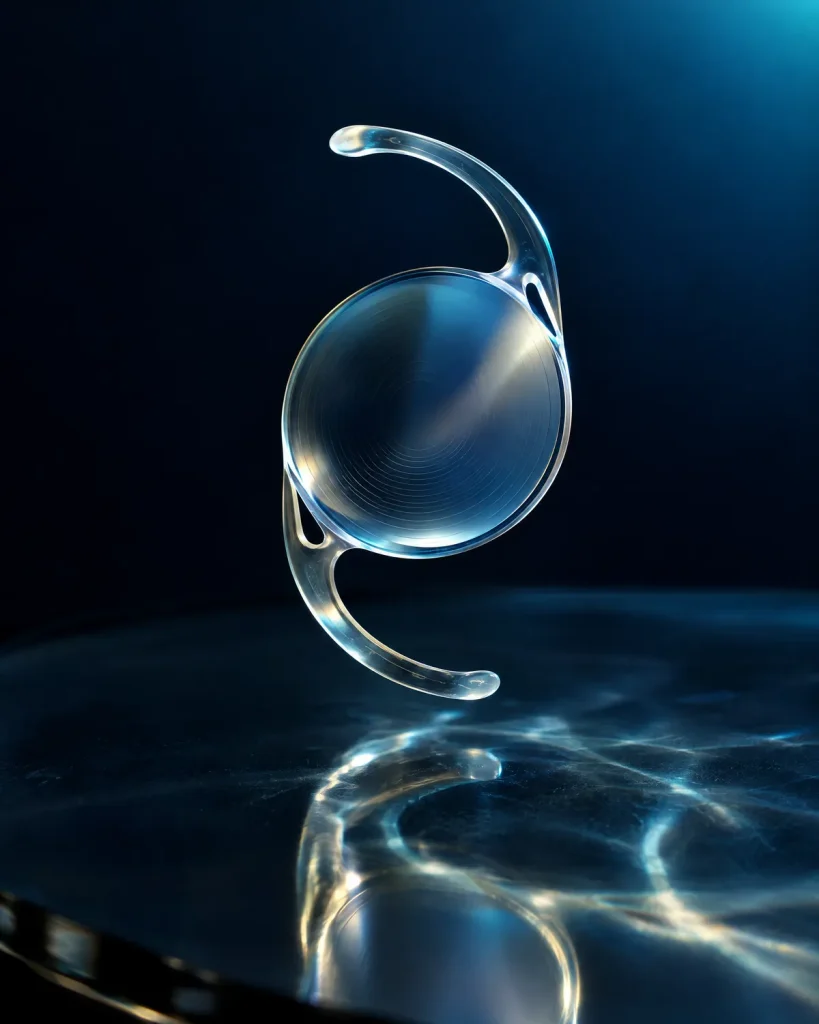
Lens surgery, called refractive lens exchange (RLE) or clear lens exchange, replaces your natural lens with an artificial lens implant, using the same operation as cataract surgery. The RCOphth describes RLE as identical to modern cataract surgery, performed with the main aim of increasing freedom from glasses. Because the natural lens is removed, it can do the following:
- Correct your prescription (short sight, long sight and, with the right lens, astigmatism).
- Treat presbyopia when a multifocal lens is used. The RCOphth reports that about four out of five patients are completely free of glasses after RLE with widely used contemporary multifocal lenses, and about 95% are satisfied with the outcome.
- Prevent cataract. RLE eliminates the need for cataract surgery in later life.
- Give a stable result. In the absence of a new eye problem, vision and prescription normally remain stable after RLE.
There are two broad lens types. Monofocal lenses give sharp focus at one range (usually distance) with fewer optical side effects, but you will usually still need reading glasses; they can also be set for blended vision. Multifocal lenses give a wider range of focus, but with more optical side effects such as halos around lights. At Laser Istanbul Clinic, Prof. Dr. Ahmet Satıcı performs lens replacement with premium trifocal lenses, and Op. Dr. Aysan Bayram also performs cataract surgery; your surgeon explains which lens suits your eyes, your work and your night driving.
Surgeons interviewed by the AAO's EyeNet magazine point out that people in their 40s and 50s are often more sensitive to the side effects of multifocal lenses than older patients, because they are used to clear vision and are more likely to drive at night. That is a reason for a careful lens choice and a frank discussion, not a reason to rule lens surgery out.
Laser or lens surgery: which carries more risk?
Both are generally safe in experienced hands, but lens surgery is an inside-the-eye operation, and the RCOphth reports that permanent serious loss of vision is significantly more common after it than after laser. The RCOphth patient information gives these figures:
| Laser vision correction | Refractive lens exchange | |
|---|---|---|
| Permanent, serious loss of vision | Rare: fewer than 1 in 5000 patients need a corneal transplant | Significantly more common than after laser: approximately 1 in 500 patients |
| Further surgery | Up to 1 in 10 patients need some additional procedure to get the best result | Second operations are sometimes needed; a laser touch-up, or a YAG laser capsulotomy for clouding behind the lens, are common |
| Retinal detachment | Not highlighted as a specific laser risk in the leaflet | Risk is approximately five times higher in the first four years after cataract surgery or RLE; retinal detachments are also more common if you are very short-sighted |
| Common side effects | Glare, halos, starbursts and dry eye, usually mild and improving within a few months | Light scatter and unwanted images in the early months; multifocal lenses give more halos; about 1% of patients cannot adapt and choose to exchange the lens |
| Satisfaction | Over 95% satisfied | About 95% satisfied; 19 out of 20 satisfied or very satisfied with their vision 3 to 6 months after a multifocal lens |
| Future cataract | May still develop later | Cannot develop (natural lens removed) |
Figures are from the RCOphth patient information leaflets (see Sources). They are averages, not a promise for your eyes.
Two practical points follow. First, the balance is different for people with a clear, flexible lens: the RCOphth says laser or phakic lens implants are generally better than RLE for them. Second, someone with a healthy eye surface, a lower prescription and no cataract may still be better off with laser, even past 50 or 60. The right answer depends on the examination, not on the date on your birth certificate.

I have already had LASIK. Can I still have cataract surgery?
Yes. Having had laser does not stop you from having cataract surgery later, but you must tell your surgeon. The RCOphth says laser vision correction can reduce the accuracy of focus correction after future cataract surgery, that any detrimental effect is small and reducing as lens-selection calculations are better understood, and that you should tell your surgeon you have had laser so they can make the right modifications. Keep your laser records (treatment details and your pre-operative prescription), because they help the surgeon choose the lens power.
How do you decide? What your surgeon checks
The decision rests on a handful of measurements, not on age alone. At a pre-operative examination your surgeon will look at:
- Your lens
Is it clear, or are there early signs of cataract?
- Your cornea
Shape (topography) and thickness, to see whether laser is safe and how much tissue can be treated.
- Your eye surface
Tear film and eyelid glands, because dry eye changes the plan.
- Your prescription and its stability
, including whether it falls inside the laser range.
- The health of the rest of the eye
For example, glaucoma, retinal problems or diabetes.
- How you use your eyes
Screens, night driving, sport, reading, hobbies and how much you want to be free of glasses.
- How you cope with blended vision
A contact-lens trial, one eye for distance and one for near, shows whether your brain accepts it before you commit.
The honest outcome of that examination is sometimes "laser", sometimes "lens surgery", sometimes "keep your glasses or contact lenses". If laser would not suit your eyes, your surgeon will say so.
Frequently asked questions
Laser reshapes the cornea, but the main changes after 45 happen in the natural lens: it stiffens (presbyopia) and starts to cloud (cataract). Laser can at best work around presbyopia with blended vision; it cannot restore focusing or prevent cataract. Dry eye also becomes more of a concern with age. For many people over 45, a lens-based option or a carefully planned blended-vision laser is therefore a better fit.
There is a minimum age (18 or older, ideally over 21) but no upper age limit if your eyes are healthy, according to the American Academy of Ophthalmology. Your prescription should be stable, and you should not have cataract that affects your vision, severe dry eye or corneal disease.
It can be, if your lens is still clear, your eye surface is healthy and your prescription is within the laser range. The Royal College of Ophthalmologists calls laser a relatively low-risk option for many patients over 50 with a lower prescription. If you also want to be free of reading glasses, you will need blended vision or lens surgery rather than standard laser.
Often not as the first choice. The AAO notes that dry eye can be a particular challenge after LASIK in people over 60 and suggests refractive lens exchange, and the RCOphth calls lens exchange the default for vision correction surgery over 65, unless there are no signs of cataract and the eye surface is healthy.
If you are over about 40, probably yes, unless you choose blended vision. The AAO says LASIK cannot correct presbyopia and almost everyone with excellent distance vision needs reading glasses after around 40. Blended vision reduces the need, but some people still need glasses for fine print.
Laser reshapes the cornea and leaves your natural lens in place. Lens replacement (refractive lens exchange) removes the natural lens and puts an artificial lens in its place, using the same operation as cataract surgery. It can correct presbyopia and means you will never need cataract surgery, but it is an inside-the-eye operation with different risks.
According to the RCOphth, permanent serious loss of vision is significantly more common after lens exchange (approximately 1 in 500 patients) than after laser, where fewer than 1 in 5000 need a corneal transplant. Retinal detachment is also about five times more likely in the first four years after lens exchange. Laser has its own risks, including dry eye, glare and halos, and up to 1 in 10 patients need some further procedure.
Yes. Tell your surgeon about your laser treatment so the lens power can be calculated with the right adjustments. The RCOphth says any effect on accuracy is small and reducing.
Have a full eye examination: lens, cornea, tear film, prescription and the health of the rest of the eye. You can start by sending your prescription and any scans for a free online review, and the surgeon tells you honestly which option, if any, suits your eyes.
Not sure whether laser or a lens is right for you?
Your surgeon at Laser Istanbul Clinic compares laser, blended vision and lens replacement for your eyes and your age, and tells you honestly if laser is not the right choice. Laser surgery is led by Prof. Dr. Ahmet Satıcı and Op. Dr. Aysan Bayram.
Sources for the facts on this page
- Royal College of Ophthalmologists. Laser vision correction: patient information (PROF/2024/499). https://www.rcophth.ac.uk/wp-content/uploads/2026/08/Laser-vision-correction-patient-information.pdf (page: https://www.rcophth.ac.uk/guidance-resources/laser-vision-correction/)
- Royal College of Ophthalmologists. Refractive lens exchange: patient information (PROF/2024/498). https://www.rcophth.ac.uk/wp-content/uploads/2026/08/Refractive-lens-exchange-patient-information.pdf (page: https://www.rcophth.ac.uk/guidance-resources/refractive-lens-exchange/)
- American Academy of Ophthalmology (AAO). LASIK: laser eye surgery. https://www.aao.org/eye-health/treatments/lasik
- AAO. Can I have LASIK at an older age? (Ask an Ophthalmologist). https://www.aao.org/eye-health/ask-ophthalmologist-q/can-i-have-lasik-at-older-age
- AAO. What is presbyopia? https://www.aao.org/eye-health/diseases/what-is-presbyopia
- AAO EyeNet. Refractive Lens Surgery in Midlife Patients, Part 1: Giving Patients More Options. https://www.aao.org/eyenet/article/refractive-surgery-midlife-patients-part-one
- US Food and Drug Administration. LASIK: What are the risks and how can I find the right doctor for me? https://www.fda.gov/medical-devices/lasik/what-are-risks-and-how-can-i-find-right-doctor-me
- National Eye Institute (NIH). Presbyopia. https://www.nei.nih.gov/learn-about-eye-health/eye-conditions-and-diseases/presbyopia
- National Eye Institute (NIH). Cataracts. https://www.nei.nih.gov/learn-about-eye-health/eye-conditions-and-diseases/cataracts