
- Home
- Knowledge centre
- Laser eye surgery guides
- Dry eyes and halos after laser surgery
Dry Eyes After Laser Eye Surgery and Halos at Night: Causes and Fixes
Why a healing cornea feels dry and scatters light, how long it usually lasts after LASIK, SMILE and PRK, what helps, and when to call your surgeon.

Dry eyes after laser eye surgery, and halos around lights at night, are common and usually temporary side effects of a healing cornea. Dryness is worst in the first month and, for most people, settles within 3–6 months; it is generally milder after SMILE than after LASIK. Halos and glare around lights usually fade over the same period. Lubricating drops, lid care and careful pre-operative screening help most people, and longer-lasting symptoms have specific treatments.
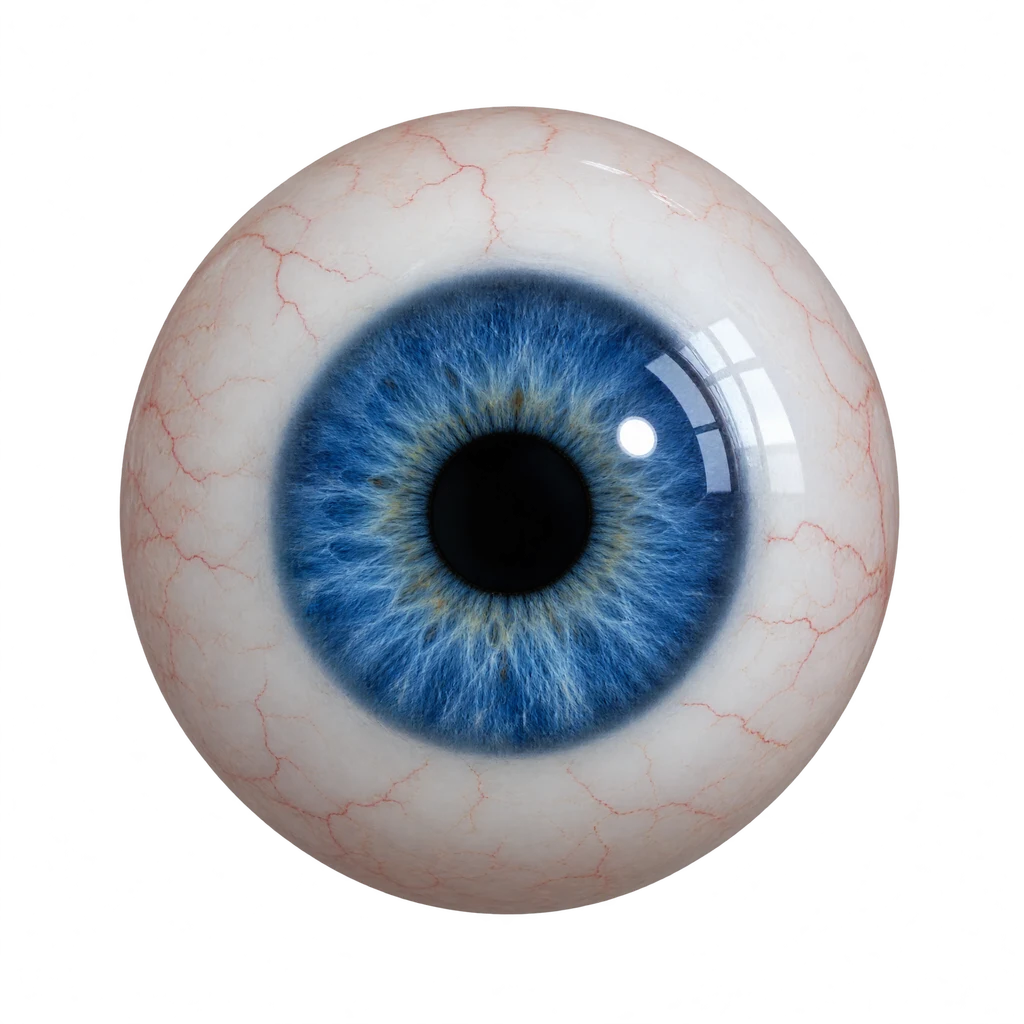
Why do you get dry eyes after laser eye surgery?
The cornea is wired to notice dryness
Your cornea, the clear window at the front of the eye, is one of the most sensitive tissues in the body: it has an estimated 300 to 600 times as many pain-sensing nerve endings as skin. Those nerves do an important job you never notice. They sense when the surface is drying out and trigger blinking and tear production.
Every type of laser eye surgery disturbs some of these nerves, because the laser has to work on the cornea. In LASIK, the surgeon creates a thin flap before the laser reshapes the tissue underneath, and cutting that flap severs many of the nerves running across the cornea. In the first month after LASIK, the density of the nerve network just under the surface falls by more than 90%. With fewer signals reaching the brain, you blink a little less, the glands make fewer reflex tears, and the tear film becomes less stable. Mild inflammation of the eye's surface adds to the problem.
That is why dry eye is the most common side effect of laser vision correction. Using modern diagnostic criteria, 60–70% of people have signs of dry eye in the early weeks after LASIK. A review in Community Eye Health puts the figure for some degree of dryness at over 90% of patients after corneal laser surgery, most bothersome in the first month and improving over 3–12 months.
Some people are more likely to be affected
Existing dry eye
People who already had dry eye or blocked oil glands in the eyelids (meibomian gland dysfunction) before surgery.
Women
Dry eye after laser surgery is reported more often in women.
Higher prescriptions
Where more tissue is treated.
Some medicines
Medicines that reduce tears, such as some antihistamines or hormone replacement therapy.
Can dry eye cause blurred vision?
Yes. A dry or uneven tear film scatters light, so vision can blur on and off, especially when reading, driving or using a screen, and then clear when you blink. The US Food and Drug Administration (FDA) notes that dry eye after LASIK can reduce visual quality through intermittent blurring. The American Academy of Ophthalmology (AAO) says almost everyone has dry eyes and vision that changes during the day after LASIK, and that this usually fades within a month. Blur that does not clear with blinking, or that gets worse, needs a check with your surgeon.
Other typical symptoms are a gritty or scratchy feeling, burning or stinging, red eyes, sensitivity to light and, surprisingly often, watery eyes, because an irritated eye produces bursts of reflex tears that don't spread well.
How long does dry eye last after LASIK, SMILE and PRK?
For most people, dry eye after laser surgery is temporary: symptoms usually resolve within 3 to 6 months, although a small proportion of people still have symptoms more than a year later. How long it lasts depends partly on the procedure, because each one affects the corneal nerves differently.
| LASIK / Femto-LASIK | SMILE / SMILE Pro | PRK / surface laser (incl. no-touch) | |
|---|---|---|---|
| How the laser reaches the cornea | A thin flap is lifted, the tissue underneath is reshaped and the flap is laid back | A small disc of tissue is removed through a 2–4 mm keyhole cut; no flap | The thin surface layer is removed and the surface is reshaped; the surface cells grow back over 3–4 days |
| Early dry eye | Very common: 60–70% in the early weeks (modern criteria) | Usually milder than after LASIK | Discomfort is worst on days 2–3 while the surface heals |
| What studies show | Symptoms usually settle within 3–6 months; a small number last beyond a year | In a meta-analysis of six studies, symptom scores were back to pre-surgery levels at 6 months after SMILE but still raised after Femto-LASIK | In a 2023 study, dry-eye scores 6 months after surgery were lower after PRK and LASEK than after LASIK |
| Corneal sensation recovers | About 95% of normal by 1 year; nerve density near normal from 6 to 16 months | About 79% at 3 months and 86% at 6 months | 85–95% within 3 months; nerve network back to its pre-surgery density at about 2 years |
Figures are averages from published studies (see Sources); your own recovery depends on your eyes, your prescription and how your surface heals.
What this means for you: if you are prone to dry eye, the choice of procedure matters. Dry eye after SMILE, and dry eye after PRK once the surface has healed, tend to be milder than after LASIK, because these methods spare more of the corneal nerves than a LASIK flap does. That is one reason your surgeon may recommend them. The trade-off is that PRK is more uncomfortable for the first few days and vision takes longer to settle.
Contact lenses and dry eyes: will laser surgery make it worse?
Not necessarily. Many people choose laser surgery because their eyes no longer tolerate contact lenses, and lens-related dryness is not the same as dry eye disease. In the US PROWL studies of 534 LASIK patients, the share of people with normal dry-eye scores was higher after surgery than before it (in one group, 55% before, 66% at 3 months and 73% at 6 months). The same studies also found that about 28% of people who had no dry-eye symptoms before surgery reported mild to severe symptoms at 3 months. Your surgeon tests your tear film after a break from your lenses to work out which group you are likely to be in.

Halos and glare
What causes halos and glare after laser eye surgery?
Halos are bright rings around lights, glare is a dazzle that makes lights harder to look at, and starbursts are rays spreading out from a light. All three are most noticeable at night, for example with car headlights or street lamps, because that is when your pupil is widest.
They happen for several reasons:
- The cornea is still healing. In the first weeks, the treated surface and the flap interface are not yet perfectly smooth, and light scatters as it passes through.
- Dry eye. A patchy tear film is an uneven optical surface, so dry eye on its own can cause halos and fluctuating vision.
- Small optical imperfections. Reshaping the cornea, and in LASIK creating the flap itself, introduces subtle optical errors called higher-order aberrations (mainly spherical aberration and coma). Glasses cannot correct these, and they show up most in dim light.
- Pupil size versus treatment zone. If your pupil opens wider in the dark than the area the laser treated, light passes through both the treated and the untreated edge of the cornea and forms a blurred ring.
- Higher prescriptions and leftover prescription. Larger corrections, a treatment zone that is slightly off-centre, small folds in a LASIK flap or a small remaining prescription all make night-vision symptoms more likely.
How common are they, and do they go away?
Fairly common at first. In the PROWL studies, 43–46% of people reported a new visual symptom such as glare, halos, starbursts or double images 3 months after LASIK. EyeWiki, the AAO's clinical encyclopedia, puts the proportion reporting some visual change after LASIK at about 20% and says these disturbances tend to settle 3 to 6 months after surgery. The NHS likewise says glare, halos and starbursts normally improve within a few months. Most people adapt well: dissatisfaction with vision in PROWL was 1–4%. In a small number, symptoms persist; the FDA notes that some patients develop glare, halos or double vision that can seriously affect night vision.
| Symptom | What you notice | Most likely cause | Usual course |
|---|---|---|---|
| Halos | Rings around lights at night | Healing surface, dry eye, pupil larger than the treated zone | Fades over weeks; usually settled by 3–6 months |
| Glare | Dazzle from headlights or sunlight | Light scatter from the healing or dry surface | Improves as the surface heals and the tear film recovers |
| Starbursts | Rays around point lights | Higher-order aberrations, flap folds | Often improves within 3–6 months; can persist in a minority |
| Fluctuating blur | Vision clears after blinking | Dry eye | Improves as dryness is treated |
What helps dry eyes after laser eye surgery?
Treatment is stepped: start simple, and add more only if symptoms continue. Your surgeon decides which steps you need.
Everyday care
Preservative-free lubricating drops used often, warm compresses, eyelid cleaning, a humidifier, screen breaks, sunglasses outdoors. For everyone, from the day after surgery.
Prescription treatment
Anti-inflammatory drops such as cyclosporine or lifitegrast, a short course of mild steroid drops, punctal plugs (tiny plugs that keep tears on the eye longer). For dryness that continues despite step 1.
Specialist treatment
Eye drops made from your own blood serum, nerve-growth-factor drops, intense pulsed light (IPL) for the eyelid oil glands, scleral contact lenses. For severe or long-lasting cases.
What are the best eye drops for dry eyes after laser surgery?
Preservative-free artificial tears are the first choice of eye drops for dry eyes after surgery. There is no single best brand: what matters is that the drops are preservative-free, because you may use them many times a day while the surface heals. In the first weeks, use only the drops your surgeon prescribes, in the order and at the times written on your sheet; your antibiotic and anti-inflammatory drops after surgery are part of your treatment, not optional extras. If lubricating drops are not enough after a few weeks, tell your surgeon rather than switching brands repeatedly.
How to treat dry eyes at home
Simple habits the US National Eye Institute recommends
Take regular breaks from computers, tablets and phones, and remind yourself to blink fully
Avoid smoke, wind and air conditioning blowing into your face, and use a humidifier in dry rooms
Wear wraparound sunglasses outdoors
Drink plenty of water (NEI suggests 8 to 10 glasses a day) and sleep 7 to 8 hours a night
Use a warm compress and gentle eyelid cleaning if your surgeon advises it, to help the oil glands work
Can dry eyes be cured permanently?
For most laser patients, dry eye is not a permanent condition to cure: it fades as the corneal nerves regrow, usually within months. For a small number of people, dryness lasts longer, and the FDA notes that severe dry eye after LASIK may be permanent. In that case treatment aims to keep the eyes comfortable and vision stable, using the prescription and specialist options above. The best protection is prevention: finding and treating dry eye before surgery.
What helps halos and glare?
Time
Most halos and glare fade as the cornea heals, usually within 3–6 months. Your surgeon will normally wait for your eyes to settle before considering any further treatment.
Treating dry eye
A smoother tear film scatters less light, so the dry-eye steps above often reduce halos too.
Care with night driving
Don't drive at night until your surgeon has confirmed that your vision meets the driving standard and you feel confident with headlights.
Glasses for night driving
If a small leftover prescription is part of the cause, a thin pair of glasses for driving at night can sharpen lights.
Pupil-constricting drops
Drops such as brimonidine or pilocarpine make the pupil smaller in dim light, so less light passes through the edge of the treated zone. These are prescription medicines.
Laser enhancement
For persistent symptoms caused by optical imperfections, a wavefront-guided or topography-guided retreatment can help once the eye is stable, if the cornea is thick enough.
Specialty contact lenses
For the rare case that does not respond, specially designed contact lenses can mask the irregularity.
Contact your surgeon the same day if you notice any of these
- pain that is getting worse rather than better
- increasing redness, sensitivity to light or discharge
- vision that is getting worse, or a sudden drop in vision in one eye
These can be signs of an infection (microbial keratitis) or inflammation under the flap (diffuse lamellar keratitis). Both are uncommon, but both need prompt treatment. While you are in Istanbul, call your coordinator; once you are home, contact your surgeon and, if you cannot reach them quickly, go to your nearest eye emergency service.
Book a review if
- dryness is still bothering you after a few weeks of regular lubricating drops
- halos or glare still affect your night driving 3–6 months after surgery
- your vision slowly becomes less sharp months or years later. A rare complication called ectasia, a weakening and bulging of the cornea, affects 0.04–0.5% of patients and can appear months to years after surgery.

Followed up at home, not forgotten
With Laser Istanbul Clinic, your surgeon checks your eyes before you fly home, and your coordinator and surgeon follow your recovery remotely, by video, at agreed intervals. If you need to be seen in person, we help you arrange it with a local optometrist or ophthalmologist and share your full surgical records.
How it works, step by stepHow do pre-operative tests reduce the risk?
Most long-lasting dry eye and night-vision problems are predictable. The aim of the pre-operative examination is to find the people at risk before surgery, treat what can be treated, and choose the right procedure, or no laser at all.
| Test | What it checks | Why it matters for dry eye and halos |
|---|---|---|
| Symptom questionnaire (such as OSDI) | How dry and uncomfortable your eyes feel day to day | Pre-existing dry eye is the strongest warning sign |
| Tear break-up time and surface staining | How quickly your tear film breaks up; dry spots on the surface | An unstable tear film is treated before surgery |
| Schirmer test and tear osmolarity | How many tears you make and how concentrated they are | Low or salty tears point to dry eye disease |
| Meibography and eyelid examination | The oil glands that stop tears evaporating | Blocked glands are treated first, often improving comfort after surgery |
| Corneal topography and thickness measurement (pachymetry) | The shape and thickness of your cornea | Rules out keratoconus and thin corneas; shows how much tissue can safely be treated and whether an enhancement would be possible later |
| Pupil size and prescription | How wide your pupil opens and how strong your correction is | Helps plan a treatment zone that suits your eyes and flags a higher risk of night halos |
Treat dry eye or eyelid disease first
And repeat the tests before setting a surgery date.
Recommend SMILE or a surface treatment such as PRK
Instead of LASIK, because they spare more corneal nerves.
Advise against laser altogether
The AAO lists severe dry eye, corneas that are too thin, corneal disease and keratoconus among the reasons a person is not a candidate for LASIK.
Before your examination, leave your contact lenses out for {{contact-lens break before the pre-op exam: soft / toric / rigid lenses}}, because lenses can temporarily change the shape of the cornea and the tear film, and the measurements need to reflect your natural eye.
Frequently asked questions
For most people, dry eye after LASIK settles within 3 to 6 months. It is worst in the first month and improves as the corneal nerves regrow; sensation is back to about 95% of normal by a year. A small minority still have symptoms beyond a year and need longer-term treatment.
Dry eye is usually milder and shorter after SMILE. SMILE uses a small keyhole incision instead of a flap, so fewer corneal nerves are cut. In a meta-analysis, symptom scores were back to normal 6 months after SMILE but still raised after Femto-LASIK.
Yes, dry eye can cause blurred vision that comes and goes, typically clearing when you blink. It is common in the first weeks after laser surgery and improves as the tear film recovers. Blur that does not clear, or that gets worse, should be checked by your surgeon.
Usually not. For most people, halos fade within 3–6 months as the cornea heals and the brain adapts. In a small number they persist; treatments then include pupil-constricting drops, night-driving glasses and, in suitable eyes, a laser enhancement.
Preservative-free lubricating drops are the usual first choice, used as often as your surgeon advises. During the first weeks, follow your written drop schedule exactly. If lubricants are not enough, your surgeon can prescribe anti-inflammatory drops or other treatments.
Often yes, after your dry eye has been treated and your tear film tests are acceptable. Your surgeon may prefer SMILE or PRK in that case. People with severe dry eye are not suitable for LASIK and may be offered a different treatment.
Yes. Most patients fly 1–3 days after laser eye surgery, once their surgeon has checked the eyes. Cabin air is dry, so keep your lubricating drops in your hand luggage and use them often during the flight.
Sources for the facts on this page
- EyeWiki (American Academy of Ophthalmology). Dry Eyes After Laser in situ Keratomileusis (LASIK).
- EyeWiki (AAO). LASIK Complications.
- EyeWiki (AAO). Photorefractive Keratectomy.
- Ying J, et al. Complications in patients who have undergone laser refractive surgery. Community Eye Health 2024;37(123):15–18.
- Shen Z, et al. Dry Eye after SMILE versus FS-LASIK for Myopia: A Meta-Analysis. PLoS One 2016.
- Yahalomi T, et al. Dry Eye Disease following LASIK, PRK, and LASEK. Journal of Clinical Medicine 2023.
- Bandeira F, et al. Corneal re-innervation following refractive surgery treatments. Neural Regeneration Research 2019.
- Dossari SK. Post-refractive Surgery Dry Eye: A Systematic Review. Cureus 2024.
- American Academy of Ophthalmology, EyeNet. Postoperative Symptoms and Satisfaction With LASIK Surgery (PROWL studies, JAMA Ophthalmology 2017).
- EurekAlert! (JAMA Network). Substantial percentage of patients surveyed report new visual symptoms following LASIK surgery.
- US Food and Drug Administration. LASIK: What are the risks and how can I find the right doctor for me?
- American Academy of Ophthalmology. LASIK — Laser Eye Surgery.
- American Academy of Ophthalmology. Facts About LASIK Complications.
- NHS. Laser eye surgery and lens surgery. nhs.uk
- National Eye Institute (NIH). Dry Eye.
- Ludwig PE, et al. Anatomy, Head and Neck, Eye Cornea. StatPearls.
Thinking about laser eye surgery, and worried about dry eyes?
Your surgeon checks your tear film, cornea and pupils before recommending LASIK, SMILE Pro or PRK, and tells you honestly if laser is not right for your eyes. Upload your prescription and scans for a free opinion.
3 eye surgeons
Your case is reviewed by a named surgeon, not a salesperson. Reply within {{response time}}.
 Prof. Dr. Ahmet Satıcı
 Doç. Dr. Muhammet Derda Özer
 Op. Dr. Aysan Bayram