
- Home
- Knowledge centre
- Eye conditions & symptoms A–Z
- Exophthalmos (Bulging Eyes): Causes, Warning Signs and What to Do
Exophthalmos (Bulging Eyes): Causes, Warning Signs and What to Do
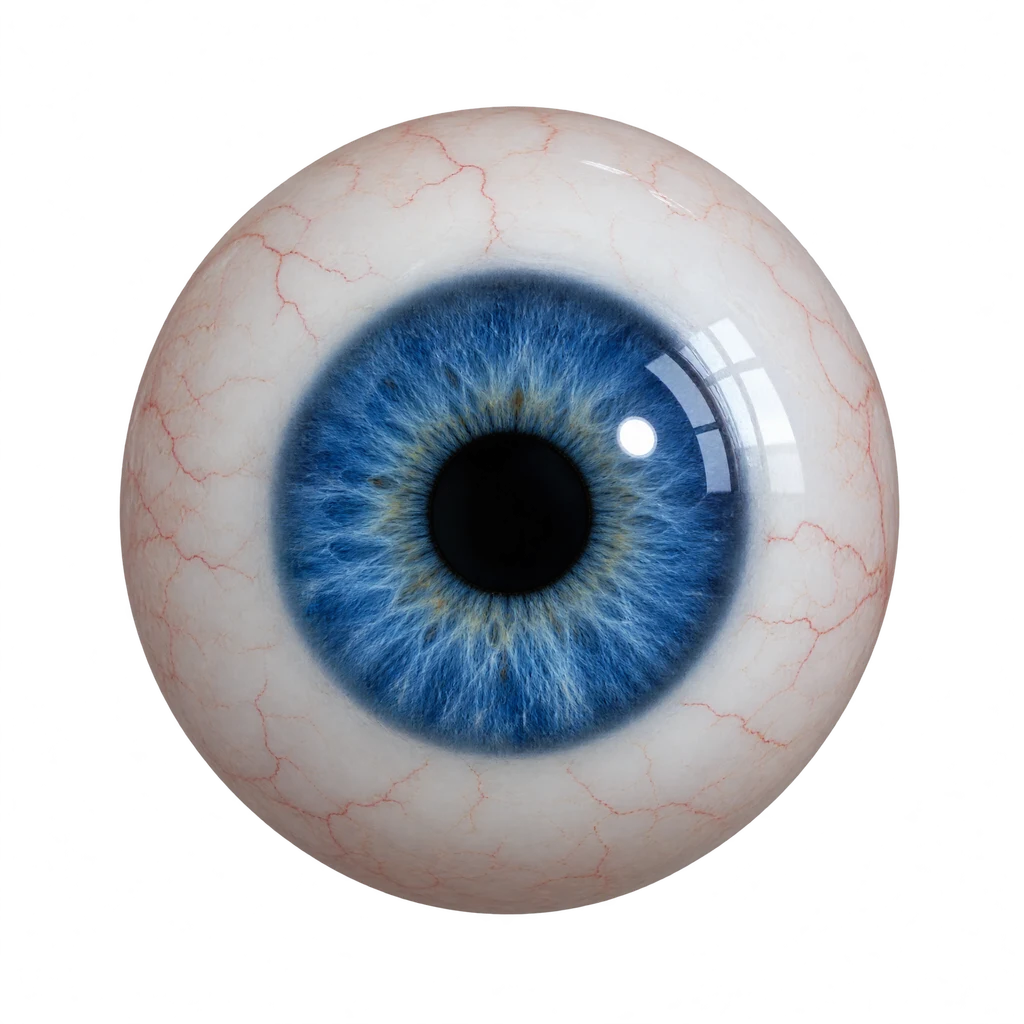
Exophthalmos, or bulging eyes, means one or both eyes sit further forward than normal. The most common cause is thyroid eye disease, an autoimmune condition linked to Graves' disease. Others include orbital infection (an emergency), inflammation, tumours, abnormal blood vessels and injury. Doctors treat the cause. Sudden bulging with pain, double vision or falling sight needs same-day emergency care.
What is exophthalmos, and what does "bulging eyes" mean?
Exophthalmos is the medical word for an eye that sits too far forward in its socket. Proptosis means the same thing, and the everyday phrase is "bulging eyes" or "protruding eyes". The eye is pushed forward by something happening behind it, inside the bony socket called the orbit: swelling, extra tissue, a growth, bleeding or an abnormal blood vessel. Our Eye glossary A–Z explains other terms you may meet in a report.
Doctors measure how far forward the eyes sit with an instrument called an exophthalmometer; the Hertel type is the one most widely used. A review of the causes of proptosis describes abnormal protrusion as a difference of 2 mm or more between the two eyes. A single "normal" number is hard to give, because readings differ between people and populations. One study of 2,010 healthy adults and children in northeast China found a mean reading of about 15 mm, which is higher than a figure in a Chinese medical textbook and lower than values reported for some other ethnic groups. That is why your doctor compares one eye with the other, and your readings over time, rather than checking one number against a chart.
This page lists the main causes of exophthalmos, explains how to tell a true bulging eye from an eye that only looks prominent, and shows which warning signs mean you should not wait. It is general information, not a diagnosis.
Prominent eyes or bulging eyes: what is the difference?
Some eyes look prominent without being pushed forward at all. Doctors call this false or "pseudo" proptosis. The proptosis review lists these reasons:
- High myopia or an enlarged eye. A very long or enlarged eyeball (as in high short-sightedness or congenital glaucoma) can look prominent.
- A sunken fellow eye. If one eye sinks back, for example after an orbital fracture, the normal eye looks as if it bulges by comparison.
- Asymmetric orbit bones. The two eye sockets can differ in size.
- Uneven eyelids. Differences in the position of the lids change how much of the eye shows.
Eyelid position matters a great deal. When the upper lid sits too high, you can see white above the coloured part of the eye, which gives a "staring" look even if the eye has not moved forward. EyeWiki reports upper lid retraction in up to 90% of people with thyroid eye disease, so a stare can be the first thing you or your friends notice.
Can you tell the difference at home? Not reliably. A real change shows up as a new difference from your older photos, one eye that has become more prominent, or a stare that was not there before. If you notice a change, have it examined rather than waiting to see whether it settles. A prominent look that has always been there, with no other symptoms, is less likely to be a problem, but only an examination can confirm that.
What are the main causes of bulging eyes?
Bulging eyes have a small number of common causes and a long list of rare ones. The table groups them by how they usually behave, drawn from the proptosis review (source 1) and the clinical sources listed at the end of this page.
| Cause | One eye or both? | Typical clues | How urgent? |
|---|---|---|---|
| Thyroid eye disease (Graves' orbitopathy) | Either; often both, sometimes uneven | Gritty, red, watery eyes; swollen or retracted eyelids; double vision | See a doctor soon; urgent if vision or colours fade |
| Orbital cellulitis (infection in the eye socket) | Usually one eye | Red, swollen, painful lids; pain moving the eye; limited movement; often follows a sinus infection | Emergency: same-day hospital care |
| Idiopathic (non-specific) orbital inflammation | Usually one eye | Pain and swelling are the usual features; proptosis is more common in the diffuse form | Prompt specialist assessment |
| Tumours in or near the orbit (benign or malignant, including lymphoma and spread from cancers elsewhere) | Usually one eye | Solid tumours develop slowly: gradual protrusion, change in eye position, double vision or reduced sight | Prompt specialist assessment |
| Blood-vessel problems (carotid-cavernous fistula, orbital varices) | Usually one eye | A fistula can cause pulsation, a noise in the head, swollen conjunctiva and corkscrew vessels on the white of the eye; varices can bulge when you strain | Urgent to prompt |
| Injury and bleeding behind the eye (retrobulbar haemorrhage) | One eye | Rapidly progressive bulging with falling vision | Emergency |
| Rare, severe infections (mucormycosis) | Usually one eye | People with diabetes or weak immunity; inflammatory signs can be muted | Emergency |
Which diseases cause bulging eyes?
Several different diseases can push the eye forward, but the proptosis review and EyeWiki both name thyroid eye disease as the most common cause overall, in one eye or both. After that, the usual pattern depends on age:
- Adults aged about 30–50: inflammatory pseudotumour (idiopathic orbital inflammation), mucoceles (sinus-related cysts) and tear-gland tumours.
- Over 70: melanoma, orbital inflammation, lymphoma and tumours that have spread from elsewhere. Spread to the orbit occurs in roughly 2–4.7% of people with cancer, and about a quarter of those have no known cancer diagnosis at that point, which is why unexplained one-sided bulging in an older adult needs a full work-up.
These lists are patterns, not predictions. They say nothing about which cause applies to you; only an examination and scans can answer that.
Is thyroid eye disease the most common cause of bulging eyes?
Yes. Thyroid eye disease (also called Graves' orbitopathy or thyroid-associated ophthalmopathy) is the most common cause of both one-sided and two-sided proptosis. It is an autoimmune condition: the immune system acts against tissue in the eye socket, the muscles and fat swell with fluid, and the eye is pushed forward. The 2022 American Thyroid Association and European Thyroid Association (ATA/ETA) consensus lists the usual signs as swelling around the eyes, lid retraction, proptosis, double vision, corneal damage and, rarely, pressure on the optic nerve.
How common is it?
- The NHS says it affects around 1 in 4 people who have an overactive thyroid caused by Graves' disease. A 2022 review puts it at about 30% of people with Graves' disease, with fewer than 10% having severe forms that need immune-suppressing treatment.
- In a study of more than 300 people with recent-onset Graves' hyperthyroidism, 74% had no eye signs, 20% had mild disease and 6% had moderate-to-severe or, rarely, sight-threatening disease.
- Registry studies put new cases at 3.3–8.0 per 100,000 women a year and 0.9–1.6 per 100,000 men. EyeWiki notes that women are affected about five times as often as men and that the median age at diagnosis is 43.
- Smoking is the main risk factor you can change: smokers are more likely to develop severe disease and respond more slowly and less well to treatment.
Can thyroid eye disease affect only one eye?
Yes. In a follow-up study of 655 people with thyroid eye disease, 89 (13.5%) had clear one-eyed proptosis at the first visit. Of those, 13 (14%) developed bulging in the other eye later, on average about 29 months afterwards. So one-sided bulging does not rule out thyroid disease, but doctors use scans when the picture is unusual.
Can you have thyroid eye disease with normal thyroid tests?
Yes, though it is uncommon. A 2022 review reports that in 7–8% of cases the eye disease occurs with chronic autoimmune thyroiditis whose hormone levels are normal or low rather than high. The ATA/ETA statement says scans should be considered when the disease looks atypical, for example when only one eye is affected or there is no history of thyroid problems.
What does thyroid eye disease feel like?
Dry, gritty and tired eyes are very common for other reasons too, including long hours on screens. If your symptoms are mild and your eyes do not look different, our guide to digital eye strain and screen time may explain them. Screen strain is not among the causes of proptosis in the sources above, so if the eyes look different, get them examined.
- gritty, dry, red or watery eyes, and sensitivity to light
- swollen or puffy eyelids and a "staring" look from upper-lid retraction
- eyes that look larger or more prominent
- double vision, particularly when looking to the side or up
- in rare cases, dimming of vision or colours, which can signal pressure on the optic nerve and needs urgent care
Why is only one eye bulging?
One bulging eye is not a diagnosis in itself, but it deserves a prompt check, because the list of possible causes is wider than when both eyes are involved. According to the proptosis review, the usual one-sided causes in adults are orbital cellulitis, orbital myositis (an inflamed eye muscle), vascular anomalies and tumours, and thyroid eye disease can also start in one eye, as explained above.
Clues that help doctors narrow it down:
- Speed. Inflammatory and infectious conditions progress over hours to days. Solid tumours and vascular lesions usually develop slowly.
- Pain. Pain suggests inflammation of nearby nerves and tissue, as in thyroid disease, orbital inflammation, infection or tumour infiltration.
- Pulsation, a noise in the head, or corkscrew vessels. These point to an abnormal artery-to-vein connection such as a carotid-cavernous fistula.
- Bulging when you strain. Orbital varices (vein malformations) can cause intermittent bulging with straining.
- A firm, fixed mass or skin changes around the eye. Firm, immobile masses and skin changes are more concerning than soft, mobile ones.
- Recent injury or surgery. This raises the possibility of bleeding behind the eye.
None of these clues is reliable alone. Imaging, usually MRI or CT, is how the cause is confirmed.
When are bulging eyes an emergency?
Go to an emergency department or eye emergency service the same day if you have bulging of one or both eyes together with any of these:
- sudden onset, over hours or a day or two
- severe or worsening eye pain, or pain when moving the eye
- a red, hot, swollen eyelid (possible orbital cellulitis)
- falling vision, dim or "washed-out" colours, or a sudden blackout
- new double vision
- an eye that cannot close properly, or a cloudy-looking cornea
- bulging after an injury or an operation
- a pulsating eye or a whooshing noise in the head
Why the speed matters: EyeWiki describes orbital cellulitis as a medical emergency needing hospital admission and intravenous antibiotics. It can lead to blindness and to life-threatening complications such as meningitis, and the outlook is excellent when it is treated promptly. About 90% of cases start from the neighbouring ethmoid or frontal sinuses, and children are most often affected. Bleeding behind the eye can threaten sight within hours: the proptosis review notes that a shorter time to treatment is associated with a lower likelihood of blindness. In thyroid eye disease, falling vision from optic nerve compression, or breakdown of the cornea, is also an emergency (ATA/ETA).
If you are travelling and have these signs, go to the nearest hospital eye or emergency service and do not wait for a booked appointment.
What causes bulging eyes in children and babies?
The causes in children differ from those in adults, and some need quick assessment. Orbital cellulitis is more common in children, with a median age of 7–12 years among those admitted to hospital, and it often follows a sinus infection. The proptosis review lists these patterns:
- Ages 1–5: dermoid cysts, spread of a tumour such as neuroblastoma, rhabdomyosarcoma, optic-nerve glioma, and blood-vessel growths (haemangioma).
- Ages 5–10: orbital inflammation, spread of a retinal tumour (retinoblastoma), leukaemia or lymphoma.
- Ages 10–30: inflammation, sinus mucoceles, thyroid eye disease and tear-gland tumours.
Most of these are rare. A review of children's orbital tumours calls orbital rhabdomyosarcoma the most common orbital cancer in childhood; it presents as a rapidly growing, painless swelling that pushes the eye forward. Any child with a new bulging eye, a swollen eyelid or an eye that seems to be changing position should be seen urgently by a doctor.
How do doctors find the cause of bulging eyes?
Doctors work through a short, logical sequence. Your appointment will usually include these steps.
Your history
When it started, how quickly it changed, pain, double vision, thyroid symptoms, smoking, recent infections, injuries and other health conditions.
Measuring the eyes
An exophthalmometer measures how far forward each eye sits, so both eyes can be compared and tracked over time.
A full eye examination
The surgeon checks eyelid position and closure, the surface of the cornea, eye movements, colour vision, pupil responses and the optic nerve.
Blood tests
A thyroid blood test is the usual first check; the NHS notes that a blood test can often show whether symptoms are caused by a thyroid problem.
Imaging
According to the proptosis review, CT is best for bone, trauma and thyroid eye disease, MRI is preferred for most soft-tissue disease, ultrasound helps with blood-vessel lesions and muscle enlargement, and angiography is used for aneurysms and carotid-cavernous fistulas.
Further tests when needed
, such as a biopsy (a small tissue sample) if a mass or an unusual inflammation needs a precise diagnosis.
It can help to bring a few recent and older photos in which your face is clearly visible, a list of your medicines and any recent thyroid results.
How is bulging eyes treated, and can it go back to normal?
Treatment depends entirely on the cause, so the first step is the diagnosis. The table summarises the main approaches; your doctor decides which apply to you.
| Cause | Main treatment | Can the eye go back to normal? |
|---|---|---|
| Thyroid eye disease, mild | Lubricating drops, night-time eye masks, treating the thyroid, stopping smoking; a 6-month course of selenium may be considered in mild, active disease | Many people improve as the thyroid is treated, but some have lasting problems (NHS) |
| Thyroid eye disease, moderate to severe and active | Intravenous glucocorticoids (steroids), the drug teprotumumab (the only drug approved by the US FDA for adults with thyroid eye disease at the time of the 2022 ATA/ETA statement) or other immune treatments, in a specialist centre with both an endocrinologist and an ophthalmologist | In the OPTIC trial, 83% of treated patients had a 2 mm or greater reduction in proptosis at 24 weeks, versus 10% with placebo; with intravenous steroids, 20–60% improved by more than 2 mm at 12 weeks, but longer studies show no lasting proptosis response |
| Thyroid eye disease, inactive but with lasting changes | Rehabilitative surgery in this order: orbital decompression, squint surgery, then eyelid surgery, once the disease has been inactive for at least 6–12 months | Surgery can reduce bulging, restore single vision in the straight-ahead position and reposition the eyelids |
| Sight-threatening thyroid eye disease | Urgent intravenous steroids and, if vision is not restored, early decompression surgery | Treated as an emergency to protect vision |
| Orbital cellulitis | Hospital admission, intravenous antibiotics, sometimes surgical drainage | Excellent outlook with prompt treatment (EyeWiki) |
| Idiopathic orbital inflammation | Typical cases are treated with systemic corticosteroids; a biopsy is needed if it does not respond, progresses or recurs | Depends on response; other immune treatments are sometimes used |
| Tumours | Depends on the type: surgery, radiotherapy, chemotherapy or targeted treatment | Depends on the type of tumour |
| Blood-vessel problems | Imaging first, then treatment of the vessel problem (embolisation is one conventional approach for a fistula) | Depends on the lesion |
The ATA/ETA consensus statement stresses that endocrinologists and ophthalmologists with thyroid eye disease expertise should work together on moderate-to-severe cases, and that smokers should be offered help to stop.
How to fix bulging eyes naturally: does anything work?
No home remedy corrects a bulging eye, because the cause lies behind it, in the socket. What can help is supportive care alongside medical treatment, mainly in thyroid eye disease:
- lubricating drops by day, and gels or a night-time eye mask if the eyes do not close fully
- extra pillows to raise your head, which is sometimes used to ease swelling
- dark glasses for light sensitivity
- stopping smoking and avoiding second-hand smoke
- keeping thyroid levels controlled with your endocrinologist
The ATA/ETA statement mentions selenium (100 micrograms twice daily for 6 months) as an option for mild, active disease, particularly where selenium intake is low. Take it only if your doctor advises it. Waiting for a natural fix can delay the diagnosis of a serious cause.

How can Laser Istanbul Clinic's surgeons help?
An examination is the right first step for any new bulging, a new stare or unequal eyes. At Laser Istanbul Clinic, three Istanbul eye surgeons can look at the parts of the problem that match their work:
- Prof. Dr. Ahmet Satıcı performs eyelid and oculoplastic surgery and squint surgery. These matter once thyroid eye disease is inactive: eyelid retraction and double vision are corrected after any orbital surgery.
- Doç. Dr. Muhammet Derda Özer (Doç. is the Turkish title for Associate Professor) treats corneal disease, uveitis (inflammation inside the eye), retinal disease and eye tumours (ocular oncology). He speaks Turkish and English.
- Op. Dr. Aysan Bayram, a female surgeon who speaks English, also treats retinal disease.
Thyroid eye disease and orbital disease are shared-care conditions: the endocrinologist treats the thyroid, and the eye team protects the cornea and vision and plans any surgery. Our surgeons will tell you honestly whether you need an urgent local assessment, a thyroid specialist first, or an orbital scan before anything else. For anything sudden, do not wait for a remote opinion: go to your nearest emergency service.
Frequently asked questions
Exophthalmos is the medical term for an eye that protrudes forward from its socket, also called proptosis or bulging eyes. It can affect one eye or both. It is a sign, not a diagnosis: the cause is something happening in the eye socket, most often thyroid eye disease.
Thyroid eye disease is the most common cause. Other causes include orbital infection, orbital inflammation, tumours, abnormal blood vessels and injury or bleeding behind the eye. Some eyes only look prominent because of high myopia, uneven eyelids or a sunken fellow eye.
Prominent eyes look large but sit in a normal position, often because of anatomy, high myopia or the way the lids sit. Bulging eyes have moved forward, and a difference of 2 mm or more between the two eyes is considered abnormal. An exophthalmometer measures the difference.
One-sided bulging has a wider list of causes than two-sided bulging. Orbital infection, inflammation, blood-vessel problems, tumours and injury are all possible, and thyroid eye disease can affect one eye first: in one study, 13.5% of people with thyroid eye disease had one bulging eye at their first visit. It needs prompt examination and usually a scan.
Yes. According to the NHS, thyroid eye disease affects around 1 in 4 people with an overactive thyroid caused by Graves' disease. A thyroid blood test is the usual first check. Some people have normal thyroid blood tests and still have the eye disease, so the eye examination matters too.
They can be. Sudden bulging with pain, a red swollen lid, new double vision or falling vision needs same-day emergency care, because orbital infection and bleeding behind the eye can damage sight within hours. Slowly developing bulging should still be examined soon, but is less often an emergency.
It depends on the cause. In thyroid eye disease, many people improve as the thyroid is treated, and some keep long-term problems (NHS). Medical treatment can reduce proptosis in active disease, and surgery can reduce it once the disease is inactive. Infections generally recover with prompt treatment.
No natural remedy corrects the cause of a bulging eye. Lubricating drops, raising your head at night, dark glasses and stopping smoking can ease symptoms in thyroid eye disease, but they do not reverse proptosis. See an eye doctor so the cause is found and treated.
Worried about a change in your eyes?
Send us recent photos and any scans or thyroid results, and one of our surgeons will tell you honestly what the next step should be: a local emergency check, a specialist in your own country, or an examination with us in Istanbul. For eyelid and squint questions after thyroid eye disease, Prof. Dr. Ahmet Satıcı is the surgeon to ask for; for corneal, inflammatory and tumour questions, Doç. Dr. Muhammet Derda Özer.
Sources for the facts on this page
- Topilow NJ, Tran AQ, Koo EB, Alabiad CR. Etiologies of Proptosis: A Review. Internal Medicine Review 2020. https://pmc.ncbi.nlm.nih.gov/articles/PMC7204542/
- Burch HB, Perros P, Bednarczuk T, et al. Management of Thyroid Eye Disease: A Consensus Statement by the American Thyroid Association and the European Thyroid Association. Thyroid 2022;32(12):1439–1470. https://pmc.ncbi.nlm.nih.gov/articles/PMC9807259/
- Bartalena L, Tanda ML. Current concepts regarding Graves' orbitopathy. Journal of Internal Medicine 2022;292(5):692–716. https://pmc.ncbi.nlm.nih.gov/articles/PMC9796560/
- Perros P, Hegedüs L, Bartalena L, et al. Graves' orbitopathy as a rare disease in Europe: a European Group on Graves' Orbitopathy (EUGOGO) position statement. Orphanet Journal of Rare Diseases 2017;12:72. https://pmc.ncbi.nlm.nih.gov/articles/PMC5397790/
- Strianese D, Piscopo R, Elefante A, et al. Unilateral proptosis in thyroid eye disease with subsequent contralateral involvement: retrospective follow-up study. BMC Ophthalmology 2013;13:21. https://pmc.ncbi.nlm.nih.gov/articles/PMC3669615/
- NHS. Overactive thyroid (hyperthyroidism): complications (thyroid eye disease). https://www.nhs.uk/conditions/overactive-thyroid-hyperthyroidism/complications/
- EyeWiki (American Academy of Ophthalmology). Thyroid Eye Disease. https://eyewiki.org/Thyroid_Eye_Disease
- EyeWiki (AAO). Orbital Cellulitis. https://eyewiki.org/Orbital_Cellulitis
- Yadalla D, Jayagayathri R, Padmanaban K, et al. Bacterial orbital cellulitis: a review. Indian Journal of Ophthalmology 2023;71(7):2687–2693. https://pmc.ncbi.nlm.nih.gov/articles/PMC10491050/
- Yeşiltaş YS, Gündüz AK. Idiopathic Orbital Inflammation: Review of Literature and New Advances. Middle East African Journal of Ophthalmology 2018;25(2):71–80. https://pmc.ncbi.nlm.nih.gov/articles/PMC6071347/
- Chaudhry IA, Elkhamry SM, Al-Rashed W, Bosley TM. Carotid cavernous fistula: ophthalmological implications. Middle East African Journal of Ophthalmology 2009;16(2):57–63. https://pmc.ncbi.nlm.nih.gov/articles/PMC2813585/
- Rao AA, Naheedy JH, Chen JY, Robbins SL, Ramkumar HL. A clinical update and radiologic review of pediatric orbital and ocular tumors. Journal of Oncology 2013;2013:975908. https://pmc.ncbi.nlm.nih.gov/articles/PMC3610355/
- Wu D, Liu X, Wu D, et al. Normal values of Hertel exophthalmometry in a Chinese Han population from Shenyang, Northeast China. Scientific Reports 2015;5:8526. https://pmc.ncbi.nlm.nih.gov/articles/PMC4336939/