
- Home
- Knowledge centre
- Eye conditions & symptoms A–Z
- Eye Strain from Screens: Symptoms, Causes and How to Relieve It
Eye Strain from Screens: Symptoms, Causes and How to Relieve It

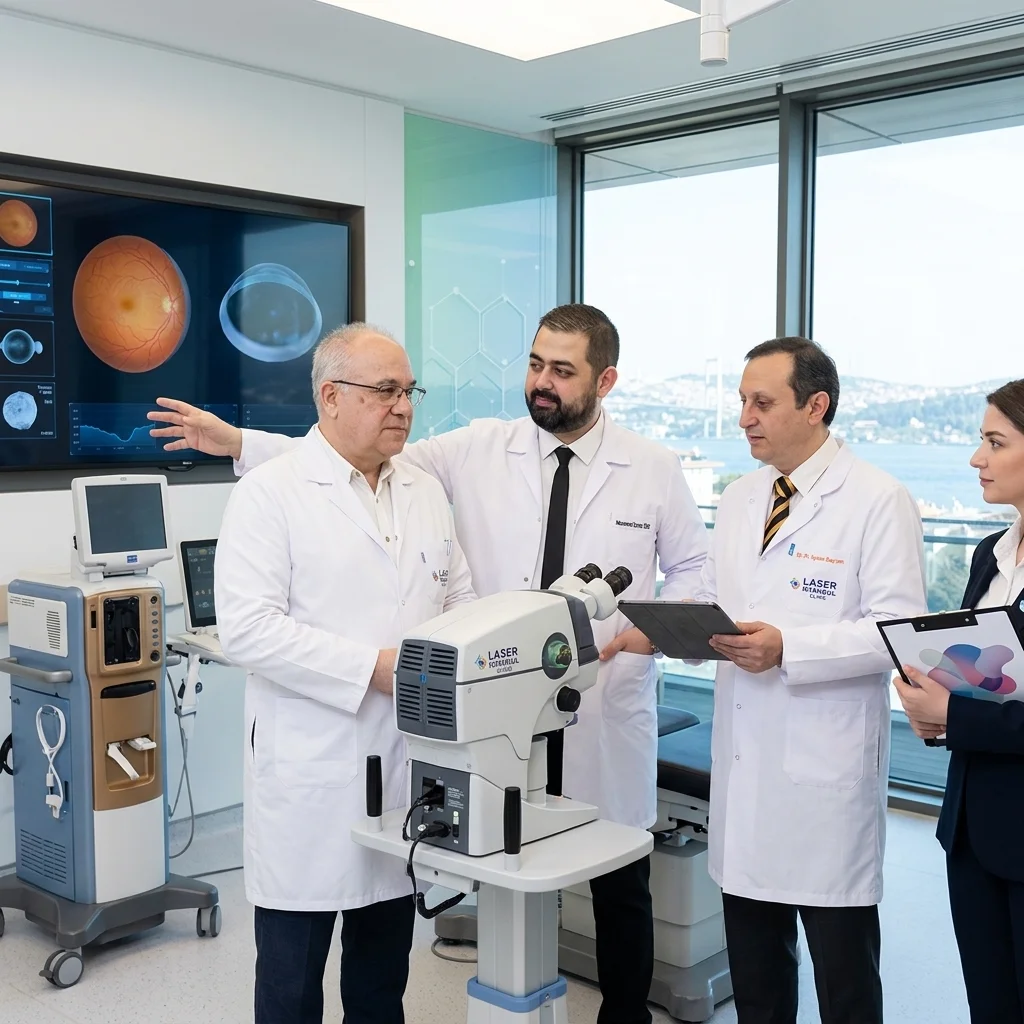
Eye strain from screens, also called digital eye strain or computer vision syndrome, is tired, sore, dry or blurry eyes, often with a headache, after long spells of near work. The main trigger is blinking far less while you look at a screen, often made worse by an uncorrected prescription, glare or a poor set-up. It is usually temporary and does not damage the eye. Regular breaks, conscious blinking, a better screen position and an up-to-date eye test relieve most cases. Eye surgeons Prof. Dr. Ahmet Satıcı, Doç. Dr. Muhammet Derda Özer and Op. Dr. Aysan Bayram see these complaints regularly.
What is eye strain?
Eye strain is the tired, aching or irritated feeling your eyes get when they work hard for a long time. The American Academy of Ophthalmology (AAO) describes it as eyes that feel sore, burning, watery or dry, sometimes with blurred vision, headaches or tired facial muscles. When it comes from phones, tablets, computers and e-readers, doctors call it digital eye strain or computer vision syndrome.
It is very common. A 2018 review in BMJ Open Ophthalmology estimated that 50% or more of computer workers have it. A 2024 survey of working adults in the UK and Ireland found 62.6% met the criteria for digital eye strain, with an average of 9.7 hours of device use a day, and symptoms were most likely in people working from home. Only 8.1% said the symptoms were significant enough to affect their work, which fits what most people experience: annoying, not dangerous.
In this guide, "eye strain" means this screen-related, temporary kind. If your eyes are painful or red, or your vision has dropped, that is something different, and the section on when to see an eye doctor tells you what to look for.
Looking up a term? See the Eye glossary A–Z →
What causes eye strain?
The short answer: your eyes are doing a job they were not designed for, for hours without a proper break. Several eye strain causes combine.
| Cause | What happens | Why it causes strain |
|---|---|---|
| Blinking much less | People normally blink about 15 times a minute; at a screen this can halve (AAO). One study measured a drop from 22 to 7 blinks a minute, another from 18.4 to 3.6 | Each blink spreads tears over the eye. Fewer blinks means a drier, less stable tear film: stinging, burning, watering, blurred vision |
| Constant near focusing | The eye's focusing muscle stays tensed to keep a close screen sharp | Aching eyes, headache behind the eyes, blur when you look up |
| Uncorrected or out-of-date prescription | Long-sightedness, astigmatism or presbyopia (age-related loss of near focus) are not fully corrected | Even 0.50–1.00 dioptre of uncorrected astigmatism makes viewing less comfortable |
| Glare and poor lighting | Reflections on the screen, a bright window behind it, or a very dark room | The eyes work harder to see the text |
| Wrong distance and posture | A screen too close, or too high or too low | Eye strain plus neck and shoulder pain |
| Eye coordination problems | The two eyes do not work together as smoothly as they should | Tiredness and headaches when reading or at a screen |
Sources: AAO, American Optometric Association (AOA), Sheppard and Wolffsohn 2018.
Two points are worth stressing. First, the cause is reduced blinking and sustained close work, not the screen somehow "radiating" the eye. Second, a screen is not the only cause: any long, close task, such as reading a book or sewing, can strain the eyes in the same way.
What are the symptoms of eye strain?
The most common eye strain symptoms are tired or sore eyes, dryness, watering, blurred vision and headache. Doctors group them in two kinds:
| Type | Typical symptoms |
|---|---|
| Surface (dry-eye type) | Burning, stinging, grittiness, irritation, watering, dry or red-looking eyes |
| Focusing (internal) type | Aching or strained eyes, eye strain pain around or behind the eyes, headache, blurred vision that clears and returns |
| Outside the eye | Neck, shoulder and upper-back pain |
Eye strain symptoms usually build up through the day, are worse on long screen days and ease when you stop. They are normally in both eyes.
What does an eye strain headache feel like, and how do you relieve it?
An eye strain headache is typically a dull ache around or behind the eyes, or across the forehead, that builds during or after long near work and eases with rest. Headache is one of the four main symptoms the AAO lists for computer eye discomfort, and researchers describe the internal, focusing type of strain as an ache and headache behind the eyes.
How to relieve an eye strain headache:
- Stop and look away. Look at something far away, ideally out of a window, for a minute or two, and blink fully several times.
- Rest your eyes for a few minutes, away from all screens, in comfortable light.
- Use lubricating eye drops (artificial tears) if your eyes also feel dry. The AAO recommends them for screen-related dryness.
- Fix the cause. Move the screen to arm's length, reduce glare and brightness, and take regular breaks (see below).
- Book an eye test if headaches keep coming back. An out-of-date prescription is a common and easily fixed cause.
Not every headache that happens at a screen comes from the eyes, so if you get frequent or severe headaches, or they come with other symptoms, speak to a doctor.
If your headaches or dizziness started after getting new glasses, that is a separate problem with its own causes:
Why do I have eye strain in one eye?
Digital eye strain usually affects both eyes, so strain or pain in only one eye deserves a little more attention. Common reasons include:
- A difference in prescription between the two eyes, or an uncorrected prescription in one eye, so that eye works harder
- A dry or irritated surface on one eye, for example from a small foreign body, a contact lens that does not suit you or an eyelid problem
- Habit and set-up: a screen or lamp off to one side, so one eye gets more glare, or you tilt your head
Strain in one eye that settles when you rest and fix your set-up is usually harmless. But pain, redness, light sensitivity, a drop in vision or blurring that does not clear in one eye should not be put down to screens. The AAO advises seeing an ophthalmologist if eyes are consistently red, blurry or watery, or become sensitive to light or painful. Have it examined.
How long does eye strain last?
Eye strain usually eases once you rest your eyes, but it comes back if the cause is not fixed. Medical reviews describe screen-related symptoms as typically transient, although they can be frequent and persistent in people who use screens every working day.
What this means in practice:
- After a normal day: it usually fades once you stop and rest.
- If it returns every day: the cause is still there (blinking, set-up, lighting or prescription), so make changes rather than waiting.
- If it lasts more than a few days despite changes, or comes with pain, redness or vision change: see an optometrist or ophthalmologist. A new or changed prescription is common.
In one study of 29 computer users with symptoms, two weeks of reminders to take regular breaks reduced digital eye strain and dry-eye symptoms. One week after the reminders stopped, those improvements had faded. So habits matter more than one-off fixes.
How do you relieve eye strain fast?
To relieve eye strain fast, look away from the screen, blink fully several times and rest for a few minutes. Then change what caused it. In order of speed:
- Blink on purpose. Slow, full blinks restore the tear film. The AAO lists conscious, frequent blinking first among its relief tips.
- Look into the distance. Gaze at something far away, which lets the focusing muscle relax.
- Use artificial tears if the eyes feel dry or gritty.
- Cut glare and match brightness. Set screen brightness close to the room's light, raise the contrast, and use a matte screen filter or close the blinds if reflections bother you.
- Reposition. Sit about 25 inches (arm's length) from the screen, with the top slightly below eye level so you look slightly downward (AAO). The AOA suggests the screen sits 15–20 degrees below eye level.
- Take a proper break and, if you can, step outside or to a window.
The 20-20-20 rule: does it work?
The 20-20-20 rule is simple: every 20 minutes, look at something 20 feet (about 6 metres) away for at least 20 seconds. It is recommended by the AOA, and a 2023 study of 29 symptomatic computer users found that rule reminders reduced digital eye strain and dry-eye symptoms. The benefit faded after the reminders stopped, and two weeks was not long enough to change eye focusing measurements or dry-eye signs. In short: it helps while you keep doing it.
Does a humidifier or the right room help?
Yes, for dryness. The US National Eye Institute (NEI) advises limiting screen time, taking breaks from staring at screens, using a humidifier so the air at home is not too dry, avoiding smoke, wind and air conditioning, and sleeping 7–8 hours a night.
What is the best eye strain treatment?
Most eye strain needs self-care, not medicine. The treatment depends on the cause:
| If the cause is… | Treatment |
|---|---|
| Dry eyes from low blinking | Conscious blinking, breaks, lubricating drops, a humidifier |
| Uncorrected or changed prescription, astigmatism or presbyopia | An eye test and the right glasses or contact lenses; some people benefit from glasses made for screen distance (20–30 inches) (AOA) |
| Poor focusing or eye coordination | Assessment by an optometrist or ophthalmologist; sometimes structured eye exercises (vision therapy) (AOA) |
| Poor lighting, glare or posture | Adjust screen, lighting and seating |
| Another eye condition causing the symptoms | Treatment of that condition, once examined |
The AAO also suggests glasses rather than contact lenses for long computer sessions.
Do blue-light glasses help eye strain?
Probably not. A 2023 Cochrane review of 17 randomised trials (619 participants) found that blue-light filtering glasses may make no difference to eye strain or visual fatigue in the short term, compared with ordinary lenses (low-certainty evidence). The review also found no studies on whether they protect the retina. The 2018 BMJ Open Ophthalmology review reached a similar view: results were inconsistent. If you want glasses to help, the best step is a current prescription, not a tinted lens.

Does screen time damage your eyes?
No: digital eye strain is uncomfortable but temporary. The AAO states that concerns about permanent eye damage from screen time are unfounded, and that the small amount of blue light from computer screens has never been shown to harm the eyes. It also reports no meaningful link between blue light and damage to human retinas.
Screens, children and short-sightedness (myopia)
The picture is different for children's growing eyes. A 2021 systematic review and meta-analysis in The Lancet Digital Health (33 studies in the review, 11 in the meta-analysis, ages from 3 months to 33 years) found that smart-device use was associated with myopia (odds ratio 1.26; combined with computer use, 1.77). The authors stress that the evidence is limited: screen time was measured by questionnaire in all studies, so it shows an association and does not prove that screens cause myopia.
For young children, the American Academy of Pediatrics, as quoted by the AAO, recommends no screen time before age 2 and no more than one hour a day for ages 2 to 5. Children who squint at a screen, sit very close or complain of headaches should have an eye test.
What is a good screen set-up?
| Setting | Aim |
|---|---|
| Distance | About 25 inches (arm's length) for a computer; the AOA gives 20–28 inches |
| Height | Top of the screen at or just below eye level; eyes look slightly downward |
| Brightness and contrast | Match the surrounding light; raise contrast |
| Glare | Matte filter, blinds, lamp to the side not behind the screen |
| Breaks | The 20-20-20 rule; stand and move regularly |
| Blinking | Blink fully and often; use drops if the eyes feel dry |
| Prescription | Eye test as often as your optician advises, and any time vision changes |
| Phones | Hold at a comfortable distance; one review measured a mean phone distance of about 32 cm and noted it can shorten during long use |
When should you see an eye doctor?
See an optometrist or ophthalmologist if eye strain keeps returning despite the changes above, because the cause is often a prescription that needs updating.
Get the eyes examined promptly if you have:
- eyes that are consistently red, blurry or watery, or that become sensitive to light or painful (AAO)
- pain or redness in one eye, or a drop in vision in one eye
- double vision, or headaches that are severe, worsening or come with other symptoms
Seek emergency care straight away for a sudden loss or sharp drop in vision, new flashes of light or floaters, or a curtain-like shadow over your vision. These are never explained by screens.
Eye strain can also sit alongside other eye problems. A routine eye test checks things a screen-comfort routine cannot, such as eye pressure. If you want to understand eye pressure, read:
For the full list of symptoms and conditions we explain, see:
Frequently asked questions
Eye strain is mostly caused by long, close focusing with too little blinking. At a screen the blink rate can halve, so the tear film dries out and the focusing muscle stays tense. An uncorrected prescription, glare, poor lighting and a bad screen position make it worse.
Tired, sore or aching eyes, dryness, burning, watering, blurred vision and headache are the main symptoms. Neck and shoulder pain often go with them. They are usually in both eyes and ease when you rest.
It is usually a dull ache around or behind the eyes, or across the forehead, that builds after long near work and eases when you rest. If headaches are severe, frequent or come with other symptoms, see a doctor rather than assuming it is the eyes.
Screen-related symptoms are typically transient and ease when you rest your eyes, but they return if the cause continues. If they last more than a few days despite better habits, or come with pain, redness or vision change, get an eye test.
Look away from the screen, blink fully several times, rest for a few minutes and use lubricating drops if the eyes feel dry. Then move the screen to arm's length and reduce glare.
Screen strain normally affects both eyes. One-eye strain can come from a prescription that differs between the eyes, a dry or irritated eye or an uneven set-up. Pain, redness or vision change in one eye needs an examination.
The evidence says probably not. A 2023 Cochrane review of 17 trials found they may make no difference to eye strain in the short term. A current prescription and regular breaks do more.
No. The AAO says permanent damage from screens is unfounded, and that blue light from screens has not been shown to harm the eyes. In children, heavy screen use is associated with short-sightedness, although the evidence is limited.
It helps while you keep doing it. In a 2023 study, reminders to follow the rule reduced digital eye strain and dry-eye symptoms in 29 computer users, but the effect faded after the reminders stopped.
Tired eyes that do not improve, or wearing glasses and wondering what else could help?
Our surgeons review your prescription, your eyes and your symptoms and tell you honestly what is behind them. Prof. Dr. Ahmet Satıcı and Op. Dr. Aysan Bayram lead lens and laser vision correction, and Doç. Dr. (Associate Professor) Muhammet Derda Özer treats corneal and retinal conditions. Laser or lens surgery is not a treatment for digital eye strain, and a correct pair of glasses is often the first answer.
Sources for the facts on this page
- American Academy of Ophthalmology. Digital devices and your eyes. https://www.aao.org/eye-health/tips-prevention/digital-devices-your-eyes
- American Academy of Ophthalmology. Computer usage: does it hurt your eyes? https://www.aao.org/eye-health/tips-prevention/computer-usage
- American Academy of Ophthalmology. Eyestrain. https://www.aao.org/eye-health/diseases/eyestrain
- American Optometric Association. Computer vision syndrome. https://www.aoa.org/healthy-eyes/eye-and-vision-conditions/computer-vision-syndrome
- Sheppard AL, Wolffsohn JS. Digital eye strain: prevalence, measurement and amelioration. BMJ Open Ophthalmology 2018;3(1):e000146. https://pmc.ncbi.nlm.nih.gov/articles/PMC6020759/ (doi 10.1136/bmjophth-2018-000146)
- Moore PA, Wolffsohn JS, Sheppard AL. Digital eye strain and its impact on working adults in the UK and Ireland. Contact Lens and Anterior Eye 2024. https://doi.org/10.1016/j.clae.2024.102176
- Talens-Estarelles C, Cerviño A, García-Lázaro S, Fogelton A, Sheppard A, Wolffsohn JS. The effects of breaks on digital eye strain, dry eye and binocular vision: testing the 20-20-20 rule. Contact Lens and Anterior Eye 2023. https://doi.org/10.1016/j.clae.2022.101744
- Singh S, Keller PR, Busija L, et al. Blue-light filtering spectacle lenses for visual performance, sleep, and macular health in adults. Cochrane Database of Systematic Reviews 2023. https://pmc.ncbi.nlm.nih.gov/articles/PMC10436683/ (doi 10.1002/14651858.CD013244.pub2)
- Foreman J, Salim AT, Praveen A, et al. Association between digital smart device use and myopia: a systematic review and meta-analysis. The Lancet Digital Health 2021. https://doi.org/10.1016/S2589-7500(21)00135-7
- National Eye Institute (NIH). Dry eye. https://www.nei.nih.gov/learn-about-eye-health/eye-conditions-and-diseases/dry-eye