
- Home
- Knowledge centre
- Eye glossary A–Z
- Cataract: What It Is, Causes, Types, Symptoms and Treatment
Cataract: What It Is, Causes, Types, Symptoms and Treatment
Medically reviewed by {{surgeon}}, {{surgeon's title and specialty}}, on {{review date}}. Last updated {{date}}.
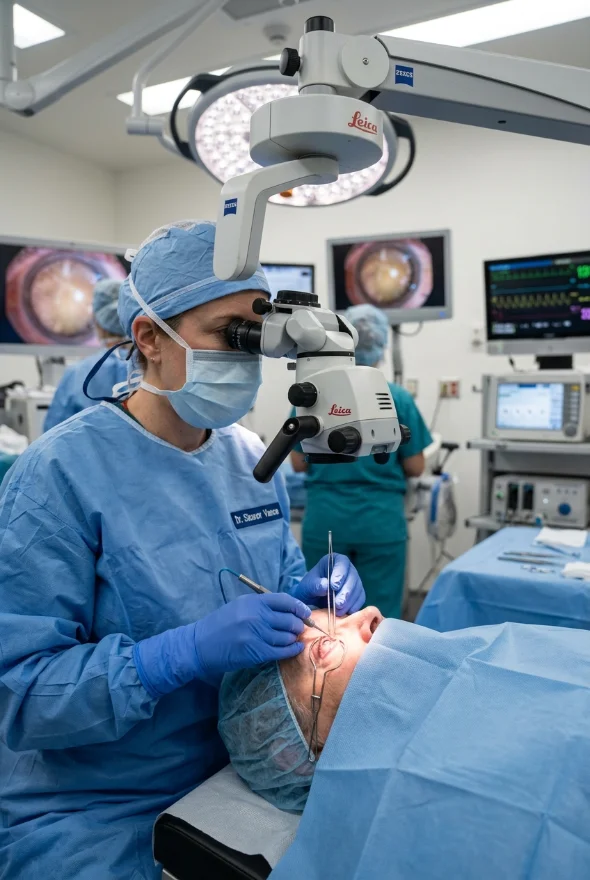
Cataract (noun, plural cataracts): a cataract is a clouding of the eye's natural lens, the clear structure behind the iris and pupil that focuses light onto the retina. It makes vision blurry, hazy and less colourful, and it usually develops slowly with age, in one or both eyes. No medicine reverses a cataract; the cloudy lens is treated by replacing it with a clear artificial lens in a short operation, and cataract surgery is one of the most common operations in the world.
Cataract: key facts
- What it is
- Cloudiness in the eye's natural lens, caused by changes in the lens proteins
- Most common cause
- Ageing. Lens proteins begin to break down naturally after about age 40, and clouding is typically noticed from around 60
- How common
- In the United States, more than half of people aged 80 or older have a cataract or have had cataract surgery (National Eye Institute)
- Symptoms
- Blurred or hazy vision, faded colours, glare and halos, poor night vision, double vision in one eye, frequent glasses changes
- Does it hurt?
- No. A cataract is painless
- Diagnosis
- Eye examination with a slit lamp, dilated retinal exam, and vision and refraction tests
- Treatment
- Surgery: the cloudy lens is replaced with an artificial intraocular lens (IOL). Early on, new glasses and brighter lighting can help
- Outcome
- About 9 in 10 people who have cataract surgery see better afterwards (National Eye Institute)
- Specialist
- Ophthalmologist (cataract surgeon); at Laser Istanbul Clinic, Prof. Dr. Ahmet Satıcı, Doç. Dr. Muhammet Derda Özer or Op. Dr. Aysan Bayram
What is a cataract? Meaning and how the lens works
The natural lens of the eye sits just behind the iris. It is clear and flexible, and it focuses light that the cornea has already bent so that a sharp image falls on the retina at the back of the eye. A lens that stays clear lets light through freely.
A cataract is what happens when that lens turns cloudy. According to the American Academy of Ophthalmology (AAO), proteins in the lens break down, so things look blurry, hazy or less colourful. Think of looking through a frosted or steamed-up window: the light still gets in, but it is scattered, so the picture loses sharpness and contrast.
Three points are worth knowing from the start:
- A cataract is not a film or growth on the surface of the eye. It is a change inside the lens, which is why it cannot be wiped away or dissolved with drops.
- Both eyes are often affected, though not always at the same speed.
- Most cataracts are age-related. The US National Eye Institute (NEI) says most are, though they can also develop after eye injuries or eye surgery.
Globally, the World Health Organization (WHO) counts cataract among the main causes of vision impairment and blindness, with about 94 million people affected, and notes that one in two people worldwide who need cataract surgery do not have access to it.
What causes cataracts? Risk factors
The main cause is ageing. The lens is made of water and protein, and the proteins slowly change over a lifetime. The AAO says this normal breakdown begins after about age 40, and that people over 60 typically start to notice clouding. Other factors can bring a cataract on sooner or make it develop faster:
| Risk factor | What the sources say |
|---|---|
| Diabetes | Cataracts can develop more quickly in people with diabetes (AAO, NEI) |
| Smoking and heavy alcohol use | Smoking is a recognised risk factor (NHS, AAO, NEI); the NEI also lists excessive alcohol |
| Sun exposure | Unprotected exposure to ultraviolet (UV) light raises risk (NHS, AAO, NEI) |
| Steroid medicines | Long-term steroid use, including inhaled steroids, is a risk factor (NHS, AAO, EyeWiki) |
| Eye injury, eye surgery or radiation | A knock to the eye, previous eye operations or radiation treatment can cause a cataract (AAO, NEI) |
| Other eye disease | Uveitis (eye inflammation) and severe short-sightedness are listed by the NHS |
| Family history | A family history of cataracts raises risk (NHS, AAO, NEI) |
Can cataracts be prevented? Not entirely. EyeWiki, the American Academy of Ophthalmology's clinical wiki, states that there is no medical treatment that prevents cataracts from developing or progressing. The NEI suggests sensible steps that may lower risk: wear sunglasses that block UV, protect your eyes from injury, do not smoke, and eat a healthy diet with plenty of fruit, vegetables and leafy greens.
What are the types of cataract?
Doctors usually describe age-related cataracts by where in the lens the clouding starts. EyeWiki lists three main types:
| Type | Where it forms | What it typically feels like |
|---|---|---|
| Nuclear sclerotic cataract | The centre (nucleus) of the lens, which yellows and hardens | Blurred distance vision and poor night driving. It often causes a short-sighted shift, so some people who normally need reading glasses find they can read without them for a while before vision clouds further |
| Cortical cataract | The outer layers (cortex) of the lens, around the nucleus | Glare is often the main symptom, especially from headlights when driving at night |
| Posterior subcapsular cataract (PSC) | The back of the lens | Often affects younger patients and progresses faster than nuclear cataract; near vision is typically more affected than distance vision |
Other terms you may hear:
- Secondary cataract (cataract caused by another condition) follows diabetes, steroid medicine, uveitis or an eye injury.
- Posterior capsule opacification (PCO), sometimes called an "after-cataract", is not a new cataract. It is clouding of the thin membrane that holds the new lens in place after cataract surgery, and it can be cleared with a quick laser treatment (see below).
- Congenital cataract is a cataract present at or soon after birth. It is assessed by a children's eye specialist.
What are the symptoms of a cataract?
Cataracts usually develop slowly and painlessly, so many people do not notice for a long time; early on there may be no symptoms at all (NEI). Typical cataract symptoms are:
| Symptom | What you may notice |
|---|---|
| Blurred, cloudy or hazy vision | Like looking through a dirty or frosted window |
| Faded or yellowish colours | Colours look dull; blues especially can look washed out (NHS) |
| Glare and halos | Bright lights, sunlight and car headlights look dazzling or surrounded by rings (NEI) |
| Poor night vision | Night driving becomes difficult |
| Double vision in one eye | A ghosted image, even when the other eye is covered (AAO) |
| Frequent changes of glasses prescription | New glasses help only for a short time (NEI) |
Early on, the NEI says, you can sometimes cope with stronger glasses, brighter lighting, anti-glare sunglasses or magnifying lenses. Symptoms that get in the way of driving, reading, work or hobbies are the main reason surgery is considered.
How is a cataract diagnosed?
A cataract is diagnosed with an eye examination. The AAO lists these tests:
- Visual acuity and refraction tests measure how well you see on a letter chart and work out your glasses prescription.
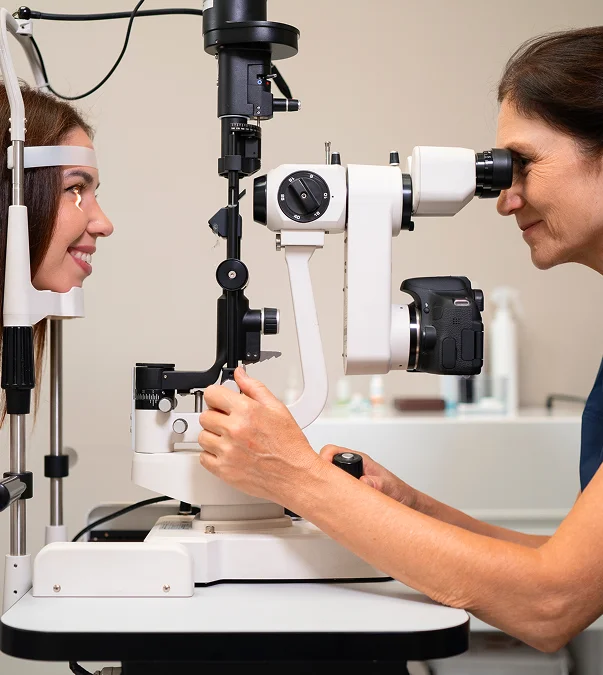
- Slit-lamp examination. A microscope with a bright, thin beam of light lets the doctor see the lens in cross-section and judge how cloudy it is and where.
- Dilated retinal examination. Drops widen your pupil so the doctor can see the lens and examine the retina behind it. The NEI recommends a dilated eye exam every one to two years for people aged 60 and over.
When surgery is planned, the surgeon also measures your eye (a scan called biometry) to choose the power of the artificial lens, and checks the cornea and retina. At Laser Istanbul Clinic, corneal topography, OCT and biometry are part of every pre-operative examination in Istanbul, and your surgeon reviews your existing scans before you book.
Cataract treatment: how are cataracts treated?
Surgery is the only way to remove a cataract. The AAO and EyeWiki both state that surgery is the only definitive treatment, and no medicine or drop clears a cataract. The NHS adds that cataracts do not usually need treatment straight away; the decision to operate depends on how much the cloudy lens limits the things you want to do.
Non-surgical options (early stage)
New glasses prescriptions, brighter lighting, anti-glare sunglasses and magnification can help for a while. They do not stop the cataract from getting worse.
Cataract surgery: how it works
In modern cataract surgery the surgeon replaces the cloudy lens with a clear artificial lens. The steps, as described by the NHS, are:
- Eye drops dilate the pupil, and the eye is numbed with drops, an injection or both, so you stay awake but feel no pain.
- The surgeon makes a tiny opening in the cornea and the lens capsule.
- Ultrasound breaks the cloudy lens into small pieces.
- The pieces are removed by suction.
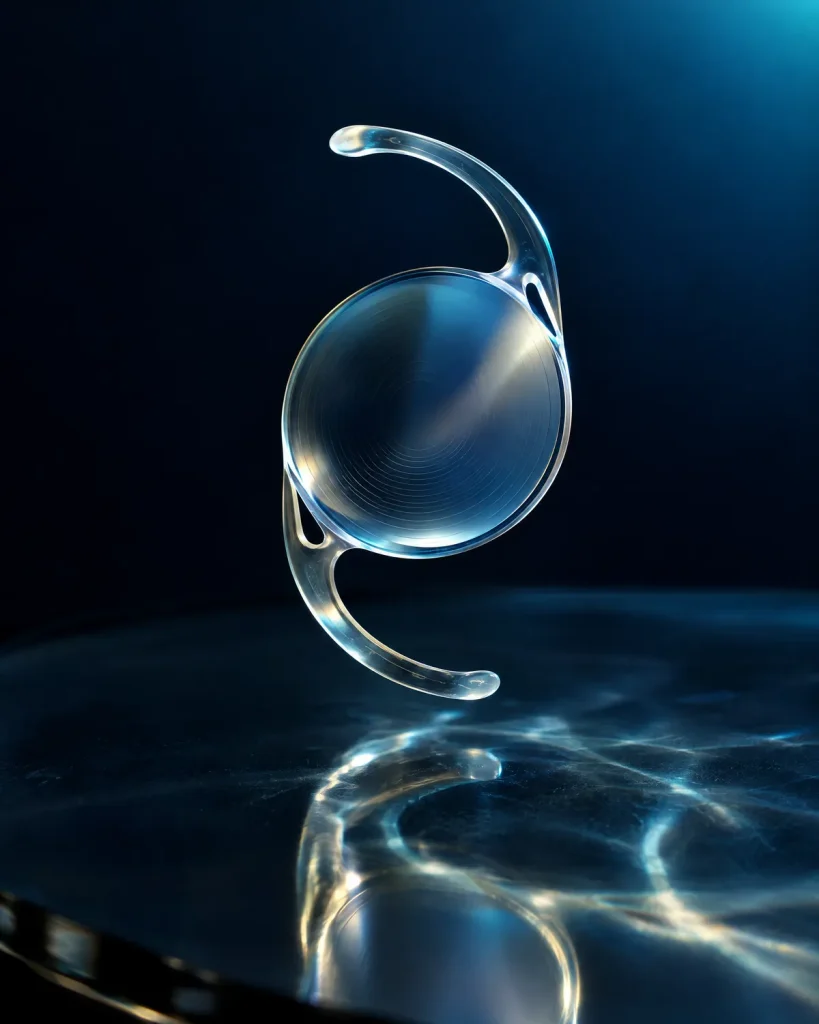
- A clear plastic artificial lens (IOL) is placed in the capsule where your natural lens was.
The AAO notes that the self-sealing incisions usually do not need stitches. The NHS states that the operation usually takes between 20 and 45 minutes. If both eyes need surgery, the NHS says they are treated on separate days.
Which artificial lens (IOL)?
The AAO describes the main lens types:
| Lens type | What it does |
|---|---|
| Monofocal | Gives clear vision at one distance (usually far); reading glasses are normally still needed |
| Toric | Also corrects astigmatism |
| Multifocal / accommodating (including trifocal) | Gives a range of vision (near, intermediate and far), which can reduce dependence on glasses |
Which lens suits you depends on your eyes, your lifestyle and your expectations, so it is worth discussing in detail with your surgeon.
Recovery
Vision may be blurry for the first hours, discomfort can last a few days, and vision usually improves over several days. The NHS says eye drops are used for about four weeks, and the AAO says complete healing takes about four to six weeks. During recovery avoid rubbing the eye, getting water in it, heavy lifting, swimming, eye make-up and driving until your vision has returned to normal (NHS). Some people still need glasses afterwards, possibly with a different prescription than before.
Results and risks
The NEI reports that about 9 in 10 people who have cataract surgery see better afterwards. The NHS describes serious complications as rare. Possible problems include infection, bleeding, inflammation, retinal detachment, lens position problems, persistent blurriness, glare or halos, and, rarely, loss of vision (NHS, AAO, NEI). Keep your follow-up appointments and use your drops as prescribed.
Can a cataract come back? Posterior capsule opacification
The cataract itself cannot return, because the natural lens has been removed. But the thin capsule that holds the new lens can turn cloudy over weeks, months or years, causing blurred vision again. EyeWiki reports that this posterior capsule opacification (PCO) develops in about 20–50% of patients within 2 to 5 years of surgery, and more often in children. It is treated with a quick Nd:YAG laser procedure that makes a small opening in the capsule. EyeWiki notes that complications of the laser are uncommon but include retinal detachment, a rise in eye pressure and swelling of the macula.
Cataract surgery with us in Istanbul
Cataract surgery and premium lens options (including trifocal lenses) are offered by Prof. Dr. Ahmet Satıcı, who also performs refractive lens exchange. Doç. Dr. Muhammet Derda Özer (Doç. means Associate Professor) and Op. Dr. Aysan Bayram also treat cataracts; Doç. Dr. Özer speaks Turkish and English, and Op. Dr. Bayram, a female surgeon, speaks English. Surgery takes place in a fully equipped, Ministry of Health–licensed operating theatre in Istanbul. Many UK patients look at options abroad because of long NHS waits: according to our market research, about 650,000 people were waiting for NHS cataract surgery, with a median wait of 41 weeks, and the NHS does not pay for premium lenses.
When to see a doctor about a cataract
Book an eye test or see your optician or eye doctor if:
- your vision is becoming blurred, hazy or dull, or colours look faded
- glare, halos or poor night vision are getting in the way of driving, reading or work
- your glasses prescription keeps changing and new glasses help only briefly
- you see double with one eye
- you are 60 or older and have not had a dilated eye examination in the last one to two years (NEI)
In the UK, the NHS advises seeing an optician first; they refer you to an eye specialist if needed. If you drive, you must meet the legal eyesight standard; in the UK, the DVLA must be told if your eyesight falls below it (NHS).
Seek urgent eye care the same day for a sudden loss or change of vision, new flashes of light or a shower of floaters, a dark curtain over part of your vision, or a painful red eye. These are not typical of a cataract and can signal other conditions that need quick treatment. After surgery, increasing pain, redness or falling vision also needs an immediate call to your surgeon.
If you already have a cataract diagnosis and want a second opinion on timing, lens options or surgery in Istanbul, you can send your prescription and scans for review before you travel.
Frequently asked questions
A cataract is a cloudy area in the eye's natural lens that makes vision blurry, hazy and faded. It forms when lens proteins break down, most often with age. It is painless and develops slowly, but it will not clear by itself.
Ageing is the most common cause. Other causes and risk factors include diabetes, smoking, long-term steroid use, unprotected sun exposure, eye injury, eye surgery, uveitis, severe short-sightedness and a family history of cataracts.
Early signs include slightly blurred or hazy vision, colours looking faded, glare from lights and headlights, poorer night vision and a prescription that keeps changing. Some people have no symptoms at first.
No. The AAO and EyeWiki both state that surgery is the only definitive treatment; no drops, tablets or supplements dissolve a cataract. New glasses, better lighting and anti-glare sunglasses can help early on but do not stop it progressing.
The NHS says it usually takes 20 to 45 minutes. It is done under local anaesthetic, with drops, an injection or both, so you are awake but should feel no pain.
Vision usually improves within several days, you use eye drops for about four weeks (NHS), and complete healing takes about four to six weeks (AAO). Avoid rubbing the eye, swimming, heavy lifting and driving until your surgeon says it is safe.
No. Surgery is advised when a cataract limits things you want or need to do, such as driving, reading or working, rather than when it reaches a particular stage. Your surgeon will advise on the timing for your eyes.
The cataract cannot return, but the capsule behind the new lens can become cloudy (posterior capsule opacification) in an estimated 20–50% of patients within 2 to 5 years. A short laser procedure clears it.
There is no single best lens. Monofocal lenses give clear vision at one distance, toric lenses also correct astigmatism, and multifocal or trifocal lenses can reduce the need for glasses at several distances. Your surgeon recommends a lens after measuring your eyes and discussing your lifestyle.
Yes. Prof. Dr. Ahmet Satıcı, Doç. Dr. Muhammet Derda Özer and Op. Dr. Aysan Bayram treat cataracts in Istanbul. You can send your scans for a free online review first.
Sources for the facts on this page
- NHS. Cataracts. https://www.nhs.uk/conditions/cataracts/
- NHS. Cataract surgery, and "What happens" page. https://www.nhs.uk/conditions/cataract-surgery/ · https://www.nhs.uk/conditions/cataract-surgery/what-happens/
- NHS. Cataract surgery: risks. https://www.nhs.uk/conditions/cataract-surgery/risks/
- National Eye Institute (NEI). Cataracts. https://www.nei.nih.gov/learn-about-eye-health/eye-conditions-and-diseases/cataracts
- National Eye Institute (NEI). Cataract surgery. https://www.nei.nih.gov/learn-about-eye-health/eye-conditions-and-diseases/cataracts/cataract-surgery
- American Academy of Ophthalmology. What Are Cataracts? https://www.aao.org/eye-health/diseases/what-are-cataracts
- American Academy of Ophthalmology. What Is Cataract Surgery? https://www.aao.org/eye-health/treatments/what-is-cataract-surgery
- EyeWiki (AAO). Cataract. https://eyewiki.org/Cataract
- EyeWiki (AAO). Posterior Capsule Opacification. https://eyewiki.org/Posterior_Capsule_Opacification
- World Health Organization. Blindness and visual impairment (fact sheet). https://www.who.int/news-room/fact-sheets/detail/blindness-and-visual-impairment
Cloudy vision, glare, or told you need cataract surgery?
Send us your prescription and eye scans. One of our three surgeons will review them and tell you which options may suit your eyes, with no obligation.
3 eye surgeons
Your case is reviewed by a named surgeon, not a salesperson. Reply within {{response time}}.
 Prof. Dr. Ahmet Satıcı
 Doç. Dr. Muhammet Derda Özer
 Op. Dr. Aysan Bayram