
- Home
- Knowledge centre
- Lens & cataract guides
- EDOF Lens vs Trifocal Lens vs Monofocal Lens: Which One Is Right for You?
EDOF Lens vs Trifocal Lens vs Monofocal Lens: Which One Is Right for You?
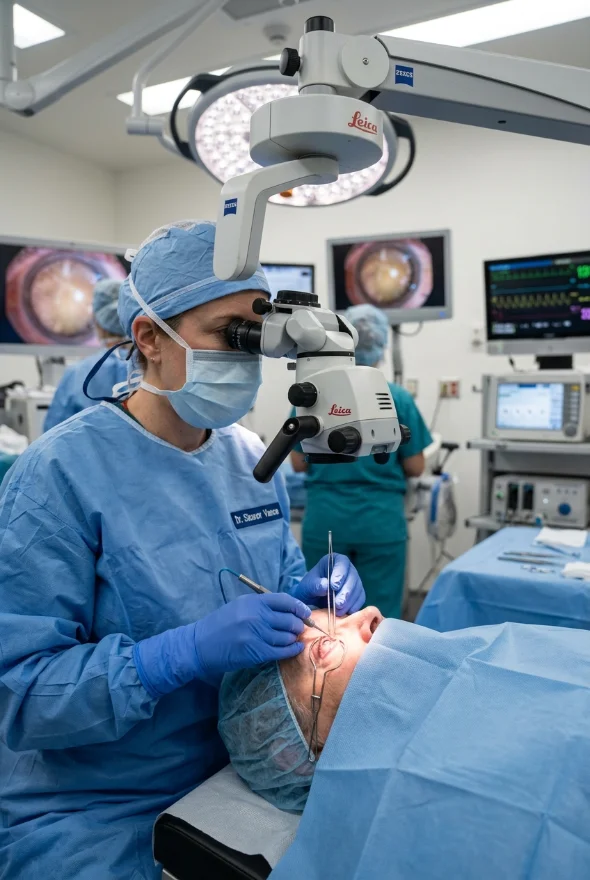
In an EDOF lens vs trifocal lens decision, the trifocal gives the most freedom from glasses, including for reading, but more halos and glare at night. The EDOF gives sharp distance and arm's-length vision with fewer night-time side effects, but you will usually still need reading glasses. A monofocal lens focuses at one distance and has the fewest side effects. Prof. Dr. Ahmet Satıcı and Op. Dr. Aysan Bayram help patients choose after a full eye examination.
What is the difference between monofocal, EDOF and trifocal lenses?
Monofocal, EDOF and trifocal lenses are three kinds of artificial lens (intraocular lens, or IOL) that replace your natural lens during cataract surgery or refractive lens exchange (RLE); they differ in how many distances they focus on. The Royal College of Ophthalmologists (RCOphth) says RLE is the same operation as cataract surgery, and that the only difference is the reason for it.
- Monofocal lens: one focus point, usually set for distance. The American Academy of Ophthalmology (AAO) says you will need glasses for reading and close-up work.
- EDOF lens (extended depth of focus): one focus point that is stretched into a continuous range, covering distance and the middle distance (screens, the car dashboard, the kitchen counter). EyeWiki, the AAO's clinical encyclopedia, describes it as a single, continuous, elongated focal point.
- Trifocal lens: three focus points, for distance, intermediate and near. EyeWiki gives the focus points of the PanOptix trifocal as about 40 cm (reading), 60 cm (computer) and distance, with roughly 25% of the light sent to near, 25% to intermediate and 50% to distance.
| Monofocal lens | EDOF lens | Trifocal lens | |
|---|---|---|---|
| How it focuses | One sharp focus point | One stretched, continuous focus range | Three focus points: near, intermediate, distance |
| Distance vision | Excellent | Excellent, similar to monofocal | Excellent, similar to monofocal |
| Arm's length (screens, dashboard) | Glasses usually needed | Good to very good | Good |
| Reading small print | Glasses needed | Often still needs glasses | Usually without glasses |
| Halos and glare at night | Fewest | Few, closer to monofocal | More common |
| Completely glasses-free | Rare | About one in three in one comparison | About four in five |
| Who pays | Standard lens, covered by most insurance in the US (AAO) | Premium lens, usually out of pocket | Premium lens, usually out of pocket |
Figures are explained and sourced in the sections below. Individual results vary.
EDOF lens vs trifocal lens: which gives better vision?
The trifocal lens gives better near vision and more freedom from glasses; the EDOF lens gives a smoother distance-to-arm's-length range with fewer night-time side effects. Both give distance vision comparable to a monofocal lens.
What the Cochrane review found. A 2024 Cochrane review compared trifocal and EDOF lenses after cataract surgery. It included 5 studies with 233 participants. Distance vision was little different between the two. Near vision favoured the trifocal: in one study only 3% of people with a trifocal lens had poor near vision, against 30% with an EDOF lens. Both lens types were reported to cause glare and halos. The evidence was low-certainty, so treat the numbers as a guide, not a promise.
What a head-to-head patient survey found. In a 2022 US study (Hovanesian et al.), complete freedom from glasses for every activity was reported by 83% of patients with the PanOptix trifocal lens and 33% with the Vivity EDOF lens (59 and 60 patients). The picture reversed for night-time symptoms: 85% of Vivity patients and 69% of PanOptix patients noticed no glare and halo, or just a little, in dim light. Satisfaction was high in every group.
What the regulator's studies found. The US Food and Drug Administration (FDA) approval documents show each lens against a monofocal control:
| 6-month FDA study | PanOptix trifocal (approved 2019) | Vivity EDOF (approved 2020) |
|---|---|---|
| Patients (monofocal control group) | 129 (114) | 107 (113) |
| Main benefit | 80.5% said they "never" needed glasses overall, against 8.2% with the monofocal lens | Depth of focus 1.53 D, which is 0.54 D more than the monofocal lens; 72.9% of first eyes read 20/32 or better at arm's length |
| Reading (near) | 83.6% never needed glasses for near work | 40.2% read 20/40 or better at 40 cm, below the 50% target the study set |
| Severe halos (monofocal control) | 12.6% (0.9%) | 0.9% (0.9%) |
| Severe starbursts (monofocal control) | 16.0% (1.8%) | 3.8% (2.7%) |
| Contrast in dim light | Slightly lower; the FDA judged it not clinically meaningful | Lower than the monofocal lens; shown as a warning on the label |
The two studies were run separately on different groups, so use them as a guide, not as a head-to-head test.
How to read this. If reading small print, menus and your phone without glasses matters most, the trifocal is more likely to give you that. If you spend your day at screens or behind the wheel and can live with light reading glasses, an EDOF lens may be the better trade. TECNIS PureSee, a newer EDOF lens approved by the FDA in March 2026, is the latest in this category; its manufacturer, Johnson & Johnson, says 97% of patients in its study reported no very bothersome halos or glare. That is a company figure, not an independent comparison.
EDOF lens vs monofocal lens: what do you gain, and what do you give up?
An EDOF lens gives you clear vision further along the range than a monofocal lens does, at the cost of a premium price and, with some designs, slightly lower contrast in dim light. Distance vision is comparable.
The AAO's consensus criteria for calling a lens "EDOF" are strict: it must be tested in at least 100 patients, give at least 0.5 dioptres more depth of focus than a monofocal control, get at least half of eyes to 20/32 or better at 66 cm (arm's length), and match the monofocal lens for distance vision. In practice:
- What you gain: better intermediate vision for screens, cooking and the dashboard. In the Vivity FDA study, intermediate vision at 66 cm was about 1.6 lines better than with a monofocal lens.
- What you give up: a monofocal lens is the reference standard for night vision and contrast. The AAO describes monofocal lenses as having minimal side effects and as suitable for frequent night drivers, whereas EDOF lenses carry concerns similar to multifocals, especially at night.
- What stays the same: with either lens you will normally need glasses for reading. EDOF lenses improve the middle of the range, not close-up reading.
- Cost: the AAO notes that monofocal lenses are covered by Medicare and most insurance in the US, while EDOF lenses are premium lenses, usually paid out of pocket. The RCOphth says monofocal lenses are generally less expensive than multifocal ones.
A monofocal lens remains a sound choice for many people. The RCOphth says monofocal lenses aim to reduce dependence on glasses for distance (driving) vision, and the AAO says multifocal and EDOF lenses are generally not recommended if you have vision loss from other eye disease such as glaucoma or macular degeneration.
EDOF lens vs multifocal lens: is an EDOF lens a multifocal lens?
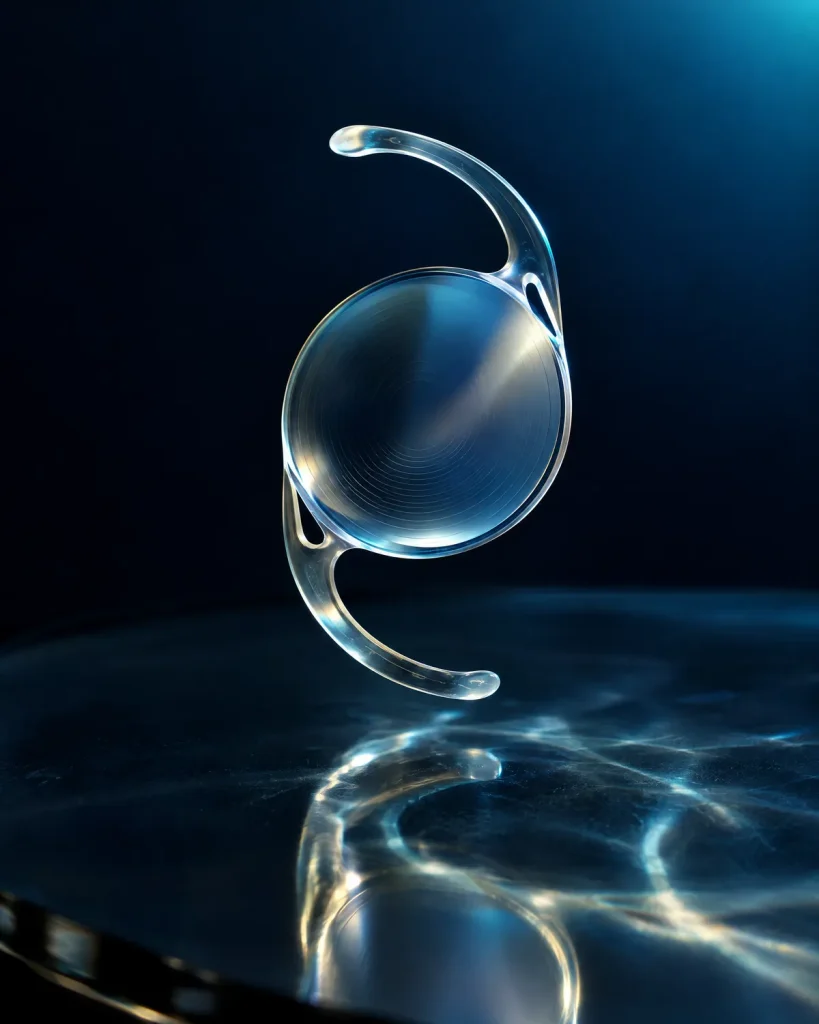
No: an EDOF lens is a different design from a multifocal lens, although both belong to the family of presbyopia-correcting lenses that aim to reduce your need for reading glasses. A multifocal lens splits light between separate focus points; an EDOF lens stretches one focus point.
- Multifocal (including trifocal): "multifocal" is the umbrella term for any lens with more than one focus point. A bifocal multifocal has two (near and far); a trifocal has three (near, intermediate and far). The AAO says multifocal lenses provide distance and near focus at the same time.
- EDOF: EyeWiki says the key principle is a single, contiguous, elongated focal point. Because EDOF lenses avoid splitting light into several zones, they can reduce the halos and glare typical of multifocals. EyeWiki also notes that both EDOF and multifocal lenses can still cause halos and glare.
- Some lenses blend the two. TECNIS Synergy combines multifocal and EDOF optics to give a continuous range from distance to about 33 cm. It is covered on our trifocal lens page and in the premium lens guide linked above.
In a Cochrane review of 20 trials with 2,061 people, multifocal lenses gave distance vision no different from monofocal lenses, better near vision and less dependence on glasses (risk ratio 0.63). The price was more visual side effects: glare was about 1.4 times and halos about 3.6 times as likely as with monofocal lenses. The authors conclude that whether better near vision outweighs these effects "will vary between people".
Which lens causes the fewest halos and glare at night?
A monofocal lens causes the fewest halos and glare, an EDOF lens a little more, and a trifocal lens the most. The pattern is consistent across the Cochrane reviews, the FDA documents and the 2022 comparison above.
| Monofocal | EDOF | Trifocal | |
|---|---|---|---|
| Halos and glare | Lowest; the AAO calls side effects minimal | Fewer than multifocal; not zero | Most common of the three |
| Severe halos / starbursts in the FDA studies | 0.9% / 1.8% (PanOptix study control lens) | 0.9% / 3.8% (Vivity study) | 12.6% / 16.0% (PanOptix study) |
| Contrast in dim light | Reference standard | Vivity: lower, with a label warning; PureSee: manufacturer says comparable to monofocal | Slightly lower in the FDA study, judged not clinically meaningful |
| Night driving | Suitable for frequent night drivers (AAO) | The AAO advises people who drive a lot at night to think carefully before choosing | The AAO advises people who drive a lot at night to think carefully before choosing |
Do halos go away? Usually they fade. The RCOphth says the optical side effects of multifocal lenses tend to diminish with time, and that 19 out of 20 patients are satisfied or very satisfied with their vision three to six months after multifocal lens implantation. About 1% cannot adapt and choose to have the lens exchanged for a monofocal lens, which the RCOphth describes as a potentially complicated procedure. EyeWiki notes that patients report these effects decrease over time as the brain adapts.
How many people are free of glasses with each lens?
About four in five people are completely free of glasses with a modern trifocal lens, about one in three with an EDOF lens in one comparison, and very few with a monofocal lens set for distance. The exact figure depends on the study, the lens and how "glasses-free" is measured.
- Trifocal: the RCOphth says about four out of five patients are completely free of glasses after RLE with widely used contemporary multifocal lenses. In the PanOptix FDA study, 80.5% never needed glasses overall.
- EDOF: in the 2022 comparison, 33% of Vivity patients were completely glasses-free for every activity.
- Monofocal: in the PanOptix FDA study, only 8.2% of people with the monofocal control lens never needed glasses. The NHS says that after cataract surgery you may still need glasses for reading or seeing long distances, and that your prescription may be different to before surgery.
"Glasses-free" rarely means "never again". The RCOphth says that if you do need glasses after RLE, it is usually for one specific activity, such as fine print, rather than all day.
Who suits each lens?
The right lens depends on how you use your eyes, your eye health and which trade-offs you accept. This table is a starting point for the conversation with your surgeon, not a prescription.
| If this sounds like you | A lens to discuss |
|---|---|
| You want to read, use a phone and drive with the fewest glasses, and accept some night-time halos | Trifocal |
| You spend most of the day at screens, drive often and are happy to wear light readers for small print | EDOF |
| You drive a lot at night for work, or you are worried about halos and glare | EDOF or monofocal |
| You have glaucoma, macular degeneration or another eye disease | Usually monofocal (AAO, RCOphth) |
| You are happy wearing glasses for reading and want the simplest, lowest-cost option | Monofocal |
| You have astigmatism | A toric version, which the AAO says is made for astigmatism; the PanOptix and Vivity lenses both have toric models |
Eye health comes first. The RCOphth says you may not be suitable for a multifocal lens if you have pre-existing eye health problems. At Laser Istanbul Clinic, if your scans show a corneal or retinal problem, your case is reviewed by Doç. Dr. Muhammet Derda Özer (Doç. means Associate Professor), our cornea and retina specialist, before any lens is chosen.
Age matters too. The RCOphth says people over 50 with a prescription outside the usual range for laser eye surgery are likely to be suitable for RLE, and that laser surgery or a phakic lens is generally better than RLE for younger people who still have a clear, flexible natural lens.
How do you choose between the three lenses?
You choose by answering four questions with your surgeon, using measurements from your own eyes.
- What do you want to see without glasses? Reading, screens, driving, or all three.
- How much do you drive at night? Frequent night driving points towards a monofocal or EDOF lens.
- Are your eyes otherwise healthy? A healthy cornea, macula and optic nerve are needed for a premium lens to work well.
- How do you feel about halos and about paying more? Premium lenses cost more, and the NHS does not pay for them.
Before any lens is chosen, your examination at Laser Istanbul Clinic includes optical biometry to calculate the lens power, corneal topography to measure astigmatism and an OCT scan of the macula and optic nerve. Lens surgery is led by Prof. Dr. Ahmet Satıcı, with Op. Dr. Aysan Bayram for cataract patients. They tell you plainly if a premium lens is not right for your eyes. Surgery takes place in a fully equipped, Ministry of Health–licensed operating theatre in Istanbul, and the NHS says a cataract operation usually takes between 20 and 45 minutes.
How much do the three lenses cost?
A monofocal lens is the least expensive; EDOF and trifocal lenses are premium lenses, so most people pay for them privately. The RCOphth says surgery to reduce your need for glasses is not available on the NHS and is not covered by private health insurance, and that monofocal lenses are generally less expensive than multifocal ones.
At Laser Istanbul Clinic, premium lens surgery starts from {{£ price}} for both eyes, confirmed in writing by your surgeon after they review your scans. The price includes your pre-operative examination and scans, surgery by your named surgeon, medication, follow-up checks in Istanbul, a personal interpreter, a coordinator and remote follow-up. Hotel and airport transfers are not included; they are a separate charge, arranged on request.
Frequently asked questions
A trifocal lens has three focus points (near, intermediate and distance), while an EDOF lens has one focus point stretched into a continuous range. The trifocal gives better near vision and more freedom from glasses; the EDOF gives fewer halos and glare. A 2024 Cochrane review found distance vision was little different between them.
It depends on what you want. An EDOF lens gives better intermediate vision than a monofocal lens with comparable distance vision, but you will usually still need reading glasses, and some EDOF designs have slightly lower contrast in dim light. A monofocal lens has the fewest side effects, and the AAO considers it suitable for frequent night drivers.
No. A multifocal lens splits light between separate focus points, while an EDOF lens creates one elongated focus point, which is why it can cause fewer halos. Both are premium, presbyopia-correcting lenses, and both can still cause some glare and halos.
A monofocal lens is the most comfortable choice for frequent night driving, according to the AAO, which advises that multifocal and EDOF lenses may not suit people who drive a lot at night. Your surgeon can check your pupil size and corneal measurements before you decide.
Probably. In the Vivity FDA study, only 40.2% of first eyes read 20/40 or better at 40 cm without glasses, and in a 2022 comparison 33% of Vivity patients were completely glasses-free. Many people are happy with light readers for small print.
A monofocal lens gives the fewest, an EDOF lens a little more and a trifocal lens the most. In the PanOptix FDA study, 12.6% reported severe halos, against 0.9% with a monofocal lens, and the RCOphth says these effects tend to fade with time.
Yes, toric versions exist. The AAO says toric lenses are designed for astigmatism, and the PanOptix and Vivity lenses both have toric models. Your corneal scan shows how much astigmatism you have and which version suits you.
Yes, but it is not simple. The RCOphth says about 1% of patients cannot adapt to a multifocal lens and have it exchanged for a monofocal lens, which can be a complicated procedure. Choosing carefully before surgery matters more than relying on a later swap.
No. The NHS does not pay for premium lenses, and the RCOphth says lens surgery to reduce your need for glasses is not available on the NHS. In the US, the AAO says premium lenses are usually paid for out of pocket.
It depends on your eyes and what you want from your vision. After a full examination, your surgeon explains which lens suits you and why, and tells you honestly if a monofocal lens is the better choice. No surgeon can promise a particular result.
Ready to compare lenses for your own eyes?
Send us your prescription and scans, and your surgeon will tell you which lens is likely to suit you: monofocal, EDOF or trifocal. Premium lens surgery is led by Prof. Dr. Ahmet Satıcı, with Op. Dr. Aysan Bayram for cataract patients.
Sources for the facts on this page
- American Academy of Ophthalmology. Factors to Consider in Choosing an IOL for Cataract Surgery (updated 31 March 2025): monofocal, multifocal and EDOF comparison; night driving; cost. https://www.aao.org/eye-health/tips-prevention/best-artificial-lens-implant-iol-cataract-surgery
- American Academy of Ophthalmology. Intraocular Lenses (IOLs) for Cataract Surgery: definitions of monofocal, multifocal, EDOF and toric IOLs. https://www.aao.org/eye-health/diseases/cataracts-iol-implants
- EyeWiki (AAO). Extended Depth of Focus IOLs: definition and consensus criteria. https://eyewiki.org/Extended_Depth_of_Focus_IOLs
- EyeWiki (AAO). Trifocal Intraocular Lenses: PanOptix focal points and light distribution; halos and adaptation. https://eyewiki.org/Trifocal_Intraocular_Lenses
- Tavassoli S, et al. Trifocal versus extended depth of focus (EDOF) intraocular lenses after cataract extraction. Cochrane Database of Systematic Reviews 2024;7:CD014891. https://pubmed.ncbi.nlm.nih.gov/38984608/
- de Silva SR, et al. Multifocal versus monofocal intraocular lenses after cataract extraction. Cochrane Database of Systematic Reviews 2016;12:CD003169. https://pubmed.ncbi.nlm.nih.gov/27943250/
- Hovanesian JA, Jones M, Allen Q. The Vivity Extended Range of Vision IOL vs the PanOptix Trifocal, ReStor 2.5 Active Focus and ReStor 3.0 Multifocal Lenses. Clinical Ophthalmology 2022;16:145–152. https://pubmed.ncbi.nlm.nih.gov/35082481/
- US Food and Drug Administration. Summary of Safety and Effectiveness Data, PMA P040020/S087: AcrySof IQ PanOptix Trifocal IOLs (approved 26 August 2019). https://www.accessdata.fda.gov/cdrh_docs/pdf4/P040020S087B.pdf
- US Food and Drug Administration. Summary of Safety and Effectiveness Data, PMA P930014/S126: AcrySof IQ Vivity Extended Vision IOLs (approved 26 February 2020). https://www.accessdata.fda.gov/cdrh_docs/pdf/P930014S126B.pdf
- The Royal College of Ophthalmologists. Refractive Lens Exchange: Patient Information (PROF/2024/498). https://www.rcophth.ac.uk/guidance-resources/refractive-lens-exchange/
- Johnson & Johnson. Johnson & Johnson announces FDA approval of TECNIS PureSee intraocular lens (12 March 2026; manufacturer statement). https://www.jnj.com/media-center/press-releases/johnson-johnson-announces-fda-approval-of-tecnis-puresee-intraocular-lens-a-breakthrough-solution-for-u-s-cataract-patients
- NHS. Cataract surgery. https://www.nhs.uk/conditions/cataract-surgery/