
- Home
- Knowledge centre
- Lens & cataract guides
- Replacement Lens Surgery Advantages and Disadvantages: What to Know Before RLE
Replacement Lens Surgery Advantages and Disadvantages: What to Know Before RLE
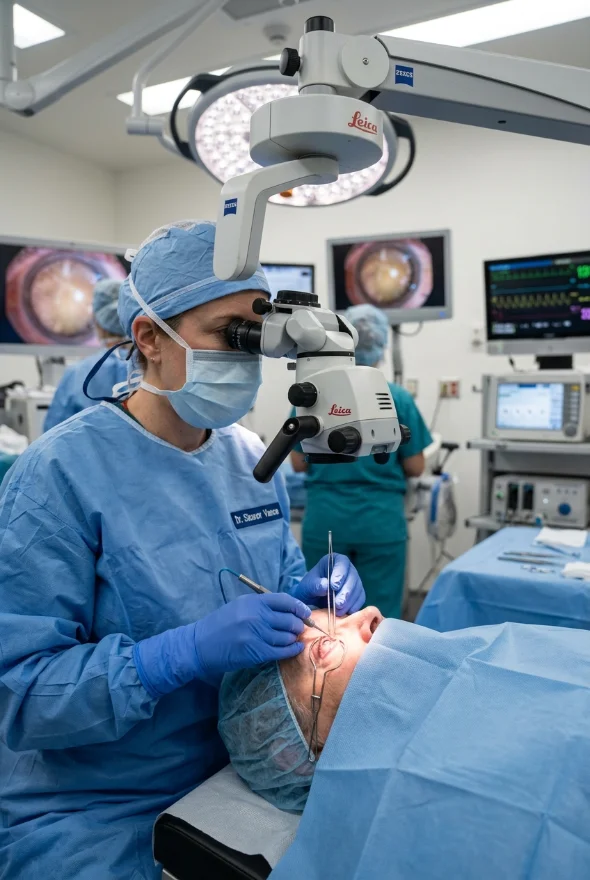
The main advantages of replacement lens surgery (refractive lens exchange, RLE) are freedom from glasses for about four in five patients with modern multifocal lenses, a stable prescription and no future cataract operation. The main disadvantages are halos and glare, a small risk of serious sight loss (about 1 in 500), a higher retinal detachment risk and a cost that is not covered by the NHS. At Laser Istanbul Clinic, Prof. Dr. Ahmet Satıcı leads lens replacement.
Replacement lens surgery advantages and disadvantages at a glance
Replacement lens surgery, also called refractive lens exchange (RLE), clear lens exchange or "smart lens" surgery, removes your natural lens and puts an artificial intraocular lens (IOL) in its place. According to the Royal College of Ophthalmologists (RCOphth), it is identical to modern cataract surgery; the only difference is the reason it is done. Cataract surgery treats a cloudy lens, while RLE aims to reduce your need for glasses or contact lenses.
| Advantages | Disadvantages | |
|---|---|---|
| Vision | About 4 in 5 patients completely glasses-free with widely used multifocal lenses; about 95% satisfied | Halos, glare and other light-scatter effects are common in the early months; about 1% of multifocal patients cannot adapt |
| Glasses | Often free of reading glasses and varifocals | Glasses may still be needed for some tasks, especially with a monofocal lens |
| Long term | Prescription normally stable; no cataract later | A misty "capsule" can develop months or years later and needs a laser |
| Safety | Quick day-case operation, usually 20 minutes per eye | Permanent serious sight loss in about 1 in 500; retinal detachment risk about five times higher for four years |
| Practical | Elective: you decide if and when | Not covered by the NHS or private health insurance; hard to reverse |
What are the advantages of replacement lens surgery?
Before the downsides, it helps to know what you would be trading them for. According to the RCOphth:
- Less dependence on glasses. About four out of five patients are completely free of glasses after RLE with widely used contemporary multifocal lenses. Those who still need glasses usually need them for one specific task, near, intermediate or distance.
- High satisfaction. Approximately 95% of patients are satisfied with the outcome, and many describe it as life changing.
- No cataract later. RLE eliminates the need for cataract surgery in later life, because the new lens cannot cloud over.
- Stable vision. If no new eye problem develops, vision normally remains good and your glasses prescription normally stays stable.
- Corrects high prescriptions. Almost any level of short sight (myopia) or long sight (hyperopia) can be corrected, and lenses with built-in astigmatism correction are available.
- A safety benefit for some long-sighted eyes. Many long-sighted eyes have a narrow drainage space that tightens as the natural lens grows with age, leaving them vulnerable to a sudden, painful form of glaucoma (angle closure). Because IOLs are thinner than the natural lens, RLE creates more space.
- Normal eye care afterwards. Glaucoma, diabetic retinopathy and age-related macular degeneration can still be monitored and treated as usual.
What are the disadvantages of lens replacement surgery?
The honest answer is that the disadvantages fall into three groups: effects on your vision that most people notice for a while, problems that are fairly common but can be put right, and rare but serious complications. The sections below take them in turn, with the numbers.
Halos, glare and other visual side effects
Most patients notice some light scatter and unwanted images in the early months after RLE, according to the RCOphth. A shadow or shimmering arc at the edge of vision is common with any lens. Some multifocal lenses tend to cause halos around lights; others cause blur or ghost images. The NHS says glare, halos, starbursts and ghost images normally improve within a few months.
Multifocal lenses split light between several focus points, which is how they give you near, intermediate and distance vision, and the price is more optical side effects. A review by Alió and colleagues notes that this can bring halos, glare and lower contrast sensitivity. The American Academy of Ophthalmology (AAO) says these effects are especially true at night or in dim light, and that people who drive a lot after dark may want to avoid multifocal or EDOF lenses, although most people adapt.
What the trials show for one widely used trifocal lens: in the US Food and Drug Administration (FDA) approval study of the AcrySof IQ PanOptix lens, starbursts were the symptom patients most often said bothered them "very much" at 6 months, at 4.8% of patients, compared with 0.9% for the monofocal control lens. Binocular contrast sensitivity was slightly reduced compared with the monofocal lens, but the difference was not judged clinically meaningful.
Do halos go away? For most people they fade. The RCOphth reports that 19 out of 20 patients are satisfied or very satisfied with their vision three to six months after multifocal lens surgery. But side effects "do not always resolve completely", and approximately 1% of multifocal patients cannot adapt and choose to have the multifocal lens swapped for a monofocal one, which the RCOphth describes as a potentially complicated procedure.
Unwanted images also occur with monofocal lenses. A 2022 review of dysphotopsia, the medical term for these effects, reports that after cataract surgery up to 67% of patients notice glare, streaks or halos early on, that symptoms settle spontaneously in most, and that in up to 2.2% they last for a year. A different problem, a dark crescent or shadow in the side vision, called negative dysphotopsia, affects up to 26% of patients early on and persists at one year in 0.13% to 3%.
You may still need glasses
RLE does not promise a life without glasses. With a monofocal lens set for distance, you will normally still need reading glasses (RCOphth, AAO). Even with multifocal lenses, about one in five patients is not completely free of glasses. Two further things can leave a small prescription behind:
- Lens-power calculation has limits. The RCOphth explains that the formulas and eye measurements used to choose your lens have limits in accuracy, so a laser touch-up to fine-tune the focus is sometimes needed. Our policy on touch-ups: {{laser touch-up and YAG capsulotomy policy and the period it covers}}.
- Dry or uneven eye surface. A study of 74 eyes at one US eye centre (Gibbons et al., 2016) looked at patients who were unhappy after presbyopia-correcting lenses. Their most common causes of complaint were residual refractive error (57%) and dry eye (35%). This is a group selected for dissatisfaction, so it shows what goes wrong, not how often. Most could be helped without further surgery, but 32% were still completely dissatisfied after treatment and 7% needed their lens exchanged.
Dry eyes and surface discomfort
Some surface discomfort is common in the early months after any eye surgery. The RCOphth says it is usually mild after RLE, often affects one eye more than the other, and responds to lubricating drops; for patients with a normal eye surface before surgery, lasting problems are unusual. A 2020 review (Naderi et al.) notes that dry eye disease is common and can be made worse by cataract surgery, which is why surgeons should look for it and treat it before the operation.
A misty "capsule" months or years later
The thin membrane that holds the new lens can become cloudy, called posterior capsule opacification (PCO). According to EyeWiki, the AAO's clinical encyclopedia, PCO occurs in 20–50% of patients within 2 to 5 years of cataract surgery. The RCOphth says it is the commonest reason for vision to deteriorate after RLE and that a one-off minor laser procedure, YAG capsulotomy, normally treats it successfully. YAG treatment has its own small risks, including retinal detachment and raised eye pressure (EyeWiki), and the RCOphth notes that clinics may charge a fee for it. Ask whether it is included before you book: {{laser touch-up and YAG capsulotomy policy and the period it covers}}.
Serious risks: sight loss, infection and retinal detachment
RLE is intraocular surgery, so the stakes are higher than for laser on the surface of the cornea. These are the figures to weigh:
| Risk | What the evidence says | Source |
|---|---|---|
| Permanent, serious loss of vision | About 1 in 500 patients, significantly more common than after laser vision correction or an implantable collamer lens (ICL) | RCOphth |
| Retinal detachment | About five times higher in the first four years after RLE or cataract surgery; also more common in very short-sighted eyes with or without surgery | RCOphth |
| Posterior capsule rupture (a tear in the membrane behind the lens during surgery) | UK benchmark for all cataract surgeons just under 1.5%; experienced surgeons have lower rates; a multifocal lens may not be safe to implant if it happens | RCOphth |
| Infection inside the eye (endophthalmitis) | Around 1 in 2,855 operations when antibiotics are placed in the eye at the end of surgery, against 1 in 485 without them (a systematic review of cataract surgery) | Kessel et al. 2015 |
| Further surgery | Possible second operations include repositioning or exchanging the lens, retrieving lens fragments or repairing a retinal detachment | RCOphth |
Very short-sighted eyes need extra care. Older published series of RLE in highly myopic eyes report retinal detachment rates from about 1.5–2.2% up to 8.1% (Alió et al., 2014), and the authors advise careful retinal examination beforehand. This is a main reason a dilated retinal check matters before surgery.
Know the warning signs. A sudden shower of new floaters, flashes of light (even with your eyes closed) or a shadow or curtain spreading across your vision can signal a retinal detachment. Most detachments can be repaired, and the chances are much better if treatment starts before the centre of vision is affected (RCOphth). Increasing aching pain, light sensitivity, redness or blur after surgery also need a same-day call to your surgeon.
It is hard to reverse, and it ends natural focusing
Your natural lens, even a stiff one, is replaced for good. In people who can still focus up close, RLE removes that ability. That is why the RCOphth says laser eye surgery or an implantable lens are generally better options than RLE for younger patients who still have a clear, flexible lens, which includes most people under 50. Alió and colleagues likewise conclude that RLE should generally be performed only in presbyopic eyes (eyes that have already lost near focusing), and that loss of accommodation must be discussed thoroughly with younger patients.
Cost and insurance
Surgery to correct the need for glasses is not available as an NHS procedure and is not covered by private health insurance schemes, according to the RCOphth. In the US, the AAO says premium lenses are usually paid for out of pocket. With us, the price of lens replacement starts from {{£ price}} for both eyes, including pre-operative examination and scans, surgery by your named surgeon, medication, follow-up checks in Istanbul, a personal interpreter, a coordinator and remote follow-up. Flights, hotel and airport transfers are not included; hotel and transfers are a separate charge we arrange on request.
If your lens is already cloudy and you are weighing a private operation against an NHS wait, the position is different from RLE: at the end of July 2026, NHS England had 620,931 ophthalmology patients waiting to start treatment, and 72.9% had been waiting under 18 weeks, below the 92% standard. Waits vary by hospital.
Who should think twice about lens replacement?
RLE is not for everyone. Your surgeon decides after examining you, but these are the situations where the disadvantages weigh more heavily.
| If this applies to you | Why it matters | Likely advice |
|---|---|---|
| You are under about 50 with a clear, flexible lens | You would give up natural near focusing (RCOphth, Alió) | Laser eye surgery or an ICL is usually better |
| You have glaucoma, macular degeneration or other vision loss | Multifocal and EDOF lenses let less light into the eye and can make things worse (AAO) | A monofocal lens, or no RLE |
| You drive a lot at night | Glare, halos and reduced contrast are most noticeable in the dark (AAO) | An EDOF or monofocal lens may suit better |
| You are very short-sighted | Higher retinal detachment risk (RCOphth, Alió) | Careful retinal check first; other options may be safer |
| You have dry eye or eye-surface disease | Dry eye is a leading cause of dissatisfaction and can worsen after surgery (Gibbons, Naderi) | Treat the surface before surgery |
| You expect perfect vision at every distance in all light | No lens delivers this; some compromise is normal | Talk through realistic expectations |
How can you reduce the disadvantages?
Most of the downsides are predictable, which means a careful assessment lowers them. In our practice, before any lens is chosen:
Your whole eye is measured and checked
You have optical biometry to calculate lens power, corneal mapping, OCT scans of the macula, eye pressure and a dilated check of the retina. Prof. Dr. Ahmet Satıcı leads lens replacement; for retinal findings, Op. Dr. Aysan Bayram (cataract and retinal disease) or Doç. Dr. Muhammet Derda Özer (cornea and retina) reviews your case. ("Doç." is the Turkish title for Associate Professor.)
The lens is matched to your life, not just your prescription
You discuss reading, screens, night driving and sport, and choose between monofocal, blended-vision, EDOF and trifocal lenses. A trifocal gives the most freedom from glasses and more halos; a monofocal or EDOF lens has fewer optical side effects.
You are told "no" when it is the right answer
If your tests suggest laser, an ICL or simply staying in glasses is better, you hear it before you book.
Surgery takes place in a fully equipped, Ministry of Health–licensed operating theatre in Istanbul
, with your named surgeon, your interpreter and your coordinator beside you.
You are checked before you fly
Your surgeon examines your eyes the day after surgery and again before you fly home, usually 3–7 days after lens surgery, and follows your recovery remotely by video at agreed intervals. Our policy if a problem needs treatment after you return home: {{complication and re-treatment policy}}.
Ask any clinic, at home or abroad, for its own figures on touch-ups, capsule laser and complications, in writing.
What are the alternatives to RLE?
The RCOphth lists three main groups of operations to correct vision, plus the option of doing nothing:
- Laser vision correction reshapes the front of the eye with no lens implant; it is generally better for younger patients with a clear lens.
- Implantable lenses (phakic IOLs, such as an ICL) sit in front of your natural lens, so your own lens and its focusing stay.
- Continuing in glasses or contact lenses. RLE is elective, and the RCOphth notes that glasses are risk free but can limit sport and exercise, while contact lenses bring a roughly 1 in 3,000 yearly risk of a serious corneal infection.
- Monofocal lenses with blended vision (one eye set for distance, the other for arm's length) are a middle path with fewer optical side effects than multifocal lenses.
Your surgeon discusses the pros and cons of each against RLE for your age and eyes.
Frequently asked questions
The main ones are halos and glare (especially at night with multifocal lenses), a possible need for glasses for some tasks, a misty capsule that needs a laser months or years later, and rare serious risks: permanent serious sight loss in about 1 in 500 patients and retinal detachment risk about five times higher for four years. It also ends natural focusing, is hard to reverse and is not covered by the NHS or private insurance.
The pros are glasses freedom (about 4 in 5 completely glasses-free with multifocal lenses), about 95% satisfaction, a stable prescription and no later cataract. The cons are light-scatter side effects, a small risk of serious complications, the loss of natural focusing and the cost. See the comparison table above.
It is intraocular surgery, so it carries more risk than laser on the cornea. The RCOphth puts permanent serious loss of vision at about 1 in 500 patients, usually from retinal damage caused by infection, inflammation, retinal detachment or bleeding. Most patients do well, and a thorough retinal and corneal check beforehand is the most important safety step.
For most people they fade over the first months as the brain adapts: 19 in 20 patients are satisfied or very satisfied three to six months after multifocal lens surgery. They do not always disappear completely, and about 1% of multifocal patients choose to swap to a monofocal lens.
Possibly, for some tasks. About four in five patients are completely glasses-free with contemporary multifocal lenses. With a monofocal lens set for distance you will normally need reading glasses. A laser touch-up can fine-tune a small leftover prescription.
Not in the sense of getting your natural lens back. A multifocal lens can be exchanged for a monofocal one, but the RCOphth calls this a potentially complicated procedure. That is why the choice of lens matters so much before surgery.
It depends on age and the state of your lens. The RCOphth says laser or an implantable lens is generally better for younger patients with a clear, flexible lens, including most people under 50, while RLE is the default option for vision correction surgery over 65. Between those ages, your prescription and eye health decide.
No. The RCOphth states that surgery to correct the need for glasses or contact lenses is not available on the NHS and is not covered by private health insurance. The NHS does treat cataracts, usually with monofocal lenses.
Call your surgeon straight away for increasing aching pain, light sensitivity, redness or blurred vision. A sudden shower of new floaters, flashes of light or a shadow across your vision can mean a retinal detachment and needs urgent eye care.
Wondering whether the advantages outweigh the disadvantages for your eyes?
Send us your glasses prescription and any recent eye report. Prof. Dr. Ahmet Satıcı will tell you whether lens replacement may suit you, which lens type is worth considering, or whether laser, an ICL or no surgery would be better, and what it would cost, with no obligation.
Sources for the facts on this page
- The Royal College of Ophthalmologists. Refractive Lens Exchange: Patient Information (PROF/2024/498; landing page https://www.rcophth.ac.uk/patient-information/refractive-lens-exchange/). PDF: https://www.rcophth.ac.uk/wp-content/uploads/2026/08/Refractive-lens-exchange-patient-information.pdf
- NHS. Laser eye surgery and lens surgery. https://www.nhs.uk/tests-and-treatments/laser-eye-surgery-and-lens-surgery/
- American Academy of Ophthalmology. Factors to consider in choosing an IOL for cataract surgery. https://www.aao.org/eye-health/tips-prevention/best-artificial-lens-implant-iol-cataract-surgery
- EyeWiki (American Academy of Ophthalmology). Posterior Capsule Opacification. https://eyewiki.org/Posterior_Capsule_Opacification
- Alió JL, Grzybowski A, Romaniuk D. Refractive lens exchange in modern practice: when and when not to do it? Eye and Vision 2014;1:10. https://pmc.ncbi.nlm.nih.gov/articles/PMC4655463/
- Salerno LC, Tiveron MC, Alió JL. Multifocal intraocular lenses: types, outcomes, complications and how to solve them. Taiwan Journal of Ophthalmology 2017;7:179–184. https://pmc.ncbi.nlm.nih.gov/articles/PMC5747227/
- Gibbons A, Ali TK, Waren DP, Donaldson KE. Causes and correction of dissatisfaction after implantation of presbyopia-correcting intraocular lenses. Clinical Ophthalmology 2016;10:1965–1970. https://pmc.ncbi.nlm.nih.gov/articles/PMC5066995/
- Pusnik A, Petrovski G, Lumi X. Dysphotopsias or unwanted visual phenomena after cataract surgery. Life 2022;13:53. https://pmc.ncbi.nlm.nih.gov/articles/PMC9866410/
- Kessel L, Flesner P, Andresen J, Erngaard D, Tendal B, Hjortdal J. Antibiotic prevention of postcataract endophthalmitis: a systematic review and meta-analysis. Acta Ophthalmologica 2015;93:303–317. https://pmc.ncbi.nlm.nih.gov/articles/PMC6680152/
- Naderi K, Gormley J, O'Brart D. Cataract surgery and dry eye disease: a review. European Journal of Ophthalmology 2020;30:840–855. https://pmc.ncbi.nlm.nih.gov/articles/PMC7549290/
- US Food and Drug Administration. Summary of Safety and Effectiveness Data, AcrySof IQ PanOptix Trifocal IOL (PMA P040020/S087, approved 26 August 2019). https://www.accessdata.fda.gov/cdrh_docs/pdf4/P040020S087B.pdf
- NHS England. Statistical Press Notice: NHS referral to treatment (RTT) waiting times data, July 2026 (published 10 Sep 2026), Table 1, Ophthalmology Service: 620,931 incomplete pathways, 72.9% within 18 weeks; 92% standard. https://www.england.nhs.uk/statistics/wp-content/uploads/sites/2/2026/09/Jul26-RTT-statistical-press-notice-PDF-578K-97ylx5.pdf