
- Home: eye surgery in Istanbul
- Knowledge centre
- Keratoconus & cornea guides
- Keratoconus in children and teenagers
Keratoconus in Children and Teenagers: Why Early Cross-Linking (CXL) Matters
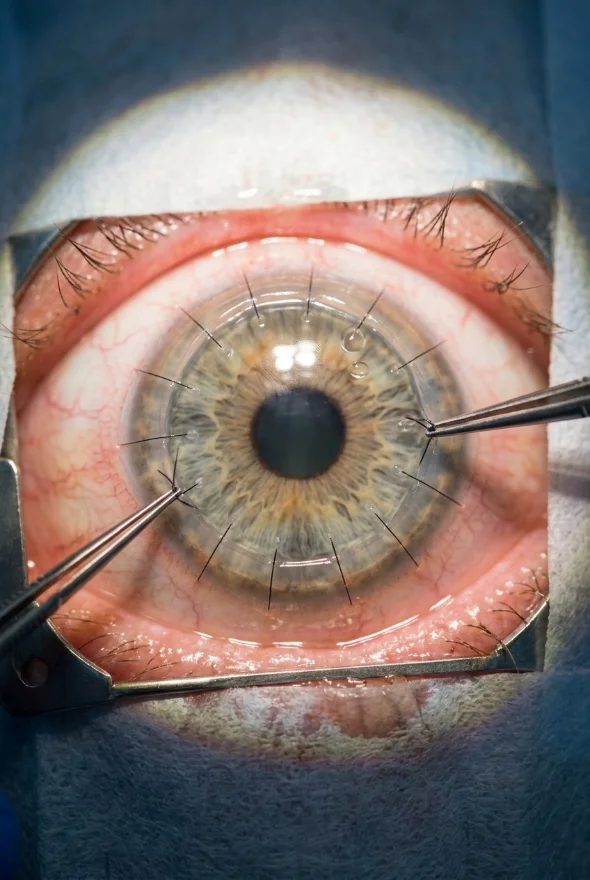
Keratoconus in children and teenagers tends to be more advanced at diagnosis and to progress faster than in adults, so waiting can cost vision. Corneal cross-linking (CXL) stiffens the cornea and stopped progression in most young patients in a randomised trial: 7% of treated eyes progressed against 43% with standard care. At Laser Istanbul Clinic, CXL is performed by Doç. Dr. Muhammet Derda Özer (Doç. = Associate Professor), our cornea specialist.
What is keratoconus in children, and why is it different from adult keratoconus?
Keratoconus is a condition in which the cornea, the clear dome at the front of the eye, gradually thins and bulges forward into a cone shape. Light no longer focuses cleanly, so vision becomes blurred and distorted and glasses stop working well. In children and teenagers it is a particular worry for one reason: the younger the patient, the faster it is likely to progress.
According to EyeWiki, the clinical encyclopedia of the American Academy of Ophthalmology (AAO), keratoconus typically begins in early adolescence and keeps progressing into the mid-20s and 30s. Disease that starts in childhood is "more likely to be advanced at diagnosis" and to show faster progression than adult disease, and children may need repeat treatment or even a transplant over a longer lifetime of risk. The AAO's patient pages describe the usual start as the late teens to early 20s, with vision worsening over 10 to 20 years. A 2024 review in Community Eye Health calls young age the most important factor for progression: the cornea naturally stiffens with age, and progression is unusual after people reach their mid-30s.
How common is it? There is no reliable figure for children alone. For all ages, EyeWiki gives a prevalence often reported as 1 in 700, while a Dutch nationwide registry study of 4.4 million insured people, using modern corneal imaging, found about 1 in 375, with an average age at diagnosis of 28.3 years. That gap between the usual age of onset and the usual age of diagnosis suggests that many young people have keratoconus for years before anyone finds it.
Doç. Dr. Özer's own research shows how far the disease can have gone by the time a child is treated. In his 2019 study in Cornea of 35 eyes in 23 patients aged 11 to 14 with progressive keratoconus, 29% of eyes (10 of 35) were already at stage 3 or 4 (of 4) when they were treated.
What causes keratoconus in kids, and who is at higher risk?
The exact cause is not known, but several risk factors are well established, and some can be controlled:
- Eye rubbing. The AAO says plainly: "Do not rub your eyes." Rubbing can damage a thin cornea and make keratoconus worse. EyeWiki lists eye rubbing as a particularly important modifiable factor in children.
- Allergic eye disease. Eye allergies, and in particular vernal keratoconjunctivitis (a severe, itchy allergy that mostly affects children), make children rub their eyes. EyeWiki also reports that allergy history was linked to faster progression in a pediatric cohort.
- Family history. The AAO notes that about 1 in 10 people with keratoconus have a parent who has it too.
- Other conditions. Down syndrome, connective-tissue disorders (such as Marfan or Ehlers-Danlos syndrome), retinitis pigmentosa and Leber congenital amaurosis are linked with keratoconus. EyeWiki advises a low threshold for corneal imaging in these children when symptoms or prescription changes are suggestive.
- A steep cornea at the start. In a pediatric cohort summarised by EyeWiki, a steepest corneal curvature (Kmax) of 55 dioptres or more at the first visit predicted faster progression.
None of this means that a child who rubs their eyes will develop keratoconus. It does mean that rubbing and untreated allergy are the two things a family can actually change.

How can you tell if a child has keratoconus? Signs to watch for
Early keratoconus is easy to miss, because a child may simply assume that blurry or distorted vision is normal. The AAO lists these early features: mild blurring, slightly distorted vision (straight lines look bent or wavy), sensitivity to light and red eyes. Later, vision becomes more blurred and distorted, and short-sightedness or astigmatism increases so that the glasses prescription keeps changing.
In practice, parents and teachers often notice behaviour rather than symptoms:
- a glasses prescription that needs changing again and again, or glasses that never seem to give sharp vision
- squinting, sitting very close to the board or screen, or complaints about glare and bright lights
- frequent, forceful eye rubbing
- one eye clearly worse than the other
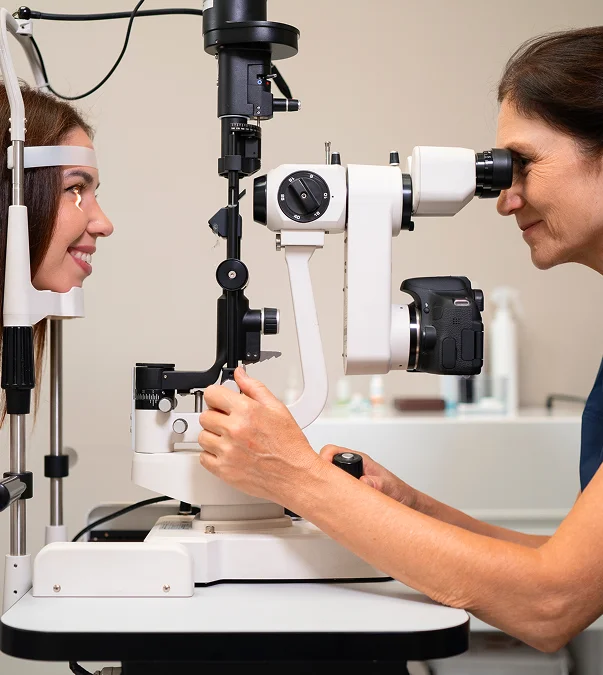
Keratoconus cannot be diagnosed with a simple eye chart. It is confirmed with a corneal topography or tomography scan, a painless picture of the shape of the cornea. If a child has the signs above, or belongs to one of the higher-risk groups, ask for this scan rather than another pair of glasses. For children at higher risk, EyeWiki describes review intervals of about 3 to 6 months, with shorter intervals when progression is suspected.
Why does early cross-linking matter for children and teenagers?
Early cross-linking matters because CXL can only stop keratoconus from getting worse; it cannot give back vision that has already been lost. Every month of progression in a child is permanent thinning and steepening of the cornea, and a child has decades ahead of them with that cornea.
What CXL is. Riboflavin (vitamin B2) drops soak into the cornea, and ultraviolet A light is then shone on the eye. Together they create new bonds between the collagen fibres of the cornea and make it stiffer, so that it stops bulging further (AAO). It is the main treatment that targets the disease itself rather than correcting the blur it causes.
What the evidence says.
| Evidence | What it found |
|---|---|
| KERALINK randomised trial, Ophthalmology 2021 | 60 patients aged 10 to 16 with progressive keratoconus were randomised to CXL plus standard care or standard care alone. At 18 months, keratoconus had progressed in 7% of the CXL group and 43% of the standard-care group. The steepest corneal curvature (K2) was on average 3.0 dioptres lower with CXL (49.7 D against 53.4 D). The authors concluded that CXL arrests progression in the majority of young patients and recommended considering it as first-line treatment for progressive disease. |
| Pediatric meta-analysis summarised by EyeWiki | Available CXL techniques generally slowed progression over at least one year; standard or accelerated epithelium-off protocols were more consistent than transepithelial (epi-on) protocols. |
| NHS patient information | CXL halts keratoconus progression in more than 90% of treated eyes; one large NHS eye hospital reports about 94% success since 2013. |
| Dutch national transplant registry, Acta Ophthalmologica 2016 | About 25% fewer corneal transplants for keratoconus in the three years after CXL was introduced (201 against 269). Before CXL, 10–20% of people with keratoconus eventually needed a transplant. |
The trial result is the strongest argument for early treatment: in the standard-care group, where nothing was done except glasses or lenses, more than 4 in 10 young eyes got worse within 18 months.
Should a child have cross-linking at diagnosis, or wait for progression?
There is no single rule, and good surgeons weigh it case by case. For adults, the usual approach is to treat once scans show progression. For children, the bar is lower. EyeWiki says the threshold for intervention is generally lower than in adults, while noting that treating every child who shows no sign of progression is still debated. The Community Eye Health review says that higher-risk young patients may be monitored every 3 months or offered CXL at diagnosis, without documented progression.
| Situation | What is usually done |
|---|---|
| Scans show progression (curvature up by more than 1 dioptre, or thinning of more than 15 microns, between scans) | Cross-linking is recommended. |
| Child diagnosed young, with a steep cornea, eye allergy or heavy eye rubbing | Cross-linking may be offered at diagnosis, or scans are repeated every 3 months. |
| Mild, early keratoconus with no sign of progression and no high-risk features | Close monitoring (about every 3–6 months), treating allergy and stopping eye rubbing; CXL when progression appears. |
Because children progress faster, the practical message for families is not to settle for a year of "let's see". If keratoconus is suspected in a child, get a baseline scan, repeat it within a few months, and act on what the two scans show. Earlier scans from other clinics help a great deal, because they show how fast the cornea is changing.
How young can a child be for cross-linking?
There is no single age rule. A child's suitability is decided by their scans, corneal thickness and general health, not by their birthday alone.
- Trials have treated children from the age of 10: the KERALINK trial enrolled patients aged 10 to 16.
- Doç. Dr. Özer's 2019 study followed children aged 11 to 14 after cross-linking, and his 2020 study included patients aged 10 to 18.
- In the United States, the drug label for the first approved cross-linking system states that safety and effectiveness have not been established below the age of 14.
- Corneal thickness matters at any age. Standard epi-off CXL needs a cornea at least 400 microns thick once the surface layer is removed, to protect the inner cell layer; a special hypo-osmolar riboflavin can swell thinner corneas to a safe thickness, so a thin cornea does not always rule a child out.
Cross-linking is usually not suitable for an eye with an active infection, a history of herpes infection of the eye, severe corneal scarring or poor surface healing. If your child is very young, Doç. Dr. Özer reviews the scans personally before advising whether treatment is appropriate; {{youngest age treated}}.
What happens during cross-linking in a child, and is it painful?
The procedure. Standard cross-linking is epi-off: the thin surface layer of the cornea is removed so that the riboflavin can soak in, and the cornea is then treated with ultraviolet A light. In the standard Dresden protocol the light takes 30 minutes; in accelerated protocols it takes about 9 to 10 minutes (EyeWiki). One large NHS trust quotes about 60 minutes per eye for the whole visit, and eyes are usually treated one at a time, months apart. In adults, NHS units use numbing drops only, with no needles or injections (Moorfields). {{anaesthesia for children: how a young child is kept comfortable and still}}
Epi-off or epi-on? Epi-on (transepithelial) cross-linking leaves the surface in place, which should mean less discomfort and a faster recovery, and the first epi-on treatment was approved by the US FDA for keratoconus in October 2025. For children, however, the pediatric meta-analysis summarised by EyeWiki found standard or accelerated epi-off protocols more consistent so far. {{protocol used: epi-off accelerated / standard / epi-on, as confirmed by Doç. Dr. Özer}}
Pain. Honest preparation helps a child. After epi-off treatment the eye is gritty, watery, red and light-sensitive, worst in the first 12 to 48 hours; the Community Eye Health review notes that the pain can be severe, especially in younger patients. A bandage contact lens protects the surface, and the surface layer usually regrows in 3 to 4 days. Patients with allergy are given a short course of steroid drops before treatment so that the surface is calm, because atopic eyes are at higher risk of slow healing.
-
First 1–2 days
The most uncomfortable phase: pain, watering and light sensitivity. Rest, prescribed drops and pain relief.
-
Days 3–7
Pain settles as the surface grows back; the bandage lens is removed at a check-up. Most people are pain-free by days 5–7.
-
Weeks 1–2
Hazy vision. NHS advice is at least one week off work or school. Avoid sport for about two weeks.
-
Weeks 2–3
Soft contact lenses can usually be worn again; swimming after about three weeks.
-
1–3 months
Vision and light sensitivity may be temporarily worse while the cornea settles.
-
6–12 months
The glasses prescription can keep changing for up to a year; repeat scans confirm stability.
Tell your child not to rub their eyes during recovery. For a young child who rubs, that single instruction is the hardest part, so plan for it.
Does cross-linking always work in children? Results and risks
CXL works in most children, but not all, and younger children carry a higher risk of continued progression. Honest figures matter here.
- In KERALINK, 7% of CXL-treated eyes still progressed at 18 months (against 43% without CXL).
- In Doç. Dr. Özer's 2019 Cornea study of 35 eyes in children aged 14 and under, followed for an average of 56 months after accelerated epi-off CXL, keratoconus progressed in 20% of eyes. Progression was linked to the child's age and to corneal measurements.
- In his 2020 International Ophthalmology study of 41 eyes in patients aged 10 to 18, progression two years after accelerated CXL was seen in 7 of 20 eyes (35%) in children aged 14 and under, against 1 of 21 eyes (4%) in teenagers aged 15 to 18. Age was the only significant predictor. The authors recommend closer monitoring and earlier intervention for the younger group.
These are single-centre studies with small numbers, not a head-to-head trial, so treat the exact percentages with care. The message they point to is consistent with the trial: young corneas are the most active, they need the closest follow-up, and a child can need a repeat treatment later.
Risks (from NHS patient information and EyeWiki; most of the data are from adults):
- Temporary haze in the cornea is very common and usually fades; EyeWiki reports permanent haze in up to 10% of eyes.
- Infection affects fewer than 1 in 100 patients.
- Some loss of vision is reported in under 3 in 100 patients.
- Keratoconus can still progress, and fewer than 1 in 100 need a repeat treatment in NHS data (the rate is higher in young children, as above).
- Damage to the inner corneal cells if the cornea is too thin, which is why thickness is measured first.
What CXL does not do. It does not remove the cone or restore perfect vision. Most children will still need glasses or contact lenses afterwards. Once the cornea is stable, options for improving vision include contact lenses, corneal ring segments or, in severe cases, a transplant.
What can parents do now to protect a child's eyes?
Stop the rubbing
Treat the allergy that drives it with your doctor, and gently coach the child. Eye rubbing is the one modifiable risk factor that both the AAO and EyeWiki highlight.
Ask for a corneal scan
if the glasses prescription keeps changing, or if there is a family history of keratoconus, Down syndrome, connective-tissue disease or severe eye allergy.
Bring old scans and prescriptions
Earlier scans are the best proof of progression and let the surgeon see how fast the cornea is changing.
Pause contact lenses before scans
So that the cornea shows its true shape, the Community Eye Health review advises a break of 1 week for soft lenses and 2 weeks for rigid gas-permeable lenses; {{contact-lens break required by Doç. Dr. Özer before scans}}.
Book regular reviews
Children at higher risk are usually re-scanned every 3 to 6 months; after CXL, repeat scans confirm that the cornea has stabilised.
Cross-linking for children with Doç. Dr. Özer in Istanbul
Corneal cross-linking at Laser Istanbul Clinic is planned and performed by Doç. Dr. Muhammet Derda Özer, an Associate Professor of Ophthalmology (Doç. is the Turkish title for Associate Professor) who specialises in the cornea, keratoconus and cross-linking, and speaks Turkish and English. Two of his first-author studies, in Cornea (2019) and International Ophthalmology (2020), follow children and teenagers after accelerated cross-linking.
What the process looks like for a young patient:
- Send your child's scans first. Upload the prescription and any corneal scans through the free online consultation. Doç. Dr. Özer reviews them before you decide to travel.
- Pre-operative examination in Istanbul. Scans and corneal thickness are repeated, so the surgeon can confirm that treatment is needed and safe.
- Cross-linking in a fully equipped, Ministry of Health–licensed operating theatre in Istanbul, with a personal interpreter and a coordinator beside you.
- Follow-up checks in Istanbul and remote follow-up afterwards by your coordinator and surgeon. {{both eyes treated on the same trip: yes / no, and the gap between eyes}}
The pre-operative examination and scans, surgery by the named surgeon, medication, follow-up checks in Istanbul, a personal interpreter, a coordinator and remote follow-up are all included in the price shown on the CXL page. Hotel and airport transfers are not included: they are arranged on request and charged separately, and flights are not included either.
Want to see the wider range of keratoconus treatment options with the same surgeon? Keratoconus treatment in Turkey →.
Keratoconus in children: frequently asked questions
Yes. Keratoconus typically begins in early adolescence, and it can start in childhood. When it starts young it tends to be more advanced at diagnosis and to progress faster than in adults (EyeWiki). Many cases are only found in adulthood: the average age at diagnosis in a Dutch registry study was 28.3 years.
Usually in the teens and early twenties: EyeWiki says early adolescence, and the AAO says the late teens to early 20s. It then progresses over 10 to 20 years and generally settles by the mid-30s, when the cornea naturally stiffens.
It is more likely to progress quickly. In the KERALINK trial, 43% of young patients given standard care alone had progression within 18 months. Because children have a longer lifetime of risk, they may also need repeat cross-linking or a transplant later in life.
In most cases, yes. Corneal cross-linking stopped progression in 93% of treated eyes in the KERALINK trial (progression in 7%), and NHS units report success in more than 90% of treated eyes. It is not a cure: the cone stays, glasses or lenses are usually still needed, and young children need close follow-up because some continue to progress.
There is no single best age. In children, doctors usually treat as soon as progression is shown, and sometimes at diagnosis if the child is at higher risk, because waiting allows irreversible thinning. The decision rests on scans and corneal thickness, not age alone.
The first 1 to 2 days after epi-off treatment are the most uncomfortable, with a gritty, watery, light-sensitive eye, and the pain can be severe in younger patients. Most people are pain-free by days 5 to 7. Pain relief, a bandage contact lens and the prescribed drops keep it manageable, and the surgeon's team explains the plan in advance.
Usually yes. CXL stops the cornea getting worse; it does not remove the cone. The glasses prescription can keep changing for up to a year, and once the cornea is stable your surgeon can discuss contact lenses, ring segments or other options.
Rubbing is a recognised risk factor and can make keratoconus worse, which is why the AAO says not to rub the eyes. It is not the only cause: genetics, allergy and connective-tissue conditions also play a part, so a child with itchy-eye allergy should have the allergy treated and the cornea scanned.
Sometimes. About 1 in 10 people with keratoconus have a parent who has it (AAO), so most people with keratoconus do not have an affected parent.
Yes, in suitable cases. Send the scans through our free online consultation, and Doç. Dr. Özer will review them and advise whether cross-linking is appropriate before you travel. {{youngest age treated}}
Worried about your child's eyes? Find out where the cornea stands
If your child has been diagnosed with keratoconus, or you suspect it, send the latest scans and prescription. Doç. Dr. Muhammet Derda Özer reviews them, tells you whether cross-linking is needed now or whether scans should be repeated first, and explains the risks plainly.
Sources for the facts on this page
- EyeWiki (AAO). Pediatric Keratoconus. https://eyewiki.org/Pediatric_Keratoconus (opened 7 Oct 2026): pediatric disease more likely advanced at diagnosis and faster; allergy, VKC and rubbing as modifiable factors; Kmax ≥55 D predicts faster progression; Down syndrome and other associations; low threshold for imaging; lower threshold for CXL but prophylactic treatment debated; pediatric meta-analysis (epi-off more consistent than epi-on); 3–6-month review intervals; repeat CXL or transplant over a longer lifetime.
- EyeWiki (AAO). Keratoconus. https://eyewiki.org/Keratoconus (opened 7 Oct 2026): onset early adolescence, progression into mid-20s and 30s; prevalence often reported as 1 in 700.
- EyeWiki (AAO). Corneal Collagen Cross-Linking. https://eyewiki.org/Corneal_Collagen_Cross-Linking (opened 7 Oct 2026): 400-micron minimum, hypo-osmolar riboflavin, Dresden 30 minutes, accelerated 10 mW/cm² for 9 minutes, permanent haze up to 10%, epithelium heals in 3–4 days, contraindications.
- American Academy of Ophthalmology. What Is Keratoconus? https://www.aao.org/eye-health/diseases/what-is-keratoconus (opened 7 Oct 2026): symptoms, 1 in 10 have an affected parent, eye allergies and rubbing, onset late teens to early 20s, "Do not rub your eyes".
- American Academy of Ophthalmology. Keratoconus Treatment. https://www.aao.org/eye-health/diseases/keratoconus-treatment (opened 7 Oct 2026): CXL uses UV light and drops to strengthen the cornea and stop further bulging.
- Deshmukh R, Gore D. Keratoconus: diagnosis and management. Community Eye Health 2024;37(123). https://pmc.ncbi.nlm.nih.gov/articles/PMC11921258/ (opened 7 Oct 2026): young age the most important factor for progression; progression unusual after mid-30s; high-risk patients monitored every 3 months or offered CXL at diagnosis; pain severe in younger patients; pre-operative steroid drops in atopy; progression thresholds >1 D and >15 µm; contact-lens breaks (1 week soft, 2 weeks RGP).
- Larkin DFP, et al. Effect of Corneal Cross-linking versus Standard Care on Keratoconus Progression in Young Patients: The KERALINK Randomized Controlled Trial. Ophthalmology 2021;128(11):1516–1526, PMID 33892046. https://pubmed.ncbi.nlm.nih.gov/33892046/ (abstract read through Europe PMC, 7 Oct 2026): 60 patients aged 10–16; K2 49.7 vs 53.4 D, adjusted difference −3.0 D; progression 7% vs 43% at 18 months.
- Ozer MD, et al. Long-Term Results of Accelerated Corneal Cross-Linking in Adolescent Patients With Keratoconus. Cornea 2019;38(8):992–997, PMID 31033692. https://pubmed.ncbi.nlm.nih.gov/31033692/ (abstract read through Europe PMC, 7 Oct 2026): 35 eyes of 23 patients, mean age 13 (11–14), mean follow-up 56 months; stage 1 31%, stage 2 40%, stage 3 23%, stage 4 6%; progression in 20%.
- Ozer MD, et al. Comparison of the efficacy of accelerated corneal cross-linking therapy in different pediatric age groups having progressive keratoconus. International Ophthalmology 2020;40(10):2651–2658, PMID 32488590. https://pubmed.ncbi.nlm.nih.gov/32488590/ (abstract read through Europe PMC, 7 Oct 2026): 41 eyes, ages 10–18; progression 7 of 20 (35%) aged ≤14 vs 1 of 21 (4%) aged 15–18; age the only significant predictor (p < 0.001).
- Godefrooij DA, et al. Age-specific Incidence and Prevalence of Keratoconus: A Nationwide Registration Study. Am J Ophthalmol 2017;175:169–172, PMID 28039037. https://pubmed.ncbi.nlm.nih.gov/28039037/ (abstract read through Europe PMC, 7 Oct 2026): prevalence 1:375, incidence 13.3 per 100,000, mean age at diagnosis 28.3.
- Godefrooij DA, et al. Nationwide reduction in the number of corneal transplantations for keratoconus following the implementation of cross-linking. Acta Ophthalmol 2016;94(7):675–678, PMID 27213687. https://pubmed.ncbi.nlm.nih.gov/27213687/ (abstract read through Europe PMC, 7 Oct 2026): 10–20% eventually need a transplant; 201 vs 269 transplants (about 25% fewer).
- Moorfields Eye Hospital NHS Foundation Trust. Corneal cross-linking. https://www.moorfields.nhs.uk/eye-conditions/keratoconus/corneal-cross-linking (opened 7 Oct 2026): success in more than 90% in three RCTs at one year, about 94% since 2013; under 3% vision reduction; under 1% infection; under 1% repeat; at least one week off work or school; contact lenses around week 2; topical anaesthetic only.
- Photrexa (riboflavin ophthalmic solution) prescribing information, DailyMed. https://dailymed.nlm.nih.gov/dailymed/drugInfo.cfm?setid=f82cfe92-1a24-11e3-8ffd-0800200c9a66 (opened 7 Oct 2026): "safety and effectiveness of corneal collagen cross-linking has not been established in pediatric patients below the age of 14 years".
- Healio. FDA approves Epioxa for keratoconus (20 Oct 2025). https://www.healio.com/news/ophthalmology/20251020/fda-approves-epioxa-for-keratoconus (opened 7 Oct 2026): first FDA-approved epi-on procedure for keratoconus; two phase 3 trials, over 400 patients.
- Guy's and St Thomas' NHS Foundation Trust. Photochemical corneal collagen cross-linking for keratoconus. https://www.guysandstthomas.nhs.uk/health-information/photochemical-corneal-collagen-cross-linking-keratoconus (verified for content/en/cxl.md on 6 Oct 2026; not re-opened this session): about 60 minutes per eye; one eye at a time, months apart.
- Hull University Teaching Hospitals NHS Trust leaflet, Corneal Collagen Crosslinking (CXL) for Keratoconus. https://www.hey.nhs.uk/patient-leaflet/corneal-collagen-crosslinking-cxl-for-keratoconus/ (verified for content/en/cxl.md on 6 Oct 2026; not re-opened this session): pain-free by days 5–7; about 3 in 100 some vision loss.