
- Home: eye surgery in Istanbul
- Knowledge centre
- Eyelid & cosmetic guides
- Fox eye and almond eye surgery
Fox Eye and Almond Eye Surgery: What Is Real and What Is Risky
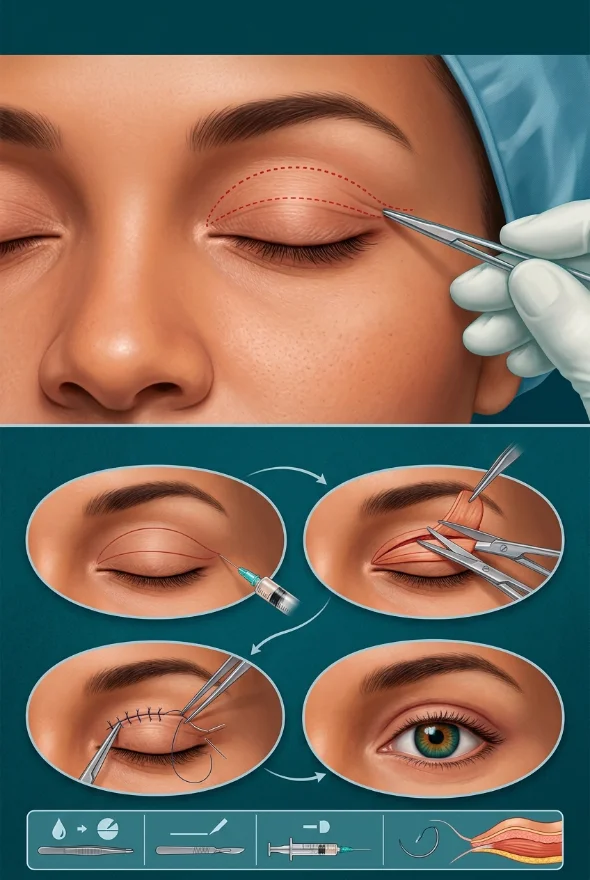
Fox eye surgery is not a single operation. The fox eye look, an outer eye corner that sits higher than the inner corner, can be pursued with makeup, temporary threads, brow or upper-eyelid surgery, or lateral canthoplasty, which permanently moves the outer corner and carries the highest risk. An eyelid surgeon such as Prof. Dr. Ahmet Satıcı examines the eye first and tells you what is realistic.
What is the fox eye look, and what gives you fox eyes?
The fox eye look is a lifted, elongated, almond-shaped eye in which the outer corner sits higher than the inner corner. It is a beauty term from social media, not a medical diagnosis, and "fox eyes", "foxy eye" and "almond eye" all describe the same family of shapes. Clinicians describe the key feature as lateral canthal tilt: the angle between the inner and outer corners of the eye (the canthi). A more upward tilt reads as a "fox" look.
Several features combine to create fox eye looks, and only some of them can be changed by a surgeon:
| Feature | What it does to the fox eye shape | Can a procedure change it? |
|---|---|---|
| Lateral canthal tilt (angle of the outer corner) | The main driver of the look | Yes, but only with canthal surgery or, temporarily, with threads |
| Tail of the eyebrow | A lifted brow tail makes the outer eye look higher | Yes: brow lift, threads or injections |
| Skin over the outer upper lid (lateral hooding) | Hanging skin hides the outer lid and makes the eye look shorter and heavier | Yes: upper blepharoplasty |
| Length of the eye opening | A longer eye looks more almond-shaped | Only by lateral canthoplasty (permanent, higher risk) |
| Cheekbone and orbital bone shape, ethnicity, sex | Sets the baseline shape of your eye | No: eyelid surgery cannot change bone structure |
Age matters too. In a 2023 study of 68 younger and 73 older Caucasian adults (Liu et al.), the outer corner of the eye tended to move towards the nose and downwards with age. That is one reason a lifted outer corner looks youthful, and one reason people ask for it.
No human face follows one fox eye template. The shape of your eyes depends on your anatomy, and what looks natural on one face can look strange on another.
Fox eye trend: why is everyone asking about it?
The fox eye trend spreads through short videos and filters, and the information in them is often poor. In a 2024 study in International Ophthalmology, researchers scored 173 YouTube videos about aesthetic canthoplasty: the quality and reliability scores were mostly poor, 82.1% of the videos were uploaded by healthcare professionals, and 46.2% were advertisements rather than scientific or educational content.
Patients are also left with high expectations. A 2026 analysis of 1,579 posts and 3,576 comments from eight Reddit communities discussing eyelid surgery (Bair et al., Aesthetic Surgery Journal Open Forum) found recurring themes of pre-operative anxiety, dissatisfaction despite an acceptable result, distress over mild asymmetry and choosing a surgeon because of social media. The authors suggest that clear counselling on asymmetry and variability helps set realistic expectations.
What this means for you: a before-and-after photo cannot show you what happens to the eye over time. Ask about function (blinking, tear film, lid position) as well as looks.
What is fox eye surgery, and which options are real?
"Fox eye surgery" is an umbrella term for several different approaches, from reversible and low risk to permanent and high risk. Fox eyes lift surgery, foxy eyes lift and "fox eye lift" in clinic marketing can mean any of the options below.
| Option | What it does | How long it lasts | Main risks | Level of risk (our summary) |
|---|---|---|---|---|
| Makeup and brow shaping | Draws the eye outward and upward | Hours to days | Skin irritation | Very low |
| Upper blepharoplasty (removing excess skin) | Removes hanging skin over the outer upper lid so the eye looks more open | Long-term (ageing continues) | Bruising, swelling, dry eye, asymmetry; rare bleeding behind the eye (NHS, AAO) | Low to moderate |
| Threads to lift the brow tail and outer corner | Lifts tissue with barbed threads under the skin | Temporary: months, not years | Infection, thread migration or extrusion, dimpling, asymmetry (IADVL review, 2026) | Moderate |
| Botulinum toxin or filler around the eye | Relaxes or adds volume to reshape the brow and outer eye | Temporary | Droopy lid, dry eye, double vision; very rarely, vision loss with filler | Moderate to high near the eye |
| Lateral canthopexy or canthoplasty | Repositions or reshapes the outer eye corner and its supporting tendon | Permanent | Lid retraction, rounding of the corner, ectropion, dry eye, asymmetry; may need further surgery | Highest |
Of these, upper blepharoplasty is the best established. The NHS describes it as surgery that removes excess skin from drooping upper eyelids, and the American Academy of Ophthalmology (AAO) notes that it can restore the upper part of your field of vision when skin hangs over the lashes. It is a way to open a heavy outer lid, but it does not move the outer corner of the eye itself.
Do fox eye threads work, and how long do they last?
Fox eye threads can lift the outer corner of the eye by a small amount for a limited time, so the effect is real but modest. The best published data we found is a 2026 retrospective study in Plastic and Reconstructive Surgery Global Open of 22 Asian women who had barbed threads placed in the temple area (Hong et al.). The average lateral canthal tilt rose from 2.1 degrees to 4.3 degrees at 6 months, then eased back to 3.6 degrees at 12 months. The outer corner moved up by about 1.8 mm at 6 months and 1.2 mm at 12 months. Of the patients, 90.9% rated their result "improved" or better at 6 months, falling to 77.8% at 12 months. The authors report that adverse events were minor and temporary, and say that prospective comparative studies are needed.
So, in that study, the visible gain was a couple of degrees and a couple of millimetres, and it faded within a year. It was also a small, uncontrolled study of one technique in one group of patients, so your result could be different.
Thread lifts in general carry their own risks. A 2026 narrative review by the Indian Association of Dermatologists, Venereologists and Leprologists (IADVL) lists infection, thread extrusion, skin dimpling and nerve injury among them. Threads can also migrate if they are not firmly anchored, and the review notes that excessive movement or facial massage can make that more likely.
What is lateral canthoplasty, and why is it the risky one?
Lateral canthoplasty is surgery on the outer corner of the eye in which the surgeon reshapes the corner and re-attaches the tendon that supports the eyelids, so it changes the shape of the eye permanently. A related, gentler procedure called canthopexy repositions the tendon without cutting the corner of the eye. Both are real, established operations in eye surgery: EyeWiki (the AAO's clinical encyclopedia) says that significant lower-lid laxity is managed with canthopexy or lateral canthoplasty to support the lid.
For fox eye, the operation is used for a different reason: to alter the look of a healthy eye. A 2025 report in Aesthetic Surgery Journal describes a lateral canthoplasty technique used in East Asia to lengthen the eye opening. The authors reviewed patients operated on between February 2018 and February 2023 and report natural-looking results and no severe complications at 6 months. That was a single-centre review with short follow-up, and it does not tell you the risk in a different eye, in a different surgeon's hands or after many years.
The reason this operation needs caution is that the outer corner holds the lids in position against the eye. EyeWiki and the AAO list problems of lid position after lower-lid surgery, including:
- lower eyelid retraction, where the lid is pulled down and shows more white of the eye (EyeWiki describes it as a major risk of lower-lid surgery)
- ectropion, where the lower lid turns away from the eye
- canthal dystopia and canthal rounding: the outer corner ends up in the wrong place or loses its pointed shape, which is the opposite of the fox eye look (AAO)
- dry eye (AAO), because a lid that does not sit snugly against the eye can affect how tears spread
Other reports show how things can go wrong. A 2024 case report from China describes a 35-year-old woman who had fluid leaking from the outer corner of the eye for more than half a year after a cosmetic lateral canthoplasty; the surgeon found a fistula connected to lacrimal gland tissue and removed it. A 2025 case report from Italy describes a woman who developed severe ectropion after upper and lower eyelid surgery and needed a midface lift, lateral canthoplasty, tarsal strip and conjunctival excision to repair it. These are individual cases, not rates, but they show that correcting a poor result can mean further operations.
Plan as if it is permanent. If you are considering lateral canthoplasty for looks alone, ask the surgeon what the plan is if the lid sits too low, how they measure that and what happens if you are unhappy.
Fox eye risks at a glance: what can go wrong?
The risks of fox eye procedures range from temporary bruising to rare, vision-threatening events, and they depend on the method. Here is a summary by what you would notice and how serious it can be.
| Risk | Which options | How serious |
|---|---|---|
| Bruising, swelling, tightness, watery or irritated eyes | All surgical options | Common and usually temporary; may last a few weeks (NHS) |
| Uneven eyes (asymmetry) | All options | Occasional (NHS); minor asymmetry is a frequent source of worry (Bair et al., 2026) |
| Dry eye, or the eye not closing fully | Blepharoplasty, canthal surgery, toxin | Occasional; may need drops or more surgery |
| Lower lid pulled down or turned out (retraction, ectropion) | Canthal and lower-lid surgery | Uncommon, but may need another operation |
| Infection, thread migration, dimpling | Threads | Uncommon (IADVL, 2026) |
| Bleeding behind the eye with vision loss | Blepharoplasty | Very rare: the AAO puts it below 1 in 20,000 for lower-lid surgery |
| Blocked blood vessel to the eye with vision loss | Filler near the eye | Very rare but can be permanent (J Clin Med review, 2025) |
On balance, standard blepharoplasty has a reassuring record. A 2025 systematic review of 36 articles on lower blepharoplasty (Gimenez et al.) reported a low overall complication profile, no major complications affecting the eye or vision, and most problems resolved by conservative treatment or revision surgery. The review also asks for more rigorous studies. The same safety picture does not automatically apply to cosmetic canthal surgery, where we found far less published evidence.

Fox eye surgery for men: is it different?
Fox eye surgery for men uses the same procedures, but an upward outer-corner tilt does not read the same on every face, so the plan needs care. In a 2026 survey of 763 people, an upward lateral canthal tilt was a strong determinant of perceived femininity (Jabbour et al., Ophthalmic Plastic and Reconstructive Surgery). If you are a man looking at fox eye men content online, that may or may not be the look you want.
Online communities have also made "positive canthal tilt" a number to chase. A 2026 paper in Plastic and Reconstructive Surgery Global Open (Maini and Janis) notes that such formulas may not account for ethnic or gender variation, and that surgeons may need to decline or modify requests driven by social media comparisons. A good surgeon will do exactly that.
Fox eye surgery cost: what does a fox eye lift cost?
There is no single fox eye lift cost, because fox eye surgery is not one operation. What you pay depends on whether you have threads, blepharoplasty, brow work or canthal surgery. The NHS gives a UK price for blepharoplasty of £2,000 to £6,000, plus extra for consultations and follow-up, and its eyelid surgery page does not indicate NHS funding for this cosmetic procedure.
At Laser Istanbul Clinic, eyelid surgery with Prof. Dr. Ahmet Satıcı costs from {{£ price}}. This covers the pre-operative examination and scans, the surgery by your named surgeon, medication, follow-up checks in Istanbul, a personal interpreter, and your coordinator and remote follow-up. Hotel and airport transfers are not included. They are a separate charge, arranged on request. Flights are not included either. You see the full written price before you decide.
What should you ask before any fox eye procedure?
Before any fox eye procedure, check who is operating, what exactly they will do and what happens if something goes wrong. The NHS advises choosing someone who is trained and experienced in the procedure and has the right insurance to correct anything that goes wrong. It also says you should be offered a cooling-off period after a consultation, and that you can walk away if you are not comfortable.
- Who will operate, and are they an eye specialist?
The eyelids protect the eye, so ask whether the person has training in eyelid and eye surgery.
- Which exact procedure is it?
"Fox eye lift" can mean threads, injections, blepharoplasty or canthoplasty. Ask for the technique in writing.
- How will you check my eye first?
Examination before eyelid surgery should include the eye surface and tear production (Oestreicher and Mehta, Plastic Surgery International, 2012). The fox eye look is about the lids, but dry eye can make surgery worse.
- Is it reversible?
Threads fade; canthal surgery does not.
- What are my personal risks, and what is the plan if my lid sits too low?
Ask for the answer in writing.
- Will you tell me if my eyes are not suitable?
A good surgeon will sometimes say no, or offer a smaller change.
- What does the price include?
Ask about follow-up, revision and aftercare costs.
Fox eye and almond eye surgery in Turkey: what does our surgeon do?
At Laser Istanbul Clinic, fox eye and almond eye enquiries start with an eyelid assessment by Prof. Dr. Ahmet Satıcı, an ophthalmology specialist since 1992 and former Professor and Head of Ophthalmology at Harran University, who leads our eyelid and oculoplastic surgery. Because he is an eye surgeon, he assesses the eye itself (tear film, eye surface and lid position) as well as the shape you want. He tells you plainly whether a change is realistic, which options suit your eyes and which do not. Whether a particular canthal or thread technique is offered is confirmed at your assessment: {{canthal and thread procedures offered}}.
Surgery takes place in a fully equipped, Ministry of Health–licensed operating theatre in Istanbul. You get a personal interpreter, a coordinator, follow-up checks before you fly home and remote follow-up afterwards.
If you also need cataract or lens surgery, it can be planned with eyelid surgery in one trip.
If your main worry is a tired look caused by shadows or puffiness under the eyes, a different treatment may suit you better than any fox eye procedure.
Frequently asked questions
Fox eye surgery is a popular name for procedures that aim to give a lifted, almond-shaped eye with the outer corner higher than the inner corner. It is not one operation: it can mean threads, brow lifting, upper blepharoplasty or lateral canthoplasty. The options differ greatly in permanence and risk.
It depends on the procedure. Standard blepharoplasty has a low overall complication profile in a 2025 systematic review, while lateral canthoplasty for appearance has less evidence and can cause lid retraction, rounding of the corner, ectropion or dry eye. Fillers near the eye carry a very rare risk of vision loss. Ask what is being done and by whom.
Canthoplasty and blepharoplasty are intended to be long-lasting, although ageing continues afterwards. Fox eye threads are temporary: in one 2026 study, the gain in outer-corner tilt fell from 2.2 degrees at 6 months to 1.5 degrees at 12 months. Plan on the basis that any surgery that changes the outer corner cannot simply be undone.
Threads give a small, temporary lift. In a study of 22 women, the outer corner moved up about 1.8 mm at 6 months and 1.2 mm at 12 months. They carry risks including infection, thread migration and dimpling. Results vary, and larger controlled studies are still needed.
You can create a similar illusion with makeup and brow shaping at no medical risk. Medical options such as threads, toxin or filler are non-surgical but still have risks, and the effect is temporary. A fox eye look is partly set by your bones and natural lid shape, so some changes are not possible without surgery.
Upper blepharoplasty removes skin that hangs over the outer upper lid, which can make the eye look more open and lifted. It does not move the outer corner of the eye itself. If you want the corner repositioned, that is a separate canthal procedure with different risks.
The price depends on the procedure, because fox eye surgery is not a single operation. In the UK, the NHS gives £2,000 to £6,000 for blepharoplasty plus consultations and follow-up. At Laser Istanbul Clinic, eyelid surgery costs from {{£ price}}, with hotel and airport transfers extra.
The procedures are the same, but an upward outer-corner tilt can read as more feminine, according to a 2026 survey of 763 people. Men considering fox eye surgery should ask the surgeon for an honest view of how the change will suit their face.
You can have an eyelid assessment and eyelid surgery in Istanbul with Prof. Dr. Ahmet Satıcı. He examines the eye first and tells you which options are realistic and which are not. Send photos for a free assessment before you travel.
Thinking about a fox eye or almond eye look? Start with an honest assessment.
Prof. Dr. Ahmet Satıcı at Laser Istanbul Clinic examines your eyelids and the eye behind them, explains what each option can and cannot do, and tells you if surgery is not the right answer for you.
Sources for the facts on this page
- Hong GW, Choi W, Wong IKJ, Liang BC, Lee HE, Kim JH, Yi KH. Anatomical Considerations in Lateral Canthal Ptosis and Temporal Hairline Lifting with Sihler Threads. Plast Reconstr Surg Glob Open 2026. PMID 42578186; PMC13456847. https://pmc.ncbi.nlm.nih.gov/articles/PMC13456847/
- Xu P, Zheng Y, Huang H, Huang R, Liu K. An Integrated Lateral Canthoplasty for Simultaneous Lateral and Vertical Palpebral Fissure Enlargement. Aesthet Surg J 2025. PMID 40298151. https://pubmed.ncbi.nlm.nih.gov/40298151/
- Yılmaz İE, Mercanlı M, Doğan L. Pitfalls of social media for aesthetic eye surgery patients: assessing YouTube's aesthetic canthoplasty content. Int Ophthalmol 2024;44:279. PMID 38918201. https://pubmed.ncbi.nlm.nih.gov/38918201/
- Bair H, Evans H, Cheslow L, Marous CL. Decoding the Digital Discourse: A Thematic and Sentiment Analysis of Reddit Posts on Eyelid Surgery. Aesthet Surg J Open Forum 2026. PMID 42004284; PMC13089458. https://pmc.ncbi.nlm.nih.gov/articles/PMC13089458/
- Maini RS, Janis JE. Looksmaxxing and the Digital Evolution of Male Beauty Standards: Ethical Implications in Plastic Surgery. Plast Reconstr Surg Glob Open 2026;14(8):e7983. PMID 42719901; PMC13557781. https://pmc.ncbi.nlm.nih.gov/articles/PMC13557781/
- Jabbour M, Morgenstern KE, Burkat CN. Perceptions of Femininity: Exploring the Influence of Eyelid Morphology and Periocular Features on Facial Feminization. Ophthalmic Plast Reconstr Surg 2026. PMID 42600132. https://pubmed.ncbi.nlm.nih.gov/42600132/
- Liu J, Rokohl AC, Liu H, et al. Age-related changes of the periocular morphology: a two- and three-dimensional anthropometry study in Caucasians. Graefes Arch Clin Exp Ophthalmol 2023. PMID 35969325; PMC9803744. https://pmc.ncbi.nlm.nih.gov/articles/PMC9803744/
- Kandhari R, Sharma R, Aggarwal I, Arora G, Ranka N. Complications of Botulinum Toxin, Fillers, and Threads: A Narrative Review by the Special Interest Group (SIG) Aesthetics, IADVL Academy. Cureus 2026. PMID 42813160; PMC13623343. https://pmc.ncbi.nlm.nih.gov/articles/PMC13623343/
- De-Pablo-Gómez-de-Liaño L, Ly-Yang F, Burgos-Blasco B, Fernández-Vigo JI. Ophthalmological Complications of Aesthetic Medicine Procedures: A Narrative Review. J Clin Med 2025. PMID 40807018; PMC12347381. https://pmc.ncbi.nlm.nih.gov/articles/PMC12347381/
- Gimenez AR, Rohrich R, Borab Z, Fisher S, Fagien S, Rohrich RJ. Safety and Complications in Lower Eyelid Blepharoplasty: A Systematic Review. Plast Reconstr Surg Glob Open 2025. PMID 40995580; PMC12456572. https://pmc.ncbi.nlm.nih.gov/articles/PMC12456572/
- Du M, Wang ST. [A case of eyelid fistula after cosmetic lateral canthoplasty]. Zhonghua Yan Ke Za Zhi 2024. PMID 38955764. https://pubmed.ncbi.nlm.nih.gov/38955764/
- Tettamanzi M, Muratore G, Ziani F, et al. Integrated Reconstructive Management of Periocular Complications Following Bilateral Blepharoplasty. Plast Reconstr Surg Glob Open 2025. PMID 40791740; PMC12333736. https://pmc.ncbi.nlm.nih.gov/articles/PMC12333736/
- EyeWiki (American Academy of Ophthalmology). Lower Eyelid Blepharoplasty: canthal support, canthopexy and lateral canthoplasty, lower-lid retraction and ectropion. https://eyewiki.org/Lower_Eyelid_Blepharoplasty
- American Academy of Ophthalmology. Lower Eyelid Blepharoplasty: complications incl. lid retraction, ectropion, entropion, canthal dystopia and rounding, dry eyes; retrobulbar haemorrhage with vision loss < 1:20,000. https://www.aao.org/eye-health/treatments/lower-eyelid-blepharoplasty
- American Academy of Ophthalmology. Upper Eyelid Blepharoplasty: restoring the upper field of vision. https://www.aao.org/eye-health/treatments/upper-eyelid-blepharoplasty
- NHS. Eyelid surgery (blepharoplasty): UK cost £2,000–£6,000 plus consultations and follow-up; risks; results cannot be guaranteed. https://www.nhs.uk/conditions/cosmetic-procedures/eyelid-surgery/
- NHS. Before you have a cosmetic procedure: choose a trained, experienced and insured practitioner; cooling-off period; you can walk away. https://www.nhs.uk/conditions/cosmetic-procedures/before-you-have-a-cosmetic-procedure/
- Oestreicher J, Mehta S. Complications of Blepharoplasty: Prevention and Management. Plast Surg Int 2012;2012:252368. https://pmc.ncbi.nlm.nih.gov/articles/PMC3357590/