
- Home: eye surgery in Istanbul
- All eye treatments
- Keratoconus treatment in Turkey
- Corneal cross-linking (CXL)
Corneal Cross-Linking Cost and CXL Treatment in Istanbul
Corneal cross-linking cost, candidacy and recovery, explained by the surgeon who treats you. At Laser Istanbul Clinic, cross-linking (CXL) for keratoconus is planned and performed by Doç. Dr. Muhammet Derda Özer (Doç. = Associate Professor), our cornea and keratoconus specialist. He reviews your corneal scans before you travel, you receive the full price in writing before you book, and a personal interpreter stays with you from your first examination to your final check-up.
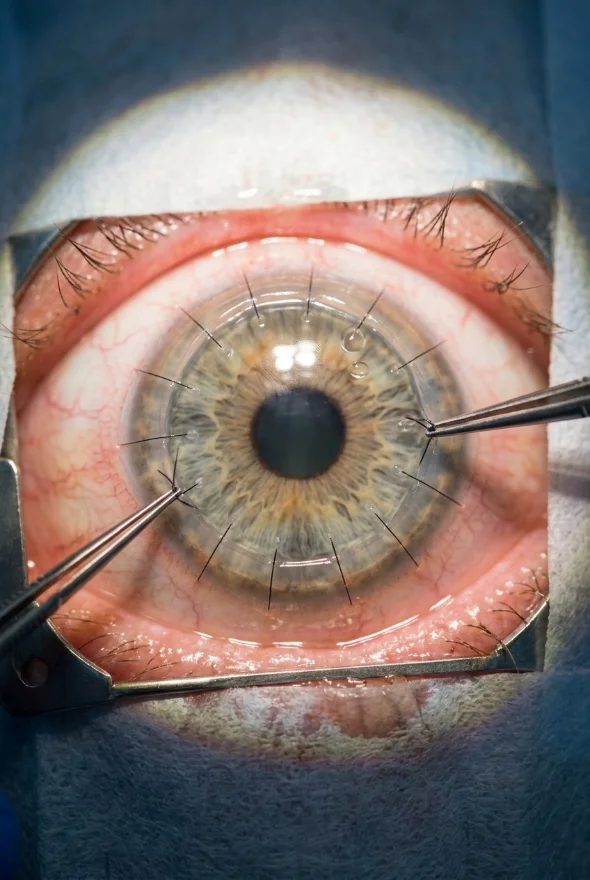
Corneal cross-linking (CXL) uses riboflavin (vitamin B2) drops and ultraviolet light to stiffen the cornea and stop keratoconus getting worse. It does not cure keratoconus, and most people still need glasses or contact lenses afterwards. NHS eye units report success in more than 90% of treated eyes. In Istanbul, CXL with Doç. Dr. Muhammet Derda Özer starts from {{£ price}} per eye; hotel and transfers are extra.
What is corneal cross-linking, and how does it work?
Corneal cross-linking is a treatment that strengthens a weak, bulging cornea so that it keeps its shape. In keratoconus, the cornea, the clear dome at the front of the eye, gradually thins and pushes forward into a cone. Vision becomes blurred and distorted, and glasses stop working well. CXL does not reverse the cone. Its job is to stop it progressing, so you keep the vision you have and stay able to wear glasses or contact lenses.
How it works. Riboflavin drops soak into the cornea. Ultraviolet A (UVA) light is then shone onto the eye. The light and riboflavin react together to form new chemical bonds, called cross-links, between the collagen fibres of the cornea, which makes the cornea stiffer. According to the American Academy of Ophthalmology, this helps flatten or stiffen the cornea and keeps it from bulging further.
A short history. CXL was first used on patients in 2003, and in September 2013 the UK's National Institute for Health and Care Excellence (NICE) concluded that the evidence on the safety and efficacy of epithelium-off CXL for keratoconus and keratectasia is adequate in quality and quantity. In the United States, the FDA approved its first cross-linking system for progressive keratoconus in April 2016, and in October 2025 it approved the first epithelium-on ("epi-on") cross-linking drug for keratoconus.
The standard protocol, step by step (epithelium-off, "Dresden" protocol):
- Numbing drops are put in your eye. No injections are used.
- The surface layer is removed. The surgeon gently removes the thin skin on the surface of the cornea (the epithelium), so the riboflavin can soak in.
- Riboflavin is applied. Drops are given every few minutes for about 30 minutes in the original protocol, until the cornea is saturated.
- UVA light treatment. In the original Dresden protocol, EyeWiki describes 370 nm UVA light at 3 mW/cm² for 30 minutes. Accelerated protocols use stronger light for a shorter time, for example 10 mW/cm² for 9 minutes.
- A bandage contact lens goes on to protect the eye and reduce pain while the surface heals, together with antibiotic and anti-inflammatory drops.
In NHS hospital leaflets, the procedure itself takes from under 30 minutes (with a rapid protocol) to about 60 minutes per eye, including the riboflavin soak.
Technology we use: {{cross-linking UVA device name}} with {{riboflavin formulation(s)}}, in a fully equipped, Ministry of Health–licensed operating theatre in Istanbul. Before treatment, your examination includes corneal topography and tomography, corneal thickness mapping (pachymetry) and a full eye examination.
Who is suitable for cross-linking?
CXL is mainly for people whose keratoconus is getting worse, and the younger you are, the more important that is. A 2024 review in Community Eye Health calls young age the most important factor for progression, and notes that progression is unusual after people reach their mid-30s, because the cornea naturally stiffens with age.
You are likely to be a candidate if:
- your corneal scans show progression, such as an increase in corneal curvature of more than 1 dioptre or thinning of more than 15 microns between scans (the thresholds suggested in the same review)
- your glasses or contact lens prescription keeps changing, or your vision is getting worse despite contact lenses (signs listed in NHS patient information)
- you are a child or teenager with keratoconus. The Community Eye Health review notes that higher-risk young patients may be offered CXL at diagnosis, without waiting for proof of progression
- your cornea weakened and bulged after laser eye surgery (post-LASIK ectasia), another use of CXL listed by the American Academy of Ophthalmology
Corneal thickness matters. Standard epi-off CXL needs a cornea at least 400 microns thick after the surface layer is removed, to protect the inner cell layer (the endothelium) from the UV light. For thinner corneas, a special hypo-osmolar riboflavin can swell the cornea to a safe thickness, so a thin cornea does not always rule you out.
CXL is usually not the right choice if you have:
- a history of herpes infection of the eye, or an active eye infection
- severe scarring or clouding of the cornea (a transplant may be more suitable)
- severe ocular surface disease or a history of poor surface healing
- some autoimmune conditions
Age. There is no single age rule. The FDA label for the first US-approved CXL system covers patients aged 14 and over, and the 2025 epi-on drug is approved from age 13; UK trials have treated children from 10. Doç. Dr. Özer decides on the basis of your scans, not your age alone.
Before your scans, take a break from contact lenses so your cornea shows its true shape: the Community Eye Health review advises 1 week for soft lenses and 2 weeks for rigid gas-permeable lenses. Bring any previous corneal scans, because they are the best proof of progression.
Epi-off, accelerated and epi-on cross-linking compared
| Epithelium-off (Dresden, standard) | Accelerated epi-off | Epithelium-on (transepithelial) | |
|---|---|---|---|
| Surface layer removed? | Yes | Yes | No |
| UVA treatment time | About 30 minutes | Shorter (for example 9 minutes) | Depends on the system |
| Pain in the first days | Significant for the first few days | Similar (the surface layer is also removed) | Less |
| Strength of evidence | Longest track record; NICE says evidence is adequate | Widely used; EyeWiki notes some protocols balance speed and effect better than others | FDA-approved in Oct 2025 (age 13+) after two phase 3 trials with over 400 patients; EyeWiki says results may be less consistent than epi-off |
| Often chosen for | Most progressive keratoconus | Most progressive keratoconus, shorter session | Selected cases, after discussion with your surgeon |
Epithelium-off CXL remains the main disease-modifying treatment for progressive keratoconus, according to EyeWiki. Doç. Dr. Özer explains which protocol suits your cornea and why.
Corneal cross-linking cost in Istanbul, and what is included
At Laser Istanbul Clinic, corneal cross-linking starts from {{£ price}} per eye ({{£ price both eyes}} if both eyes are treated). Doç. Dr. Özer confirms your exact price in writing after reviewing your scans, before you book anything.
Typical published prices for corneal collagen cross-linking (2025–26):
| Where | Typical published price |
|---|---|
| UK private clinics (2026 price lists) | about £1,700–2,400 for one eye; about £2,500–4,000 for both eyes |
| USA | about $2,500–6,000 per eye |
| Istanbul (published package prices) | about $1,400–2,240 per eye |
| Istanbul with Laser Istanbul Clinic | from {{£ price}} per eye |
Figures are typical ranges published by clinics and price-comparison sites in 2025–26, not quotes. Some UK prices are the surgeon's fee only, with scans and facility fees charged separately. Published Istanbul prices are often packages that include a hotel.
What changes the cross-linking eye surgery cost:
- one eye or both: prices are normally quoted per eye
- the protocol: standard epi-off, accelerated or epi-on
- combined treatment: CXL can be combined with corneal ring segments or a topography-guided laser treatment, which costs more
- your scans: whether you need repeat tomography to confirm progression
Your treatment price includes:
- full pre-treatment eye examination and corneal scans with your surgeon
- cross-linking by Doç. Dr. Muhammet Derda Özer
- medication, eye drops and the bandage contact lens
- follow-up checks in Istanbul with the same surgeon
- a personal interpreter, a dedicated coordinator and remote follow-up after you return home
Not included: flights, hotel and airport transfers. Hotel and transfers are a separate charge, and we can arrange them for you if you ask.
Getting a quote takes three steps: send your current glasses or contact lens prescription, any eye reports and, most importantly, your previous corneal topography or tomography scans. Doç. Dr. Özer replies with his opinion and a written quote within {{response time}}.

Cross-linking for keratoconus on the NHS
Yes, cross-linking is available on the NHS when there is evidence that your keratoconus is progressing. NHS cornea services offer epithelium-off CXL to patients whose scans or prescriptions show the condition is getting worse, in line with NICE guidance from 2013.
Waiting times for a cornea clinic and treatment vary between hospital trusts. If you are waiting, ask your NHS team how quickly your scans are changing. For teenagers and young adults with fast-changing scans, timing matters: one NHS patient leaflet notes that about 1 in 5 people with progressive keratoconus may eventually need a corneal transplant without CXL.
Some patients choose private treatment, in the UK or abroad, to be treated sooner or to choose their surgeon. If you are already on an NHS pathway, you can send us your NHS scans for a second opinion before you decide.

Your cross-linking journey, step by step
Free online assessment
Send your prescription, eye reports and previous corneal scans. Doç. Dr. Özer tells you whether CXL is likely to help and sends a written quote.
Book your dates
Plan to stay in Istanbul for {{number of days}}. We help you choose dates and recommend flights.
Full eye examination (day 1)
Corneal topography and tomography, thickness mapping, refraction and a full eye check. If CXL is not right for you, your surgeon tells you and explains the alternatives.
Cross-linking (day {{day}})
Numbing drops, then the treatment, usually 30–60 minutes per eye. You go back to your hotel the same day with a bandage contact lens, drops and pain relief. Bring a companion if you can; one NHS leaflet advises having someone with you for at least the first 3 days.
Check-up and bandage lens removal
Your surgeon checks that the surface has healed, usually a few days after treatment, and removes the bandage lens.
Home and follow-up
Your coordinator stays in touch. Repeat corneal scans are usually done about 6 months after treatment; you can have them near home and send them to Doç. Dr. Özer for review.
One eye or both? NHS patient leaflets say eyes are often treated one at a time, several months apart. {{Your surgeon's policy on treating both eyes in one trip.}}
Recovery after corneal cross-linking
Recovery after epi-off CXL is slower and more uncomfortable than after laser eye surgery, because the surface layer of the cornea has to grow back.
-
First 12–48 hours
The most painful phase: gritty, watery, red and light-sensitive eyes. Rest with your eyes closed as much as possible and use the drops and pain relief you are given.
-
Days 3–7
Pain eases as the surface layer grows back, which usually takes 3–4 days; most people are pain-free by days 5–7. The bandage contact lens is removed at a check-up.
-
Week 1–2
Vision is hazy or blurred. NHS advice is at least one week off work, or two weeks if your job involves a lot of computer work. Avoid sport for about 2 weeks.
-
Weeks 2–3
Soft contact lenses can usually be worn again once the surface has fully healed, around the end of the second week. Swimming and saunas after about 3 weeks.
-
1–2 months
Rigid contact lenses can usually be worn again after 1–2 months.
-
1–3 months
Vision may be temporarily worse and light sensitivity may continue while the cornea settles.
-
6–12 months
Your glasses prescription may keep changing for up to a year. Repeat scans confirm whether keratoconus has stabilised.
Do not rub your eyes. Rubbing is a known risk factor for keratoconus. Call your coordinator straight away if pain gets worse after the first two days, or if redness, discharge or blurred vision increase.
How successful is cross-linking, and what are the risks?
Results. NHS eye units report that CXL stops keratoconus progressing in more than 90% of treated eyes. One large NHS eye hospital reports about 94% success since 2013, and another reports that it works for 95–98 in 100 people with up to 6 years of follow-up. In US trials summarised by EyeWiki, the steepest corneal curvature (Kmax) fell by an average of 1.6 dioptres at one year, and about a third of treated eyes gained some best-corrected vision.
In children and teenagers, the UK KERALINK randomised trial (Ophthalmology, 2021) treated 60 patients aged 10–16. At 18 months, keratoconus progressed in 7% of eyes treated with CXL versus 43% with standard care, and corneal curvature was on average 3 dioptres lower in the CXL group.
Risks, as reported in NHS patient information:
- Temporary haze in the cornea is very common and usually fades; EyeWiki reports permanent haze in up to 10% of eyes.
- Infection in fewer than 1 in 100 patients; infection or scarring in about 1 in 100.
- Some loss of vision in around 3 in 100 patients or fewer.
- Keratoconus still progressing after treatment in 2–5 in 100 people; fewer than 1 in 100 need a repeat treatment.
- Damage to the inner corneal cells if the cornea is too thin, which is why thickness is measured first and the 400-micron rule is followed.
What CXL does not do. It does not remove the cone or restore perfect vision, and you will still need glasses or contact lenses afterwards. Once the cornea is stable, your surgeon can discuss ring segments or a topography-guided laser treatment to improve vision further.
Doç. Dr. Özer explains your personal risks in writing and through your interpreter before you sign anything.
Corneal cross-linking: frequently asked questions
In 2026, UK private clinics publish prices of about £1,700–2,400 for one eye, and US prices are about $2,500–6,000 per eye. In Istanbul, published package prices are about $1,400–2,240 per eye. With Laser Istanbul Clinic, CXL starts from {{£ price}} per eye, including your scans, treatment, medication, follow-up checks, interpreter and coordinator; hotel and transfers are extra.
Corneal collagen cross-linking is normally priced per eye, because often only one eye is progressing or the eyes are treated at different times. If both eyes need treatment, ask for a both-eyes price. Ours is {{£ price both eyes}}.
Yes. NHS eye units offer CXL when scans or prescription changes show that keratoconus is progressing. Waiting times vary by hospital trust. You can send us your NHS scans for a free second opinion at any point.
The treatment itself is not painful, because numbing drops are used. Afterwards, epi-off CXL is sore: NHS leaflets describe the worst pain in the first 12–48 hours, easing by day three and gone by days 5–7 once the surface has healed. You go home with pain relief, drops and a bandage contact lens.
NHS advice is to plan at least one week off work, or two if you work at a screen. Vision is blurry for 1–2 weeks and can keep changing for several months. Repeat scans at around 6–12 months confirm the result.
NHS eye units report that CXL stops keratoconus progressing in more than 90% of treated eyes, and one large NHS eye hospital reports about 94% success since 2013. In a small number of eyes, keratoconus keeps progressing and a repeat treatment or another procedure is needed.
Yes, most people do. CXL is designed to stabilise the cornea, not to correct your prescription, although the cornea flattens slightly in some eyes. Your glasses or contact lens prescription may need updating over the following year.
The best time is as soon as keratoconus is shown to be progressing, because CXL protects the vision you still have. Progression is fastest in children and teenagers and unusual after the mid-30s, so young patients are treated earlier. In the KERALINK trial, CXL was safe and effective in patients aged 10–16.
Epi-on CXL is more comfortable because the surface layer is left in place, and the FDA approved an epi-on treatment in October 2025. Epi-off CXL has the longest and strongest evidence, and EyeWiki notes that epi-on results may be less consistent. Doç. Dr. Özer recommends a protocol after examining your cornea.
Sometimes. Once the cornea is stable, a topography-guided surface laser treatment or corneal ring segments can improve vision in suitable eyes, sometimes on the same day as CXL. Standard LASIK is not suitable for keratoconus.
Keratoconus surgery: cross-linking, rings or transplant?
Cross-linking is one of three main keratoconus surgery options. They do different jobs, and some patients need more than one.
| Corneal cross-linking (CXL) | Corneal ring segments (Intacs) | Corneal transplant | |
|---|---|---|---|
| Main goal | Stop progression | Flatten the cornea to improve vision | Replace a scarred or very thin cornea |
| Usually suits | Progressing keratoconus | Moderate keratoconus | Advanced keratoconus or corneal scarring |
| Improves vision? | Mainly stabilises; small improvement in some eyes | Aims to improve vision by flattening the cone | Replaces cloudy or badly misshapen tissue with clear donor cornea |
| Combined with CXL? | — | Can be | Usually done instead, in advanced cases |
Corneal ring segments (Intacs)
Small curved implants placed inside the cornea to flatten the cone, often combined with cross-linking.
Intacs and corneal ring segments in IstanbulCorneal transplant
Partial or full-thickness replacement of the cornea with donor tissue when it is too scarred or thin for other treatments.
Corneal transplant in Turkey (DMEK, DSAEK, PK)Sources for the facts on this page
- NICE, Photochemical corneal collagen cross-linkage using riboflavin and ultraviolet A for keratoconus and keratectasia (IPG466, 25 Sept 2013): first used on patients in 2003; evidence on safety and efficacy of epithelium-off CXL adequate in quality and quantity; epithelium removed, riboflavin, UVA usually up to 30 minutes. https://www.nice.org.uk/guidance/ipg466 (page blocked automated fetching; wording confirmed via NICE search summary)
- Moorfields Eye Hospital NHS Foundation Trust, Corneal cross linking: success in more than 90%, about 94% at Moorfields since 2013; epi-off rapid protocol, under 30 minutes; at least one week off work (two for computer work); contact lenses around the end of week 2; scans at 6 months; vision loss under 3%, infection under 1%, repeat treatment under 1%; progression unusual after mid-30s; NHS for progressive cases. https://www.moorfields.nhs.uk/eye-conditions/keratoconus/corneal-cross-linking
- Guy's and St Thomas' NHS Foundation Trust, Photochemical corneal collagen cross-linking for keratoconus: about 60 minutes per eye; usually one eye at a time, months apart; peak pain 12–18 hours, 24–48 hours total; blurred vision 1–2 weeks; no contact lenses 2–3 weeks; 10 days off work; sport after 2 weeks; companion for 3 days; works for 95–98 in 100 with up to 6 years' follow-up; infection/scarring 1 in 100; progression despite treatment 2–5 in 100. https://www.guysandstthomas.nhs.uk/health-information/photochemical-corneal-collagen-cross-linking-keratoconus
- Leeds Teaching Hospitals NHS Trust, Keratoconus & corneal cross-linking: suitable for progressive keratoconus (prescription changes, worsening vision in contact lenses, topography progression); about 95% no progression; swimming/sauna after 3 weeks; hard lenses after 1–2 months; vision temporarily worse 1–3 months. https://www.leedsth.nhs.uk/patients/resources/keratoconus-corneal-cross-linking/
- Hull University Teaching Hospitals NHS Trust, Corneal Collagen Crosslinking (CXL) for Keratoconus: very painful in the first 48 hours, less by day 3, pain-free by days 5–7; bandage lens removed at 2–3 days; around 3 in 100 some vision loss; about 1 in 5 with progressive keratoconus may eventually need a transplant without CXL. https://www.hey.nhs.uk/patient-leaflet/corneal-collagen-crosslinking-cxl-for-keratoconus/
- EyeWiki (AAO), Corneal Collagen Cross-Linking: Dresden protocol (0.1% riboflavin, 370 nm, 3 mW/cm², 30 minutes, 5.4 J/cm²); 400 µm minimum; hypo-osmolar riboflavin for thin corneas; contraindications; accelerated 10 mW/cm² for 9 minutes; US trials Kmax −1.6 D at 1 year, about a third gained corrected acuity; permanent haze up to 10%; epithelium heals in 3–4 days; Epioxa FDA approval Oct 2025, epi-on may be less consistent; combinations with PRK and ring segments. https://eyewiki.org/Corneal_Collagen_Cross-Linking
- EyeWiki (AAO), Keratoconus: prevalence often reported as 1 in 700; onset in adolescence; eye rubbing as a risk factor; epi-off CXL the principal disease-modifying treatment. https://eyewiki.org/Keratoconus
- American Academy of Ophthalmology, Keratoconus Treatment: CXL uses UV light and drops to strengthen the cornea and keep it from bulging further; Intacs flatten the cornea; transplant for severe cases. https://www.aao.org/eye-health/diseases/keratoconus-treatment
- American Academy of Ophthalmology, Corneal crosslinking overview: epi-off vs epi-on, 30-minute treatment, post-LASIK ectasia, endothelial risk below 400 microns. https://www.aao.org/eye-health/treatments/corneal-crosslinking
- Deshmukh R, Gore D. Keratoconus: diagnosis and management. Community Eye Health 2024;37(123): contact-lens breaks (1 week soft, 2 weeks RGP); progression thresholds (>1 D, >15 µm); young age the most important variable; progression unusual after mid-30s; high-risk young patients may be treated at diagnosis; 400 µm stromal thickness. https://pmc.ncbi.nlm.nih.gov/articles/PMC11921258/
- Larkin DFP, et al. Effect of Corneal Cross-linking versus Standard Care on Keratoconus Progression in Young Patients: The KERALINK Randomized Controlled Trial. Ophthalmology 2021;128(11):1516–1526 (PMID 33892046): 60 patients aged 10–16; progression 7% (CXL) vs 43% (standard care) at 18 months; K2 3 D lower. https://pubmed.ncbi.nlm.nih.gov/33892046/ and https://www.ophthalmologytimes.com/view/apao-2023-keralink-trial-efficacy-and-safety-of-corneal-cross-linking-for-children-with-keratoconus
- Avedro / Business Wire, FDA approval for Photrexa Viscous, Photrexa and the KXL System (18 Apr 2016). https://www.businesswire.com/news/home/20160418006610/en/ ; Photrexa prescribing information (safety and effectiveness not established below age 14): https://dailymed.nlm.nih.gov/dailymed/drugInfo.cfm?setid=f82cfe92-1a24-11e3-8ffd-0800200c9a66
- Healio, FDA approves Epioxa for keratoconus (20 Oct 2025): epi-on CXL, adults and children 13+, two phase 3 trials with over 400 patients. https://www.healio.com/news/ophthalmology/20251020/fda-approves-epioxa-for-keratoconus
- UK private CXL prices (2026 published price lists, opened 6 Oct 2026; clinics not named on the page): £1,995 one eye / £2,495 both eyes (https://www.newmedica.co.uk/private-patients/private-eye-treatment-prices/); £1,700 one eye / £1,500 per eye for both (https://www.optimalvision.co.uk/corneal-collagen-crosslinking-eye-clinic); £2,399 one eye / £3,999 both eyes, surgeon's fee only (https://kvisionc.co.uk/treatments/corneal-cross-linking/costs).
Is your keratoconus progressing? Find out, free
Send us your glasses or contact lens prescription and your corneal scans. Doç. Dr. Muhammet Derda Özer will tell you whether cross-linking, ring segments or another option suits you, and what it would cost, with no obligation.
3 eye surgeons
Your case is reviewed by a named surgeon, not a salesperson. Reply within {{response time}}.
 Prof. Dr. Ahmet Satıcı
 Doç. Dr. Muhammet Derda Özer
 Op. Dr. Aysan Bayram