
- Home
- Knowledge centre
- Eye glossary A–Z
- Posterior Capsular Opacification (PCO): Causes, Symptoms and Treatment
Posterior Capsular Opacification (PCO): Causes, Symptoms and Treatment
Medically reviewed by {{surgeon}}, {{surgeon's title and specialty}}, on {{review date}}. Last updated {{date}}.
Posterior capsule opacification (PCO), also written posterior capsular opacification and also called secondary cataract or after-cataract, is the clouding of the thin, clear capsule that holds your lens implant after cataract surgery. It happens when leftover lens cells grow across the back of the capsule, and it can blur vision months or years after an operation that went well. It is not a new cataract. It is treated in minutes with a painless laser, YAG laser capsulotomy, which our cataract surgeons Prof. Dr. Ahmet Satıcı, Doç. Dr. Muhammet Derda Özer and Op. Dr. Aysan Bayram perform.
Posterior capsule opacification: key facts
- Also called
- Secondary cataract, after-cataract
- What it is
- Clouding of the lens capsule left in the eye after cataract surgery, caused by lens epithelial cells growing across it
- Who gets it
- Anyone with a lens implant; more likely if younger at surgery, or with diabetes, uveitis, myotonic dystrophy, retinitis pigmentosa or a past eye injury. In children, rates reach 100% (EyeWiki)
- How common
- 20–50% of patients within 2 to 5 years of cataract surgery (EyeWiki); up to 2 in 5 people (US National Eye Institute)
- When it appears
- Weeks, months or years after surgery (NEI)
- Main symptoms
- Blurred or misty vision again, glare, halos, sensitivity to light, reduced contrast, trouble reading
- Treatment
- Nd:YAG laser capsulotomy: a quick, painless laser opening in the clouded capsule, no cut
- ICD-10
- H26.4 "after-cataract" (WHO); in US ICD-10-CM, H26.49x "other secondary cataract"
- Specialist
- Cataract surgeon (ophthalmologist); at Laser Istanbul Clinic, Prof. Dr. Ahmet Satıcı, Doç. Dr. Muhammet Derda Özer or Op. Dr. Aysan Bayram

What does the NHS say about posterior capsular opacification?
The NHS says that after cataract surgery "sometimes your vision can become cloudy months or years after surgery", and that this may be a condition called posterior capsule opacification (PCO). It advises seeing an optician if your vision becomes cloudy or blurry, or you find it hard to focus. The NHS adds that cataract surgery is usually successful and serious complications are rare. Its page does not explain how PCO is treated, so the details below come from the US National Eye Institute (NEI), the American Academy of Ophthalmology (AAO) and its EyeWiki, which describe the laser treatment, how common PCO is and how it is prevented.
The key message from all of them is the same: PCO is common, it is not a returning cataract, and it can be fixed.
What causes posterior capsule opacification?
During cataract surgery your surgeon removes the clouded natural lens but leaves the thin outer bag, the capsule, in place, because it holds the new artificial lens (intraocular lens, IOL). A few lens epithelial cells can remain on the capsule. Over months or years they multiply, migrate across the back of the capsule and turn it hazy. Because that haze sits right behind the implant, in the line of sight, light is scattered before it reaches the retina. EyeWiki calls PCO the most frequent complication of cataract surgery.
Who is more likely to develop it?
- Younger age at surgery. EyeWiki lists younger patients as having a significantly higher risk, and children reach rates of 100%.
- Certain conditions. Diabetes, uveitis (eye inflammation), myotonic dystrophy, retinitis pigmentosa and cataract caused by injury.
- The lens implant design. Lenses with a sharp, square back edge are associated with less PCO than round-edged ones (see the prevention section).
Posterior capsular opacification symptoms
The symptoms of PCO are the ones that made you need cataract surgery, returning slowly: EyeWiki lists decreased or blurred vision, glare and sensitivity to light, reduced contrast, halos around lights and difficulty reading, typically starting months to several years after surgery.
| Symptom | What it feels like |
|---|---|
| Blurred or misty vision | Like looking through a frosted window, after a period of good vision |
| Glare | Bright light, headlights or sunlight bother you more |
| Halos | Rings around lights, especially at night |
| Reduced contrast | Faces, steps and kerbs look washed out |
| Reading difficulty | Print seems faint or needs more light |
PCO is painless and the eye is not red. If you have pain, redness, a sudden drop in vision, flashes or new floaters, this is not typical PCO: see an eye doctor the same day (see "When to see a doctor").
Types of posterior capsular opacification
There are two main types of PCO, plus one related finding. EyeWiki and a review in the Indian Journal of Ophthalmology describe them like this:
| Type | What happens | What it looks like |
|---|---|---|
| Fibrous (fibrosis) PCO | Lens cells change into scar-like cells and lay down fibrous tissue | Wrinkles and folds in the capsule; can be dense |
| Pearl (Elschnig pearl) PCO | Lens cells from the edge of the lens grow into swollen, bubble-like cells | Round, clear pearl-like beads; they cause most PCO-related loss of vision when they cover the central line of sight, called the visual axis |
| Soemmering ring (related finding) | A ring of lens cells and fibres trapped between the capsule remnants | Usually causes peripheral symptoms unless severe |
The type affects how treatment is planned: EyeWiki notes that a dense, fibrotic membrane may be better treated with surgical capsulotomy than with the laser.
How is PCO diagnosed and graded?
PCO is diagnosed by an eye examination with a slit lamp, a microscope with a bright thin light. Your surgeon asks when the vision changed, compares your current vision with your best vision after surgery, and looks at the capsule behind the lens implant (EyeWiki).
If your vision is worse than the haze appears to explain, a macular OCT scan can check for other causes, such as swelling in the central retina (cystoid macular oedema), a membrane on the retina, diabetic macular swelling or age-related macular degeneration. Other scans can tell PCO from clouding of the implant itself.
Posterior capsular opacification grading. In everyday practice a surgeon simply judges how much haze lies over the visual axis. In research, PCO is scored with standard tools: the EPCO score (a subjective score from photographs), POCOman (semi-objective software) and AQUA (fully automated). OCT and Scheimpflug imaging give objective measurements (Indian Journal of Ophthalmology review). These scores are used mainly to compare lens designs in studies. The decision to treat depends on whether the haze is affecting your vision.
PCO ICD-10 and ICD-9 codes (left eye, right eye, bilateral)
ICD codes are used by hospitals, insurers and doctors for records; you do not need them to be treated.
- WHO ICD-10: category H26.4 "After-cataract", which covers secondary cataract and Soemmerring ring.
- US ICD-10-CM (which adds laterality): H26.49 "Other secondary cataract", with H26.491 for the right eye, H26.492 for the left eye, H26.493 for both eyes (bilateral) and H26.499 for an unspecified eye. H26.41 is Soemmering's ring.
- ICD-9: this older system was replaced in the US by ICD-10 on 1 October 2015 (CMS), so you will only meet ICD-9 codes in older records. Its after-cataract category was 366.5.
The treating doctor or the coding team chooses the code, and local rules vary.
How is posterior capsule opacification treated?
The treatment is YAG laser capsulotomy. The NEI says the doctor uses a laser to make an opening in the cloudy part of the capsule, and describes it as quick and painless. The AAO calls it a capsulotomy, and EyeWiki describes the Nd:YAG laser as non-invasive, quick and effective, but "not without significant risk", which is why the lowest effective energy and the smallest useful opening are used.
How it works. Drops numb the eye, and your surgeon may give a pressure-lowering drop. You rest your chin on a support while the laser, which emits short pulses of invisible infrared light (1064 nm), is focused just behind the lens implant. Each pulse mechanically splits a tiny part of the capsule, without a cut, so light can pass again. The visit is short and you go home the same day.
When it is delayed. EyeWiki lists reasons to wait: active inflammation in the eye, recent cystoid macular oedema, unstable retinal disease, a recent symptomatic vitreous detachment, a lens implant that may need to be rotated or exchanged, or a suspected chronic low-grade infection. Extra caution and closer checks apply with glaucoma or raised eye pressure, a past retinal tear or detachment, uveitis, and high short-sightedness at a younger age. A French nationwide study of 6,210 patients (YAG 2 study, 2023) found more side effects, mainly macular swelling, when the laser was done within the first year after cataract surgery.
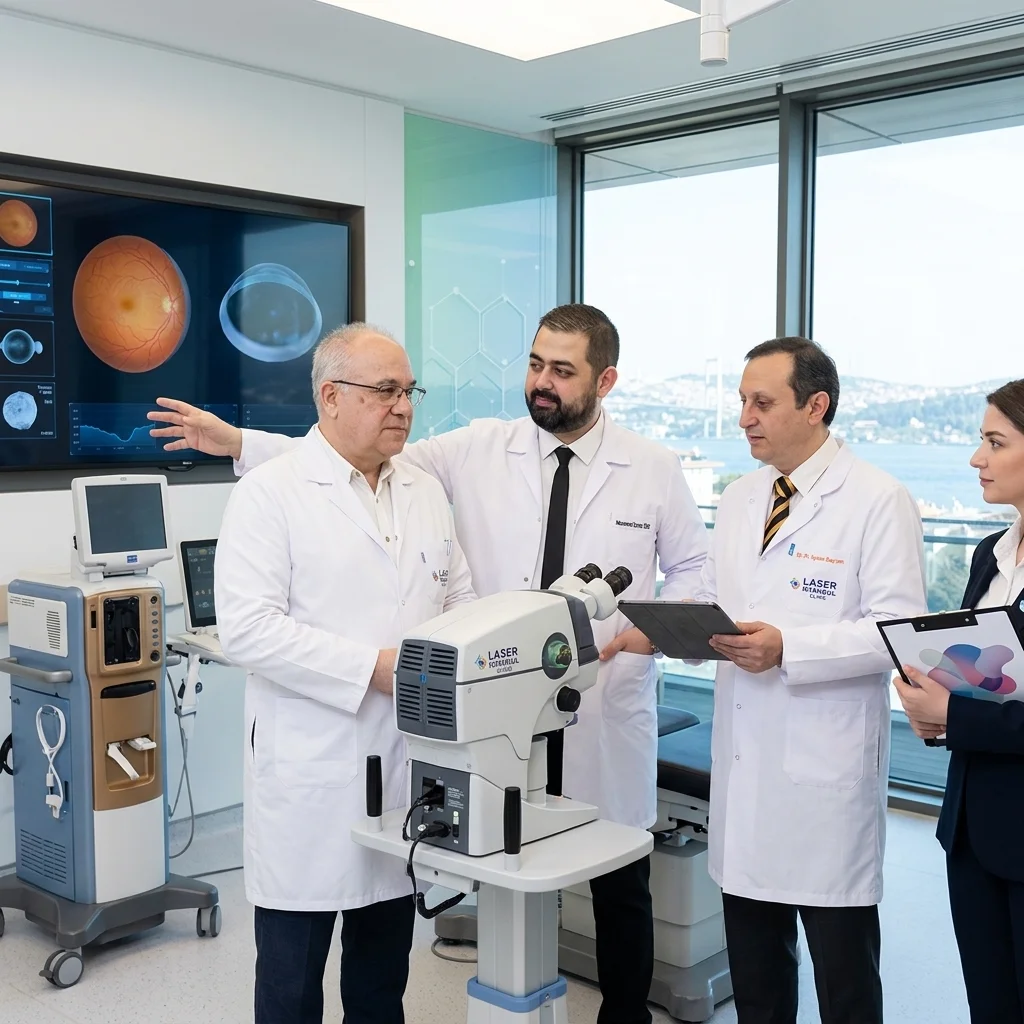
Treatment with us: YAG laser capsulotomy is performed by our cataract surgeons, Prof. Dr. Ahmet Satıcı, Doç. Dr. Muhammet Derda Özer ("Doç." is the Turkish title for Associate Professor; he speaks Turkish and English) and Op. Dr. Aysan Bayram (she speaks English; patients can choose a female surgeon), in a fully equipped, Ministry of Health–licensed operating theatre in Istanbul. Our treatment page explains who needs it, the steps, the risks and what is included.
What are the risks of YAG laser capsulotomy?
The most common side effect is a temporary rise in eye pressure, which is why pressure is checked after the laser; one review reported it in 15–30% of patients despite preventive treatment in some studies (Karahan et al., 2014). Other effects are small marks on the lens implant (pitting, reported in 9.4–19.8% in different studies), macular swelling, floaters and, rarely, a retinal detachment. In the French YAG 2 study, pressure rise and macular swelling each occurred in about 5% at three months, and retinal detachment stayed at or below 0.5% over twelve months. Whether the laser itself raises detachment risk is still debated: a 2022 meta-analysis of 11 studies found a modestly higher risk, while a large Finnish study found none. Your surgeon explains your personal risk before you agree.
Posterior capsular opacification recovery time
Most people notice their vision is back to normal within a few days (NEI). Vision can be blurred for the first hours because of the drops.
-
First hours
Blurred vision from the drops; do not drive; bring someone with you
-
Same day
Eye pressure checked after the laser
-
First few days
Vision clears for most people
-
1–4 weeks
Glasses prescription can shift slightly towards long sight, more with larger openings; the 2014 review advises waiting at least 1 week, or 4 weeks after a large opening, before new glasses
-
About 6 months
Routine check recommended by EyeWiki to look for any return of haze
Report pain, a sudden drop in vision, new flashes or floaters, or a curtain over your vision immediately.
What happens if posterior capsular opacification is left untreated?
Untreated PCO does not clear up by itself, and the blur it causes is unlikely to improve without treatment. The haze lies over the visual axis, so as it spreads, blur, glare and loss of contrast persist and can slowly worsen. The NEI and AAO describe laser as the way to restore clear vision. Not every case needs treatment at once: if the haze is slight and your vision is good, your surgeon may simply monitor it. Treatment is advised when the haze affects daily life, such as reading, driving or night vision. Before blaming PCO, your surgeon also checks for other causes of blur.
Does posterior capsular opacification go away?
No. Once the capsule has clouded, it stays clouded unless it is opened. The laser makes a permanent opening, and EyeWiki says reopacification needing repeat laser is rare.
How to prevent posterior capsular opacification
PCO cannot be prevented completely, but surgical technique and lens design reduce it. According to EyeWiki and the Cochrane review:
- A sharp, square-edged lens implant. The sharp back edge acts as a barrier to migrating cells. A Cochrane review of 10 randomised trials (1,834 eyes) found lower PCO scores with sharp-edged lenses (moderate-certainty evidence) and fewer laser treatments in the longer term.
- Thorough clean-up of leftover cells and cortex during surgery, with hydrodissection and, where needed, capsular polishing.
- Placing the implant in the capsular bag, with a round opening in the front of the capsule slightly smaller than the lens, so the capsule wraps closely around the implant.
- Controlling related conditions, such as uveitis and diabetes, as far as possible.
No eye drop or medicine has yet been shown to prevent PCO; EyeWiki reports that drug approaches remain experimental. A real-world study of 20,763 eyes in seven UK NHS clinics (Ursell et al., 2020, industry-funded) found that 5.8–19.3% needed YAG capsulotomy within five years, depending on the lens model.
When to see a doctor about posterior capsule opacification
Book an appointment (or see an optician first, as the NHS advises) if:
- your vision becomes cloudy or blurry again after cataract surgery
- you find it hard to focus, or glare and halos are getting worse
- you notice reduced contrast, or reading becomes harder
Seek same-day care from an eye doctor or eye emergency service if you have:
- a sudden drop in vision
- new flashes of light, a shower of new floaters or a curtain over part of your vision (possible retinal detachment; the NHS lists these as warning signs after cataract surgery)
- a red, painful eye, or pain with sensitivity to light
Other causes of blurred vision after cataract surgery can look similar, so an examination is needed before a diagnosis: swelling in the central retina, retinal disease, dry eye, an out-of-date glasses prescription, or problems of the cornea such as keratoconus and corneal inflammation (see keratitis).
If you had your cataract surgery elsewhere and are now struggling with misty vision, you can send us your eye report and, if you have it, your operation note with the lens model; a surgeon will tell you whether YAG laser is likely to help.
Frequently asked questions
Posterior capsular opacification, or PCO, is clouding of the thin capsule that holds your lens implant after cataract surgery, caused by lens cells growing across it. It is also called secondary cataract or after-cataract. It can blur vision months or years after surgery and is treated with a quick YAG laser.
The NHS says vision can become cloudy months or years after cataract surgery and that this may be posterior capsule opacification. It advises seeing an optician if vision turns cloudy or blurry. For treatment details, the NEI explains that a YAG laser opens the cloudy capsule, a quick and painless procedure.
No. Once the natural lens has been removed, a cataract cannot grow back. PCO is clouding of the capsule that stays behind to hold the new lens. The NEI says up to 2 in 5 people develop it after cataract surgery.
Blurred or misty vision returning after a period of good vision, glare, halos around lights, sensitivity to light, reduced contrast and difficulty reading. It is painless. Pain, redness or sudden vision loss points to something else and needs urgent care.
With Nd:YAG laser capsulotomy: after numbing drops, a laser makes a small opening in the clouded capsule behind the lens implant, without a cut. It takes minutes and you go home the same day. Rarely, a dense fibrous membrane needs surgical removal instead.
Most people notice normal vision within a few days (NEI). Your glasses prescription can shift slightly, so wait at least a week, or four weeks after a large opening, before new glasses. A check at about six months is advised.
It does not clear up by itself, and blur, glare and loss of contrast can slowly worsen as the haze spreads over the line of sight. Slight haze with good vision may just be monitored. Your surgeon recommends treatment when it affects daily life.
Not without treatment. The clouded capsule stays clouded until a laser opens it. The opening is permanent, and haze needing repeat treatment is rare.
It cannot be fully prevented, but a sharp-edged lens implant, careful cleaning of lens cells and placing the lens in the capsular bag all reduce it. Ask your surgeon about the lens design before cataract surgery.
In US ICD-10-CM, PCO is usually coded H26.49 "other secondary cataract": H26.491 right eye, H26.492 left eye, H26.493 both eyes. The WHO ICD-10 category is H26.4 "after-cataract". The treating doctor or coding team chooses the code.
Rarely. The laser opening is permanent, and EyeWiki lists reopacification needing repeat treatment as rare. Follow-up at about six months checks for it.
Sources for the facts on this page
- NHS. Cataract surgery (reviewed 6 March 2025): vision can become cloudy months or years after surgery (posterior capsule opacification); see an optician. https://www.nhs.uk/tests-and-treatments/cataract-surgery/
- National Eye Institute (NIH). Types of cataract: secondary cataracts. https://www.nei.nih.gov/eye-health-information/eye-conditions-and-diseases/cataracts/types-cataract
- National Eye Institute (NIH). Cataract surgery. https://www.nei.nih.gov/eye-health-information/eye-conditions-and-diseases/cataracts/cataract-surgery
- American Academy of Ophthalmology. What are cataracts? (capsulotomy). https://www.aao.org/eye-health/diseases/what-are-cataracts
- EyeWiki (AAO). Posterior Capsule Opacification. https://eyewiki.org/Posterior_Capsule_Opacification
- Sinha R, Shekhar H, Sharma N, Titiyal J, Vajpayee R. Posterior capsular opacification: a review. Indian J Ophthalmol 2013. https://pmc.ncbi.nlm.nih.gov/articles/PMC3759120/
- Maedel S, Evans JR, Harrer-Seely A, Findl O. Intraocular lens optic edge design for the prevention of posterior capsule opacification after cataract surgery. Cochrane Database Syst Rev 2021. https://pmc.ncbi.nlm.nih.gov/articles/PMC8406949/
- Karahan E, Er D, Kaynak S. An Overview of Nd:YAG Laser Capsulotomy. Med Hypothesis Discov Innov Ophthalmol 2014;3(2):45–50. https://pmc.ncbi.nlm.nih.gov/articles/PMC4346677/
- Ursell PG, Dhariwal M, O'Boyle D, Khan J, Venerus A. 5 year incidence of YAG capsulotomy and PCO after cataract surgery with single-piece monofocal intraocular lenses: a real-world evidence study of 20,763 eyes. Eye 2020;34(5):960–968. https://pmc.ncbi.nlm.nih.gov/articles/PMC7182577/
- Dot C, Schweitzer C, Labbé A, et al. Incidence of retinal detachment, macular edema, and ocular hypertension after Nd:YAG capsulotomy: the French YAG 2 study. Ophthalmology 2023. https://pubmed.ncbi.nlm.nih.gov/36581227/
- Liu H, Liu X, Chen Y, et al. Effect of Nd:YAG laser capsulotomy on the risk for retinal detachment after cataract surgery: systematic review and meta-analysis. J Cataract Refract Surg 2022. https://pubmed.ncbi.nlm.nih.gov/34538778/
- Elbaz U, Hakkala L, Hecht I, et al. Nd:YAG capsulotomy is not a risk factor for retinal detachment after phacoemulsification cataract surgery. Acta Ophthalmol 2021. https://pubmed.ncbi.nlm.nih.gov/33423371/
- WHO. ICD-10 (2019), H26.4 After-cataract. https://icd.who.int/browse10/2019/en#/H26.4
- ICD-10-CM H26.49 and child codes H26.491–H26.499 (coding reference listing, FY 2027). https://www.veroscribe.com/icd-10/codes/H26.49
- Centers for Medicare & Medicaid Services. ICD-10 codes (transition from ICD-9 on 1 October 2015). https://www.cms.gov/medicare/coding-billing/icd-10-codes
Cloudy vision after cataract surgery?
Send us your eye report and, if you have it, your cataract operation note. One of our cataract surgeons will review it and tell you whether posterior capsule opacification is the likely cause and whether YAG laser could help, with no obligation.
3 eye surgeons
Your case is reviewed by a named surgeon, not a salesperson. Reply within {{response time}}.
 Prof. Dr. Ahmet Satıcı
 Doç. Dr. Muhammet Derda Özer
 Op. Dr. Aysan Bayram