
- Home
- Aftercare at Home, Remote Follow-Up and Fruits to Eat After Eye Surgery
Aftercare at Home, Remote Follow-Up and Fruits to Eat After Eye Surgery
Your surgery takes a few minutes; your recovery takes weeks, and most of it happens at home. This page explains what you take home, how your surgeon follows you up by video, what to avoid and for how long, which symptoms need help today, and the question many patients ask: are there fruits to eat after eye surgery that help you heal?

There are no special fruits to eat after eye surgery, and official guidance from the NHS, the US National Eye Institute and the Royal College of Ophthalmologists lists no diet you must follow. A normal balanced diet with vitamin C-rich fruit is enough. What protects your result is using your drops, not rubbing your eye, and attending every check-up. At Laser Istanbul Clinic, Prof. Dr. Ahmet Satıcı, Doç. Dr. Muhammet Derda Özer or Op. Dr. Aysan Bayram reviews your recovery by video once you're home.
What aftercare at home involves
Aftercare at home means three things: following your drop and activity plan, sending your surgeon regular updates, and knowing exactly who to contact if something changes. At Laser Istanbul Clinic, the same surgeon who examined you and operated on you also checks your recovery, first in person in Istanbul and then remotely.
Before you fly home, your surgeon examines you again. You only fly when your surgeon is happy with the eye. You then leave with a handover pack in English:
| What you take home | Why it matters |
|---|---|
| Your full surgical report | Any eye doctor who sees you later knows exactly what was done |
| Lens model and power (lens and cataract surgery) | Needed for future eye tests, glasses and any later treatment |
| Laser type and treatment data (laser surgery) | Needed if you ever need an enhancement or another eye procedure |
| A written drop schedule with dates | Different drops stop on different days; a printed plan avoids mistakes |
| Your activity plan | When you can shower, swim, exercise, wear make-up and drive |
| Your remote follow-up dates | Agreed before you leave: {{remote follow-up schedule}} |
| Direct contacts for your coordinator | One number for questions, appointments and urgent problems: {{WhatsApp number}} |
Your price already includes this. Pre-op examination and scans, surgery by your named surgeon, medication, follow-up checks in Istanbul, your personal interpreter, your coordinator and remote follow-up are all included. Hotel and airport transfers are not included: we arrange them on request for a separate charge. Flights are not included.
How remote follow-up after eye surgery works
Remote follow-up means your surgeon reviews your recovery by video call at agreed points after you get home, with your coordinator arranging each call and any in-person examination you need near home. It replaces routine visits that don't need a microscope, not urgent care.
This approach reflects how eye care is organised in many countries. In England, for example, the National Institute for Health and Care Excellence (NICE) advises that people should not be offered a routine in-person review on the first day after uncomplicated cataract surgery. What NICE does require is a process that spots complications and gives prompt access to specialist eye care. Laser surgery is different: the US Food and Drug Administration (FDA) says LASIK patients should see their doctor within 24 to 48 hours and at regular intervals for at least the first six months. Your first checks therefore happen in person in Istanbul, before you fly; the later ones are remote.
How a video check-up works:
- Your coordinator books the call at a time that suits your time zone and sends a reminder the day before.
- You prepare three things: a list of the drops you are using and any you have missed, a short note of what you notice (comfort, redness, how clear your vision is at distance and for reading), and, if your surgeon asks, a clear photo of the eye taken in daylight.
- Your surgeon talks to you, with your interpreter on the call if you want one, looks at the eye on camera and asks about your symptoms.
- You get a clear outcome: carry on as planned, change a drop, or have an in-person examination near home. If you need one, we help you book a local optometrist or ophthalmologist and send them your full records.
- Your file is updated and your next check-up date is confirmed in writing.
Typical recovery checkpoints (your surgeon sets your own dates):
| When | What usually happens | Where |
|---|---|---|
| Day 1 | First check of the eye, as your surgeon plans it | In person, Istanbul |
| Before you fly | Final examination; handover pack | In person, Istanbul |
| First weeks at home | Drops, healing, comfort, first questions | Video call: {{remote follow-up schedule}} |
| Around 1–3 months | Vision settling; when to get new glasses | Video call, plus a local eye test if needed |
| Any time | New pain, redness or loss of vision | Urgent: see "When to worry" below |
Eye drops after surgery: how to use them at home
Your drops are the most important part of your home aftercare, so use them exactly as prescribed, for as long as prescribed. After cataract surgery, the NHS says you'll usually need drops for about 4 weeks to help the eye heal and prevent infection. After laser surgery, the Royal College of Ophthalmologists (RCOphth) advises antibiotic and anti-inflammatory drops as prescribed, plus frequent lubricant drops, especially in the first hours after LASIK.
How to put drops in, based on American Academy of Ophthalmology (AAO) and RCOphth advice:
Wash your hands
with soap and water before you touch the bottle or your eye.
Don't touch the dropper tip
with your fingers or your eye; a touched tip can pick up bacteria and contaminate the bottle.
Tilt your head back, gently pull the lower lid down
and let one drop fall into the pocket.
Close your eye and press lightly where the eyelid meets the nose
for a minute or two, so the drop stays in the eye.
Wait between different drops
The RCOphth says to leave at least two minutes; the AAO suggests 3 to 5 minutes. Use the gap your surgeon gives you.
Not sure the drop went in?
The RCOphth says applying a second drop is no problem.
Set phone alarms for each drop. If you run out early, or a bottle is contaminated, message your coordinator before you buy a replacement, so your surgeon can confirm the right one.
What to avoid after eye surgery, and for how long
Most restrictions after eye surgery last from a few days to a month, and they depend on the operation you had. The table summarises official guidance; your surgeon may give you different dates for your eye.
| Activity | After cataract or lens surgery | After LASIK or SMILE | After surface laser (PRK, LASEK, Trans-PRK) |
|---|---|---|---|
| Rubbing the eye | No (NHS) | No; it protects the LASIK flap | No |
| Shield at night | Often, while the eye heals (NHS) | Shield usually given after surgery (FDA) | As your surgeon advises |
| Showering | Keep water out of the eye (NHS) | Fine from day one (RCOphth) | Once the bandage contact lens is out, typically day 4–7 (RCOphth) |
| Eye make-up, creams | Not until your surgeon says so (NHS) | Avoid for up to two weeks (FDA) | Avoid for up to two weeks (FDA) |
| Swimming | Not even with goggles, until your surgeon says so (NHS) | Not for at least a week (RCOphth); the FDA suggests avoiding pools and hot tubs for 1–2 months | As LASIK |
| Gym, jogging | Avoid heavy lifting and sport until cleared (NHS) | Usually from day one (RCOphth) | Usually from day one (RCOphth) |
| Contact sports | Until your surgeon says so | Not for at least a month (RCOphth) | Can usually return sooner than after LASIK (RCOphth) |
| Driving | Not until your vision is back to normal (NHS) | Once you meet the driving standard; many LASIK patients are back at work the next day (RCOphth) | Often a week or longer before you reach the driving standard (RCOphth) |
| Bending, heavy lifting | Avoid for a few weeks (NEI) | Follow your surgeon's advice | Follow your surgeon's advice |
After retina surgery, the NHS says you may need to keep your head in a particular position for up to 7 days, and you may need to avoid flying for some time if a gas bubble was put into your eye. Recovery usually takes 2 to 6 weeks, with blurred vision and a sore, red eye during that time.
What's normal in the first weeks: the NHS says the eye may hurt for a few days and that you may feel more tired than usual. After laser surgery, the RCOphth describes dry, gritty eyes, variable vision, glare and halos at night as common and usually improving over a few months. Red marks on the white of the eye are common after LASIK and can take up to six weeks to fade.
Fruits to eat after eye surgery: is there a special diet?
No. There are no specific fruits to eat after eye surgery, and no food has been shown to speed up healing of the eye. The NHS, the National Eye Institute (NEI), the RCOphth and the FDA list drops, hygiene and activity limits in their aftercare advice, not a special diet. You can eat as you normally do. A varied, balanced diet supports your general health while you recover.
Why fruit still makes sense. According to the NHS, vitamin C helps protect cells, keeps skin and blood vessels healthy and helps with wound healing. Adults aged 19 to 64 need 40 mg a day, and the NHS says you should be able to get all of it from your daily diet. Good sources include oranges, strawberries, blackcurrants and kiwifruit, as well as peppers and broccoli. For eye health in general, the AAO also points to colourful fruit and leafy green vegetables for lutein and zeaxanthin, and to oily fish for omega-3 fatty acids; the NEI recommends dark leafy greens and fish such as salmon and tuna.
| Food | What it gives you | Source |
|---|---|---|
| Oranges, kiwifruit, strawberries, blackcurrants | Vitamin C | NHS, AAO |
| Peppers, broccoli, tomatoes | Vitamin C | NHS, AAO |
| Colourful fruit, kale, spinach, Swiss chard | Lutein and zeaxanthin | AAO |
| Salmon, trout, sardines, tuna | Omega-3 fatty acids | AAO, NEI |
| Almonds, sunflower seeds, avocado, olive oil | Vitamin E | AAO |
| Beans, lentils, eggs, dairy | Zinc | AAO |
Two cautions:
- Supplements are not a treatment. The AAO says vitamins and supplements are not a cure for eye disease and won't restore vision you have already lost. The NHS adds that more than 1,000 mg of vitamin C a day can cause stomach pain and diarrhoea. Specific supplement formulas are used for some people with macular degeneration; ask your surgeon before you start any.
- Grapefruit can interact with some tablets. The FDA warns that grapefruit juice affects some medicines, including some statins and blood-pressure drugs, and that Seville oranges, pomelos and tangelos may have the same effect. If you take regular tablets, check the leaflet or ask your pharmacist.
Foods to avoid after eye surgery? None in the official guidance we checked. If you have diabetes, keep to your usual diet and medication plan and tell your surgeon about it before surgery, so your recovery plan takes it into account.
When to worry after eye surgery
Get help the same day if your eye gets more painful, redder or blurrier instead of better. Some discomfort, grittiness and blurred vision are normal at first; getting worse is not. The FDA tells LASIK patients to contact their eye doctor immediately for severe pain or if vision or other symptoms get worse instead of better. The NEI lists vision loss, bad pain that doesn't go away with painkillers, very red eyes, and flashes or floaters as reasons to call straight away after cataract surgery.
| Symptom | What to do |
|---|---|
| Mild grittiness, watering, light sensitivity in the first days | Normal; use your lubricant drops and mention it at your next check-up |
| Increasing pain, redness, light sensitivity or blurred vision | Message your coordinator now; your surgeon reviews you the same day |
| An injury to the eye followed by pain, blurring or watering (RCOphth) | Contact your surgeon without delay; get examined locally |
| Sudden new floaters, flashes of light, a dark curtain or shadow across your vision (NHS) | Go to eye casualty or an emergency department first, then tell us: these can be signs of a detached retina |
| Vision worsening slowly over months after cataract surgery | Book an eye test; this can be a secondary cataract, which the NEI says is fixed with laser treatment |
Out of hours, your coordinator can be reached at {{out-of-hours contact and hours}}. In an emergency, don't wait for a reply: go to the nearest eye casualty or emergency department and send us the details afterwards.
If something goes wrong: {{complication policy: what the surgeons cover if there is a complication or a re-treatment is needed, for how long, whether a return trip to Istanbul is covered, and who pays for an in-person review at home}}
Seeing an eye doctor near home
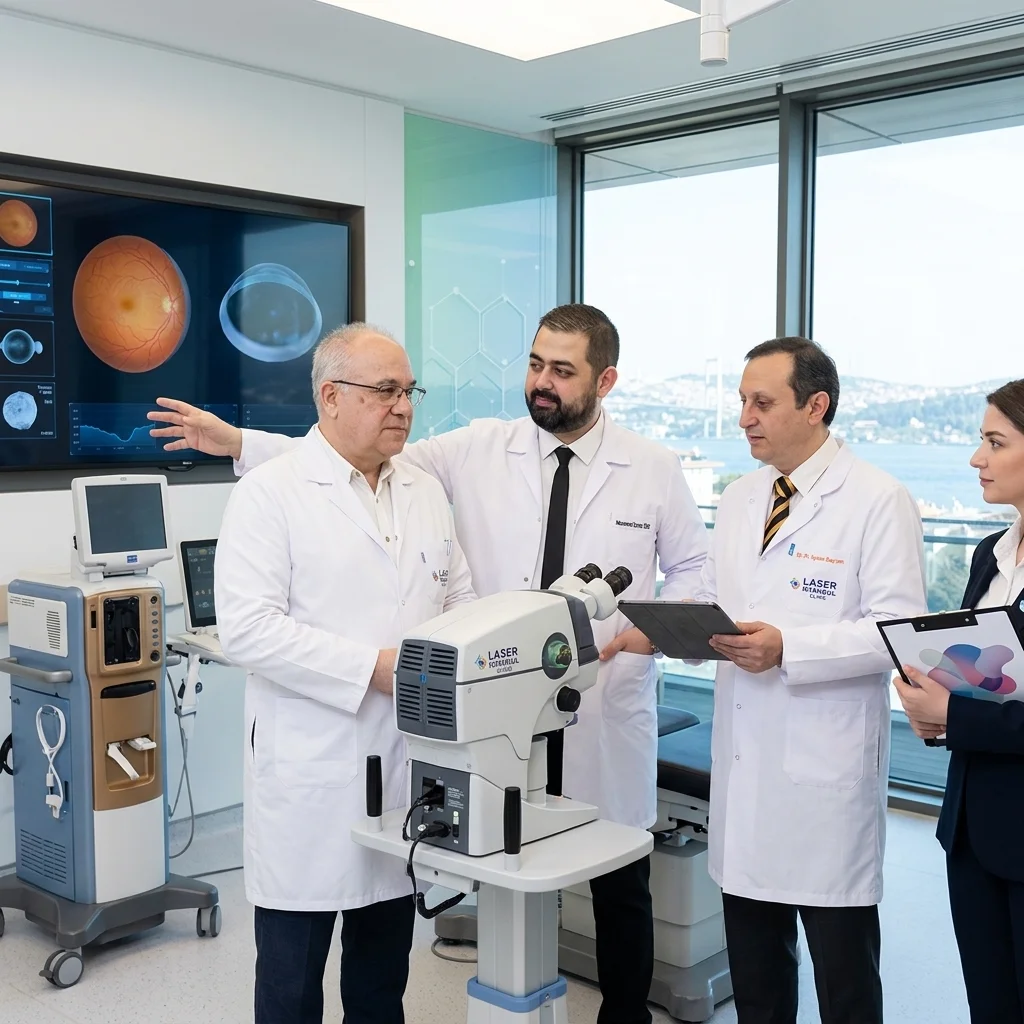
You can see a local optometrist or ophthalmologist at any point, and we encourage it whenever your surgeon wants the eye examined in person. Your coordinator helps you find one, sends your full records and arranges for your surgeon to discuss the findings.
In the UK, it's a good idea to tell your GP or optometrist about your surgery before you go and to share your handover pack when you're back. The NHS treats emergencies, but the RCOphth says it is unlikely to help with aftercare for surgery abroad unless you have a serious complication that needs emergency or life-saving treatment, which is why your remote follow-up plan with your own surgeon matters.
Long-term checks still count. According to the NEI, most people are completely healed 8 weeks after cataract surgery, and once the eye has healed you may need a new glasses prescription. After LASIK, the FDA says vision can take three to six months to stabilise. A secondary cataract (posterior capsule opacification) can appear weeks, months or even years after cataract surgery. Keep having regular eye tests at home, and take your lens or laser details with you.
Your interpreter and coordinator after you fly home
Your coordinator stays your single point of contact after you fly home, and your interpreter can join any video check-up. Doç. Dr. Özer and Op. Dr. Bayram speak English, and every document in your handover pack is in English. If you'd rather talk through a symptom in your own language, your interpreter joins the call, so nothing is lost between you and your surgeon.
Your coordinator also handles the practical side: booking calls in your time zone, chasing results from a local eye test, sending records to a local doctor and arranging a return visit to Istanbul if your surgeon recommends one.

Planning your stay so aftercare starts well
Good aftercare begins with booking enough days in Istanbul. Plan 3–5 days for laser eye surgery and 5–7 days for lens replacement or cataract surgery, so your surgeon can check your eye before you fly. Most patients can fly 1–3 days after laser surgery and about 3–7 days after lens or cataract surgery. After some retina operations that use a gas bubble, flying isn't safe for several weeks.
On the flight home, keep your drops and your handover pack in your hand luggage, carry your eye shield, and keep to your drop times on the plane (set your alarms to the same schedule). Hotel and airport transfers are not included in your treatment price; we can arrange them for you at a separate charge.
Who looks after your recovery
Your recovery is followed by the surgeon who operated on you:
- Prof. Dr. Ahmet Satıcı, ophthalmology specialist since 1992: cataract, premium lens and lens replacement, laser surgery (LASIK, SMILE Pro, PRK), ICL, eyelid surgery, squint and glaucoma
- Doç. Dr. Muhammet Derda Özer ("Doç." means Associate Professor): cornea, keratoconus and cross-linking, corneal transplant, retina, uveitis and ocular oncology, as well as cataract; speaks Turkish and English
- Op. Dr. Aysan Bayram, ophthalmology specialist since 1999: cataract, laser surgery and retinal disease; speaks English
Surgery takes place in a fully equipped, Ministry of Health–licensed operating theatre in Istanbul. After that, the same surgeon, your coordinator and your interpreter stay with you until your surgeon signs off your recovery.
Frequently asked questions
There are no specific fruits you need to eat after eye surgery. Eat a normal balanced diet; vitamin C-rich fruit such as oranges, kiwifruit, strawberries and blackcurrants is a good choice, because the NHS says vitamin C helps with wound healing. If you take regular tablets, check whether grapefruit interacts with them.
Whatever you normally eat. The NHS and the NEI give no dietary restrictions after cataract surgery; what matters is your drops, keeping water and dirt out of the eye, and not rubbing it. If you have diabetes, stick to your usual diet and medication plan.
Official aftercare guidance doesn't list any. The one food caution is grapefruit (and Seville oranges, pomelos and tangelos), which the FDA says can interact with some medicines, such as certain statins and blood-pressure drugs. High-dose vitamin C supplements above 1,000 mg a day can upset your stomach (NHS).
The surgeon who operated on you, through video check-ups at agreed dates, with your coordinator as your day-to-day contact. If you need to be seen in person, we help you book a local optometrist or ophthalmologist and send them your full records.
After laser surgery, yes: the FDA advises a check within 24 to 48 hours, and you'll have it in Istanbul. After uncomplicated cataract surgery, NICE in England advises against a routine in-person first-day review, but you will still be examined before you fly home.
It depends on the operation. After cataract surgery, the NHS says drops are usually needed for about 4 weeks. After laser surgery, you use antibiotic and anti-inflammatory drops as prescribed, and the RCOphth says lubricant drops keep most people comfortable while the eye surface heals over a few months. Your written schedule tells you when to stop each one.
After LASIK or SMILE, gym and jogging are usually fine from day one, swimming after at least a week and contact sports after a month (RCOphth); make-up after up to two weeks (FDA). After cataract surgery, wait until your surgeon says so. Your handover pack lists your own dates.
If pain, redness or blurred vision get worse instead of better, contact your surgeon the same day. If you see sudden floaters, flashes of light or a dark curtain across your vision, go to an eye casualty or emergency department first, because these can be signs of a detached retina.
After cataract surgery, the NEI says most people are completely healed by 8 weeks. After LASIK, the FDA says vision can take three to six months to stabilise. Wait until your surgeon says the eye has settled before buying new glasses.
Sources for the facts on this page
- NHS, Cataract surgery: drops for about 4 weeks; plastic shield at night; do not rub the eye, drive until vision is back to normal, lift heavy things, play sport, wear eye make-up, get water in the eye or swim (even with goggles); eye may hurt for a few days; feeling more tired; retinal detachment warning signs (floaters, flashes, dark curtain, sudden blur). https://www.nhs.uk/tests-and-treatments/cataract-surgery/
- NHS, Detached retina (retinal detachment): positioning for up to 7 days; recovery 2–6 weeks; avoid flying with a gas bubble; get help if pain, redness or blurring gets worse. https://www.nhs.uk/conditions/detached-retina-retinal-detachment/
- NHS, Vitamin C: protects cells, healthy skin and blood vessels, helps with wound healing; sources (citrus fruit, peppers, strawberries, blackcurrants, broccoli, Brussels sprouts, potatoes); adults 19–64 need 40 mg a day; enough from diet; over 1,000 mg a day can cause stomach pain and diarrhoea. https://www.nhs.uk/conditions/vitamins-and-minerals/vitamin-c/
- National Eye Institute (NIH), Cataract Surgery: drops, shield, avoid touching the eye, bending and heavy lifting for a few weeks; eye feels better after 1–2 days; call for vision loss, bad pain, very red eyes, floaters/flashes; most people completely healed by 8 weeks; new glasses prescription; secondary cataract weeks, months or years later, fixed with laser. https://www.nei.nih.gov/learn-about-eye-health/eye-conditions-and-diseases/cataracts/cataract-surgery
- National Eye Institute (NIH), Keep Your Eyes Healthy: dark leafy greens; fish high in omega-3 (salmon, tuna, halibut). https://www.nei.nih.gov/learn-about-eye-health/healthy-vision/keep-your-eyes-healthy
- American Academy of Ophthalmology, Diet and Nutrition: vitamin C foods (oranges, grapefruit, kiwifruit, strawberries, tomatoes, peppers, broccoli); vitamin E (almonds, sunflower seeds, olive oil, avocado); lutein and zeaxanthin (leafy greens, colourful fruits); omega-3 (salmon, trout, sardines); zinc (legumes, seeds, meat/seafood, dairy, eggs); supplements are not a cure and won't restore lost vision. https://www.aao.org/eye-health/tips-prevention/diet-nutrition
- American Academy of Ophthalmology, How to Put in Eye Drops (May 2023): wash hands; don't touch the dropper tip; wait 3–5 minutes between different drops; press on the tear duct for a minute or two. https://www.aao.org/eye-health/treatments/how-to-put-in-eye-drops
- US Food and Drug Administration, What should I expect before, during and after LASIK surgery?: shield after surgery; follow-up within 24–48 hours and at regular intervals for at least six months; non-contact sports after 1–3 days; avoid lotions and make-up for up to two weeks; avoid swimming and hot tubs for 1–2 months; contact sports after at least four weeks; vision may take 3–6 months to stabilise; contact the doctor immediately for severe pain or worsening symptoms. https://www.fda.gov/medical-devices/lasik/what-should-i-expect-during-and-after-surgery
- US Food and Drug Administration, Grapefruit Juice and Some Drugs Don't Mix: interacting drug groups (some statins, blood-pressure drugs, antihistamines and others); ask a doctor or pharmacist; Seville oranges, pomelos and tangelos may have the same effect. https://www.fda.gov/consumers/consumer-updates/grapefruit-juice-and-some-drugs-dont-mix
- NICE, Cataracts in adults: management (NG77), recommendations 1.1.5 and 1.9.1–1.9.3: information on drops, warning signs and contacts after surgery; processes to identify complications with prompt access to specialist care; do not offer an in-person first-day review after uncomplicated cataract surgery. https://www.nice.org.uk/guidance/ng77/chapter/Recommendations
Ask a surgeon how your recovery would work
Tell us which treatment you're considering and where you live. Your surgeon will explain your recovery plan, how many days to stay in Istanbul and how your follow-up will work once you're home, with no obligation. You'll get a reply within {{response time}}.
3 eye surgeons
Your case is reviewed by a named surgeon, not a salesperson. Reply within {{response time}}.
 Prof. Dr. Ahmet Satıcı
 Doç. Dr. Muhammet Derda Özer
 Op. Dr. Aysan Bayram