
- Home: eye surgery in Istanbul
- All eye treatments
- Eye examinations & diagnostic tests
- Tonometry (eye pressure measurement)
Eye Pressure Test (Tonometry): How It Works and What Your Result Means
An eye pressure test, called tonometry, measures the fluid pressure inside your eye in millimetres of mercury (mmHg). It takes a few minutes, it does not hurt, and it is one of the main tests used to find glaucoma early, because high eye pressure usually causes no symptoms you can feel. At Laser Istanbul Clinic eye pressure is checked as part of every pre-operative and glaucoma examination, and your surgeon explains the result with you, through your interpreter if you wish.
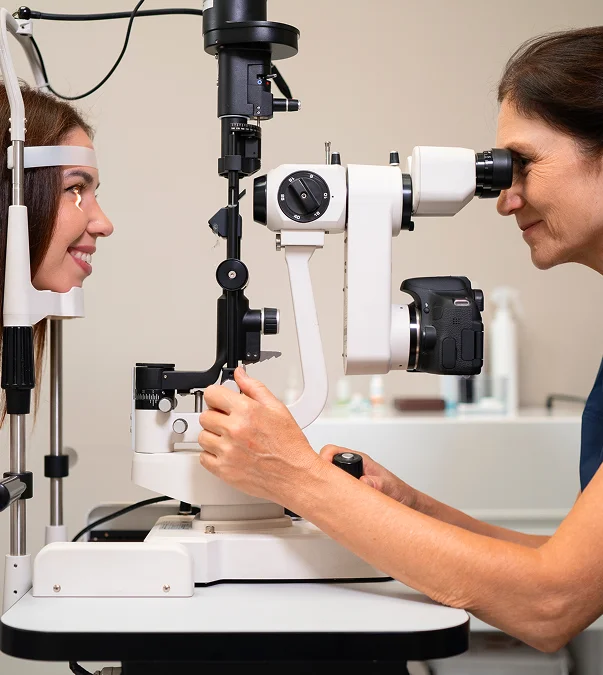
An eye pressure test (tonometry) measures the pressure inside your eye, normally about 10 to 21 mmHg. It is done with a puff of air, a gentle probe touch or a small rebound probe, and takes only a few minutes. A high reading does not mean glaucoma on its own: your surgeon also checks your optic nerve, corneal thickness and visual field. At Laser Istanbul Clinic, pressure and glaucoma care is led by Prof. Dr. Ahmet Satıcı.
What does an eye pressure test measure?
An eye pressure test measures intraocular pressure (IOP): the pressure of the fluid inside your eye, which keeps it firm and in shape. The unit is millimetres of mercury (mmHg), the same unit as blood pressure, although the two are unrelated. The test does not diagnose anything alone; it is one piece of a full eye examination.
Most tonometers work indirectly. They flatten or indent a small area of the cornea and convert the force needed into a pressure reading. The Goldmann tonometer, for example, is based on the Imbert–Fick principle: the pressure inside a thin-walled sphere equals the force needed to flatten its surface divided by the area flattened.
Eye pressure measurements are used for three things:
- Finding glaucoma and ocular hypertension (pressure above normal with a healthy optic nerve)
- Monitoring treatment, to see whether drops, laser or surgery are bringing the pressure down to your target
- Planning and safety checks around eye surgery, including laser vision correction, cataract and lens surgery
Why is an eye pressure test important?
High eye pressure is the main treatable risk factor for glaucoma, a group of eye diseases that damage the optic nerve. The National Eye Institute explains that early glaucoma usually has no symptoms, so it is typically found on an eye examination rather than because something feels wrong. The American Academy of Ophthalmology (AAO) stresses that a single eye pressure test by itself is not enough: the only sure way to diagnose glaucoma is a full, comprehensive eye examination.
Global figures show why screening matters. A 2014 meta-analysis in Ophthalmology estimated that 64.3 million people aged 40 to 80 had glaucoma worldwide in 2013, rising to 111.8 million by 2040.
An eye pressure test is also part of getting ready for surgery. Your surgeon needs to know your pressure before laser eye surgery, cataract surgery or lens replacement, because a high reading may point to glaucoma that needs treating first or alongside, and because some surgery changes how your pressure reads afterwards (see "What can change your eye pressure reading?" below).
What types of eye pressure test are there?
There are several ways to measure eye pressure. Which one you have depends on the purpose of the visit and what the clinic uses.
| Eye pressure test | How it works | Anaesthetic drops? | Touches the eye? | Main use |
|---|---|---|---|---|
| Goldmann applanation tonometry (slit lamp) | A small prism gently flattens the cornea while the doctor looks through a microscope; yellow dye stains your tears so the flattened area can be seen | Yes | Yes | The reference ("gold standard") method; used to confirm a diagnosis and to guide treatment |
| Non-contact (air-puff) tonometry | A brief puff of air indents the cornea and the machine measures how it flattens | No | No | Quick screening; often the first test in an examination |
| Rebound tonometry (e.g. iCare) | A very light, single-use probe touches the cornea for a fraction of a second | No | Yes, very lightly | Children, people who dislike the puff, and prescribed home devices |
| Hand-held electronic indentation (e.g. Tono-Pen) | A pen-like device with a rounded tip touches the cornea; the reading appears on a display after several measurements | Yes | Yes | A portable contact method |
Goldmann applanation tonometry at a slit lamp is described in the medical literature as the gold standard for measuring eye pressure. UK guidance (NICE) asks for Goldmann-type tonometry in the diagnosis of glaucoma, and says a decision to refer should not rest on non-contact tonometry alone.
Our examination uses {{tonometer types used by your surgeons}}.
The air puff test: what is it, and is there an alternative?
The "eye puff test" is non-contact tonometry. You rest your chin on a support and look at a light inside the machine. It blows a quick puff of air onto your cornea, and the machine converts how the cornea flattens into a pressure reading. Nothing touches your eye, so the instrument carries no risk of a scratch or infection, and it is the easiest method for children and anxious patients. The puff feels like a sudden breath of air and may make you blink; it is not painful.
How accurate is the air-puff test? It is a good screening test, but it is not the reference method. In a 2019 study of 90 healthy volunteers aged 7 to 75, air-puff readings were on average about 4.4 to 4.7 mmHg higher than Goldmann readings in every age group. EyeWiki (AAO) reports that air-puff tonometers tend to read too high at lower pressures and too low at higher pressures compared with Goldmann. That is why, as NICE advises, an air-puff result alone is not used to decide on referral or treatment, and a worrying reading is repeated and checked with a contact method.
What is the alternative to the eye puff test?
- Goldmann applanation tonometry, with numbing drops and yellow dye, is the standard alternative when more accuracy is needed. The Dudley Group NHS Foundation Trust describes the test as painless, with anaesthetic drops preventing discomfort.
- Rebound tonometry needs no drops and uses a disposable probe. In the same 2019 study, rebound and Goldmann readings did not differ significantly in any age group, and the authors called rebound tonometry a reliable alternative. Some other studies find it reads slightly differently from Goldmann, which is why your doctor compares readings from the same method over time.
If you dislike the puff, tell your examiner. Asking for a different method is perfectly reasonable.
What to expect: the eye pressure test procedure
Before the test
- Tell the examiner if you wear contact lenses. Lenses are normally removed before a pressure test and, according to Healthwise, not put back for about 2 hours afterwards. Your coordinator will confirm the timing for you.
- Wear comfortable clothing. Healthwise advises loosening tight neck clothing, because pressure on the neck veins can raise eye pressure, and staying relaxed during the test.
- Bring your glasses, your list of eye drops and any earlier pressure readings. Previous numbers help your surgeon see whether yours is stable.
During the air-puff test
- You sit and rest your chin and forehead on a support.
- You look at a light or target inside the machine and keep your eye open.
- The machine blows a puff of air and records the reading. Machines often take several readings per eye so the result can be averaged.
During Goldmann tonometry
- Numbing drops are put into your eyes, followed by yellow-orange dye (fluorescein) that temporarily stains your tears.
- You sit at the slit lamp with your chin on the rest and look straight ahead.
- A blue light shines on your eye, and the doctor touches a small prism very gently against your cornea and turns a dial until the dye pattern lines up. The pressure is read from the dial.
How long does it take? The test itself takes only a few minutes. Your pressure check is one short part of your full examination, which also includes your prescription, a corneal scan, a retina check and, if glaucoma is suspected, a visual field test.
Is it safe? The risks are small. Healthwise lists a minimal risk of a corneal scratch or an allergic reaction to the drops with contact methods, and none from the air puff. Contact tonometry is not done if the cornea has been injured or has an ulcer.
What is a normal eye pressure? How the result is read
The normal eye pressure range is about 10 to 21 mmHg. A 2023 review in Cureus gives the usual population range as 10 to 21 mmHg, with an average of about 15 mmHg in healthy adults. The AAO describes the typical range as about 10 to 20 mmHg. The same range is used for the air-puff test, so the normal range for an eye puff test is the same; but because methods can differ by a few mmHg, your doctor notes which method produced the number.
| Reading (mmHg) | What it usually means | What happens next |
|---|---|---|
| About 10–21 | Within the normal range | Routine eye tests. Glaucoma can still develop at normal pressure (normal-tension glaucoma), so your optic nerve is checked too |
| Above 21 | Higher than the usual range; if your optic nerve and visual field are healthy this is called ocular hypertension | A repeat reading, corneal thickness, optic nerve examination and visual field test |
| 24 or more on Goldmann-type tonometry | In the UK, NICE advises confirming on another occasion and referring to an eye specialist | A full glaucoma assessment, and possibly treatment if you are at risk of losing sight in your lifetime |
A high reading is not a diagnosis. Ocular hypertension means higher-than-normal pressure without optic nerve damage or visual field loss; it raises the risk of glaucoma but is not glaucoma. Glaucoma itself is diagnosed from the optic nerve and visual field findings together with pressure, corneal thickness and the drainage angle. The AAO notes that you can develop glaucoma even if your pressure is in the "normal" range.
Is there a "good" eye pressure for treatment? If you have glaucoma, your surgeon sets an individual target pressure, which depends on how much damage there is and how fast it is progressing. It is not the same number for everyone.
What can change your eye pressure reading?
A single reading is a snapshot. Several things can make it higher or lower than your usual pressure, which is why your surgeon looks at the whole picture.
- Time of day. Pressure normally varies by 3 to 5 mmHg over a day, highest at the end of the night and in the early morning. In people with glaucoma it can vary by 10 mmHg or more over 24 hours, and two-thirds of glaucoma patients have their highest readings outside normal clinic hours, particularly during sleep (EyeWiki, AAO).
- Corneal thickness. The Goldmann tonometer was designed for an average corneal thickness of about 520 microns. A thin cornea can make the reading too low and a thick cornea too high; EyeWiki gives the effect as roughly 5 to 7 mmHg per 100 microns of difference. NICE advises measuring central corneal thickness to help interpret pressure, which is why pachymetry is part of a glaucoma assessment.
- Astigmatism. High corneal astigmatism affects Goldmann readings; EyeWiki notes that measuring twice, 90 degrees apart, is advised in moderate to high astigmatism.
- Laser eye surgery. LASIK, PRK and other laser treatments make the central cornea thinner and change its curvature and stiffness, so pressure can read lower than it truly is. The Royal College of Ophthalmologists warns that laser vision correction can affect eye-pressure readings. In one study of LASIK patients, readings after surgery fell by about 2.2 mmHg with a Perkins tonometer and about 4.1 mmHg with a non-contact tonometer. If you have had laser surgery, tell every eye doctor who measures your pressure and keep your pre-laser readings.
- Tension and tight clothing. Healthwise advises loosening tight neck clothing and staying relaxed, because neck pressure can raise a reading.
Can I test my eye pressure at home? What about an eye pressure test machine?
You cannot feel your eye pressure, so you cannot judge it without a measurement. The honest answer to "eye pressure test at home" has two parts.
Home tonometers exist, but they are prescribed medical devices. The iCare HOME2 is a hand-held rebound tonometer for patient self-use. It received US FDA 510(k) clearance in 2022 and is a prescription device: it is prescribed by an eye doctor, and the readings are shared with that doctor through a connected app. It exists because pressure changes during the day and night, and a few clinic readings can miss the peaks. EyeWiki reports studies finding home rebound tonometry accurate and easy to use for most patients.
What this means for you:
- If you have glaucoma or ocular hypertension and want home readings, ask your eye doctor whether home monitoring suits you and which device they trust. Readings are only useful if your doctor knows which device made them.
- Searches for an "eye pressure tester for sale" or an "eye pressure test machine at home" lead to many consumer gadgets. Do not use an unprescribed device to decide whether you have glaucoma or to change your drops. A normal home reading does not rule out glaucoma, because the optic nerve and visual field also need checking.
- Eye pressure test machine price: clinic-grade tonometers (Goldmann slit-lamp units, non-contact machines, rebound devices) are professional instruments bought by clinics and opticians, and their prices vary by type and supplier. We do not quote machine prices. If you need a device for home use, the right route is a prescription and advice from your eye doctor.
If you are worried about your pressure, the quickest reliable step is a professional test as part of a full eye examination.
Eye pressure test price
Eye pressure measurement is included in every treatment price at Laser Istanbul Clinic, as part of your full pre-operative or glaucoma examination and scans with your surgeon. If you only want a pressure check or a glaucoma assessment, for example a second opinion, a standalone examination including tonometry costs {{£ price for a standalone eye pressure check and glaucoma assessment}}. Hotel and airport transfers are not included and are a separate charge if you would like us to arrange them.
You can also send recent pressure readings and reports from your own optician or eye doctor for a free initial review before you travel.
Who reads your eye pressure results?
Your pressure is read by the surgeon who will treat you, together with your other findings. Prof. Dr. Ahmet Satıcı leads glaucoma and eye-pressure care at Laser Istanbul Clinic. Doç. Dr. (Associate Professor) Muhammet Derda Özer reviews pressure alongside corneal disease, uveitis and retinal conditions, where pressure and the cornea interact. Op. Dr. Aysan Bayram, a female surgeon who speaks English, checks pressure as part of cataract, laser and retina assessments. If your reading is unexpected, your surgeon explains what it means and what the options are, through your interpreter if you wish.
Treatments an eye pressure test supports
| Treatment | How eye pressure testing is used |
|---|---|
| Glaucoma treatment and surgery (drops, SLT laser, MIGS stents, trabeculectomy, drainage tubes) | Diagnosis, setting a target pressure, checking that treatment works and monitoring over time |
| Laser eye surgery (LASIK, SMILE Pro, PRK) | Baseline pressure before surgery; readings are interpreted with care afterwards because laser can make them read low |
| Cataract and lens replacement surgery | Pressure is checked before and after surgery, and glaucoma is identified so it can be managed safely |
| ICL implantable lenses | Pressure is part of the assessment before and after the lens is placed |
Other tests in your eye examination
An eye pressure test is usually done alongside other tests, each answering a different question:
- Corneal topography: maps the shape of your cornea, which also helps interpret pressure (/en/eye-tests-diagnostics/corneal-topography/)
- OCT scan (optical coherence tomography): detailed cross-section scans, including the optic nerve (/en/eye-tests-diagnostics/oct-scan/)
- Visual field test (perimetry): checks your side vision, which glaucoma damages first (/en/eye-tests-diagnostics/visual-field-test/)
- FFA (fundus fluorescein angiography): imaging of the blood vessels at the back of the eye (/en/eye-tests-diagnostics/fluorescein-angiography/)
- Eye ultrasound (B-scan): imaging when the inside of the eye cannot be seen directly (/en/eye-tests-diagnostics/eye-ultrasound/)
- VEP & ERG electrophysiology tests: measure the electrical responses of the retina and visual pathway (/en/eye-tests-diagnostics/vep-erg-tests/)
Eye pressure test: frequently asked questions
An eye pressure test, or tonometry, measures the pressure inside your eye in mmHg. It is used to find glaucoma and ocular hypertension, to check that treatment is working and to prepare for eye surgery. It takes only a few minutes and does not hurt.
It is non-contact tonometry. You look at a light while the machine blows a quick puff of air at your cornea, and it works out your pressure from how much the cornea flattens. Nothing touches your eye. It is a screening test, and a high result is normally confirmed with another method.
No. The air puff feels like a sudden breath of air and may make you blink. With Goldmann tonometry your eye is numbed with drops first, so you feel little or nothing.
The normal range is the same as for any eye pressure test: about 10 to 21 mmHg, with an average around 15 mmHg in healthy adults. Air-puff readings can be a few mmHg higher than Goldmann readings, so a reading just above the range is repeated and checked before conclusions are drawn.
Normal eye pressure is about 10 to 21 mmHg (the AAO gives about 10 to 20). Your own pressure moves by a few mmHg over a day, usually highest in the early morning. A single reading never decides on its own whether you have glaucoma.
The usual alternative is Goldmann applanation tonometry at the slit lamp, with numbing drops and dye. Rebound tonometry, which uses a very light disposable probe and needs no drops, is another option and is often easier for children or people who dislike the puff. Ask your examiner for another method if the air puff bothers you.
A reading above about 21 mmHg is higher than the usual range. If your optic nerve and visual field are healthy it is called ocular hypertension, which raises your risk of glaucoma but is not glaucoma. In the UK, NICE advises a repeat reading and a specialist assessment when pressure is 24 mmHg or more. You will not feel high pressure, so it is found by testing.
Not reliably by yourself. Home tonometers such as the iCare HOME2 are prescription devices that your eye doctor chooses and reviews. Do not use an unprescribed gadget to decide whether you have glaucoma. A professional test is the dependable route, and a normal reading still needs the optic nerve and visual field checked.
Clinic tonometers are professional equipment sold to clinics and opticians, with prices that vary by type. If you need home monitoring because of glaucoma, ask your eye doctor about a prescribed home tonometer rather than buying a device yourself.
It can change the reading, not the true pressure. Laser surgery thins the central cornea and changes its shape, so a standard test can read lower than the actual pressure. The Royal College of Ophthalmologists advises telling any eye doctor who measures your pressure that you have had laser vision correction. Keep your pre-laser readings.
Eye pressure measurement is included in every treatment price at Laser Istanbul Clinic as part of your examination. A standalone glaucoma assessment including tonometry costs {{£ price for a standalone eye pressure check and glaucoma assessment}}. Hotel and transfers are not included.
Yes. Upload your latest readings with any visual field or OCT reports and your prescription, and a surgeon will review them free of charge. Say which method was used (air puff or contact) and the time of day, if you know it.
Sources for the facts on this page
- American Academy of Ophthalmology, Understanding Glaucoma: Symptoms, Causes, Diagnosis, Treatment (reviewed by Anju Goyal, MD): a single eye-pressure test is not enough; full comprehensive exam; normal pressure typically about 10–20 mmHg; glaucoma can occur at normal pressure; corneal thickness, drainage angle, optic nerve and visual field tests. https://www.aao.org/eye-health/diseases/glaucoma-diagnosis
- American Academy of Ophthalmology, What Is Ocular Hypertension?: definition; pachymetry; tonometer used after numbing the eye; monitoring, drops, laser or surgery. https://www.aao.org/eye-health/diseases/what-is-ocular-hypertension
- National Eye Institute, Glaucoma: no early symptoms; risk groups; comprehensive dilated eye exam including visual field testing. https://www.nei.nih.gov/learn-about-eye-health/eye-conditions-and-diseases/glaucoma
- Noya-Padin V, et al. Intraocular Pressure Fluctuation Throughout the Day. Cureus 2023: normal IOP 10–21 mmHg, average about 15 mmHg; daily oscillation 3–5 mmHg; highest at the end of the night and early morning. https://pmc.ncbi.nlm.nih.gov/articles/PMC10722343/
- EyeWiki (AAO), The Reliability of Intraocular Pressure Measurements: Goldmann designed for a 520 µm cornea; correction about 5–7 mmHg per 100 µm; astigmatism and two measurements 90° apart; air-puff over- and underestimation; rebound tonometer; home tonometry; two-thirds of glaucoma patients peak outside clinic hours; 10 mmHg or more variation over 24 hours. https://eyewiki.org/The_Reliability_of_Intraocular_Pressure_Measurements
- How to measure intraocular pressure: applanation tonometry. Community Eye Health (PMC3588125): Goldmann applanation tonometry at the slit lamp as the gold standard; anaesthetic drops and fluorescein; endpoint of two semicircles forming an "S"; contraindications such as corneal trauma or ulcer. https://pmc.ncbi.nlm.nih.gov/articles/PMC3588125/
- Comparison of rebound tonometry and non-contact airpuff tonometry to Goldmann applanation tonometry. Therapeutic Advances in Ophthalmology 2019 (PMC6419246): 90 healthy subjects aged 7–75; air-puff readings 4.4–4.7 mmHg higher than Goldmann; rebound not significantly different; rebound needs no anaesthetic and uses a disposable probe. https://pmc.ncbi.nlm.nih.gov/articles/PMC6419246
- Study of IOP before and after LASIK with Perkins, non-contact and Diaton tonometers (PMC4475733): fall of 2.16 ± 2.47 mmHg (Perkins) and 4.05 ± 2.72 mmHg (non-contact) after LASIK; no significant change with the transpalpebral device. https://pmc.ncbi.nlm.nih.gov/articles/PMC4475733
- WebMD/Healthwise (Kaiser Permanente health encyclopedia), Tonometry (current January 2026): preparation (contact lenses out and not reinserted for 2 hours, loosen tight neck clothing), three methods (applanation, electronic indentation, non-contact air puff), test takes a few minutes, minimal risks, normal 10–21 mmHg. https://healthy.kaiserpermanente.org/health-wellness/health-encyclopedia/he.tonometry.hw201323
- The Dudley Group NHS Foundation Trust, Glaucoma and monitoring tests: Goldmann tonometry with anaesthetic drops and yellow dye, chin on headrest, painless. https://www.dgft.nhs.uk/leaflet/glaucoma-and-monitoring-tests
- iCare HOME2 self-tonometer, FDA 510(k) clearance (2022; reported dates vary between sources), prescription device, rebound probe, app-based sharing with clinician. https://www.ophthalmologyweb.com/1315-News/584710-ICare-HOME2-Tonometer-for-Glaucoma-Receives-FDA-510-k-Clearance/?catid=5588
- Tham YC, et al. Global prevalence of glaucoma and projections of glaucoma burden through 2040. Ophthalmology 2014: 64.3 million (2013) to 111.8 million (2040), aged 40–80. https://pubmed.ncbi.nlm.nih.gov/24974815/
Worried about your eye pressure? Let a surgeon look at your results, free
Upload your prescription and any eye pressure, OCT or visual field reports. Prof. Dr. Satıcı, Doç. Dr. Özer or Op. Dr. Bayram will tell you what they show and which tests or treatments may suit you, with no obligation.
3 eye surgeons
Your case is reviewed by a named surgeon, not a salesperson. Reply within {{response time}}.
 Prof. Dr. Ahmet Satıcı
 Doç. Dr. Muhammet Derda Özer
 Op. Dr. Aysan Bayram