
- Home
- Knowledge centre
- Laser eye surgery guides
- What Is RLE? Refractive Lens Exchange vs Laser Explained: IOL Master Meaning Included
What Is RLE? Refractive Lens Exchange vs Laser Explained: IOL Master Meaning Included
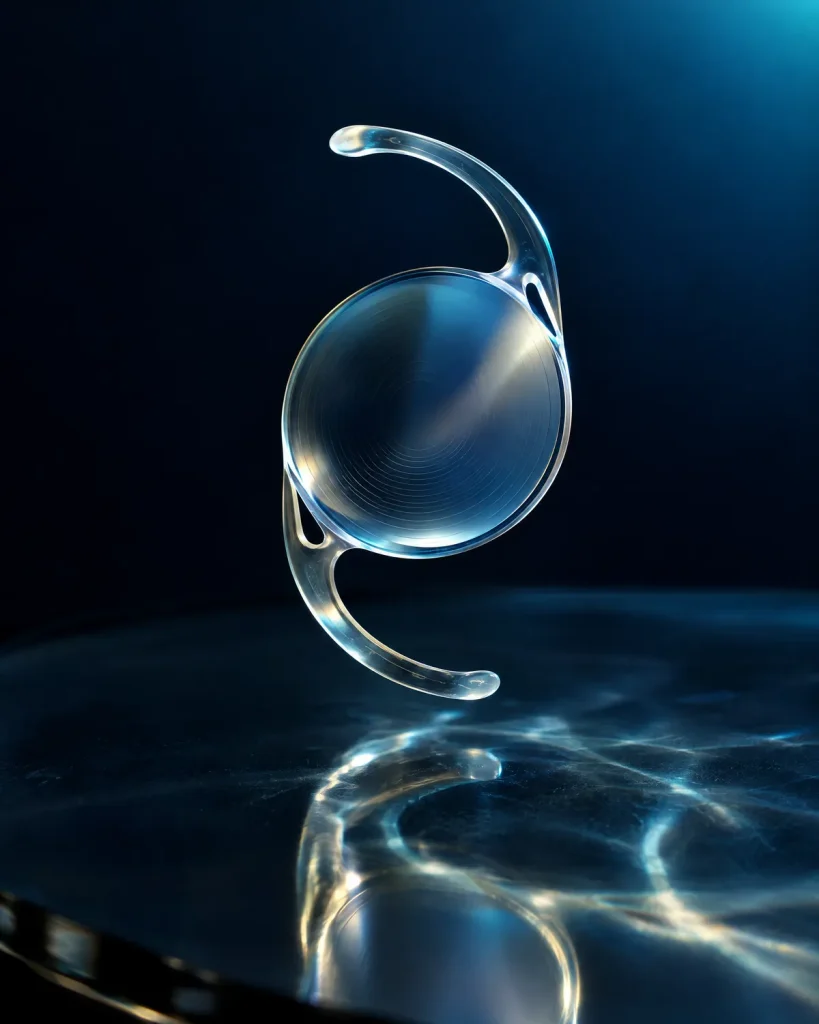
RLE (refractive lens exchange) replaces your natural lens with an artificial lens to reduce your need for glasses, while laser eye surgery reshapes the cornea and leaves your lens in place. RLE tends to suit people over 50, high prescriptions or early cataract; laser suits a clear lens. The IOL Master meaning: a non-contact eye-measuring machine that sets your new lens power. Prof. Dr. Ahmet Satıcı performs both.
What is RLE (refractive lens exchange)?
RLE is an operation in which the eye's natural lens is removed and replaced with a clear artificial lens, called an intraocular lens (IOL), so that you depend less on glasses or contact lenses. It is also called lens replacement surgery, clear lens exchange or, in marketing, "smart lens" surgery.
The Royal College of Ophthalmologists (RCOphth) explains that RLE is "identical to modern cataract surgery": both operations replace the natural lens with an IOL. The only difference is the reason. Cataract surgery treats a lens that has gone misty; RLE is done mainly to reduce the need for glasses. The RCOphth compares an IOL to "building your glasses or contact lenses into your eyes".
There are two main families of lens:
- Monofocal IOLs aim for sharp vision at one distance, usually far, so reading glasses are normally still needed.
- Multifocal IOLs (including trifocal and extended-depth lenses) aim to cover a wider range: distance, computer screens and reading. The RCOphth says about four in five patients are completely free of glasses after RLE with widely used modern multifocal lenses, and that those who still need glasses usually need them for one specific task.
Because the natural lens is removed for good, RLE also ends the need for cataract surgery later in life. The RCOphth adds that your glasses prescription normally stays stable afterwards. If vision later mists because the membrane behind the lens clouds, a quick one-off laser treatment called YAG capsulotomy usually clears it.
At Laser Istanbul Clinic, lens replacement is led by Prof. Dr. Ahmet Satıcı. Our full treatment guide is the page on lens replacement (RLE / smart lens) in Turkey.
RLE vs laser eye surgery: what is the difference?
The difference is where the surgery happens. Laser eye surgery (LASIK, SMILE, PRK) reshapes the cornea, the clear window at the front of the eye. RLE works on the lens inside the eye. The RCOphth describes laser as "altering the curvature and focusing power of the front surface of the eye".
| Laser eye surgery (LASIK, SMILE, PRK) | RLE (lens replacement) | |
|---|---|---|
| What is treated | The cornea is reshaped with a laser | The natural lens is removed and replaced with an IOL |
| Natural lens | Stays in the eye and keeps ageing | Replaced for good; an implant cannot become a cataract |
| Prescription range | Generally up to −10.00 D short sight, +4.00 D long sight and ±6.00 D astigmatism | Almost any level of short or long sight; lenses with built-in astigmatism correction exist |
| Reading vision | LASIK does not cure presbyopia; blended vision can partly help | A multifocal lens can reduce or remove the need for reading glasses |
| Future cataract surgery | Still likely later in life | Not needed |
| Typical operating time | About half an hour | About 20 minutes per eye |
| Serious permanent vision loss | Fewer than 1 in 5,000 | About 1 in 500 |
| Typical age | Often better for younger patients with a clear, flexible lens | Often preferred over 50; the default over 65 |
Source: RCOphth patient information on refractive lens exchange and on laser vision correction (see Sources). These are population figures; your surgeon explains your own risks.
If laser is the route you are weighing, start with our overview of laser eye surgery in Turkey or browse all our laser eye surgery guides.
How is RLE done, step by step?
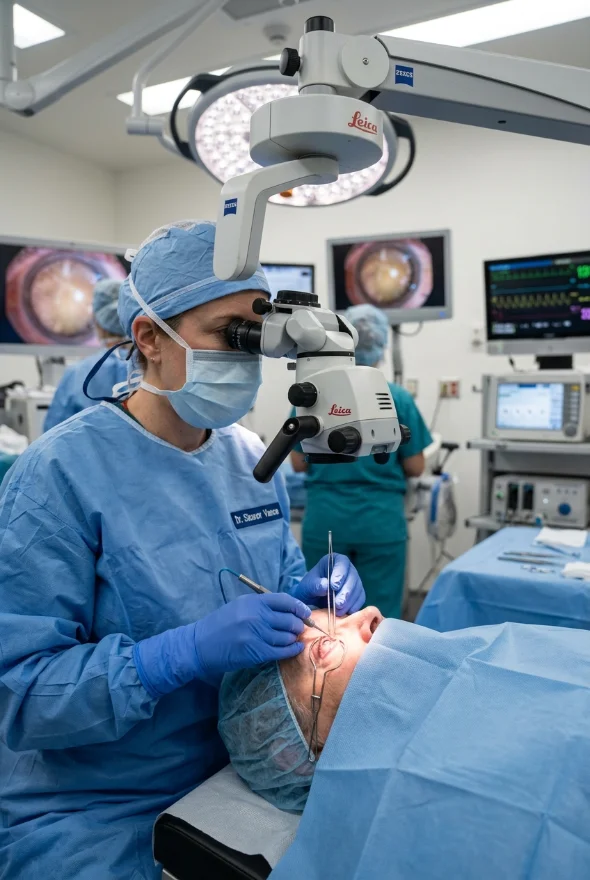
RLE is a day-case operation, usually under drop anaesthetic, and takes about 20 minutes per eye, according to the RCOphth. You go home the same day. The main steps are:
- Preparation. Strong dilating drops widen the pupil. Your eye is numbed, and a drape keeps the eyelashes out of the way.
- Entry points. The surgeon makes small, self-sealing openings at the edge of the cornea.
- Capsulotomy. A circular opening is made in the front of the thin membrane (the lens capsule) that wraps the natural lens.
- Phacoemulsification. A fine, high-frequency vibrating probe breaks up the natural lens, which is washed out and suctioned away.
- IOL insertion. The folded artificial lens is injected into the capsule, where it unfolds into position.
- Wash-out. The supporting gel is washed out and the eye is refilled with fluid and antibiotics.
Some centres use a femtosecond laser for a preparatory stage, mainly the capsulotomy. The RCOphth says these lasers are costly and have no proven benefit for your vision after RLE or cataract surgery, though they may make some steps easier for surgeons to perform consistently. The NHS gives a similar 20 to 30 minute ballpark for lens surgery and notes that both eyes are often treated on the same day, although some lens procedures involve separate-day surgery.
Who should choose RLE, and who should choose laser?
Choose between them by looking at your age, lens and prescription, not at the price tag. The RCOphth gives these rules of thumb:
- RLE is likely to suit you if you are over 50 and your glasses prescription is higher than the normal range for laser surgery.
- Laser or a phakic implant is generally better for younger patients with a clear, flexible lens, which includes most people under 50.
- Over 65, RLE is the default, although laser may still be better if there are no signs of cataract and the eye surface is healthy.
- Long-sighted with a shallow front chamber: because an IOL is thinner than the natural lens, RLE can reduce the need for glasses and remove the risk of angle-closure glaucoma.
- Existing eye disease: you may not be suitable for a multifocal lens, and a monofocal lens may be a better fit.
Why does around 50 matter? The US National Eye Institute (NEI) says presbyopia, the loss of near focus, usually starts after age 45 because the lens becomes harder and less flexible, and usually stops getting worse after 65. A laser on the cornea does not touch the lens, so it cannot fix that.
Your surgeon decides after your scans. At Laser Istanbul Clinic, Prof. Dr. Ahmet Satıcı performs both lens replacement and laser (LASIK, SMILE Pro and PRK), so he can compare both for your eyes. Op. Dr. Aysan Bayram also performs cataract and laser surgery. If your scans show an irregular cornea, Doç. Dr. Muhammet Derda Özer, our cornea specialist ("Doç." is the Turkish title for Associate Professor), reviews your case first.
IOL Master meaning: how is your new lens power chosen?
IOL Master meaning: the IOL Master (made by Zeiss) is an optical biometer, a machine that measures your eye with light, without touching it, so your surgeon can calculate the power of the lens to implant. "IOL" stands for intraocular lens, and "biometry" means measuring the eye's dimensions.
What does an IOL Master measure?
Biometry rests on three main measurements, according to EyeWiki, the American Academy of Ophthalmology's clinical encyclopedia:
- Axial length: the distance from the front of the cornea to the back of the eye, about 24 mm in a typical adult eye.
- Keratometry: the steepness of the cornea, which gives its focusing power.
- Anterior chamber depth: the distance behind the cornea, used to estimate where the new lens will sit.
A formula then turns these numbers into lens power. Accuracy matters: EyeWiki says axial length changes the lens power needed by roughly 2.5 to 3 times, so a 1 mm error in length produces about a 2.5 to 3 dioptre error in the result. Optical devices such as the IOL Master are preferred because they are non-contact and more accurate than contact ultrasound, which can squash the cornea.
What is the difference between the IOL Master 500 and 700?
The 500 uses partial coherence interferometry (infrared light at 760 nm). The newer 700 uses swept-source optical coherence tomography (SS-OCT at 1,050 nm), which also produces cross-section scans of the eye. In a 2020 study in the Korean Journal of Ophthalmology, axial length could not be measured in 9.7% of eyes with the 500 (12 of 124) and 2.4% with the 700 (3 of 124), all in people over 70 with dense cataracts. A report in ESCRS EuroTimes on 1,226 consecutive eyes found 6.4% unmeasurable with the 500 and 0.5% with the 700; the 700's scans also let surgeons check that you were looking at the target correctly and screen for macular disease.
The Korean study found the devices predicted refractive outcomes equally well, so a newer machine is a helpful tool, not a guarantee. EyeWiki notes that optical biometry cannot measure about 8 to 17% of eyes, usually because of dense cataracts, so ultrasound is kept as a backup. Our surgeons use {{biometer model used by your surgeons}}.
Why does this matter if I had laser before?
Previous laser surgery changes the cornea's shape, which can throw off standard formulas. The RCOphth says laser vision correction can slightly reduce the accuracy of focus after later cataract or lens surgery, and that the effect is small and shrinking. Keep your pre-laser prescription and treatment records and tell your surgeon.
What are the risks of RLE compared with laser?
RLE is surgery inside the eye, so its stakes are higher than laser on the cornea. The RCOphth states that permanent, serious loss of vision is significantly more common after RLE than after laser vision correction, affecting approximately 1 in 500 patients, usually through damage to the retina from infection, inflammation, retinal detachment or bleeding.
| Laser eye surgery | RLE | |
|---|---|---|
| Satisfaction | Over 95% satisfied | About 95% satisfied |
| Serious permanent vision loss | Fewer than 1 in 5,000 | About 1 in 500 |
| Further surgery | Up to 1 in 10 need some extra surgery for the best result | Possible: lens repositioning or exchange, retinal detachment repair, laser touch-up |
| Retina | Short sight itself raises detachment risk | Detachment risk is about five times higher in the first four years after RLE or cataract surgery |
| Later clouding | The natural lens may cloud later | Capsule clouding (PCO) affects many patients months or years later; treated with a quick YAG laser |
| Night-time glare and halos | Common early, usually improve over months | More common with multifocal lenses; usually fade |
| Dry eye | Common early | Usually mild; lasting problems unusual if the eye surface was healthy |
Source: RCOphth patient information (see Sources).
Other points from the RCOphth: the UK benchmark rate for a capsule tear during surgery is just under 1.5%, and this can make a multifocal lens unsafe to implant; limits on biometry mean a laser touch-up is sometimes needed to fine-tune the result; and about 1% of multifocal patients cannot adapt and choose to swap to a monofocal lens. The NHS lists glare, halos, floaters, starbursts, blurred vision and dry or sore eyes as common effects that normally improve within a few months, and a detached retina, permanent serious loss of vision, under- or over-correction and cloudy vision behind the lens as complications.
The RCOphth also says these risks should be weighed against the real alternatives: contact lenses, which carry a risk of serious corneal infection of about 1 in 3,000 wearers a year, and varifocal glasses.
Refractive lens exchange reviews: what do patients report?
Published satisfaction data are more reliable than any single review. The RCOphth reports that approximately 95% of RLE patients are satisfied with the outcome, many calling it life changing, and that 19 out of 20 patients are satisfied or very satisfied with their vision three to six months after a multifocal lens. Optical side effects tend to fade with time.
Reviews of our own patients: {{patient review summary and link to verified reviews}}. Read any clinic's reviews alongside what it tells you about risks, not instead of it.
What is recovery like after RLE?
Most patients recover quickly. The RCOphth says vision normally recovers substantially within two to three days once the dilating drops have worn off, and you can wash and shower normally from day one. Surgeons usually advise no swimming for a week and no contact sports for a month, and a clear shield is normally worn at night for one week. Report increasing pain, light sensitivity or falling vision to your surgeon straight away.
If you are travelling for surgery, ask when you may fly. Our guide on flying after laser eye surgery and the laser eye surgery recovery day-by-day timeline cover the laser side. For lens replacement, our patients usually plan about 5 to 7 days in Istanbul and fly home about 3 to 7 days after surgery, once the surgeon has checked the eyes.
Does the NHS offer RLE or laser eye surgery?
Not usually. The NHS says laser eye surgery and lens surgery are not usually offered on the NHS and are mostly available privately, unless a vision-threatening condition cannot be corrected with glasses or contact lenses. NHS cataract surgery treats a misty lens and normally takes between 20 and 45 minutes. Our patients from the UK and Ireland usually pay privately; costs are on the lens replacement page.
Frequently asked questions
RLE (refractive lens exchange) removes your natural lens and replaces it with an artificial lens to reduce your need for glasses. The RCOphth says it is identical to modern cataract surgery, only done for a different reason.
IOL Master is the name of an optical biometer from Zeiss. IOL stands for intraocular lens. The machine measures axial length, corneal curvature and anterior chamber depth with light, without touching the eye, so your surgeon can calculate the power of your new lens.
LASIK reshapes the cornea with a laser and leaves your natural lens in place. RLE removes the natural lens and replaces it with an IOL. LASIK cannot correct age-related loss of reading vision; a multifocal lens can reduce it.
Neither is better for everyone. The RCOphth says laser or phakic implants are generally better for younger patients with a clear lens, while RLE is likely to suit people over 50 with a prescription above the laser range, and is the default over 65.
RLE is a well-established operation, but it is surgery inside the eye. The RCOphth puts permanent serious loss of vision at about 1 in 500 patients and says retinal detachment risk is about five times higher in the first four years. Your surgeon explains your own risk.
Often not, but it depends on the lens. About four in five patients are completely glasses-free with widely used multifocal lenses, according to the RCOphth. Monofocal lenses usually need reading glasses.
The 500 uses partial coherence interferometry; the 700 uses swept-source OCT. In a 2020 study, axial length could not be measured in 9.7% of eyes with the 500 and 2.4% with the 700, but predicted outcomes were comparable.
Yes. Laser does not prevent lens surgery later, but it makes the power calculation harder. Bring your pre-laser records and tell your surgeon.
Not usually. The NHS says lens and laser surgery are mostly private unless you have a vision-threatening condition that glasses cannot correct.
Not sure whether RLE or laser is right for you?
Send us your prescription and scans, and one of our three surgeons, led for lens replacement by Prof. Dr. Ahmet Satıcı, tells you honestly which route suits your age and eyes, or whether neither does. Surgery takes place in a fully equipped, Ministry of Health–licensed operating theatre in Istanbul.
Sources for the facts on this page
- The Royal College of Ophthalmologists. Refractive Lens Exchange: Patient Information (PROF/2024/498). https://www.rcophth.ac.uk/wp-content/uploads/2026/08/Refractive-lens-exchange-patient-information.pdf
- The Royal College of Ophthalmologists. Laser Vision Correction: Patient Information (PROF/2024/499). https://www.rcophth.ac.uk/wp-content/uploads/2026/08/Laser-vision-correction-patient-information.pdf
- NHS. Laser eye surgery and lens surgery. https://www.nhs.uk/tests-and-treatments/laser-eye-surgery-and-lens-surgery/
- NHS. Cataract surgery. https://www.nhs.uk/conditions/cataract-surgery/
- National Eye Institute (NIH). Presbyopia. https://www.nei.nih.gov/learn-about-eye-health/eye-conditions-and-diseases/presbyopia
- EyeWiki (American Academy of Ophthalmology). Biometry for Intra-Ocular Lens (IOL) Power Calculation. https://eyewiki.org/Biometry_for_Intra-Ocular_Lens_(IOL)_Power_Calculation
- Song JS, Yoon DY, Hyon JY, Jeon HS. Comparison of ocular biometry and refractive outcomes using IOL Master 500, IOL Master 700, and Lenstar LS900. Korean Journal of Ophthalmology 2020. https://pmc.ncbi.nlm.nih.gov/articles/PMC7105785
- O'hEineachain R. OCT biometry. ESCRS EuroTimes, 18 May 2017. https://www.escrs.org/eurotimes/oct-biometry