
- Home
- Knowledge centre
- Eye conditions & symptoms A–Z
- Eye Redness: Causes of Red Eyes, Treatment and When to Worry
Eye Redness: Causes of Red Eyes, Treatment and When to Worry

Eye redness happens when the blood vessels on the surface of the eye widen or leak. The most common causes are a burst blood vessel, conjunctivitis, dry eyes and eyelid inflammation (blepharitis), and many of them clear up on their own. Redness with pain, light sensitivity, a drop in vision or contact lens wear needs same-day assessment, because inflammation inside the eye, a corneal infection or acute glaucoma can look similar. Our cornea and uveitis specialist, Doç. Dr. Muhammet Derda Özer, and our other two surgeons treat the conditions behind persistent red eyes.
What causes red eyes?
Red eyes are caused by the blood vessels of the eye's surface becoming enlarged, inflamed or broken. Most causes are minor, but a few are serious, and the way to tell them apart is the pattern: is the eye painful, is the vision blurred, is there discharge, and is the redness patchy or all over?
Here are the most common causes of redness in the eye, with the signs the NHS and the American Academy of Ophthalmology (AAO) use to describe them:
| Cause | What you notice | Usually |
|---|---|---|
| Burst blood vessel (subconjunctival haemorrhage) | A bright red patch on the white of the eye | Harmless; heals on its own |
| Conjunctivitis ("pink eye") | Red eyes, gritty or burning feeling, watering, sticky discharge | Usually better within a couple of weeks |
| Dry eyes | Sore, gritty, red, blurry eyes; sometimes watering | Long-term; managed with lubricants and eyelid care |
| Blepharitis (inflamed eyelid edges) | Itchy, sore, crusted eyelids; flakes at the lash roots | Comes and goes; daily lid cleaning |
| Ingrowing eyelash or eyelid problem | Feeling of something in the eye; swollen or twitching lids | Needs a check if it persists |
| Allergy | Itchy, red, watery eyes | Not contagious; allergy drops and avoiding the trigger |
| Scleritis and uveitis | Painful red eye, light sensitivity, blurred vision | Urgent: needs prompt specialist treatment |
| Corneal infection (keratitis), especially with contact lenses | Pain, redness, light sensitivity | Urgent |
| Acute angle-closure glaucoma | Intense eye pain, red eye, rainbow-coloured circles around lights, nausea | Emergency |
If you are asking "why are my eyes red?", the sections below take the common causes one by one, then explain which signs mean you should not wait.
What is the cause of blood in the eye (a burst blood vessel)?
A bright red patch of blood on the white of the eye is almost always a subconjunctival haemorrhage: a small blood vessel has broken and blood has leaked between the clear surface layer (the conjunctiva) and the white of the eye (the sclera). The AAO describes it as usually harmless and often healing on its own. Blood in the eyeball like this looks alarming, yet it is trapped under the surface layer.
What causes blood vessels to burst in the eye? According to the AAO:
- coughing, sneezing or straining, which briefly raise the pressure in the blood vessels
- an eye injury, or vigorous eye rubbing
- less commonly, diabetes, high blood pressure, blood-thinning medicines (such as aspirin, warfarin, clopidogrel, apixaban or rivaroxaban) and rare clotting disorders
How long does it last? The AAO says healing takes from a few days to a few weeks, depending on how big the patch is.
What is the treatment? In most cases none is needed. Artificial tears can soothe mild irritation. Do not rub the eye. If burst blood vessels keep coming back, an ophthalmologist may recommend further tests.
Seek care the same day if the blood followed a knock to the eye, or if the eye is painful or your vision has changed. The NHS lists a very dark red eye, an eye injury and sight changes among the reasons to go to A&E.
How to get rid of red eyes: what helps, by cause
There is no single eye redness cure, because redness is a sign, not a disease. Treating it means treating what is behind it. The table sets out the usual approach for the common causes; your own doctor decides which applies to you.
| Cause | What usually helps | Source |
|---|---|---|
| Burst blood vessel | Nothing active; time. Artificial tears if sore | AAO |
| Viral conjunctivitis | Your body clears the virus on its own; cool compresses and artificial tears for comfort | AAO |
| Bacterial conjunctivitis | Antibiotic drops prescribed by a doctor | AAO |
| Allergic conjunctivitis | Allergy eye drops and avoiding the trigger; not contagious | AAO |
| Dry eyes | Eyelid cleaning, screen breaks, a humidifier, glasses instead of contact lenses where possible; lubricating drops; prescription drops and tear-duct plugs in persistent cases | NHS, NEI |
| Blepharitis | Daily lid hygiene: a warm cloth on closed lids for 5–10 minutes, gentle massage, careful cleaning; antibiotic ointment for stubborn cases | NHS |
| Uveitis or scleritis | Prescription treatment from a specialist, such as steroid drops, anti-inflammatory medicines or, in severe cases, immune-suppressing drugs | NHS, AAO |
Bloodshot eye treatment at home: what is safe
If your eye is painless and your vision is normal, the NHS says redness may clear up on its own, and suggests simple steps:
- do not touch or rub your eyes
- stop wearing contact lenses until the redness has gone
- for sticky eyes, clean the lids with cooled boiled water and a clean cotton pad, and use a cold compress
- wash your hands often, and do not share towels or pillows if an infection is possible
- ask a pharmacist, who can suggest eye drops for dryness or allergy
Do redness-relief eye drops work?
They work for a short time, and then they can make things worse. The AAO explains that most redness-relieving drops contain a decongestant (tetrahydrozoline) that temporarily shrinks the blood vessels of the eye. When the effect wears off, the eyes can become redder than before: "rebound redness". The AAO advises using them only for special occasions, and for no more than 72 hours. Brimonidine-based drops have a lower risk of rebound redness, and preservative-free lubricating drops may clear mild redness without that risk. People with narrow-angle glaucoma should not use decongestant drops at all, because they can trigger angle-closure glaucoma, a very serious emergency. If redness keeps coming back, find the cause rather than masking it.
Can red eyes be cured permanently?
If the cause is short-lived (a burst blood vessel, viral conjunctivitis), the redness goes away completely. If the cause is long-term, such as dry eyes or blepharitis, the aim is control rather than a one-off cure: the NHS describes blepharitis symptoms as coming and going over time, and the NEI notes that severe untreated dry eye can damage the cornea, which is why persistent redness deserves a proper diagnosis.
Conjunctivitis: the most common infection behind red eyes
Conjunctivitis (pink eye) is inflammation or infection of the conjunctiva, the thin layer covering the white of the eye and the inside of the eyelids. The AAO names three types: viral (the most common, usually linked to cold viruses), bacterial (less common, highly contagious) and allergic (not contagious).
Typical signs are red eyes with a watery or thick discharge, burning or itching, light sensitivity and puffy eyelids. The NHS says conjunctivitis usually gets better in a couple of weeks without treatment, and that antibiotics help only bacterial cases, not viral or allergic ones.
Viral and bacterial conjunctivitis spread easily by direct contact. The AAO advises people with either type to avoid contact with others until the eyes are no longer red and discharging; the NHS adds that you do not need to stay off work or school unless you feel very unwell. Hand-washing and not sharing towels or pillows reduce the spread.
See a GP or optician if symptoms last longer than 7 days (NHS). Seek urgent care for eye pain, light sensitivity or changes in vision, or if a newborn under 30 days has a red, sticky eye.
Dry eyes and eyelid problems: the quiet causes of redness that keeps coming back
If your eyes are often red but not painful, dry eyes and blepharitis are likely explanations. The NHS lists the symptoms of dry eyes as itchy, sore, gritty, red and blurry eyes, light sensitivity and, confusingly, watering. Risk factors named by the NHS and the National Eye Institute (NEI) include:
- being over 50, or female
- long hours on screens
- air conditioning, wind, dust or smoke
- contact lens wear
- some medicines, and conditions such as Sjögren's syndrome or lupus
- blepharitis, where the eyelid oil glands are not working well
The NEI says nearly 16.4 million Americans have dry eye, so it is among the most common reasons for a persistently red eye.
For most people the first line is practical: daily lid cleaning, screen breaks, a humidifier and lubricating drops. See an optician or GP if symptoms persist after several weeks of home treatment (NHS). Prescription anti-inflammatory drops such as cyclosporine or lifitegrast and tear-duct plugs are the next steps (NEI).
Redness can also come with eyelid trouble. If the lids are swollen or lumpy as well, see our guide to a swollen eyelid: causes and home care.
Which red eye is an emergency?
A red eye is an emergency when it comes with pain, a change in vision, strong light sensitivity, nausea, or contact lens wear. Conditions that cause this pattern include acute angle-closure glaucoma, uveitis, scleritis and corneal infection, and all can threaten vision if treatment is delayed.
The NHS sorts red eye into three levels. Use it as a guide, and when in doubt, get checked:
| Level | Signs | What to do (NHS wording, UK) |
|---|---|---|
| Non-urgent | Sticky discharge, symptoms lasting more than a few days, a child under 2 with a red eye, or you are worried | See a GP or optician |
| Urgent | Severe pain with redness; a contact lens wearer with a suspected infection; a newborn under 28 days with red eyes | Same-day: GP, optician or NHS 111 |
| Emergency | Vision changes (wavy lines, flashing lights, loss of sight); light sensitivity or severe headache with nausea; very dark red eye; eye injury or object in the eye; chemical in the eye; unequal pupils | A&E or 999 |
Why these conditions matter
- Acute angle-closure glaucoma: the NHS lists intense eye pain, a red eye, rainbow-coloured circles around bright lights, blurred vision and nausea, and says to call 999 or go to A&E if these come on suddenly. It is a medical emergency that may need immediate treatment.
- Uveitis (inflammation inside the eye): pain that may feel worse when reading, redness, watering, blurred vision, light sensitivity and floaters. Most cases have no known cause; known triggers include immune system conditions, viral infections such as herpes simplex or shingles, and eye injury (NHS). Early treatment is important to prevent complications.
- Scleritis (inflammation of the white of the eye): pain and tenderness with redness and swelling of the white of the eye, and sometimes jaw, face or head discomfort. It is often linked to an autoimmune disease such as rheumatoid arthritis, and the AAO stresses that it must be treated as soon as symptoms appear to protect vision.
- Corneal infection (keratitis): the Centers for Disease Control and Prevention (CDC) highlights serious infections, including fungal and acanthamoeba keratitis, linked to poor contact lens care, with a risk of vision loss. If you wear lenses and your eye is red and sore, take the lenses out and be seen the same day.
If you are travelling or abroad and develop any of these signs, go to the nearest eye emergency department. Do not wait for a planned appointment.
When should I see an eye doctor about red eyes?
See an eye doctor if redness appears suddenly, does not go away, comes with vision changes or eye pain, follows an injury, or comes with discharge. This is the AAO's advice, and it matches the NHS levels above.
Book a routine appointment if:
- your eyes are red most days and drops do not help
- you keep needing redness-relief drops to look or feel normal
- burst blood vessels in the eye keep coming back
- red, itchy, crusted eyelids do not improve after regular cleaning
Related symptoms are worth reading about too. If the whites of your eyes look yellow rather than red, see Yellow eyes: what they mean.
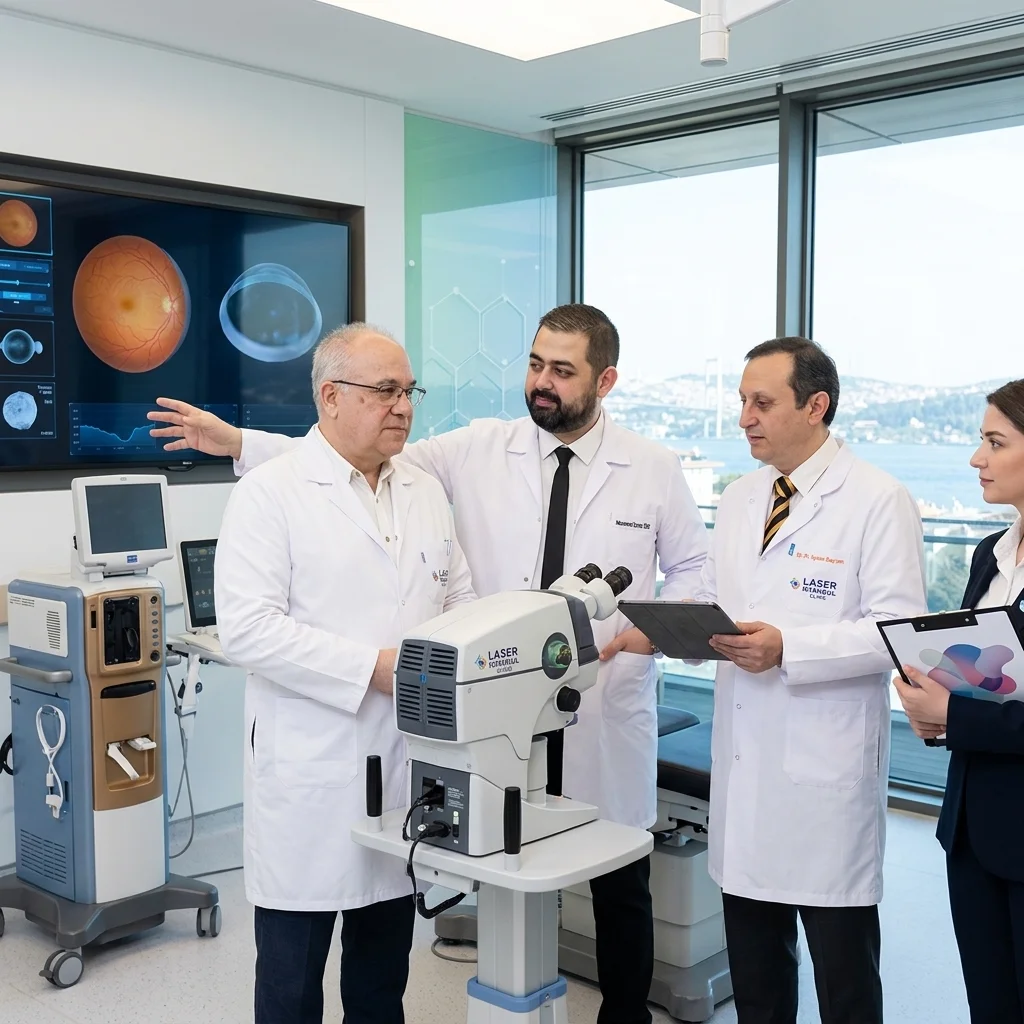
Who treats persistent red eyes at Laser Istanbul Clinic?
Persistent redness is usually a symptom of an eye-surface, eyelid or inflammatory condition, and our three Istanbul surgeons cover these between them:
- Doç. Dr. Muhammet Derda Özer (Doç. means Associate Professor): cornea, uveitis and related inflammatory eye disease. He speaks Turkish and English.
- Prof. Dr. Ahmet Satıcı: eyelid and oculoplastic surgery and glaucoma, among his fields.
- Op. Dr. Aysan Bayram: cataract, laser and retinal disease. She speaks English, and is a female surgeon if you prefer one.
An acute red eye is a local emergency and should be seen where you live, not in Istanbul. If redness is a long-term problem, or you want a second opinion on a diagnosis you already have, we can look at your reports first: send your prescription, scans and notes through the free online consultation, and a coordinator will reply with which surgeon fits your case. If treatment in Istanbul is the sensible next step, we say so. If your local eye service is the better option, we say that as well.
Frequently asked questions
Most often because of a burst blood vessel, conjunctivitis, dry eyes or inflamed eyelids, and many clear up on their own. Redness with pain, light sensitivity, blurred vision or contact lens wear can mean uveitis, scleritis, a corneal infection or acute glaucoma, and needs same-day assessment.
Long-term redness is usually dry eyes, blepharitis or allergy. Screens, wind, dust, air conditioning, smoke and contact lenses make dry eyes worse. If lubricants and lid care do not settle the redness after several weeks, see an optician or ophthalmologist to look for the cause.
A bright red patch on the white of the eye is usually a harmless subconjunctival haemorrhage, which the AAO says often heals on its own over a few days to a few weeks. See a doctor the same day if it follows an injury or comes with pain or vision changes, and ask an ophthalmologist if it keeps recurring.
Coughing, sneezing, straining, eye injury or rubbing are the common triggers. Less often the cause is diabetes, high blood pressure, blood-thinning medicines or a clotting disorder.
Treat the cause: do not rub the eye, take out contact lenses, use artificial tears, clean the eyelids and ask a pharmacist. Redness-relief drops give a short effect only and can cause rebound redness, so the AAO advises no more than 72 hours of use.
No treatment fixes every cause overnight. A burst blood vessel takes days to weeks to fade, and conjunctivitis usually takes up to a couple of weeks. Lubricating drops can ease mild redness from dryness. Anything painful or affecting vision should be seen by a doctor instead of treated at home.
Viral and bacterial conjunctivitis are contagious; allergic conjunctivitis, dry eyes, blepharitis and burst blood vessels are not. Wash your hands often, do not share towels or pillows, and avoid close contact until the redness and discharge have gone.
Yes. The NHS advises not wearing lenses until the eye has recovered. If a lens wearer has pain, light sensitivity or reduced vision, get a same-day check, because corneal infections linked to contact lenses can threaten vision.
We can review your reports, prescription and scans and advise which specialist suits your problem, but a new, painful or sudden red eye cannot be diagnosed over the internet. It needs an in-person eye examination, today, where you are.
Red eyes that keep coming back?
Persistent redness, repeated burst blood vessels or a diagnosis you want a second opinion on: our surgeons review your records before you travel. Cornea and uveitis problems are covered by Doç. Dr. Muhammet Derda Özer; eyelid problems and glaucoma by Prof. Dr. Ahmet Satıcı; cataract, laser and retinal disease by Op. Dr. Aysan Bayram.
Sources for the facts on this page
- NHS. Red eye. https://www.nhs.uk/conditions/red-eye/
- NHS. Conjunctivitis. https://www.nhs.uk/conditions/conjunctivitis/
- NHS. Dry eyes. https://www.nhs.uk/conditions/dry-eyes/
- NHS. Blepharitis. https://www.nhs.uk/conditions/blepharitis/
- NHS. Glaucoma (sudden-onset symptoms). https://www.nhs.uk/conditions/glaucoma/
- NHS. Uveitis. https://www.nhs.uk/conditions/uveitis/
- American Academy of Ophthalmology. What Is Subconjunctival Hemorrhage? https://www.aao.org/eye-health/diseases/what-is-subconjunctival-hemorrhage
- American Academy of Ophthalmology. Pink Eye (Conjunctivitis). https://www.aao.org/eye-health/diseases/pink-eye-conjunctivitis
- American Academy of Ophthalmology. What Is Scleritis? https://www.aao.org/eye-health/diseases/what-is-scleritis
- American Academy of Ophthalmology. Redness-Relieving Eye Drops. https://www.aao.org/eye-health/tips-prevention/redness-relieving-eye-drops
- National Eye Institute (NIH). Dry Eye. https://www.nei.nih.gov/learn-about-eye-health/eye-conditions-and-diseases/dry-eye
- Centers for Disease Control and Prevention. Contact Lens-Related Eye Infections. https://www.cdc.gov/contact-lenses/about/index.html