
- Home
- Knowledge centre
- Eye conditions & symptoms A–Z
- Astigmatism Symptoms and Causes: Astigmatism Explained
Astigmatism Symptoms and Causes: Astigmatism Explained
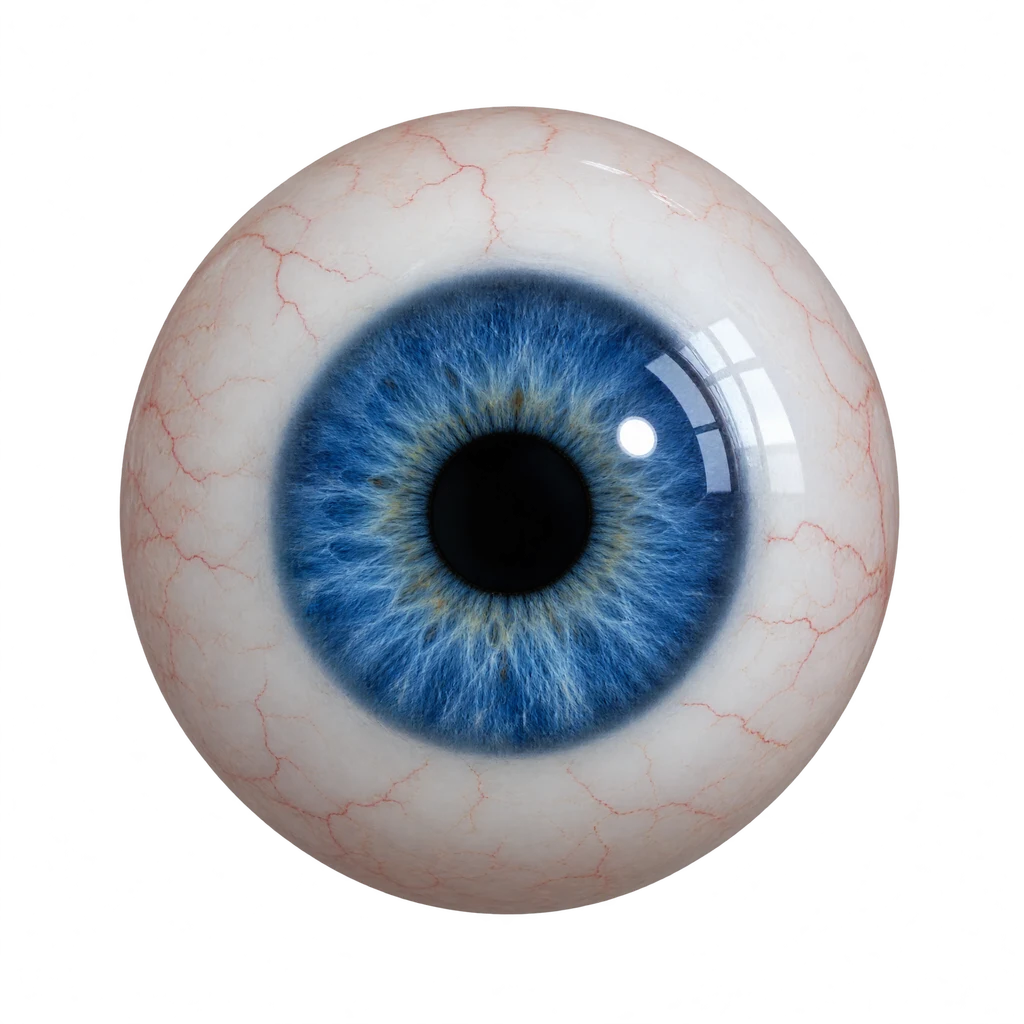
Astigmatism symptoms are blurred or distorted vision, squinting, eye strain, headaches and trouble seeing at night. Astigmatism means the front of the eye is shaped more like a rugby ball than a football, so light focuses at more than one point. It is very common, often mild and easy to correct. Prof. Dr. Ahmet Satıcı and Op. Dr. Aysan Bayram treat it with laser or toric lenses.
What does astigmatism mean?
Astigmatism means that your eye focuses light at more than one point instead of one. The NHS describes it as an eye shaped more like a rugby ball than a football. The American Academy of Ophthalmology (AAO) defines it as an imperfection in the normal curvature of the cornea or the lens. The cornea is the clear window at the front of the eye. When it has one steeper curve and one flatter curve, light from a single object is spread over two focus points, and the picture on the retina is smeared rather than sharp.
Astigmatism is a refractive error, in the same family as short-sightedness (myopia) and long-sightedness (hyperopia), not an eye disease. The NHS says it normally happens alongside short-sightedness or long-sightedness, which is why one prescription often lists all three.
How common is it? Very. A 2018 systematic review in the Journal of Current Ophthalmology found astigmatism in about 40.4% of adults and 14.9% of children worldwide, making it the most common refractive error in both groups. If you have it, you are in good company.
Regular and irregular astigmatism. Most astigmatism is "regular": the two main curves sit at right angles to each other, like the two curves of a rugby ball, and glasses can correct it. "Irregular" astigmatism means the surface is uneven, for example because of keratoconus, scarring or earlier surgery. It is less common, is not fully corrected by ordinary glasses and needs a specialist assessment.
What are the symptoms of astigmatism?
The main symptom of astigmatism is blurred or distorted vision, at near, far or both. The US National Eye Institute (NEI) lists the typical symptoms as:
- blurry or distorted vision
- needing to squint to see clearly
- headaches
- eye strain
- trouble seeing at night
The NHS names blurred vision, headaches and eye strain, especially after concentrating for a long time, and the AAO adds eye discomfort. Many people describe letters that have a shadow or a smear in one direction, and lights at night that stretch into streaks, rays or halos, because a small bright light is focused at two places instead of one.
Mild astigmatism may cause no symptoms at all. The NEI says mild cases may produce nothing you notice. That is why astigmatism is often discovered only at a routine eye test.
Children often do not notice. The NEI points out that children may be less likely to realise their vision is not normal, so regular eye tests matter. The AAO warns that astigmatism that goes uncorrected in children can lead to lazy eye (amblyopia) and to problems at school and in sport. Squinting and headaches after reading are worth acting on.
| Symptom | What you might notice | Also worth checking for |
|---|---|---|
| Blurred or distorted vision | Letters or faces look smeared in one direction | Short or long sight, keratoconus |
| Squinting | You narrow your eyelids to sharpen the picture | Other refractive errors |
| Eye strain and headaches | Tired, aching eyes after reading or screens | Dry eye, other refractive errors |
| Trouble seeing at night | Streaks, starbursts or halos around headlights | Cataract, dry eye |
What are the symptoms of astigmatism in one eye?
Astigmatism in one eye gives the same symptoms as astigmatism in both, but you may notice them less, because your better eye covers for the weaker one. If one eye is affected, or one is much more astigmatic than the other, you may see a smeared image with that eye alone, or find that the world looks sharper when you cover the other eye.
That is why a one-eye difference matters most in children. The AAO explains that when one eye has a worse refractive error, including astigmatism, a child's brain may "turn off" that eye, which leads to lazy eye (amblyopia). The AAO says treatment works best before about age 7 to 8, and the NHS likewise lists lazy eye as a possible result of astigmatism that goes undetected.
Practical check: cover one eye at a time and look at a line of text or a distant sign. If one eye is clearly blurrier or smears in one direction, book an eye test. This is a prompt to get tested, not a diagnosis. Only an eye test can confirm astigmatism.
In adults, astigmatism that appears or changes in one eye only deserves a prompt check. Possible reasons include an eye injury, a lump on the eyelid, a growth on the eye or early keratoconus, all covered below.
What causes astigmatism to develop?
Astigmatism develops because the cornea or lens is not perfectly round. Doctors do not know exactly why. The NEI says the cause is unknown: some people are born with astigmatism, others develop it in childhood or young adulthood, and an eye injury, eye disease or eye surgery can also cause it. The AAO lists family history as the main risk factor.
| Cause | How it leads to astigmatism | Typical situation |
|---|---|---|
| Inherited shape | The cornea is slightly more curved in one direction | Present from childhood; often runs in families |
| Normal growth | Eyelid pressure on the maturing cornea shapes it (EyeWiki) | Childhood and adolescence |
| Keratoconus | The cornea thins and bulges into a cone, causing irregular astigmatism | Usually starts in the late teens to early twenties |
| Eye injury or corneal disease | A scar or damage changes the surface | After an injury or a corneal problem |
| Pterygium | A fleshy growth extending onto the cornea induces astigmatism | A growth on the white of the eye that spreads toward the pupil |
| Large chalazion | A big eyelid lump presses on the cornea | A lump on the eyelid that stays or grows |
| Eye surgery | Incisions or stitches change corneal shape | After cataract or corneal surgery |
What does not cause astigmatism. The AAO calls it a myth that reading in low light or sitting very close to the television causes astigmatism or makes it worse. Those habits can tire your eyes, but they do not change the shape of your cornea.
What causes astigmatism to worsen?
Astigmatism can worsen as the eye changes shape or ages. The AAO says astigmatism changes gradually and may worsen, improve or stay the same as the eyes grow and age. These are the documented reasons it gets worse:
Ageing of the eyelids and cornea
EyeWiki, the AAO's clinical encyclopaedia, explains that after about age 40, "against-the-rule" astigmatism (the cornea steeper across the horizontal) is the most common type. It reports that mean astigmatism rose from 0.6 D to 1.2 D across age groups from 49 to 97 years, and suggests that falling eyelid pressure on the cornea with age contributes.
Cataract
EyeWiki notes that the hardening of the lens (nuclear sclerosis) and the change in its refractive index at older ages may contribute to astigmatism. The NEI lists frequent changes to your glasses or contact-lens prescription as a sign of cataract.
Keratoconus
The cornea becomes progressively thinner and more cone-shaped. The AAO lists progressive astigmatism and frequent changes in glasses prescription among its features.
A growth near the cornea
As a pterygium grows, EyeWiki says vision may be affected by induced astigmatism.
Eye surgery or injury
Both can alter the corneal curve, as the NEI notes.
Eye rubbing and keratoconus. The AAO lists excessive eye rubbing and eye allergies as risk factors for keratoconus, and EyeWiki states that eye rubbing and repeated trauma in genetically predisposed people result in keratoconus and its progression. If your eyes itch because of allergies, treating the itch rather than rubbing protects your cornea.
A short-term shift that is not a worsening. Reading and other near tasks can shift corneal astigmatism by about 0.25 D within 15 minutes, with recovery within 30 to 60 minutes, according to EyeWiki. This may explain why your eyes feel different after a long reading session, but it does not mean your astigmatism is progressing.
What causes astigmatism to worsen suddenly?
Astigmatism that gets noticeably worse over weeks rather than years needs an eye examination, because the cause may be treatable. If your vision or your prescription changes quickly, get it checked soon rather than waiting for your next routine test.
The documented causes of faster change are:
- Progressing keratoconus. EyeWiki reports that keratoconus typically begins in early adolescence and progresses into the mid-20s and 30s, and that people diagnosed at 18 or younger tend to progress faster. A prescription that keeps changing and never quite sharpens vision is a classic warning sign.
- An eye injury. Damage to the cornea can change its shape, as the NEI notes.
- A growing pterygium. Specialists track how far it has extended onto the cornea, measuring it every 1 to 2 years.
- A large chalazion. EyeWiki says large chalazia can occasionally press on the cornea and cause astigmatism and blurred vision.
- A developing cataract. Glare, halos and a changing prescription are listed by the NEI.
- Recent eye surgery. Corneal shape shifts as the eye heals.
Get seen the same day if the change comes with pain, redness, sensitivity to light, a sudden drop in vision or a recent injury. These are not typical astigmatism symptoms and need urgent assessment.
What causes astigmatism to improve?
Astigmatism improves in a few specific situations, and in adults it usually does not disappear on its own. The AAO says astigmatism may improve as well as worsen over the years, so a drop in your cylinder number between tests is possible.
- In babies and young children. EyeWiki reports that almost all infants at 3 months have at least 1 D of astigmatism, and that this falls to adult levels by around 18 months as the cornea becomes less toric.
- When the cause is treated. If a growth was distorting the cornea, treating it removes the pull, although EyeWiki notes that mild residual astigmatism may remain after a pterygium is removed.
- When keratoconus is stabilised. Corneal cross-linking strengthens the cornea. EyeWiki reports reduced progression compared with controls. Its aim is to stop keratoconus getting worse rather than to remove astigmatism.
- When it is corrected, not cured. Glasses and contact lenses correct astigmatism while you wear them. Laser eye surgery or a toric lens can correct it permanently. MedlinePlus (US National Library of Medicine) says laser vision correction can most often eliminate or greatly reduce astigmatism.
We found no evidence that an eye exercise, supplement or eye drop reshapes the cornea in adults. Be cautious of anyone who claims otherwise.
What is a normal eye axis for astigmatism?
There is no single "normal" axis. The axis is the direction of the steepest curve in your cornea, written as a number from 0 to 180 degrees on a prescription, next to the cylinder (CYL) value that shows how much astigmatism you have. EyeWiki uses this 0 to 180 notation. A different axis does not mean a worse eye. It tells the lens-maker which way to turn the correction.
The axis also tells doctors which pattern you have:
| Pattern | What it means | When it is most common |
|---|---|---|
| With-the-rule | The cornea is steeper vertically, like a rugby ball standing up | Develops through childhood, according to EyeWiki |
| Against-the-rule | The cornea is steeper horizontally | The most common type in adults over 40 (EyeWiki) |
| Oblique | The steepest curve is diagonal | Less common |
How much astigmatism is "normal"? Small amounts are very common and often need no correction. The NHS says astigmatism does not always need to be treated. Your optometrist or surgeon decides whether the cylinder and axis on your prescription need correcting for your vision and your daily life.

How is astigmatism diagnosed?
Astigmatism is found at an eye examination. The NEI says the exam is simple and painless. Your optometrist or ophthalmologist will:
- test how clearly you read letters at distance and near
- measure the refractive error, giving your sphere, cylinder and axis numbers
- measure the curve of your cornea, often with a corneal map called topography
If your astigmatism is irregular, changes quickly or you are considering surgery, the cornea is mapped in more detail. The AAO notes that corneal topography, a computer map of the cornea, is used to diagnose keratoconus. The NHS advises an eye test if you have symptoms or have not had one in the last two years, partly because astigmatism can be linked to keratoconus.
How is astigmatism treated?
Mild astigmatism may need no treatment, and most people are corrected with glasses or contact lenses. The NHS calls glasses the cheapest option and the NEI says glasses or contact lenses are the most common treatment. Surgery is for adults who want to reduce their dependence on glasses or contact lenses.
| Option | How it helps | Who it usually suits |
|---|---|---|
| Glasses | A lens with extra power in one direction cancels the uneven curve | Everyone, including children |
| Toric soft or rigid contact lenses | Toric lenses stay aligned to correct astigmatism; rigid lenses give a smooth new front surface | Regular astigmatism (toric); higher or irregular astigmatism (rigid, per the AAO) |
| Laser eye surgery (LASIK, SMILE Pro, PRK) | Reshapes the cornea so both curves focus together | Adults with a stable prescription and healthy corneas |
| Toric implantable lens (ICL) or toric lens replacement | A lens with built-in astigmatism correction is placed inside the eye | Higher prescriptions, thin corneas, cataract, or lens replacement from the mid-40s |
| Corneal cross-linking | Strengthens a weak cornea to stop progression | Progressive keratoconus |
The Royal College of Ophthalmologists (RCOphth) says laser vision correction can treat up to ±6 D of astigmatism in suitable patients, in the same treatment as short or long sight. The NHS notes that laser and lens surgery are not available on the NHS, so UK patients who want them pay privately.
Who treats astigmatism at Laser Istanbul Clinic. Laser surgery and toric lenses are led by Prof. Dr. Ahmet Satıcı and Op. Dr. Aysan Bayram. Irregular astigmatism and keratoconus, including corneal cross-linking, are managed by Doç. Dr. Muhammet Derda Özer (Doç. means Associate Professor), who specialises in the cornea. Your surgeon examines your eyes, maps your cornea and tells you honestly whether laser, a lens or glasses is the right choice for you.
When should you see an eye specialist?
See an optometrist or ophthalmologist if:
- you or your child have symptoms such as blurred vision, squinting, headaches or eye strain, or have not had an eye test in the last two years (NHS advice)
- your glasses prescription keeps changing, or your glasses no longer seem to sharpen your vision
- one eye seems much blurrier than the other
- lights at night have become more streaky or glaring
- you have a lump on the eyelid, or a growth on the eye that is getting bigger
- you want to know if you are suitable for laser or lens surgery
Get urgent care for eye pain, a red eye, sudden loss of vision or an eye injury.
Frequently asked questions
The main symptoms are blurry or distorted vision, squinting, headaches, eye strain and difficulty seeing at night, according to the NEI. Mild astigmatism may cause none of these. Children may not notice anything, so regular eye tests are important.
It means the cornea or lens is not perfectly round, so light focuses at more than one point. The NHS compares the eye to a rugby ball rather than a football. It is a common refractive error and can be corrected with glasses, contact lenses or surgery.
The exact cause is unknown. Some people are born with it, others develop it in childhood or young adulthood, and eye injury, eye disease and eye surgery can also cause it (NEI). The AAO says family history is the main risk factor. Keratoconus, a pterygium and a large chalazion are specific causes that need checking.
Ageing, cataract, keratoconus, a growing pterygium, injury and eye surgery can all increase it. After age 40, against-the-rule astigmatism is the most common type. Reading in low light does not make it worse (AAO).
Astigmatism that changes quickly should be examined soon. Keratoconus, injury, a growth on the eye, a large eyelid lump or a developing cataract are the documented causes. Get urgent help if the change comes with pain, redness or a sudden drop in vision.
In babies it falls to adult levels by about 18 months (EyeWiki). In adults it can change either way over the years (AAO), but it does not usually disappear unaided. Glasses and contact lenses correct it while worn, and laser surgery or a toric lens can correct it permanently.
You may see a smeared image with that eye alone, or find vision clearer when you cover the other eye. Only an eye test can confirm it. In children, astigmatism in one eye can lead to lazy eye, so early testing matters (AAO).
There is no single normal axis. The axis is a number from 0 to 180 that gives the direction of the steepest curve, and it does not show severity. The cylinder value shows how much astigmatism you have.
Yes, for suitable adults. Laser eye surgery reshapes the cornea, and a toric implant lens corrects astigmatism inside the eye. Your surgeon decides which suits you after corneal scans. Surgery cannot treat every case, and irregular astigmatism from keratoconus needs a different approach.
Want to stop depending on glasses or contact lenses for astigmatism?
Your surgeon at Laser Istanbul Clinic maps your cornea, measures your astigmatism and tells you whether laser, a toric lens or glasses is right for you, including when the honest answer is not to operate. Laser surgery and toric lenses are led by Prof. Dr. Ahmet Satıcı and Op. Dr. Aysan Bayram; corneal conditions such as keratoconus are led by Doç. Dr. Muhammet Derda Özer.
Sources for the facts on this page
- NHS. Astigmatism. https://www.nhs.uk/conditions/astigmatism/
- National Eye Institute (NIH). Astigmatism (last reviewed 4 Dec 2024). https://www.nei.nih.gov/learn-about-eye-health/eye-conditions-and-diseases/astigmatism
- American Academy of Ophthalmology. What Is Astigmatism? https://www.aao.org/eye-health/diseases/what-is-astigmatism
- EyeWiki (AAO). Physiology of Astigmatism. https://eyewiki.org/Physiology_of_Astigmatism
- Hashemi H, Fotouhi A, Yekta A, Pakzad R, Ostadimoghaddam H, Khabazkhoob M. Global and regional estimates of prevalence of refractive errors: systematic review and meta-analysis. Journal of Current Ophthalmology 2018;30(1):3–22. https://pubmed.ncbi.nlm.nih.gov/29564404/ (PMC5859285)
- American Academy of Ophthalmology. What Is Keratoconus? https://www.aao.org/eye-health/diseases/keratoconus
- EyeWiki (AAO). Keratoconus. https://eyewiki.org/Keratoconus
- EyeWiki (AAO). Pterygium. https://eyewiki.org/Pterygium
- EyeWiki (AAO). Chalazion. https://eyewiki.org/Chalazion
- American Academy of Ophthalmology. What Is Amblyopia (Lazy Eye)? https://www.aao.org/eye-health/diseases/amblyopia-lazy-eye
- National Eye Institute (NIH). Cataracts. https://www.nei.nih.gov/learn-about-eye-health/eye-conditions-and-diseases/cataracts
- MedlinePlus (US National Library of Medicine). Astigmatism. https://medlineplus.gov/ency/article/001015.htm
- The Royal College of Ophthalmologists. Laser Vision Correction: patient information (suitability, up to ±6 D astigmatism). https://www.rcophth.ac.uk/guidance-resources/laser-vision-correction/