
- Home
- Knowledge centre
- Comparisons
- Hyperopia vs Hypermetropia: Long-Sightedness vs Short-Sightedness (Myopia) Explained
Hyperopia vs Hypermetropia: Long-Sightedness vs Short-Sightedness (Myopia) Explained

Hyperopia and hypermetropia are the same condition: long-sightedness, where near objects look blurry and distance is clearer. Short-sightedness (myopia) is the opposite: close things are clear and distant things blur. Both are refractive errors, and both can be corrected with glasses, contact lenses, laser eye surgery or a lens implant, once a surgeon has examined your eyes.
- Hyperopia = hypermetropia = long-sightedness. Only the spelling changes between the US ("hyperopia") and the UK ("hypermetropia").
- Myopia = short-sightedness = nearsightedness. You see close things clearly; distant things blur.
- Astigmatism is a third, separate problem (an uneven curve of the cornea or lens) that can sit on top of either one.
- Treatment depends on your prescription, your age and your cornea, not only on the label. A named surgeon should examine you before choosing laser, a lens implant or no surgery at all.
Short-sightedness vs long-sightedness: side by side
The NHS describes short-sightedness as a very common eye condition in which you cannot see objects far away clearly, and long-sightedness as finding it hard to see things nearby while seeing far away clearly. The table sets the two next to each other.
| Short-sightedness (myopia) | Long-sightedness (hyperopia / hypermetropia) | |
|---|---|---|
| What you struggle to see | Distant objects (whiteboard, road signs) | Nearby objects (books, phone screens) |
| Where light focuses | In front of the retina: the eye's optical power is too strong for its length (EyeWiki) | Behind the retina: the eye is often too short, or the cornea too weakly curved (EyeWiki) |
| Typical symptoms | Trouble reading distant text, holding devices very close, headaches, eye rubbing (NHS) | Fuzzy close work, eye fatigue, headaches when reading (NHS) |
| When it shows up | Often starts between about 6 and 13 and can worsen until around age 20 (NHS) | Can be there from childhood, but young eyes compensate by focusing; it often affects people over 40 (NHS, EyeWiki) |
| Runs in families? | Frequently (NHS) | Often passed on from parents and cannot be prevented (NHS) |
| Glasses lens | Concave (minus) lens ⚑ | Convex (plus) lens ⚑ |
| Possible complications | High myopia (above about 6 dioptres) raises the risk of retinal detachment, myopic macular degeneration, glaucoma and cataract (EyeWiki) | Severe long-sightedness in young children can lead to lazy eye and squint (NHS); angle-closure glaucoma is a recognised secondary risk (EyeWiki) |
| Surgical options | Laser eye surgery, lens implants such as ICL, lens replacement | Laser eye surgery, lens replacement |
Hyperopia vs myopia in one line: myopia makes the distance blurry, hyperopia makes close-up blurry.
Myopia is not rare. A 2016 analysis in Ophthalmology estimated that 22.9% of the world's population (1.41 billion people) had myopia in 2000, and projected 49.8% (4.76 billion) by 2050, with high myopia rising from 2.7% to 9.8% (Holden et al.).
Hyperopia vs myopia lens: which glasses or contacts correct which?
A short-sighted eye focuses light too early, so the lens has to spread the light slightly before it enters the eye: a concave lens, written with a minus sign on your prescription. A long-sighted eye focuses light too late, so the lens has to add focusing power: a convex lens, written with a plus sign. ⚑
According to the US National Eye Institute, glasses are the simplest and safest way to correct refractive errors, and contact lenses do the same job from the surface of the eye. The NHS adds that contact lenses for long-sightedness are usually for adults only, and that special glasses or contact lenses and more time outdoors can help slow short-sightedness in children.
If you wear glasses or contacts all day and wonder about a permanent option, see our comparison of contact lenses vs laser eye surgery: 10-year cost and safety.
Myopia vs hyperopia vs astigmatism: what is the difference?
Astigmatism is a different kind of problem. The American Academy of Ophthalmology describes it as an imperfection in the normal curvature of the cornea or lens, so the eye is shaped more like a football than a basketball. It is inherited, and it often comes together with myopia or hyperopia, which is why a prescription can have three numbers (sphere, cylinder and axis).
| Myopia | Hyperopia | Astigmatism | |
|---|---|---|---|
| Everyday label | Short-sightedness | Long-sightedness | Uneven focus |
| Main cause | Eye too long, or optical power too strong | Eye too short, or optical power too weak | Uneven curve of the cornea or lens |
| Blurry at | Distance | Close up | All distances, often with distortion |
| Can it occur together with astigmatism? | Yes | Yes | n/a |
| Corrected by | Glasses, contacts, laser, lens implants | Glasses, contacts, laser, lens replacement | Glasses, toric contact lenses, laser |
Sources: NEI and AAO. Presbyopia is a fourth, age-related problem: it makes it hard for middle-aged and older adults to see things up close (NEI).
Long-sightedness or presbyopia? How to tell
People often mix up hyperopia and presbyopia because both blur near vision. They are different:
- Hyperopia comes from the shape of the eye and can be present at any age, although young eyes often hide it by focusing harder.
- Presbyopia comes from the natural lens stiffening with age, and usually becomes noticeable in your 40s. The NHS notes that long-sightedness often affects people over 40, partly because of lens stiffening.
- You can have both. A long-sighted person's need for glasses often grows with age, because the focusing reserve that hid the problem fades (EyeWiki).
Only an eye test can tell them apart. The NEI notes that refractive errors are found through a comprehensive dilated eye exam, which is simple and painless. If you are not sure whether you are short-sighted, long-sighted or both, send us your latest prescription and a surgeon will help you read it (link at the end of the page).
Who suits which treatment?
Glasses and contact lenses are the first-line answer for both conditions, and surgery is an option, not a necessity. The NHS notes that laser eye surgery and lens replacement are available privately for both short-sightedness and long-sightedness, and are not usually offered on the NHS.
If you are short-sighted (myopic)
- Low to moderate myopia, stable prescription, healthy cornea: often a good candidate for laser eye surgery. The American Academy of Ophthalmology advises that your prescription should be relatively stable for about a year beforehand, and notes that vision can keep changing until around age 25.
- High myopia or a thin cornea: a lens implant such as an ICL may be considered instead of laser. The surgeon decides after scans.
- Over 40: you may also need reading help, because presbyopia arrives on top of myopia.
If you are long-sighted (hyperopic)
- Younger adult with a stable prescription: laser eye surgery can be an option once the eye has stopped changing. EyeWiki notes that refractive surgery is considered after eye growth stabilises, typically in the third decade of life.
- Over 40 or 50: lens replacement surgery, in which the natural lens is replaced with an artificial one, is a common route, and with a cataract it can treat both problems in one operation. Your surgeon will explain whether it suits you. ⚑
- A child with high long-sightedness: this is a matter for a children's eye specialist, because severe cases risk lazy eye and squint (NHS). It is not a laser or travel decision.
What matters for both
The American Academy of Ophthalmology notes that severe refractive errors reduce the chance of success and increase the chance of retreatment, and that not everyone reaches 20/20 vision. Risks are real and should be discussed with the surgeon in person.
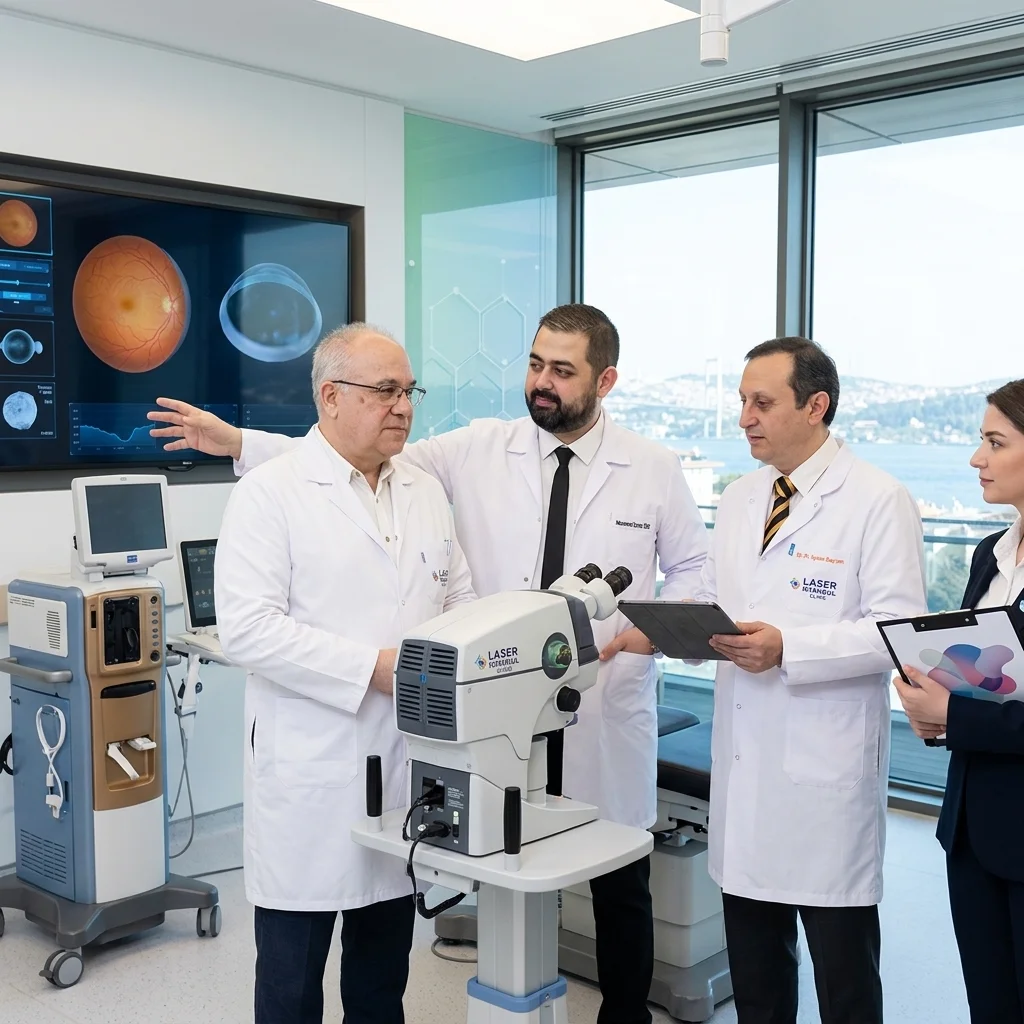
Laser eye surgery in Turkey: how it works, who it suits and what it costsDoes it cost more to treat long-sightedness than short-sightedness?
The price of eye surgery in Istanbul depends mostly on the technique and the technology, and, for lens surgery, on the lens you choose. Your exact prescription, and any extras such as a premium lens, are set out in the written quote your surgeon gives you after reviewing your reports. We do not publish separate prices for "myopia" and "hyperopia", because the surgeon decides which treatment applies.
Typical published package prices in Istanbul (USD, 2025–26)
| Treatment | Typical published Istanbul price |
|---|---|
| LASIK / Femto-LASIK (both eyes) | $1,450–2,700 |
| SMILE / SMILE Pro (both eyes) | $2,000–3,450 |
| Trifocal lens replacement (both eyes) | $3,400–7,000 |
| ICL (per eye) | $1,800–3,500 |
Advertised ranges, not quotes. Many of these packages include a hotel and airport transfers, so compare like with like. At Laser Istanbul Clinic, laser treatment starts from {{price}} for both eyes. Hotel and transfers are not included; they are a separate charge, arranged on request.
Typical published laser and lens prices in Istanbul are around 60–70% lower than private prices in the UK and US, comparing the middle of each price range.

Which of our surgeons treats short- and long-sightedness?
- Prof. Dr. Ahmet Satıcı: laser eye surgery (LASIK, SMILE Pro, PRK), ICL, cataract and premium lens surgery. An ophthalmology specialist since 1992 and former Professor and Head of the Department of Ophthalmology at Harran University. Profile and treatments
- Op. Dr. Aysan Bayram: cataract surgery, laser eye surgery and retinal disease. An ophthalmology specialist since 1999. She speaks English and is our female surgeon. Profile and treatments
- Doç. Dr. Muhammet Derda Özer (Doç. = Associate Professor): cornea, keratoconus, cross-linking, retina and cataract. He sees patients whose refractive problem comes with corneal or retinal disease. He speaks Turkish and English. Profile and treatments
How it works:
- Send your prescription and any eye reports. A surgeon reviews them and tells you whether laser, a lens implant or glasses is the better route, with a written price.
- Your surgeon examines you in Istanbul. Corneal topography, OCT and lens-power measurements are done before any treatment. If surgery is not right for you, your surgeon tells you.
- Surgery takes place in a fully equipped, Ministry of Health–licensed operating theatre in Istanbul. Your surgeon also checks your recovery in Istanbul and by video once you are home.
Included: pre-operative examination and scans, surgery by your named surgeon, medication, follow-up checks in Istanbul, a personal interpreter, a coordinator and remote follow-up. Not included: flights, hotel and airport transfers (a separate charge, arranged on request).
Frequently asked questions
Yes. Hyperopia and hypermetropia are two names for long-sightedness. "Hypermetropia" is the term mostly used in the UK and "hyperopia" in the US, and the NHS lists both for the same condition.
With short-sightedness (myopia) you see near objects clearly and distant ones blurry. With long-sightedness (hyperopia or hypermetropia) near objects are hard to see while the distance is clearer. In myopia light focuses in front of the retina; in hyperopia it focuses behind it.
Neither is automatically worse; it depends on how strong your prescription is. High myopia (above about 6 dioptres) carries a higher risk of retinal detachment, glaucoma and cataract, so regular eye checks matter. Severe long-sightedness in young children can lead to lazy eye or squint.
Myopia is corrected with a concave (minus) lens and hyperopia with a convex (plus) lens. ⚑ Contact lenses work the same way, while surgery reshapes the cornea or replaces the lens instead.
Myopia blurs distance and hyperopia blurs close-up vision, because of the eye's length and focusing power. Astigmatism comes from an uneven curve of the cornea or lens and blurs vision at all distances. It often occurs together with myopia or hyperopia.
No. Hyperopia comes from the shape of the eye, while presbyopia is the age-related stiffening of the lens that makes close work harder, usually from the 40s. Many people have both, and only an eye test can tell which one is causing your blur.
It can be an option. The NHS lists laser eye surgery and lens surgery as treatments for long-sightedness, and EyeWiki notes that surgery is considered once the eye has stopped changing, typically in the third decade of life. Your surgeon decides after measuring your cornea and prescription.
Typical published prices in USD are $1,450–2,700 for LASIK and $2,000–3,450 for SMILE (both eyes), and $1,800–3,500 per eye for ICL. At Laser Istanbul Clinic, laser treatment starts from {{price}} for both eyes. Hotel and transfers are not included; they are a separate charge.
Sources for the facts on this page
- NHS, "Short-sightedness (myopia)": definition, symptoms, onset 6–13 and worsening to about 20, family history, glasses/contacts, myopia management in children, private laser and lens surgery. https://www.nhs.uk/conditions/short-sightedness/
- NHS, "Long-sightedness (hyperopia)": definition ("also called hypermetropia or hyperopia"), symptoms, causes, over-40s, lens stiffening, children (lazy eye, squint), glasses/contacts/laser/lens surgery, not usually on the NHS. https://www.nhs.uk/conditions/long-sightedness/
- National Eye Institute (NEI), "Refractive errors": definitions of myopia, hyperopia, astigmatism and presbyopia; glasses as the simplest and safest correction; diagnosis by a comprehensive dilated eye exam. https://www.nei.nih.gov/learn-about-eye-health/eye-conditions-and-diseases/refractive-errors
- American Academy of Ophthalmology, "What Is Astigmatism?": definition, inheritance, co-occurrence with myopia and hyperopia, treatment. https://www.aao.org/eye-health/diseases/what-is-astigmatism
- American Academy of Ophthalmology, "Questions to Ask When Considering LASIK": stable prescription for about a year, vision changes until about 25, severe errors lower success and raise retreatment, 20/20 not guaranteed. https://www.aao.org/eye-health/treatments/lasik-questions-to-ask
- EyeWiki (AAO), "Myopia": optical definition, high myopia above 6 D or axial length above 26.5 mm and its complications. https://eyewiki.org/Myopia
- EyeWiki (AAO), "Hyperopia": definition, axial length, accommodation, symptoms worsening with age, angle-closure risk, refractive surgery after eye growth stabilises. https://eyewiki.org/Hyperopia
- **Holden BA et al. "Global Prevalence of Myopia and High Myopia and Temporal Trends from 2000 through 2050." Ophthalmology 2016. PMID 26875007** (22.9% / 1.41 billion in 2000; 49.8% / 4.76 billion in 2050; high myopia 2.7% to 9.8%; abstract read via Europe PMC). https://pubmed.ncbi.nlm.nih.gov/26875007/
- Not verified (web-search budget was used up while drafting): FDA LASIK pages returned 404, so FDA-approved correction ranges and SMILE/PRK indications were left out rather than stated unsourced. The ICL-for-high-myopia remark rests on the research extract's table (ICL: "High myopia, thin corneas").
Not sure which one you have? Ask a named surgeon, free
Send your glasses prescription, scans or eye reports, and Prof. Dr. Satıcı, Doç. Dr. Özer or Op. Dr. Bayram will tell you which treatments may suit you, who would operate and what it would cost, in writing, with no obligation.
3 eye surgeons
Your case is reviewed by a named surgeon, not a salesperson. Reply within {{response time}}.
 Prof. Dr. Ahmet Satıcı
 Doç. Dr. Muhammet Derda Özer
 Op. Dr. Aysan Bayram