
- Home
- Knowledge centre
- Lens & cataract guides
- What Does Blurry Vision From Cataracts Look Like, and Why Can It Return After Surgery?
What Does Blurry Vision From Cataracts Look Like, and Why Can It Return After Surgery?
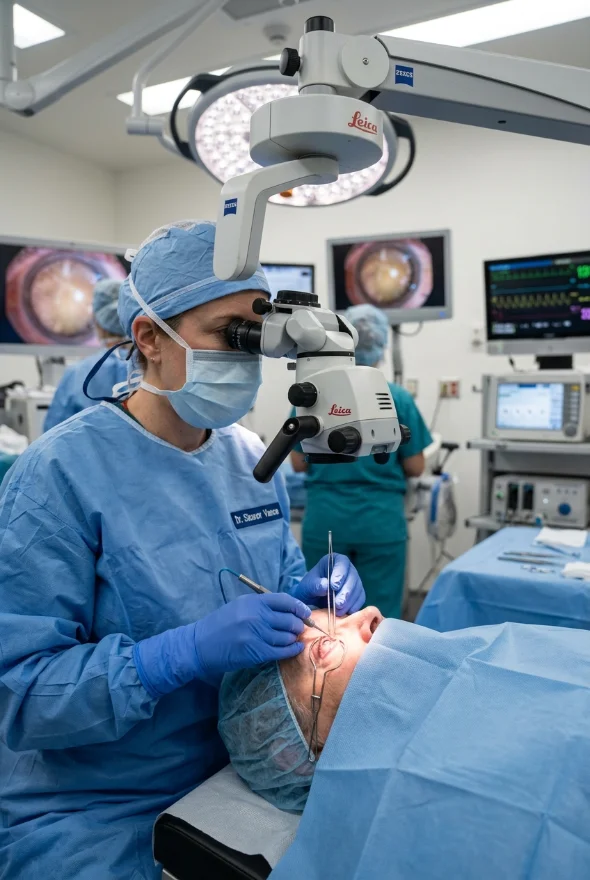
Blurry vision from a cataract looks like seeing through a foggy or dusty windscreen: hazy, dim, with faded colours and glare around lights. If that misty vision returns months or years after cataract surgery, the usual cause is posterior capsule opacification (PCO), a "secondary cataract", not a new cataract. A quick, painless YAG laser treatment clears it. Prof. Dr. Ahmet Satıcı, Doç. Dr. Muhammet Derda Özer and Op. Dr. Aysan Bayram treat both.
What does blurry vision from cataracts look like?
Cataract blur looks like a film over everything you see. The American Academy of Ophthalmology (AAO) compares it to looking through a foggy or dusty car windscreen: things look blurry, hazy or less colourful. The NHS lists these typical symptoms:
- blurred or cloudy vision
- colours that look faded, especially blue
- glare, and discomfort in bright light
- glowing rings (halos) around lights
- difficulty seeing at night
- double vision in one eye
- difficulty reading or watching television
- a glasses prescription that needs changing more often than usual
Cataracts usually develop slowly and can affect each eye differently. The US National Eye Institute (NEI) adds that early cataracts may cause no symptoms at all.
The same picture can come back after surgery. Cataract surgery removes your cloudy natural lens and replaces it with a clear artificial one, so vision normally becomes sharper and colours brighter. The NEI says about 9 out of 10 people see better afterwards. But if your vision slowly turns hazy again months or years later, with the same fog, glare and halos, that is not the old cataract coming back: once the natural lens is gone, a cataract cannot form in it again. The cause is most often a clouding of the thin, clear bag (the capsule) that holds your new lens.
| Cataract before surgery | Clouding after surgery (PCO) | |
|---|---|---|
| What is cloudy | The natural lens | The capsule behind your lens implant |
| How it looks | Foggy, dim, faded colours | Foggy again, with glare and halos; reading harder |
| How it starts | Slowly, over years | Usually months to years after surgery (EyeWiki) |
| Treatment | Cataract surgery | A quick laser opening in the capsule (YAG capsulotomy), no cut |
Is blurry vision normal after cataract surgery?
Yes, for a short time. Blurry vision in the first hours and days after cataract surgery is expected. The NHS says your vision may be blurry for a few hours because of the drops that widen the pupil, and that it can take several days to improve. You will usually use eye drops for about 4 weeks. The NEI says most people heal completely within 8 weeks, although you may need a new glasses prescription once healing is complete.
-
First hours
Blurred vision from the dilating drops; the eye may feel sore or tired
-
First days
Vision improves day by day; mild discomfort
-
About 4 weeks
The drop course ends (NHS)
-
Up to 8 weeks
Healing is complete for most people (NEI); a new glasses check
-
Months to years later
Slowly returning haze is not part of healing: have it examined
The operation itself is short: the NHS says it usually takes 20 to 45 minutes. How long does cataract surgery take? →
Blur that appears or returns after the first weeks of recovery has a cause that can usually be found and treated. The most common one is described next.
Why is my vision blurry again after cataract surgery? Posterior capsule opacification (PCO)
The usual cause is posterior capsule opacification (PCO), also called a secondary cataract or after-cataract. During cataract surgery your surgeon removes the clouded lens but leaves its thin, clear outer bag in place, because it holds the new lens. A few lens cells remain on that bag. Over time they can multiply and spread across the back of the capsule, which turns hazy and scatters light. A 2025 review defines PCO as light-scattering material on the part of the capsule in your line of sight, and describes two main forms: pearl-like clusters of cells ("Elschnig pearls") and a wrinkled, fibrous haze.
Typical symptoms (EyeWiki, the AAO's clinical encyclopedia), usually appearing months to several years after an uneventful operation:
- blurred or hazy vision
- glare and halos around lights
- sensitivity to bright light
- poorer contrast
- difficulty reading
How common is PCO?
Quite common: the NEI says up to 2 out of 5 people who have cataract surgery will develop a secondary cataract. Published figures differ because studies count different things (any visible clouding, or only clouding that needed laser), follow patients for different lengths of time and compare different lens designs.
| Study or source | What was measured | Result |
|---|---|---|
| NEI | People who develop a secondary cataract after cataract surgery | Up to 2 in 5 |
| EyeWiki (AAO) | PCO within 2 to 5 years of surgery | 20–50% |
| Karahan et al., 2014 (review) | PCO after cataract surgery | 20.7% at 2 years; 28.5% at 5 years |
| Ursell et al., 2020 (20,763 eyes, UK NHS clinics, single-piece acrylic lenses) | Needed YAG laser within 5 years | 5.8–19.3%, depending on the lens model |
| Ursell et al., 2018 (52,162 eyes) | Needed YAG laser within 3 years | 6.4% overall; 2.4–4.4% with hydrophobic lenses, 10.9% with a hydrophilic lens |
| Rakib-Uz-Zaman et al., 2025 (review) | Early-onset PCO within 1 year | 2–4.5% of adults with modern techniques |
Hydrophobic and hydrophilic describe how the lens material behaves with water; your surgeon can tell you which kind you have.
Who is more likely to get it. EyeWiki names younger age as the most significant risk factor, and lists diabetes, uveitis (eye inflammation), myotonic dystrophy, retinitis pigmentosa and eyes injured in an accident. In infants and children PCO reaches 100%. The lens design matters too: a sharp, square back edge on the implant creates a barrier that slows the cells from creeping across the capsule (EyeWiki).
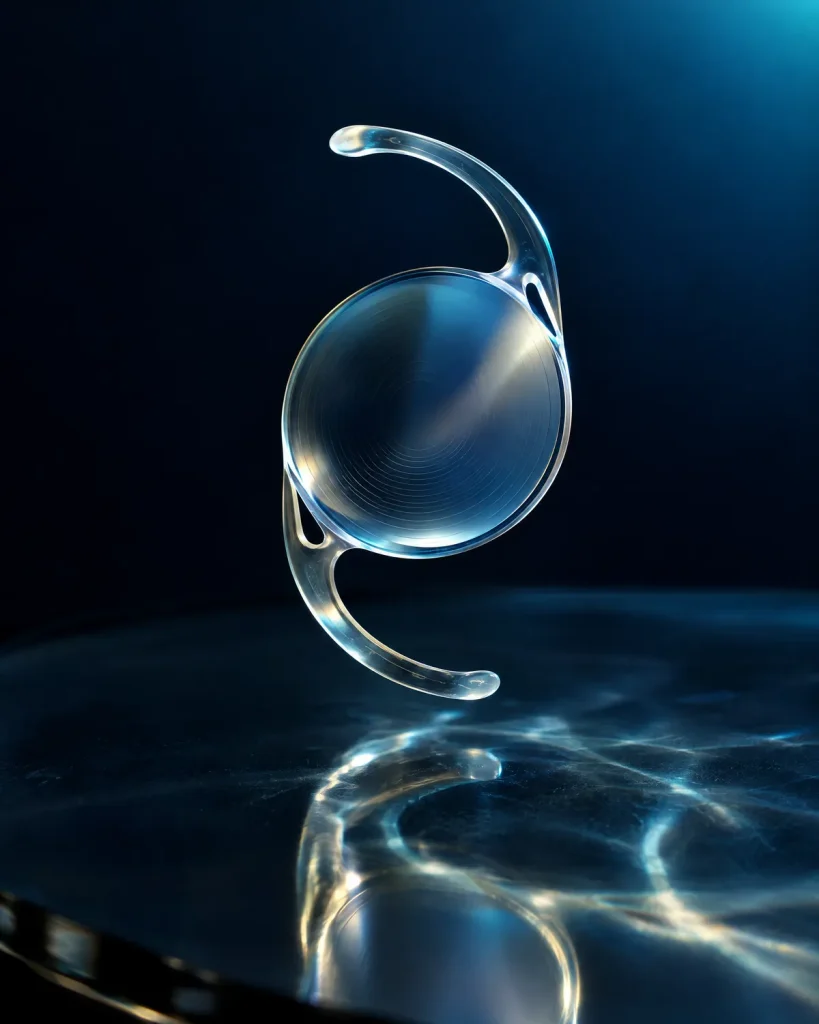
Premium lenses are affected as well. Trifocal, EDOF and toric implants sit in the same capsule. In one study of people who were unhappy after premium (presbyopia-correcting) lenses, 12.2% needed a YAG laser, and all but one were satisfied afterwards (Gibbons et al., 2016).
What else can cause blurry vision after cataract surgery?
Not every case of blur after surgery is PCO. That is why your surgeon compares your current sight with your best vision after surgery and examines the retina before suggesting treatment. EyeWiki advises an OCT scan of the macula (the centre of the retina) when the symptoms seem worse than the capsule haze explains.
| Possible cause | What it feels like | What happens next |
|---|---|---|
| Normal healing | Blur and soreness in the first days | Improves over days to weeks; keep using your drops (NHS, NEI) |
| Dry eye | Gritty eyes, blur that changes with blinking | Lubricating drops; found in 35% of patients unhappy with premium lenses in one study (Gibbons et al.) |
| Leftover prescription (refractive error) | Blur at a distance or near, sharper with glasses | New glasses; the same study found it in 57% of unhappy patients |
| Swelling at the macula (cystoid macular oedema) | Blurred central vision, usually 1–6 months after surgery | Anti-inflammatory drops, sometimes injections; mild cases often settle within about three months (Grzybowski et al., 2016) |
| Posterior capsule opacification | Slowly returning haze, glare, halos | YAG laser capsulotomy |
| Retinal detachment (rare) | New floaters, flashes, a dark curtain or shadow | Emergency: same-day care |
| Infection or serious inflammation | Painful, very red eye, falling vision | Urgent: same-day care |
Studies report swelling at the macula in anything from 1% to 30% of eyes, depending on how it is measured, and it is more likely in people with diabetes, a history of uveitis, a membrane on the retina or a complicated operation (Grzybowski et al., 2016). Glare and halos around lights can also be part of life with a multifocal lens; your surgeon explains in advance which trade-offs apply to the lens you choose.
When is blurry vision after cataract surgery an emergency?
Get same-day help if your sight changes suddenly. The NHS says to call NHS 111 straight away if you notice:
- floaters (dots and lines) that appear suddenly or suddenly increase
- flashes of light
- a dark curtain or shadow crossing your vision
- sudden blurring
These can be signs of a retinal detachment. The NEI also says to contact your doctor straight away for vision loss, severe pain that medication does not ease, a very red eye, or floaters and flashes with dark spots. If you are in Istanbul, call your coordinator; if you are at home, go to your nearest eye emergency service (in the UK, NHS 111).
Book an appointment (not an emergency) if your vision becomes cloudy or blurry gradually, you notice light or dark areas in your vision, your eye is red or painful, or light bothers you. The NHS suggests seeing your optician first.
How is PCO diagnosed?
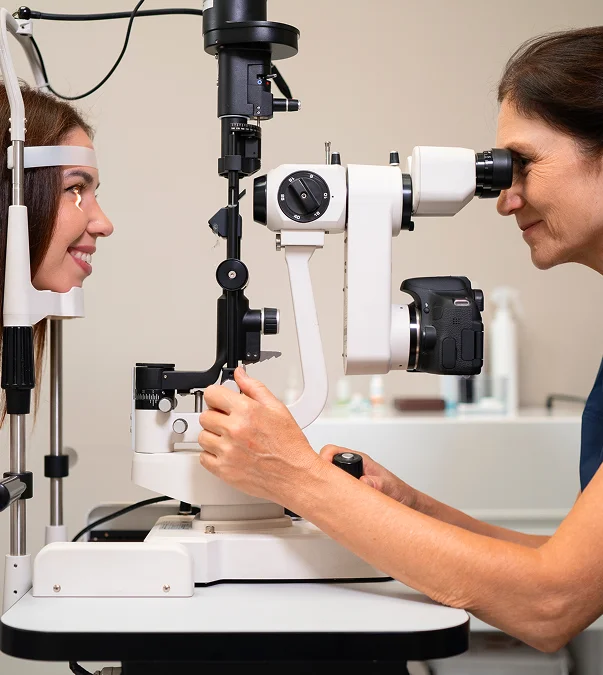
PCO is diagnosed at an eye examination. The doctor looks at the capsule through a slit lamp (a microscope with a bright light). According to EyeWiki, the doctor also compares your vision with your best vision after surgery and checks that there is no problem at the macula or retina. If something else could explain the blur, an OCT scan takes a cross-section picture of the macula.
Bring your lens details. Your cataract surgery report or lens card shows the implant model and power. It helps the doctor plan any laser treatment and decide whether anything else should be settled first.
What is YAG laser capsulotomy, and what are the risks?
YAG laser capsulotomy is the standard treatment for PCO: the surgeon uses a laser to make a small opening in the hazy part of the capsule. The NEI describes it as quick and painless, and says most people notice their vision is back to normal within a few days. Karahan and colleagues call it a noninvasive procedure: there is no cut, and light passes through the clear opening straight to the retina.
What to expect (your surgeon confirms the details for your eye):
- Your surgeon explains the treatment and may use drops before the laser.
- You sit at the laser with your chin on a rest and see bright flashes of light.
- The surgeon opens the capsule. EyeWiki advises using the lowest effective energy and avoiding an opening larger than needed.
- Your eye pressure is checked afterwards where needed, because a temporary rise is the most common side effect. EyeWiki advises early pressure checks after higher-energy treatments and pressure-lowering drops for people with glaucoma.
- You go home the same day. Vision may be blurred for the first hours; do not drive until it is clear.
How safe is YAG laser capsulotomy?
It is a routine treatment with low rates of serious problems, but it is not risk-free. The best large figures come from a French nationwide study of 6,210 patients and 7,958 procedures (Dot et al., Ophthalmology, 2023).
| Possible problem | How often | Notes |
|---|---|---|
| Raised eye pressure | About 5% at 3 months (French study); other studies report 0.6% to 30%, depending on patients and laser energy (Karahan et al.) | Usually temporary and treated with drops; matters most if you have glaucoma |
| Swelling at the macula (macular oedema) | About 5% at 3 months (French study) | Treated with drops; more likely in people with diabetes |
| Retinal detachment | 0.5% or less within 12 months (French study) | Whether the laser itself raises the risk is debated: a 2022 meta-analysis of 11 studies and 65,117 eyes found a relative risk of 1.57 |
| Any one of these three | 8.6% at 3 months and 13.3% at 12 months; 68.4% of events came in the first 3 months | Higher when the laser is done within a year of cataract surgery, and in people with diabetes |
| Small marks on the lens implant ("pitting") | Up to 19.8% of eyes in one study of 86 eyes (Karahan et al.) | Lower laser energy reduces the marks |
| Other problems | Persistent inflammation in 1.4% of patients in one series (Karahan et al.); lens implant movement and macular hole are also listed (EyeWiki) | Rare |
Some eyes carry a higher risk. Karahan and colleagues list long eyes (axial length above 24 mm, typical of high short-sightedness), a history of retinal detachment, lattice degeneration and complications at the cataract operation as risk factors for retinal detachment after the laser. If you are highly short-sighted, tell your surgeon. ICL vs laser for high myopia and thin corneas →
When the laser should wait. EyeWiki says to delay treatment if the eye is inflamed, if there has been recent macular swelling, if the retina is unstable, if new floaters have recently appeared from a vitreous detachment, or if a hidden low-grade infection is suspected. The French study also found more side effects when the laser was done within a year of cataract surgery, so your surgeon weighs the timing against how much the haze affects your daily life.
Can PCO come back after the laser? It can recur, which is why EyeWiki advises a follow-up about 6 months after the laser; a second treatment is occasionally needed.
How can you lower the chance of PCO?
You cannot remove the risk completely, but a few choices help.
- Ask which lens you are having. Sharp, square-edged optics are associated with less PCO (EyeWiki), and in UK data hydrophobic lens materials had lower laser rates at three years than a hydrophilic lens (Ursell et al., 2018).
- Keep your lens card or surgery report. The model and power matter for any later laser or lens decision.
- Look after other eye conditions. Diabetes and uveitis raise the chance of PCO (EyeWiki), and diabetes raises the chance of side effects after the laser, so keep your check-ups.
- Do not ignore slow haze. An examination is quick, and most people notice clear vision again within days of laser treatment (NEI).
Cataract surgery with Laser Istanbul Clinic: what if vision clouds later?
Cataract surgery at Laser Istanbul Clinic is performed by Prof. Dr. Ahmet Satıcı, Doç. Dr. Muhammet Derda Özer or Op. Dr. Aysan Bayram, in a fully equipped, Ministry of Health–licensed operating theatre in Istanbul. ("Doç." is the Turkish title for Associate Professor.) Prof. Dr. Satıcı leads cataract and premium lens surgery; Doç. Dr. Özer, who speaks Turkish and English, also treats cataract in eyes with corneal, retinal or uveitis problems; Op. Dr. Bayram, who speaks English, is the choice for patients who prefer a female surgeon.
- Your surgeon checks your eye before you fly home, and your coordinator and surgeon follow your recovery remotely, by video, at agreed intervals.
- If you need to be seen in person, we help you arrange it with a local optometrist or ophthalmologist and share your full surgical records, including your lens model.
- PCO can appear years later. YAG capsulotomy is a short outpatient treatment that many eye clinics near your home can do, and our surgeons also perform it in Istanbul. Our policy for our own cataract patients: {{YAG laser / PCO treatment policy and the period it covers}}.
Frequently asked questions
Like looking through a foggy or dusty car windscreen: hazy, dim vision with faded colours, glare from lights and halos around them, and trouble reading or seeing at night. It usually builds slowly over years and can affect each eye differently.
Blur from the dilating drops lasts a few hours, and vision usually improves over several days. Eye drops continue for about 4 weeks, and the NEI says most people heal completely within 8 weeks. Blur that returns months or years later is not part of normal healing and should be examined.
The usual cause is posterior capsule opacification (PCO): the thin capsule that holds your lens implant turns hazy. It is also called a secondary cataract, and the NEI says up to 2 in 5 people develop it. It is not the old cataract returning, and a laser opening clears it. Other causes, such as macular swelling, dry eye or a changed glasses prescription, need to be ruled out first.
No. Once your natural lens has been removed, a cataract cannot form in it again. Hazy vision after surgery is usually PCO, a clouding of the capsule behind the new lens. It feels like a cataract but is treated with a quicker, different procedure.
No. The NEI describes treatment for secondary cataracts as quick and painless. You see bright flashes of light while the laser opens the capsule. Tell your surgeon if anything feels uncomfortable afterwards.
Most people notice their vision is back to normal within a few days (NEI). Vision may be blurred for the first hours, so do not drive on the day, and keep any follow-up pressure check your surgeon asks for.
The most common are a temporary rise in eye pressure and swelling at the macula, each seen in about 5% of patients at 3 months in a large French study. Retinal detachment stayed at 0.5% or less over a year. Most problems appear within 3 months and can be treated, which is why follow-up matters.
It can, which is why a check about 6 months after the laser is advised (EyeWiki). If the opening clouds over again, a second treatment may be needed.
Yes. PCO affects premium lenses as well, and YAG laser is the standard treatment. If you are unhappy with the lens for other reasons, tell your surgeon before treatment, because that question is better settled before the capsule is opened.
Sudden new floaters, flashes of light, a dark curtain or shadow in your vision, or sudden blurring can mean retinal detachment. Call NHS 111 or your nearest eye emergency service the same day. Vision loss, a very red eye or severe pain that medication does not ease also need urgent attention.
Worried about your vision after cataract surgery, or thinking about having it?
Send us your eye report and, if you have had surgery, your cataract surgery details. Prof. Dr. Ahmet Satıcı, Doç. Dr. Muhammet Derda Özer or Op. Dr. Aysan Bayram will tell you what is likely to explain your symptoms and what could help, with no obligation.
Sources for the facts on this page
- National Eye Institute (NIH). Types of Cataract, section "Secondary cataracts" (other names after-cataract and PCO; up to 2 out of 5 people; YAG laser capsulotomy quick and painless; most notice vision back to normal in a few days). https://www.nei.nih.gov/eye-health-information/eye-conditions-and-diseases/cataracts/types-cataract
- National Eye Institute (NIH). Cataracts (symptoms; early cataracts may cause no symptoms). https://www.nei.nih.gov/learn-about-eye-health/eye-conditions-and-diseases/cataracts
- National Eye Institute (NIH). Cataract surgery (9 out of 10 see better; most heal within 8 weeks; secondary cataracts weeks to years later; warning signs). https://www.nei.nih.gov/learn-about-eye-health/eye-conditions-and-diseases/cataracts/cataract-surgery
- NHS. Cataracts (symptoms list). https://www.nhs.uk/conditions/cataracts/
- NHS. Cataract surgery (20–45 minutes; PCO). https://www.nhs.uk/conditions/cataract-surgery/ and https://www.nhs.uk/tests-and-treatments/cataract-surgery/
- NHS. Cataract surgery: recovery (blurry for a few hours; drops for about 4 weeks). https://www.nhs.uk/conditions/cataract-surgery/recovery/
- NHS. Cataract surgery: risks (PCO; urgent and non-urgent warning signs). https://www.nhs.uk/conditions/cataract-surgery/risks/
- American Academy of Ophthalmology. What Are Cataracts? (foggy or dusty windscreen comparison; laser capsulotomy). https://www.aao.org/eye-health/diseases/what-are-cataracts
- EyeWiki (American Academy of Ophthalmology). Posterior Capsule Opacification (20–50% within 2–5 years; risk factors; symptoms; evaluation; Nd:YAG principles; when to delay; square-edge optics; 6-month follow-up). https://eyewiki.org/Posterior_Capsule_Opacification
- Karahan E, Er D, Kaynak S. An Overview of Nd:YAG Laser Capsulotomy. Med Hypothesis Discov Innov Ophthalmol 2014. https://pmc.ncbi.nlm.nih.gov/articles/PMC4346677/
- Ursell PG, Dhariwal M, O'Boyle D, Khan J, Venerus A. 5 year incidence of YAG capsulotomy and PCO after cataract surgery with single-piece monofocal intraocular lenses: a real-world evidence study of 20,763 eyes. Eye (Lond) 2020. https://pmc.ncbi.nlm.nih.gov/articles/PMC7182577/
- Ursell PG, Dhariwal M, et al. Three-year incidence of Nd:YAG capsulotomy and posterior capsule opacification (52,162 eyes). Eye (Lond) 2018. https://pmc.ncbi.nlm.nih.gov/articles/PMC6189124/
- Rakib-Uz-Zaman SM, Werner L, Duncan MK. Unanswered questions regarding the pathogenesis of late onset posterior capsular opacification. Front Ophthalmol 2025. https://pmc.ncbi.nlm.nih.gov/articles/PMC12584618/
- Dot C, Schweitzer C, Labbé A, et al. Incidence of Retinal Detachment, Macular Edema, and Ocular Hypertension after Nd:YAG Capsulotomy: The French YAG 2 Study. Ophthalmology 2023. https://pubmed.ncbi.nlm.nih.gov/36581227/
- Liu H, et al. Effect of Nd:YAG laser capsulotomy on the risk for retinal detachment after cataract surgery: systematic review and meta-analysis. J Cataract Refract Surg 2022. https://pubmed.ncbi.nlm.nih.gov/34538778/
- Gibbons A, Ali TK, et al. Causes and correction of dissatisfaction after implantation of presbyopia-correcting intraocular lenses. Clin Ophthalmol 2016. https://pmc.ncbi.nlm.nih.gov/articles/PMC5066995/
- Grzybowski A, Sikorski BL, Ascaso FJ, Huerva V. Pseudophakic cystoid macular edema: update 2016. Clin Interv Aging 2016. https://pmc.ncbi.nlm.nih.gov/articles/PMC5025006/