
- Home
- Knowledge centre
- Keratoconus & cornea guides
- Cross-Linking vs Corneal Rings vs Transplant: Which Keratoconus Treatment Do You Need?
Cross-Linking vs Corneal Rings vs Transplant: Which Keratoconus Treatment Do You Need?
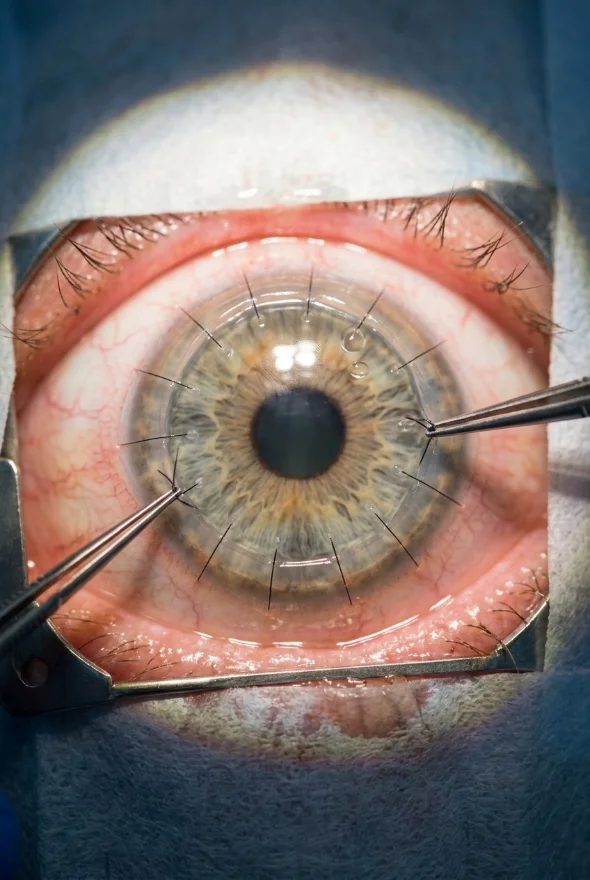
Corneal cross-linking (CXL) stops keratoconus from getting worse, corneal rings reshape the cornea to improve vision, and a corneal transplant replaces diseased tissue when the cornea is scarred or too thin. They are steps, not rivals: most people start with cross-linking, some add rings, and a minority need a transplant. Cornea specialist Doç. Dr. Muhammet Derda Özer plans all three at Laser Istanbul Clinic.
How does keratoconus differ from a normal eye?
In keratoconus the cornea, the clear dome at the front of the eye, thins and bulges into a cone shape, while a normal cornea keeps a smooth, evenly curved dome. The American Academy of Ophthalmology (AAO) describes it as the cornea thinning out and bulging like a cone, which makes light focus badly and vision blurred and distorted.
| Normal eye | Keratoconus | |
|---|---|---|
| Shape of the cornea | Smooth, evenly curved dome | Thinned, with a cone-like bulge |
| Vision | Sharp with a stable prescription | Blurred and distorted, with frequent prescription changes |
| Light | Comfortable | Light sensitivity and glare |
| Typical start | n/a | Teenage years or twenties; it gradually gets worse, at a pace that varies between people |
| Both eyes | n/a | Usually both, often unevenly (EyeWiki) |
| Blindness | n/a | Keratoconus does not cause blindness (NHS patient information) |
EyeWiki, the AAO's clinical encyclopedia, puts the prevalence at about 1 in 700 people overall, higher in some regions including the Middle East, India, China and Australia. Because glasses cannot fully correct an irregular cone, the treatments below do different jobs, which is why the choice is not "which is best" but "which job needs doing in your eye".
Cross-linking vs corneal rings vs transplant: what is the difference?
The three treatments do three different jobs. Cross-linking strengthens the cornea to stop it getting worse. Corneal rings (intracorneal ring segments, ICRS) reshape the cornea to improve vision. A transplant replaces weakened or scarred tissue with donor tissue.
| Corneal cross-linking (CXL) | Corneal rings (ICRS, e.g. Intacs) | Corneal transplant (DALK or PK) | |
|---|---|---|---|
| Main job | Stops the cornea getting weaker | Flattens the cone to improve vision | Replaces diseased cornea |
| What is done | Riboflavin (vitamin B2) drops and ultraviolet A light strengthen the cornea | Two small curved segments are placed in the cornea | The weakened cornea, or its damaged layers, is replaced with donor tissue |
| Stops progression? | Yes, in over 90% of cases (NHS patient information) | Not by itself; the benefit may be lost if the disease keeps progressing | Replaces the weakened tissue |
| Improves vision? | Aims to stabilise, not improve; glasses or lenses are still needed | Often, mainly in eyes with poor vision to start with | Yes, in advanced disease; glasses or lenses are often still needed |
| Typical stage | Progressive keratoconus, cornea at least 400 µm thick for the standard method | Clear central cornea, vision not good enough, contact lenses not tolerated | Advanced: scarring, very thin cornea, or lenses no longer work |
| Can it be undone? | No | Yes, segments can be removed | No |
| Recovery | At least 1 week off work; vision clears over several weeks (NHS patient information) | {{your surgeon's recovery advice for ring segments}} | Up to 18 months (DALK) or 2 years (full-thickness) for full vision (NHS) |
Figures come from the sources listed below; your own result depends on your eye.
What does corneal cross-linking do, and how well does it work?
Corneal cross-linking is the only one of the three treatments aimed at stopping keratoconus itself. Riboflavin eye drops and ultraviolet light strengthen the cornea by creating cross-links between its collagen fibres, which NHS patient information describes as mimicking the normal stiffening of the cornea with age. EyeWiki calls it the principal disease-modifying treatment for progressive keratoconus.
How well does it work? NHS patient information reports effectiveness in over 90% of cases in clinical trials and about 94% in one large UK eye hospital's own data since 2013, with fewer than 1% needing a repeat treatment. The main aim, it says, is to stabilise the cornea, not to improve vision, so spectacles or contact lenses are still needed afterwards. In US trials summarised by EyeWiki, the steepest corneal reading fell by 1.6 dioptres at one year, about a third of treated eyes gained some corrected vision and about 5% lost some.
Who is it for? People whose scans show keratoconus getting worse. A 2024 review in Community Eye Health says the standard approach is to offer cross-linking to patients who are progressing, and that for young people at higher risk it can be considered at diagnosis, without waiting for proof of progression. Progression is unusual after the mid-30s because the cornea stiffens naturally with age.
Limits and risks. The standard method needs a cornea at least 400 µm thick (EyeWiki lists modified methods for thinner corneas in selected cases). Recovery is slower than after laser surgery because the surface layer is removed: NHS patient information advises at least one week off work, two if your job involves a lot of computer use. NHS patient information reports vision loss afterwards in fewer than 3% of patients; EyeWiki lists haze, infection and scarring among the possible complications. In October 2025 the US FDA approved the first epithelium-on (surface left in place) cross-linking treatment for people aged 13 and over (EyeWiki).
What do corneal rings do, and when are they used?
Corneal rings are small, curved segments placed in the cornea to flatten the cone and improve vision, but they do not strengthen the cornea. The AAO describes Intacs, the best-known brand, as a small curved device placed surgically in the cornea that helps flatten its curvature to improve vision.
Who is a candidate? A 2016 review by Vega-Estrada and Alió in Eye and Vision lists three main criteria: corrected vision below 0.9 on the decimal scale, contact lens intolerance and no central scar. EyeWiki adds that the cornea must be thicker than 450 µm where the segments sit.
What results can you expect? Most studies report the corneal curvature reading flattening by 3 to 5 dioptres. The gain depends on where you start. In the same review, among eyes with the poorest corrected vision, 82.85% gained at least one line on the eye chart. Among eyes that already saw well, only 37.90% gained a line and 36.29% lost one. In other words, rings help most when vision is poor, and carry a real risk of making sharp vision worse when it is already good.
Are they reversible? Yes. The review states that segments can be safely removed and measurements return to pre-operative levels. That is a real advantage over a transplant.
Risks. The review lists segment extrusion (working its way out), new blood vessels, haze, migration, melting and infection. EyeWiki reports complication rates of up to 30% in published series, ranging from harmless to sight-threatening.
Do rings stop keratoconus getting worse? No. The review says that in stable disease results stay stable, but when the disease is progressing the benefit achieved is expected to be lost. That is why rings are often paired with cross-linking.
Intacs vs cross-linking: which is better?
Neither is "better", because they do different jobs: cross-linking stabilises the cornea, Intacs reshape it. "Intacs" is one brand of corneal ring segments, so "intacs vs cross-linking" is really "rings vs cross-linking".
| Question | Cross-linking | Intacs / corneal rings |
|---|---|---|
| Is my keratoconus getting worse? | This is the treatment that addresses it | Does not address it |
| Is my vision poor even with the best glasses or lenses? | Does not aim to improve vision | Can improve vision, especially if it was poor to start with |
| Can I wear contact lenses comfortably? | Not a deciding factor | Contact lens intolerance is one of the usual reasons for rings |
| Can it be removed later? | No | Yes |
Can you have both? Yes. EyeWiki lists CXL combined with Intacs as an approach to improve visual acuity. In the 2016 review, studies found that placing rings first and then cross-linking gave better visual, refractive and topographic results than the reverse order, although other studies disagree. Your surgeon chooses the order and timing for your eye.
Many people also ask whether laser or an implantable lens (ICL) can replace these treatments. We answer that in a separate guide.
When is a corneal transplant needed?
A corneal transplant is needed when the cornea is too scarred or too thin for other treatments, or when contact lenses no longer give useful vision. The AAO says transplant is recommended when symptoms are severe, and that in advanced disease lenses may no longer fit or be comfortable.
How common is it? Less common than it used to be. A Dutch nationwide study by Godefrooij and colleagues reported that about 10–20% of keratoconus patients eventually need a transplant, and about 25% fewer transplants were performed in the three years after cross-linking was introduced (201 against 269). NHS patient information states that without cross-linking at least 20% of keratoconus patients eventually need one, and calls transplant rare since cross-linking was introduced.
Which type? There are two main options for keratoconus:
- DALK (deep anterior lamellar keratoplasty): replaces the front and middle layers of the cornea and keeps your own inner layer, the endothelium.
- PK (penetrating keratoplasty): replaces the full thickness of the cornea.
How well do keratoconus transplants do? Very well. A 2023 study in the British Journal of Ophthalmology followed 502 keratoconus eyes (228 DALK, 274 PK) and found graft survival at 20 years of 97.0% after DALK and 94.9% after PK. Vision improved from an average of 20/378 before surgery to 20/32 at 30 months. Raised eye pressure needing treatment was more common after PK (21.5%) than DALK (11.8%), and endothelial cell density at 10 years was higher after DALK (1,966 against 827 cells/mm²). The authors concluded that DALK may be better than PK when it can be done.
| DALK | PK | |
|---|---|---|
| Layers replaced | Front and middle layers | Full thickness |
| 20-year graft survival (BJO 2023) | 97.0% | 94.9% |
| Rejection episodes (BJO 2023) | 16.7% | 19.0% |
| Raised eye pressure needing treatment | 11.8% | 21.5% |
| Full visual recovery (NHS) | Up to 18 months | Up to 2 years |
What does the NHS say about recovery and risks? The operation takes 1 to 2 hours and most people need about two weeks off work. Risks listed by the NHS include rejection of the donor cornea, clouding, astigmatism, inflammation, glaucoma, infection, retinal detachment and cataract; problems can usually be treated when found early.
Which treatment do you need? A simple guide by situation
Your scans decide this, not a rule of thumb, but this is how the options usually line up. The Community Eye Health review lists the ladder as spectacles or rigid gas-permeable lenses, then cross-linking, then corneal ring segments, then transplantation.
| Your situation | What is usually considered | Why |
|---|---|---|
| Mild keratoconus, stable scans, good vision in glasses or lenses | Glasses or contact lenses, regular scans | Nothing to stop, nothing to fix yet |
| Scans show it getting worse, or a young patient at higher risk | Cross-linking | It is the treatment that stops progression |
| Stabilised, but vision is poor and lenses are uncomfortable, with a clear central cornea | Corneal rings, often with cross-linking | Rings improve vision; cross-linking keeps the result stable |
| Advanced: scarring, very thin cornea, or no useful vision with lenses | Corneal transplant (DALK where possible) | The cornea can no longer be improved by reshaping or strengthening |
Why scans, not symptoms, decide. Significant progression is often defined as an increase of more than 1 dioptre in corneal curvature or more than 15 microns of thinning between scans, although the same review cautions that there is no consensus on what counts as significant change. That is why repeat topography matters, and why older scans are so useful.
Stop rubbing your eyes. The AAO lists eye allergies and eye rubbing among the factors linked to keratoconus and advises avoiding rubbing. Rubbing leads to the next question.
Keratoconjunctivitis vs conjunctivitis: what is the difference?
Keratoconjunctivitis vs conjunctivitis comes down to depth: conjunctivitis inflames only the thin membrane covering the white of the eye, while keratoconjunctivitis also involves the cornea. Neither is the same as keratoconus, which is a thinning and bulging of the cornea, not an infection or allergy.
| Conjunctivitis | Keratoconjunctivitis (for example vernal) | Keratoconus | |
|---|---|---|---|
| What it is | Red or "pink" eye caused by infection or allergy (NHS) | Inflammation of the conjunctiva and the cornea; vernal keratoconjunctivitis is an allergic (atopic) condition of the eye surface (EyeWiki) | Thinning and cone-shaped bulging of the cornea |
| Cornea involved? | Usually not | Yes: surface damage (keratitis), which can scar | Yes, by definition |
| Usual symptoms | Redness, grittiness, burning, sticky discharge, itching, watering | Severe itching, light sensitivity, foreign-body feeling, mucous discharge, blurred vision | Blurred, distorted vision; frequent prescription changes; glare |
| Who | Anyone | Mainly ages 5 to 25, typical onset 10 to 12, more often males (EyeWiki) | Usually starts in the teens or twenties |
| Course | Usually clears within a couple of weeks (NHS) | Seasonal or long-term; needs specialist treatment | Gradually worsens; needs monitoring and often cross-linking |
Why this matters for keratoconus. EyeWiki notes that keratoconus is more common in people with vernal keratoconjunctivitis, possibly because chronic irritation increases eye rubbing, and it lists eye rubbing associated with atopy or vernal keratoconjunctivitis as a risk factor. If your child has itchy, allergic eyes and rubs them, treat the allergy and ask for a corneal scan. NHS patient information also notes keratoconus is more frequent in people with allergies such as asthma and eczema.
When to seek help. The NHS advises an urgent appointment or NHS 111 if red eyes come with pain, sensitivity to light or changes in vision, because these point to something more serious than simple conjunctivitis.
Frequently asked questions
It depends on whether your keratoconus is getting worse and how well you see. If it is progressing, cross-linking comes first because it is the treatment that stops progression. Rings are considered when vision is poor and lenses are uncomfortable, and a transplant is kept for advanced, scarred or very thin corneas.
No. Rings reshape the cornea but do not strengthen it, and a 2016 review notes that in progressive disease the benefit is expected to be lost. That is why rings are commonly combined with cross-linking.
Yes. Intacs is a brand of corneal ring segments, and EyeWiki lists CXL combined with Intacs as an approach to improve visual acuity. The review found that rings first, then cross-linking, tended to give better results than the reverse order, although studies differ.
Mainly it stabilises it. NHS patient information says the main aim is to stabilise, not improve, vision, so spectacles or contact lenses are usually still needed. Some people do gain some corrected vision: about a third in the US trials summarised by EyeWiki.
Yes. The 2016 review says segment removal can be done safely and measurements return to pre-operative levels, which is one reason rings are considered less permanent than a transplant.
No. Estimates are that 10–20% of people with keratoconus eventually need one without cross-linking, and in the Netherlands about 25% fewer transplants were performed in the three years after cross-linking was introduced.
When it can be done, often yes. In a 2023 study of 502 eyes, graft survival at 20 years was 97.0% after DALK and 94.9% after PK, with less raised eye pressure and more endothelial cells after DALK. Your surgeon decides which is possible in your eye.
Conjunctivitis affects the membrane over the white of the eye and is usually caused by infection or allergy. Keratoconjunctivitis also involves the cornea, so it can scar the surface and needs specialist care. Neither is keratoconus, but chronic itchy allergic eyes and rubbing are linked to it.
No. NHS patient information states that keratoconus does not cause blindness, and even advanced cases can usually have vision corrected with lenses. Untreated progression can still reduce vision badly, which is why monitoring matters.
Not sure which stage you are at?
Send your corneal scans and prescription and a cornea specialist will tell you which of these steps your eye needs now, and which it does not. At Laser Istanbul Clinic, cross-linking, corneal rings and corneal transplant are planned by Doç. Dr. Muhammet Derda Özer (Doç. = Associate Professor), who treats you in a fully equipped, Ministry of Health–licensed operating theatre in Istanbul.
Sources for the facts on this page
- EyeWiki (American Academy of Ophthalmology). Keratoconus. https://eyewiki.org/Keratoconus
- EyeWiki (AAO). Corneal Collagen Cross-Linking. https://eyewiki.org/Corneal_Collagen_Cross-Linking
- EyeWiki (AAO). Vernal Keratoconjunctivitis. https://eyewiki.org/Vernal_Keratoconjunctivitis
- American Academy of Ophthalmology. What Is Keratoconus? https://www.aao.org/eye-health/diseases/what-is-keratoconus
- American Academy of Ophthalmology. Keratoconus Treatment. https://www.aao.org/eye-health/diseases/keratoconus-treatment
- NHS specialist eye hospital patient information. Keratoconus. https://www.moorfields.nhs.uk/eye-conditions/keratoconus
- NHS specialist eye hospital patient information. Keratoconus diagnosis and treatment. https://www.moorfields.nhs.uk/eye-conditions/keratoconus/diagnosis-and-treatment
- NHS specialist eye hospital patient information. Corneal cross-linking. https://www.moorfields.nhs.uk/eye-conditions/keratoconus/corneal-cross-linking
- NHS. Cornea transplant. https://www.nhs.uk/conditions/cornea-transplant/
- NHS. Conjunctivitis. https://www.nhs.uk/conditions/conjunctivitis/
- Vega-Estrada A, Alió JL. The use of intracorneal ring segments in keratoconus. Eye and Vision 2016. https://pmc.ncbi.nlm.nih.gov/articles/PMC4791885/
- Borderie VM, et al. Long-term outcomes of deep anterior lamellar versus penetrating keratoplasty for keratoconus. British Journal of Ophthalmology 2023. https://pmc.ncbi.nlm.nih.gov/articles/PMC10803977/
- Godefrooij DA, et al. Nationwide reduction in the number of corneal transplantations for keratoconus following the implementation of cross-linking. Acta Ophthalmologica 2016;94(7):675–678 (abstract read via Europe PMC). https://pubmed.ncbi.nlm.nih.gov/27213687/
- Deshmukh R, Gore D. Keratoconus: diagnosis and management. Community Eye Health 2024;37(123):7–9. https://pmc.ncbi.nlm.nih.gov/articles/PMC11921258/