
- Home
- Knowledge centre
- Eyelid & cosmetic guides
- Before and After Hooded Eye Surgery: Surgical and Non-Surgical Options for Hooded Eyelids
Before and After Hooded Eye Surgery: Surgical and Non-Surgical Options for Hooded Eyelids
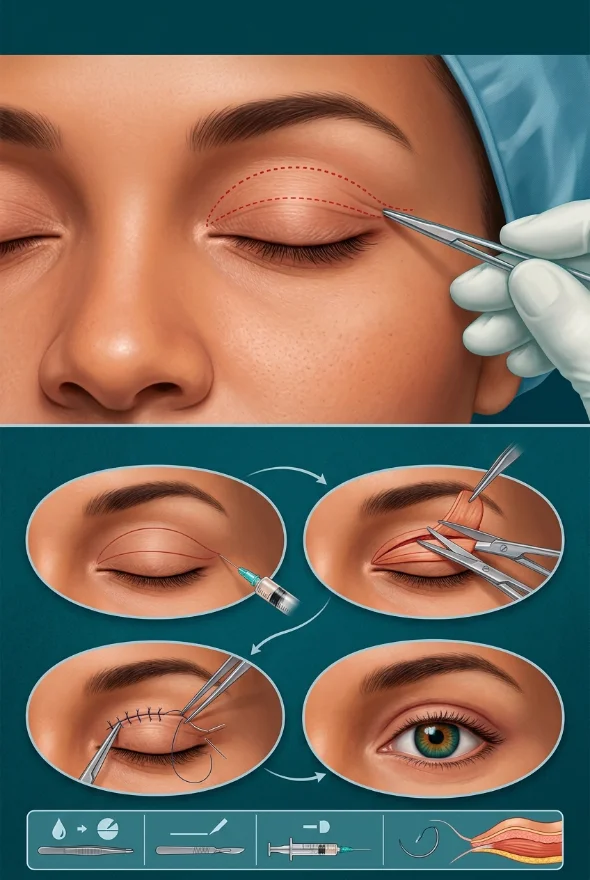
Before and after hooded eye surgery, the skin that rested on the lashes is gone and the eye looks more open. Surgery (upper blepharoplasty) is the only option that removes the excess skin, and it is usually done under local anaesthetic. Non-surgical treatments lift or tighten by millimetres. Prof. Dr. Ahmet Satıcı, our eyelid surgeon in Istanbul, first checks whether the cause is skin, a low brow or a drooping lid, because each needs a different fix.
What are hooded eyelids, and why do you get them?
Hooded eyelids are upper lids with a fold of loose skin that hangs down over the natural crease and sometimes onto the lashes. The medical term is dermatochalasis, defined by EyeWiki (the American Academy of Ophthalmology's encyclopaedia) as loose and redundant eyelid skin. It is part of ageing, but not only about age: EyeWiki lists genetic predisposition as the strongest risk factor, followed by higher body mass index, male sex, lighter skin and current smoking. Thyroid eye disease, past trauma and some connective-tissue conditions can also cause it, which is why some people notice hooding in their thirties.
Hooded eyelids are usually a cosmetic concern, but not always. EyeWiki and the American Academy of Ophthalmology (AAO) describe functional symptoms too:
- heavy, tired-feeling lids
- reduced upper or side vision when skin hangs over the lashes
- an ache across the brow, or headaches, from lifting your eyebrows all day to see
- irritation or dermatitis in the fold of skin
- trouble applying eye make-up, which is often what first prompts people to ask about it
If your hooding blocks your vision, that matters for treatment and, in the UK, for NHS funding (see the cost section below).
Is it hooded eyelids, droopy eyelids (ptosis) or a low brow?
The three look alike in a mirror but are different problems with different treatments. EyeWiki lists dermatochalasis, blepharoptosis (ptosis) and brow ptosis as separate diagnoses.
| Hooded eyelid (dermatochalasis) | Droopy eyelid (ptosis) | Low brow (brow ptosis) | |
|---|---|---|---|
| What is wrong | Extra, loose skin of the upper lid | The lid-lifting muscle (levator) has stretched or weakened, so the lid edge sits too low | The eyebrow has descended and pushes the lid skin down |
| What you see | A fold covering the crease; the lid edge itself may be normal | The lid edge covers part of the pupil | Brow sits low; skin piles up at the outer corner |
| Typical fix | Upper blepharoplasty | Ptosis surgery (sometimes with blepharoplasty) | Brow lift, or botulinum toxin in mild cases |
According to the AAO, adult ptosis arises when the levator muscle stretches or separates from the lid, usually with age, after injury or after eye surgery. A prescription eye drop containing oxymetazoline helps some adults but has to be used every day to keep working.
Why this matters: surgeons check all three before they operate. In one US series of 521 patients with overactive forehead muscles who asked for periorbital rejuvenation, relaxing the forehead muscles before surgery revealed brow ptosis in 131 patients and upper-lid ptosis in 39 (Sweis et al., 2018). People often raise their brows without noticing, which hides the true brow position. EyeWiki advises that people with significant brow ptosis may need a brow lift at the same time, because brow position affects how the upper lid looks.
Can hooded eyes be fixed without surgery?
Partly, and only by small amounts. Non-surgical treatments cannot remove excess skin; they lift the brow slightly or tighten the skin a little. The published studies are small and short-term, so treat every claim with caution.
| Option | What it does | What the evidence shows | Main cautions |
|---|---|---|---|
| Botulinum toxin (brow lift) | Relaxes the muscles that pull the brow down, so the muscles that lift it work unopposed | A 2025 cohort of 460 people found toxin raised the brow by 1.35 mm on average. A 2024 review (Kaufman-Janette and Trindade de Almeida) calls toxin brow lifting an off-label technique and says more placebo-controlled data are needed | Effects wear off: in pooled trials for frown lines the median effect lasted 120 days (about 4 months). A meta-analysis of upper-face toxin trials found eyelid ptosis and brow ptosis more often than with placebo, and a 2026 review names upper-lid ptosis as the most frequently reported significant complication of facial toxin injections |
| Radiofrequency skin tightening | Heats the lid skin with a tiny probe to tighten it | A 20-patient pilot study (Carruthers, 2007) found at least 25% tightening in 87% of upper lids at 6 months, but concluded the effect was at best mild to moderate. A 2025 Korean study of 14 patients reported brow elevation of about 1.45 mm at 6 months | Small studies. The eye must be protected during treatment (the studies used a protective contact lens) |
| Light and laser devices | Resurfacing or heating to improve skin quality and tightness | A 2021 review (Heitmiller et al.) found ablative laser resurfacing gave the most impressive improvement, while non-ablative devices gave noticeable but smaller improvement with fewer side effects and shorter recovery | Ablative lasers mean a longer recovery. Choose a doctor who treats the eyelid area regularly |
| Hyaluronic acid filler near the brow or eyelid | Adds volume to support the brow | A 2025 cohort found similar patient satisfaction with filler and toxin for brow elevation | The US Food and Drug Administration (FDA) recommends against filler in the periorbital area and forehead (not approved uses) and warns that filler accidentally injected into a blood vessel can cause vision problems including blindness, and stroke. We do not recommend it for hooded eyes |
The honest summary: if your hooding comes mainly from a low or heavy brow, or you have only mild skin laxity, a non-surgical treatment may give a modest lift that lasts months and has to be repeated. If you have a visible fold of skin over the crease or lashes, no injection or device removes it. Make-up and eyeliner techniques can change how the fold looks but do not change the anatomy.
What does hooded eye surgery involve?
Hooded eye surgery is upper eyelid blepharoplasty: the surgeon removes the extra skin, and sometimes a strip of muscle or a little fat. The NHS describes three steps:
- An incision along the natural eyelid crease. EyeWiki puts the crease at roughly 7–9 mm above the lash line in men and 8–10 mm in women.
- Removal of the excess skin (and, if needed, muscle or fat). EyeWiki advises keeping at least 20 mm of skin between the lid margin and the brow so the eye can still close fully.
- Closure. The scar sits in the natural fold, so it is usually hidden when your eyes are open.
The NHS says the operation takes 45 minutes to 2½ hours depending on what is done, can be done under local or general anaesthetic, and that most people go home the same day. With a local anaesthetic you are awake but the lids are numb.
Technique we use: {{Prof. Satıcı's usual technique for upper blepharoplasty, e.g. incision method, muscle-sparing approach, type of stitches}}, in a fully equipped, Ministry of Health–licensed operating theatre in Istanbul.
What the research says about results. A 2025 systematic review and meta-analysis of 12 randomised trials with 450 patients found that dry-eye symptoms were lower after upper blepharoplasty than before it, with no difference in satisfaction between the techniques compared. Removing muscle as well as skin raised the rate of the eye not closing fully (lagophthalmos) compared with removing skin only, which is why muscle-sparing techniques are often favoured. Upper blepharoplasty alone also lifts the lid edge slightly (0.7 mm on average in a study of 19 patients) without changing the brow position (-0.2 mm).
Before and after hooded eye surgery: what results can you expect?
Before and after hooded eye surgery, the visible changes are these: the fold of skin no longer rests on the lashes, more of the eyelid and the lash line shows, the crease is clearer, and eye make-up goes on more easily. The functional changes matter just as much to many patients: a 2026 narrative review reports improvement in the upper visual field after upper blepharoplasty, and lists better contrast sensitivity, less headache and brow ache, and less eyelid heaviness among the reported benefits.
Results do not appear overnight. Typical timeline, from the AAO and NHS:
-
First 2–3 days
Swollen, tight lids; cold compresses and sleeping with your head raised help
-
First 1–2 weeks
Stitches or suture strips come out (NHS: up to a week; AAO: 7–14 days); the AAO says most people resume normal activities within 24–48 hours
-
10–14 days
Bruising fades; the NHS says most people take about 2 weeks off work
-
2–4 months
Numbness and residual swelling settle; scars, which may feel tight at first, fade to barely visible
Our photos. {{before-and-after gallery: photographs of Prof. Dr. Satıcı's own upper blepharoplasty patients, with dates}}
How to read before-and-after photos of hooded eyelid surgery
Results for "hooded eye surgery before and after" and "hooded eyes blepharoplasty before and after" are full of pictures that tell you less than they seem to. Check these things:
- Time since surgery. A photo taken at two weeks shows swelling, not the result. Look for photos taken at three months or later.
- Same conditions. Same lighting, angle, expression and eyes open. A raised chin or a lifted brow can fake a change.
- Brow position. If the brow is higher in the "after" picture, some of the lift did not come from the lid.
- Someone like you. Look for patients with a similar age, lid shape and degree of hooding.
- No filters. Retouching and lighting changes are common in marketing images.
- Both eyes. Slight differences between the two sides are normal and should be visible, not cropped out.
Photos show you a best case. Your own surgeon should tell you what is realistic for your lids, in writing, before you book.
Surgery or non-surgical: how do you choose?
Start with what is causing the hooding, then how much it bothers you and whether you want a lasting change.
| Your situation | What usually fits | Why |
|---|---|---|
| A clear fold of skin over the crease or lashes | Upper blepharoplasty | Only surgery removes the skin |
| Skin blocks part of your vision, or you get brow ache or headaches | Upper blepharoplasty (may qualify for NHS funding in the UK) | The AAO lists blocked vision and headaches from overworked forehead muscles as functional reasons for surgery |
| Lid edge sits low over the pupil | Ptosis assessment, possibly ptosis surgery | The cause is the lifting muscle, not the skin |
| Low or heavy brow, little loose skin | Brow lift or botulinum toxin | Brow position is the main cause |
| Mild hooding, no wish for surgery, and you accept repeat treatments | Botulinum toxin or radiofrequency | Small, temporary lift (see the table above) |
| Dry eyes, thyroid eye disease or blood-thinning medicines | See an eye surgeon first | The AAO advises caution in dry eye, poor blinking and Graves' disease; surgeons need to know about aspirin, warfarin or apixaban |
An eye surgeon is the right person to make this call because the lids sit on the eye. Prof. Dr. Satıcı examines the tear film and eye surface as well as the skin, and tells you if surgery is not right for you.

How much does hooded eye surgery cost?
Hooded eye surgery cost in the UK. The NHS states that eyelid surgery in the UK may cost anywhere between £2,000 and £6,000, plus consultations, follow-up care and any further surgery. Price-comparison data for 2025–26 puts UK prices for upper and lower eyelid surgery together at about $4,000–10,000 and US prices at about $6,000–12,000.
Hooded eye surgery cost in Turkey. Published Istanbul prices for upper and lower blepharoplasty together are typically about $2,200–4,800, often as packages that include a hotel. Hooded eyelids usually need the upper lids only, which is the smaller operation. At Laser Istanbul Clinic, eyelid surgery for hooded eyes starts from {{£ price}}. That includes your examination and photos, surgery by Prof. Dr. Ahmet Satıcı, medication, follow-up checks in Istanbul, a personal interpreter, and your coordinator and remote follow-up. Hotel and airport transfers are extra (arranged on request), and flights are not included. You see the exact price in writing, after we review your photos, before you travel.
Non-surgical options. Each session costs less than surgery, but botulinum toxin lasts months and radiofrequency may need repeating, so the cost adds up. When you compare, ask for the total over three to five years, not the price of one session.
Does the NHS pay? Only in limited cases. NHS commissioners generally fund upper eyelid surgery for functional problems, such as measured loss of visual field or lid position that blocks the pupil, and not for cosmetic reasons. Most people who want it for appearance pay privately.
What are the risks of hooded eye surgery?
Blepharoplasty is well established, but like any surgery it carries risks, and results cannot be guaranteed (NHS). The NHS and the AAO list these:
- swelling, bruising, redness, tight or sore lids, and temporary blurred vision
- uneven eyelids or noticeable scarring
- dry eye made worse, or the eye not closing fully if too much skin is removed
- rarely, injury to an eye muscle (double vision) or drooping of the lid
- infection or a blood clot, as with any operation
The most serious complication is bleeding behind the eye (orbital haemorrhage). In a survey of members of the American Society of Ophthalmic Plastic and Reconstructive Surgery covering 269,433 cosmetic eyelid operations (Hass et al., 2004), it occurred in 0.055% (about 1 in 2,000) and caused permanent loss of vision in 0.0045% (about 1 in 22,000). Most bleeds started within the first 3 hours and the risk fell sharply after 24 hours, which is why you are watched after surgery and stay close by for the first days. High blood pressure, aspirin and vomiting after surgery were common factors, so tell your surgeon about every medicine you take.
Because too much skin removal can stop the eye closing fully (AAO), choose a surgeon who checks how well you close your eyes before and after the operation. If you are drawn to an extreme "lifted" look, read our guide to what is real and what is risky.
Hooded eye surgery in Turkey: what happens with Prof. Dr. Satıcı?
Hooded eye surgery in Turkey with Laser Istanbul Clinic is planned and performed by Prof. Dr. Ahmet Satıcı, an ophthalmologist and former Professor and Head of Ophthalmology who has operated on eyes and eyelids since 1992. The steps:
Send photos
Front-facing photos of your eyes, open and closed, in daylight, through our free online consultation. He tells you whether surgery, ptosis surgery, a brow lift or a non-surgical option looks right, and gives a price in writing.
Examination in Istanbul
He checks lid position, brow position, tear film and eye surface, and, if skin may block your vision, tests your visual field. Photos are taken and the operation is planned with you through your personal interpreter.
Surgery
Usually under local anaesthetic, in a fully equipped, Ministry of Health–licensed operating theatre in Istanbul. Most people go home the same day.
Stitch removal and check
Stitches usually come out after about 5–7 days. Plan {{eyelid stay length}} days in Istanbul. Your surgeon checks you before you fly: {{surgeon's guidance on when patients can fly after blepharoplasty}}. Remote follow-up continues after you go home.
If you also need lens or cataract surgery, he can discuss both procedures in one visit.
Hooded eyelids: frequently asked questions
In the UK the NHS gives a range of £2,000–£6,000 for eyelid surgery, plus consultations and follow-up. At Laser Istanbul Clinic eyelid surgery for hooded eyes starts from {{£ price}}, including surgery by Prof. Dr. Satıcı, medication, follow-up checks, interpreter and coordinator. Hotel and transfers are extra.
One session of botulinum toxin or radiofrequency costs less than surgery, but botulinum toxin typically lasts a few months, so repeat treatments add up. Surgery is a one-off cost and removes the skin. Ask any provider for the total over several years.
Only in limited cases. NHS commissioning policies generally fund upper eyelid surgery when excess skin measurably blocks your vision or sits over the pupil, and not for cosmetic reasons. Your GP or optometrist can tell you whether your vision is affected.
They can be improved slightly, not removed. Botulinum toxin, radiofrequency and some light devices lift or tighten by millimetres, and the effect fades. Only blepharoplasty removes the excess skin.
They show the fold of skin gone, a clearer crease and more visible eyelid. Judge photos taken at three months or later, in the same light and angle, of patients like you. At two weeks you see swelling, not the result.
The skin that is removed does not grow back, so the change is long-lasting, but your face keeps ageing and the brow and skin can loosen again over the years. Your surgeon can tell you what to expect for your lids.
The surgery itself should not hurt, because the lids are numbed. Afterwards they feel tight, sore and swollen for a few days; paracetamol or the painkillers you are given are usually enough, according to the NHS.
The AAO says most people resume normal activities within 24–48 hours, and the NHS says most take about 2 weeks off work. Bruising fades over 10–14 days, and numbness and slight swelling can last 2–4 months.
Upper blepharoplasty alone did not change brow height in a study of 19 patients (an average change of -0.2 mm). If your brows are already low, your surgeon may suggest a brow lift as well.
The operation is the same as anywhere: the risks depend on who plans and performs it and on your own health. Prof. Dr. Satıcı is an ophthalmologist who examines the eye as well as the skin, you see the risks in writing, and your coordinator and remote follow-up stay with you after you return home.
Sources for the facts on this page
- EyeWiki (American Academy of Ophthalmology). Dermatochalasis: definition (loose, redundant eyelid skin), genetic predisposition as the strongest risk factor, BMI, male sex, lighter skin, smoking, thyroid eye disease; symptoms; differential from ptosis and brow ptosis. https://eyewiki.org/Dermatochalasis
- EyeWiki (AAO). Upper Eyelid Blepharoplasty: assessment of brow position, ptosis and dry eye; indications; complications; muscle-sparing approaches reduce dry-eye risk. https://eyewiki.org/Upper_Eyelid_Blepharoplasty
- EyeWiki (AAO). Upper Eyelid Blepharoplasty (technique details used on the eyelid pillar page: crease 7–9 mm in men and 8–10 mm in women, at least 20 mm of skin preserved). https://eyewiki.aao.org/Upper_Eyelid_Blepharoplasty
- American Academy of Ophthalmology. Upper Eyelid Blepharoplasty: functional indications, alternatives (brow and ptosis repair), normal activities in 24–48 hours, bruising 10–14 days, suture removal 7–14 days, numbness 2–4 months. https://www.aao.org/eye-health/treatments/upper-eyelid-blepharoplasty
- American Academy of Ophthalmology. What Is Ptosis? Levator muscle, causes in adults, oxymetazoline drops, surgery. https://www.aao.org/eye-health/diseases/what-is-ptosis
- NHS. Eyelid surgery (blepharoplasty): cost £2,000–£6,000, anaesthetic, procedure, 45 minutes to 2½ hours, recovery, risks. https://www.nhs.uk/conditions/cosmetic-procedures/eyelid-surgery/
- US Food and Drug Administration. Dermal Fillers (Soft Tissue Fillers): unintentional injection into a blood vessel can cause vision abnormalities including blindness, and stroke; FDA recommends against use in the periorbital area and forehead. http://www.fda.gov/medical-devices/aesthetic-cosmetic-devices/dermal-fillers-soft-tissue-fillers
- Todorov D, et al. Functional and Aesthetic Outcomes After Upper Blepharoplasty: A Systematic Review and Meta-analysis of Randomized Control Trials. Aesthet Surg J 2025;45(6):554–562. PMID 40152471. https://pubmed.ncbi.nlm.nih.gov/40152471/
- Whitelaw TA. Beyond visual field restriction: reconsidering functional assessment in upper eyelid dermatochalasis. Orbit 2026 (online 3 Sep). PMID 42693598. https://pubmed.ncbi.nlm.nih.gov/42693598/
- Nakra T, et al. The effect of upper eyelid blepharoplasty on eyelid and brow position. Orbit 2016;35(6):324–327. PMID 27561080. https://pubmed.ncbi.nlm.nih.gov/27561080/
- Sweis IE, Hwang L, Cohen M. Preoperative Use of Neuromodulators to Optimize Surgical Outcomes in Upper Blepharoplasty and Brow Lift. Aesthet Surg J 2018;38(9):941–948. PMID 29474688. https://pubmed.ncbi.nlm.nih.gov/29474688/
- Shome D, et al. Eyebrow elevation using chemomodulation and myomodulation (hyaluronic acid gel): a cohort analysis. Indian J Ophthalmol 2025;73(12):1834–1839. PMID 41288638. https://pubmed.ncbi.nlm.nih.gov/41288638/
- Kaufman-Janette J, Trindade de Almeida A. Lifting With Neuromodulators. Dermatol Surg 2024;50(9S):S58–S63. PMID 39196835. https://pubmed.ncbi.nlm.nih.gov/39196835/
- Glogau R, et al. OnabotulinumtoxinA: a meta-analysis of duration of effect in the treatment of glabellar lines. Dermatol Surg 2012;38(11):1794–1803. PMID 23106853. https://pubmed.ncbi.nlm.nih.gov/23106853/
- Brin MF, et al. Safety and tolerability of onabotulinumtoxinA in the treatment of upper facial lines from global registration studies in 5298 participants: a meta-analysis. JAAD Int 2024;14:4–18. PMID 38035126. https://pubmed.ncbi.nlm.nih.gov/38035126/
- Freixo S, Camões-Barbosa A. Management of Complications Following Botulinum Toxin Facial Injections: A Narrative Review. Cureus 2026;18(1):e100675. PMID 41640941. https://pubmed.ncbi.nlm.nih.gov/41640941/
- Carruthers J, Carruthers A. Shrinking upper and lower eyelid skin with a novel radiofrequency tip. Dermatol Surg 2007;33(7):802–809. PMID 17598845. https://pubmed.ncbi.nlm.nih.gov/17598845/
- Suh DH, et al. Tightening of the eyelids with monopolar radiofrequency in Asians. Lasers Med Sci 2025;40(1):530. PMID 41402632. https://pubmed.ncbi.nlm.nih.gov/41402632/
- Heitmiller K, Ring C, Saedi N, Biesman B. Nonsurgical Light and Energy-Based Devices: Utility in Eyelid and Periorbital Surgery. Facial Plast Surg Clin North Am 2021;29(2):323–334. PMID 33906764. https://pubmed.ncbi.nlm.nih.gov/33906764/
- Hass AN, Penne RB, Stefanyszyn MA, Flanagan JC. Incidence of postblepharoplasty orbital hemorrhage and associated visual loss. Ophthalmic Plast Reconstr Surg 2004;20(6):426–432. PMID 15599241. https://pubmed.ncbi.nlm.nih.gov/15599241/
Find out whether surgery or a non-surgical option suits your eyelids
Send us front-facing photos of your eyes, open and closed, in daylight. Prof. Dr. Ahmet Satıcı will tell you whether upper eyelid surgery, ptosis surgery, a brow lift or a non-surgical treatment fits your eyelids, and what it would cost, with no obligation.
3 eye surgeons
Your case is reviewed by a named surgeon, not a salesperson. Reply within {{response time}}.
 Prof. Dr. Ahmet Satıcı
 Doç. Dr. Muhammet Derda Özer
 Op. Dr. Aysan Bayram