
- Home
- Knowledge centre
- Eyelid & cosmetic guides
- Eye Lift Before and After: Blepharoplasty Recovery Week by Week
Eye Lift Before and After: Blepharoplasty Recovery Week by Week
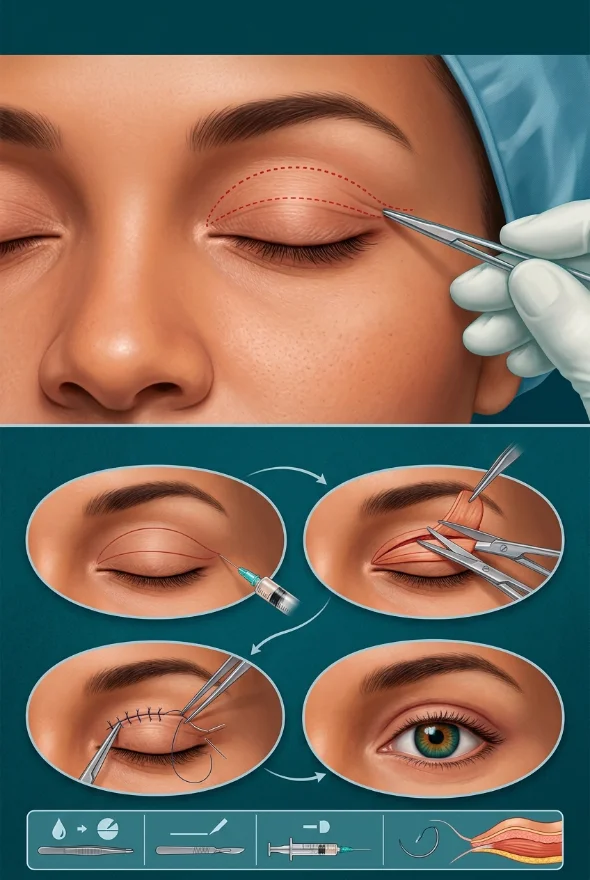
An eye lift before and after, meaning blepharoplasty, looks very different at week 1 than at month 3. Swelling and bruising typically last 10–14 days, most people are back to normal activities within 1–2 weeks, and numbness and scar tightness settle over 2–4 months. Eyelid surgeon Prof. Dr. Ahmet Satıcı operates at Laser Istanbul Clinic; judge any result after healing, not on the day the stitches come out.
What does an eye lift look like before and after?
"Eye lift" usually means blepharoplasty: surgery that removes extra skin, and sometimes fat and muscle, from the upper lids, the lower lids or both. The "before" is heavy, hooded or baggy lids. The "after" is not one photo but a sequence, and the lids usually look worse before they look better, because swelling and bruising are strongest in the first days and then fade.
A realistic way to read any eye lift before and after photo:
- Day 1–3: puffy, tight lids, often bruised; the lids may be hard to close fully.
- Week 1–2: bruising changes colour and fades; stitches or strips come out; the new lid crease is visible but still swollen.
- Weeks 3–8: redness and swelling continue to settle; the scar line may feel tight.
- Month 3 and later: numbness has mostly gone, the scar has faded, and your surgeon can judge lid height and symmetry.
If a before-and-after picture shows a flawless result "a few days after surgery", ask when it was taken and whether it was edited. The American Academy of Ophthalmology (AAO) says bruising and swelling after upper eyelid surgery typically last 10–14 days, so a clean-looking eyelid at day 3 is unusual.
Upper eye lift before and after, versus lower. Upper blepharoplasty removes excess skin (and sometimes fat) from the upper lid through an incision in the natural crease; lower blepharoplasty treats bags and loose skin below the eye. Recovery is similar but not identical, and the table later in this guide shows the differences. For the operation itself, see eyelid surgery (blepharoplasty) in Turkey.
Blepharoplasty recovery timeline at a glance
| When | What you may see and feel | What you usually do |
|---|---|---|
| Day 0–3 | Swollen, tight, sometimes numb lids; bruising; blurred vision from ointment; watery or sensitive eyes | Cold compresses, head raised, ointment and lubricating drops, rest |
| Day 4–7 | Swelling and bruising still present; stitches or strips removed in about a week (up to 14 days for some upper lid stitches) | Gentle lid cleaning as instructed; no heavy exertion; sunglasses outdoors |
| Week 2 | Bruising and swelling typically fading (10–14 days, AAO) | Many people are back at work after about 2 weeks (NHS); no strenuous exercise until your surgeon agrees |
| Weeks 3–4 | Redness and any remaining bruising settling; scar may feel tight | Scar care only if your surgeon advises it; no eye make-up on healing skin until cleared |
| Weeks 5–8 | Swelling and redness continue to settle | Return to exercise and normal routines as your surgeon agrees |
| Months 3–6 | Numbness resolved for most (2–4 months, AAO); scars fade (NHS); lid height and asymmetry reviewed at about 3 months | Final photos and review; revision is usually delayed 3 months or more |
These are typical ranges from the sources listed below. Your own recovery depends on which operation you have, your skin and your general health.
Week 1: what happens in the first days after eyelid surgery?
In the first week your eyelids are at their most swollen, and your job is to keep them clean, cool and lubricated.
Days 0–3. Expect puffy, tight lids and bruising. The NHS says your eyelids may be swollen and numb and hard to close, and that eyes may be sore, sensitive or watery. To reduce swelling, prop your head up with pillows for a couple of days and use a cold pack on the eyelids (NHS). Surgeons give slightly different instructions. EyeWiki, the AAO's clinical encyclopedia, advises ice compresses for the first 3 days after upper eyelid surgery and for the first 48 hours after lower eyelid surgery, then warm compresses. A 2012 review in Plastic Surgery International describes ice-water compresses used continuously for 3 days, apart from meals and sleep, with the head raised 45 to 60 degrees. Follow your own surgeon's written instructions, not a general rule.
Antibiotic ointment and lubrication. EyeWiki notes that antibiotic ointment is prescribed for the incision sites 3–4 times a day, with artificial tears or a night-time gel as needed. The same 2012 review says ointment blurs vision and suggests planning not to drive for a week. The NHS says only that you cannot drive for a number of days; your surgeon decides when it is safe.
Pain. Discomfort is expected and is usually managed with acetaminophen (paracetamol) according to EyeWiki.
Days 4–7. Swelling is often still visible, and bruises change colour. Stitches or suture strips come out in this window or a little later:
- the NHS says suture strips are usually removed up to a week later
- EyeWiki says non-absorbable stitches in the upper lid are removed 7–14 days after surgery, and in the lower lid 5–7 days after surgery
Activity in week 1. The AAO says most people can resume normal activities within 24–48 hours. That means light, ordinary tasks, not exercise. EyeWiki advises avoiding lifting, bending, straining and exercise for the first 10 days; the NHS says to avoid strenuous activity and swimming for a few days, not to rub your eyes, and not to wear contact lenses.
Call your surgeon straight away if you have severe pain, falling vision or swelling that keeps growing. These can signal bleeding behind the eye (see "When is it an emergency?" below).
Week 2: when do swelling and bruising go down?
By the end of week 2 most people are visibly better. The AAO says bruising and swelling after upper eyelid surgery typically last 10–14 days. The NHS adds that bruises and redness may take several weeks to fade, and that most people take about 2 weeks off work, depending on their job.
How common is bruising? In a 2024 randomised trial of 58 people (average age 37.8) who had blepharoplasty with ice on one side and a different dressing on the other, 46.6% of the eyes treated with ice alone had visible bruising on day 5, with an average bruise area of 1.21 cm². Two things follow: visible bruising is common, and in that trial it was small. It is one study in a younger group, so do not read it as a forecast for your own lids.
What to do in week 2:
- keep using lubricating drops and ointment as prescribed
- keep protecting your eyes from sun and wind with sunglasses (NHS)
- avoid eye make-up for a minimum of 10–14 days (a 2017 review in the Indian Journal of Ophthalmology)
- contact lenses can usually be resumed about 1 week after upper eyelid surgery, according to EyeWiki, but follow your own surgeon's advice
- if you are in Istanbul, expect your stitch-removal visit and your pre-flight check with your surgeon around this time
Follow-up visit. EyeWiki recommends a follow-up within 1–2 weeks after upper eyelid surgery and within a week after lower eyelid surgery. It is the best moment to ask what your swelling and bruising mean for you.
Weeks 3–4: when can I exercise, drive and wear make-up?
By weeks 3 and 4 the lids look more like the final result but are not there yet. Some tightness, redness and uneven swelling between the two eyes can still be part of normal healing, and your surgeon is the right person to tell you what is normal for you.
| Activity | Typical advice from the sources |
|---|---|
| Light daily activity | Usually within 24–48 hours (AAO) |
| Work | About 2 weeks off, depending on the job (NHS) |
| Driving | Not for a number of days (NHS); one review suggests planning for about a week because of ointment blur. Only once your vision is clear and your surgeon agrees |
| Exercise, lifting, bending | Avoid for the first 10 days (EyeWiki); return in stages once your surgeon agrees |
| Swimming | Avoid for a few days (NHS); your surgeon sets the date |
| Contact lenses | Not during early recovery (NHS); about 1 week after upper eyelid surgery (EyeWiki) |
| Eye make-up | Avoid for a minimum of 10–14 days (2017 review) |
| Sun | Sunglasses outdoors (NHS); sun protection and sun avoidance reduce the risk of darker or irregular scars (2017 review) |
Scar care. The NHS says scarring may be visible and feel tight for a few months, and should eventually fade to almost invisible. If a scar still looks thick or red at 4 weeks, the 2012 review says time, massage and vitamin E cream are useful; do this only if your surgeon advises it. A 2017 review also describes silicone-based gels as a safe scar-care option.
Flying home. Your surgeon sets the earliest safe flight date: {{surgeon's guidance on when patients can fly after blepharoplasty}}. Keep lubricating drops in your hand luggage, because cabin air is dry.
Weeks 5–8 and months 3–6: when will I see the final result?
Healing continues for months after the swelling fades. The AAO says numbness of the upper lid skin and eyelashes typically resolves over 2 to 4 months, because the small sensory nerves that were cut regrow. The NHS says scars may feel tight for a few months before fading.
Some findings are judged only at about 3 months:
- Lid height (ptosis). Mild drooping is common on day one because of swelling. The 2012 review says persistent drooping is usually watched for 3 months before it is repaired, because most cases resolve in that time.
- Asymmetry. Minor differences between the two lids disappear with time (same review). The 2017 review lists asymmetry as one of the most common complications of upper eyelid surgery, so ask your surgeon how it will be assessed.
- Revision surgery. The 2012 review says revisions should usually be delayed for 3 months or more after the first operation, if possible.
That is why a before-and-after picture taken at 2 weeks and one taken at 4 months can look quite different.
How do I take my own before and after photos of eyelid surgery?
Good before-and-after photos help your surgeon plan the operation and track healing, and they are the only fair way to compare your own result. EyeWiki says photos taken in the acute postoperative phase and again after complete healing help the surgeon and the patient monitor progress.
For your online assessment with us, and again for your recovery review:
Take photos in daylight,
facing a window, with no flash and no filters.
Keep a neutral face
relaxed brows, looking straight at the camera.
Shoot front-on with eyes open, then with eyes gently closed
Add a side view of each eye.
Hold the camera at eye level,
at the same distance every time, without wide-angle mode.
Repeat at the same set times
before surgery, day 3, week 2, week 4, month 3 and month 6.
Take off make-up and glasses
unless your surgeon asks otherwise.
When you send pictures for an assessment, we tell you exactly what we need: {{photo requirements for eyelid assessment}}.
Is recovery different after upper and lower eyelid surgery?
Yes, in a few ways, although the timelines overlap.
| Upper blepharoplasty | Lower blepharoplasty | |
|---|---|---|
| Cold compresses | Ice for the first 3 days, then warm (EyeWiki) | Cold for the first 48 hours, then warm (EyeWiki) |
| Stitches | Non-absorbable stitches removed 7–14 days (EyeWiki) | Removed 5–7 days (EyeWiki) |
| Follow-up | Within 1–2 weeks (EyeWiki) | Within a week (EyeWiki) |
| Early effects | Tight, swollen lids; bruising; numbness of lid skin and lashes for 2–4 months (AAO) | Swelling, bruising; chemosis (swelling of the white of the eye) is a recognised early complication (AAO, EyeWiki) |
| What to watch for | Incomplete lid closure, dry eye, ptosis, asymmetry | Lid pulling down (retraction or ectropion), chemosis, asymmetry |
Your surgeon tells you which operation you are having and the recovery steps that go with it. If you have both lids done together, plan for the longer of the two timelines.
Why are my eyes dry or watery after eyelid surgery?
Dry, gritty or watery eyes are common in the first weeks after blepharoplasty; the 2017 review calls dry eye a common complaint in the early postoperative period.
What the studies show:
- A retrospective study of 21 women (42 eyes) after upper eyelid blepharoplasty measured tears before surgery and at 1 week, 1 month and 3 months. Tear break-up time dipped at 1 month, and the Schirmer test (a measure of tear production) was lower at 3 months than before surgery (14.1 mm vs 15.7 mm). No patient had severe dry-eye signs, and eye pressure did not change.
- A small study of 7 people measured blinking 6–8 months after upper blepharoplasty. Blinking speed was unchanged, but dry-eye symptom scores were higher than before surgery (20.5 vs 14.8 points). It is a very small group, so it shows that dryness can last for months in some people, not how many.
What helps: lubricating drops and night-time gel as prescribed (EyeWiki), and full, regular blinking. If your eyes do not close fully, or you have pain, redness or falling vision, call your surgeon; the AAO lists incomplete lid closure and dry eye among the possible problems after upper blepharoplasty.
When is it an emergency?
Bleeding behind the eye (orbital or retrobulbar haemorrhage) is rare but needs urgent treatment. A survey of members of the American Society of Ophthalmic Plastic and Reconstructive Surgery covering 269,433 cosmetic eyelid operations found orbital haemorrhage in 0.055% (about 1 in 2,000) and permanent visual loss in 0.0045% (about 1 in 22,000). Most bleeds started within the first 3 hours; the risk fell sharply after 24 hours, but bleeding was reported as late as several days after surgery. High blood pressure, aspirin use, vomiting after surgery and increased physical activity were linked with bleeding.
Contact your surgeon or go to an eye emergency service immediately if you have:
- severe pain that is getting worse
- a fall in vision
- swelling that keeps growing (EyeWiki lists severe pain, decreased vision and progressive swelling as signs of retrobulbar haemorrhage)
Contact your surgeon the same day if you have:
- increasing redness or inflammation around the eyes; EyeWiki says progressive inflammation may indicate infection or an allergy to the ointment
- a lid that does not close fully, or a lower lid turning outwards
Before surgery, the 2012 review recommends stopping aspirin, anticoagulants, anti-inflammatory painkillers, vitamin E, ginkgo and herbal medicines up to 3 weeks beforehand if possible. Never stop a prescribed medicine without asking the doctor who prescribed it. After surgery, avoid bending and straining as your surgeon instructs.

Fox eye lift before and after: is recovery the same?
Not necessarily. "Fox eye" surgery aims to change the outer corner of the eye and the line of the lids, and it is not the same operation as standard blepharoplasty, so the timeline above does not cover its recovery or risks. Searches for "fox eye lift before and after", "fox eye surgery before and after" and "fox eye before and after" return many edited or social-media pictures, which rarely show how the eye looks after a year. We explain what is real and what is risky in a separate guide.
Recovery when you have eyelid surgery in Istanbul
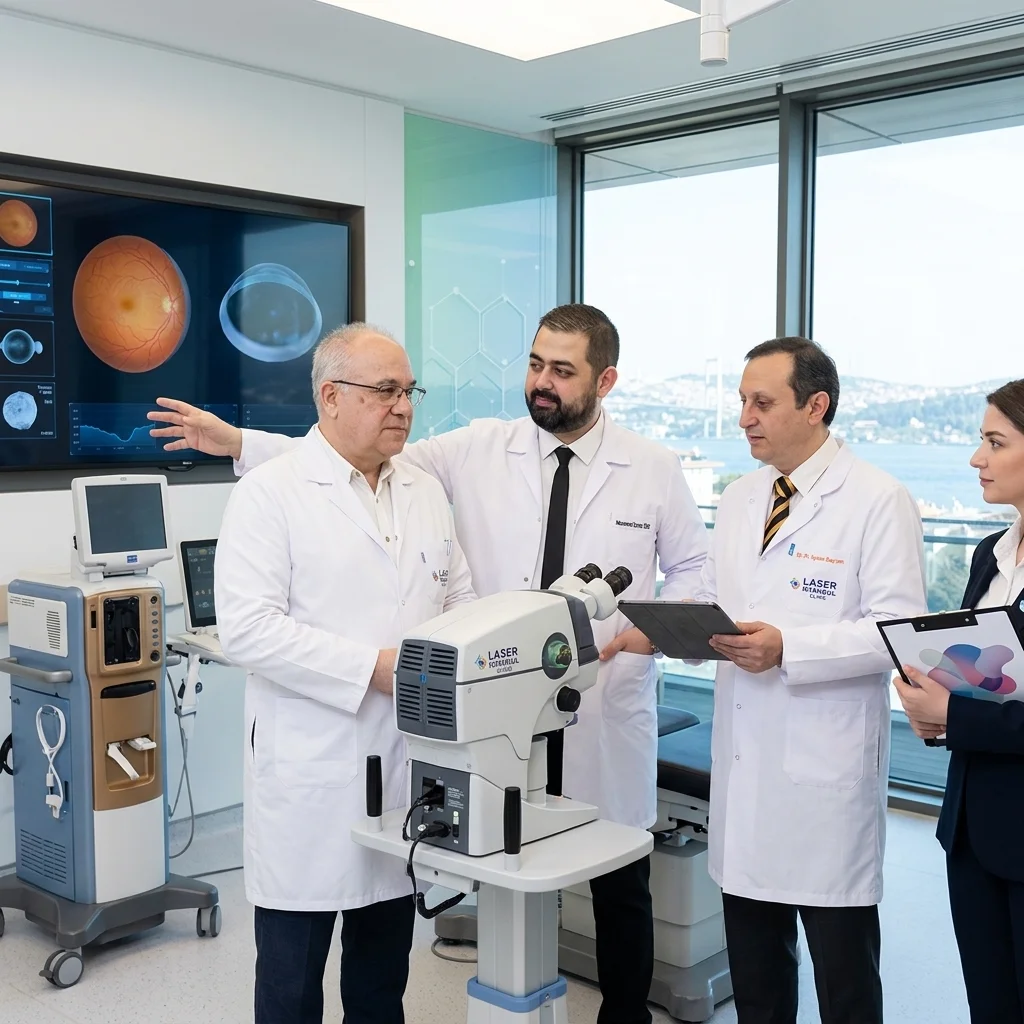
If you travel for blepharoplasty, plan your stay around stitch removal and your surgeon's check, not just the operation day. At Laser Istanbul Clinic, eyelid surgery is led by Prof. Dr. Ahmet Satıcı, an ophthalmologist who has operated on eyes and eyelids since 1992. He examines your lids, brow position and eye surface before surgery, which takes place in a fully equipped, Ministry of Health–licensed operating theatre in Istanbul.
- Before you travel: send your photos and medical history for a free online assessment.
- In Istanbul: examination and surgery, a check the next day, and removal of stitches or strips when your surgeon decides. Plan {{eyelid stay length}} days.
- Your check before flying: your surgeon examines the wounds, tells you when you can fly and gives you written aftercare.
- At home: your coordinator and surgeon follow your recovery remotely, by photo and video, at agreed intervals. If you need to be seen in person, we help you arrange it locally and share your surgical records.
Price, what is included and how to book are on the eyelid surgery page.
If you are over 45 you may also need lens or cataract surgery. We explain how to do both in one trip, and what that means for recovery, in a separate guide.
Frequently asked questions
Most people return to normal daily activities within 1–2 weeks. Bruising and swelling typically last 10–14 days (AAO), and numbness settles over 2–4 months. The NHS says most people take about 2 weeks off work, depending on their job, and scars may feel tight for a few months.
In the first week the lids are puffy, tight and often bruised, so the "after" can look worse than the "before". Stitches or strips come out at about 5–14 days, depending on the operation. A picture from week 1 does not show your result; compare photos taken at the same times, in the same light.
Numbness resolves over 2–4 months (AAO), and surgeons usually wait 3 months or more before judging lid height or considering a revision. Photos at month 3 and month 6 give the fairest picture of an upper eye lift before and after.
The recovery timelines in the sources are not split by sex. What differs is the plan: EyeWiki notes that in Caucasian eyelids a typical upper lid crease sits about 8–10 mm above the lash line in women and 7–9 mm in men. Your surgeon sets the crease height with you for your face.
Bruising and swelling typically last 10–14 days after upper eyelid surgery (AAO). The NHS says bruises and redness may take several weeks to fade. It is common for one eye to swell more than the other for a while, and your surgeon can tell you what is normal for you.
A 2017 review advises avoiding eye make-up for a minimum of 10–14 days. EyeWiki says contact lenses can usually be resumed about 1 week after upper eyelid surgery; the NHS says not to wear them during early recovery. Your surgeon gives you the exact day.
You cannot drive for a number of days (NHS), and one review suggests planning for about a week because of ointment blur. Do not drive until your vision is clear and your surgeon agrees. EyeWiki advises avoiding lifting, bending, straining and exercise for the first 10 days.
Dry eye is a common early complaint (2017 review). One study found mild, temporary changes in tear quality over 3 months, and a small study found higher dry-eye scores 6–8 months after upper blepharoplasty. Lubricating drops, night-time gel and full blinking help; call your surgeon if your eyes do not close or pain increases.
Your surgeon decides after checking your wounds: {{surgeon's guidance on when patients can fly after blepharoplasty}}. Keep drops in your hand luggage and use them often in the dry cabin air.
Severe pain, falling vision or swelling that keeps growing can signal bleeding behind the eye, which was reported in about 1 in 2,000 cosmetic eyelid operations (Hass et al., 2004) and needs urgent treatment. Other warning signs are growing redness or inflammation, and a lid that does not close fully.
Thinking about an eye lift? Start with a free assessment.
Prof. Dr. Ahmet Satıcı examines your eyelids, brow and eye surface, tells you honestly whether blepharoplasty is likely to help, and explains your recovery before you book.
Sources for the facts on this page
- NHS. Eyelid surgery (blepharoplasty). https://www.nhs.uk/conditions/cosmetic-procedures/eyelid-surgery/
- American Academy of Ophthalmology. Upper Eyelid Blepharoplasty. https://www.aao.org/eye-health/treatments/upper-eyelid-blepharoplasty
- American Academy of Ophthalmology. Lower Eyelid Blepharoplasty. https://www.aao.org/eye-health/treatments/lower-eyelid-blepharoplasty
- EyeWiki (AAO). Upper Eyelid Blepharoplasty (page last updated 28 Sep 2026). https://eyewiki.org/Upper_Eyelid_Blepharoplasty
- EyeWiki (AAO). Lower Eyelid Blepharoplasty (page last updated 21 Jul 2026). https://eyewiki.org/Lower_eyelid_blepharoplasty
- Oestreicher J, Mehta S. Complications of Blepharoplasty: Prevention and Management. Plastic Surgery International 2012. https://pmc.ncbi.nlm.nih.gov/articles/PMC3357590/
- Bhattacharjee K, Misra DK, Deori N. Updates on upper eyelid blepharoplasty. Indian Journal of Ophthalmology 2017. https://pmc.ncbi.nlm.nih.gov/articles/PMC5549405/
- Hass AN, Penne RB, Stefanyszyn MA, Flanagan JC. Incidence of postblepharoplasty orbital hemorrhage and associated visual loss. Ophthalmic Plastic and Reconstructive Surgery 2004 (PMID 15599241). https://europepmc.org/article/MED/15599241
- Turker IC, Dogan CU. Evaluating the Effects of Upper Eyelid Blepharoplasty on Tear Film Quality and Intraocular Pressure. Beyoglu Eye Journal 2020. https://pmc.ncbi.nlm.nih.gov/articles/PMC8784458/
- Mak FHW, Ting M, Edmunds MR, et al. Videographic Analysis of Blink Dynamics following Upper Eyelid Blepharoplasty and Its Association with Dry Eye. Plastic and Reconstructive Surgery Global Open 2020. https://pmc.ncbi.nlm.nih.gov/articles/PMC7413808/
- Zou P, Zhang K, Jin Y, Liu G. The Efficacy of Magnesium Sulfate (MgSO4) Wet Dressing in Reducing Eyelid Swelling and Bruising after Blepharoplasty. Facial Plastic Surgery 2024. https://pmc.ncbi.nlm.nih.gov/articles/PMC10774007/