
- Home
- Knowledge centre
- Eye conditions & symptoms A–Z
- Puffy Eyelids in the Morning and Swollen Eyelid: Causes and Home Care
Puffy Eyelids in the Morning and Swollen Eyelid: Causes and Home Care
Puffy eyelids in the morning are usually harmless and have a short list of common causes: allergy, a blocked eyelid oil gland (stye or chalazion), eyelid inflammation (blepharitis), or loose eyelid skin and fat that come with age. Most mild swelling settles with a warm or cold compress and gentle eyelid care. Swelling with pain on eye movement, a bulging eye, blurred or double vision or fever is an emergency. Swelling that keeps coming back should be examined; Prof. Dr. Ahmet Satıcı treats eyelid conditions, including surgery for persistent eyelid puffiness.
What causes puffy eyelids in the morning?
Puffy eyelids in the morning have a short list of usual causes, and most can be told apart by whether one or both eyelids are affected, whether the lid is itchy or painful, and how long it lasts. Eyelid skin is very thin and loosely attached, so even a small amount of inflammation or fluid shows. Many people first notice the swelling on waking, because that is when they look in the mirror.
| Cause | Typical pattern | Usual first step |
|---|---|---|
| Eye allergy (hay fever, dust, pets, cosmetics) | Both eyelids; itchy, watery, red eyes | Cold flannel, no rubbing, ask a pharmacist about antihistamine drops |
| Stye | One eyelid; a painful, red lump near the lash line | Warm compress; do not squeeze |
| Chalazion | One eyelid; a firm lump that grows slowly, usually not tender | Warm compress and massage; see a doctor if it persists |
| Blepharitis | Both eyelids; sore, red lid edges, crusting, sticky lids on waking | Daily eyelid cleaning |
| Loose skin and fat "bags" (dermatochalasis) | Both eyelids; puffy or heavy lids on most days, more with age | Examination; surgery if it bothers you |
| Infection (preseptal cellulitis) | One eyelid; red, hot, swollen, sometimes with fever | Same-day medical review |
| Thyroid eye disease | Both eyelids, often with gritty or bulging eyes | Medical assessment |
| Angioedema (sudden allergic swelling) | Sudden swelling of eyelids, lips or face | See the emergency section below |
Overnight, fluid can also collect in the loose tissue of the eyelids and then clear once you have been up for a while. If your puffiness is mild, equal on both sides, painless and gone within a few hours, that kind of ordinary morning swelling is the most likely explanation. If it lasts all day, returns every day, or comes with other symptoms, look at the causes below.
Why is one eye swollen in the morning?
One eye swollen in the morning most often means a local problem in that eyelid: a stye, a chalazion, an infection of the lid skin, or a reaction in that eye alone. Allergy and general fluid usually affect both sides, so a clearly one-sided swelling points to a blocked gland or a small infection.
One swollen eyelid can have these causes:
- A stye. The NHS describes a stye as a small, painful lump on the eyelid, sometimes filled with yellow pus, with redness and swelling around it. The eye may be red and watery, but vision is not affected, and a stye should settle within a week.
- A chalazion. According to EyeWiki, the American Academy of Ophthalmology's clinical encyclopedia, a chalazion is a chronic, sterile lump caused by a blocked oil gland in the eyelid. It enlarges gradually and, left alone, can resolve over weeks to months.
- Eyelid infection. EyeWiki lists eyelid trauma, sinusitis and insect bites as risk factors for preseptal cellulitis, an infection of the tissues in front of the eyeball (see the emergency section).
- Rubbing. The American Academy of Ophthalmology (AAO) says rubbing your eyes only irritates them more and causes swelling.
If the lump is painful, hot and getting bigger, or the swelling is spreading, get it looked at the same day.

Why is my upper eyelid swollen?
An upper eyelid swollen in the morning is usually a stye, a chalazion, blepharitis or allergy, and in older adults it can be loose skin and fat resting on the lid. Each looks slightly different, which helps you tell them apart.
- Stye or chalazion: a tender (stye) or firm and usually painless (chalazion) lump on the lid, sometimes making the whole upper lid look puffy.
- Blepharitis: inflammation of the lid margins. The AAO describes redness, swelling, burning and crusting at the base of the lashes, caused by bacteria, blocked eyelid oil glands or Demodex mites, and more common in people with oily skin, dandruff or rosacea. The NHS adds sticky eyelids on waking and says symptoms come and go over time.
- Dermatochalasis: EyeWiki defines this as loose, redundant eyelid skin, a common sign of ageing that mainly appears in middle-aged and older people. It can make the upper lid look heavy or puffy and, in some people, reduce the side field of vision or cause a feeling of heaviness around the eyes and brow discomfort.
If your upper eyelid looks swollen most days rather than only some mornings, ask an eye specialist whether it is swelling at all or the shape of the eyelid itself.
Swollen lower eyelid: why does it happen?
A swollen lower eyelid is most often allergy, a stye or chalazion, or the lower-lid "bags" of ageing; it can also be an infection spreading from nearby tissue such as the sinuses. Allergy and inflammation tend to swell the lower lids on both sides, while a gland blockage gives a single lump.
Lower eyelid bags are different from temporary swelling. EyeWiki explains that dermatochalasis (loose skin) is commonly associated with fat herniation, where fat that normally sits behind the lid pushes forward. These are separate problems, skin laxity versus fat protrusion, and they often occur together. When the lower lid is involved, it is mainly a cosmetic concern, although skin folds can become irritated by trapped moisture. Bags like these do not go away with compresses or time; they are treated surgically (see the blepharoplasty section).
Swollen eyes from allergies: remedy and home care
For swollen eyes from allergies, the remedy is to remove the trigger, stop rubbing, cool the eyes and use pharmacy eye drops. Eye allergy often comes with hay fever, and the NHS lists itchy, red or watery eyes among the typical symptoms, worst from late March to September when pollen levels peak.
Home remedies for swollen eyes from allergies
Cool the eyes
The NHS suggests holding a cold flannel over your eyes for a few minutes.
Do not rub
The AAO advises always avoiding rubbing, because it irritates the eyes and causes more swelling.
Reduce exposure
The AAO advises limiting time outdoors in mid-morning and early evening during high pollen, wearing sunglasses outside, keeping windows closed, keeping home humidity between 30% and 50%, and washing bedding frequently in hot water. The NHS adds wraparound sunglasses, showering after being outdoors, and not drying clothes outside.
Use artificial tears
The AAO lists artificial tears (up to 4 times a day) as an over-the-counter option.
Ask a pharmacist about antihistamine drops or tablets
The AAO notes that decongestant-antihistamine drops should be limited to 2 to 3 days.
Leave contact lenses out
until the eyes have settled (NHS).
See a GP or an ophthalmologist if symptoms last longer than 7 days (NHS) or if you need stronger, prescription treatment (AAO). Spots on the eyelid in a contact-lens wearer can point to a lens allergy (NHS).
Stye, chalazion or blepharitis: which is it?
The three most common lumpy or crusty causes of a swollen eyelid look similar at first but need slightly different care. A stye is an acute, painful infection, a chalazion is a chronic, usually painless blockage, and blepharitis affects the whole lid edge.
| Stye (hordeolum) | Chalazion | Blepharitis | |
|---|---|---|---|
| What it is | A small, painful infected lump on the lid | A blocked oil gland with sterile inflammation | Long-term inflammation of the eyelid margins |
| Pain | Painful, tender | Usually not tender | Sore, itchy, gritty |
| Where | One spot on the lid | A firm nodule in the lid | Whole lid edges, often both eyes |
| How long | About a week (NHS) | Weeks to months if untreated (EyeWiki) | Comes and goes; no permanent cure (AAO) |
| Home care | Warm compress | Warm compress and massage | Daily lid hygiene |
| See a doctor if | No improvement within a few weeks; severe pain; vision affected | It persists, is large, or keeps recurring | Symptoms do not improve with cleaning, or get worse |
Swollen eyelid treatment: what is the fastest safe home remedy?
The fastest safe home remedy for a swollen eyelid depends on the cause: a warm compress for a stye, chalazion or blepharitis, and a cold flannel for an allergy. There is no instant fix, and the things people try to speed it up, squeezing and rubbing, make it worse.
For a stye or chalazion (warm compress)
- The NHS recommends a warm, damp flannel held on the closed eye for 5 to 10 minutes, repeated 2 to 4 times a day.
- Use paracetamol or ibuprofen for pain if you can normally take them (NHS).
- Do not squeeze or burst a stye and do not pull out an eyelash yourself; the NHS warns this can spread the infection.
- Avoid contact lenses and eye make-up until it has healed (NHS).
For blepharitis (eyelid cleaning)
- Hold a flannel soaked in warm water on your closed eyelids for 5 to 10 minutes (NHS).
- Gently massage the lids for about 30 seconds (NHS).
- Wipe the lash base with cotton wool or a clean pad dipped in baby shampoo diluted in warm water (NHS). The AAO suggests scrubbing the lash base for about 15 seconds.
- Keep doing it daily, even when your eyes feel better (NHS).
For allergy
What does not help: squeezing, rubbing, wearing eye make-up over a swollen lid, or using someone else's eye drops.
- Cold flannel, no rubbing, pharmacy drops and trigger avoidance, as above.
Swollen upper eyelid treatment: when a doctor steps in
A swollen upper eyelid needs a doctor if it does not improve within a few weeks, keeps coming back, or has any of the red flags below. Treatment depends on the diagnosis.
| Diagnosis | What a doctor may do |
|---|---|
| Blepharitis | Antibiotic cream, ointment, drops or tablets (NHS); steroid drops, artificial tears and omega-3 supplements may also be used (AAO) |
| Chalazion that does not settle | A steroid injection for a persistent lump, or incision and curettage for a large or unresolved one (EyeWiki) |
| Recurrent or unusual lump | Sent for pathology to rule out a tumour (EyeWiki) |
| Preseptal cellulitis | Oral antibiotics with daily review for mild cases; hospital treatment if severe or not improving (EyeWiki) |
| Persistent bags or heavy lids | Blepharoplasty (eyelid surgery) |
A lump that comes back in the same place, or that looks unusual, should always be examined, because on rare occasions it is not a simple chalazion. This is the kind of assessment where an eye surgeon with oculoplastic experience, such as Prof. Dr. Ahmet Satıcı, can help, and where Doç. Dr. Muhammet Derda Özer (Doç. means Associate Professor), who works in ocular oncology, can advise on suspicious eyelid lesions.
When is a swollen eyelid an emergency?
A swollen eyelid is an emergency if it comes with pain on moving the eye, a bulging eye, reduced or double vision, a high fever or fast-spreading redness. These signs can mean the infection has moved behind the eyelid into the eye socket (orbital cellulitis), which can threaten sight and needs hospital treatment.
| Preseptal cellulitis (in front of the eye socket) | Orbital cellulitis (emergency) | |
|---|---|---|
| Eyelid | Red, swollen | Red, swollen |
| Vision | Normal | Reduced |
| Eye movements | Normal | Painful, limited |
| Eye position | Normal | Bulging (proptosis) |
| Pupils | React normally | May be abnormal |
| Fever | Low-grade, if any | Higher |
Source: EyeWiki, Preseptal Cellulitis. EyeWiki describes orbital cellulitis as a medical emergency needing immediate hospital admission and intravenous antibiotics; complications can include permanent vision loss.
Get urgent help (same-day eye casualty, NHS 111 in the UK, or A&E) if:
- the eyelid is hot, red and rapidly swelling, especially with fever or feeling unwell. The NHS says cellulitis around the eye is very serious and needs prompt medical attention
- the swelling comes with severe pain, vision changes or pus (NHS)
- swelling that is being treated as an infection has not improved within 48 hours (EyeWiki)
- a young child has a swollen, red eyelid; EyeWiki notes preseptal cellulitis is most common in children under 5
Call 999 or your local emergency number if your lips, mouth, tongue or throat suddenly swell, or you struggle to breathe or swallow. The NHS lists these as emergency signs of angioedema. Angioedema, a sudden swelling that often affects the eyelids, lips or face, is usually an allergic reaction to food, medicines or another substance, and some medicines such as ACE inhibitors can also cause it (NHS).
Severe or worsening eye pain deserves its own check: see our guide to eye pain: causes by type of pain. If your swollen eyelids come with gritty, burning eyes, read burning eyes: causes and relief.
Can the thyroid cause swollen eyelids?
Yes. Thyroid eye disease is an autoimmune condition in which the tissues around the eye become inflamed and swollen. It can cause swollen eyelids, eyelid retraction (a staring look), gritty, watery or dry eyes and a bulging eye. EyeWiki gives its incidence as roughly 19 per 100,000 people per year.
- Eyelid retraction is found in up to 90% of patients, and eyelid swelling is also a sign (EyeWiki).
- Women are affected about five times more often than men, and the median age at diagnosis is 43 (EyeWiki).
- Smoking is the most consistently linked risk factor, and quitting reduces the risk (EyeWiki).
- Compressive optic neuropathy, a sight-threatening complication, occurs in fewer than 5% of cases and is an emergency: progressive loss of vision needs same-day assessment (EyeWiki).
Persistent eyelid swelling together with a bulging eye, double vision or known thyroid disease should be assessed by a doctor.
When is eyelid surgery the answer for puffy eyelids?
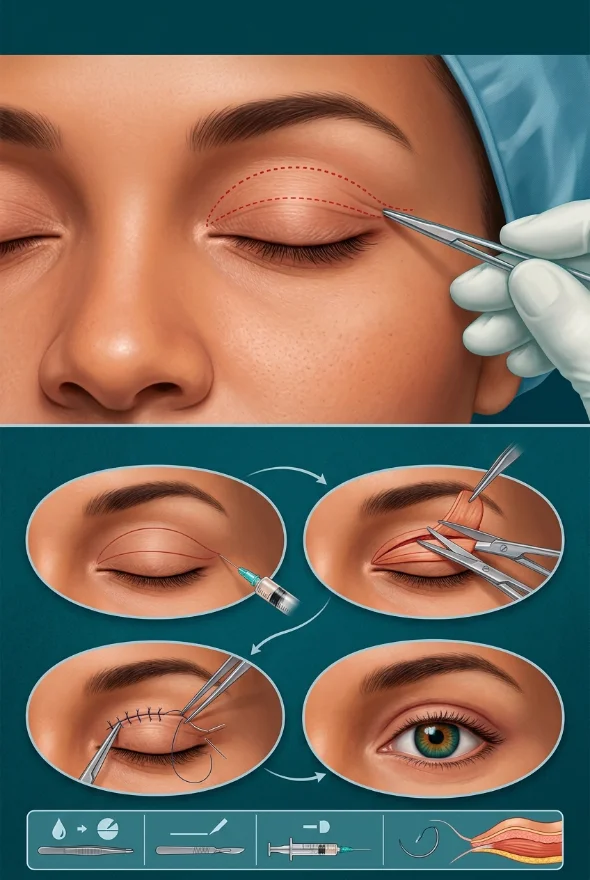
Eyelid surgery (blepharoplasty) is the treatment for puffiness caused by the structure of the eyelid, loose skin and herniated fat, rather than by swelling. If your lids look puffy or heavy on most days, are not itchy or painful, and do not improve with the measures above, this is the likely cause.
EyeWiki describes blepharoplasty as removing excess eyelid skin through an incision hidden in the eyelid crease, with protruding fat trimmed to improve the contour. Bruising lasts about 1 to 2 weeks, and healing continues gradually over several months. A surgeon first checks that the swelling is not due to another medical cause, such as thyroid eye disease or allergy, because surgery will not fix those.
At Laser Istanbul Clinic, eyelid and oculoplastic surgery is performed by Prof. Dr. Ahmet Satıcı in a fully equipped, Ministry of Health–licensed operating theatre in Istanbul. Eyelid surgery is often combined with cataract or lens surgery for patients over 45, so ask for a joint assessment.
Frequently asked questions
Puffy eyelids in the morning are most often caused by allergy, a blocked eyelid gland, eyelid inflammation (blepharitis) or age-related loose skin and fat. Mild puffiness that is equal on both sides, painless and gone within a few hours is typically harmless. Puffiness every day, pain, a lump or any change in vision needs a medical check.
A single swollen eyelid usually points to a stye, a chalazion or a small local infection, because allergy and general fluid tend to affect both eyes. A stye is painful and settles within about a week; a chalazion is firm, usually painless and can last weeks to months. See a doctor if the eyelid is hot, spreading or comes with fever.
The upper eyelid is commonly swollen by a stye, a chalazion, blepharitis or allergy, and in older adults by loose skin and fat resting on the lid. Look for a lump (stye or chalazion), crusting on the lashes (blepharitis) or itching (allergy). Swelling that never goes away may be the shape of the lid itself, and an eye specialist can tell you.
For a stye, chalazion or blepharitis, use a warm, damp flannel on the closed eye for 5 to 10 minutes, 2 to 4 times a day (NHS), and do not squeeze anything. For allergy, hold a cold flannel on the eyes and do not rub them. No home treatment works instantly, and a swelling that is not improving after a few weeks should be examined.
Avoid the trigger, stop rubbing, cool the eyes with a cold flannel and ask a pharmacist about antihistamine eye drops or tablets. The AAO lists artificial tears up to 4 times a day as an over-the-counter option. See a GP if symptoms last more than 7 days.
Often yes. A stye should settle within about a week (NHS) and a chalazion can resolve over weeks to months (EyeWiki). Seek treatment if it does not improve within a few weeks, keeps recurring, or shows any red flag.
It is an emergency if it comes with pain on moving the eye, a bulging eye, reduced or double vision, fever or rapidly spreading redness, as these can indicate orbital cellulitis. Sudden swelling of the lips, tongue or throat, or trouble breathing, needs a 999 or emergency call.
It can if the puffiness comes from loose skin and fat. Blepharoplasty removes excess skin and trims protruding fat. It does not treat allergy, thyroid eye disease or infection, which is why your surgeon examines the cause first.
Puffy or heavy eyelids that do not go away?
Send us your photos and questions. Prof. Dr. Ahmet Satıcı, who performs eyelid and oculoplastic surgery, will tell you honestly whether your puffiness is surgical, medical or simply temporary.
Sources for the facts on this page
- All pages below were opened and read on 7 Oct 2026.
- NHS. Stye. https://www.nhs.uk/conditions/stye/
- NHS. Blepharitis. https://www.nhs.uk/conditions/blepharitis/
- NHS. Conjunctivitis (allergic conjunctivitis section). https://www.nhs.uk/conditions/conjunctivitis/
- NHS. Hay fever. https://www.nhs.uk/conditions/hay-fever/
- NHS. Cellulitis. https://www.nhs.uk/conditions/cellulitis/
- NHS. Angioedema. https://www.nhs.uk/conditions/angioedema/
- American Academy of Ophthalmology. What Is Blepharitis? https://www.aao.org/eye-health/diseases/what-is-blepharitis
- American Academy of Ophthalmology. Eye Allergies. https://www.aao.org/eye-health/tips-prevention/eye-allergies
- EyeWiki (AAO). Preseptal Cellulitis. https://eyewiki.org/Preseptal_Cellulitis
- EyeWiki (AAO). Orbital Cellulitis. https://eyewiki.org/Orbital_Cellulitis
- EyeWiki (AAO). Chalazion. https://eyewiki.org/Chalazion
- EyeWiki (AAO). Thyroid Eye Disease. https://eyewiki.org/Thyroid_Eye_Disease
- EyeWiki (AAO). Dermatochalasis. https://eyewiki.org/Dermatochalasis