
Ptosis Surgery Cost in Turkey: Droopy Eyelid Repair in Istanbul
Ptosis surgery cost with Laser Istanbul Clinic starts from {{£ price}} per eye, for droopy eyelid repair planned and performed in Istanbul by Prof. Dr. Ahmet Satıcı, an ophthalmologist and eyelid surgeon who has operated on eyes and eyelids since 1992. He first finds out why your lid droops, then recommends the right operation. You see the full price in writing before you travel, and a personal interpreter stays with you from your first examination to your final check-up.
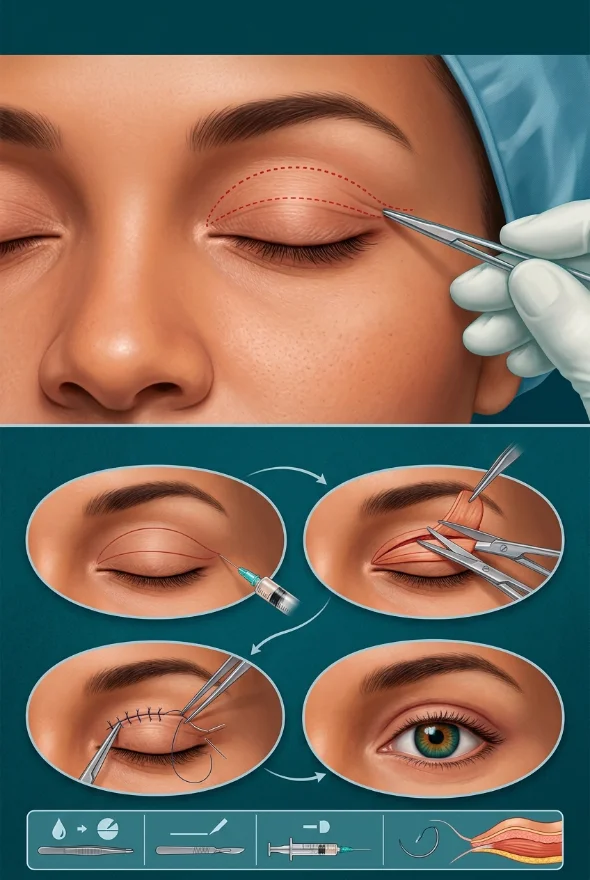
Ptosis is a drooping upper eyelid, most often because the muscle that lifts the lid has stretched or come loose with age or long-term contact lens wear. Surgery tightens or reattaches that muscle, usually under local anaesthetic as a day case, taking about 45 minutes to an hour per eye. Ptosis surgery cost in Istanbul with Prof. Dr. Ahmet Satıcı starts from {{£ price}} per eye; hotel and transfers are extra.
What is ptosis?
Ptosis (blepharoptosis) is a drooping of the upper eyelid, so that the edge of the lid sits lower than it should over the eye. According to EyeWiki, the American Academy of Ophthalmology's encyclopaedia, a normal upper lid covers only 1–2 mm of the top of the cornea, the clear front of the eye. In ptosis it sits lower, and in more severe cases it covers part of the pupil and blocks the upper part of your vision (AAO, January 2026).
Ptosis can affect one or both eyes. Besides the look of a "tired" or "sleepy" eye, NHS hospital patient leaflets describe eyebrow ache, eye strain and tiredness towards the end of the day, because people lift their eyebrows or tilt their head back to see under the lid.
Ptosis is not the same as hooded eyelids. With hooded lids, extra skin folds down over the crease, but the edge of the lid is in the right place; that is treated with blepharoplasty. With ptosis, the lid edge itself is too low, so removing skin will not lift it. The two often occur together, and can be corrected in the same operation.
| What you see | What it usually is | Usual treatment |
|---|---|---|
| The edge of the upper lid sits low over the pupil | Ptosis: a stretched, detached or weak lid-lifting muscle | Ptosis surgery |
| A fold of skin hangs over the crease, lid edge in a normal position | Excess upper lid skin (dermatochalasis) | Upper blepharoplasty |
| Both | Ptosis with excess skin | Ptosis surgery combined with blepharoplasty |
| Bags under the eyes | Fat bulging forward from the lower lid | Lower blepharoplasty |
Not to be confused: ptosis, proptosis and exophthalmos. The words sound alike but describe opposite problems. Ptosis is a lid that sits too low. Proptosis and exophthalmos both mean an eye that bulges forward, and MedlinePlus (US National Library of Medicine) treats them as the same thing: "exophthalmos" is used mostly when the cause is thyroid disease, especially Graves' disease, the most common cause of bulging eyes. A bulging eye can make the lid look higher than normal, with white showing above the iris; it needs a medical check, not ptosis surgery.
Droopy eyelid causes: why one or both lids drop
The most common cause of a droopy eyelid in adults is a stretched or detached lid-lifting tendon. The levator muscle lifts your upper lid through a thin tendon (the aponeurosis). With age, eye rubbing, eye surgery or many years of contact lens wear, that tendon stretches or separates from the lid, and the lid slowly sinks (AAO; NHS hospital patient leaflets).
| Type of ptosis | Cause | Typical features |
|---|---|---|
| Aponeurotic (age-related) | The levator tendon stretches or detaches; more common with long-term contact lens wear and after eye surgery | Gradual, often one side more than the other; a high or faint lid crease; the most common type in adults |
| Congenital | The lid-lifting muscle did not develop properly before birth | Present from birth or the first year; the lid may not drop fully when looking down |
| Myogenic (muscle) | Myasthenia gravis, muscular dystrophies | Varies during the day; may come with double vision |
| Neurogenic (nerve) | Third nerve palsy, Horner syndrome | Often sudden; may come with double vision or a pupil of a different size |
| Mechanical | A lump, cyst, swelling or scar weighs the lid down | A visible or palpable lump |
| Traumatic | Injury to the lid or the muscle | After an accident or a cut |
Classification from EyeWiki (AAO), "Blepharoptosis".
One droopy eyelid: what does ptosis in one eye mean?
Ptosis in one eye is common and is usually aponeurotic, the slow age-related type, especially in long-term contact lens wearers. But a droopy eyelid on one side can also be the first sign of a nerve or muscle problem, so the speed it appeared and what comes with it matter more than which side it is on.
Warning: when a droopy eyelid is an emergency. Get same-day emergency care (in the UK, call 999 or go to A&E) if a droopy eyelid appears suddenly, especially with:
- double vision, or an eye that cannot move normally
- a pupil that is larger or smaller than the other one
- a severe headache, or weakness, numbness or drooping elsewhere in the face or body
The American Academy of Ophthalmology describes a third nerve palsy, which causes a sudden droopy eyelid and sometimes an enlarged pupil, as "a medical emergency", because it can signal a swollen blood vessel (aneurysm) in the brain. A droopy lid with a small pupil on one side (Horner syndrome) is a red flag for stroke, aneurysm or a tumour, according to the AAO's journal EyeNet. Do not book cosmetic surgery for a lid that dropped suddenly; see a doctor first.
One droopy eyelid and the NHS. If your lid has drooped slowly over months or years and you are otherwise well, start with your GP or an optometrist, who can refer you to an NHS eye clinic. If it changes through the day, getting worse when you are tired and better after sleep, mention it: the NHS lists droopy eyelids and double vision, worse towards the end of the day, as common early symptoms of myasthenia gravis.
How is ptosis diagnosed?
Ptosis is diagnosed with a complete eye examination and a few simple measurements of the lid. The AAO notes that an ophthalmologist may also order blood tests or scans when the cause is not clear.
Your surgeon measures:
MRD1 (margin reflex distance)
The distance between the light reflected from the centre of your pupil and the edge of your upper lid, in millimetres. The lower the number, the more the lid covers the pupil.
Levator function
How far the lid travels from looking fully down to fully up, with the brow held still. EyeWiki grades more than 10 mm as excellent and 0–5 mm as poor. This number decides which operation is possible.
Lid crease height and the brow position
, and whether excess skin is also present.
Visual field
A test of how much the lid blocks your upper vision, with the lid in its natural position and lifted.
Tests for specific causes
For example, an ice pack test for suspected myasthenia gravis, or eye drops that briefly stimulate the small Müller's muscle to show whether an operation from inside the lid will work (EyeWiki).
The eye itself
tear film, dry eye, pupil reactions and eye movements, because lifting a lid exposes more of the eye's surface.
Ptosis surgery: how droopy eyelid repair is done
Ptosis surgery lifts the lid by tightening, shortening or reattaching the muscle that raises it, or, if that muscle is too weak, by linking the lid to the forehead muscle. The right technique depends on the cause and on your levator function (EyeWiki; NHS hospital patient leaflets).
| Technique | How it is done | Usually chosen for |
|---|---|---|
| Levator advancement (external, skin-crease approach) | An incision in the natural lid crease; the levator tendon is reattached or shortened to raise the lid | Age-related and contact-lens ptosis with good or fair levator function (more than about 5 mm); can be combined with blepharoplasty through the same incision |
| Müller's muscle–conjunctival resection (internal approach) | Performed from the inside of the upper lid, so there is no skin incision | Mild to moderate ptosis with good levator function, when the eye-drop test lifts the lid well |
| Frontalis (brow) suspension, or "sling" | A thin strip of material passes under the skin to connect the lid to the forehead muscle, so raising the brow lifts the lid | Poor or absent levator function (under about 4 mm), common in congenital ptosis |
Awake for a reason. In adults, ptosis surgery is usually done under local anaesthetic: the lid is numbed with drops and an injection while you stay awake. NHS hospital leaflets explain why: the surgeon can ask you to open your eyes, or even sit up, during the operation to adjust the height and curve of the lid, which makes the result more predictable. Sedation or general anaesthetic is possible when needed; children are treated under general anaesthetic.
How long it takes. About 45 minutes to an hour per eye, as a day case, so you go home the same day (NHS hospital patient leaflets; AAO).
Technique we use: Prof. Dr. Satıcı chooses the approach after measuring your lids: {{techniques Prof. Satıcı uses for ptosis, e.g. levator advancement, Müller's muscle resection, frontalis sling; sling material; stitch type}}, in a fully equipped, Ministry of Health–licensed operating theatre in Istanbul.
Droopy eyelid treatment without surgery: what works, and what does not
Surgery is the only permanent fix for most ptosis, but there are honest non-surgical options for some people. Mild ptosis that does not bother you does not need any treatment at all, according to NHS hospital patient leaflets.
| Option | What it does | Limits |
|---|---|---|
| Prescription eye drops (oxymetazoline 0.1%) | Stimulates the small Müller's muscle to lift the lid a little. Approved in the US in 2020 for acquired ptosis in adults | Temporary: one daily drop lasts about 8 hours (EyeWiki); must be used every day (AAO). Side effects can include eye irritation, redness, dry eye, blurred vision and headache; caution with heart disease. Availability outside the US varies |
| Ptosis prop (crutch) glasses | A thin plastic arm attached to glasses gently holds the lid up | Offered by NHS eye clinics to people who cannot have or do not want surgery. Must be custom-fitted, and can stop you blinking fully, which may dry and irritate the eye (Sun et al., Orbit, 2018) |
| Eyelid tape or glue | Holds the lid up for a few hours | Very little evidence on safety or results; can irritate the skin and dry the eye |
| Treating the cause | Myasthenia gravis, thyroid or nerve problems are treated medically first | The lid may improve, or surgery may follow once the condition is stable |
How to fix droopy eyelids instantly? Nothing fixes ptosis permanently in an instant. The fastest temporary options are a prescription drop, which in trials acted within hours and lasted about a working day, or a ptosis prop fitted to your glasses. Both stop working when you stop using them.
How to fix droopy eyelids without surgery in the UK? Start with your GP or optometrist. If you need a non-surgical option, an NHS eye clinic can fit a ptosis prop; prescription drops for ptosis may not be available to you, so ask your doctor.
Do droopy eyelid exercises work? No recognised medical source we checked (NHS hospital leaflets, the AAO and EyeWiki) lists eyelid exercises as a treatment for ptosis. In the common age-related type, the tendon has stretched or detached from the lid, and exercising the muscle cannot reattach it. "Droopy eyelid exercises before and after" photos online are not controlled studies: lighting, brow position and make-up change how a lid looks. If your lid droop varies with tiredness, see a doctor rather than exercising, because that pattern can point to myasthenia gravis.
Who is a good candidate for ptosis surgery?
You are likely to be a good candidate for ptosis surgery if your upper lid edge sits low because of a stretched or weak lifting muscle, the cause has been identified, and you are in good general health. People choose surgery for function, appearance or both:
- the lid blocks the top of your vision when reading, driving or using a screen
- you lift your eyebrows or tilt your head back all day to see, with brow ache or tired eyes
- one lid is lower than the other and you want them to look even
Your surgeon will take extra care, or suggest a different plan, if you have:
- dry eye: a higher lid exposes more of the eye's surface, and NHS hospital leaflets warn that dry eye symptoms can get worse after surgery
- a lid droop that varies through the day, double vision or a pupil difference: the cause needs to be found first, and may be treated medically
- thyroid eye disease, or an eye that bulges (proptosis)
- contact lenses you want to keep wearing: one NHS hospital leaflet advises no contact lenses for 6 weeks after surgery, because they may increase the risk of the lid dropping again
- blood-thinning medicines such as aspirin, clopidogrel, warfarin or apixaban: they increase bruising and bleeding, and any change must be agreed with the doctor who prescribed them
- smoking, which slows healing (NHS hospital patient leaflet)
Children with ptosis. A child's droopy lid can block vision while the eyes are still developing and cause amblyopia (lazy eye), so children need regular eye checks (AAO). MedlinePlus notes that mild cases are often operated on at around 3–4 years old, while severe ptosis needs earlier surgery. {{Confirm whether Prof. Satıcı operates on children's ptosis; if not, keep this paragraph as information and remove any reference to treating children with us.}}
Ptosis surgery cost: Turkey vs the UK
At Laser Istanbul Clinic, ptosis surgery costs from {{£ price}} for one eye and from {{£ price both eyes}} for both eyes. Ptosis repair combined with upper blepharoplasty starts from {{£ ptosis and blepharoplasty price}}. Prof. Dr. Satıcı confirms your exact price in writing after reviewing your photos, before you book anything.
Typical published prices for ptosis surgery (2025–26):
| Where | Typical price range |
|---|---|
| UK private clinics | {{verified UK private ptosis surgery price range}} |
| USA | {{verified US ptosis surgery price range}} |
| Istanbul with Laser Istanbul Clinic | from {{£ price}} per eye |
Comparison ranges will be added from published price lists once verified; they are not quotes.
What affects the cost of ptosis surgery?
- one eye or both eyes
- the technique: skin-crease levator surgery, an operation from inside the lid, or a brow suspension (sling)
- whether excess skin is removed at the same time (upper blepharoplasty)
- local anaesthetic alone, or with sedation or general anaesthetic
- a first operation, or a revision of previous surgery
Your treatment price includes:
- a full pre-operative eye and eyelid examination with your surgeon, including lid measurements
- ptosis surgery by Prof. Dr. Ahmet Satıcı
- medication, antibiotic ointment and lubricating drops for your recovery
- follow-up checks in Istanbul, including stitch removal if you are still in Istanbul
- a personal interpreter, a dedicated coordinator and remote follow-up after you return home
Not included: flights, hotel and airport transfers. Hotel and transfers are a separate charge, and we can arrange them for you if you ask.
Ptosis surgery on the NHS. The NHS funds ptosis surgery when the droop causes a functional problem, not for appearance alone. As one example, the 2026 draft policy for NHS Cheshire and Merseyside funds upper lid surgery in adults only when the lid reduces the visual field, measured as an MRD of 3 mm or less looking straight ahead, a loss of more than 12° or 24% of the upper visual field that improves when the lid is lifted, or an MRD of 2 mm or less looking down when it affects reading. Ptosis surgery for cosmetic reasons, or a lid that only looks uneven, is not funded, so most people pay privately. Criteria vary between NHS areas; your GP can tell you which apply to you.

Your ptosis surgery journey, step by step
Free online assessment
Send clear, front-facing photos in daylight: eyes open looking straight ahead, looking up, looking down and closed, plus an older photo if your lid has changed. Tell us when the droop started and about any double vision, contact lens wear or medicines. Prof. Dr. Satıcı tells you whether ptosis surgery is likely to suit you and sends a written quote within {{response time}}.
Book your dates
Plan {{ptosis stay length}} days in Istanbul. Stop smoking, and agree any changes to blood-thinning medicines with your own doctor before you travel.
Examination (day 1)
Your surgeon measures MRD1, levator function, the lid crease and your brow, checks your tear film, pupils and eye movements, and tests your visual field if needed. The operation is planned with you, through your interpreter. If the cause needs other tests first, or surgery is not right for you, your surgeon tells you.
Surgery (day 1 or 2)
Local anaesthetic numbs the lid while you stay awake, so your surgeon can check the lid height with you during the operation. About 45 minutes to an hour per eye. A pad may stay on the eye until the next morning, and you return to your hotel the same day.
First check (the next day)
The pad comes off, and your surgeon checks the lid height, the wound and how well your eye closes, and shows you how to use the ointment and drops.
Stitch check and home
Stitches are removed or checked at about 5–7 days, or dissolve on their own. Your surgeon checks you before you fly; {{surgeon's guidance on when patients can fly after ptosis surgery}}. Your coordinator stays in touch, and your surgeon reviews your photos and progress at agreed intervals.
Recovery after ptosis surgery
-
First night
A pad may be placed over the eye until the next morning. Pain is usually mild and controlled with paracetamol for the first 24–48 hours. Sleep with your head raised, not on the operated side.
-
Days 1–3
Swelling and bruising. Use ice packs regularly for the first 2–3 days. The lid may not close fully at first; use the lubricating drops and ointment as prescribed (usually for about 2 weeks).
-
First 5 days
Keep the wound dry; you can shower and gently pat the lid dry. No driving until the swelling is out of your line of sight and your surgeon agrees.
-
Days 5–14
Stitches are removed at about 5–7 days, or dissolving stitches come away after 2–3 weeks. Bruising usually settles over 10–14 days. Most people take 1–2 weeks off work.
-
About 2 weeks
No swimming, eye make-up or strenuous exercise for about 2 weeks.
-
6 weeks
One NHS hospital leaflet advises no contact lenses for the first 6 weeks, because they may increase the risk of the lid dropping again. Ask your surgeon about your own lenses.
-
A few months
Grittiness and dry-eye symptoms can last a few months; artificial tears help. The lid height and crease settle as the last swelling goes.
Timings from NHS hospital patient leaflets (2026); your surgeon may adjust them.
Call your coordinator straight away if you have severe or increasing pain, worsening vision, or swelling with a feeling that the eye is being pushed forward. These can be signs of bleeding behind the eye, a very rare complication most likely in the first few hours, which needs urgent treatment.
Ptosis surgery risks and success rate
Ptosis surgery is a well-established operation, but no operation can guarantee its result, and lid height is a matter of millimetres. You should know the numbers before you decide.
Success rate. NHS hospital patient leaflets put the chance of reaching a satisfactory lid height at about 80–90%, or "8 out of 10 eyelids". One reports a 10–20% chance of over-correction (the lid too high), with under-correction (the lid still too low) less common. Another NHS hospital reports that around 7% of its patients needed further surgery for over- or under-correction.
Common and usually temporary
- bruising and swelling of the lids for 10–14 days, sometimes a few weeks
- gritty, dry or watery eyes for a few months
- the eye not closing fully at night for a while, treated with ointment and lubricating drops
Less common
- over- or under-correction, or a lid curve (contour) that is not smooth, which may need adjusting
- uneven lids (asymmetry)
- the other eyelid dropping. Both lids are lifted by the same nerve signal, so when one droopy lid is raised, the brain may send less signal and the other lid can drop slightly (NHS hospital leaflet)
- dry eye made worse, because the eye is now more open
- wound infection, treated with antibiotics
- a visible scar (usually hidden in the lid crease), double vision, or the droop returning over time
Very rare but serious
Your surgeon explains your personal risks in writing and through your interpreter before you sign anything.
- bleeding behind the eye in the first few hours, which can threaten sight. NHS hospital leaflets describe severe vision loss as "extremely rare", around 1 in many thousands, which is why you are checked after surgery and stay nearby for the first days.
Ptosis surgery: frequently asked questions
With Laser Istanbul Clinic, ptosis surgery costs from {{£ price}} per eye in Istanbul, including your examination, surgery by Prof. Dr. Ahmet Satıcı, medication, follow-up checks, interpreter and coordinator. Hotel and transfers are extra. The cost depends on whether one or both eyes are treated, the technique, and whether blepharoplasty is added. Your exact price is confirmed in writing after your free assessment.
Yes, if the droop affects your vision or function and meets your local NHS criteria, such as a lid covering the pupil to within 3 mm or a measurable loss of the upper visual field. Ptosis surgery for appearance alone is not funded. Ask your GP or optometrist for a referral to an NHS eye clinic.
In adults, the most common cause is a stretched or detached lid-lifting tendon, linked to ageing, long-term contact lens wear or previous eye surgery. Less often, ptosis is present from birth, or caused by a nerve or muscle condition such as myasthenia gravis, a lump on the lid or an injury. Your surgeon finds the cause before recommending treatment.
Ptosis in one eye is common and is usually the slow, age-related type. But if one droopy eyelid appeared suddenly, or comes with double vision, a headache or a pupil difference, get emergency care the same day, because it can be a sign of a nerve problem, stroke or aneurysm.
For some adults, a prescription eye drop (oxymetazoline 0.1%) lifts the lid a little for about 8 hours, and must be used every day. A ptosis prop fitted to your glasses can hold the lid up. Neither is permanent; surgery is the only lasting fix for most ptosis.
No recognised medical source we checked recommends exercises for ptosis. In the common age-related type, the tendon has stretched or come loose from the lid, and exercise cannot reattach it. If your droop gets worse when you are tired, see a doctor, because that can be a sign of myasthenia gravis.
Usually, yes. Adults normally have a local anaesthetic, so the lid is numb but you are awake and can open your eyes when asked. This lets your surgeon fine-tune the lid height during the operation. Sedation or general anaesthetic can be used when needed.
Bruising and swelling usually settle over 10–14 days, and most people take 1–2 weeks off work. Avoid swimming, eye make-up and strenuous exercise for about 2 weeks. Plan {{ptosis stay length}} days in Istanbul, so your surgeon can check your lids before you fly.
No. Ptosis surgery lifts the edge of the lid by tightening or reattaching the lifting muscle; blepharoplasty removes excess skin or fat. Many people need both, and they can be done in the same operation through the same crease incision.
The lid can drop again over time, as the tissues continue to age, and some people need a second operation, for example around 7% for over- or under-correction in one NHS hospital's figures. Avoiding contact lenses for the first weeks, as your surgeon advises, may lower the risk.
Both mean an eye that bulges forward, and MedlinePlus uses the terms for the same condition. "Exophthalmos" is used mostly when the cause is thyroid eye disease. Neither is ptosis, which is a lid that sits too low.
Ptosis surgery vs other eyelid surgery
A "tired-looking" eye can come from the lid edge, the skin above it or the fat below it. The right operation depends on which part is the problem, and many people need more than one.
| Ptosis surgery | Upper blepharoplasty | Lower blepharoplasty (eye bags) | |
|---|---|---|---|
| Problem | The edge of the upper lid sits too low | Excess, hooded skin on the upper lid | Bulging fat or loose skin under the eye |
| What is done | The lifting muscle is tightened or reattached, or a brow sling is placed | Excess skin, and sometimes fat, removed along the crease | Fat removed or repositioned, skin tightened if needed |
| Can improve vision | Yes, when the lid covers the pupil | Yes, when skin blocks the upper field | No |
| Often combined with | Upper blepharoplasty | Ptosis surgery, lower blepharoplasty, lens surgery | Upper blepharoplasty |
Hooded upper eyelids
If skin hangs over your crease but your lid edge sits in the right place, an upper blepharoplasty is the usual answer.
Eyelid surgery (blepharoplasty) in Turkey: upper and lower lidsBags under the eyes
Lower lid bags are a separate problem and a separate operation, often done together with upper lid surgery.
Under-eye bag removal (lower blepharoplasty)Sources for the facts on this page
- American Academy of Ophthalmology, What Is Ptosis? (reviewed by Cesar A. Briceno MD, published 15 Jan 2026): definition; can block the pupil; adult causes (levator stretches or separates, ageing, injury, after eye surgery, rarely disease or tumours); complete eye exam, possible blood tests and imaging; children: surgery and amblyopia monitoring/patching; oxymetazoline drop must be used every day; surgery outpatient under local anaesthesia. https://www.aao.org/eye-health/diseases/what-is-ptosis
- EyeWiki (AAO), Blepharoptosis: normal lid covers 1.0–2.0 mm of the superior cornea; classification (aponeurotic, myogenic, neurogenic incl. third nerve palsy and Horner syndrome, mechanical, traumatic, congenital); MRD1 definition; levator function >10 mm excellent, 0–5 mm poor; ice pack and phenylephrine tests, visual fields; Müller muscle–conjunctival resection, levator advancement (>5 mm), frontalis suspension (<4 mm); complications (under/overcorrection, exposure keratopathy, asymmetry, lagophthalmos). https://eyewiki.org/Blepharoptosis
- EyeWiki (AAO), Oxymetazoline: Upneeq 0.1% approved in the US in 2020 for acquired blepharoptosis in adults; alpha-agonist acting on Müller's muscle; about 8 hours from one daily drop; two 6-week RCTs, 304 patients; side effects (punctate keratitis, hyperaemia, dry eye, blurred vision, irritation, headache); caution in cardiovascular disease and with MAOIs. https://eyewiki.org/Oxymetazoline
- American Academy of Ophthalmology, Third Nerve Palsy (J. D. Ferris FRCOphth, 27 Oct 2015): "a medical emergency"; sudden droopy eyelid; enlarged pupil; posterior communicating artery aneurysm; immediate assessment. https://www.aao.org/basic-skills/third-nerve-palsy
- American Academy of Ophthalmology EyeNet, 4 Neuro Conditions Not to Be Missed (June 2012): Horner syndrome (ptosis, miosis, anhidrosis) as a red flag for malignancy, stroke or aneurysm; myasthenia never involves the pupil. https://www.aao.org/eyenet/article/4-neuro-conditions-not-to-be-missed
- NHS, Myasthenia gravis: droopy eyelids and double vision; worse when tired and towards the end of the day. https://www.nhs.uk/conditions/myasthenia-gravis/
- NHS hospital patient leaflet, University Hospitals of Leicester, Having surgery to treat a droopy upper eyelid (ptosis) (leaflet 894, last reviewed July 2026): not the same as overhanging skin; eyebrow ache, eye strain, tiredness; causes incl. long-term contact lens use; mild ptosis needs no treatment; ptosis prop on glasses; skin-crease, inside-the-lid and brow suspension operations; local anaesthetic so lid height can be adjusted, sometimes sitting up; children under general anaesthetic; day case; 1–2 weeks off work; no driving for a few days; pad until next morning; ice packs 2–3 days; sleep at 45°, not on the operated side; paracetamol; dissolving stitches rubbed out after 2–3 weeks; keep dry 5 days; no swimming or eye make-up ~2 weeks; no contact lenses for 6 weeks; further surgery for over/under-correction around 7%; contour, asymmetry, dry eye, incomplete closure, infection; very rare bleeding behind the eye in the first hours; warning signs. https://yourhealth.leicestershospitals.nhs.uk/library/musculoskeletal-specialist-surgery-mss/ophthalmology/1020-ptosis/file
- NHS hospital patient leaflet, Cambridge University Hospitals, Ptosis correction (adults): causes (age-related levator thinning/stretching, long-term contact lens wear, trauma, rarely tumour or nerve/muscle problems); local anaesthetic day case allowing careful height adjustment; skin-crease incision, muscle shortened; 45 minutes to 1 hour per eye; double pad overnight; stitches often removed at 1 week; bruising 10–14 days; driving next day if vision unaffected; ointment and lubricants for 2 weeks; satisfactory height 80–90%; 10–20% chance of over-correction, under-correction rarer; severe vision loss from bleeding 1 in many thousands; blood thinners. https://www.cuh.nhs.uk/patient-information/ptosis-correction-adults/
- NHS hospital patient information, Guy's and St Thomas', Ptosis surgery: causes incl. contact lens wear, trauma, previous surgery, myasthenia gravis, myotonic dystrophy; local anaesthetic with optional sedation; about 45 minutes per eye; paracetamol 24–48 hours; stitches removed at 1–2 weeks; avoid strenuous activity and swimming for 2 weeks; dryness for a few months; "8 out of 10 eyelids"; bleeding/vision loss extremely rare. https://www.guysandstthomas.nhs.uk/health-information/ptosis-surgery
- NHS hospital patient information, Leeds Teaching Hospitals, Ptosis: aponeurosis dehiscence as the commonest cause, particularly in contact lens wearers; external crease or internal approach, sling for severe cases; 45 minutes to 1 hour per eye; stitches removed 5–7 days; double vision, asymmetry, rare retrobulbar bleed; smokers heal less well; the other eyelid may droop after surgery. https://www.leedsth.nhs.uk/patients/resources/ptosis/
- NHS Cheshire and Merseyside ICB, CMICB_Clin096 Blepharoplasty and Ptosis Surgery (clinical commissioning policy, draft v0.2): ptosis surgery not funded for cosmetic purposes; funded for functional impairment in adults (18+) with MRD ≤3 mm in primary gaze, or superior visual field loss >12° or 24% before and after manual lid elevation, or MRD ≤2 mm in down gaze impairing reading, or upper eyelid wick syndrome; ptosis and dermatochalasis are separate conditions. https://www.cheshireandmerseyside.nhs.uk/media/dmzikss2/pol-clin096-blephptosis-draft-v02.pdf
- Sun MT, et al. 3D printing for low-cost, rapid prototyping of eyelid crutches. Orbit 2018 (PMC6119648): traditional crutches need customising by a specialised optician; non-surgical options for ptosis are limited; incomplete blinking can harm the cornea. https://pmc.ncbi.nlm.nih.gov/articles/PMC6119648/
- MedlinePlus (US National Library of Medicine), Bulging eyes: exophthalmos or proptosis = abnormal protrusion of one or both eyes; hyperthyroidism, especially Graves' disease, the commonest cause; visible white above the iris; one-sided bulging needs prompt care. https://medlineplus.gov/ency/article/003033.htm
- MedlinePlus, Ptosis – infants and children: congenital ptosis; mild cases may wait until age 3–4; severe ptosis treated early to prevent amblyopia; see a doctor if a lid suddenly droops. https://medlineplus.gov/ency/article/003035.htm
Find out what is causing your droopy eyelid, free
Send us front-facing photos of your eyes, open, looking up, looking down and closed, in daylight. Prof. Dr. Ahmet Satıcı will tell you whether ptosis surgery, blepharoplasty, both or no surgery suits you, and what it would cost, with no obligation.
3 eye surgeons
Your case is reviewed by a named surgeon, not a salesperson. Reply within {{response time}}.
 Prof. Dr. Ahmet Satıcı
 Doç. Dr. Muhammet Derda Özer
 Op. Dr. Aysan Bayram